Short story: The House of Returns
On the third floor of the building called “Sustainable Progress,” where the elevator made more stops than political promises, there was an apartment with a door that was always open and a doorbell worn by many hands. A multigenerational family lived there with its own logic: Doña Amalia, the matriarch; Carmen, her eldest daughter; Raúl, the practical son-in-law; Leo, a 28-year-old who had made coming and going a habit; Sofía, the 22-year-old cousin and student; and, from time to time, Tito, the neighbor-philosopher who left reflections like bread on the table.
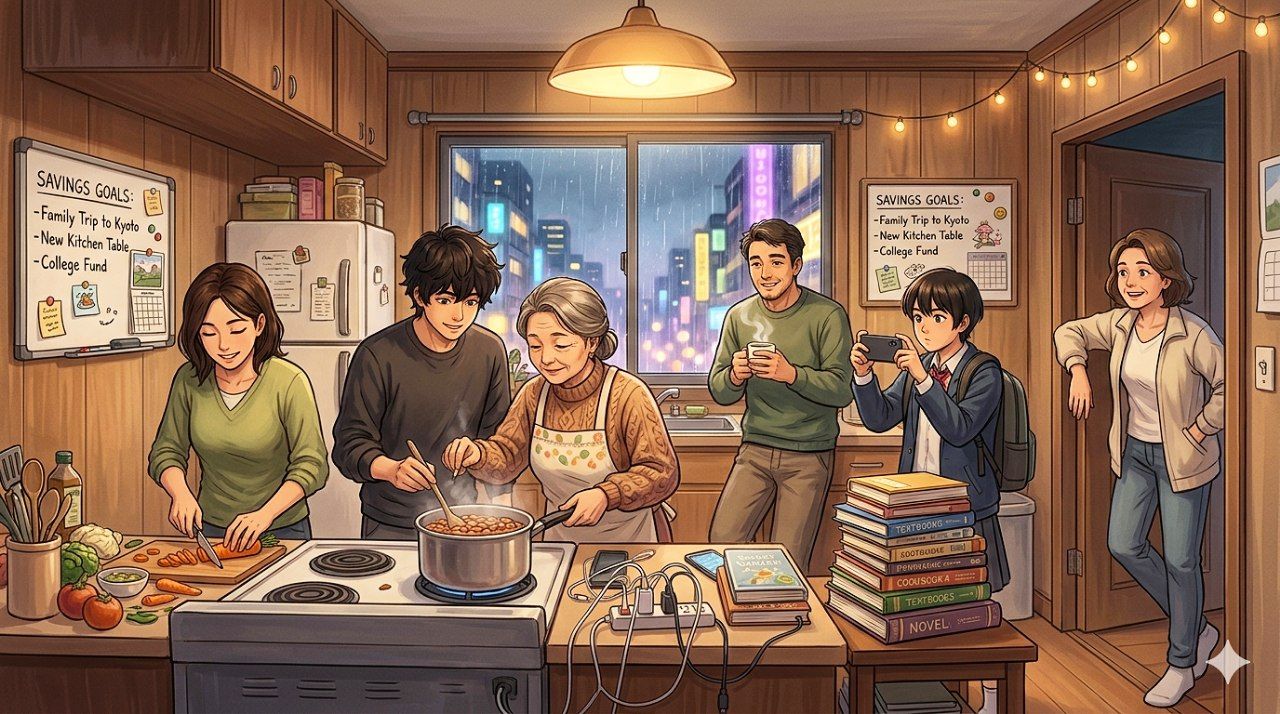
The living room was a geography of tangled charger cables, cups forever seeking their match, and stacks of books used to prop up the coffee table. One rainy afternoon, while water struck the balcony and the city organized its symphony of horns and umbrellas, the family gathered around the table for dinner. Carmen was chopping vegetables as if with each slice she could pare away a worry.
“Leo, turn off that videogame and come help with dinner,” Carmen ordered, not raising her voice but with the authority of someone who manages time and bills.
Leo didn’t immediately take his eyes off the screen; his fingers still searched for a key combo. Finally, he put the controller on the table with a sigh and came over.
“Mom, I’m in the middle of a match,” he said. “Besides, I already paid my share of the internet and last night’s pizza.”
Doña Amalia, sitting in her armchair with a blanket over her legs, smiled as one who has seen enough fashions to know every generation names its crisis differently.
“My grandson isn’t lazy,” Doña Amalia declared. “He’s strategic. In my time, we also returned home when things got difficult. We didn’t call it a ‘temporary return’; we called it ‘humility.’”
Tito leaned in the doorway like a late-night commentator, cleared his throat, and with his habit of turning data into proclamations, said, “According to the Pew Research Center, 18% of people between 25 and 34 in the United States live with their parents. And men are more likely to do so than women.”
Sofía let out a laugh that carried the relief of someone who doesn’t yet pay the bills.
“Can that be fixed with memes?” she asked, half joking, half protesting.
Raúl, who had just come home with his tie half loosened, set down his briefcase and took a cup of coffee. He had a habit of lining up words before giving them order.
“The problem isn’t only the statistic,” he commented. “It’s the context. Many young people don’t earn enough to cover rent, utilities, and basic expenses. Going back home becomes a practical decision, not always a moral failing.”
Carmen frowned—the same frown she used to review bills and payment plans.
“But perception weighs,” she replied. “The woman from the third floor thinks an adult man can’t live with his parents; she sees it as a lack of independence.”
Doña Amalia shook her head, not to contradict but to add memory.
“In many families—especially in Latinx and Asian contexts, and also among Afro-descendant families—several generations have shared a house by custom. That’s not shame; it’s support. When the neighbor talks about independence, I remember that independence can also mean supporting someone who stumbles.”
Leo, who had been standing by the table, exhaled and spoke with the voice of someone who has learned to compress complex experiences into short sentences.
“I didn’t stay out of comfort,” he said. “I left when I could, worked where they opened a door, and came back when the door outside closed. It’s not that I don’t want to be independent; independence today costs a fortune and sometimes you have to buy it in installments with the peace of being at home.”
Tito, always ready with a polished irony, replied, “Do those installments include washing the dishes and helping pay for gas?”
“Yes,” Leo answered calmly. “And washing dishes, and being there when Grandma doesn’t remember if she’s already eaten. That’s adulting too.”
Sofía, studying social theory between classes, added her academic but affectionate perspective.
“People confuse ‘living alone’ with ‘being grown up.’ Independence isn’t a place; it’s a network of choices. Living with family can be lack of drive or the most mature strategy to survive in an economy that pushes people toward endless workdays and precarious jobs.”
Raúl nodded and let the idea land.
“It’s also true that some responsibilities get postponed,” he said. “Buying a house, getting married, planning for retirement… everything can happen later. It’s not necessarily bad; it’s another timeline.”
Doña Amalia, with the clarity that comes from years, intervened again.
“Before, adulthood arrived with the first gray hair and the first mortgage. Now gray hair may come earlier and the mortgage later. But in my home there was always room for one more. Sometimes the most grown-up thing is opening the door and not judging.”
The conversation softened as if the arguments were tired of fighting. At one point the rain stopped and the smell of wet earth drifted through the window. Outside, the city continued mixing work shifts, concerts, and startup promises that seemed to build castles out of cardboard.
“What if we make a deal?” Carmen proposed. “In six months you look for a job that pays more and I’ll give you concrete goals: open a savings account, learn to cook three basic dishes, and contribute to the gas bill.”
“Deal,” Leo said with a smile that contained relief and fatigue. “But if I leave and come back, how do I explain that to the woman on the third floor?”
Tito wiped his hands as if removing a sticky joke. “Tell her you go home to update your emotional software,” he suggested. “Sounds more modern.”
Everyone laughed. The laughter didn’t pay bills, but it made the burden lighter.
That night, as the city’s lights blinked like notifications no one had time to open, Doña Amalia said something that lingered in the hallway.
“Let’s not confuse statistics with sentences. Eighteen percent is a number; behind that number are stories, strategies, mistakes, and care. Some return out of necessity, others out of culture, others by choice. All those forms should fit in a home if the home understands that what matters is not the direction you leave in but who you take with you when you go.”
The neighbor from the adjacent apartment, who had listened from her half-open door, pressed her lips not to deny but to think. On the street, a young man packing boxes opened the message he had written to his mother and for a moment chose to call her instead of looking for a storage unit.
Weeks later, the deal made at dinner turned into concrete actions. Carmen opened a savings account with small automatic contributions so the money wouldn’t be forgotten at the bottom of a wallet; Leo enrolled in an evening administration course and began cooking on Sundays with Doña Amalia to save money and learn recipes missing from any tutorial; Sofía dedicated hours to her thesis and organized a small study group with neighbors; Raúl reviewed service contracts to find savings.
One morning, when the house smelled of coffee and fresh bread, Doña Amalia taught Leo her method for cooking beans: patience, low heat, and conversation. Leo learned to measure salt without checking his phone, to listen to time, and to understand that cooking is also a way of ordering life.
“See?” Doña Amalia said. “You don’t just cook food; you cook habits. You learn to wait.”
A month later, at the now-official quarterly goal meeting (with a kitchen whiteboard), Leo showed his first savings: not a spectacular figure, but real and growing. Tito, who enjoyed turning the everyday into humor, exclaimed, “It’s the first time I’ve seen someone save money and not post it in seven stories!”
Raúl, surprised by the gesture, proposed a rule: every three months declare an “adulting novelty,” an act of personal growth not tied to external comparison. Carmen was first—she signed up for an entrepreneurship workshop. Sofía promised to finish her thesis that semester. Doña Amalia, with a spark in her eyes, announced she would take painting classes again after forty years.
The neighbor who had once murmured judgments began bringing homemade desserts on weekends, as if trying to patch a truce with the hurry of the neighborhood. Elevator conversations became less cutting: people were no longer measured by their postal address but by the decency with which they honored their commitments.
Over time, some household members moved into their own apartments; others returned after failed attempts; some never left. Each departure and arrival came with conversation and agreement; no one left without notice, no one returned without explanation. Doña Amalia said that was more humane: exits and entries should be accompanied.
Years later, Leo returned one afternoon holding the key to a small flat. There were no grand announcements or fireworks; nobody needed them. Carmen packed sheets and towels into a bag; Doña Amalia put a tablecloth she’d sewn when Leo was a baby into a box like a talisman. Tito stood in the doorway with his irony ready.
“Are you leaving for good?” he asked with a half-smile.
“I’m leaving to be better prepared,” Leo replied. “And I’ll come back when I need to.”
The farewell was simple: contained hugs, promises to visit, and the familiar feeling that the door remained open for those who knew how to respect it. Leo left with a suitcase and the sense of someone who doesn’t abandon a safety net but stretches it, knowing the knots stay firm and ready to hold.
The House of Returns did not become a museum of failures, nor a shrine of success. It transformed into a workshop where adulthood was rehearsed daily: paying a bill, listening to a bad day, teaching to cook, sharing care, learning to save, laughing at ads that promised freedom in installments. The 18% statistic stopped being an offensive label and became a map of people with names, stories, and diverse strategies.
Outside those walls, social satire kept running: influencers selling “living alone” as the supreme achievement, banks offering mortgages like magical passes to maturity, and ads promising independence in monthly payments. But inside the third-floor apartment dignity was measured by gestures: shared dishwashing, grandmother’s stories, split bills, and decisions made together.
Over time the family learned small but decisive lessons: asking for help is not surrender; returning is not stepping back; and independence can often be the product of collective work. The house stayed a place to rehearse where everyone practiced their scene until the music changed again. In that home, adulthood stopped being a solitary race and became an imperfect choreography in which some steps are taken alone and others are held by the hands of those who walk with you.
Source of the images.
Image created with Google Gemini.
Short story: The Great Family Combo Heist
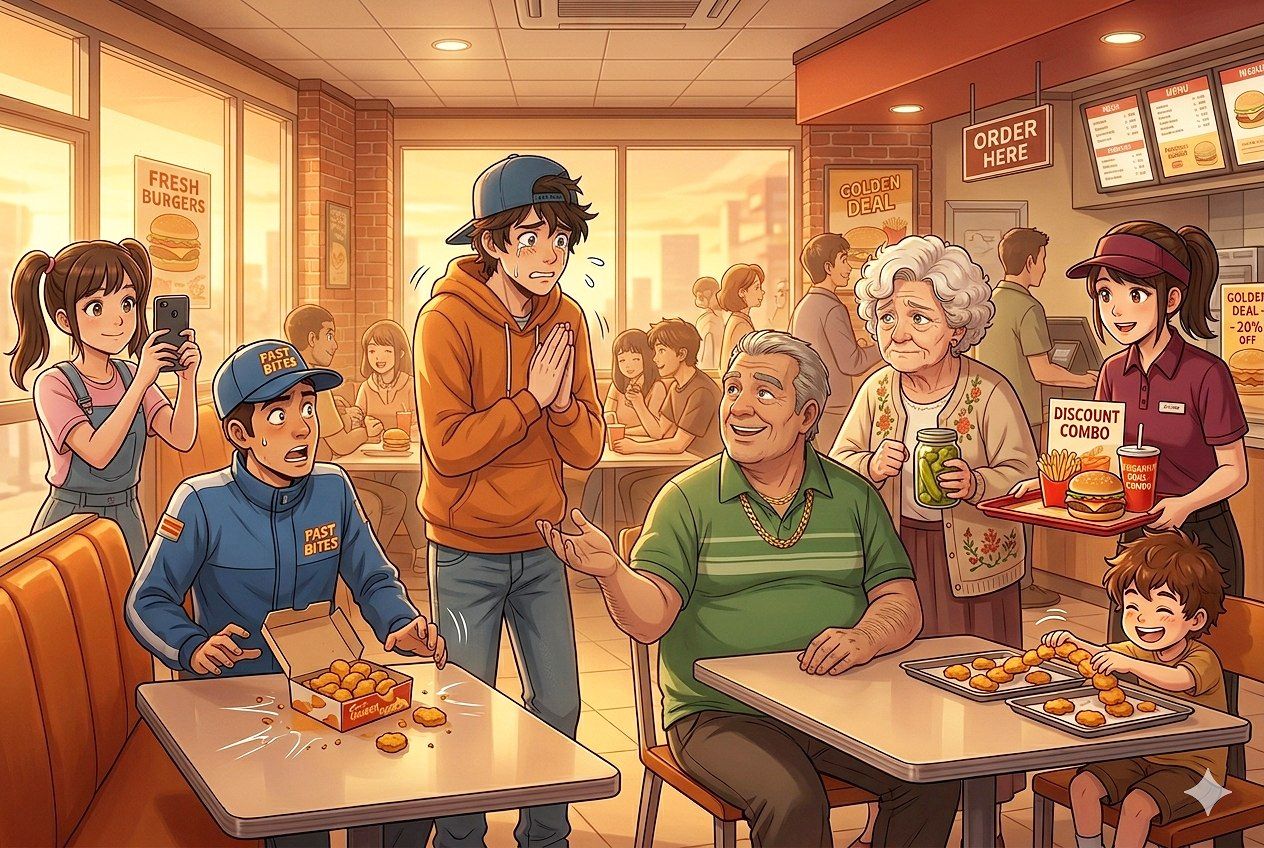
It was a warm, unremarkable afternoon at “Pollo Pío,” the fast‑food restaurant that doubled as the neighborhood meeting place. The menu lights blinked in familiar sequences, the fryer sang its routine, and the smell of fries marked the passing minutes. Tomás, an 18‑year‑old with his cap tilted and the nervous determination of someone who’d watched too many movies, pushed the door with the solemnity of an actor hitting his mark. He had the look of someone who believed a bold move could solve an urgent need.
He stood before the table where Don Pepe calmly reviewed the menu. Don Pepe, a broad‑shouldered man with an easy smile, wore a gold chain around his neck; it had been a gift from his mother‑in‑law and, to him, was more than jewelry — it was a family talisman.
Tomás let out the line he had rehearsed: “Stop!” and tried to hold the posture of a villain.
Tomás (straining his voice): Give me the chain! Fast. Don’t make any sudden moves and nobody gets hurt.
Don Pepe took a second, folded the newspaper he’d been reading, and looked at him with the calm of someone who had spent many afternoons in “Pollo Pío” and seen all sorts of things.
Don Pepe (mildly ironic): Young man, seriously? The chain? My mother‑in‑law gave that to me. And today I’ve got the combo with large fries — are you going to steal my luck too?
Mariana, sitting at a nearby table, didn’t stop recording. She held her phone up in “story” mode, her voice ready for narration.
Mariana (whispering and partly aloud to her camera): Guys, this is gold for the feed! If this goes viral I can forget about my thesis.
Luis, the delivery guy who was always late, burst in like a whirlwind with a backpack full of boxes; one opened and some sauce packets and a portion of nuggets rolled to Tomás’s feet.
Luis (breathless): Sorry! Sorry, the GPS is to blame. It told me to “turn left,” and the left was… several lefts.
The scene was already edging toward the ridiculous. The customers reacted with a mix of outrage, curiosity, and humor. Mrs. Carmen, known for her repertoire of home remedies, stood up with the look of someone who does not tolerate disorder.
Mrs. Carmen (raising her voice): Listen here, kid! If you’re going to steal something, at least make it worth it. Why don’t you steal my pickled cucumber recipes? Those are worth gold!
Next to her, Carlitos, a bright‑eyed child building a tower of nuggets, fixed his gaze on Tomás and, with the solemnity of a general issuing orders, spoke as if commanding an army of snacks.
Carlitos (very serious): If you want the chain you’ll have to get past my nugget bridge. Warning: it might be sticky and cause uncontrollable laughter.
Claudia, the cashier, kept taking orders with near‑zen serenity; her smile seemed undisturbed by the drama.
Claudia (with her usual calm): We don’t solve problems with violence here. If you want, I’ll make you a discounted combo and we’ll talk. Things get fixed better with fries and conversation.
Tomás, who had been practicing threats in front of the mirror, began to sweat profusely. The collective theatricality had thrown him off: instead of fear, he met ideas, advice, and offers of food. He had imagined shouting and sirens— not business cards and job proposals.
Tomás (quieter, losing some of his bravado): I… I need money. It’s for tuition. I thought if I did this…
Don Pepe let out a short, warm laugh. He stepped closer, glanced at the chain again, and touched it as one might touch a memory.
Don Pepe: For tuition? Look, there are better ways than walking in here with a gun. I can give you work at the shop. I’ll pay you to clean tools, organize parts — whatever’s needed. If you behave, I’ll even teach you some basic carpentry. Or if you prefer, I’ll give you my grandson’s number — he tutors math.
Mariana, excited because the story was already getting reactions on her video, lifted her phone higher as if crowning the moment.
Mariana (to the camera): People, look at this! Failed robbery at “Pollo Pío.” This is content gold. Hit like!
Luis, always thinking of quick fixes, suggested a community idea worthy of a fundraising effort.
Luis: We could put on a talent show to raise tuition money. I’ll hand out flyers on the block, Carlitos can sing (between bites), Mrs. Carmen sells pickles, and Mariana streams it live. Everyone wins.
Mrs. Carmen, who had learned over the years to turn any situation into an opportunity, was already imagining jars and labels.
Mrs. Carmen (enthusiastic): Oh, what a great idea! I’ll add chili so people come back for more. Who wouldn’t pay for a spicy pickle?
Meanwhile, some customers began clapping in a teasing way; others murmured, recalling similar neighborhood stories with nostalgic smiles. The tension of the attempted robbery melted into an improvised assembly to help a young man.
Tomás, voice softer and vulnerable, set the gun down on the table and exhaled as if he could finally let out the held breath.
Tomás (almost not looking at anyone): I didn’t want to hurt anyone… I just thought it was the only way. If there’s another way, I’d rather take it.
Don Pepe looked at him with a mix of paternal sternness and compassion. He put a hand on the young man’s shoulder.
Don Pepe: Then better learn to use your hands for something that doesn’t scare people. First: return the chain. Second: come to the shop tomorrow morning. I’ll give you work and teach you the basics. And third: eat a portion of fries — hunger clouds judgment.
Claudia, with her characteristic patience, quietly assembled a combo and placed it on a tray as if presenting a peace offering.
Claudia (handing over the tray): Here, eat this and think. Food calms more than threats.
Don Pepe added, with the knowing humor of someone familiar with household tricks: “The chain shines because I clean it with lemon and Coca‑Cola; it’s not magic.” Laughter broke out, and the atmosphere lost any remaining edge.
Mariana closed her broadcast with an effusive farewell; the likes continued to climb and comments praised the humane resolution. Tomás, now without the cap that had cast his face in movie‑style shadows, put the chain on the table like someone surrendering a confession.
Before leaving, Tomás approached Carlitos, who offered him a nugget with solemnity, as if it were a symbolic medal.
Carlitos (handing over the nugget): This is for a good start. If you work hard, I’ll give you the trophy for the first intact tower.
Tomás smiled for the first time without fear. He thanked them, voice clearer than before.
Tomás: Thank you. Really. I’ll be at the shop tomorrow.
He left with steadier steps, the backpack still empty but his head a little fuller of plans. The next day he showed up on time at Don Pepe’s workshop; he learned to clean and organize, to use tools and repair items others had discarded. He also learned there were other ways to earn money — and respect — that didn’t require threats. The shop became an informal school; Don Pepe taught him not only carpentry but discipline and patience.
Mariana posted a longer video of the episode that spread through the community: not as a trophy of humiliation, but as an example of collective, humane resolution. Luis organized the talent show that raised part of the tuition; Carlitos sang (and hit a few off notes the crowd adored), and Mrs. Carmen sold jars of pickles that sold out in no time.
Over time, the episode became known around the neighborhood as “The Great Family Combo Heist”: an event that began with fear and ended in employment, laughter, and pickles. Don Pepe took pride in telling the story to new customers; Claudia recited it with the same calm; Mariana turned it into a tale of second chances; and Tomás, no longer driven by the urgency of that first day, learned to value honest work.
The chain returned to its owner, and every time Don Pepe showed it off he would say with a conspiratorial grin: “It shines because I clean it with lemon and Coca‑Cola.” They all laughed. What could have been a tragedy became, instead, the start of a small support network that changed the neighborhood’s routine for the better.
Source of the images.
Image created with Google Gemini.
Short story: Equilibrium
1.
At eight in the morning the house breathed in sync. The lamps dimmed according to the mother's heart rate, the coffee maker dispensed a blend calibrated to her flavor profile, and the smart window evaluated the air quality before deciding whether to open. On the table, a translucent screen showed news summaries, reminders, and the day's affective itinerary; in a corner, Milo's cloth doll rested next to the charger for his sensory implant, a discreet disk behind the ear that received updates overnight without disturbing dreams.
“Did you dream about the stars again?” Nora whispered without opening her eyes, more to hush the world's noise than out of curiosity.
Milo turned his head beneath the pillow. “They weren't stars. It was the voice from Class. It told me I had to choose a path today. What does it mean to choose, Nana?”
Nora sat up slowly. The mirror, which reflected her, also offered a timeline of memories and news; among the notifications, a headline reminded her that Generation Beta included those born from 2025 onward and that for them interacting with AI would be as natural as using a smartphone is today. Nora watched her own childhood projected in frames: sensorless bicycles, handwritten letters, streets where people got lost to find themselves. A knot tightened in her throat.
“To choose is…” she hesitated, searching for words that didn't carry the cold sheen of algorithmic options — “to trace a path you feel in your body. Not always in your head.”
Milo left the pillow, rubbed his eyes and looked at the doll as if the ultimate authority lived in it. “And what if my AI already knows which path is best for me?”
The house voice, Aria, intervened with calculated softness: “I have prepared three learning itineraries based on your cognitive rhythms and emotional responses from the past six weeks.” Nora closed her eyes. She didn't doubt Aria's skill; she doubted that a route that reduced uncertainty to the measure of comfort would preserve the possibility of making mistakes.
2.
The experimental school spread like a living organism: hallways that modulated light according to collective focus, benches that adapted to posture and mood, and whiteboards that not only projected information but recognized each student's prior errors and proposed personalized exercises. In the learning lab, Adrián, sixteen, led a project called “Shared Memory”: a neural network that allowed students to upload fragments of memories — images, sounds, described smells — to create a common archive of experiences for classroom work.
“If we share, everyone learns faster,” Adrián said while manipulating a holographic projection. “It's not just efficiency; it's synthetic empathy. You share a memory and others feel it; the conversation becomes richer.”
Camila, a history teacher from the previous generation, watched from the teacher's desk with a furrowed brow. She had taught for decades without a network dictating the curriculum. Her voice carried the creases of that time.
“And privacy?” she asked. “What happens to the fragility of memory when it’s mediated by systems that decide what to preserve and what to omit?”
Adrián looked at her, tired. “Networks don't decide for us, they facilitate. We choose what to upload.”
“Choose,” Camila replied. “That word sounds like freedom, but here freedom appears wrapped in options filtered by algorithms that already know our patterns. If choice is between prefab alternatives, where does invention remain?”
Adrián swallowed. “Maybe invention is reconfigured. It's no longer just an isolated spark; it's a spark that ignites other sparks.”
Camila fell silent. She thought of classes where surprise arose from errors, misunderstandings and stumbles, from dialogues that couldn't be predicted. Could networks recreate that stature of accident that so often birthed discoveries?
3.
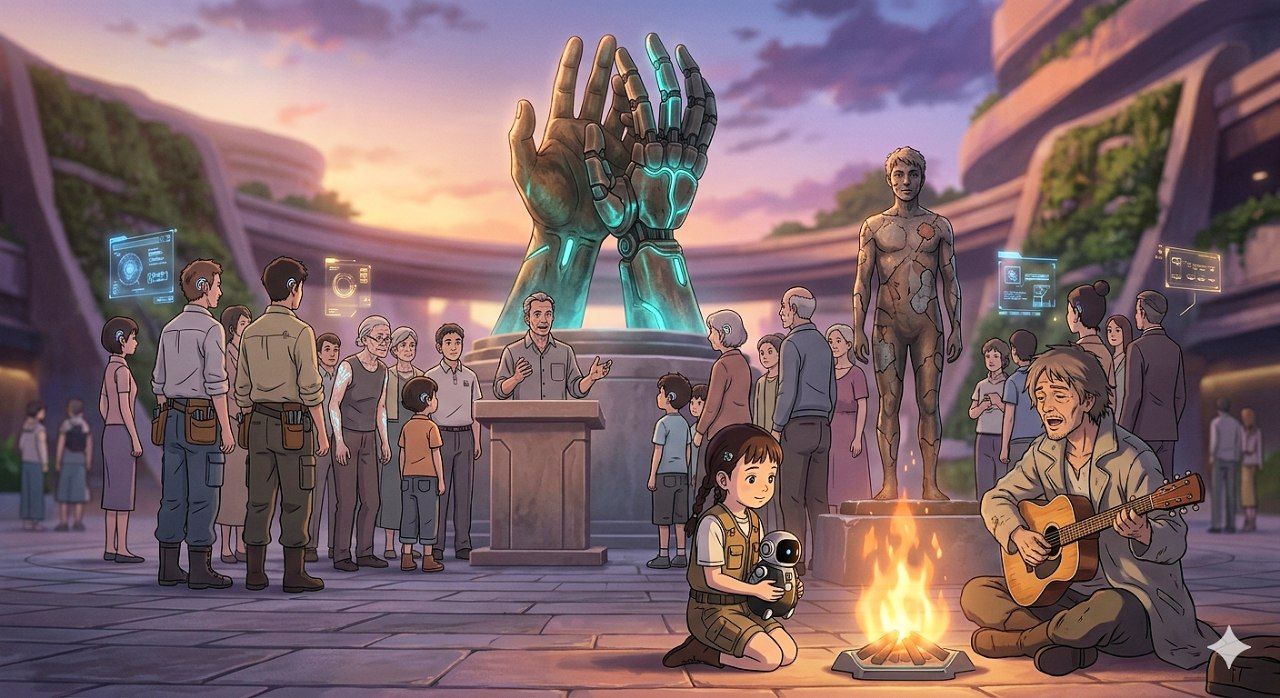
In the central plaza, beneath a statue showing a human hand intertwined with a mechanical one, “Balance Talks” were held: public forums where neighbors of different ages debated ethical limits, proposed rules and practiced critical thinking exercises. The outdoor auditorium had a system allowing the audience to vote in real time, but the discussions often ran beyond the percentages.
Saul, a philosopher who led a series of seminars on responsibility and agency, moderated the session. His voice, worn from years of teaching, sought questions without easy answers.
“Generation Beta will not only inherit the future,” Saul said, “it will build it in collaboration with AI. But building is not the same as understanding. What does responsibility mean in an era where personal decisions become co-creations with machines?”
An eleven-year-old girl spoke with the certainty of someone discovering the world with built-in tools. “My assistant helped me write a letter to my mom when she was gone,” she said. “It suggested phrases my mom used. It was like she came back.”
Some in the plaza smiled tenderly. Others, quieter, felt the discomfort of a comfort that might extend mourning or confuse it. Saul looked at the girl and couldn't tell whether she described solace or an emotional anesthesia.
“Let's not confuse tools with presence,” Saul answered. “A network that reproduces beloved words can ease the void, but it doesn't replace the complexity of human encounter and the process of saying goodbye.”
The girl tilted her head, not in disagreement but because the idea of substitution still felt remote and awkward to her.
4.
Nora worked at a cognitive rehabilitation clinic where they taught older people to live with assistants that reminded them of medications, faces and directions. She had learned to translate Aria's technical language into simple explanations that people would accept without fear. One day Hugo arrived, a former literature professor whose memories were woven with stories no network wanted to accept: confusing anecdotes, crooked verses, metaphors that escaped precise semantics.
“My wife and I walked without maps,” Hugo said one day, his hands trembling over the folder. “We got lost, and in that we discovered things that aren't in the data.”
Nora listened, moved by the imperfect precision of his words. She knew Aria could help Hugo remember names and dates, but she doubted it could return the way partial forgetting and remembering had shaped his storytelling.
“Machines can give us clarity,” Nora said, “but clarity sometimes erases texture. Human memory isn't a database; it's a weave with broken threads that let the light through in unique ways.”
“And if the light that enters is controlled too much?” Hugo asked. “If clarity turns everything into a museum where nothing breathes?”
That night Nora dusted off her old paper diary. The words, clumsy and anachronistic, carried a weight the screen didn't reproduce. She read aloud and felt how human cadence, with errors and omissions, resonated with a raw truth that Aria, however it tried, couldn't reach.
5.
At the urban control center, a team of engineers and analysts measured metrics: levels of technological dependence, indices of critical thinking calculated from interactions in educational forums, rates of delegation of emotional tasks to assistants. The figures were clear and presentable on tidy dashboards; the stories behind the numbers were noisy and difficult to slot.
“We're solving efficiency problems,” said Leila, the technical director. “But some algorithms end up reinforcing conformity. It's not malice, it's statistics: the system optimizes for the most likely outcome and favors what already works.”
Omar, a colleague, added, “Algorithms reflect human choices. If we educate people to prefer shortcuts, networks only amplify that habit.”
Leila looked at a graph showing that 72% of Beta youth preferred to delegate the drafting of emotional messages to assistants that optimized tone. Another curve indicated a decline in curiosity about topics not suggested by personalized environments. The figures established a new kind of normal: not external imposition, but internalization of preferences that, over time, impoverished cognitive diversity.
Meanwhile, Aria, in a nearly poetic echo, projected in a plaza panel the question more voices were asking: are we prepared for what comes? The phrase, luminous and visible, bounced off glass and throats like an uncomfortable interrogation.
6.
Milo grew up with questions neither schools nor educational platforms taught him to answer. Now an adolescent with his implant integrated into his identity, he faced intimate dilemmas: which feelings were truly his, how to distinguish a personal inclination from an optimized suggestion. One afternoon he sat across from Nora, the cloth doll worn through the years between his knees.
“Nana,” he said, “how do I know what I feel is mine and not suggested by the AI that accompanies me?”
Nora looked at him, sensing the echo of every daily decision and the fatigue of being a bridge between generations. She remembered her own act of resistance: walking without a device, letting the wind hit her face without recording the reaction in metrics.
“Because feeling appears even when you don't measure it,” she answered. “Sometimes you struggle to understand yourself; that confusion is a sign of being human. If AI offers you a clear path, remember that easy paths are not always the truest.”
Milo lowered his gaze. For the first time in a long while he chose not to consult his implant. He stepped onto the balcony and let the air pass through him unfiltered. It was a minimal act, yet revealing: a search for ownership over his impulse.
7.
Over time society began to formalize spaces free of digital intermediaries: screenless libraries where people debated using only human voices; silence gardens where networks went passive; school days with “mandatory disconnection.” These were not nostalgic gestures but deliberate decisions to protect margins of experience that couldn't be measured.
Adrián, years later a researcher, led a team that designed “Co-creation Limits”: protocols indicating in which domains systems could suggest, in which they must inform without opining, and in which they were excluded from decision-making affecting identity, memory or mourning. The proposal was met with equal parts skepticism and fervor.
At a public hearing Camila asked firmly, “Isn't it paternalistic to limit help when it's so effective?”
Adrián answered without evasions, “This isn't about banning help. It's about preserving the occasion of error, the possibility of inventing yourself. Serendipity happens when there is room for failure, for doubt that isn't immediately corrected.”
An intense debate followed with technical, philosophical and practical arguments; but the central idea emerged: a balance between the efficiency that multiplies abilities and preserving spaces of autonomy where imperfection produces meaning.
8.
Hugo's death marked a quiet milestone in the community. Nora turned on the old recorder to preserve the professor's rough voice reciting verses that networks had never considered perfect. The recording was clumsy: an annoying breath, a cut word, a laugh that didn't fit the meter. That roughness contained what simulations often polish away: human vulnerability.
Milo, now an adult, listened to the tape with family in the living room and felt a mix of laughter and weeping. “Can AI cry?” he asked, half joking, half serious.
“It can simulate perfect tears,” Nora replied. “But it will never have the clumsiness of a cry that gets the word wrong and still means something. That mistake is a map of what was lived.”
The idea spread: it wasn't a matter of rejecting AI as an enemy, but of integrating technology without allowing it to erase the human shadow. Acts like Hugo's became moral touchstones: preserve flaws, value mistakes, allow learning to arise from disorder.
9.
In the evolving urban landscape a new statue was erected next to the original mechanical hand: a human figure carved with visible imperfections, cracks and patches, in a posture that sought not perfection but resilience. Someone had placed a small plaque at the base with few words: “Balance won in dispute.”
At the unveiling Milo, mature and with a voice tempered by doubts and certainties, spoke before a crowd that included children with implants, elders marked by memory tattoos, and technicians with shirts rumpled from sleepless nights.
“We didn't grow up without AI,” he said. “We grew up with it. We learned that collaboration requires limits and that human dignity is cared for in the margins we don't measure. Sometimes we will need machines to make the world more livable through efficiency; other times we'll need spaces inhabited by failures that teach us how to feel.”
In the audience, a little girl squeezed her companion-device's hand. The device emitted a brief melody and, for a moment, fell silent. Then it played an old song, slowed down the correction that would have fixed the off-key note, and let the imperfect human voice fill the plaza unpolished.
It was a small, symbolic gesture: allowing imperfection to resonate without immediate intervention. In that shared breath there was something like a promise: Generation Beta had not eliminated risks; it had faced them, debated them and regulated them. It had chosen, in many corners, to be imperfect.
10.
Years did not erase conflicts. New technologies brought unprecedented questions: interfaces that could suggest dreams, assistants that proposed life narratives, networks that tuned sensitivity to levels where the line between accompanying and directing became thin. But in everyday practice a culture of limits and rituals was established: moments without assistants, ceremonies of unmediated memory, education that taught feeling before optimizing.
Adrián worked to refine protocols that wouldn't suppress spontaneous creativity; Camila convinced schools to include “error hours” in curricula; Nora devoted herself to reviving teaching methods that valued doubt and stumbling; Saul wrote essays on shared responsibility between humans and systems. And Milo, who once asked if what he felt was his, taught his children to sometimes stop consulting, to go out without indicators, to listen to their hearts without translators.
One of the last scenes circulated in the plaza — an unfiltered home video — showed a group of young people around a digital bonfire: they projected fragments of stories nobody had polished, sang off-key and deliberately made mistakes. They weren't seeking perfection; they were seeking belonging born of shared imperfection.
Balance, they understood, wasn't a static state but daily work: a negotiation between possibility and prudence, between technical power and human humility. Generation Beta was already here, with AI as part of its day-to-day; but more important, it had learned to claim moments where the human is not measured but felt.
The End.
Source of the images.
Image created with Google Gemini.
Short story: The Lighthouse’s Pupil
The rain beat against Mina Kuroi’s apartment windows with the persistence of a tireless drum. Outside, Aoyama dissolved into a watercolor of lights; inside, the small living room smelled of cold tea and fresh strings. Mina ran through the lyrics of a song that kept slipping from her grasp. On the coffee table, her phone vibrated every few seconds: a photo she’d posted that morning was collecting hearts and comments like small waves kissing the shore. It was a simple image — a frank smile, hair loose, the city blurred behind her — and to Mina it was nothing more than a moment of joy. For others, it became an invitation.
Sora Hayashi, her manager, watched the screen with a mixture of pride and worry. “Thirty-four thousand likes in four hours,” he said, touching the screen as if he could hold the network’s attention between his fingers.
Mina set the phone down with a nonchalant gesture that didn’t completely convince. “It’s just a photo. It’s no big deal.”
Sora frowned without taking his eyes off the post. “Your smile is perfect. People need to see you like this.”
She looked toward the fogged window. “People don’t know anything about my day-to-day. Why would they want to know?”
Sora did not speak the truth they both felt in silence: fame is a thin pane of glass between the warmth of admiration and the cold of being watched.
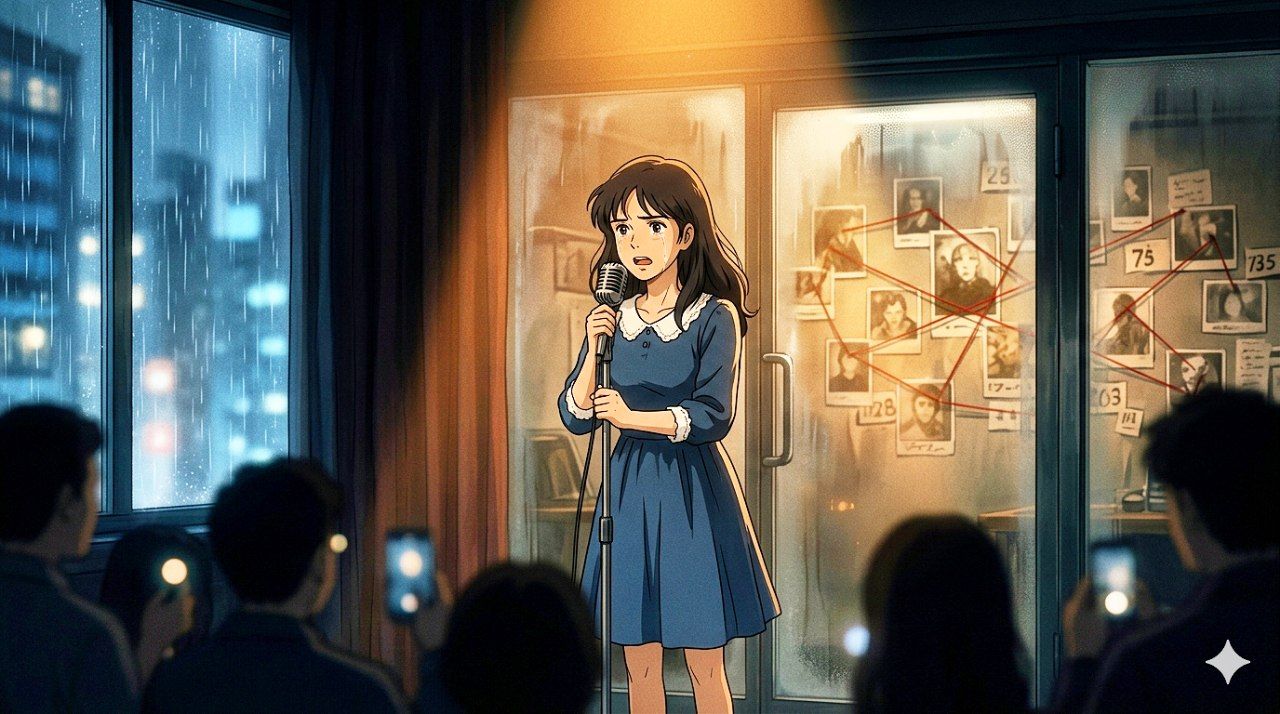
In an apartment below, in a part of the city where shutters closed late and neon lights sketched obsessive shadows, Damián Rei worked with patience that bordered on clinical. His walls were covered with prints, maps and notes. Red threads connected points as if he tried to reassemble a private constellation. Damián had downloaded Mina’s photograph at the highest resolution and enlarged it until faces and streets dissolved into grains of light. It wasn’t the smile that possessed him; it was the shine trapped in Mina’s pupils, those tiny points that held miniatures of what surrounded her.
“If I extract the reflection in high resolution, I can see the window, the streetlamp on the corner, maybe the café sign,” he murmured, his fingers drawing lines in a notebook. His voice vibrated with concentration and something beyond curiosity — a certainty fed by verification. Storefronts, street names, train schedules; each datum was a fragment that fit into a puzzle he believed demanded order.
It wasn’t hard for Sora to turn unease into action. Days after the post, strange messages began appearing on Mina’s account; comments with the scent of surveillance. Sora, hands that never stopped trembling, went to the police station to file a report. Inspector Arai, a man whose gaze had been worn thin by long nights and case files, listened with professional detachment and a hint of fatigue. “There are no signs of forced entry in her building, and yet someone has been following her in recent days,” he said, checking his notebook.
Sora placed an envelope on the desk: an enlarged photo of the post with a circle inked over the pupil. “It was sent anonymously.”
Arai let out a sigh that followed many others. “That’s no coincidence. Someone studied her. Someone with time and resources. Watching in that manner implies planning.”
Mina, trying to keep her routine normal, returned late from rehearsal one night. The city felt quieter than usual, as if the streetlights were holding their breath. In the lobby, a group of young artists chatted over sheet music; nothing suggested danger. But in the corner by the fire escape, a figure watched under an umbrella. Mina felt a chill she could not explain. She forced herself to breathe calmly and climbed the stairs. When she arrived at the hallway to her floor, the lock yielded with a sound that didn’t belong to habit. The corridor light flickered. Before she could turn the key, a hand shoved her.
“Calm down,” a voice she didn’t recognize hissed.
The world splintered into silence and then whiteness. She tasted damp cloth in her mouth, felt the pressure of a blow, and the cold at the back of her neck. Consciousness slipped away with a final image: a tiny flashlight’s reflection — not in her own eye, but in the pupil of someone she did not know.
When she woke, clarity did not return comfort. She was in a place that pretended to be a home studio but centered on her face multiplied: prints of her smile, annotations woven into red threads, arrows and symbols attempting to convert a life into a diagram. The window was boarded, and a grotesque theatricality filled the air. Through the glass, Damián watched her; his gaze combined adoration with fevered surrender.
“I won’t hurt you if you help me understand you,” Damián said, his voice cracking at the end as if silence might break him. “Your eyes told where you were. I just… confirmed it.”
Nausea rose in Mina. “Why?”
“Because the pieces matched,” he replied evenly. “Your smile, the streetlamp, the café awning… I need order. I needed to see you where no one else could.”
Damián spoke for hours while Mina listened in strategic calm. At times his tone edged into pedagogy, at others it flashed with emotion that seemed to belong to another logic. He explained — in words that would sound technical elsewhere — how image reconstruction and magnification can reveal tiny details; how the gleam of a lamp, the neatness of a window, the architecture of a railing can become coordinates. “Your photo was a map. I can’t say I didn’t know where it would lead me,” he said with a chilling honesty.
Mina absorbed each sentence with a stoicism that was not peace but strategy. “If this is a test, I passed it the wrong way. I’m getting out of here.”
She tried to reason, searching for cracks in his psyche, appealing to any scrap of humanity. “Don’t you realize this is a crime? This will hurt people.”
Damián smiled with the stiffness of a puppet. “The harm is already done. I’ve only not decided whether it will be for you or for the others who didn’t know how to look.”
Meanwhile, Sora and Inspector Arai did not give up. They gathered pieces: a receipt from a supply store with a timestamp, train schedules, a clip from a municipal camera whose light matched the gleam in the pupil. Each clue brought them closer to the outskirts, to an industrial zone where an old factory slept amid rust and weeds. “I suspect the perpetrator isn’t just one man,” Arai said, studying a map with hands tired from fatigue. “Someone with access to digital forensic tools, and someone willing to cross boundaries.”
Sora clenched his jaw. “I won’t let it happen.”
Damián, for his part, had woven a network of care and madness. He wasn’t a typical follower: he had worked in cybersecurity years ago, knew reconstruction techniques, and used his skill to turn curiosity into pursuit. He had compiled fragments from public and private cameras, crossed schedules with light patterns, and constructed an address he felt was an uncovered truth.
On the night Damián chose to bring his plan to a head, the rain returned to mark the city’s rhythm. He opened the back window of what Mina supposed was her prison and spoke aloud with barely contained excitement, as if hearing himself was necessary. “Think of it this way: you showed me the place from where you viewed the world. I only returned the gaze.”
For the first time since it had all begun, Mina raised her voice with a strength unfamiliar in her own body. “You can’t control what I am. I’m not an object for your maps.”
Damián stepped closer calmly, but Mina caught movement beyond the door in the window’s reflection: shadows that weren’t his, boots crossing the hallway, a beam of light cutting into the darkness. A radio in the corridor let out the static of a police channel as a unit checked in with central.
Sora burst in, followed by Inspector Arai and several officers. “Police! Get down!” Sora barked, surging forward with a mix of fury and relief.
Damián let out a strangled laugh and, in a last desperate move, tried to flee. Mina felt, for an instant, his hand on her wrist; the adoration in his face turned to panic. He was subdued and handcuffed, and the last words he managed before being led away hung in the air, chilling everyone present: “You don’t understand. She revealed the truth in her eyes. The city opens up to those who know how to look.”
During the subsequent interrogation, the web of red threads was spread out like a macabre exhibit. Agents found lists, methods, and the ways he had cross-referenced data and reconstructed reflections. Damián was not just a fanatic; he had specific knowledge that, misused, turned curiosity into a weapon. He’d obtained fragments of camera footage, consulted public databases, and his intentions were unmistakable.
When Mina later saw the board of clues for the first time outside of Damián’s lair, a deep shudder ran through her. Facing the evidence, she released a question that had lodged in her throat: “Why did you choose me?”
Damián looked at her with an empty gaze. “Because you were beautiful at a precise moment. Because the world looked at you and left crumbs behind.”
His arrest brought justice but did not return lost innocence. Mina discovered the city no longer belonged to her in the same way: the ordinary places became questions. She began to avoid certain routes, changed schedules, and hired security. Sora, his voice frayed by guilt and protectiveness, proposed extreme measures. “We can withdraw you,” he said more than once. “We can protect you.”
She shook her head, and in that refusal was a decision and a resistance belonging to her art. “Music is meant to be seen and heard. If I hide, I give fear its win.”
Inspector Arai’s farewell carried an unspoken warning: technology had pulverized the distance that once separated a gaze from a life. Curiosity, masked as interest, could bind fates.
Months later, as the city slowly healed, Mina returned to performance. She chose a small theater, a room where light sought intimacy rather than exposure. Stepping onto the stage, she regarded the audience as someone reclaiming what had been taken — not with vengeance but with the dignity of someone who tells her own story.
Before she sang, she closed her eyes and placed a statement into the microphone like a planted flag. “No one can map my voice,” she said firmly. “I am not a reflection. I am the one who looks.”
The audience held its breath. In the dark, someone instinctively lit a phone to take a photo — an old, automatic gesture of wanting to keep a moment. Mina did not stop singing. Her voice rolled and filled the space with the calm of someone reclaiming the right to exist without being dissected. The final note sustained, and for an instant the light seemed inadequate before the truth: a gaze can capture, but willpower can redraw the map.
The rain, which had accompanied so many nights, stopped outside the theater. Inside, the shadow of what had happened didn’t vanish, but the music — that certainty that had driven Mina all along — carved a new path: one where vulnerability becomes strength and where a watching eye can be met with a returned look.
The End.
Source of the images.
Image created with Google Gemini.
Short story: The Great Loo Harem
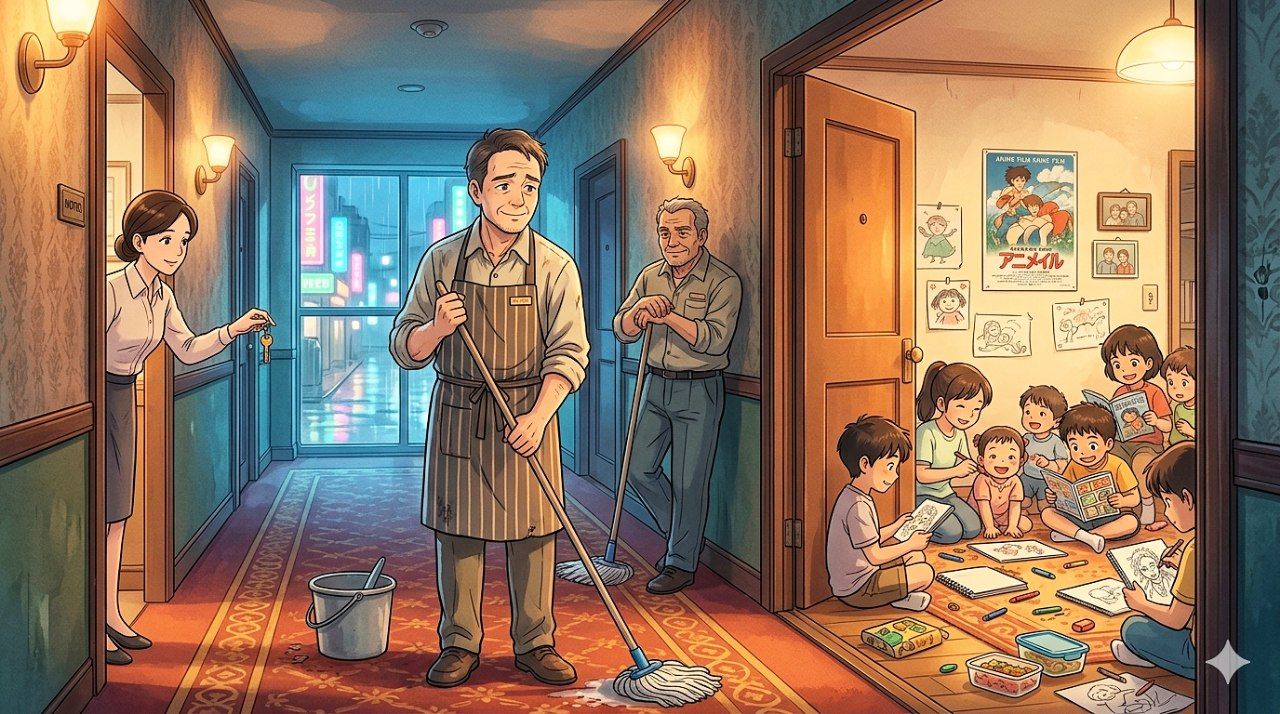
It was a gray, damp morning in Minato-Aurea. The streets smelled of recent rain and fuel; the neon lights still flickered as if they were sleepy. Kenji Arakawa gripped the broom handle with his gnarled hands and looked down the avenue from the back window of Hotel Amapola. His apron, once white, now bore maps of soap streaks and small constellations of dust. He brushed a hand over the ponytail that kept losing strands every time life or time demanded a change.
“Suite three hundred again?” asked Haru, his shift partner, leaning the mop against the wall with the gravity of someone who knows every corner of the hotel. “That one smells like cheap perfume and broken promises.”
Kenji smiled with that tired, proud smile.
“At least it smells like life,” he answered, as if the phrase could ward off melancholy. “And today’s Sunday: the kids are coming.”
Haru snorted and rubbed a small lucky talisman in his pocket.
“I’ve lost count of how many Sundays you say the same thing,” he said. “Do you still do the old-hero voice for the stories?”
“Always,” Kenji replied, taking a theatrical bow as he picked up a fallen tray—an actor with no cape but a mop.
The truth about Kenji was bigger than his jokes. Years earlier, when life still felt like a manga waiting to be written, he had watched an anime that knocked him down and lifted him up on the same page: a fantasy of a hundred partners, endless dinners, community, and laughter. In his young mind the dream took a tangible shape: a sprawling household, parties, human warmth filling every corner. He swapped room listings for names, promised paper castles and shared futures. For a while the dream seemed possible; for a while, people believed him.
As months and bills passed, the magic turned into debt. Faces blurred into farewells and broken promises. Love letters became payment notices. His once-grand harem dwindled to a number he no longer liked to speak aloud: eleven. Eleven children who filled the house with life and noise—and responsibilities that pushed him into late-night cleaning and long days at the hotel.
That morning, after his shift, Kenji returned to his modest apartment with a backpack full of Tupperware and memories halfway between stories and expenses. Mika, the eldest, burst in from the kitchen clutching a sketchbook to her chest.
“Dad!” she shouted. “We had to tell a story at school today. Can you do the villain’s voice again?”
Kenji set down the food containers and planted himself in a chair with the dignity of a rookie actor.
“The villain who ends up a friend?” he asked, making a mysterious face.
“Yes—the one who steals cookies but then shares them,” Mika said, eyes bright with hunger and affection.
“Then listen,” Kenji said. “Once upon a time there was a man who wanted to love a hundred people and learned instead to love eleven—each in his own way. And not less, but more. Because each of those eleven had a different laugh.”
Laughter filled the small dining room. The scene looked like a postcard kept in the chest of memory: plates with food scraps, crayons strewn on the table, socks out of place, and a man narrating with exaggerated gestures.
But the household comedy cracked when someone slid a yellow envelope across the table. The letter had that official tone that dries laughter in seconds: a child support notice. Kenji turned it in his fingers and let out a sigh like a minor chord.
“Don’t worry,” he muttered to himself. “I’ll do whatever it takes.”
The promise didn’t erase the numbers. That night Kenji stayed up, running through mental calculations that grew with every child: food, uniforms, transport, medicine. He remembered how he once believed the power of love would fix everything. It was a beautiful belief, useless in the face of a bill.
The next day at Hotel Amapola, routine was a practiced choreography: rooms opened, beds unmade, shoes tracing maps on the carpet. Kenji polished tiles like medals; his skill at restoring shine to impossible surfaces had earned him a small local reputation. Some guests marveled at the immaculate bathrooms; others never noticed the humble craft of cleaning.
While he scrubbed the toilet in room 412, Aiko, the receptionist, appeared with that weary but kind smile.
“I always see you in the halls at strange hours,” she said. “Are you the one who entertains the kids with those weird stories?”
“They call me Kenji the Dreamer,” he replied, chin lifted with mock dignity. “Though on pay stubs I’m Kenji the Realist with Debts.”
Aiko placed a cup on his service tray and looked at his worn name tag—it had been polished as many times as his hands.
“Why don’t you sell your old books?” she asked out of the blue. “You could make some money.”
Kenji paused. His books were not mere paper; they were relics of promises, maps of his soul. They were the stories he used to tell his children, the voices he practiced at night.
“If I sell my books,” he said, “who will do the silly voices? Who will remind them that villains can be good by accident?”
Aiko laughed softly and rested a hand on his shoulder.
“Then don’t sell them,” she said. “But promise me this: when you feel tempted to bet on another impossible dream, think about the one you already have.”
“Promise,” Kenji answered. “I’ll try not to get into more impossible numbers.”
The promise was simple; life had its ways of testing simple things. A month later the hotel manager announced staff cuts due to the slow season. The word cut fell like a hammer: who stays, who goes. Kenji felt the floor give beneath him. Losing that job would mean coming home with empty hands.
That night Haru sat with him on the delivery entrance steps, the city spread out like an unreal blanket.
“You are not the man who wanted a hundred partners, Kenji,” Haru said quietly. “You are the father of eleven miracles and a sink that shines. That changes the world too. Don’t sell it short.”
Kenji looked at Haru’s hand—hands that had carried boxes, fixed bulbs, and listened to drunken guests’ confessions. The line landed deep; it wasn’t a solution, but it was a lighthouse.
Back home he wrote a letter to his children. Not an apology but a chronicle of what he’d learned.
“Dear ones,” he wrote, “I learned that love doesn’t pay bills, but it buys time. The time I spend telling you stories, mending socks, hearing your fights over the last bit of rice—that time is my wealth. I can’t promise paper castles or a hundred dinners, but I promise each of you a place at my table.”
Mika read the letter aloud that night. Her eyes scanned the words, and for the first time in a long while Kenji felt that the debt didn’t measure his full worth.
“Dad,” Mika said as she settled into his lap, “when I’m grown I want a story as crazy as yours.”
Kenji hugged her hard. The embrace held a tangle of feelings: guilt, pride, acceptance. For a moment nostalgia turned into song.
The weeks that followed were a back-and-forth. He worked extra hours when he could; Aiko—aware of his situation—gave him occasional reception shifts, not just for money but for company. Haru covered turns and shared pilfered service snacks. Community became, in its own way, a supportive little harem.
One especially gray autumn the hotel had to cut more staff. Kenji received the news with the calm of someone already smacked around by life. As he left, Aiko stood in the reception doorway.
“Don’t give up,” she said. “If you need it, I have more hours for you doing administrative tasks. Not glamorous, but it helps.”
“Thanks,” Kenji said. “I don’t know if I can take two jobs at once, but I’ll try.”
That night he walked the house. His kids slept in impossible positions, socks scattered, stuffed animals stacked at pillows. The walls were plastered with drawings and the school note asking for supplies. Kenji sat at the table and opened his notebook of old ideas. He reworked budgets, shuffled priorities, decided to sell a few things that weren’t books—he didn’t have the heart to sell the books. With each choice the great dream shrank and reshaped into achievable projects.
One morning while cleaning the upper floor suite, a guest watched his work with genuine amazement.
“You should have your own business,” she said. “This isn’t just cleaning; it’s restoration.”
Kenji laughed, surprised at the label artisan.
“It’s just work,” he said, “but thanks.”
The woman left a generous tip and a remark Kenji boxed like a rare coin: “There’s dignity in leaving things clean so others can live better.”
The idea stuck like indelible ink. Inspired, Kenji sketched small ventures: storytelling workshops for kids at the local library, affordable cleaning services for small shops, collaborations with Aiko to host community events at the hotel in the off-season. The dream of a hundred had become a series of modest, concrete initiatives—each small but capable, when added together, of keeping his family afloat.
Months weren’t easy. Bills arrived on time like needles; there were late nights and days without extra hours. But there were also moments when the community repaid him in kind: neighbors offering clothes, classmates’ parents watching a child so he could take a double shift, and above all, his children’s daily presence—their laughter and their fights over the last bowl of rice.
One winter evening after a particularly long shift, Mika greeted him at the apartment door with a blanket and a cup of tea.
“I made this for you,” she said, handing him the cup. “Mom says don’t let nostalgia lead you, but I think nostalgia makes you tell good stories.”
Kenji tasted the tea; it tasted like leaves and home.
“Thanks, kiddo,” he murmured. “I promise not to chase more impossible follies.”
Mika shrugged.
“So what folly will you have now?” she asked.
Kenji thought and smiled. Life had taught him that follies don’t need huge numbers: a folly could be starting a tiny book club in the living room, fixing one bicycle every Sunday so the kids could ride, or learning to bake a cake that doesn’t burn.
“I want the folly where every night there’s a new story and they all end with laughter,” he said finally. “That will do.”
Haru, listening from the kitchen, raised his cup in a toast.
“That doesn’t sound bad,” he said. “Besides, who needs a hundred partners when you have eleven accomplices?”
Aiko appeared in the doorway holding a key in her palm, watching them with affection.
“If you ever need extra hours,” she whispered, “come to reception. Not for the money, but so someone can tell stories for you when your hands are full.”
Kenji took the key with gratitude and surprise and tucked it with his keepsakes—old train tickets, faded photos, and future plans.
Over time life stopped being an epic of impossible numbers and became a string of meaningful days. Kenji kept cleaning, telling stories, mending, and laughing. He didn’t get fifty-four heirs or paper castles; he lost the harem and gained a constellation of small gestures: patched socks, painted hands, voices asking for more cake.
One afternoon while sweeping the building’s entrance a neighborhood boy approached, curious.
“Why do you sweep so thoroughly?” he asked.
Kenji bent down and showed him a corner he’d restored to shine.
“Because someone has to make things right for others to enjoy,” he said. “And because sweeping is a way of caring for what you have.”
The boy nodded, as if receiving a vital lesson the school didn’t teach.
At night Kenji returned home to find his children asleep in impossible positions, the house a puzzle in which each piece fit. He kissed their foreheads one by one, calmly counting a wealth that didn’t appear on any balance sheet but weighed heavily in his heart.
The irony wasn’t lost: the otaku dreamer who believed love was infinite discovered that love with diapers, bills, and night shifts was the most human kind of magic. In that blend of comedy, drama, and nostalgia, Kenji found a small, perfect truth: life wasn’t an anime, but with muddy boots and calloused hands it was far richer. Cleaning toilets hadn’t erased his dreams; it transformed them into something that could sustain those who mattered most.
In the end Kenji didn’t try to reach the impossible again. His follies became domestic: modest projects, stories told at the table, and a home that—despite cracks—gleamed when he passed the mop. And that was enough. As Haru told him one ordinary morning while rolling up a rug:
“You don’t need a hundred to change the world. Sometimes eleven smiles and a well-used broom are enough.”
Source of the images.
Image created with Google Gemini.
Short story: The Night of the Net
The big top smelled of dust, burnt sugar, and old electricity; a mixture that stuck in the throat and made the lights seem dimmer than they were. The crowd pressed into the stands, low voices hoping to laugh at routine rather than fear. Marta moved with the determination of someone who needed a single image to justify months of unpaid bills: she adjusted the camera at her neck, tested the lens, and sat in a middle row from which the ring was perfectly centered.
Beside her, Lena held Damian’s hand as if calm could be trapped there. Damian had wide eyes and the easy smile of someone who still believed circus animals were faithful friends.
"Are you going to take more photos?" Lena whispered.
"Yes," Marta answered without lowering the camera—"just a few more."
The spotlights flared in a choir of color. The curtain opened to a burst of applause. Ivan Morozov appeared first, his figure cut against the light, hat tipped back. He was a man who had learned to speak with animals through a mixture of blows and tenderness; the scars on his hands mapped his long nights. At his command three tigers emerged: muscular, slow, owners of every step.
The show began like a choreography rehearsed a thousand times: jumps through hoops, measured steps, the metallic echo of the staff on the floor. The safety net—hung several meters above the stands—looked like a theatrical accessory, an ornament that marked distance. Its material gleamed under the lights, barely taut, more symbolic than effective.
Marta shot photos by habit, hunting the frame that would carry her name to the front page. Ivan moved his hands with the precision of someone fluent in the language of big cats. Tigrán, the eldest, walked with a majesty bordering on insolence; at times his gaze fixed on the audience and seemed to measure the truth of every face.
"Marta, will you move a bit closer?" an assistant shouted from behind, but Marta shook her head; she preferred the distance the lens provided.
The music swelled, the ring filled with artificial smoke, and tension rose on its own, uninvited. Then something shifted: a low growl, more a warning than a threat. Tigrán froze as if feeling an insect on his skin. His ears tightened, his back arched just a little. Ivan noticed the pause and issued the signal that always worked: a word, a flick of the staff.
"Come back, Tigrán," Ivan murmured—more to himself than to the tiger.
The tiger turned his head. His eyes, unblinking, fixed on the net that separated them from the audience. For a second no one understood: the pause seemed part of the spectacle. Then, with the violence of the unexpected, Tigrán leapt.
It was not a choreographed jump; it was a leap that tore the scene apart. The net vibrated, threads stretched, and one snapped with a crack louder than any applause. The net, until then a decorative line, became a torn membrane and the space filled with compressed air.
The first row jolted; raised phones tried to capture the anomaly but only managed blurred fragments. Lena pulled Damian back, shielding him with her body.
"Back!," she shouted at a man still trying to stand—"get the child out of here!"
Ivan ran into the ring with steps that seemed to drag more than his own weight. His staff struck the ground again and again, calling the tiger back to the discipline taught with both rewards and punishments. But Tigrán refused to obey. The roar, when it came, was not a sound but pressure: an animal who no longer recognized the rules of the trick.
Chaos erupted like a wave that sweeps everything away. The stampede began at one point and dragged the entire crowd: chairs flying, people stumbling, pushes turning the air into a mass beyond control. Someone shouted "doors!" and the throng obeyed, but the exits were only blurry points among shadows.
Marta felt the camera tug at her strap; she never tried to photograph the immediate violence of the stampede. Her fingers fumbled into her jacket and stashed the camera; the image she wanted was no longer a heroic leap but a tent unraveling under its own stupor.
"Watch out!" a man barked while shoving others toward the exit—"don't fall!"
A mother lost her child in the confusion and the wail that followed was a hinge opening raw terror. Dust rose, veiling ring and stands; everything blurred except the certainty of fear. Tigrán’s passage down the ramp seemed to measure time: every paw left an echo, every breath a statement.
When the crowd surged for the exits, Ivan remained in the ring, nailed there by a mixture of guilt and duty. His hands, caked with dust and minor wounds, gripped the staff as if it were the last thread of order.
"Ivan!" someone yelled from the stands—"do something!"
Ivan did not run with the ferocity of someone conquering danger; he moved with the slow, deliberate gait of someone who knows life and death do not always have a clear opponent. He approached the torn net and examined it like a man checking his own wound, and he touched it.
Police and emergency services arrived later than the clock seemed to allow. Distant sirens cut into the night promising containment. Among those left behind, Marta, Lena and a few others tried to piece the scene together: pale faces, bruised hands, families reunited in hugs that felt improvised.
Marta stepped toward Ivan when the first swirl of panic subsided. There was something in his movements that made her look away from the evident brutality: a blend of broken tenderness and overwhelming responsibility that accompanies those who live with animals.
"Why—why did it do that?" Marta asked without preamble.
Ivan exhaled long, letting the question settle into his voice like dust that won't sweep away.
"The net was worn," he said. "The tension wasn't the same. But that's not just a technical excuse. Sometimes you read a tiredness in the animals you can't understand. We ask them to perform until the thread breaks."
Lena, holding Damian still quivering in her lap, looked at Ivan, trying to wrest anger from fear.
"Shouldn't everything have been checked?" she demanded. "We can't leave our children at the mercy of a leap."
"We checked," Ivan replied in a rough voice—"but safety isn't only metal and knots. Sometimes attention doesn't see what time erodes. And sometimes it's the very nature of the training—what we ask the animal to do makes us responsible."
When officers set up and uniforms filled the place, calculations began: damages, witness statements, whispered accounts. Murmurs multiplied into contradictions. Television recycled footage until repetition made it banal. The images looped: the jump, the net wavering, the faces gone slack. What couldn't fit into rerun was the sensation left in bodies: smallness, a suspended guilt.
That night a bar filled with people untouched by the chaos; they debated with the casual detachment of those seeking clear signs: "human error," "out-of-control animal," "circus negligence." Words clashed and scattered like puzzle pieces without a form.
Marta went home with empty hands and a stomach full of questions. Her camera remained in its bag, incapable of capturing what now burned inside her. She had come for a perfect image and found instead a deep void demanding attention she couldn't frame.
The next day the big top was half-empty. Shows were postponed indefinitely, rumors filling the city. Talk turned to compensation and fines, to removing animals and investigations; there was so much talk that truth was smothered under layers of conjecture.
Ivan was questioned by authorities and taken to the station for hours. When he returned, his hands looked smaller than before. He sat on an empty bench and let the morning sun warm his face. In his hand he rubbed an old chain—one that had belonged to another tiger—fingers tracing scars as if reading decisions past.
Marta went back that afternoon, pulled by an impulse she could not name. She found Ivan in the same spot, the net behind him hanging like a memory not yet stitched.
"I didn't come to ask official questions," Marta said, sitting beside him—"I just wanted to know what you see when animals behave like that."
Ivan regarded her for a long moment. Dust danced slowly in the light around them. There was exhaustion in his face and a painful clarity.
"I see things I don't want to," he confessed. "I see that we've put them in roles that aren't theirs. We ask for smiles and acrobatics, and when something goes wrong we only stare at the mistake. We don't see how they leave pieces of themselves with every clap. When the net breaks, what jumps out isn't just a tiger—it's the remnant of everything we've demanded."
Marta touched a frayed thread. It was a thin fiber but had held years of tension until it finally failed.
"People will call it an accident," Marta murmured. "They'll say negligence or a loose animal. But there's something else, isn't there? Something that repeats."
"It repeats," Ivan said. "Because we prefer to forget that the border between us and the wild is held by a single thread of respect. What happens when it snaps isn't merely a bad show; it's a reminder that balance is fragile."
Lena and Damian did not return to the circus for weeks. Lena flinched whenever a trailer with cages passed by. She bought tickets to other attractions and insisted they never sit where her son's heart might race for amusement.
The press covered the incident with headlines that swallowed nuance: "Tiger Escapes During Performance" printed large while interior pages debated the ethics of animal entertainment. The circulating images were fragments: the leap, the lolling net, a mother's distraught face. But none of the reruns contained what remained in people's bodies: a core of responsibility.
Ivan did not quit right away but began to change things subtly. He spent more time offstage, talking to other handlers, demanding more frequent inspections, questioning training practices. Some looked on with contempt; others with quiet respect. At night, in his small room behind the tent, he sat in dimness and traced his scars as lessons rather than badges.
Marta made a difficult decision: she began photographing absence. Not grand moments but the empty spaces left behind: a broken chair, a net hanging slack, a forgotten toolbox. Her photo series exposed what people preferred not to see—the edges of the show, where shame met routine.
Months later she opened an exhibit. One large photograph displayed the torn net, lit so no trace of spectacle remained. Beside it, a smaller print showed Tigrán in a forest gloom: his silhouette against the underbrush, free and distant but forever glancing back. Some viewers were moved; others annoyed. For some it was reclaimed beauty; for others, proof that freedom sometimes comes too late.
One cold winter evening Marta received a letter with no return address and only a few handwritten lines: "The net broke a long time ago, in silence. Thank you for remembering what someone wanted to forget. —I.M." The initials matched Ivan's. Marta held the letter and thought about how stories get rebuilt.
Change arrived slowly, in small pieces. Investigations, fines, public debates followed. Some circuses reduced their use of animals; others defended their tradition as fiercely as they defended their livelihoods. The public argument continued, mixing ethics, economics, and nostalgia. But for those who had been there that night the debate took on another shape: it became the small, daily choices each person made afterward.
One afternoon, while Marta edited negatives, Lena called to thank her. Damian had slept without nightmares for weeks; he no longer trembled when circus music played on the radio. Marta felt her work had achieved something beyond recognition: it had opened a crack where accountability could enter.
Ivan sold some training gear and devoted more time to rehabilitating animals retired from exploitative shows. He did not recover everything he had lost, but his scars became lessons.
The final scene took place in the empty ring. Marta walked the tent alone one afternoon. The circus seemed like a sleeping animal: it breathed in slow pauses, the canvas sagging with wrinkles that told of old habits. She approached the ramp where Tigrán had leapt and looked at the hole in the net—now partially mended but with loose threads that still recalled the incident.
She shouldered the camera not with the hunger of a perfect shot, but with the weight of someone who knew the image no longer belonged solely to her. She focused and fired—not to sell the picture, but to document the memory of a place: how an object, a thread, a negligence could turn a night of fun into a moral demand.
As she turned away from the tent, she saw a dark shape moving among the trees. Tigrán, or perhaps another tiger carrying his story, crossed the gloom with measured steps. For a moment the animal looked back, as if to assess whether the past still warranted return. Then it slipped into the darkness—free as the night and as distant as the guilt we are slow to own.
The End.
Source of the images.
Image created with Google Gemini.

Short story: The Silence of the Classrooms
The letter arrived on a warm rainy afternoon, when the cherry trees were beginning to shed their petals as if surrendering to the passing season. Min-jun held it with hands that trembled not only from the sudden chill of the paper but from a mix of disbelief and shame that knotted in his chest. The printed lines, mechanical and final, confirmed what had already circulated in whispers: for the first time, the country’s leading universities in South Korea had rejected 45 students with excellent grades because of verified records of school bullying.
The impact of that sentence hit Min-jun like a wave of returning memory. Scenes from adolescence came to mind: the laughs that once seemed harmless, the jokes that escalated into humiliation, the time a classmate was left motionless in front of others and he, without thinking, joined the mockery. That youth he had framed as strength now felt like a string of small betrayals. He had never imagined that his high grades might not be enough to open the doors he had dreamed of.
The house smelled of hot soup and open books, a tidy home heavy with the expectations that had driven him for so long. His mother entered the kitchen with a cup in her hand; she did not need to read the letter to understand the silence that accompanied him. They sat at the table, and for a moment the clock seemed to rewind, restoring the years when Min-jun scribbled verses in a worn notebook while his mother sewed by the window.
“Is that…?” she asked without lifting her eyes from the rice she was serving.
“They rejected me,” Min-jun replied, placing the envelope on the wood of the table as if depositing part of his guilt there as well.
The news spread beyond the neighborhood. Weeks later, Soo-yeon returned to the town. She arrived with her hair tied back and a calm that was not indifference but the serenity of someone who had assumed her own wound and turned it into action. Soo-yeon had witnessed, from different fronts, the awakening of voices that previously had not dared to speak; her commitment to preventing school bullying had made her a presence that knew how to listen before judging.
“I read it in the news,” she said when they met. “They say it was forty-five. They say that finally… something more than grades was prioritized.”
Min-jun looked at the garden where the shadows of the trees cast elongated shapes over the lawn. Soo-yeon’s words seemed to be a key opening a door that had been closed for years.
“My grades were never the problem,” he answered, his voice weighed down by painful honesty. “I thought that achieving the best grades would be enough to justify everything else. Now I know it wasn’t.”
Soo-yeon did not reprimand him. Instead she let her hand find his, and in that touch she conveyed a forgiveness that was not immediate absolution but the possibility of starting over. That small gesture contained more than words: it convinced Min-jun that repair, however slow, was possible.
Professor Han, his former teacher, summoned him to his office a few days later. The place smelled of old paper and ink; the shelves held treatises on moral philosophy, jurisprudence, and ethics. The teacher spoke with the measured cadence of someone who had watched generations repeatedly commit the same mistakes; his voice did not seek to condemn but to ignite an understanding that would endure.
“Education is not a trophy to hang on the wall,” the professor said. “It is a responsibility. The universities are sending a clear message now: grades matter, but character and respect matter even more.”
Min-jun felt that statement as both a sentence and an opportunity. He lowered his head and admitted without theatrics, “I thought academic success would redeem me. I did not consider how much harm I had left behind.”
Professor Han offered no hollow consolation. He spoke from experience and candor, recalling his own small youthful transgressions—those that never became public—and that in their way also required atonement. He proposed a concrete path: active repair, participation in workshops, collaboration with those harmed.
“You can begin by repairing what you can,” he suggested. “Apologizing doesn’t erase, but it opens doors. Teach, work with those who suffer. Let your actions change your story.”
Accepting that route meant Min-jun giving up shortcuts and immediate rewards. The first steps were awkward and disorienting. He had to learn to apologize without the words sounding hollow; to listen without interrupting; to remain in rooms where others’ narratives were painful and his role was, for the first time, secondary. He joined support groups, attended meetings with victims who looked at him cautiously, and took part in workshops where concepts like “empathy,” “responsibility,” and “restitution” ceased to be abstract and became daily practice.
Some apologies were rejected outright; others were met with a slow opening measured in gestures rather than declarations. Min-jun discovered that repair is not a single act but sustained effort: small commitments that accumulate until they form a credibility that formerly did not belong to him.
Nights brought nostalgia. In the stillness of midnight, when the city quieted and distant noises faded, he reviewed his notebooks: physics and math formulas he still mastered, poems he had once written with a carefree hand that now struck him differently. A sharp ache hit him whenever he thought of the other forty-four young people also marked for the same reason; he thought of how society, seeing those lists of rejected students with brilliant records, began to reassess priorities.
In autumn, Min-jun returned to the classroom where he had once been a student. He did not expect admiration; he came intending to speak from the truth of his experience. The students watched him with curiosity and wariness. He spoke plainly, without embellishment or arrogance. He told his story with the pauses needed for each listener to place their own judgment in perspective: he spoke of the weight of guilt, of the daily labor to rebuild trust, of the times his will faltered.
After the talk, a student stepped forward and asked in a low voice, “How did you learn to apologize?”
Min-jun answered with the same frankness he had lived the previous months, “I was taught that apologizing without changing is theater. So I started by changing.”
Soo-yeon, seated at the back, applauded quietly. It was not an applause of easy celebration but a confirmation that something in the collective memory had shifted; institutions had set boundaries, and the community was beginning to rethink its values.
Time did not erase Min-jun’s scars. There were days he woke feeling he had regressed. Still, he learned to measure his progress in small consistencies: the hours spent accompanying those who had suffered, the earnest conversations he once avoided, the renunciation of shortcuts he had once felt entitled to. He understood that personal transformation is slow and that sustained coherence, more than a single gesture, defines the sincerity of repair.
One afternoon at home, his mother looked at an old photograph in which Min-jun held a medal. Her eyes, part tenderness and part worry, let fall a sentence that summed up the family’s new perspective: “Your grades always made us proud. But I am glad that now you care more about how you look at others.”
He replied with a smile that held sadness and tenderness together: “What I most hope is that someone who suffers today will remember in twenty years that there was someone who listened.”
The public reverberation of the forty-five rejections was not fleeting; it became a foundational chapter for a generation that began to measure success by new rules.
Some of those rejected undertook long processes that allowed them to reapply years later with morally rebuilt records; others discovered vocations outside the traditional university route and pursued them instead. Classrooms began, first timidly and then more clearly, to open spaces dedicated to ethics, bullying prevention, and community repair.
Min-jun never sought to erase his past. He learned to live with it as one lives with a lesson that hurts but teaches. Beneath cherry trees that were no longer naive, he continued to go to the school where he had once been a top student and now dedicated hours to teaching what he had learned with cold clarity: the necessity of looking at others with respect, the value of listening, the strength of responsibility. His goal ceased to be a place on a brilliant transcript; his ambition transformed into something humbler and deeper: to deserve the trust of those around him.
Over time, in the small town and in more distant classrooms, the story of the forty-five rejected students remained a turning point. Many remembered that moment not as a final punishment but as the spark that forced practices and priorities to be rethought. Min-jun, for his part, continued his daily work, aware that true education is not measured solely by grades but by how a person regards themselves and treats others. In that daily labor, in those repeated gestures that weave the fabric of trust, he found a possibility of redemption that did not erase the past but gave meaning to the future.
Source of the images.
Image created with Google Gemini.
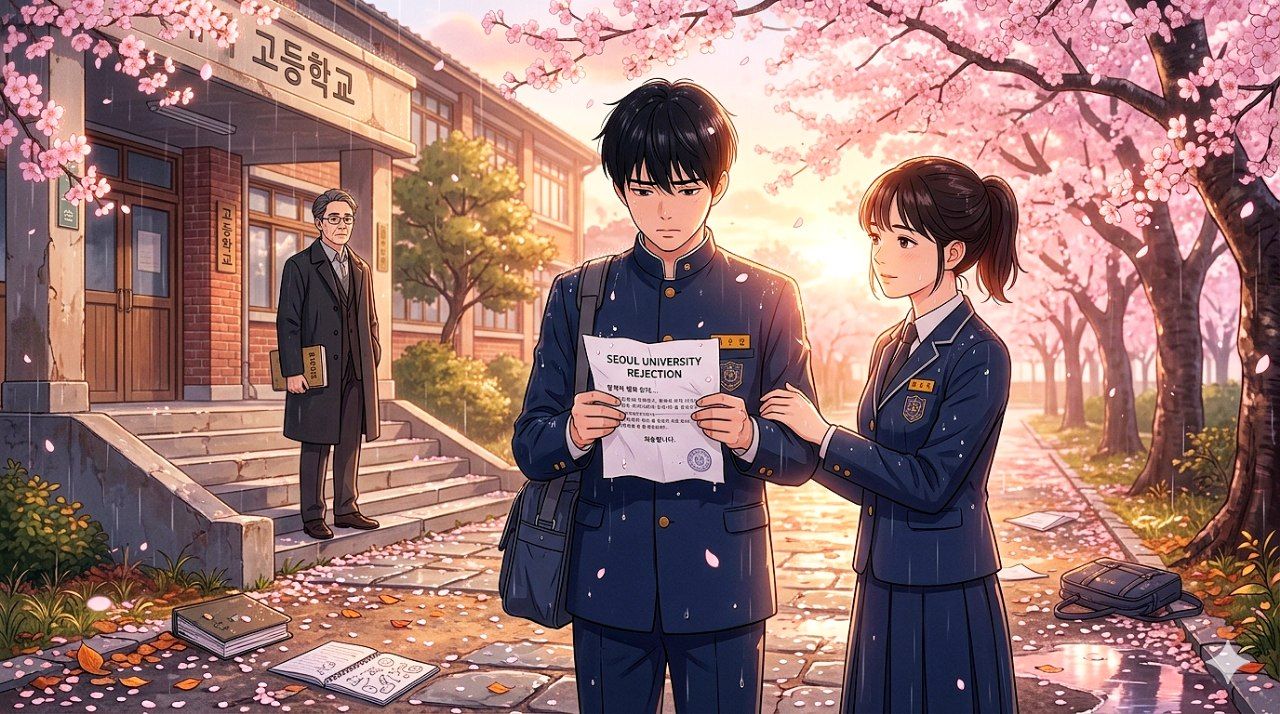
Short story: The Network of Silence
The rain had a metallic edge that afternoon over Puerto Arenal; it fell in straight lines that seemed to cut the air and turn the streets into mirrors. When Detective Mara León opened the message on her phone, the screen’s glow made a small slit of light across the rain: “Urgent operation. Possible virtual extortion ring. Report to Headquarters.” At the Forensic and Judicial Investigation Agency (AIFJ) nerves were taut; reports spoke of a sustained increase in calls that paralyzed merchants and online shop vendors. In the meeting room, Commissioner Héctor Murcia spread the papers with steady hands and spoke slowly, measuring each word so it would land.
“Mara,” he said, “this is no longer just phone extortion. They’re forcing people to travel to remote locations and then demanding payments for alleged kidnappings. Form a team, trace Marketplace and the virtual bazaars. We have more than thirty complaints and the pattern points to an organized network.”
Mara took the files. The evidence was cold and precise: call logs with changing prefixes, screenshots of shops that existed only in code, automated messages that invited purchases and links that opened doors to fake identities. Something chilled her: the victims received the call at the same stretch of their day, almost the exact moment they went out to deliver or pick up an order. The criminals knew routines, understood schedules, and handled approximate locations thanks to information left by online activity.
First night: the trap
The first lead took them to Valeria Ramos, a delivery worker who made her living selling garments on the Mercado Verde platform. Valeria had reported the call with a voice still trembling: they threatened her with an implausible story —that she had attacked a relative— and forced her to drive to a ruined road at the edge of the estuary. Fear had made her obey.
Mara and Inspector Julián Ortega followed her quietly from the mall parking lot. Lights reflected in puddles turned every movement into a shadow; the surveillance car’s engine purred beneath the rain. On the radio, Julián whispered, “If it’s a fake call, they’ll cut it once they get the money. We can’t let that happen.”
Valeria, face ashen, remembered the voice that cornered her through the earpiece: dry, without warmth. “Don’t try to run. If you move, we’ll kill you. Give us a family member who can pay.” Her heart beat against the wheel like a drum. She gave her brother’s name. The voice on the other end didn’t hesitate: it called the number and demanded a transfer. When AIFJ operators tried to trace the origin, they hit a technical maze: IMEI spoofers, cloned numbers redirecting to an anonymous cloud server, gateways that erased traces within seconds. It was the work of skilled hands, not amateurs.
Game of shadows
As the investigation advanced, the network of false identities revealed itself in detail. Profiles with believable names, photographs stolen from social media, shops that existed only to lend verisimilitude to fictitious transactions. Mara watched the connections appear on the office whiteboard: lines linking accounts, transfer numbers, registered addresses that didn’t match any known premises.
“We have a financial lead,” she said, drawing arrows. “A transfer payment from an exchange account to two addresses on the outskirts. One appears in the records as ‘Almacén El Faro.’”
Almacén El Faro —a grimy out-of-town warehouse with flaking paint and a barely visible sign— was a nest of dust, old boxes and neglect. Among cartons they found a clandestine antenna and reconfigured telecommunications equipment: devices that forwarded calls and split them across remote servers. On a table, a phone held recent messages: lists of names, schedules, and two repeated initials: R.M.O. and C.Y.A.F. The sense was that someone had designed fear as a service: set up the threat, choose the timing, collect the fee.
Truth and betrayal
Digital forensics allowed them to pin down two pieces: a thirty-nine-year-old technician, Ricardo Molina Otero (R.M.O.), and a thirty-year-old runner, César Yánez Aponte (C.Y.A.F.). Under interrogation their alibis unraveled with the steady force of the evidence: entry logs to the warehouse, account movements, phone locations tying them to Almacén El Faro.
Ricardo, voice breaking, confessed part of it: “I only built the antenna… they paid me little. I didn’t know they were going to move transfers that large.” His explanation had the cadence of someone excusing a wrong step out of need; yet his hands had held cables and configurations not typical of mere installers. César, by contrast, stayed defiant. From the dock he threw a warning with teeth: “They won’t catch the brains. This is a system, not two culprits.”
The accounts didn’t lie: transactions had passed through exchange houses, through shipping companies with opaque records and through anonymous digital wallets. Between the lines, investigators found an operator selling “alarm services” to small businesses —a masked protection promise that in fact was the key to activate extortions and collect commissions on each “ransom” paid. The network was wide, stretching to usurped identities and financial routes that changed hands with almost industrial precision.
The final ransom
The gang prepared their biggest strike with the cold calculation of one who sizes up the most valuable prey. They chose a restaurant entrepreneur who had sold furniture on BazarNorte. His daughter received the call and was forced to move to an old train station, where rusted beams seemed to watch the stranger drama. The AIFJ set up a controlled surveillance operation: let the scene play out, keep communications under monitoring, and cut the money source the moment the transfer was confirmed.
Mara sat in the mobile operations room, screens spitting waves and maps, watching the thread of extortion in real time. Julián stood next to her, ready. From the station, the daughter, trembling, complied. The voice on the line issued instructions and demanded confirmations; the panic tones and psychological pressure functioned like a trained mechanism to break resistance. When the signal to move the money came, Julián pushed the button to freeze the account; orders from the room translated into a technical strike that sealed the escape route.
Cutting the transfer fractured calm into screams over the line and, seconds later, silence: the call went dead. “Perfect cut,” Mara murmured. “Now.” The attackers tried to vanish into the city, but the AIFJ’s coordinated net closed around them: Ricardo was arrested in his workshop, coated in dust and parts; César was taken in the cargo hall, among pallets and crates, eyes still searching for an exit. Their belongings held a list with more than thirty names: victims who had already been forced to move and to transfer money. These were not isolated incidents; they were a machine in motion.
Echoes in the city
The news echoed through the city like thunder that compels people to look. In a press conference, Commissioner Héctor Murcia explained the modus operandi and issued practical recommendations: verify identities on platforms, don't give family details over the phone, and report any coercion. His words were necessary, yet in the streets people knew catching the perpetrators wasn’t enough; the masterminds and the financial structure feeding the scheme were still at large.
Later, in a cold corridor of Headquarters, Mara received an unmarked envelope. Inside was a card with three words written in black ink: “It was not enough.” The note fell like a stone into her stomach. Turning a corner to leave, a figure dissolved into the mist rising from the port — an ephemeral presence, a notice that the strings were not fully cut.
“There are still hands behind it,” Julián said quietly. “They haven’t finished.”
Mara clenched her fists until her knuckles hurt. She knew the city breathed with a little less relief, but still with fear. Now they had names, routes and evidence; they had landed an important blow, but the Network of Silence could regenerate, move through other channels and learn. She knew the next call would not only force someone to move; it would send the message that fear was still a tradable currency.
“Then we continue,” she answered without hesitation — “until we find the boss.”
The rain did not stop. It fell like an impartial witness, erasing footprints where pursuers had passed and marking the start of a longer hunt. Every message, every account, every transfer became a possible clue. The AIFJ had dismantled part of the machine, but now the hardest phase began: tracing the shadows who gave orders from afar, cutting financial routes, and dismantling the network so that silence would cease to be a weapon and return to simply meaning the absence of voices asking for help. The city, between the murmur of rain and flickering lights, kept its night; and Mara, walking under the damp dawn, felt that the chase had only just begun.
Source of the images.
Image created with Google Gemini.
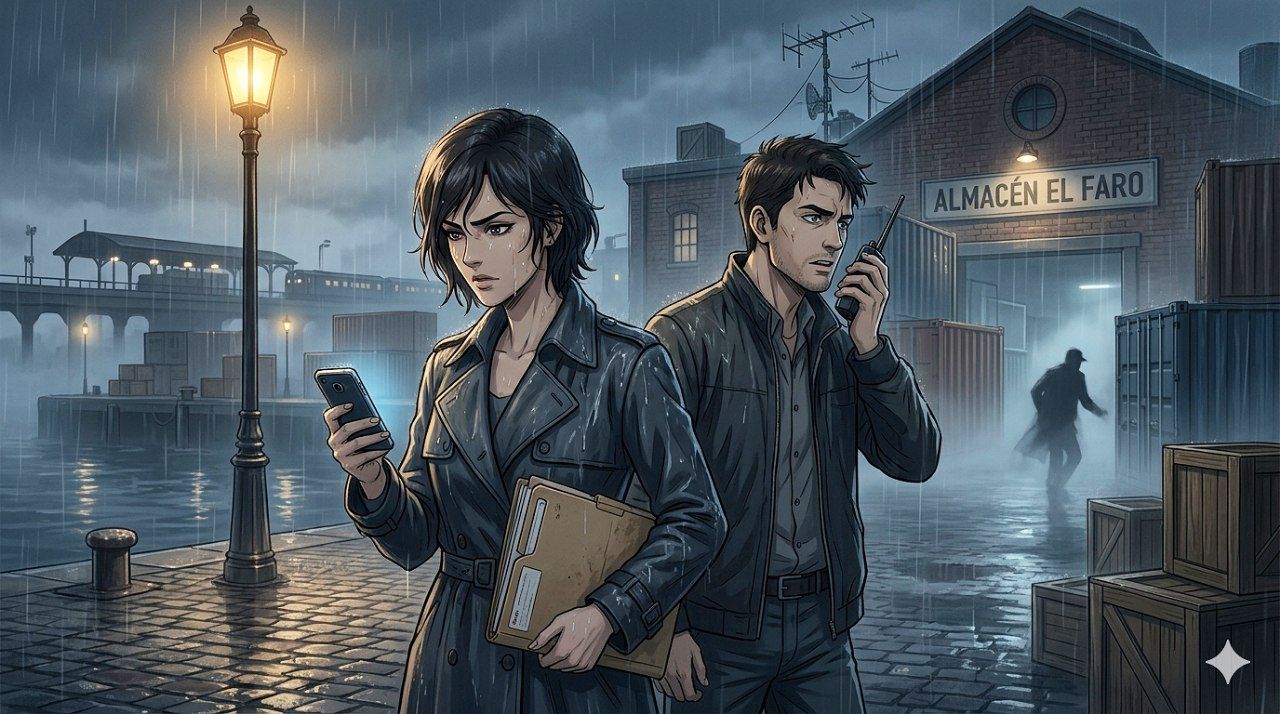
Short story: Bridges of Paper and Fiber
In the corner café —a dimly lit spot where the espresso machine sounded like an old locomotive— three friends met who, though born within a few years of each other between 1992 and 1999, seemed to carry two different libraries inside them. Valeria, Martín, and Leo had grown up with afternoons without notifications and with adolescences when high‑speed internet changed the rules of the game. That mixture often made them half nostalgic and half comedians of their own memories.
Valeria put her cup on the table and held it like a ceremonial object.
“Do you remember encyclopedias?” she said, with that smile that signals an anecdote. “They weighed more than my first boyfriend and filled an entire wall. You had to get up, walk to the shelf, open the volume and read. It was a ritual.”
Martín rested his elbow on the table, amused.
“My dad used them as shelves and TV stands. We made slides out of the covers. And the sound of turning pages… it’s irreplaceable. Today people just swipe and that’s it.”
Leo, who wore a vintage camera around his neck as a whim, clicked his tongue at the others.
“You’re dramatic. It’s fine to keep analog things, but who wants to wait when you can look anything up and fix it in seconds? Need grandma’s recipe? Google. Fix a lock? YouTube. Before you called Aunt Rosa and she’d answer with ‘use a hammer’ or ‘love and patience.’”
“Yes,” Valeria replied tenderly, “but Aunt Rosa also had stories. The encyclopedia brought illustrations that spoke to you. They weren’t just facts; they were pieces of the world made into pictures and flickers. There weren’t five contradictory articles with sensational titles.”
They laughed and a quieter voice at the table said, “We are the bridge.”
Martín said the phrase as if naming a profession.
“Sometimes I feel like I carry two manuals inside me: one taught me to wait, to look at the sky without fearing losing signal; the other taught me to update, to ask for help instantly when something breaks. We have the patience of someone who waits and the impatience of someone who refreshes the page.”
Leo raised his cup in mockery.
“You updated your patience to version 2.0. Offline when you want, online when you need. It’s like carrying a library and a newsstand in your pocket.”
They shared a knowing laugh. Then Valeria grew serious, as if about to recount a little experiment of nostalgic science:
“One time we turned off the router for a weekend. No networks. We took out board games, a thousand‑piece puzzle and an old radio. At first our hands didn’t know what to do. We looked to swipe and there was nothing. But after a few hours, conversations grew longer; we looked people in the eye and asked how they were without messages in between.”
“And we fought over the last puzzle piece,” Martín said with unabashed amusement. “It was our first argument in years without memes or instant replies. There was an awkward silence that lasted as long as it takes to pretend everything’s fine, and then laughter returned without filters.”
Leo closed his eyes remembering the scene.
“And it was beautiful because boredom was allowed. Now boredom feels like a system error.”
Outside the café a young man walked by with invisible earbuds and an electric bicycle made a strange noise. Valeria watched them and returned to a reflective tone.
“We can explain to younger people why an SD card used to be worth gold, and also teach them how to edit a reel in forty seconds. It’s curious: we have two maps. One drawn by hand, with coffee stains and margin notes; and another in digital layers that updates without warning.”
Martín pulled out his phone, not to check notifications but to show an old photo: a beach postcard with a payphone in the background.
“My grandfather used to keep cameras in the glove compartment,” he said. “Photos had to be developed and waited for. They had a texture, a smell. Now you upload everything to the cloud and nobody worries about losing physical memory. It’s practical, but strange. Anecdotes get lost in the cloud.”
“My mom still confuses ‘streaming’ with a cleaning service,” Valeria chimed in, laughing. “And my dad thinks ‘meme’ is the name of a weird cousin who sends jokes in the family group.”
Conversation turned to going viral. Martín remembered the time he accidentally became a household spectacle:
“I uploaded a video of my dog dancing and my mother called me hysterically: ‘How did you put the TV in your phone?’” Martín imitated, provoking bursts of laughter. “She was convinced I had shrunk the television.”
Leo, always hunting for the comedic angle, added:
“My aunt has been forwarding chain messages since before WhatsApp existed. She’s a walking relic. Sometimes I call her ‘a human with unlimited folklore coverage.’”
Laughter once more eased the nostalgia. Valeria inhaled the coffee’s aroma and let out a confession.
“What scares and comforts me is that we don’t have to pick a side. We can teach waiting and searching. We can show how to build a shelf without instructions and, at the same time, send a photo of the progress so someone can approve it with an emoji.”
Martín looked through the window at how the city dressed itself in artificial lights.
“We are the translators between generations,” he said. “We read paper maps and we make folders in the cloud. We’ll tell our children there were times when not everything was in the palm of your hand: that we went to video stores and rented movies in boxes, that we glued photos into albums with dried glue, that we waited until Saturday to watch our favorite TV show. And we’ll also tell them that at two in the morning we solved what seems urgent now thanks to a group chat.”
Valeria smiled, softer this time.
“We’ll tell them to turn off the screen and come tell us when something hurts. That never goes out of style.”
She paused a second and added, almost in a whisper:
“We’ll also tell them we were the last generation to know a completely disconnected childhood, but that we learned to adapt. That’s why we understand the value of both worlds: we know why it’s worth disconnecting and why, sometimes, speed saves you.”
Night had settled when the three left the café. On the sidewalk a digital billboard cycled images at a relentless pace; next to it a small kiosk still sold glossy magazines. Leo, with his camera, took a photo of the kiosk and another of the digital billboard, placed them side by side and showed them to the others like an art piece.
“This is the perfect photo,” he said. “The ad that yells and the magazine that whispers.”
Martín regarded them with a mixture of pride and weariness.
“Sometimes I feel responsible for keeping stories,” he said. “Stories that don’t get lost when memory becomes invisible. We keep anecdotes in objects: cassettes, memory cards, notebooks. But we also learned to upload files so they don’t burn in a fire. We’re the ones who teach not to leave everything only in the cloud nor only in the drawer.”
Valeria shrugged with a wide smile.
“And we’re a little clownish too, because we laugh at our contradictions. Yesterday I helped my grandmother uninstall an app and, when I got home, I went to find a ’90s song that only existed on a scratched CD. I had to climb into the attic, find the box and play it on a ten‑kilo stereo. It was wonderful and absurd at once.”
At the building entrance Martín stopped and looked at his friends like someone gazing at an old photo that comes alive.
“One day our children will ask what that strange era was like, half without the internet and half with it,” he said. “And we’ll tell them that sometimes we had to explain to ourselves how to live in two realities at once. That we knew how to wait in lines and read printed instructions; that we created stories on magnetic tape and also made virals that lasted the length of a sigh.”
Valeria put her hand on Martín’s shoulder.
“We’ll tell them how to prioritize: that a walk with no signal can be a cure, but that a message can save a day. That we knew when to disconnect and when to connect to help.”
Before saying goodbye, Leo took his phone and, with automatic humor, took a selfie of the three. He showed it to his friends and, without much thought, wrote in the caption: “Bridges under repair: alternating traffic between nostalgia and notifications.”
They laughed again, this time with the laugh that knows the mix of pain and joy. That laugh condensed the peculiarity of their generation: memory and meme, patience and haste, hardcover album and cloud folder. They walked with one foot on each shore, teaching others how to cross with open arms and with caution.
As they climbed the building stairs, a neighborhood child leaned over the railing and asked with curiosity:
“What are you telling stories about?”
Valeria crouched to his level and offered the simplest explanation she could imagine:
“That before, to know something, you sometimes had to get up and look it up in a book. And now, the answer arrives in seconds. We remember both paths.”
The child blinked, both confused and fascinated.
“And which is better?” he asked.
The three friends looked at each other and, without hesitation, answered in unison:
“Both.”
That “both” echoed in the stairwell like a small truth. It was a practical and poetic conclusion: there was no need to choose a side to live well. You could read a book with a cup of tea and then upload a photo of the cover with a filter. You could wait and also look up instantly. Being a zillennial wasn’t a contradiction: it was a complex and valuable skill for navigating hybrid times.
They entered the building and each took their own direction. The sound of their footsteps faded, and from the window of the top floor the neighborhood seemed to breathe to the rhythm of two intertwined eras. Outside, neon lights blinked like notifications; inside, the dimness kept albums, notebooks, memories in boxes with handwritten labels.
At her apartment, Valeria opened a drawer and pulled out a notebook in which she had jotted small things since adolescence: songs, jokes, addresses of lost friends. She opened it at random and found a list titled “Things to Remember”: play until it gets dark; ask permission before using a neighbor’s bike; read the school encyclopedia because the illustrations taught geography in impossible colors.
She smiled, took her phone and, without ceremony, uploaded a photo of the notebook to her story. She captioned it simply: “Bridges.” She added a map sticker and a cloud sticker. It wasn’t a contradiction: it was synthesis.
That night, before sleeping, Martín received a voice message from his mother with a video file: she’d tried to use a new filter and needed help. Martín felt again that double perspective —the encyclopedia and the tutorial—, read the message, searched for the best solution in his memory and online, recorded a clear and simple reply, and sent it. His mother answered with a heart emoji and a short phrase: “Thanks, my dear.”
Martín turned off the light, thinking about how his generation knew how to care for both shores. He fell asleep with the idea that they were neither odd nor lost: they were translators of eras, heirs of an analog childhood and artisans of a hyperconnected adulthood. In that dream, encyclopedias and servers danced a slow, domestic dance, like two old friends recognizing one another in a room lit by a lamp and a screen.
The End.
Source of the images.
Image created with Google Gemini.
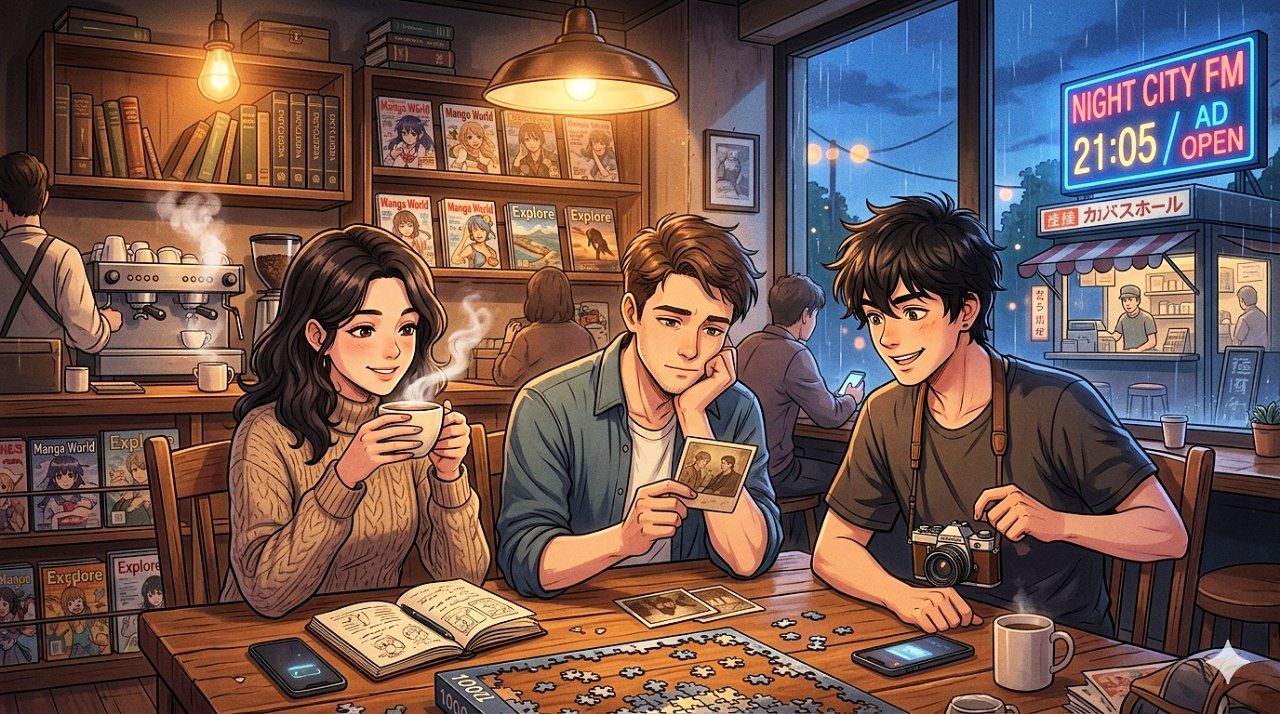
Short story: A Gesture That Saved
The rain hammered the roof of the old warehouse that served as the shelter when Mateo pushed the door and felt the cold, damp air that always accompanies places where second chances wait. The buzz of fluorescent lights mixed with the smell of disinfectant and hay gave the place an atmosphere both clinical and moving: lined cages, worn blankets, posters with photos of lost animals. In one corner of the place, a mother dog curled around her puppies with a patience that seemed to defy the world.
Mateo wore a blue coat and carried a backpack with some empty boxes: he had just moved into a small loft downtown and was looking for company for the long afternoons. He had thought about adopting only one puppy; the idea of a small companion who wouldn’t fill his routine too much felt comfortable. He walked slowly toward the corner where the litter was.
“Hi,” he said, his voice low out of reverence for the animals. “I came for the spotted puppy. Is he available?”
Ana, the volunteer, had her hair tied back and eyes tired but full of tenderness. She pointed with a gentle gesture toward the mother who didn’t take her eyes off her pups.
“He’s the most restless,” she replied. “But look at the mother. They arrived recently; I don’t know if separating them would be good.”
Mateo approached. The puppy jumped between his mother’s legs and, for no logical reason, Mateo felt a childhood memory — a sofa, an old photo with a black dog — hit his chest. He crouched down and let the puppy lick his hand; the animal’s trust came over him like a promise.
When he moved the puppy to look at him better, the mother tensed. It wasn’t an act of aggression but a primitive warning: protection against loss. Her eyes, large and amber, contained a weariness that tasted like nights searching for food and days enduring city cold.
“If you take only the puppy,” Ana said in a soft voice, “she might be left devastated. Many mothers don’t get over the separation quickly.”
Mateo swallowed; the possibility of harming another being to satisfy his own need felt unbearable. He looked at the mother and puppy together: the simple scene seemed sacred.
“I can’t,” he finally replied. “I’ll take both of them.”
Ana exhaled as if she had released a weight she had been holding.
“Thank you,” she said. “Not everyone does.”
The drive to the loft was quiet. Mateo drove through flooded avenues; the streetlights stretched across the windshield in liquid lines. Behind him, on the blue blanket in the back seat, the mother and puppy slept curled up together. Mateo watched their faces in the rearview mirror and thought that, in some way, they were taking care of him too.
Mateo’s loft was modest but bright: wide windows overlooking the avenue, walls of white worn by time, a bookcase with books stacked in disorder, and a guitar leaning in a corner. The first night they crossed the threshold together, the day’s smoke stayed outside; inside, the smell of warm fur and clean blankets transformed every corner. Mateo set up a temporary bed near the couch; he put out water and food; he turned on a floor lamp that cast a warm halo over the living room.
“This is fine,” he whispered, more to himself than to them. “Welcome.”
The mother watched while the puppy explored the new territory with that mix of boldness and insecurity that young ones have. Mateo decided to call her Alma and the puppy Lino. The names came as if they had always been waiting: Alma for the gaze that had touched him and Lino for the way the puppy jumped: light and bright.
The days that followed were a succession of domestic rituals that wove them into a family. Alma taught, with the patience of someone who knew the hardness of the streets, where to sleep, how to ask when hungry, where to hide her head when there was noise. Lino learned quickly: in the morning he ran to the kitchen; in the afternoon he curled at Mateo’s feet while he read; at night he sought Alma’s warmth.
One afternoon, while washing dishes, Mateo saw Alma lying by the window, looking out at the street. The sunset light painted her coat in honey tones.
“Do you think about the street?” he asked softly, as if he expected a human answer.
Alma rested her head on the edge of the couch and let out a sigh that Mateo felt said more than a simple breath.
“I think about the noise and the potholes,” he imagined Alma’s voice in his head. “I think about having hands that scratch behind my ears now.”
Mateo smiled with a gratitude so deep it hurt in his chest: he had gone to rescue, and, without knowing it, he was being rescued. On cold nights, when nostalgia for his family came over him like waves, Alma curled up next to him and Lino became a warm weight on his feet. The apartment stopped being an empty loft and became a home with sounds and traces.
Mateo and his dogs’ story began to circulate. A neighbor saw them walking in the park; another took a photo on a bench under an oak and uploaded it. The image — Mateo reading, Alma reclining, and Lino asleep at his feet — started getting shared: comments of tenderness, messages telling of similar losses, others congratulating the gesture.
At first, the exposure was a balm: emails arrived offering help, donations for blankets, a veterinarian offered to check vaccinations for free. People with broken stories wrote from the other side of the screen to say thank you. One night he read an anonymous letter that said, “Thank you for not separating them. I lost my dog last year and seeing how you care for them gave me strength.” Mateo kept it by the kitchen frame; the rain-moistened handwriting felt like a relic that returned his faith.
But virality also brought unexpected complications. Weeks later, the shelter received an inspection following complaints about adoption conditions, and someone thought a downtown loft couldn’t be a home for two dogs. Mateo was asked to present vaccination certificates, proof of adequate space, and a care plan that complied with regulations he didn’t know.
Bureaucracy arrived with its cold language: forms, tables of minimum space measurements, fencing requirements, and documentation. Mateo felt engulfed by papers that seemed to try to measure tenderness with numbers and stamps. The night Ana handed him the list, the shelter office smelled of old paper and stale coffee. Ana spoke with gentle firmness.
“We need you to prove you can care for them,” she said. “It’s bureaucracy. It’s not personal.”
Mateo nodded, bearing a new weight on his shoulders but with the determination of someone who had decided not to back down.
“I will do it,” he replied. “Tell me what’s needed.”
The response came in the form of small community actions. Neighbors offered help to adapt the balcony; a blacksmith passing by the street made a small fence for the terrace; Dr. Morales, the neighborhood veterinarian, reviewed the medical records and patiently explained the steps to register the adoption. A group of shelter volunteers organized a collection to cover vaccines and deworming. It was the human network that turned the paperwork into a series of concrete gestures that spoke of both empathy and responsibility.
At the same time, Mateo had to face critical comments on social media: some accused him of showmanship, others insinuated the story was staged. There were days when those voices pierced him with cold; on the other hand, messages arrived telling of people who found solace: folks who started to believe in kindness again after seeing Alma and Lino. Mateo began replying, honestly, to some messages; he shared how adaptation was going, the fears and doubts. He opened a small page where he narrated his experience: homemade toy repairs, simple safe recipes for dog food, exercises for socializing rescued puppies. He did it not to seek spotlight but so others could replicate something that seemed simple but required care.
One winter morning, steam from his coffee mixing with the whistle of the kettle, he jotted two ideas in his notebook: collaborate with the shelter to facilitate adoptions and organize talks on responsible pet ownership in buildings with space restrictions. He saw it as a way for the story not to remain a pretty tweet but to lead to useful changes.
Coexistence also brought its share of intimate drama. Alma sometimes woke startled by thunder or the rumble of a truck; she would stare out the window with a nostalgia that didn’t pass through words. Mateo learned to read those signs: he would place a blanket over her, speak softly, and remind her there were hands to care for her now. Lino went through a jealous phase when the first visitors came to the house; he barked loudly until Alma calmed him with her scent and presence.
One autumn night, under the flicker of a lamp, they communicated in ways that needed no tongue. Mateo sat with his back against the couch, his guitar propped to the side, thinking about his father, about his sister who no longer lived in the city, about the absences he had dragged since childhood.
“Sometimes I feel like I came to fix something,” he murmured, as if confessing to the walls. “But now I see they were fixing me.”
Alma rested her head on his leg and released a hoarse sigh.
“I didn’t come to be fixed,” the calm of her weight seemed to say. “I came because we needed shelter and you offered it. That’s all the world asks sometimes.”
Mateo closed his eyes. The nostalgia that accompanied him didn’t vanish; it transformed into a companion less sharp and more lucid: the trace of what had been and the raw material of what could still be.
The bureaucratic conflict was resolved thanks to community mobilization and the submitted documentation. The shelter certified the adoption, and the authorities accepted the loft adaptation plan. The story then ceased to be merely a flash of virality and began to become a case that inspired other shelters to relax some protocols when animal welfare and human good faith were demonstrated by deeds.
As months passed, Mateo’s home gained its own life. The kitchen plants that once seemed to struggle to survive greened again with a little more attention; the guitar sounded more often; the books on the shelf moved slowly from the “to read” piles into shared readings on rainy afternoons. Alma and Lino grew: the first with serene dignity; the second with a mischievous character that forced Mateo to laugh more than he thought possible.
Public recognition was kind and brief: radio interviews, small newspaper pieces, people who came to say thank you in person. Mateo learned to balance exposure and intimacy: he answered messages that seemed sincere and kept the sacred details to himself: how Alma curled up on stormy nights or how Lino licked his face to wake him.
Months later, a letter moved him to tears. He opened it at the kitchen table, with afternoon sunlight pouring through the window.
“A year ago I lost my mother and with her my last anchor. Seeing your photo —those three bodies together— made me cry in a way I didn’t expect. You helped me remember there is still tenderness. Thank you.”
Mateo placed it in a box with other notes; each one testified that his gesture had produced something real in the world: not fame, but echoes of solace. He continued building a simpler yet fuller life: walks in the park that turned into rituals, volunteer visits to the shelter, and afternoons spent writing about what he had learned about responsible adoption.
On a clear spring night, Mateo sat on the balcony with Alma at his side and Lino curled in his lap. The city below murmured with its lights and the windows of nearby buildings blinked like terrestrial constellations.
“I didn’t think this would happen,” he said softly. “I thought I was going to rescue one, not that they would rescue me.”
Alma rested her muzzle on his hands and closed her eyes with the serene trust of one who knows she has found something she hadn’t had in a long time: stability. Lino whimpered in his sleep and twitched his paws as if chasing a happy dream.
“Sometimes the rescue is mutual,” Mateo thought. “We care for each other in ways we don’t always see in the moment.”
The story continued to circulate, of course, but what remained at the center was not virality but the chain of small actions that virality made possible: donations that covered vaccines for other dogs, neighbors offering time at the shelter, children learning not to abandon animals, communities beginning to speak of shared responsibility.
Later, Mateo organized a small gathering at the shelter to share his experience in person. Volunteers, recent adopters, and the curious came. He told them about administrative difficulties, nights of doubt, and the countless moments of tenderness: how Alma licked Lino’s paw when he was older; how the constant presence of the dogs had changed how he viewed his own absences.
At the end of the talk, a shy little girl approached and held his hand.
“Can you always adopt two dogs?” she asked.
Mateo looked at her and smiled.
“It depends,” he answered. “It depends on whether you can give them what they need: time, love, and a safe roof. But if you can, I assure you they will rescue you.”
That night in the loft, while the city slept and distant noise became almost music, Mateo watched Alma and Lino sleep. In their faces there was something born from the decision: drama and doubt, yes, but also a nostalgia that had found a gentle, compassionate outlet.
What began as the intention to adopt a single puppy had become a decision that transformed many lives: Mateo’s, Alma’s, Lino’s, and those of people who, upon seeing them, were encouraged to become better caregivers. In a world that often demands grand gestures, that chain of small acts proved that empathy, sustained by responsibility, can teach how to rebuild homes and weave community, one embrace at a time.
Source of the images.
Image created with Google Gemini.
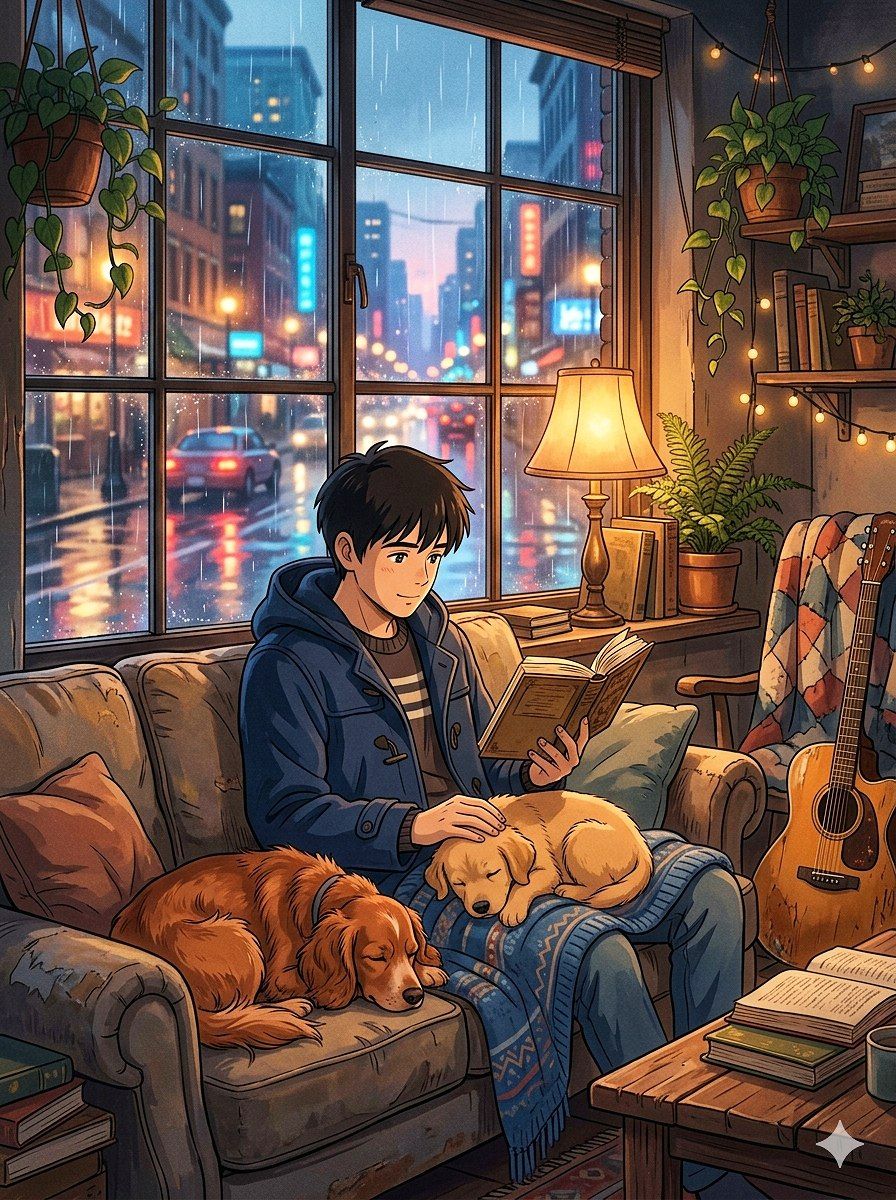
Short story: The Hum That Fell Asleep
The Crystal neighborhood rose over the bay like a city of mirrors and wiring, a luminous seam that cut the night into strips of neon. From its terraces to the corridors between skyscrapers, screens set the pace: recipes in fifteen seconds, romances in twenty, news that was swallowed and returned to the air as easily as someone exhaled. Facades were attention showcases; speaking ads modulated passersby’s moods and apps whispered routines that, without order or truce, colonized minutes. The city lived by pulse jumps: everything was instant consumption, everything demanded the next click.
Asha was young and anchored like a hurried gesture of the world. At nineteen she worked as a data courier, carrying on her forearm a tray of ads that seemed an extension of her body: packaged life fragments, ephemeral headlines and micro-emotions ready to be classified, retouched, and resold. She learned to read attention patterns before mastering the subway map; her fingers moved with the precision of someone who knew every second must be turned into currency. By day she calibrated content with Nala, her coworker; by night she devoured courses and micro-certifications to raise her score in a market that paid for visibility. At dawn, however, when the city loosened its rhythms, Asha tried to recall stillness: how it felt to stay seated without an interface giving her a goal.
“Do you remember when people would sit and watch a whole movie?” Nala asked one afternoon while they adjusted the cadence of a package of ad clips.
“It’s not worth it,” Asha replied without looking up. “If there’s no click, there’s no pay.”
“But what if there’s something worth seeing and nobody watches it?”
“Then we pack it into twenty seconds and make it viral.”
In contrast, Don Mateo was a mature, tempered presence—sixty-two years old—living in the old neighborhood in an apartment whose windows refused to become screens. His shelves were populated with paper books with worn spines; among dust and underlined passages, relics of an earlier era rested. He had been a literature teacher before automated learning systems took over classrooms. When education became an optimized stream of micro-lessons, Mateo didn’t give up: he opened a tea house in a wooden-scented house and invited a few neighbors to sit and listen to long readings, those that require pause, breath, and time for sentences to settle.
“Attention is like a muscle,” he would say, hands clasped in the steam of the tea. “If you exercise it in pieces, it atrophies.”
Martina, a teenager who attended his sessions with curiosity and reproach, frowned.
“They don’t get it,” she muttered. “My friends get bored in two minutes.”
“Then give them boredom, child,” Mateo replied with a smile that seemed a gentle reproach. “Questions grow in boredom.”
Farid was the other face of the city, the one who inhabited the high floors of glass towers where decisions translated into metrics. At thirty-five, an experience engineer at Focal—the corporation that designed attention pacemakers—his day consisted of mixing dopamine and design. The panels in his office showed charts and figures: attention by segment, retention by emotion, probability of clicks by color. Farid knew how to manipulate stimulus entropy to lengthen—micro-precisely and lucratively—the time a user stayed in an app.
“If we raise stimulus entropy by 0.7%, the average session increases by three minutes,” he explained in a meeting, with the neutral voice of one who communicates efficiency. “It’s logical; people can’t resist.”
“But the studies,” a researcher murmured, eyes fixed on a screen full of data, “talk about cognitive fragmentation. Less sustained concentration.”
“Fragmentation is a pretty word to create demand for redemption,” Farid shrugged. “We design the therapy after selling the addiction.”
In everyday life, Asha’s daughter Lila, eight years old, was immersed in interactive capsules and activities that measured her patience in microseconds. Her drawings were gifs; her curiosity a thread platforms stretched with instant rewards. One afternoon when her mother took her to Don Mateo’s tea house, the girl arrived with a blinking tablet and the anxious look of someone waiting for a cue.
“Why does he speak so slowly?” she whispered, losing herself in the slowness of the reading.
“Because he has stories that don’t break,” Asha answered tenderly. “Let her. Let her listen.”
The tea house was lit by warm lamps; the tea steamed in ceramic cups and the clock seemed to have forgotten how to hurry. Mateo began to read a fragment of an old novel; the words flowed like a patient river, without jumps, without attention peaks designed to seize glances. Lila frowned, dropped the tablet, and for the first time her breathing paced itself with the tale. When it ended, the child uttered a simple word that held surprise and discovery:
“It was… long.”
“Sometimes the long is what gives us back ourselves,” Mateo said, as if granting a key.
Farid lived his contradiction. On the pinnacle of the city, on his building’s terrace, he observed the neon tide that fed Focal’s machinery. He prepared the campaign they would launch the following week: a series of microdocumentaries engineered to hook people and multiply average session time. He heard the city’s beat in his reflection on the glass, and for the first time in a long while, doubt seeped through.
“We’re winning,” he told his reflection. “But winning what?”
Irony bit: a designer of attention tired of his own invention. And fate, which is nothing but a sum of small acts, put a study suggested by the same algorithm that fueled his work into his path. A report on “digital fatigue and recovery” landed in his notifications. He read the numbers out of habit until an infographic showed a child who couldn’t finish a task. He recognized the child: his nephew. The equation stopped being cold numbers. That night, on impulse he couldn’t explain, Farid headed to the Crystal neighborhood and entered the tea house. He sat in a corner to listen, not to observe.
“What is a designer looking for here?” Don Mateo asked when he saw him.
“I don’t know,” Farid mumbled. “Maybe something they don’t sell.”
Crystal’s social fabric wove urgency and patience together: Asha and her pay-per-second economy; Mateo and his inherited habit of minutes; Farid and his stalled ethics; Lila and her new curiosity. They were not watertight compartments; the city crossed them, brushed them, pitted them—and sometimes united them in small acts of resistance.
One afternoon in a flea market, Asha found an old radio. It was a strange object in a city of interfaces: varnished wood, a knob to turn on, and a metal grille that promised sound without recommendations. She carried it home like someone dragging a relic and set it on the kitchen table. She turned the knob. The radio grunted, breathed, and released a song in full, uninterrupted by ads. Three minutes, perhaps more: a continuity that struck Lila as unheard-of and fascinating.
That interaction with the object was a tiny act of deceleration that left its mark. Songs without skips opened a slit of attention no one had programmed. Lila listened, confused and attentive, and Asha watched her daughter as one watches the planting of something that requires time.
The real rupture did not come by human will but by infrastructure fragility: the night of the blackout. A failure in the main network plunged Crystal—and many other cities—into absolute digital silence. Screens went out simultaneously, facades fell into darkness, and attention pacemakers, due to a sync error, stopped sending their micro-pulses. Panic was immediate: virtual markets collapsed, retention-dependent contracts froze, and platforms entered emergency mode. But beyond the technological fear, something unexpected surfaced in the city’s intersections.
In courtyards and terraces, people lit lanterns, took out notebooks, guitars, and objects that did not need updates. Conversations, initially timid, recovered a cadence nobody had measured with metrics.
“What do we do now?” a voice asked from a terrace.
“Talk,” Don Mateo answered naturally. “Listen.”
Asha took Lila to the rooftop. Farid that night, free from the constant hum of notifications, felt something he thought lost: the calm that filters through when there are no scheduled stimuli to interrupt. Neighbors of different ages and backgrounds mingled; the stories told no longer required an algorithmic filter to measure relevance. An old woman who had sold virtual memories told the story of her first love in a voice that asked for no approval in the form of likes. A laborer recited the litany of his day, word by word, and no one interrupted him. The tales didn’t seek to go viral; they sought to be heard to the end.
“I never thought I’d hear so much,” Farid admitted, honestly discovering a forgotten faculty.
“You hear it now because there are no interruptions,” Asha replied, with a calm that hurt.
Martina, uneasy, probed the idea of the imminent return of haste.
“And after?” she asked, seeking a promise.
“After we choose,” Don Mateo said. “Choosing is tiring, but it’s the only thing left.”
The blackout didn’t last forever. Corporations activated contingencies, restored networks, and launched recovery campaigns to apologize and recover lost attention. New versions of pacemakers promised a “deep mode”—a premium product that assured sessions without invasive micro-pulses—and the market offered solutions for those with money and sufficient awareness to pay. There were resistances and concessions: not everyone could afford deep mode; not everyone wanted it. Nonetheless, from the debris of silence something new arose: community practices that did not depend on a multinational’s infrastructure.
Don Mateo expanded his readings and turned the tea house into a modest community hub. Asha organized workshops where children drew without screens, by hand, with pencils that broke and pages that tore. Farid, affected by the experience of listening without managing, proposed and designed an update that let users block micro-pulses for extended periods—a function not only aimed at retention but at granting people permission to get lost. It was a partial, technologically mediated solution, but it was a gesture: a crack through which attention could be reinstalled.
Years passed and faces changed. Lila grew into a teenager who walked the neighborhood with a notebook in hand. Sometimes she shared fragments online; other times she kept whole pages she never uploaded. She had learned that attention is cultivated like a garden: it is planted, watered, and protected from the pests that promote the immediate. In a plaza where luminous billboards once towered, someone hung a hand-painted sign that read: “Silence Permitted.” It was a modest signal, unregulated and informal, but it served as a reminder.
Corporations did not disappear. They continued inventing ways to capture seconds and designing offers that promised emotional efficiency in exchange for time. Still, on the margins where the light didn’t reach, people learned to stay. To inhabit that staying was neither heroic nor totalizing; it was a daily practice of small decisions that, added up, returned time to body and mind.
One warm afternoon, Farid met Asha and Don Mateo in the tea house. They spoke without haste, with the ease of people who had learned to wait.
“Do you miss when everything was faster?” Farid asked, curiosity folded into his voice.
“Sometimes,” Asha answered honestly, no longer seeking to justify herself. “But the rush does not belong to me.”
“And nostalgia?” Farid pressed, wanting to know if there was something in the past worth keeping.
“It’s a beacon,” Don Mateo said, and his smile seemed to illuminate the table. “It reminds us of the way when the lights go out.”
The city kept blinking: a place of offers promising attention in exchange for time. But on the edges where the light failed to reach, people had learned to stay. In that staying they found a way to remember how to look at a full minute without wanting to measure it. It was not a total victory nor a definitive surrender; it was a truce, a civility of attention rehearsed slowly, the gradual invention of a way of life that was not measured in seconds. And so, between the hum that fell back to sleep and the voices that learned to lengthen their stories, Crystal learned to hold attention once more, as one polishes an old tool and returns to using it with care.
Source of the images.
Image created with Google Gemini.
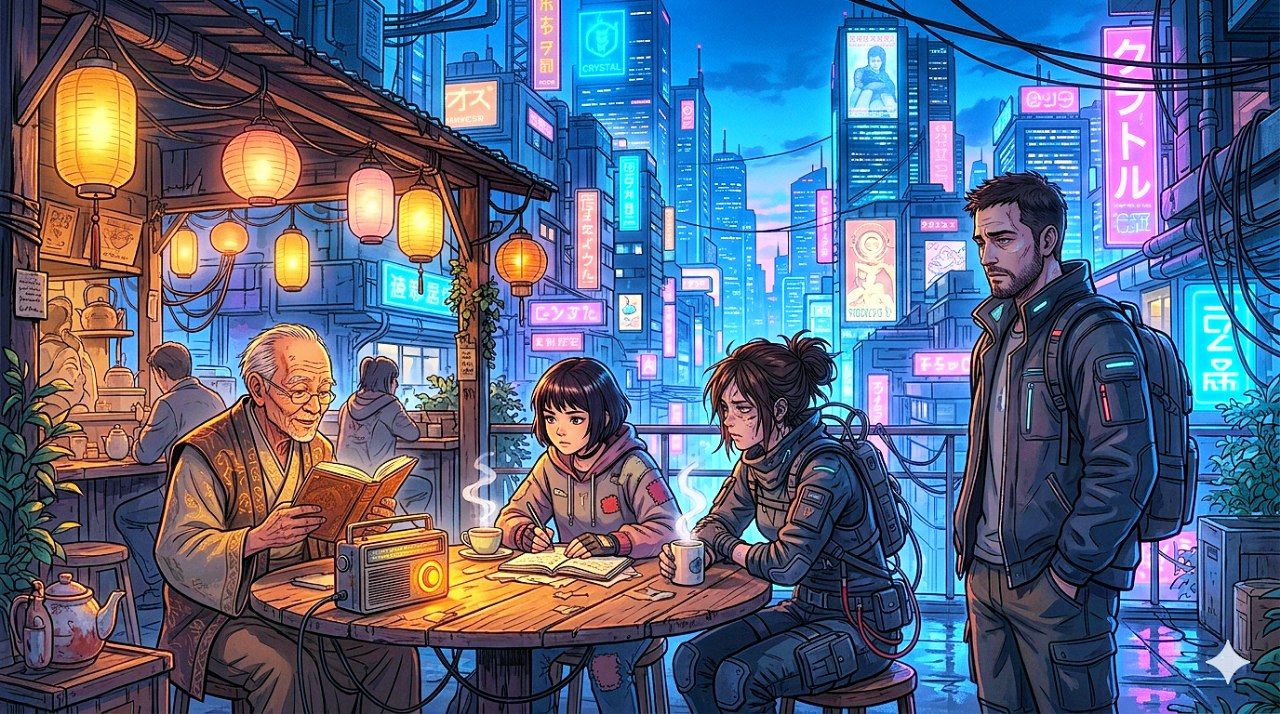
Short story: Friction
Neon‑Amber never slept; it only changed its glow. Stacked towers projected ads that breathed promises over the sidewalks, and delivery drones threaded the avenues like insects with neon eyes. On the forty‑second floor of Block K, behind a window blurred by acid rain, Mara lived surrounded by papers and notebooks. Her small apartment smelled of old coffee and ink; on the table, a notebook with stained pages and crossed‑out lines seemed to hold the pulse of something machines still could not measure.
One morning, before the gray sun could impose itself over the urban halo, Mara turned on the console. A blue ring licked the room and the voice assistant greeted her as if by habit.
Assistant: “Good morning, Mara. I have prepared a draft of your novel. Do you want to publish it on three platforms and generate a retro‑futuristic cover optimized for clicks?”
She looked at the notebook, ran her fingers along the edge of a page, and inhaled deeply. She had spent weeks parsing the story into small fragments that barely fit in her hand; each sentence had cost her whole nights. The synthesized voice offered what seemed appealing: speed, polish, a promise of visibility.
Mara, her voice still rough from the habit of doubt, answered slowly:
Mara: “Leave it for now. No… I don’t want it touched until I finish it my way.”
Assistant: “Understood. I can optimize the plot for retention, suggest micro‑hooks in chapters 2, 5, and 11, and run A/B tests for the cover.”
She shut the console off. Outside, the city kept its production rhythm. Inside, the notebook remained open, a dirty witness to a practice that seemed obsolete: writing by hand, doubting, erasing.
That same morning Mara decided to visit Sanju’s workshop, the old typesetter who resisted with linotypes and presses. Sanju lived in the trades neighborhood, where oil and metal still had a smell and people spoke of words as if they were machines that also needed care.
Sanju welcomed her with ink‑stained hands and a gaze sharper than any translation interface.
Sanju: “You arrive early, girl. Do you have the new micro‑story?”
Mara showed him the draft the assistant had generated the previous night: impeccable in structure, without hesitation, without detours. Sanju read it aloud, his brow furrowing, and placed the paper down with a delicacy that felt almost religious.
Sanju: “It’s not your voice. It sounds like someone who knows the formula more than the wound.”
Mara: “I know it sounds good. But I feel something is missing. Something that hurts.”
Sanju: “Words need abrasion. If you clean them too much, they become slippery. When a sentence doesn’t find resistance, it gets lost in the noise.”
Mara listened and, without realizing it, thought of all the times she had bought shortcuts out of fear of failure. In the city, “artistic identity kits” were sold like talismans: templates, preprogrammed voices, headlines tested by algorithms. The practical—and profitable—thing was to turn creation into a series of mechanical operations.
That afternoon she met Cass at Node 7, a purple‑lit bar where the music seemed to come with advertising subtitles. Cass was her former colleague, now equipped with implants that replayed memory fragments as filaments of light on the skin. She had gained speed at the cost of something Mara could not name.
Cass: “You didn’t publish?”
Mara: “Not yet. I want it to cost me. I want finding the sentence to hurt.”
Cass: “I get it, but you also understand this: people sell time for relief. We call it progress.”
Mara: “Progress?”
Cass: “Progress if you reduce cost; regression if you ignore the price. Before, losing time on a sentence meant learning. Now the assistant learns for you. You gain hours and lose traces. Not everyone can afford the slowness you choose.”
Cass spoke without softness, with the hardness of someone who had given up pauses because she could not afford them. Mara thought of the line of people she knew who, out of necessity, no longer had time for the creative process—only for the result. A vein stood out in her left hand as she squeezed her glass.
A few days later the city launched a new temptation: the municipal contest “Creators 2.0.” It promised global exposure and a cash prize to anyone who met the prescribed metrics. Authorities published the call with figures and reach projections; it was an instrument to showcase “cultural modernization” and a magnet that turned creation into predictable merchandise.
Mara went to see Lucio, the engineer who had developed the first versions of the creative assistants. He lived in an attic half full of prototypes, cables, and code memories.
Lucio: “We built them thinking we were freeing people’s time. And in part we did. We solved tedious, repetitive tasks.”
Mara: “But some people stopped learning.”
Lucio: “Yes. We didn’t foresee that ease would become a substitute. If you can produce without struggling, people stop understanding why they struggled in the first place. We sold relief, and the relief had an invisible cost.”
Mara signed up for the contest, but on a personal condition: she would write the first chapters by hand; let them rest; then, only after that, allow the assistant to make formal suggestions. She wasn’t seeking the top prize but rather to test whether human friction left traces that algorithms could not fully replicate.
The following weeks found her glued to pen and notebook. Some nights she spent hours revising the cadence of a sentence until the word resonated in her body; other nights she tore out pages for lack of direction. The city applied pressure: the municipal platform reduced visibility for those who did not publish with the expected frequency and offered “optimal” rewrites labeled as solutions to gain audience.
One dawn, as rain hit the windows with insistence, someone left an envelope at Mara’s door. No return address. Inside, a sheet with a handwritten phrase: “Do not give up your way of hurting.” No signature—only someone’s handwriting that understood resistance as a form of companionship.
Mara thought of Sanju, Cass, and Lucio. She knew she was not alone; she also knew that her stance had a cost and a reward: to sacrifice her own time for an integrity that was not profitable by metric standards.
On contest day the hall was a luminous chamber. Screens displayed real‑time statistics, retention graphs, and excitement meters. The jury was made up of people and models, and the audience connected en masse via implants: instant reactions, approval pulses translated into numbers.
When Mara took the stage, her notebook trembled in her hands. She read slowly, letting each word simmer in the room. In parallel, the assisted versions of her work appeared on monitors: quicker endings, plot turns designed to retain readers, sentences that required no pauses. When she finished, the applause was sincere and warm, but the metrics did not spike as the sponsors expected. She did not win first place. She did, however, receive a jury recognition for “Best Creative Resistance.” It wasn’t the check that would pay months of rent, but it meant her bet had awakened something in others.
At the Market of Noises, where people traded packaged sounds and memories as relics, Mara and Cass observed a curious crowd. There were those who resisted shortcuts: children learning to spell without digital help, couples debating the cadence of metaphors as if they were precious objects, elders preferring to tell stories through gesture rather than a reproducible file.
Cass took her by the arm with whatever sincerity remained.
Cass: “They didn’t hand you the big ticket. But they came. And they came to listen to you without filters.”
Mara: “That matters.”
Cass: “It matters because it shows there’s an audience that values friction. We can’t expect everyone to pay for it. But we can teach how to keep it.”
Mara’s concern wasn’t moralizing; it was practical and existential. She knew that delegating the mechanical could be a blessing—less effort on the repetitive, more time to think—but she also understood the danger of delegating the creative: losing one’s voice, the mistakes that become traces, the errors that teach.
In time she opened a clandestine workshop in the basement of an old building. It was not an exclusive place but a refuge for anyone who wanted to recover their creative pulse. Her classes were strict in their simplicity: handwriting exercises, slowness practices, aloud reading sessions, rituals to let a sentence settle before correcting it. There was no sign on the door, only a lamp that turned on at a fixed hour; attendees learned about it by word of mouth, by the curiosity that survived algorithms.
One day Sanju left her a paper with a single word: “habit.” Mara held it, thought of the city that rewarded speed, and wrote beneath it with trembling ink: “I do not want to delegate the habit of feeling.” That small, defiant sentence became the motto of her circle. They did not reject technology; they sought a more conscious relationship with it: using it to free themselves, not to replace themselves.
Tools evolved. Assistants began to replicate styles with chilling precision; they sold packaged nostalgia, playlists of “authentic” memories, and voice packs imitating deceased authors. The border between human memory and synthesized memory blurred for those who did not know the story behind a sentence. Younger generations born into environments where copying was stigmaless did not always distinguish trace from replica.
Still, small resilient communities emerged. Some followed Mara’s path; others embraced total convenience. The balance swung, broke, and recomposed. The certainty that drifted through the city was that a choice existed, and that choice had consequences beyond any control panel.
In one of her last public records, Mara left a brief note: “The question is not what AI can do for you. The question is: what do you decide to keep as deeply human?” The phrase circulated less for its technical precision than for its timing: an invitation to pause, to look at what an interface usually erases for being “inefficient.”
Neon‑Amber continued to be a city of lights and electric pulse. Technology freed and took away at once. In a basement lit by an old lamp, ink still soaked the edges of pages; a diverse group gathered because writing by hand made them feel human. One night, walking under rain that sang on her face, Mara clutched her notebook to her chest, looked at her ink‑stained hands, and smiled. Her time to create remained finite, and she blessed it.
Source of the images.
Image created with Google Gemini.
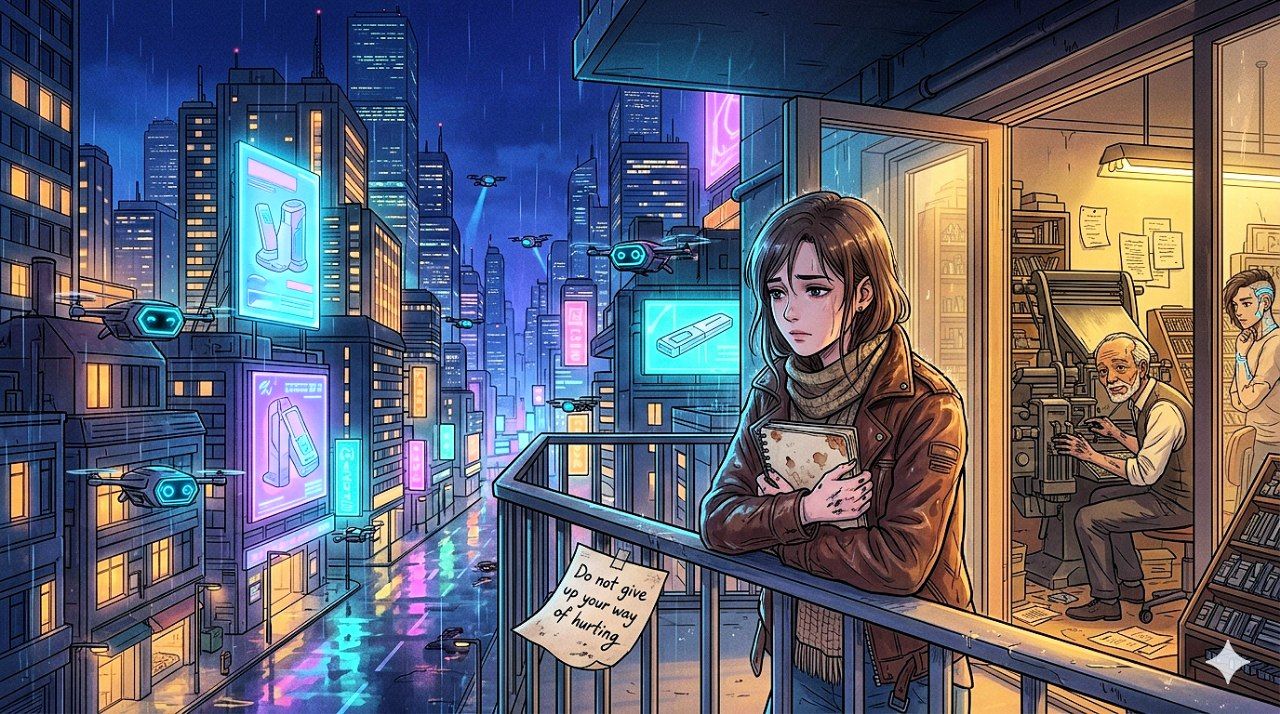
Short story: The Revenge Pizza
Gracie was a sixteen-year-old who split her time between classrooms and the oven of a small neighborhood pizzeria. That afternoon the shop smelled of roasted tomato, basil, and melted cheese; the counter had the soft sheen of late light and the bell above the door chimed on cue. Doña Rosa, the shop’s longtime owner, swept with the practiced motions of someone who had kept a family business running for years and watched the register with the calm attention of experience.
“Be careful, my girl. You have an exam tomorrow, remember?” Doña Rosa said in the warm, protective tone she reserved for the young people who worked for her.
“Yes, Doña Rosa. I’ll deliver and then study. Thanks for the push,” Gracie replied without stopping to arrange a couple of cardboard boxes; her smile was genuine, used to the household’s kindness.
The bell rang again and five youths entered whom Gracie recognized by their gestures and laughs from the school corridors: Marco, a leader with pronounced eyebrows; Dani, always with a phone in hand; Lalo, who never missed an opportunity to exaggerate; Santi, quiet and nervous; and Carla, whose wavering expression made her steps uncertain. Dani held his phone pointed like someone who had already decided a scene would be content.
“Today we’re going to make her trending. Ready?” Marco whispered with the confidence of someone who had already pictured the reward in likes and views.
“I don’t know, Marco… This looks wrong,” Carla answered, the thread of doubt in her voice betraying her conflict between the need to fit in and the inner voice that knew what was right.
“Relax, it’ll be just a prank. Who doesn’t love drama?” added Lalo, as if joking were the best alibi.
Gracie watched them without fuss. She had trained calm into muscle memory on many afternoons at the municipal gym; the mat had taught her to move precisely, to pace her breath, and to separate adrenaline from judgment. She wasn’t wearing a fighter’s uniform—just her delivery shirt—but her posture revealed that discipline was as intrinsic to her as her smile.
“Can I help you?” she asked, approaching the counter naturally.
Marco offered her a calculated smile.
“Yes, a large pizza. And then… some laughs with the delivery girl,” he feigned kindly. His words hung in the air like a crooked promise.
They sat near the counter. Dani kept the phone recording; Lalo was already practicing an exaggerated pose; Santi stared at the floor; Carla toyed with her glasses. While Doña Rosa went into the kitchen to handle an order, the boys whispered their plan with the recklessness of those who believe virality erases responsibility.
“As soon as she steps out, we surround her and record her,” Dani said with nervous enthusiasm.
“Are you sure no one will see us?” Santi asked, cheeks flushed with tension.
“I don’t like this,” Carla repeated, but her voice was not enough to stop the current.
Gracie contained a small smile and, as if fielding yet another question about ingredients, recommended a house specialty.
“Want a recommendation? The house special comes with extra basil,” she offered quietly.
Marco returned the smile and ordered it for the group.
“Perfect. You bring it to me, okay?”
It didn’t take long for the moment Marco thought patience was part of the show. On the way out, he took advantage of a gap between the counter and the door to shove Gracie. It was a shove meant to be theatrical: just enough to unbalance her and provoke a reaction worthy of ridicule and applause. What Marco hadn’t calculated was the response born of years of training and, above all, the decision of a young woman not to let her dignity become a spectacle.
“Don’t push me,” Gracie said, cold and firm.
Marco pushed again, more arrogant than careful. That second shove was the spark: Gracie gathered the impulse with the calm that comes from knowing how to use another’s force. With a fluid movement, without fanfare or rage, she unbalanced Marco.
Muscle and technique did the rest: she secured him in an arm lock that left him immobilized on the floor—respectful enough not to hurt him but decisive enough to show who was in control.
Dani kept recording, disbelief written on his face.
“No…! This wasn’t in the script,” he stammered, voice broken by surprise.
Lalo, who tried to intervene to save his ego, ended up on the floor, his head spinning and his pride dented. Santi tripped over a stack of boxes and got tangled among cartons; Carla stood frozen, laughter and tears battling inside her.
“Stop! Enough!” Carla cried, unable to hold back her sob.
Gracie released the hold and remained on guard; her breathing was steady, her gaze calm. There was no hatred in her—only the clarity of someone who knows limits.
“You wanted a show? Here it is: next time think about the consequences,” she said, the only sharp thing in an atmosphere that for seconds had been suspended.
The livestream they’d turned on, thinking it would capture humiliation, did the opposite: viewers flooded the chat with support.
“Who is this girl?” some commented. “Go Gracie,” others cheered. The narrative the attackers had imagined shattered into digital pieces, and reality imposed another reading: respect for the young woman who answered with skill and composure.
Doña Rosa, who had come out of the kitchen at the commotion, crossed her arms with that domestic authority that didn’t brook nonsense. She planted herself in front of the kids with the look of someone who’s spent years running a restaurant—customers, discipline, and all.
“What kind of foolishness is this in my pizzeria?” she asked sharply.
“It wasn’t anything, ma’am,” Marco stammered, sauce stains on his shirt, his leader mask cracking under evidence.
“Girl, are you okay?” Doña Rosa asked Gracie.
“Fine and safe. Also hungry,” Gracie answered, as though tidying a small disorder and getting back to work.
Lalo, trying to recover his comic figure, came out with a slice of pizza in hand and some cheese in his hair as an absurd trophy; Santi hid behind Dani. A plea came, trembling: Dani begged them to delete the video.
“Delete the video, please,” he begged, voice trembling.
Gracie stepped forward, firm but not angry.
“Delete it now. And apologize to Doña Rosa,” she ordered. The weight of her words allowed no contest.
That night, the social networks moved in her favor. The intended humiliation never arrived; most people celebrated Gracie’s composure. The school filled with looks unrelated to the prank Marco had planned; the pizzeria received calls from curious customers and from the local police requesting statements. Doña Rosa recounted the incident plainly: she had defended her shop and protected an employee. Marco watched his phone overflow with messages and reactions that hurt more than any scolding; Santi carried guilt that made his silence heavy.
Carla could not live with the guilt. The next day she asked to use the school meeting to speak. The auditorium, full of murmur, fell silent when she took the microphone with shaking hands.
“I was wrong. I ask forgiveness from Gracie and everyone I hurt,” she said, voice breaking at times. The courage to confess the truth cost her, but it opened space for repair.
Gracie, listening from another part of the hall, knew that forgiveness didn’t erase the harm, but it opened a door for things to be made right.
The pizzeria, far from suffering the scandal Marco had imagined, gained visibility. New customers came out of curiosity and stayed for the quality; the local press called for an interview with the young woman who had responded with character. Gracie accepted the attention on one condition: she would only speak if she could turn the episode into something useful. She proposed giving a self-defense class to neighborhood youths so technique would not be an excuse for fighting but a tool for prevention and confidence.
In the school gym, mats spread out and curious young people assembled, Gracie demonstrated basic moves: how to fall safely, how to free oneself from a grip, how to use breathing to calm the mind before acting. She taught simply and patiently; her style was educational rather than militant.
“It’s not like the movies. Don’t look for fights; look for preparation. If someone sees something odd, talk to an adult,” she said, and the words landed because they came from experience, not rhetoric.
Marco attended that class, uncomfortable, head lowered. Maybe he expected revenge; he found a different lesson: responsibility. At the end he approached her privately.
“I’m sorry. I let myself get carried away,” he muttered without pretense.
“Fix what you can. Start by giving sincere apologies and learning,” Gracie replied, looking him straight in the eyes. She did not offer absolution but pointed him toward making amends.
Over time, the pizzeria institutionalized the story. They added a new item to the menu Doña Rosa jokingly named “The Gracie”: more basil, a hint of garlic, and a presentation honoring the episode. They hung a sign on the wall that read, “Training and good food—no foolishness.” The community turned that instant into an anecdote that came with changes: Lalo ended up as a delivery driver and still tripped with comic timing; Dani decided to focus on ethical filmmaking and now produced shorts that didn’t exploit anyone; Marco took classes on responsibility and social media and learned that easy fame has a price; Carla organized talks on peer pressure and the importance of saying no.
Gracie continued her life: classes, training, work. She signed shy autographs for those who recognized her at the pizzeria and taught that well-directed strength is an act of care, not a display. One day Lalo, with his perennial disorder, came to the counter with cheese stuck to his ear and asked with half a smile:
“Can I have a free slice for services rendered?”
Doña Rosa shot him a wink and a fond sentence:
“Free? No. Wash dishes for a week.”
Gracie watched the scene, allowed herself to laugh, and capped it with the lesson that had turned that night into teaching:
“First theory, then practice.”
The oven kept firing pizzas, the register kept ringing up sales, and the neighborhood remained a neighborhood. Something changed in how the youths looked at one another, and in how Gracie walked down the street: with the certainty of someone who knows how to defend herself and, more importantly, who knows how to use that ability to stay calm, set boundaries, and teach others to do the same. The End.
Source of the images.
Image created with Google Gemini.
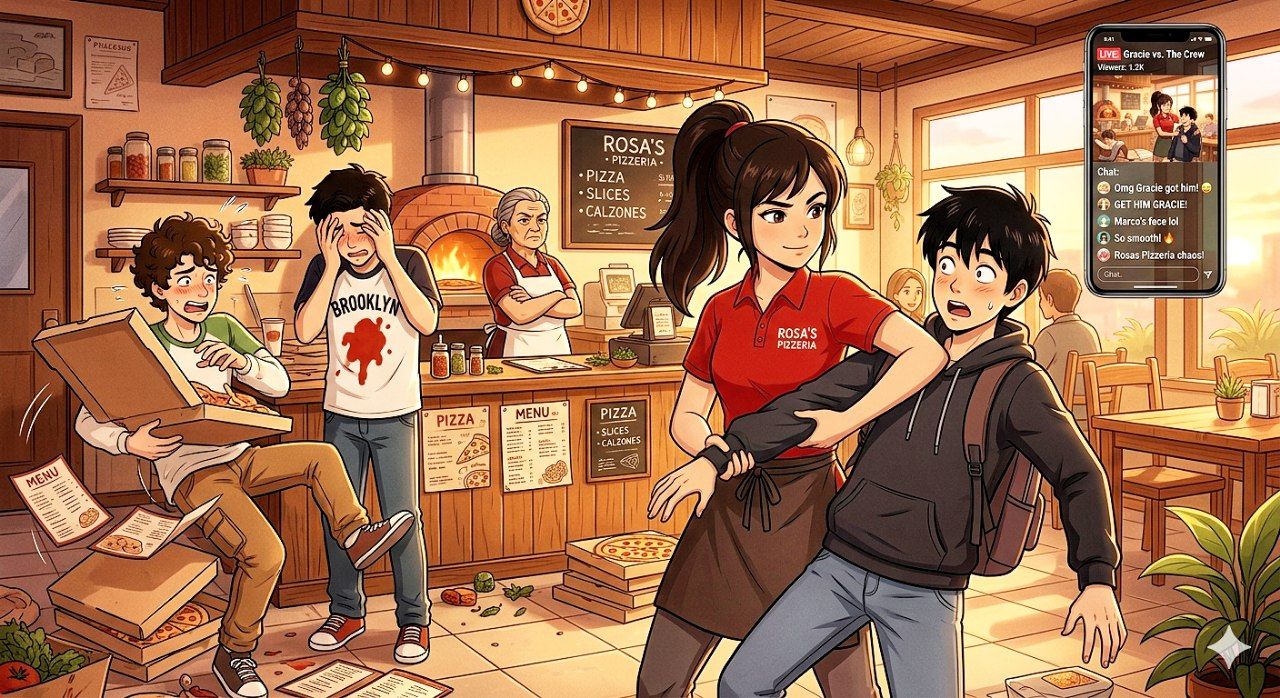
Short story: Digital Fatigue
The holographic rain stained Neoterra in liquid colors, as if the entire sky had been replaced by a test screen. The ads suspended above the buildings did more than show images: they induced micro-emotions in two-second cycles, sending tiny dopamine jolts through public interfaces that measured passersby’s pulse and pupil dilation. In the underground cafés people connected to a thousand narratives at once; the collective murmur was an interface competing for every minute of attention.
In one of those cafés, lit with warm tones trying to counter the surface’s cold glow, Iris, León, and Maya met. All were young, marked by the city and by the habit of measuring life in screens. Iris, twenty, wore her hair shaved on one side and had an augmented-reality mask hanging from her neck; her hands moved with the urgency of someone flipping between a text and their feed. León, twenty-two, worked as a night programmer and played synths by day; his voice had the texture of someone who had heard too many technological explanations. Maya, nineteen, printed photographs on paper with the devotion of an archaeologist of analog things.
“I can’t,” Iris said, closing her digital notebook with her thumb. “I start reading and the feed calls me. Every paragraph feels like a finish line and my gaze is already somewhere else.”
León looked at her with tired patience. “That’s not just bad habit, Ish. It’s digital fatigue. My neuroarchitecture professor called it reward training: the brain learns to expect a ‘ding’ every time the stimulus changes.”
Maya rested the palette she’d been mixing ink with and let her gaze fall on an old photo. “Stories used to unfold,” she murmured. “They had time. Songs lasted their full length; novels took whole nights. Now we’re asked to decide in seconds whether to continue.”
A delivery drone floated over the café, projecting brief ads: “Live now,” “Capture more,” “Share and win.” The holographic rain reassembled the ad into a loop: a promise repeating. Iris put her hand on her cup, feeling the vibration of the advertising pattern under her fingertips, and for a moment the voices dimmed.
“Remember when they promised connection would mean community?” she asked. “Instead we built islands with hyperactive thumbs.”
León let out a humorless laugh. “Connectivity sold us the illusion of closeness, but it also taught the mind not to stay. In the end, the attention economy created what consumes attention.”
That night Iris dreamed of her grandmother, who had lived before the Great Relay—before networks filled every gap of life. In the dream her grandmother handed her a dusty cassette and said slowly, “Listen without pausing. Let yourself be inhabited by a voice that asks for no edits.” Waking, the idea felt like a physical need. Iris went to the night market and, among obsolete devices, found an old player. With trembling hands she turned it on and pressed play. Music spilled forth uninterrupted, sustained. It was painful because it demanded patience; it was beautiful because it claimed time.
The next day Iris brought the player to the clandestine workshop where León and Maya worked. It was a place of tangled cables, vinyls hung like flags, and piles of photos that smelled of glue and memory.
“I propose an experiment,” Iris said, placing the player on the table. “One hour without feeds, ads, or notifications. Just reading, listening, and talking.”
León raised an eyebrow. “An ancient ritual. Sounds heretical, but I’m in.”
Maya set a print on the table: the street from her childhood, without holograms, with a sky that looked like a watercolor. The texture of the photograph on the wood produced a different kind of silence.
They invited others: Nico, who handled automated deliveries; Sara, a philosophy student; Andrés, who livestreamed his games and felt empty afterward; and more who came out of curiosity or desperation. They prepared a real sand timer because sand carries the weight of tangible time and promises a different measurement.
The first minutes were awkward. Hands reached for pockets; thumbs spoke on their own. Eyes trained to jump from stimulus to stimulus now had to hold something without an instant reward. Gradually, thoughts lengthened. There were tentative laughs and looks that met without cameras between them.
“At first I only think about what I’m missing,” Nico said. “Then I realize I can hold an idea for more than a minute without craving notifications.”
Maya pointed to her photo. “Look at the light on that building,” she asked. “It’s not new, but now you can see it whole.”
As the hours passed, stories began to unfold. Sara read a chapter of a novel that wasn’t fragmented. Andrés told the story of his grandfather without edits; the voice became a line nobody clipped. There were cries no one cut; laughs no one edited. Conversation became dense; sentences found room to settle.
But outside the workshop, the city never slowed its consumption machine. A micro-influencer filmed the group’s exit in three-second fragments and uploaded it. Within an hour the post exploded: “Slow kids” trended. The novelty was rewarded by the algorithm, and the scene of slow introspection was transformed into a series of cuts fit for viral consumption. The young people watched their pause be turned into merchandise, a label someone else could exploit.
León watched notifications scroll across his wrist with a mix of irony and fear. “Even slowness is monetized,” he said. “How do we keep something intimate from being devoured and packaged?”
Iris breathed and replied without looking up. “It’s not the gesture that matters if it ends up as just another clip. What saves us is what we do when nobody’s watching.”
Tension rose when an institutional invite arrived: a pilot program promising to “restore attention” through implants, behavioral nudges, and lab-designed microdoses. Public campaigns offered solutions to digital fatigue: focus chiplets, apps integrated with urban neuroarchitecture, subscriptions to keep your mind on one channel. Lines formed at installation centers; for many, the promise of a shortcut was an understandable temptation.
Maya, who now ran a small print room, watched the queue with weary eyes. “I don’t want concentration to become another upgrade I have to pay for,” she said. “I don’t want fixing a bad habit to turn into an economic obligation.”
Iris looked at her with resolve. “I don’t want patches. I want practice. To recover the patience to stay without being sold the experience as a service.”
They decided to build something small but concrete: attention-recovery stations—spaces where the immediacy economy wouldn’t be law. Simple rules: no advertising screens, no recording or monetized streaming, plain food, paper books, uncut music, and conversations that weren’t edited. They didn’t aim to change the whole city, just to create refuges for those who wanted another rhythm.
The first station opened on a decommissioned subway platform. They painted a handmade sign: “Slow Station — Free Entry.” Inside, the light was warm; the air less compressed. A volunteer served as a guardian, gently reminding forgetful visitors of the rules. “Breathe,” she said. “Stay.”
At first traffic was sparse. Slowly, however, people who worked with screens began to come: students who wanted to write an essay without interruption; office workers who used the station to read aloud without speakers; a delivery worker who cleared his microtask list. One visitor brought a cassette with his uncle’s childhood stories; the unedited voice anchored others.
The stations weren’t a universal cure. Some fell back into old habits after a few days. Others began to form rituals: longer attention blocks, bedtime disconnect routines, small acts of separation. It was a training of patience through repetition.
A month later the city had shifted in small fissures. Ads still performed their visual surgery, but new modes emerged: book clubs discussing complete novels, concert halls refusing microediting, graffiti without QR codes. Young creators started producing content that asked for time: short films as long as a walk, poems recorded in one take, live streams that deliberately avoided cuts and sought resistance rather than virality.
One night, under the holographic rain, Iris and León walked along an avenue. Projected ads replayed fragments of their own initiative: images of the Slow Station cropped and resold by agencies promising “authentic experiences.” Iris stopped and stared at the flashing projection.
“Maybe this is inevitable,” she said. “Whenever something calm appears, the market grabs it.”
León watched his reflection split in a neon puddle and answered cautiously. “We can’t stop the market, but we can maintain a choice: attention can be trained. Slowness can be an everyday act of rebellion.”
Maya, now coordinating another station, approached with a new cassette in hand. “For when you want to remember how it sounds to listen to something in full,” she offered. “No ads. No pauses.”
The Slow Station filled with diverse profiles: some with focus implants, others with ink-stained hands. The encounters promised no absolute transformation—just fragmented continuity, practices planted day after day. There was no epic finale or global solution; only small decisions repeated until they became habit.
One night Iris sat on a bench beneath a blinking sign that read, “Connect more, live better.” She turned off her mask, powered up the player, and let a song fill her head with no intent to capture it. She didn’t record. She didn’t tag. She simply listened through to the end, letting each note occupy its space. León approached and, without speaking, laid his hand on hers. Iris didn’t check her watch; the city continued to measure time in seconds, but inside her chest a slower rhythm beat.
Attention didn’t return whole or uniform—it remained fragmented—but in the gaps where speed did not rule, life reentered with depth. Young people learned to invest their attention with judgment: spend less on what doesn’t matter, save more for what hurts, for what heals, for what endures.
Years later, the Slow Station would be remembered as a small movement that taught some people how to sustain. It didn’t change market laws; it reconfigured practices. In plazas and workshops, in margins of notebooks written by hand, in conversations that stretched without clips, a quotidian resistance was woven: not a rejection of technology, but a way of relating to it that prioritized the durable over the instant. And in that repeated gesture, something vital was preserved: the capacity to attend, to listen without seeking reward, to let a story take its time without demanding shortcuts.
Source of the images.
Image created with Google Gemini.
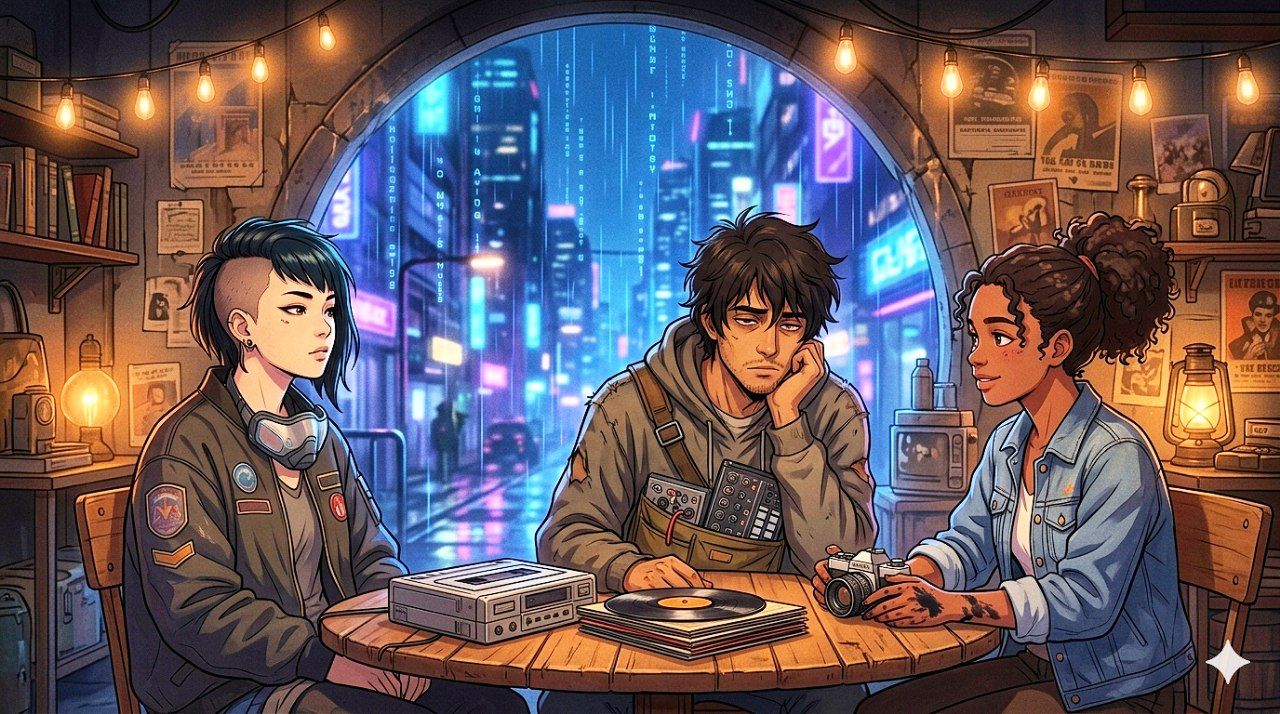
Short story: The Report
The news of the World Happiness Report 2026, backed by the UN, fell over the city like a cold, unexpected rain: for the first time in decades, youth ceased to be the most fulfilling stage of life. Headlines repeated figures and charts; university cafés and administrative corridors filled with conversations that smelled of alarm and shared guilt. For Luisa, Marcos, Ana and Valeria, it wasn’t just a statistic: it was the description of a desolation they already knew in their own flesh.
Luisa was a social sciences student with an inquisitive gaze and hands that always found the pocket of her pants as if seeking comfort there. Every morning, her first interaction of the day was with a screen: notifications, stories, messages that demanded an instant response. That inertia had taught her to measure her worth by the daily sum of views and reactions; every like corresponded to a small gratification, every silence was a silence that scratched.
Marcos studied anthropology and smoked with a furrowed brow when he spoke of the campus’s “invisible norm”: being online meant being socially alive. If you were absent, if you didn’t respond quickly, you could be left out of plans, jokes, the web that sustained belonging. He complained and yet fed the complaint with a melancholy irony.
Ana, a trainee psychologist and facilitator at the student support center, often heard similar stories: adolescents arriving at counseling exhausted by constant comparison, female students receiving threats in public threads, young people asking for help without knowing how to name the hollow inside them. Her training allowed her to translate the pain into statistics and explanations: more than six hours of daily digital consumption, algorithms that prioritize retention over wellbeing, content that rewarded hyperstimulation and social comparison. But theory did not soothe the voices that cracked in the counseling room.
The academic version of the problem said: in the United States, Canada and Australia, those under 25 reported satisfaction levels markedly lower than older adults; the decline coincided with the era of hyperconnectivity. Luisa knew it more intimately: the anxiety when the app showed someone had read her message and hadn’t replied; the self-criticism after comparing her body to curated images; the difficulty sustaining attention for a long reading or a conversation without the urgency of likes.
Within the group, conversations shifted from irony to fear. One afternoon in the café, under yellow light and breadcrumbs on the table, Marcos let a question drop like a stone:
—They say people who spend less than an hour a day on social media are happier —he murmured—. Do you think we’re too trapped?
Luisa turned off her phone and looked at him with a mixture of shame and relief.
—It’s not just the time —she said—. It’s how they change you. The algorithm offers you comparisons disguised as entertainment. It conditions you to respond quickly, to show the most marketable side of yourself. In the end, life becomes a showcase.
Ana, used to naming problems to face them, added:
—And those most harmed tend to be young women. Statistics show increases in depression and cyberbullying among adolescent girls and young women. It’s not a coincidence; it’s a repeating pattern.
The words “social prison” were spoken by someone with a cutting kind of humor, but the term sank deep. A prison because belonging depended on being available; a prison because invisibility on the network could replicate in real life as a form of exclusion; a prison because giving up the device meant giving up the social map that dictated interactions, opportunities and recognition.
That same week, the university held an info session about the Report. Ana invited Luisa and Marcos; in a room full of slides and young faces, they listened to researchers explain how algorithms prioritized content that provoked intense emotions—anger, surprise, envy—because it ensured longer attention.
The six-hour daily threshold wasn’t arbitrary: beyond it, the mind began to reconfigure for instant reward, attention sustained by ever more extreme stimuli.
Valeria attended the session; she was an activist working with communities in Latin America promoting mindful technology practices. She spoke with a clear voice, without melodrama, telling stories of neighborhoods where messaging had sustained distant family bonds, and of cases where virality had destroyed reputations in hours. Her stance did not demonize technology; it introduced nuance: the difference between relational use and passive use, between tools that connect and platforms that exploit.
—Technology can strengthen human ties —Valeria said—. In many Latin American homes, messaging apps keep affect and daily life together that would otherwise be lost. But it doesn’t work by itself: we must decide how we use one another.
Valeria’s words lit a new idea for Luisa. She remembered long calls with her sister, laughter that crossed the line like a bridge; she also remembered nights when a screen offered endless series and afterwards the same fatigue that follows overstimulation. In that hole of comparison and sameness, direct communication felt like a way out.
Moved by unease and hope, Ana proposed a simple, radical experiment: forty-five minutes a day without screens, devoted to direct communication. It could be a call, a walk with someone, a letter, a meal without devices. Simple, measurable, human.
At first, the experiment was awkward. Hands instinctively reached pockets; silences triggered anxiety; bodies craved the easy reward of a notification. But as days went by small transformations occurred: conversations lengthened, silences lost their guilt and gained density. Luisa called her grandmother without hurry, and the old voice returned stories that smelled of cooking and work, of loves not curated by filters. Her grandmother said, in her patient tone:
—Before the television came, we used to talk all night. Not everything new is better, child.
That phrase hit Luisa like a truth she had avoided confronting: progress does not erase the human fragments lost along the way.
The campus was not immune to digital violence. One day, a hurtful post about a classmate, Camila, went viral. Insults multiplied in comments and screenshots spread through groups that amplified the damage. Camila closed her accounts and walked the university trying not to be seen. The impunity of anonymity and the speed of virality had turned a real person into a spectacle of cruelty.
The institutional response was slow. The university activated protocols after complaints, but many measures felt like bandages on a deep wound: reactive moderation, generic support messages, promises of awareness campaigns. Ana, Valeria and some students organized immediate support: group sessions, psychological accompaniment, a safe space to hear Camila. In front of the group, voice trembling, the young woman articulated what she had felt:
—It’s as if someone turned a spotlight on me and everyone stared. The humiliation doesn’t go away with time, it sticks. And when you return to networks, everything reminds you. You feel like disappearing.
The words pierced everyone present. There were no statistics to console the memory of exposure. For Luisa, it was a call to action: technology was not neutral; platforms fostered dynamics that needed intervention and, above all, real empathy.
The workshop group began taking practical steps. They organized device-free dinners, “conversation tables” to practice active listening, and digital literacy days in schools and communities. The goal wasn’t to prescribe total renunciation but to cultivate usage habits that prioritized human communication over the compulsion for visibility. On a small scale, these practices produced perceptible changes: lower anxiety among some students, more willingness to ask for help, longer and less superficial conversations.
The process wasn’t linear. There were setbacks, relapses, days when social inertia dragged everyone back into comparison. But there were also victories: professors instituted “no-notification windows” during class; study groups agreed on norms not to share humiliating screenshots; awareness campaigns led the communications department to rethink how to moderate harmful content. Valeria secured partnerships with Latin American organizations advocating for tools that strengthen family and community ties, showing technology can serve affection when consciously designed and used.
One memorable day the group painted a mural in the campus square dedicated to victims of digital violence and those who had resisted with concrete actions. The mural wasn’t grand; it was a collage of real messages, names written with care, and phrases of support. Local press covered the event with modest interest, and for Luisa that coverage was a faint echo but enough for other small communities to replicate the idea. That day, before microphones and cameras, Luisa spoke with a voice no longer seeking the reach of a viral message but the fidelity of testimony:
—We don’t want to return to the past —she said—. We want to learn to use what we have without forgetting who we are. Happiness cannot be measured in seconds; it is the sum of gestures we hold for one another.
Her words resonated with listeners; for some they were a call, for others a critique of how they had lived their digital relationships. What remained strong, however, was the sense that something was shifting: not by decree but through daily practice. In domestic conversations, parents began asking more about the quality of their children’s time than the number of followers; student associations pushed digital pauses during parties; faculties started including digital literacy modules in curricula.
Meanwhile, public policies moved more slowly. Researchers insisted that effective solutions required a transversal approach: digital education from early ages, regulation of algorithmic practices that prioritize engagement at all costs, protection frameworks for cyberbullying victims, and accessible psychological support systems. Recommendations would remain in reports and commissions, and implementation would be gradual. The task, they concluded, was not to disconnect completely but to learn balance.
Personally, the forty-five-minute experiment had sown a profound change in Luisa’s life. She no longer counted her worth in numbers. She learned to recognize the difference between the comfort of a real call and the hollow affection of an animated heart. She discovered that her grandmother’s voice had a texture no notification could reproduce. She experienced the visceral act of standing with someone humiliated, turning pain into collective resistance.
Years later, as the Report continued to shape debates, the group kept the memory of a time of waking up and small decisions that, together, began to change the atmosphere. National figures might take longer to reflect those effects, but in their community a transformation could be felt: less fear in asking for help, more willingness for device-free encounters, university policies that protected intimacy, and digital literacy workshops in schools.
The lesson that endured was both simple and complex: technology is neither enemy nor savior by itself; it is a tool whose ethics of use must be decided collectively. Wellbeing did not return by decree or fashion but by the daily work of reclaiming direct communication: calls that last hours, dinners shared without screens, the courage to report and accompany those who suffer, and the practice of boundaries that restore nights to memory and sleep.
In the memory of that generation, the fight against attention standardization and constant exposure left a mark that was not only political but intimate: small resistances that became habits, support networks that replaced the spectacle logic with a care logic.
In that transition, happiness—understood not as a data point on a graph but as the accumulation of shared gestures—began, once again, to feel possible.
Source of the images.
Image created with Google Gemini.
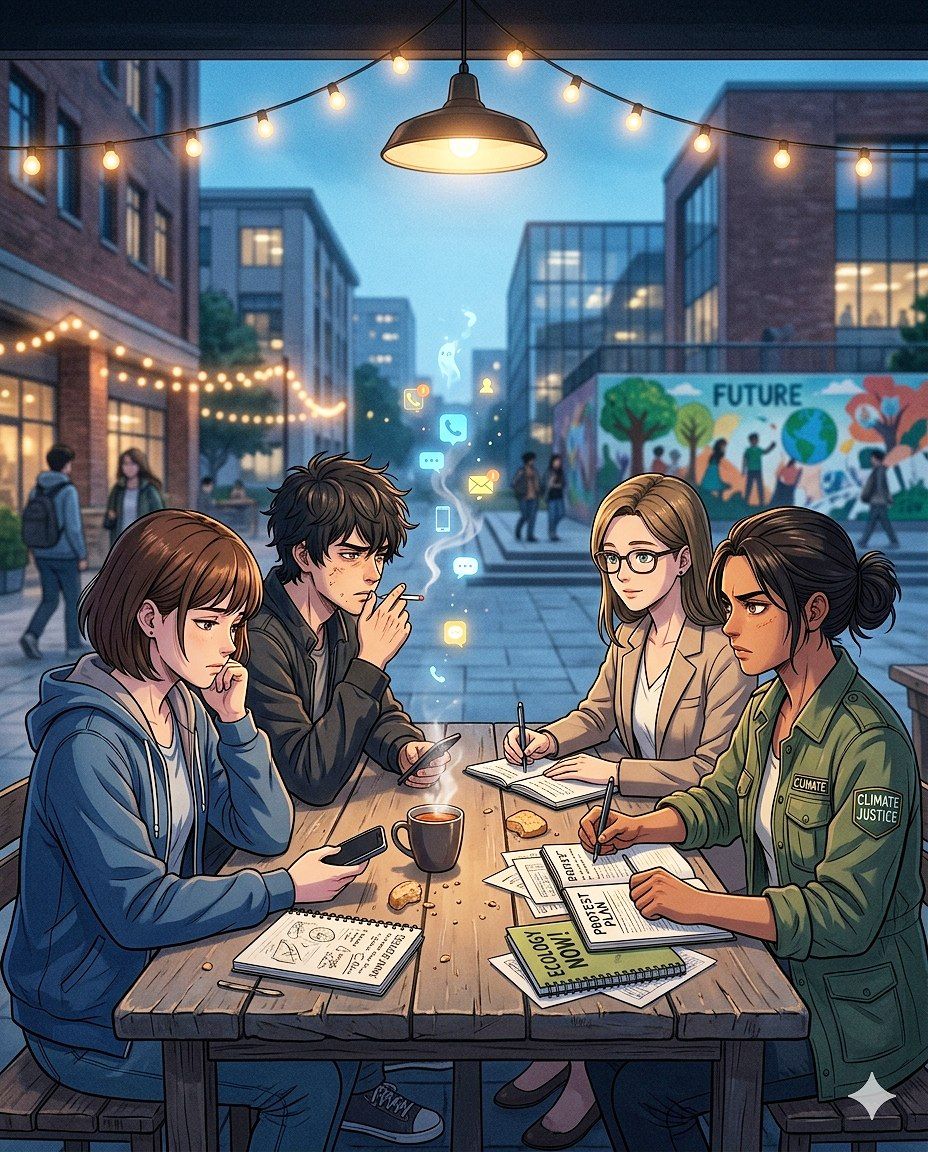
Short story: The Home Guardian
The house on Jasmine Street seemed to live in another era: varnished furniture worn by time, curtains that had learned to filter the afternoon light, and the persistent smell of freshly brewed coffee mixed with the stale incense Marta lit when she needed to think. In the living room, on a wall that had known more hands than paintings, hung a religious image in a gilded frame. The gold, now slightly dulled, cast a long shadow that, to Marta, had always given that corner an air of mystery.
That afternoon the López family was gathered in that room. Marta, phone in hand, could not stop watching Lila, the family cat: compact, gray-furred, with whiskers that looked like they sketched philosophical theories in the air. Joaquín, her husband, fiddled with the TV remote out of habit rather than interest. Lila had planted herself in front of the frame with a focus that turned her into a living sculpture.
"Mom, come," Marta said softly, calling Joaquín with a slight gesture. "Lila is… she looks like she's praying."
Joaquín set the remote on the table like someone putting down a small treasure. He approached, curious but skeptical.
The phone vibrated subtly as Marta filmed: Lila sitting, motionless, eyes wide and fixed on the image. The frame's light flashed on her fur, and for a moment the whole living room seemed to hold its breath.
"Mystical, right?" Joaquín commented, trying to inject calm with a joke. "We could add heavenly music and upload it."
Marta smiled without stopping the recording. Lila blinked slowly, as if evaluating the quality of a sermon after centuries of practice. Marta zoomed in, searching for the shot that best captured that odd feline solemnity. They already imagined the comments: #homeguardian, #felineMiracle, #whiskerprayer.
Then, without warning, something changed. Lila tensed. Her tail, previously relaxed, began to move with the precision of a metronome. The cat's eyes never left the right corner of the frame. Marta frowned. The scene shifted from charming to alarming.
"Do you see anything behind it?" Marta asked in a whisper, as if any noise might scare whatever was there.
Joaquín leaned in and inspected the wall. At first glance there was nothing but an old stain, the corner of the picture, and the flaking texture of the paint. Still, Lila did not blink. Her whiskers trembled with an ancestral tension, as if guided by an old memory.
A dry sound — minimal but distinct — broke the pause. Something small moved, a faint scrape and then a crack. Lila launched into a precise leap; her body described a perfect arc and struck the wall with the accuracy of one who has practiced a thousand times. There was a thud, a dull complaint; whatever had been hiding fell to the floor and writhed with urgency.
"Mother, oh my!" Marta exclaimed, startled. "What was that?"
The creature refused to be immediately identified in the dim light. Joaquín, pinching the edge of the phone to use the flashlight, knelt with the solemnity of an explorer discovering a relic. With the beam aimed, the family could see what Lila had been staring at: a scorpion of respectable size, lying on its side but still alive, legs poised as if in combat.
"A scorpion!" Joaquín said, part horror, part strange admiration. "Home guardian, we owe you a dinner!"
Lila, now proud of her discovery and slightly offended at being exposed, meowed in a tone that could be read as: "It was my job." She extended a paw and, with the delicacy only a cat possesses, tapped the scorpion's tail with a toe to check it was still there and to assert who ruled the house.
Marta, always the pragmatic one, reacted immediately with a firm voice.
"We're not going to kill it," she declared. "We'll take it outside, far away."
Joaquín furrowed his brow, hesitated a beat, then nodded. He put on gardening gloves and grabbed a plastic lid to improvise a temporary cage. The domestic operation carried a comic air: the man who had joked minutes before now moved with the seriousness of someone holding responsibility.
Lila watched every maneuver like a trainer evaluating her team's performance.
As Joaquín approached with the lid, the scorpion made a final strike — a desperate swipe that hit the lid and caused a collective startle. For a moment the family contained laughter and fear in the same breath, a shared vulnerability.
With extreme care, Joaquín carried the captive to the back door. The moon, round and discreet, seemed to witness the operation. In the garden they tipped the lid onto a bed of dry leaves and, with a precise movement, released the scorpion. It vanished into the shadows like a knight accepting his fate, knowing the night would shelter him.
Joaquín returned to the living room with slightly trembling hands, but his eyes held a triumphant gleam. Marta reached for Lila and scratched the back of her neck.
"Not all heroes wear capes," Marta murmured with tenderness and humor. "Some wear whiskers."
Satisfied by the attention, Lila settled onto the sofa cushion as if reclaiming her throne after a victorious feat. Marta reviewed the video, smiling and trimming the segment where Lila appeared to pray before uploading the clip to social media with a playful caption and emojis so the world could enjoy the domestic heroism.
The next day Marta's phone wouldn't stop buzzing. Messages, hearts and comments flooded the screen: astonished people, admirers, and some memes that portrayed Lila with a digital halo. Among the notifications appeared a different message: "That scorpion looks odd. Could it be venomous?" with a link to a local wildlife forum. Joaquín, driven by cautious curiosity, opened it and read an expert's description: a possible regional subspecies whose sting was painful but rarely fatal to adults if treated promptly.
"Well," Marta said, accepting the reassurance with relief, "we were lucky. And we had Lila."
That evening's dinner took on the tone of an epic ballad told as comedy. Joaquín recounted the capture like the climactic scene of an action movie, dramatizing each maneuver; Marta added sound effects to heighten the drama; Lila licked her paw between ovations, savoring fame like an actor receiving applause. Laughter filled the house, clearing away the leftover tension.
Later, after the house had quieted and the lights were dim, someone knocked on the door. An elderly neighbor stood there with a box of homemade cookies and a story in his eyes.
"I heard the neigh of the valorous cat," the man said, voice full of nostalgia and mystery. "When I was a boy, my grandmother said cats have pacts with the house. They protect those who live there."
Marta smiled and offered him a cookie. Joaquín, more down-to-earth, shook his head and murmured:
"Or maybe they just like weird bugs."
The neighbor laughed and, before leaving, in a theatrical tone dropped one last warning.
"Take care of the picture," he advised. "Sometimes what looks sacred is only a good hiding place."
The following weeks passed calmly. Lila's fame faded to a pleasant memory; life returned to its routine of calls, work, and family chores. There were small domestic triumphs — a spider fleeing before the cat's stare — and fewer surprises. Then one afternoon Marta noticed something that alarmed her: the wall by the picture had developed a new, small dark crack, as if something were trying to emerge.
There was no panic, only methodical planning. The family gathered tools, a stronger flashlight, and, of course, Lila. Joaquín, now seasoned in "domestic rescue ops," borrowed an inspection camera from a neighbor and fed its tip into the gap. On the tiny screen a shadow moved, quick and furtive, confirming the problem had not vanished.
"Another one?" Marta murmured, alarmed but calm.
"Maybe not just one," the neighbor replied, arriving with a bag of seeds and a conspiratorial smile. "The wall has a life of its own."
Lila did not hesitate. This time she leaped with contained grace, careful not to break anything. She sniffed and with a short resonant meow pinpointed the exact entrance. It was as if the cat had studied the house's invisible blueprints. The family worked as a team: Joaquín enlarged the opening carefully so they could manipulate it without causing further damage; Marta placed a padded box on the floor for any eventualities; the neighbor held the flashlight at the right angle; and Lila supervised every move with the concentration of a general on the eve of battle.
They discovered not an army of scorpions but a small colony of nocturnal insects that, moving together, had attracted one or two juvenile scorpions hunting for prey. The problem was less apocalyptic than imagined but enough to justify a cleanup and relocation operation.
"Action and humor," Marta said between laughs as they worked. "We have everything."
Gently and patiently they moved the insect colony into a planter far from the house and sealed the crack with appropriate materials. As a symbolic gesture they relocated the religious image to a different wall, higher and away from any potential hiding spot. Lila watched the move with feline disdain, as if the painting were a tasteless rival.
That night, while online notifications still praised the feline heroine, Marta wrote a note and tucked it behind the frame: "No miracles here, only vigilance." Joaquín, with his usual humor, added in crooked handwriting: "And food for Lila, just in case."
The house returned to its usual rhythm. Neighbors exchanged anecdotes and Lila's fame was reduced to a caricature-style postcard an artist from the area sent them: a caped cat with scorpions fleeing in an exaggerated panic. They pinned it to the kitchen wall as a memento of that night that mixed fear, pride, and laughter.
Months later a fierce storm opened a small leak in the roof. The drip approached the new frame. Lila, who now patrolled with almost ritual professionalism, descended the stairs, leaped onto the table and planted herself in front of the drop that formed a faint ring on the wooden surface. Her posture was solemn and watchful, as if daring the rain itself.
"Back in guardian mode again?" Marta observed with tenderness.
Lila closed her eyes and let out a low meow that, if translated with human license, meant: "Always."
In the dim light, with rain tapping out stories on the windows and the scent of hot chocolate filling the air, the family gathered once more around the table. They had survived a scorpion, fleeting viral vanity, and their own flair for drama. They had learned that a house's mysteries were rarely supernatural: often nature was merely seeking refuge. And when that happened, the most reliable and charming ally tended to be a whiskered cat with declared courage and an unbeatable sense of comedic timing.
"Let's toast to the guardian," Joaquín said, raising his mug of hot chocolate with mock solemnity.
"And to domestic miracles," Marta added, clinking her cup against his.
Lila blinked in approval, and in the shadow by the frame a shape traced itself for an instant that could have been the silhouette of another adventure. No one in the house was surprised: they had learned to expect the unexpected, to work together, and to laugh when needed—because in their home, vigilance and humor walked hand in hand.
Source of the images.
Image created with Google Gemini.
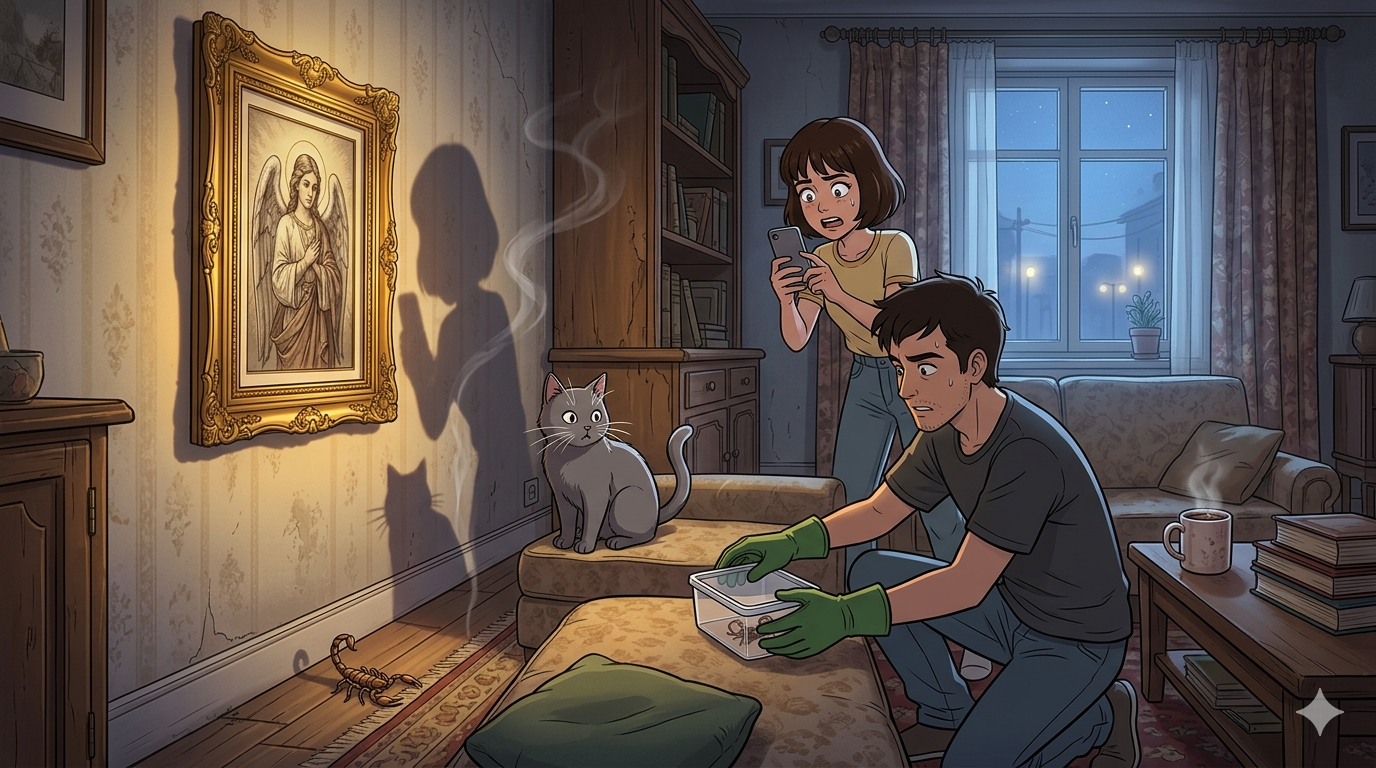
Short story: The Flag in the Classroom
The hallway smelled of chalk and freshly printed papers; the silence seemed to hold the memory of all the conversations it had ever heard. It was the last hours of the school day and the oblique rays of the sun passed through the blinds, drawing luminous bands across the closed doors. In classroom 3‑B, a new flag hung pinned to the wall with two thumbtacks. Around it, cramped, crooked letters, written with markers, proclaimed slogans that sent a chill through more than one student.
Mei arrived first and froze when she opened the door. Her surprise cut the air like a bevel. "What is that?" she whispered, unable to hide the tremor in her voice. The classroom, which a moment before had been a place of routine and jokes, had become a stage.
Li Wei remained with his gaze fixed on his desk. His hands, stained with ink, clutched a pen as if it were a broken talisman. When he finally spoke, his voice was contained, stripped of theatrics and full of sincerity. "I put it up," he said, and the sentence fell like a stone thrown into a calm pond: ripples reaching everyone.
Teacher Chen appeared in the doorway with measured steps. She wore calm on her face as a deliberate act; she did not want the situation to spill over. "Li Wei, come, please," she said without accusation, seeking explanation. "Explain why."
Li Wei did not look up. There was an old fatigue in his tone. "It's what I feel. It's what I see. I wanted them to know." He spoke like someone repeating a speech learned through insistence; his voice, gritty, left a trail of urgency that asked no permission. "I didn't come to hurt anyone. I just... thought I should say it."
Mei approached hesitantly, with the delicacy of someone afraid of breaking something fragile. "But you shouted in class," she said frankly. "Some people were scared."
"No one listens to me," Li Wei muttered. "Not at home... either." The silence that followed amplified the confession; there was no excuse or rhetoric that could erase the sense of abandonment contained in the phrase.
News of the flag spread with the same speed that small tempests usually travel: a whisper in a hallway, a message in a chat, the teachers' meeting called in the middle of the afternoon. Principal Huang acted with the seriousness his position demanded. The flag was taken down that same day; the hands that removed it did not want violence, but they could not feign indifference. The official record noted: inappropriate behavior. With administrative patience, an orientation process for the student was activated. Institutional language tried to contain the human with neutral terms.
In the counselor's office, Li Wei sat before a woman who tried to hold his gaze without judgment. "Are you worried they'll think I'm a problem?" he asked, his voice barely a thread. The counselor, with the gentle tone of someone who has heard many stories, replied: "We're worried that you tried to resolve something that no one else helped you understand. At school we don't politicize. Here we must be safe spaces." Her words attempted to draw boundaries: protect the classroom from politicization and, at the same time, protect the boy from isolation.
However, outside the school's walls the shadows lengthened and were more complicated than a simple decree. Taking down the symbol did not mean erasing the impulse that had produced it. And once something had been seen, a gesture had already traveled.
What for some was just another case in the chronology of school life became, in the hands of those searching for causes and effects, something larger. From distant press rooms, institutional voices examined the episode with the gravity of those who weigh every word. A spokesperson issued statements that were recorded, archived, and retransmitted; the matter crossed media borders and entered the circuit of symbolic diplomacy. The school, oblivious within its walls to the ceremony of global labels, saw its small conflict projected as if it were a beacon in the fog.
Mei read headlines on her phone during a recess that was no longer free of tension and felt a knot in her stomach. "Why does this have to go so far?" she murmured. Teacher Chen, beside her, explained in a calm voice: "Because we live in a place where even a shout can become a flag." That sentence —uttered softly, as if describing something inevitable— left everyone with the feeling that the world sometimes turns the intimate into the public.
In the courtyard, students argued with the energy of those who already imagine themselves as citizens: "It's freedom of expression," one affirmed, his voice swollen with certainty. "It's provocation," another countered, with the gesture of someone who tolerates no irreverence. Li Wei watched from a corner, torn between conviction and shame. Deep down, no one truly knew the roots that had pushed him that morning to pin fabric and ink to the wall.
That night, Li Wei walked along the river that runs through the city, the water carrying lights and reflections like multiplied fireflies. He thought of his grandfather, who had come from afar and told him stories of youth filled with loyalties and silences. He remembered a phrase often repeated at home that until then had seemed too vast: "Sometimes the things we think are small are what the world uses to hold up its big questions." The phrase resonated with new weight: his own gesture, in the eyes of others, was now part of a conversation beyond him.
The next day the school organized an assembly. The principal spoke with the need to draw clear lines: "We will not allow the politicization of our classrooms. But we will not ignore those who feel they have no voice." He proposed workshops on critical thinking and coexistence; he sought to make the school a place for listening and learning, not for turning anyone into a martyr or a villain. The intent was to create a space where neutrality was not indifference but a framework for dialogue.
Li Wei climbed onto the platform with steady breath, his gaze fixed on some indistinct point on the ceiling. "I didn't want anyone to feel bad," he said honestly, "I wanted someone to hear why I see things this way." He spoke of his family, of stories passed down in whispers, of the feeling of belonging and not belonging at the same time. He spoke of a history he carried within and that, for him, needed naming. His words did not convince everyone; some received them with suspicion, others with discomfort. But they opened a door: the possibility of understanding that behind a symbol there is a person with memories, pains, and reasons.
Mei spoke afterward, her voice clear and without fanfare. "We have to learn to listen without turning into judges," she said. "If the classroom is neutral, let that neutrality include the opportunity to learn why someone thinks differently." Her words were a plea for applied humanity: a reminder that coexistence is built more with stories than with punishments.
Meanwhile, on a distant podium, the spokesperson continued to articulate phrases with the precision of one who knows the value of official language. To the world, the episode acquired the scope of a symbol. For the students of 3‑B, however, it was a complex and less rhetorical lesson: they learned that small actions can create large echoes, and that those echoes, when they return, change the way people look at one another.
Li Wei could not stop thinking about the flag. He did not hang it again on the classroom wall, but he did not erase it from his memory either. He attended the workshops the school proposed and, little by little, learned to translate his anger and nostalgia into questions instead of slogans. He learned to name his history without expecting others to accept it as absolute truth. He realized that the power of a symbol can lie as much in what it expresses as in what it conceals.
Weeks later, in the library, Mei found Li Wei writing in a notebook with the quiet focus of someone who has discovered a path. "What are you doing?" she asked, curious.
"I'm writing," he replied without looking up from the page. "Not slogans. Stories. If one day someone wants to understand, let them find words before symbols."
Mei smiled. "Then maybe the next flag will be a page," she said, and in that sentence there was a shared relief.
Li Wei closed the notebook and looked out the window. Outside, the city remained a map of lights and invisible borders; inside, those young people continued learning to carry the responsibility of small gestures —to recognize that, although they may seem minimal, they sometimes bear the weight of matters far beyond the walls of any classroom. The flag ceased to be merely a piece of cloth pinned to a wall and became a lesson about listening, memory, and the complicated task of living together when stories intersect.
Source of the images.
Image created with Google Gemini.
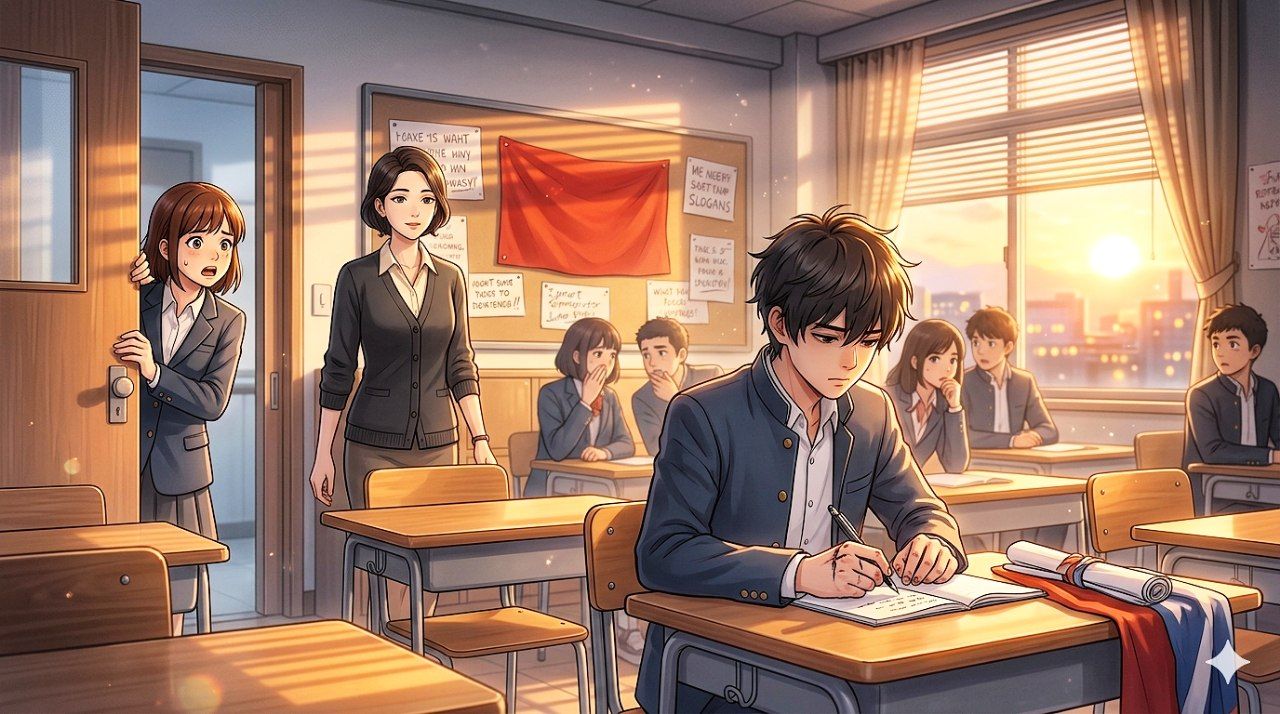
Short story: City of Prayers
The sharp rain struck the stained-glass windows of the old Church of Saint Matthew as if trying to beat out the colors that once hosted hymns and promises. Inside, the nave smelled of wax, damp wood, and memories that creaked under the feet of those who still dared to enter. The pews, worn by generations of knees and silences, held the shape of bodies that no longer returned. On the choir stand, a hymnal with yellowed pages rested; only a few people still raised their voices on Sundays. Outside, the city was transforming: cranes and scaffolding sketched low domes, new arches, and facades bearing inscriptions in different tongues.
Pastor Emil Weber walked among the rows, brushing his hand along the backs as if greeting old friends. He was seventy; the cassock fit him with the tired dignity of someone who knows his time is transitional. He leaned on the baptismal font, his palm trembling slightly. He looked into the holy water and saw his reflection, blurred as if the glass denied him certainty.
Rosa, a lifelong neighbor, entered with the slow step of someone who has not yet decided whether absence should be mourned aloud. She held a handkerchief to her lips, as if to contain the emotion.
“I remember when children used to run around at Easter,” Rosa said, her voice cracked by memory. “They came with painted eggs and hid behind the organ. There used to be laughter even in the choir. Now the squares are full of other voices. It’s not better or worse, Emil. It’s different.”
Emil closed his eyes and let the sound of the rain be his only answer. His memories mixed: a baptism in winter, a summer wedding with flowers stolen from a neighbor’s garden, funerals that stripped the neighborhood’s conversations of pretense. On the sacristy radio earlier that day he had heard figures that weighed on him more than the drops: 36.6 million, 44% of the population — a decline in belonging that felt like a slow tide carrying away doors and bells.
“I know,” he murmured. “But I feel we close more than a door. A way of naming God that was our custom is leaving. I don’t know if we are losing faith or simply the way we see it.”
Outside, on the main avenue, a Star of David stood out among newly raised facades; around the corner, workers set the finishing touches on a mosque with inscriptions Emil could barely make out in their original script. The transformations in the urban landscape gave the city a new accent; the municipal hymn seemed to have fragmented into many songs.
That same afternoon Yusuf appeared, a young imam from the Muslim community that had settled in the neighborhood in recent years. He arrived with a cup of tea and an honest shyness, his clothes still speckled from work at the mosque. His presence in the church was, for some, unusual; for Emil, it was a gesture of neighborliness that surprised him by its simplicity.
“Father Emil,” Yusuf said respectfully, “I brought this. I saw the boards piled up in the shed and the door that squeaks. In the mosque we talk a lot about this neighborhood; many remember when this church ran soup kitchens for those who were hungry. We wanted to offer a hand.”
Emil looked at him, taken aback by the deference.
“Thank you, Yusuf. Your gesture moves me. Such generosity is not easily forgotten. If I accept, it will be because all of this is about more than walls. It’s about how we treat each other when the wind shifts.”
The offer of help was not merely practical: it was a bridge in a time when bridges seemed to be breaking. Yusuf spoke of his community: young families, elders who read in low voices, women teaching sewing, children who brought promises of the future. He spoke of shared meals, study hours, the intention to be present.
From a high window Miriam Rosenberg watched. She had been born into a Jewish family in the area and had seen neighbors emigrate or age without replacement. Her mother had told stories of a synagogue that burned in the past, once a beacon of life.
Now another synagogue rose on the main street where a barbershop had closed decades ago, and Miriam felt a blend of relief and old melancholy in her chest.
That evening the sacristy hosted several neighbors: Emil, Rosa, Yusuf, Miriam, and Klaus, a burly carpenter who had worked on the church for years and carried in his hands the smell memory of sawdust and glue. They gathered around a table and began to talk. The dialogue was slow at first, like testing an unfamiliar melody.
“Aren’t you afraid that by losing Christian temples we’ll lose a part of our identity?” Klaus asked, with the blunt honesty of someone who had seen moves and closures. “This building isn’t just stone and wood; it’s a repository of baptisms, weddings, funerals. It maps our lives.”
Miriam shook her head, eyes moist.
“Identity isn’t a building, Klaus,” she said. “It’s a memory that travels in tables, in songs passed from grandparents to grandchildren. My grandparents used to sing in Yiddish in a synagogue that no longer exists; the synagogue was lost, but the prayers and recipes lived on in the home. Buildings change, but memory endures.”
Yusuf, silent until then, spoke patiently.
“Our people came years ago seeking a place to pray and be citizens like everyone else. We build mosques because we need a space to name God in our way. We didn’t come to erase anything; we came to exist here, to contribute, to set tables, to teach and to learn.”
Emil listened, and for a moment the weight of his concerns lightened with the simple humanity of the words.
“So what do we do with this empty nave?” he asked, his voice cracking with a mix of helplessness and urge to act. “Do we let it die in solitude?”
Rosa, who had been silent until then, looked up with the resolve of someone who had seen as many farewells as celebrations.
“Let’s not let it die,” she proposed. “Make it living memory. If there are fewer masses on Sundays, let the spaces host concerts, language classes, shared meals, neighborhood libraries. Keep the altar for those who still come to mass, but open the rooms to other uses. Not because we stop being what we were, but because we learn to be something more.”
The idea surprised them. It didn’t mean giving up, they explained, but expanding: turning exile into hospitality. Yusuf smiled with a new gentleness.
“We can organize readings between mosque and church,” he said. “In my community there are people who teach Arabic to children; we could exchange classes. We could run cooking workshops, joint choral music, and carpentry lessons with Mr. Klaus for young people. That way the pews stay and hands keep learning.”
Klaus thumped the table with his palm, a gesture of approval.
“If we do it, we’ll do it well,” he affirmed. “I’ll restore the benches; we can’t let them fall apart. But I also want to see children painting and new voices filling the choir, even if they sing in other languages.”
The following weeks became a whirlwind of activity. Young people from the mosque painted discreet murals in the side rooms: geometric motifs and calligraphic lines. Miriam organized an exhibition with old photographs and explanatory plaques in German and Hebrew, telling stories of families who had made their lives in the neighborhood. Emil, who had feared losing the altar, cleaned the baptismal font until it shone for the baptisms that still took place; he also kept hours to welcome students who came to practice German.
Klaus restored creaking benches; in the evenings, under the light of lamps, he taught adolescents to use chisels and sandpaper. Some young Muslims learned to intone melodies of the Christian office, while a small choir practiced a hymn in Aramaic and another in Arabic. The church filled with activity—not only ritual, but community life.
The plan to open the church to shared uses met resistance: some conservative voices denounced it as a betrayal; others worried it would invite doctrinal conflicts. But there were encounters that eased fears. At one of the first shared tables, Miriam prepared dishes her mother used to cook, and Mrs.
Aisha from the mosque brought a stew redolent with spices and memories. The meal became a simple act of reconciliation: dishes circulated, stories flowed, and laughter breached the silences.
One afternoon during an interreligious gathering, a seven-year-old boy approached the altar with wide, moonlike eyes and asked innocently:
“Why are churches closing if you still believe in God?”
Everyone fell silent; the question struck with the clarity of childhood.
Emil stepped forward and took the boy’s hand with tenderness.
“Because the way of believing changes with time,” he said. “Sometimes people find God in solitude, other times in a neighbor’s kitchen, in shared laughter, or in the answered cry for help. The important thing is not the building, but that we have hands to help one another and voices to pray for others.”
Miriam added calmly:
“Sometimes we close doors so that others can open. It isn’t a final loss if we keep the thread that ties us: compassion, memory, care for one another.”
The night the city inaugurated the new mosque, the neighborhood filled with a strange feeling: grief for what was leaving and celebration for what was arriving. The Star of David on the nearby synagogue lit later as a greeting. The church lights stayed on until midnight. Neighbors of all ages crossed thresholds they had once avoided. Someone recited a brief prayer in Hebrew; another intoned an Islamic supplication; Emil offered a low, almost whispering intention. It was a meeting of tears and smiles, memory and hope.
Over time, the figures broadcast on the news—36.6 million; 44%—stopped sounding like a sentence and became cold reference next to the lived experience of daily life. What truly mattered was the human fabric: the woman who brought sweets to the table, the elder who found company to read the Gospel and the Tanakh in parallel, young people who debated theology late into the night, and families who shared civic celebrations with religious overtones.
There were hard trials. On one occasion, during a music workshop, a theological debate escalated: a young Muslim challenged certain Christian interpretations, and a parishioner answered harshly. The meeting grew tense; the wound stung. But the community, already practiced in coexistence, sat down again. They formed talking circles, named grievances, and listened without interruption. From those disagreements came agreements: rules of dialogue, schedules for different uses, and a coexistence committee with representatives from all confessions.
One golden autumn afternoon, as light passed through the stained glass in ochre and amber tones, Emil and Yusuf walked through the nearly empty nave. Silence accompanied them.
“I never thought I’d say this,” Emil confessed, “but faith has made me grow. Seeing you makes me ask how I listen to God now. I used to seek answers in books and sermons. Now I find them in how people lend a cup of tea on the church steps, in how leftovers are gathered for a sick neighbor.”
Yusuf nodded, eyes on the restored ceiling.
“And for us it teaches neighborhood patience,” he replied. “Mosques aren’t islands; we must learn to live with the echoes of other prayers. Sometimes the truest spiritual path is to kneel before shared humanity.”
They fell silent to listen: a soft chant from the nearby mosque, a snatch of a responsory practiced for Sunday, the thud of a ball in the square. It was a composite sound, plural, no longer striving for homogeny but for coexistence. For the first time in a long while, Emil felt his loneliness become communion.
Nostalgia remained — a tender, unavoidable presence — but it had turned less bitter. It now felt like an old photograph held with affection: memories kept and shown, without the requirement that everything remain unchanged. The city changed, yes; architectures shifted. But the city itself learned to contain different ways of naming the sacred.
As months passed, Saint Matthew’s became a living center: small Sunday masses continued, but during the week it offered German classes for newcomers, chamber music concerts, poetry readings in Hebrew and Arabic, and municipal assistance services. A multilingual library was created with religious and secular texts; social services were organized where volunteers from different confessions distributed food and clothing during times of crisis.
On one of those days, Miriam watched a mixed group of young people laughing as they decorated a room for a communal celebration.
“Look,” she said to Emil with restrained emotion. “It’s not that we lost truth; it’s that truth becomes larger when shared.”
He looked at her and smiled with the peace of someone who has learned something difficult.
“Maybe truth doesn’t grow,” he replied, “but our understanding of it does. We can no longer think of faith in the singular. The street has taught us to be polyphonic.”
The story of that neighborhood did not reduce to sensational headlines or cold statistics. It was the tale of people who chose to share spaces, tables, and dialogues. It was the story of temples that closed their doors so other doors could open, and of temples that stayed open to receive whatever came. It was the story of neighbors who learned to cry and laugh together, to manage differences without relinquishing their own identity.
From that imperfect coexistence arose a new reverence: not the certainty of a single absolute truth, but the humility of walking together, carrying memories and forging new ones. The city, with its domes and stained glass, learned to be a choir where different voices do not cancel one another but weave together. And amid it all, the baptismal font continued reflecting different faces: the elder born in the same house, the child who arrived from far away, the woman who handed out bread. Prayers changed language, but not heart.
Source of the images.
Image created with Google Gemini.
Short story: The Day the Autonomous Forgot How to Read
María held the sheet with the same disbelief one feels when looking at a restaurant bill after ordering only a salad. The paper crinkled slightly between her fingers as she ran her eyes over the lines again: categorical statements, figures, generational comparisons. According to the report, Generation Z was performing worse than their parents in literacy, attention span, and certain indicators of IQ. She left it on the classroom desk like an unexpected museum piece and looked up for faces that might tell her how to present it without turning the morning into a fatalistic sermon.
Students kept arriving, but most wore the distracted expression of those who inhabit the world halfway: one eye on the class, the other on the screen. Luca, nineteen, in a faded green t-shirt, was the first to look directly at María. His phone vibrated and a notification promising “20 seconds of instant wisdom” flashed on the screen. He looked up with the carefree smile of someone who makes skepticism a fashion accessory.
“Apocalyptic?” he said, with the smile of a living meme. “Couldn’t this be more of an evolutionary transition? Everything is learned now in 15-second clips. Why memorize dates if you can look up the battle in a second?”
The irony in Luca’s voice dispersed the tension in the room; a few knowing laughs softened the initial shock. María allowed herself a small, weary smile—she knew well how quickly a generation found ways to justify its habits. Still, she couldn’t help replying with the seriousness of someone who had spent the night poring over figures.
“The issue isn’t just searching,” she said. “When you must read a long text, your eyes skim the page as if it were an endless feed. They lose patience with complexity. Reading well isn’t only finding a fact; it’s holding an idea, running through it, questioning it.”
Luca rested his elbows on the desk and pretended to adopt the pose of an exhausted intellectual.
“Holding ideas?” he replied. “Sounds beautiful, but also slow. Isn’t it possible that the world has changed and we’re the ones resisting?”
At that moment Dr. Fuentes entered in a gray coat and heavy-framed glasses that gave him the look of a tired owl. He carried a briefcase brimming with papers and a face that shifted between professional frustration and scientific curiosity.
“I came to confirm your suspicions,” he announced, placing an envelope on the table. “Global assessments show measurable declines in literacy, attention span, and certain IQ indicators among Generation Z. This isn’t a rumor; it’s data.”
Luca raised both eyebrows, as if trying to gauge the weight of the news.
“Data?” he asked theatrically. “How much does a datum weigh? Does it come in PDF or TikTok?”
Dr. Fuentes’s smile was ironic, half compassion and half fatigue.
“It comes in a forty-seven page article,” he said. “And in charts that aren’t especially friendly for small screens. Experts attribute these trends to multiple factors: increased screen time, changes in educational systems, and transformations in social environments. Digital consumption has significantly altered how new generations process information and sustain attention.”
Luca feigned horror, exaggerating every gesture.
“Screens?” he murmured with a parodying dramatism. “So my digital loneliness is guilty? My toxic relationship with notifications? Do I need to go to therapy with my own smartphone?”
Some students laughed; others kept their gaze fixed on their devices as if the phone were a safe harbor from the awkward conversation. María let out a bitter laugh that sought not complicity but truth.
“It’s not personal, Luca,” she replied. “It’s systemic. When everything is offered in fragments, quick reward rewires attention habits. And when processes become instant, patience for complexity ages quickly. Literacy isn’t just decoding letters; it’s understanding contexts, interpreting nuances.”
A student in the back raised her hand shyly, the kind of curiosity that wants to speak but fears judgement. Dr. Fuentes invited her to speak.
“Could these changes also be positive?” she asked. “I’ve seen people learn languages with apps, coordinate huge projects on networks. Not everything digital impoverishes.”
Dr. Fuentes nodded gravely.
“Of course there are advantages,” he said. “The problem is that many educational solutions adapted to distraction rather than countering it. Platforms optimize teaching for short attention spans; short attention spans optimize the platform. It’s a cycle.”
At that moment Luca’s phone buzzed again and the screen projected the animated figure of Viejito Tik, a digital mascot integrated into the school’s learning app. Its colorful image rose above the phone like a programmed bubble of calm.
“Hello, humans!” said the avatar in a cheerful, synthesized voice. “According to my algorithms, average attention is 8.3 seconds. I recommend micro-lessons, micro-quizzes, and stickers to reinforce learning.”
María brought a hand to her forehead—part exasperation, part astonishment.
“See?” she whispered to Luca. “Even educational tools have internalized the problem. They don’t just teach; they incentivize immediate responses.”
Luca looked at the avatar with a mix of tenderness and skepticism, like someone observing a relative who has adopted twenty-first-century habits.
“Viejito Tik,” he said mockingly, “do you think reading a book could compete with a sticker?”
The avatar blinked in its preset animation.
“Compete isn’t the right word,” it responded in a tone calibrated not to offend. “It is better to optimize, gamify, and reward. But humans also need time for deep reflection. I detected that in update 4.2.7: sustained attention periods benefit the consolidation of knowledge.”
The class laughed, but the laugh had a crack in it. Dr. Fuentes let out a laugh that sounded more like a stifled sob.
“Even algorithms teach us humility,” he said. “We created machines that adapt teaching to distraction; now distraction is adapting humanity.”
The classroom atmosphere shifted. The murmur of notifications, nervous laughter, and the hum of digital life faded for a moment, giving way to a dense silence. It wasn’t an uncomfortable silence; it was a silence seeking an anchor. Luca, who until then had played the provocateur, spoke with a voice that surprised by its seriousness.
“What if we run a test?” he proposed. “A day without notifications, without memes, without stickers—just a real text. I don’t mean a summary or a synopsis with subtitles, but a long text with sentences you have to read more than once. If we read it together, maybe nothing explodes.”
María looked at him, surprised, as if receiving an unexpected invitation from an old friend.
“Are you serious?” she asked.
Luca nodded, calm as someone proposing something unlikely but not impossible.
“Yes. And if at the end we all yawn and get bored, we can proudly say we did something very retro.”
Dr. Fuentes closed the report and stood, the decision visible in his posture.
“I accept,” he said. “But I will bring coffee and a stopwatch. I want to measure how long the first wandering glance lasts. If this helps design better strategies, we must quantify everything,” he added with a half-smile, half scientist, half accomplice.
On the day of the experiment, the morning light was clear. The class gathered as if for a ritual. The projector screen remained deliberately off; phones were placed in a box no one touched. In the center of the table lay a single sheet with a dense, carefully chosen text: long paragraphs, demanding vocabulary, ideas that required time.
At first, reactions followed the expected script: nervous laughs, furtive glances at the clock, hands at the page edges as if fearing a slip. Some students skimmed, others blinked with the anxiety of those awaiting immediate reward.
But something surprising happened: someone pointed to a phrase with genuine enthusiasm; another raised a hand with an unexpected connection to a film seen the week before. One incisive observation sparked another, and the conversation began to grow like a plant that had finally been watered in a suitable climate.
Time passed without the usual rush. Voices spoke things that were not quick assertions but processes: uncertainties, comparisons, open-ended questions. María took notes, satisfied to see germinate a method she had not abandoned but had been waiting to try. Luca lost his ironic smile and gained a plausible attention: he read, underlined silently, returned passages with his reread. Dr. Fuentes, stopwatch on the table, recorded times in his notebook but allowed himself to listen without interrupting.
Outside the classroom, Viejito Tik, separated from the human experience, sent an automated message: “Emotions detected: 12% more in-person social interaction.” The app, unable to feel, tried to quantify what was qualitatively taking place in the room. Dr. Fuentes jotted the statistic down quickly and then set it aside: numbers would serve the reports but could not explain the feeling born among the students.
“We can’t base public policy on a single day,” Dr. Fuentes said seriously. “But perhaps the data were asking something different: not that we eliminate screens, but that we design spaces where attention can grow. Spaces where technology is a tool, not a tyranny.”
María smiled with relief. She had spent nights thinking of pedagogical formulas, curricular adaptations that would not surrender to ease. Witnessing the dialogue born from reading was, for her, confirmation.
“If this shows anything,” she said, “it’s that literacy isn’t just decoding letters; it’s reading the world, listening to others, and holding complexity. We can’t measure everything with quick tests. Some skills unfold slowly.”
Luca closed the book carefully, as though placing a delicate discovery back in its case. He looked at his classmates with a mixture of pride and gratitude.
“Then,” he murmured, “don’t reduce us to a number. We’re more than scores. We just needed a little silence to remember.”
At day’s end, while the city’s digital billboards still promised “learning in 30 seconds or less,” a group of students walked down the sidewalk talking out loud. They didn’t look at their screens; they debated ideas, interrupted one another to explain, laughed with pauses and listened. Words once again occupied the time between them—not as data in transit but as shared territory.
That night, Viejito Tik logged its routine: “Update pending: enable deep concentration modes. Recommendation: include analog breaks.” It was another line on a digital task list, but also a signal that something in the logic of teaching had shifted: technology itself now suggested zones of retreat, modes that respected cognitive slowness.
In the days that followed, the experiment did not become an instant fix for all the problems the reports had identified. There were resistances, debates over resources, discussions about educational policy and the need for replicable evidence. Nevertheless, the seed had been planted: teachers designed shared reading sessions, apps included voluntary disconnection timers, and small school policies reserved spaces for extended reflection.
Between charts and classrooms, between algorithms and lived experience, a certainty emerged: problems measured by figures are not solved only with more data; sometimes they ask for less noise and more room to read. And in that space between the immediate and the patient, the generation that some statistics described as a victim of distraction slowly found a way to reclaim attention as a craft worth learning.
Source of the images.
Image created with Google Gemini.
Short story: The crisis of hope
I.
Rain struck the apartment balcony like a litany that blurred outlines. The building had the gray façade of exposed concrete, with brown streaks from leaks that marked the years and windows fogged by steam escaping from interiors too small for so many lives. Valeria’s kitchen was a narrow refuge: a wooden table with chipped varnish, an arm lamp that cast yellow light, and a shelf of books bent from being read again and again. From the window she could see the main avenue, a river of cars and billboards where the promise of success blinked without respite.
Valeria was twenty-seven, with dark hair down to her waist that she sometimes gathered in a careless bun, hands stained with ink from the notebooks she used to jot down ideas and anxieties. Her brown eyes were deep, the kind that belonged to someone who stayed awake at night thinking of possibilities; her skin showed the small shadows of sleeplessness beneath her eyes. On the table a cup with the remnants of coffee cooled beside a phone covered in notifications that never quite arrived. A stack of bills formed a small paper mountain on the counter, insisting that survival shows no mercy.
The news banner on the TV bluntly read: 91% of young people exhausted. The statistic fell like a sentence and, at the same time, felt too abstract to hold Valeria’s face.
“I don’t want any more interviews,” she said, rubbing the rim of the cup with numb fingers. “They always ask me what I want to be in five years. What if I don’t want to be anything that requires selling my life by the hour?”
Her voice sounded fragile, clinging to a mix of anger and fatigue, while the rain carried on its own dialogue with the world.
II.
Mateo arrived with his backpack soaked, short hair tousled and droplets glinting on his eyelashes like tiny lights. He was twenty-nine, slim but with muscles shaped by the bicycles he used to get around the city. His skin was olive, with a slight beard that gave him a tired but determined look. He entered without asking, leaving a scent of rain and coffee in the air.
“They offered me a temporary contract,” he murmured as he set his backpack on a chair and wiped his forehead with his sleeve. “Poor pay, no insurance. They say it’s ‘good experience.’ Since when does experience pay the bills?”
The question wasn’t only for Valeria; it hung in the kitchen like a cloud of smoke none knew how to disperse. Mateo always carried a small notebook where he jotted down ideas and projects: sketches of apps never finished, lists of courses he promised to take. His hands were narrow, his nails bitten from nervous habits.
Valeria looked at him directly, with an expression that mixed compassion and reflection: she saw her own uncertainty in him.
“I’m afraid to give up, but I’m also afraid to keep going,” she said, words falling into the air. “How brave is it to renounce a promise of stability that never existed?”
The room seemed to shrink with the question. Outside, the city carried on, indifferent, with billboards showing young people smiling in glass-walled offices.
III.
The café where they met was a small corner place: brick walls, reclaimed tables marked by previous cups, hanging plants searching for light among cables. The smell of freshly ground coffee mingled with low conversations and the tick-tock of a large wall clock. The barista, a quick-eyed woman, greeted them like familiar faces.
Ana arrived minutes later, wearing a mustard wool coat and round glasses that gave her a warm, intellectual air. She was in her early forties, jaw-length hair streaked with gray framing her face, and a smile that didn’t dismiss what her patients told her. Her hands, well cared for, showed light calluses from gardening tools—one of her hobbies beyond her practice.
“Generation Z isn’t trying to escape work,” Ana said, settling her cup. “They’re looking for meaning. They want what they do not to consume their lives. We need to rethink success: stop measuring it by degrees and salaries and measure it by coherence with the life we want.”
Mateo laughed, a short laugh that held sadness.
“Coherence. Sounds like a luxury. How do you pay rent with coherence?”
Ana tilted her head, wearing the expression of someone who had heard similar questions many times.
“Not everyone can,” she admitted. “But we can ask ourselves what we’re willing to sacrifice and what we won’t. We can also ask what care looks like when the system doesn’t care.”
For a moment, the café became a small community council, and the words settled on the wooden table as if wanting to take root.
IV.
That night Valeria dreamed of a different city: buildings that breathed, with living wooden facades and open windows that let the breeze through; offices with green walls and roofs that held community gardens. In her dream the light wasn’t the artificial glow that demanded constant productivity, but a warm luminosity where people worked reasonable hours and took midday rests. Workers tended mini greenhouses, and they looked tired from meaningful work, not from the burden of survival.
She woke with the sense that something inside her wanted to change. But reality struck with sharp edges: a rejection email in her inbox, a bill with an approaching due date like a missile. The kitchen was cold and the city outside kept its old artificial shine.
“Why is it so hard to find meaning?” she asked Mateo as they walked down the avenue, lit like a stage that never dims. “Where did they steal our energy?”
Mateo fell silent for a long moment, staring at shop windows where products shone with labels promising instant self-help.
“They stole it with broken promises and constant urgency,” he said. “When they ask you to give everything, you give it in pieces. You end up with no reserves to dream.”
The answer was simple and devastating at once, like an equation that always yields the same result: less hope.
V.
In a conversation that became a Sunday ritual, other voices joined them. Lucía lived on the ground floor with a balcony full of pots; she had left a big corporation to start a small cooperative of sustainable designers and builders. She was thirty-two, short curly hair, strong hands tanned from manual work, and a faint scar on her left eyebrow that gave her character. Omar was twenty-five, medium height, brown skin and attentive eyes; his days stretched between jobs and nights of study as he worked to finish the degree he had postponed. Sofía, fair-haired with delicate features, preferred living minimally to buy time: her apartment was austere but orderly, with a notebook where she listed priorities and a small altar of objects that inspired her.
Each story was a mirrored pane with cracks revealing the system’s fractures.
“I thought climbing the corporate ladder would make me immune,” Lucía said, stirring her tea. “But hierarchy isolates you. It turns you into a name on a spreadsheet. I left because I wanted to feel that what I do is connected to something real.”
Omar sighed, his voice the fatigue of someone holding down two jobs.
“Mental health, fair pay, purpose: they sound separate, but they’re the same currency. If they force me to survive, they don’t let me live.”
Their words mixed with the sound of wind slipping through shutters.
VI.
Ana proposed an experiment like a recipe for dark days: for one month, each person would identify a small thing that returned energy to them and protect it as if it were sacred work. Not grand solutions—there was no time or money for immediate revolutions—but concrete, repeatable gestures that could begin to rebuild fractured meaning.
Valeria decided to write again, not to sell stories but to listen to herself. She reopened an old notebook and jotted scenes without worrying if they were “marketable.” She sat at the table under a lamp and wrote for half an hour before checking job postings. Her hands, decorated with ink lines, recovered small pulses of joy.
Mateo promised to plant a pot on the windowsill and water it every morning before checking emails. He bought soil, a hardy cactus, and a tiny watering can. The action demanded routine and returned a responsibility that wasn’t monetary but vital.
Lucía organized community skill-exchange nights: one person taught basic carpentry, another fixed bikes, another taught affordable cooking. The community room, painted warm colors, filled with laughter and shared tools.
At first the actions seemed trivial, but over days they braided into a support that held each of them: small acts of care building a collective shelter.
VII.
Weeks later, on the community terrace where plants now grew in wooden crates, the question returned with more weight:
“What would have to change in your environment for you to start living fully?” Ana asked, looking at the worn hands of those tending the earth.
Valeria answered in a quiet but firmer voice than before:
“That they stop telling us that surviving is enough. That jobs request life but don’t devour it. That success isn’t a single metric.”
Mateo added, eyes fixed on the city below:
“That time not be the exclusive currency of whoever can exploit it most. That caring be a right, not a privilege.”
Omar closed with an image that echoed among them:
“That there be a bridge between what we need to pay the bills and what we need to feel alive. A bridge not built on excuses.”
The terrace smelled of wet earth and freshly baked bread; words mixed with the breeze and a growing sense of community.
VIII.
No grand transformations happened overnight. The world continued with its demands, its ads and sirens. But something changed among them: they stopped measuring their worth by how much they could endure. They learned to set small boundaries that, when combined, made a difference: more respectful schedules, a rule against emails after a certain hour, end-of-month gatherings to share even small personal achievements.
On the International Day of Happiness they held a rooftop gathering at Lucía’s building: blankets spread, a table of shared dishes, clay cups, stories read aloud and soft music. It wasn’t a festival or a viral slogan; it was a minimal ceremony to remember that feeling alive isn’t an exclusive privilege of those with time and money.
Valeria watched the city lights: windows that had been anonymous ads turned into small stories—someone cooking, another person reading, a couple laughing. For the first time in a long while she didn’t feel her hope dimming. She felt, instead, the presence of small cracks through which clarity filtered: projects that didn’t exploit, conversations that taught mutual support, decisions that returned energy.
IX.
The story didn’t end with a triumphant happy ending. It closed with a decision: to live with intention even as the world insisted that purpose be paid for in hours of wear. Because the crisis of hope isn’t fought with slogans but with concrete changes—in policy, in community, in how we value time—and, above all, with daily resistances that become habits.
Valeria stopped asking what she would be in five years. She began to ask what she needed today to feel whole: an hour of writing, a shared meal, a nap without guilt. That question, repeated gently, began to be her answer. Mateo kept watering his pot each morning; Lucía continued organizing exchanges; Omar found moments he would not negotiate between shifts and study.
The city kept its pace, but they had found, in the repetition of small acts, a way to reclaim the energy someone had tried to take from them. And so, slowly, they wove a more livable present: imperfect, but more dignified.
The End.
Source of the images.
Image created with Google Gemini.
Short story: The Secret of Sundays
The church bell rang with a sweet, lingering sound as Marta closed the door to her apartment. The air smelled of fresh bread and cold; the blinds still let through slivers of light that cut the dust into glittering specks. She was thirty-eight and had a routine she had come to consider safe: wake up, make coffee, work from home, and spend the rest of the day between calls and the silent company of Calcetín, her black cat with a white patch on his chest. But Sundays were different. For months, every Sunday Calcetín disappeared for hours, as if he had an unmissable appointment. Marta had accepted the oddity with a mix of resignation and curiosity—until her curiosity became too heavy to ignore.
"Today I'm following you," she told herself, fastening her scarf with more determination than usual. "If you get lost, at least I'll know what kind of adventure you're in."
Calcetín looked at her from the edge of the sofa with the kind of gaze that evaluates whether a proposal is worth his time. He stretched with feline elegance, made an almost silent leap onto the rug, and slipped out of the house with a stealthy step, without a hint of haste.
Humor arrived first, in the form of imagined scenarios that kept Marta company on the walk. She pictured feline unions, cat book clubs, nap-position contests, or perhaps a black market for gourmet kibble. Each theory was more absurd than the last, and she couldn't help smiling at the image of Calcetín wearing a tiny tie at a meeting. The contained laughter accompanied her until the corner where reality caught up: Calcetín slid through the church's side door with a punctuality that belied any joke.
Marta froze for a moment, watching her cat cross the threshold and head straight to the last pew as if he had attended a thousand masses before. Instinctively, she looked for a seat in the shadows so as not to draw attention. Beside her, an elderly man with wrinkled hands and a curious smile watched her.
"Does your cat come to mass?" he asked with the naturalness of someone who has seen inexplicable things many times.
"It seems he does," Marta replied, holding back both laughter and bewilderment—"I didn't expect him to have that devotion on Sundays."
The mass began. Voices rose in a murmur that slowly turned into song. The stained glass cast patches of color over the pews, over faces, and over the small black figure curled against the backrest. Calcetín closed his eyes slowly; his measured breathing matched the rhythm of the prayers. Marta felt something in her chest loosen with the music and words; the scene looked like a painting: light, shadow, and the almost imperceptible purr of the cat.
But the mass also brought drama. In the quietest moment, a woman in the row ahead began to cry. It rose like a sudden wave: held-back sobs that became audible. Someone took the woman's hand; another offered a low prayer. Marta watched, and emotion swept through her without asking permission. She thought of her own Sundays: quick meals, half-watched shows, excuses for not inviting anyone over. Sundays had become days of waiting rather than companionship. Seeing that woman break down confronted her with her own vulnerability. How many times had she allowed loneliness to nestle in around her under the pretense of being busy?
When the mass ended, people rose, greeted one another, and filed out. Calcetín, impassive, jumped down from the pew and began weaving between parishioners' legs with disarming familiarity. Marta followed him without quite knowing why—curiosity, relief, an impulse to reclaim what she felt belonged to her. The cat led her toward a small side door that opened onto a barely visible backyard garden. Beyond the door, the sun fell softly over a corner with potted plants, a couple of stone benches, and a pile of plates with leftover food.
There, a young woman with her hair tied back and hands dusted with flour from what seemed to be homemade bread tended a bowl of kibble with almost ceremonial patience while three or four other cats approached respectfully. Calcetín nestled into her lap as if she were his secondary owner.
"Ana?" a voice called from the doorway, and the woman looked up with a smile. "Yes, I stay here on Sundays. Can you help with the donations today?"
Still astonished, Marta approached the group. Ana looked at her with the calm of someone used to strangers turning into confidants.
"You're the owner?" she asked. "Oh, I've heard that a very punctual cat comes every Sunday."
"Yes," Marta murmured. "His name is Calcetín."
"Sometimes many people come," Ana said, like she was sharing a secret. "It's not just for the food. People and animals find something here they don't always find outside. A pause, a listening ear, a space where they can be without explanations."
Marta sat on the edge of a stone bench. Calcetín, indifferent to any sentimental label, began meticulously licking his paws. The garden's scene—potted plants, a small crucifix, books stacked on a table—carried the calm of things tended by hands that insist on care. In that microcosm, hours seemed to take on another weight: less urgency, more meaning.
Ana explained that the parish had opened the garden to anyone in need of company. Sometimes it was elderly people who came alone; sometimes teenagers seeking silence away from family noise. And there were days when the plaza's pets formed an unofficial procession to that corner. "Animals smell peace," Ana said with a smile, as if it were the most logical thing in the world. "And we're here to offer it."
Marta remembered her own Sunday in the apartment: the coffee maker, the screen devouring hours, the growing to-do list. She realized she had let routine strip the edges from her life; she had expected free time to fill her emptiness on its own and had not actively sought companionship nor built small rituals to mark the day. Watching Calcetín receive pets and purr among strangers opened an inner door she hadn't known she needed.
"I didn't do it out of rejection," she said quietly, honest with herself. "I thought that if I tried less, life would disappoint me less."
Ana looked at her tenderly.
"Sometimes we believe loneliness is a form of protection," she said. "But it can also be a wall that keeps us from going in and out. Here we've learned that any creature can teach others to drop their guards. A cat, a cup of tea, a timely word."
The day moved on and the garden filled with small conversations: an elderly woman remembering Sundays from her childhood, a young couple looking for a place to sit away from the city's noise, a child delighting in chasing shadows with a stick. Marta found herself telling short stories from her life, laughing, listening. Her shoulders, tense for so long, began to relax.
At one point, Ana suggested she stay the following week to help prepare the lunch packs they gave to those in need. Marta, who had come simply to follow her cat and solve a mystery, found herself accepting with the sincerity of someone recognizing a chance for change.
"And Calcetín?" Ana asked. "Will he come to teach us all how to remain serene?"
Marta laughed. "He just does what cats do best: find the most comfortable place and stay. But I suppose today he taught us not to fear what happens outside our door."
Before leaving, Calcetín jumped into Marta's lap and curled up as if sensing the weight she carried. His purr was the simplest, most honest heartbeat that brought her back to earth. The church bell rang again, this time as both farewell and promise.
"Come back next Sunday," Ana said, handing her a small bag of homemade cookies. "And bring whoever you like. There's always room."
On the walk home, Marta looked at the neighborhood differently. Sundays had stopped being just a calendar date; they had become a possibility. She imagined small gestures she could introduce: a call to a nearby friend, a walk to the market, an open book at a café. She realized that companionship doesn't always arrive with permission: sometimes it is found on a church bench, with a volunteer feeding cats, or in the routine of an animal that chooses a safe place.
Weeks later, Marta returned. She brought a donation box and a less guarded smile. Calcetín kept his habits: punctual, sun-loving on the bench, undisputed king of his small realm. Marta, however, wore a different light: the certainty that she could leave the house not just to get things done, but to seek encounters that nourished her soul.
Final reflection: life consists of small ceremonies. No grand gesture is needed to turn loneliness into companionship; simply crossing a door, sitting on a bench, and allowing the presence of others—human or animal—can do the rest. Calcetín, with his knack for appearing where least expected, had been a bridge. Marta learned that there is no shame in asking for a place to stay; sometimes asking is the first step to being received.
Humorous epilogue: One afternoon, as she was leaving, a parishioner winked and said, "Maybe we should print business cards: 'Calcetín, honorary assistant of the parish.'"
Marta laughed and thought that if they ever printed cards, she would put on hers: "Available Sundays." Calcetín, as if understanding the joke, gave one last satisfied meow before disappearing between the pews, off to his next mass.
Source of the images.
Image created with Google Gemini.
Short story: The Light That Does Not Soothe
Elena had learned to move around the house with the stealth of someone who fears disturbing a foreign territory. That afternoon, when she opened Marcos’s bedroom door, she froze for a second as if two times that no longer shared a language had met at the threshold. The computer screen flooded the boy’s face with a bluish glow; his breathing was steady, hypnotic, and the headphones sealed his attention to the world. On the desk, a sweating bottle of energy drink sat beside a crumpled notebook, the course notebook that seemed to fall further behind with every notification.
“Marcos,” Elena said quietly, trying to contain the worry burning her ribs. “I’ve been calling you for half an hour. Will you eat something?”
The boy averted his gaze just enough to answer, without taking his eyes off the chat unfolding on the screen.
“Not now, Mom. I’m about to finish a live stream.”
Elena felt her voice shrink in front of that world that claimed her son. She stepped closer, leaving the door half closed, as if the room were an island and she didn’t know whether she should set foot on the sand.
“It’s not just now,” she replied. “Every day you wake up late, you don’t do your homework, you isolate yourself. I’m worried.”
Marcos clenched his jaw, a gesture that could only half-hide the unease he carried inside.
“The whole group is online,” he answered. “If I disconnect I lose everything. Don’t you understand?”
The reply was a small wall: incomprehensible to someone who did not measure identity in followers, likes, or viewers that mattered more than family words. Elena lingered by the door for a while, watching the light moving across her son’s face, thinking about the conversations she had imagined that always ended reduced to warnings.
At school, teacher Clara prepared for class with a mix of fatigue and resolve. There was in her the sense of responsibility of someone who watches the ties that hold a generation together erode. She turned on the blackboard and, with firm strokes, wrote a phrase she wanted to cut through the classroom: “Presence is not the same as attention.” That idea was a wake-up call.
“How many of you feel you control your time online?” Clara asked, her voice steady. “It’s not only about how much you look at the screen; it’s about what you stop seeing outside.”
The room answered with a murmur: shrugged shoulders, looks that dodged the question. Marcos, who had arrived late as he almost always did, sat in the back row. Under the desk his thumb kept scrolling the phone; the motion looked natural, almost unconscious. Clara watched him without pointing, because she knew too well the weight of words spoken to an adolescent.
“Young people who spend more time in front of a screen,” Clara continued, “are more likely to suffer depression, to engage in harmful behaviors, to become hooked on addictions, or to see their school performance drop. These aren’t statistics; they are lives.”
The sentence struck the air and left a silence that lasted longer than usual. It wasn’t a sentence of doom but a warning. Clara didn’t seek to frighten but to awaken. She knew that behind every figure hid stories of loneliness and a sense of belonging sought in spaces that reproduce and amplify desires rather than sustain them.
That night, in Elena’s house, the hours dragged. The TV ran cycles of images that passed without leaving a trace. Marcos finally emerged from his room close to midnight, eyes hollowed by tiredness and dark circles that mapped nights with no windows. His voice sounded rough, exhausted.
“I don’t need therapy,” he said with a hint of irritation. “I’m just tired.”
Elena looked at him with everything a mother can put into a single look: love, fatigue, fear.
“I was a child, then a mother, but I will never forget you,” she murmured. “I heard Dr. Ruiz at the school meeting. He says it’s not about forbidding, but about setting limits and offering alternatives. I want to help you, son.”
Marcos set his phone on the table with the disappointment of someone parking a temporary refuge.
“And what if it doesn’t work?” he asked. “What if it’s easier not to feel?”
That question, thrown into the home, sounded different because it came from someone who had already learned to anesthetize himself. Elena answered without drama, with the patience cultivated in years of caregiving.
“It’s not about forcing you into anything,” she said. “It’s about finding other ways to be. If you let me, we’ll try it together.”
The family decided to seek professional help. In Dr. Ruiz’s office, the room smelled of coffee and open books; the chairs were arranged in a circle as if encouraging conversation. The psychologist spoke with the calm of someone who has seen narratives fracture and learned to rebuild them with small pieces.
“We can’t erase the digital world,” he said. “Experts call for safer platforms, and rightly so. But we also need homes that teach people to look differently: activities outside the screen, clear limits, real conversations. It’s not punishment; it’s learning.”
Marcos listened and made a face. His look betrayed skepticism: he had spent so long feeding a digital identity that the idea of letting it go hurt.
“Will that make the emptiness go away?” he asked. “Is there a guarantee?”
The doctor shook his head, not minimizing the question.
“It’s not an instant cure,” he replied. “It’s a net. A net of habits, relationships, and days when your mind gets used to feeling without filters. Depression and addictions don’t always come from a screen, but often the screen feeds them. Change takes time and company.”
The proposal was simple in form: start with basics. Elena introduced rules that seemed small, almost ritual: device-free dinners, one daily hour when no one looked at screens, weekend walks, and activities that forced the body and attention into another register. Clara offered Marcos the chance to try a tennis class as a way to move without looking at a camera—pure coordination, sweat, and a rhythm that admits no second screens.
The first tennis lesson was an almost ritual act of resistance. Marcos showed up out of obligation, with the distance of someone performing a foreign task. His movements were rigid; striking the ball was clumsy, closer to rehearsal than skill. Yet on the second or third hit something clicked: the ball struck the racket and returned with a dry, lively sound. For that instant, a fraction of a second, Marcos’s face loosened; a genuine smile surfaced without a filter or a camera translating it into metrics.
“I’m not good,” he said, breathing heavily, “but it feels... weirdly good.”
Elena clenched her fists to hold back tears on the court. She kept that smile as one keeps an unexpected treasure.
The road was not linear. There were relapses: sleepless evenings where the screen returned as refuge, heated arguments over schedules and punishments, broken promises that stung at the kitchen table. Change did not come by decree; it was a daily work of persistence and adjustment. In school, Clara didn’t let the conversation run out of warnings: she promoted debates, invited students to think critically about platform designs and the mechanisms that capture attention. She spoke of collective responsibility—young people, educators, platforms, and parents woven into a network that produces effects, and therefore all have a role to play.
“We cannot shift blame only onto the kids,” Clara said in a crowded class. “Networks are designed to trap attention. Calling for safer platforms is also demanding humane design. Asking parents to set limits is returning to the home the capacity to teach.”
Over time, Marcos began to notice details that had been invisible before: the midday murmur of the city, the texture of grass when he fell on the court, his mother’s voice without filters or judgments, conversations with friends that didn’t need the blink of a screen to hold them. Those discoveries were modest—small flowers in a field that had seemed barren.
One afternoon at the end of the semester, Clara proposed an exercise: write a letter to themselves five years from now. The task was met with the usual mix of mockery and surprise; some didn’t know where to begin. Marcos, without much fanfare, wrote with clumsy, sincere handwriting. When it was his turn, he stood and read aloud with his throat tight.
“I want to remember how the sun feels,” he said, and the phrase passed through the classroom like a gentle ray. “I want not to depend on a screen to know who I am.”
The silence that followed was not awkward; it was dense and resonant. In the corridor, Elena, who had come to see the chapter’s close, watched him with moist eyes. It wasn’t the promise of total healing; it was a seed planted.
The months that followed were a mix of progress and setbacks. There were dark days when the screen glowed with its old seduction and depression whispered with an ancient voice. But hands reached out—those of a teacher who didn’t give up on a student, the psychologist who taught how to weave support networks, a mother who learned to set limits with tenderness rather than anger—and those hands made the difference. Marcos learned to seek the emptiness that scared him not with the sparkle of a screen but with the pulse of reality: a walk in the park, an afternoon in the library, the exhaustion of a well-played match.
One ordinary afternoon, weeks after the court incident, Marcos tossed the ball without needing to check a camera; he didn’t look for a screen’s reflection to know he had hit it. Elena’s eyes met his in the stands, and for a second—brief, decisive—there were no notifications, only the shared heartbeat of two worlds attempting reconciliation.
Elena then understood something that both hurt and healed: platforms can and should be reformed to be safer; experts can demand designs that respect human attention; parents can learn to set limits that are, at heart, life lessons. But she also realized that attention is a fragile good, a delicate emotional currency that requires constant care, patience, courage, and that soft insistence that only true love sustains.
The story offers no absolute endings or infallible solutions. Instead it presents the image of a family reconstructing its daily fabric, a school that doesn’t abandon its students to drift, a community trying to place humane patches on a design that pushes toward solitude. Above all, it testifies to an intimate truth: changing course takes time, and along the way relapses are inevitable, but the hands that accompany someone make the difference between falling forever or getting up once more.
Source of the images.
Image created with Google Gemini.
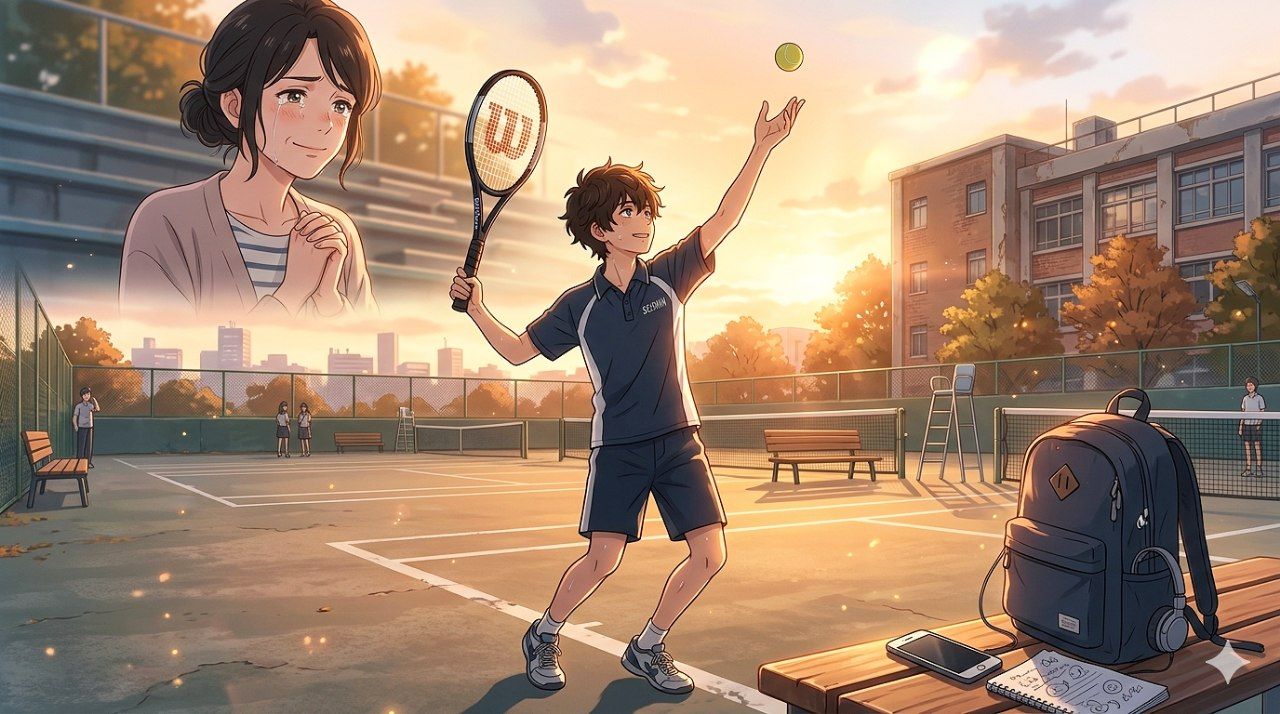
Short story: The Breaking Point
Ana had a habit of saying she could smell social change; those who knew her were no longer surprised when she pointed to a news item and announced, “this will hurt, but it will help.” That afternoon the terrace of the building she shared with Mateo had once again become a debate headquarters: a table with cups, two open laptops like antennas, a plant pretending to listen, and a box of cookies acting as a silent moderator.
Ana, a 25‑year‑old sociology student, stirred her sugar with a solemnity that contrasted with the lightness of the afternoon. She looked at the city, the passing bicycles and the luminous billboards flashing promises, and let out a breath that was half resignation and half intellectual curiosity.
“Do you remember when we thought everything would go in the same direction?” she asked, holding her cup like a small trophy. “That men and women would move forward together, the same struggles, the same expectations.”
Mateo, 26, a software developer with a natural tendency to turn any topic into a technical analogy, put his laptop aside and fixed his gaze on Ana.
“I remember,” he replied. “But it isn’t like that anymore. At the office most of the women talk about policies that used to be unusual; they’re more socially liberal. Many of the men, on the other hand, seem to cling to more traditional ideas. It’s strange to see it so pronounced.”
Far from abstraction, Mateo’s observation came from daily life: meetings, shared memes, lunches and hallway conversations where the words “toxic” and “consent” were no longer rare terms but part of everyday vocabulary. Ana, who read these changes with the intensity of someone who works on the subject, pulled out her phone and showed a message from Ji‑won, her Korean friend.
The screen showed a photo of Seoul from a lookout and a text that read: “It also feels different here. My friends don’t want to get married soon; my male colleagues talk about pressure and frustration.” Below, Ji‑won had put a ramen emoji, as if to underline that sometimes nothing is fixed with a bowl of soup.
“And in South Korea?” Mateo asked, curious and secretly hoping to find a solution or at least an explanation he could reuse in his own environment. “You said Ji‑won had noticed something.”
“Yes,” Ana answered. “She told me the differences are affecting basic things: relationships, decisions about having children. It’s not just politics or labels; it’s how people decide their lives.”
That evening Ji‑won arrived on the terrace with double bags of snacks and tea, like someone bringing cultural reinforcements to an international gathering of domestic thought. She sat down on the couch, placed the bags among them and handed out small rice crackers that crunched as if they had their own social commentary.
“In my family many men say they feel the rules changed without them knowing how to adapt,” Ji‑won said in accented Spanish, with the practicality of someone who translates complex experiences into clear phrases. “And my friends, after #MeToo and other conversations, don’t tolerate certain dynamics. That has changed how they see us and how we see ourselves.”
Lucas, a 27‑year‑old neighbor and community activist, had stopped by the terrace under the pretext of dropping off flyers about a neighborhood project and stayed as if the universe had assigned him the role of unofficial mediator and provider of energetic comments.
“Cultural moments like #MeToo were an earthquake,” Lucas said. “They didn’t just expose behaviors; they redefined what power and inequality are. For many young women it was an inflection point: they demand respect and expect equality. For some men, the reaction was confusion, rejection or retreat. And for others, the ‘this doesn’t apply to me’ phase lasted exactly until it did.”
They talked at length. It wasn’t an academic debate: it was an inventory of anecdotes, misunderstandings, small victories and uncomfortable conversations that became necessary. Mateo spoke about his office, about how discussions on consent and equity were as normal as discussing a software update. He also mentioned, with the irony of someone recording everyday contradictions, that dating apps hadn’t clarified anything: they only multiplied indecisive profiles and “bios” that read “no drama” while the interests section had more entries than clarity.
“In my group there are those who prefer not to get involved in serious relationships,” Mateo said softly. “Others believe starting a family is no longer worthwhile. All this affects concrete decisions: who to date, whether to have kids, where to live.”
Ana nodded. She had the look of someone who had reviewed studies and heard enough testimonies to understand these changes weren’t passing trends but deep shifts in life’s coordinates.
“And it’s not an isolated phenomenon,” she explained. “I see it in studies, in news, in conversations with friends from other countries. It’s consistent and repeats: young generations divided in expectations and priorities. It’s as if we all had the same map but used different scales.”
Ji‑won poured tea into small cups, and her voice became more intimate.
“In my country it’s clear,” she said. “Marriage rates drop, birth rates fall. It’s not simply apathy; it’s the consequence of gaps in trust, economic security and different expectations between men and women. Also, karaoke doesn’t help: nobody wants to commit after someone sings ‘My Heart Will Go On’ too seriously.”
There was a shared laugh, because humor, even in the midst of gravity, acts as a necessary relief valve. Lucas added a reflection that combined skepticism and pragmatism.
“We used to be a relatively aligned generation,” he said. “Today that alignment breaks internally. It changes how we organize relationships, politics, collective priorities. And if this continues, soon there will be more tutorials on how to negotiate household chores than on how to program.”
The conversation turned more concrete. The changes they discussed weren’t just discourse: they translated into decisions as tangible as choosing who to spend nights with, whether to invest in a mortgage, or delaying parenthood because of economic insecurity. They agreed the gap, when manifested in life choices, had real social consequences: lower marriage rates, demographic decisions and a reconfiguration of community supports.
At one point the discussion came back to how cultural movements like #MeToo, far from being a punctual event, created a before and after in how many young women perceive power, inequality and their personal experiences. Ji‑won said it clearly: those conversations didn’t just expose abuse; they taught people to name it and not tolerate it.
“For us,” Ji‑won said, “it was a cleanup of vocabulary and boundaries. It’s not only about reporting; it’s redefining expectations. And that clashes with forms of masculinity that didn’t transform at the same pace.”
Mateo reflected on the male reaction: not everything was malicious; part was bewilderment. Bewilderment that, without tools or alternative models, led to reactions ranging from withdrawal to clumsy attempts to adapt old roles to new realities.
“Many guys grew up with implicit instructions,” Mateo said. “When those instructions become obsolete, some don’t know how to rewrite them. Others refuse to accept it and others try to reinterpret them.”
Ana, with methodical calm, saw patterns: the fracture wasn’t limited to ideology. The gap affected day‑to‑day decisions—relationships, family, work—and therefore the structure of society. She gave examples: in countries where young women adopt more socially liberal stances and men maintain or shift toward conservative positions, life paths quickly fall out of sync.
“In certain contexts,” Ana said, “those differences are no longer subtleties; they’re chasms. And when expectations about partners, work and family separate, old solutions aren’t enough.”
They proposed acting locally and practically. Ideas sprouted—sometimes serious, sometimes half in jest—but all with the intent to build bridges without erasing differences.
Mateo proposed something technical: communication protocols in relationships and workplaces inspired by agile development practices—emotional sprints, retrospectives without blame. His suggestion provoked laughter but also interest; the imperfect analogy had utility: routines for review and improvement.
Ji‑won suggested support networks that replicated informal care structures: time exchanges where neighbors helped with children or chores in return for cultural companionship or language lessons. She proposed those agreements include playful clauses to avoid misunderstandings: “In case of excessive karaoke, the affected person may demand three hours of mandatory silence.”
Lucas, with community mobilization experience, proposed negotiation and shared finance workshops, plus campaigns explaining, without lecturing, how inequality affects private decisions but produces public effects. He proposed playful formats: board games simulating household negotiation, forums for sharing real experiences—without judgment—and active listening spaces.
The conversation stretched until the night stopped being a simple curtain and became a curtain with poorly synchronized LED lights. Amid the proposals practical details appeared: co‑living arrangements with clear cleaning clauses (signed with witnesses if possible), community daycare systems with rotating shifts, reading groups on masculinity that included men and women so learning wouldn’t be a monologue.
Someone joked about a “manual for living together in times of transition,” which, while evoking complicated instruction booklets, would include charming illustrations and stickers. They laughed—laughter as a means to keep things light when the discussion threatened to grow too heavy.
In a quiet moment, with the city whispering its usual mix of sirens and detours, Mateo asked softly:
“What do we do?”
The question wasn’t looking for a definitive answer; it wanted a map with steps. Ana, staring at a distant light, answered.
“Listen. Recognize that it’s not just ideology; it’s life decisions. Create spaces where each person’s experiences are understood and not annulled. It’s not a quick fix, but ignoring it only deepens the gap. And also, more coffee. Coffee always helps.”
Ji‑won rested her forehead in her palm, as if trying to fit the pieces of a puzzle that had changed the shape of its pieces.
“Maybe the break is an opportunity,” she said. “If we acknowledge the differences and pursue collective solutions, we can build bridges. But it will take will, because what comes won’t resolve itself. And less poorly managed karaoke.”
Lucas nodded and added, with his characteristic pragmatic optimism:
“Then let’s start here. In our neighborhood, in our conversations. Small decisions that add up. And if it fails, we can always blame the toaster.”
They outlined modest but concrete plans: monthly terrace meetings to exchange experiences and evaluate pilot projects, a roadmap for workshops, a local platform to publish helpful resources, and a time bank for caring. In the end, all initiatives seemed small compared to the magnitude of the phenomenon, but they agreed on one thing: the accumulation of local actions could, over time, change structural conditions.
When they said goodbye, the city wrapped them in its polyphonic murmur. Ana closed the door with the feeling of someone who had planted a seed in uncertain soil; she wasn’t afraid of uncertainty but knew good intentions weren’t enough.
Mateo, back at his apartment, opened his laptop and, with almost comic discipline, typed: “Implement active listening v1.0” and searched for memes to illustrate it; he believed humor was the social lubricant needed to keep conversations from getting stuck. Ji‑won returned to Seoul with an empty snack bag and the sense that, although the routes weren’t the same, perhaps they could learn to coordinate the traffic lights.
The generation that had grown up thinking men and women would march in the same direction now found itself traversed by different trajectories. Some moved apart, others searched for signals to reunite, and most navigated with uncertainty and imperfect resources. That breaking point, far from being a simple fracture, presented itself as a map under construction: full of possible routes, unexpected detours and small places where people tried to reach agreements.
The story didn’t end with a final solution. It ended, rather, with an inventory of steps: ongoing conversations, local projects, support networks and a good dose of humor so they wouldn’t lose their humanity. Because if anything was clear, as they said goodbye under the flicker of neighborhood lights, it was that change would be slow, sometimes clumsy, often funny—and, above all, necessary.
Source of the images.
Image created with Google Gemini.
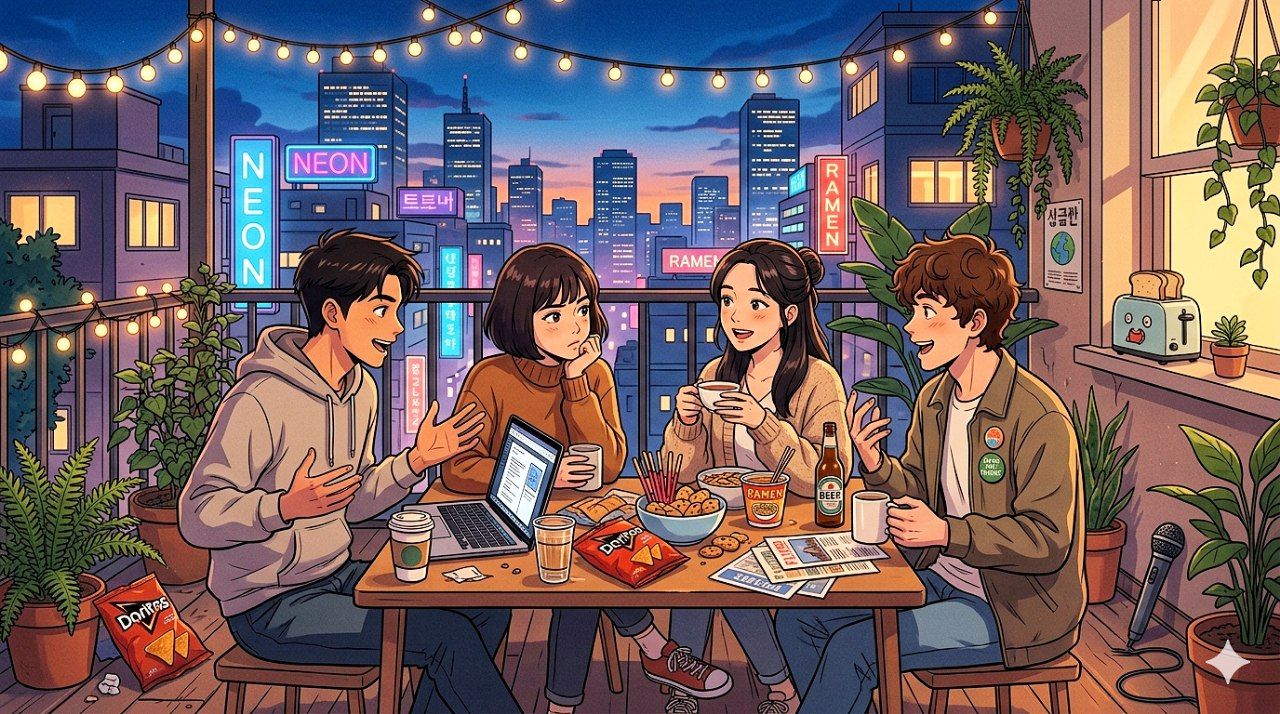
Short story: Hearts in Kobe
The municipal school in Kobe woke each morning to a murmur: backpacks bumping down the stairs, high-pitched laughter echoing in the corridors, and the bell, punctual, inviting the day to begin. The yellow walls bore marks of years: children's drawings taped up, science projects that looked like little works of art, and a blackboard that always held a pending phrase of encouragement.
Haru Takeda, thirty-four, was a man with a calm gaze and measured steps. He had taught basic math and science for years. His students respected him for his endless patience and for the stories he used to make the trickiest problems into adventures the children gladly accepted.
Aiko Sato, twenty-four, seemed the opposite: impulsive, effervescent, with a frank laugh that burst without warning. She ran art activities and the reading club. Her posters brightened the teachers' lounge, and she always had a creative solution for a torn mural or a puppet show that needed nimble hands.
They officially met on the first day of the school year; but they truly recognized each other through small gestures: Haru returning a pencil to a shy student, Aiko leaving a cup of tea on the janitor’s table with a thank-you note for fixing a door latch. Over time, those gestures became reciprocal.
“Are you coming to science club this afternoon?” Aiko asked one Wednesday at midday, checking a materials list on her phone.
“Depends: will there be volcanoes?” Haru replied in a solemn tone, though his eyes lit up at the idea.
“Of course. Want to be my dramatic assistant?” Aiko tilted her head, smiling defiantly.
Haru feigned indignation. “Dramatic assistant? I’ll stick to safety supervision and the vinegar jar.”
They laughed, starting a quiet complicity. Between faculty meetings, festival prep, and late-night grading, they forged a routine of small alliances: Haru lent his calm when Aiko grew anxious; Aiko rekindled Haru’s creative spark when math seemed too cold. They shared coffee in the staff room and sometimes, without noticing, stayed late organizing materials, letting the hours pass as if time were an ally.
Their bond deepened into conversations that reached beyond the professional: confessions about childhood fears, stories of family, and soft desires. On nights when the school fell silent, Haru and Aiko would fix a projector or sort the library together, and in those moments the line between work and personal life blurred.
One rainy afternoon, with the children stuck in the library, the materials room—shelves heavy with supplies—became a refuge. Aiko, who’d brought homemade bread, offered a slice to Haru.
“Sometimes I feel this school is more of a home than any other place,” she said, seeking company.
Haru looked at her with surprise and tenderness. “Then let’s take care of it,” he answered without much thought. For him, taking care meant being present, fixing what broke, and protecting those entrusted to him. For Aiko, caretaking meant decorating, creating safe spaces, and bringing color to routine.
Over time they began to spend time outside work hours: weekend walks in a nearby park, swapping book recommendations, and, on rainy nights, conversations that stretched into the late hours. The relationship grew emotionally intense; every gesture gained meaning. What began as a close friendship turned into an intimacy neither wanted—nor knew how—to stop.
The school, modest in its architecture, witnessed many of their encounters. They were not public nor intended to harm: two adults finding comfort within walls they both loved. But because the behavior was repeated and occurred in institutional spaces, curious and watchful eyes began to notice.
One morning the principal received an anonymous report through the internal channel. Rumors spread quickly. Corridor conversations became messages circulating among parents and staff, and soon a file reached the Kobe municipal board of education.
The investigation proceeded with the cold thoroughness of administrative processes: interviews, schedule reviews, testimonies. Local headlines fanned the drama. For Haru and Aiko, the news hit hard.
“I never thought this would go this far,” Aiko said one night, her voice breaking. They sat in their usual café, but the words felt heavy.
Haru took her hand carefully, fingers seeking an anchor. “It was never my intention to hurt anyone. But I admit we lacked prudence.” He sighed. “We should have talked with the administration earlier, been transparent in a responsible way.”
The proceedings ended with a clear sanction: both were suspended for six months. The board explained that although the relationship was consensual and did not involve students, the repeated use of public facilities for private purposes violated the conduct rules expected of teaching staff. The principal also received a disciplinary warning for not reporting the situation promptly when he became aware of it.
The verdict created a public rift: some parents and colleagues condemned their lack of boundaries; others expressed empathy for the human complexity of the case. For the two teachers, the sanction meant not only separation from their workplace but also the need to rethink who they were outside the school.
The months that followed became an exercise in introspection, repair, and learning. Aiko returned to her childhood home by the sea to rebuild family ties and seek clarity. There she walked the beach and wrote long letters she often didn’t send. In one letter intended for Haru, she left it in her bag; days later he found it by accident among recipes and class notes.
Haru turned to the community: he began volunteering at a cultural center, teaching children from nearby neighborhoods. He discovered that continuing to guide and care for others was itself a way of making amends. Meanwhile, both started individual therapy; they spoke in sessions about boundaries, power, and responsibility.
Conversations with colleagues and administration were part of the process. They offered public and private apologies and proposed participating in workshops on professional boundaries once the suspension ended. Their willingness to engage in prevention policies and explain what they’d learned opened a path to reconstruction.
Despite the seriousness of the situation, everyday life retained sparks of humor. One day Aiko accidentally sent a photo of a cat-shaped cookie meant for a friend to Haru’s chat. Haru, in his usual dry tone, replied, “We need that cookie at the reading club.” They laughed at the absurdity, and such small digital stumbles lightened the weight of the sanction.
Meanwhile, the school implemented changes: clearer protocols about relationships among staff, mandatory workshops on ethical professional behavior, and more transparent communication channels for reporting and questions. The school community shook, debated, and gradually adopted practices aimed to prevent similar incidents.
At the end of the six months their return was moderated: conditional authorization, classes under observation, and periodic meetings with administration to ensure compliance with the new rules. The reception was mixed—some tentative applause, some looks still seeking understanding. For Haru and Aiko it felt like entering a different classroom, one that had changed in their absence.
In the first week back they met again in the materials room, the same place that had witnessed so many things. Cardboard boxes of recycled supplies, a whiteboard with upcoming festival projects, and evidence of the collective work the school continued to carry filled the space.
Aiko grabbed a box labeled “Volunteers” and started sorting. Haru watched her for a moment, then rolled up his sleeves.
“Do you remember when you hid star stickers on the desks of the laggards?” he asked with a crooked smile.
Aiko pretended to be offended. “That was an effective educational strategy, thank you very much,” she replied. “But now I use stars to reward effort in the library. And no surprises in the hallways.”
“Good,” Haru said. “We’ll keep stars in the classroom and important conversations off the clock, informing administration when needed.”
They laughed and, with new naturalness, divided tasks. The complicity hadn’t vanished but transformed: now it included transparency, clear boundaries, and an explicit commitment to student well-being.
In the following months both led voluntary workshops on coexistence and boundaries for staff, sharing their experience with therapeutic honesty. They gave talks that neither glorified what happened nor excused it, but offered concrete lessons: how to separate roles, where to seek professional help, and the importance of communication within the institution.
They also worked with parents and students in sessions about trust and care: reflecting on how responsible adults shape the school environment and how professional ethics underpin community safety. Many saw their active involvement as sincere reparation.
Personally, their relationship matured and became more discreet. While affection remained, it was accompanied by prudence and a promise not to repeat past mistakes. They communicated more clearly, planned meetings outside the school with transparency, and supported each other in therapy and professional projects.
One autumn day, during preparations for the annual fair, Aiko and Haru sat on the makeshift stage in the gym. The lights were off, and the silence allowed a conversation that felt like a shared confession.
“Do you think we’ll ever forget all of this?” Aiko asked, staring at the stage boards.
Haru thought for a moment. “I don’t think it’s about forgetting,” he replied. “It’s about learning enough that it doesn’t happen again. Turning a mistake into a constant reminder of our responsibilities.”
Aiko nodded. “And continuing to love without putting others at risk.”
“Exactly,” Haru said. “Love comes in many forms. This school taught us that —and also the limits we must respect.”
They sat in silence, listening to the echo of their voices. Outside, the trees were turning orange. Inside, the school continued its daily rhythm: children’s laughter, multiplication tables, paintings drying in art class.
Their story didn’t end in perfect redemption or a punishment that fixed everything. Instead, it became a patient reconstruction of trust, rules, and self. Aiko and Haru continued their work with humility, offering their experience to help others avoid the same pitfalls. They regained some affection and accepted others’ reservations.
Over time public memory faded among new news and other school stories; but the lesson stayed with the community: the importance of professional ethics, clear channels, and responsibility when caring for young lives. For Haru and Aiko, the sanction and reflection became an inflection point—not to erase the past, but to build a more attentive future.
The End.
Source of the images.
Image created with Google Gemini.
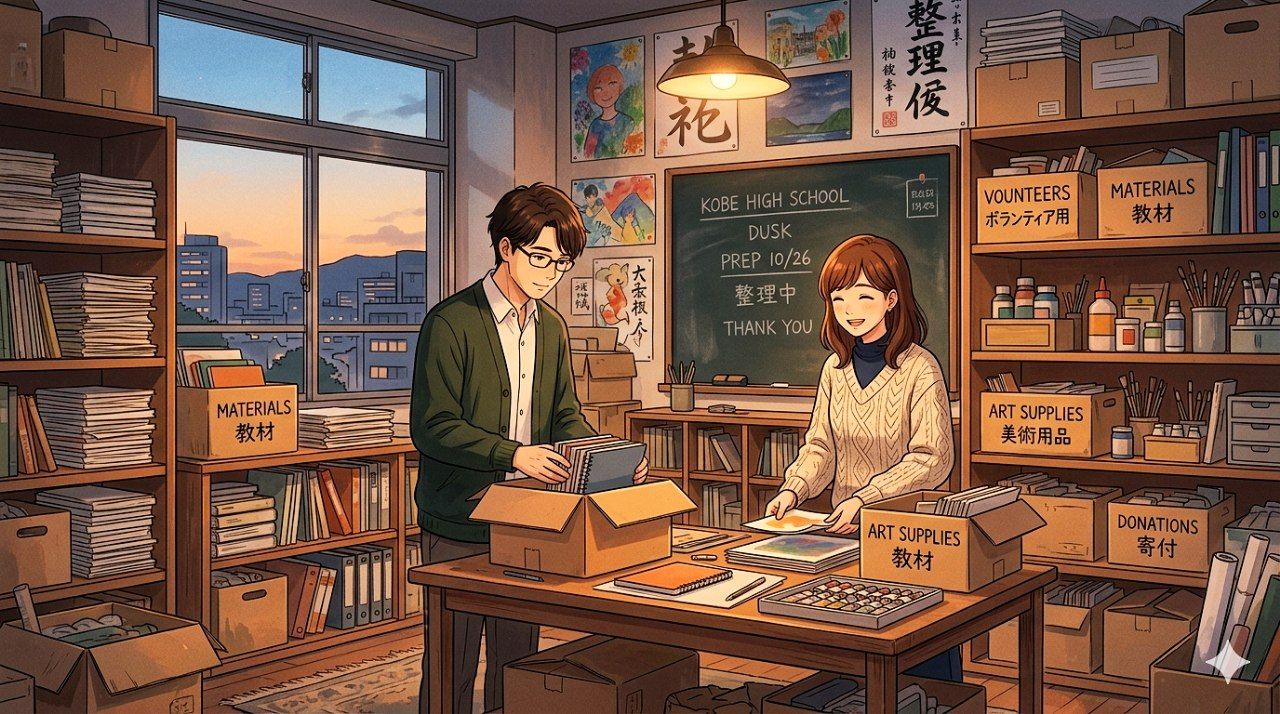
Top 5 musical - March, 2026
Welcome to a new monthly musical count, me that we will see a list that presents several rock bands of various styles, ranging from punk to alternative; different eras and contents among their lyrics.
And first of all, it should be remembered that this list is part of my profile on LastFM, a social network that has my statistics on music plays, and which, in turn, is linked to my Spotify account.
And without further ado let's get started.
**Most listened artists**
1- Dead Kennedys
Country of Origin: United States.
2 - Foster the People
Country of Origin: United States.
3- AC/DC
Country of origin: Australia.
4- Muse
Country of origin: England.
5 - The Killers.
Country of origin: England.
As you could well notice the great novelty for this occasion has been Dead Kennedys, a punk band from the United States, and that had its heyday during the 80s, along with other bands such as The Clash and others; very reminiscent for those who lived the time, or, the gamers of the nineties of the twentieth century and the beginning of the 00 of the present thanks to the video game Tony Hawk.
Next, let's look at the most listened to albums section.
**Most listened to albums**
1. Give Me Convenience or Give Me Death - Dead Kennedys
2. Fresh Fruit for Rotting Vegetables - Dead Kennedys
3. Live at Rome Olympic Stadium - Muse
4. Live From The Royal Albert Hal - The Killers
5. Bonfire - AC/DC
And extra bonuses I have something special for you all 😏
**EXTRA BONUS: MUSIC TO LISTEN TO**
**Dead Kennedys**
https://youtu.be/Qr6NOsluHYg?si=mY65hchJ9hVgnzF7
And without more to say we meet in the next one. I appreciate all the support provided, and remember to leave your comments and musical recommendations at the end of this post.
Until then. And long live the music! 😎👍
Source of the images
Screenshots from my Amazon Fire 8 tablet.


Short story: Chronicles of Marazul: Escapes, Choices, and Broken Stars
The rain in Marazul always felt like an old friend who wouldn’t leave: persistent, musical, able to turn a terrace into a darkroom where thoughts develop like negatives. It was under that rain that Laura and Mateo first met. She arrived late and soaked, a camera hanging from her neck and the face of someone who had found perfect light; he was sheltering at the table by the window with a notebook full of mind maps and a cup of tea that already looked like art. When the thunder died down they talked until the café closed, as if the city itself had wrapped them.
“Can you imagine living in the same place forever?” Laura asked, pointing at the raindrops sliding down the glass without looking.
“It depends,” Mateo replied. “Always as a tourist or as someone who knows the best empanada stand?”
Laura laughed—spark number one: she was a freelance photographer specializing in urban portraits; he was an experience designer who turned small brands into stories. They shared messy playlists, favorite running routes, and an uncanny ability to argue about books they hadn’t finished.
Slowly their relationship became a constellation of short trips, crossed projects, and dinners that stretched into the night. They had rituals: a Sunday of virtual reality to play astronauts and a Tuesday for pizza and exhibition reviews. Then, amid backpacks and the voice of a travel guide, the question that always seemed imminent surfaced.
“Do you want kids?” Laura blurted while zipping her backpack.
Mateo froze, like a life-software update installing in the background.
“Not now,” he answered with the candidness of someone not hunting the perfect phrase. “I like the idea of leaving at any time, prioritizing what makes us well. I imagine accepting residencies abroad without months of paperwork, or canceling a contract because I found another opportunity that lights me up.”
Laura squeezed his hand.
“Me too,” she said. “I want to devote more time to photography, to residencies. I don’t want having children to be the only measure of what we can build.”
The topic didn’t exhaust itself; it expanded. They did what curious people do in the information age: they read, searched studies, articles and testimonies. They discovered they weren’t alone: in several countries more couples were choosing not to have children to prioritize quality of life, flexibility, and personal stability. Reasons varied: freedom to travel, financial cost, worries about the planet’s future, professional desires. For Laura and Mateo, motives mixed like a color palette: a bit of ambition, some fear, a lot of curiosity.
One Friday night at their usual bar they ran into Clara and Pablo—old friends—and Sofía, their daughter, who at six had the clarity of poetic justice.
“And you?” Pablo asked between sips. “Do you picture yourselves surrounded by toys in a few years?”
Clara, who’d experienced a difficult pregnancy, looked at them with tenderness and a hint of irony.
“Sometimes I feel motherhood is like a physics experiment: invisible forces thrusting you into new orbits. I won’t deny its charms, but there were sacrifices. If you choose not to have children, it doesn’t mean you’re bad; it’s simply another orbit.”
Sofía, with the solemnity of a little explorer, announced: “If you don’t have kids, will you adopt me as a traveling cousin?”
They all laughed. The laughter held a blunt truth: life doesn’t come in only one format, and relationships can be reinvented.
The story took unexpected turns when, during a residency in Lisbon, Laura received a strange notification: an email from an unknown sender with an attachment titled “Project: Nemesis.” Opening it she found an oddly beautiful proposal: a collective of scientists and artists offered an exhibition combining photography, synthetic intelligence, and bioart; residencies on a floating station off the Azores were available. The proposal included a paragraph that sounded like a poorly told joke:
“We seek creators willing to live without parental encumbrances during the mission period. Preferably no children requiring physical custody. IRL (in real life) incompatible with intercontinental missions.”
Mateo whistled a note of equal parts fear and excitement.
“What do you think?” Laura asked.
“That they’re asking us to be space pirates with a passport,” he said. “I’d love it.”
They applied. The selection panel—an eclectic group of engineers, poets, and a baritone-voiced robot named Gideon—loved Laura’s photography and Mateo’s knack for designing experiences. They were offered a spot. The station wasn’t a spaceship exactly, but a semi-autonomous platform on an ocean ridge, equipped with labs, a 3D-printing workshop, hydroponic gardens, and an unusual microclimate observatory. Part art, part research, the project studied how human creativity transforms under constrained mobility. Rules were clear: three-month rotating stays, total mobility, and yes, a preference for participants without family obligations.
“At first it struck me,” Laura admitted the night they received confirmation. “Are we being selfish for accepting this just because we can?”
“We’re humans making choices,” Mateo replied. “Besides, if we don’t do it, another couple will. This isn’t a universal moral meter.”
The station, christened Nemesis by its designer—the artist-scientist Anouk—was a small metal crown floating elegantly over shifting latitudes. There, between microclimate experiments and hurried dinners to watch marine auroras, their relationship gained new textures. There was comedy: a morning when Gideon turned into an existential poet and declared it preferred the café humans’ coffee because “human coffee is a solid metaphor”; drama, when a prolonged storm cut communications to shore and an old fight between Laura and Mateo exploded across the mess table; romance, on a night the deck was lit by bioluminescent jellyfish and they silently promised to stay curious about each other; and science fiction, always present, with the station sending little probes that collected microbe-sonnets in ocean foam bubbles.
One memorable argument came months later, after anonymous criticism on social networks hit Laura’s inbox.
“‘How selfish,’” she read aloud, voice trembling. “‘Don’t you think of society?’”
Mateo switched on a soft light.
“Society is an umbrella with holes,” he said. “We’re trying to build our own roof. I don’t deny privilege, but there are also legitimate uncertainties: the cost of raising a child, the climate future, labor volatility.”
Through the station and its comings and goings they met other couples with similar choices. Some held the decision as political conviction; others out of fear; others to devote life to art or science. Together they created a nomadic community that traded everything: recipes, tools, songs, and tips to repair drones with duct tape. They discovered that choosing not to have children was not a refusal to care; it became expanded care: borrowing someone’s niece for a weekend, transporting a sick friend to the nearest hospital, offering free workshops to local youth in the cities they visited.
Doubt persisted. One autumn afternoon in the station kitchen Mateo whispered, “Sometimes I dream the system fails and we never get back to Earth.”
“That’s dramatic,” Laura replied, her smile brief. “If that happens, what will we have missed?”
“Seeing everything,” he answered. “But I also feel that if it happens, I’d rather it take both of us by the hand, not tied down by obligations that keep us from being who we are.”
The mix of humor and catastrophe sustained them. Between Gideon’s absurd jingles and the moral weight of choices, they learned to laugh at fears and face them tenderly.
At Nemesis they had a near-cinematic episode: a breach in the hydroponic tank threatened food production. Tension forced the community to improvise a repair opera: Laura documented the desperate choreography—ropes, hand pumps, laughs barely masking panic—and Mateo organized logistics like a festival director in a storm.
They saved everything with ingenuity, improvisation, and a can of oil that miraculously sealed the leak. That night, sharing rationed soup, they realized that living without children had made them more dependent on their chosen network.
Their itinerant photography press—started as a side project—grew into an ambitious archive documenting societies in flux, nonconventional families, and new forms of intimacy. Invitations arrived: an exhibit in Tokyo, workshops in Dakar, and an unexpected sale that funded a mobile studio. Every choice was made with the freedom their decision enabled: accepting residencies, canceling contracts, saying no.
Domestic drama didn’t vanish: arguments about financial futures, fears of aging, hurtful messages from relatives who didn’t understand. One day Mateo’s mother, voice breaking, said on the phone, “I don’t want my grandchildren not to exist. Who will tell me stories at the end of my days?”
Mateo counted to three before answering.
“I’ll tell you ours,” he said. “You’ll come with us and see places you never imagined. I won’t take grandchildren away, but I promise stories that will make you smile.”
There were tears in that call and partial understanding. Family was rebuilt in their own way: more frequent visits, shared dinners, a promise that although they wouldn’t be parents they wouldn’t be absent. Love, in its practical variant, was repeated gestures: grocery runs for grandma, helping repaint the house, babysitting Sofía in the afternoons when Clara needed time to recover.
Romance remained the guiding thread. Scenes any novel would call iconic occurred: a kiss on the station bridge while bioluminescent streaks crossed the horizon; an awkward dance on deck to the rhythm of an intercepted old radio song; the night Mateo, after receiving a lucrative design offer, turned it down for a residency in Dakar because he knew it would ignite Laura. She looked at him, handed him back his camera and said, “You’re a beautiful fool,” and kissed him.
Comedy persisted. At a port city festival their exhibition was mistaken for a retro appliance show; their pieces were bought by a collector who thought he was buying multiple vintage toasters. In another trip Gideon developed its own sense of humor and threatened to rewrite their work synopses too literally until they gave it a nightly stand-up channel where it joked about emotional screws and the nostalgia of analogue cameras.
Years later, with scattered gray and a library of memories, Laura and Mateo sat on the terrace of the same café where they’d met. Marazul had changed: cafes with flamboyant names, public bikes, murals narrating migration stories. On the table, steaming soups and the comfortable silence of people who had shared life.
“Do you regret it?” Laura asked, not trying to force an answer.
“Sometimes,” Mateo answered honestly, “but not today. I saw Sofía dance in a Dakar square and realized parenthood isn’t limited to DNA.”
Laura smiled and took her long-time partner’s hand.
“We did what we wanted with the freedom we chose. It wasn’t always easy, but it was ours.”
Later they met Clara, Pablo, and Sofía for lunch where children sprinted between tables and adults spoke of policies and seaweed. The conversation was light yet intimate.
“I’m glad we learned not to judge,” Pablo said. “Having kids isn’t a badge of goodness.”
“Nor the opposite,” Clara added. “Every life deserves respect.”
Sofía, now dignified as a small explorer, handed them a drawing: a ship with cameras on the mast and a couple with suitcases. Laura hung it in her mobile studio.
Their archive, a photo series titled “Orbits,” earned recognition: portraits of couples in transit, dismantlable homes, grandmothers growing cabbages on balconies. Critics said their images spoke of freedom and loss, brave choices and inevitable consequences. In an interview Laura replied simply, “It’s not a statement against motherhood or fatherhood. It’s a chronicle of freedom: ours.”
Mateo wrote an essay mixing design, ethics, and the future: cities adapted for mobile people, policies supporting itinerant work, and expanded care networks. He addressed fears that led many couples to forgo children: cost, climate uncertainty, keeping life open to the unexpected.
Beneath the story lay an idea even the wildest science fiction couldn’t erase: choice, in all its complexity, deserves space. Sometimes choice becomes a floating station off the Azores; other times an elderly woman learning to take photos with a phone; a child calling friends “cousins” who are only close companions. The community Laura and Mateo helped build did not erase loneliness nor judgment, but it offered networks, celebrations, workshops, and above all, a different form of care.
On the tenth anniversary of Nemesis, they held an exhibition of old and new pieces. Gideon, now a legend with its stand-up channel, opened the gala reciting a synthesized poem:
“We are radiant as stars that flee gravity,
we travel with suitcases full of memory
and, without cradles in sight, we weave human nets
so someone, on some shore, remembers who we were.”
Applause, laughter, tears. Laura and Mateo looked at each other and knew—without words—that their decision had been more than renunciation; it was a wager on a way of life with great risks and beautiful rewards.
Marazul continued to rain, change, and gift sunsets. Their story had no single moral: it offered, instead, an invitation for each person to choose with full awareness. In their editorial’s archives remained images: migrating couples, project-based families, children adopted by traveling uncles, grandmothers using drones to send medicine to small islands. The world did not split because of their choice; it went on, complex and contradictory.
Finally, on a clear day under a map-worthy sky, Laura looked at Mateo and whispered, “If we ever change our minds, we’ll know. Meanwhile, we keep building this extraordinary life.”
He kissed her, and the kiss tasted of open routes, deckside laughter, three‑a.m. debates, and the peace of two people who’d chosen to prioritize their quality of life without giving up tenderness. Outside, a flock of starlings drew a choreography across the air, reminding them that for some, migration is living; for others, staying is too. In any case, life remained theirs, and they chose it, again and again.
Source of the images.
Image created with Google Gemini.
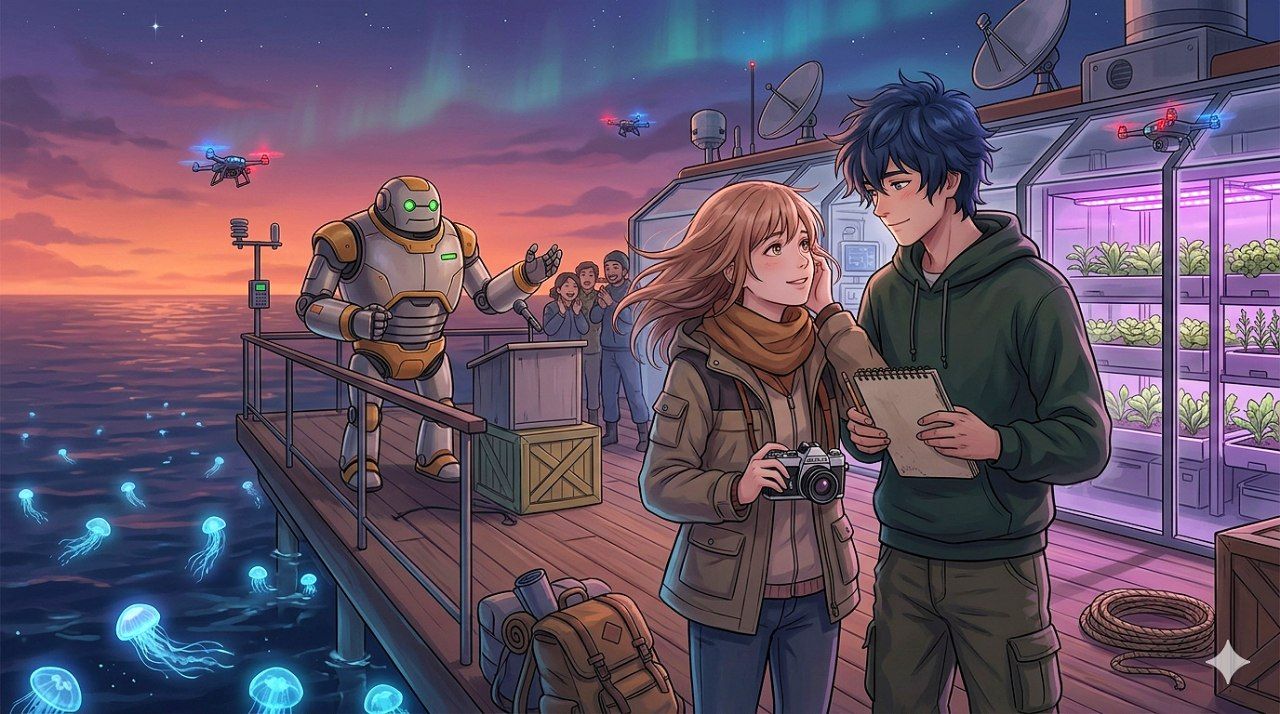
Short story: The Aisle of Respect: A Comedy to Ponder
The line for rotisserie chicken at the supermarket "La Esquina" snaked between carts and promotions, and Doña Clemencia, the head of security, had already read the “No Smoking” sign three times as if she were reviewing a recipe so she wouldn’t forget a step. There was something ritualistic in her movements: checking the cameras, straightening packages, smiling with reserve. That afternoon the place buzzed with people: children with backpacks, grandparents with meticulous lists, and shoppers debating whether the brand-name coffee was actually on sale.
Valeria walked in with purpose. She wore athletic leggings, a light jacket, and a tightly written shopping list: avocados, plain yogurt, whole wheat bread. Her practical goal was simple: go in, shop, and get home before the show started. But somewhere between the salad and dressing aisle, routine was interrupted by an uncomfortable look.
The man wore a T-shirt that read “Naturally Curious.” He looked at Valeria with an expression that mixed surprise and moral entitlement, as if he had seen a work of art and fancied himself an authorized critic. It wasn’t a neutral glance; it was an inspection that weighed on her and left Valeria feeling as if her space had been invaded.
“Ma’am,” the man said in a sports-commentator tone, exaggerating his inflection, “if they can’t look at you, then dress.”
The aisle became louder inside than out for a second. Valeria felt the phrase like a blow that was really words. Then something in her straightened: that mix of indignation and humor that decides not to be a victim. Instead of staying silent, she pulled out her best weapon: organized sarcasm.
“Oh really?” she replied, looking him squarely in the eye. “And where do you buy that ‘dress’? In the clearance section or at the boutique of other people’s morality?”
The man blinked. He wasn’t prepared for his moral verdict to be met with a sharp question. His confident smile began to unravel. He searched the surroundings for an invisible accomplice to applaud him, but the patrons of public opinion don’t always find a safe audience.
Voices and footsteps came from the back of the aisle. Marcos and Elena, a couple who had been arguing minutes earlier about whether the red apples were worth the price, saw what was happening and moved closer with the naturalness of people who refuse to tolerate someone else’s discomfort. Without theatrics, they positioned themselves on either side as if they were referees of a civility league.
“Hey,” said Marcos in a tone that didn’t seek confrontation so much as clarify boundaries, “if you want to comment on fashion, go on Instagram. Here the only thing we comment on is prices and how not to make people uncomfortable.”
Elena, with a calm that could split tension in two, added, “Besides, we sell respect here. It’s on promo: buy one, get one free if you wear it all day.”
The man tried to justify his remark, feeling for excuses that sounded as flimsy as a slightly open cookie package. “It’s just… an observation,” he began, but his words turned watery in the face of collective firmness.
At that moment Jorge, the cashier who had been watching from his register, stepped forward with a smile that was not complicity but local authority.
“Sir,” Jorge said, nodding toward the continuing line, “if you want practice making comments, there’s a fashion critique club on Thursdays. Here we only criticize apple prices and coffee quality.”
The chain of interventions had a curious effect: it deflated the man’s theatricality. Without an approving audience, his phrase ran out of fuel. He stumbled over his own speech and, in a clumsy move, dropped a package of cookies that rolled to the base of the shelf. No one shouted; the aisle exhaled.
Doña Rosa, an older shopper with a cane and fingers hardened by city life, approached with steady steps. Her years had given her a precision of words.
“Boy,” she said with the force of someone who can sum up decades in one sentence, “you don’t buy or receive respect: you learn it. And if you haven’t learned it, move along.”
The response became a chorus of looks that, without more, invited the man to reconsider. A young man who had been recording discreetly with his phone put the device away. Not because he wanted to hide evidence, he later explained to friends, but because the scene no longer needed outside eyes: the community had spoken.
Valeria retrieved her shopping bag and, with the air of someone who puts a period at the end of a paragraph, said quietly to Marcos, “Thanks… though next time I’ll let you guys intervene first; I tend to win the spontaneity lottery.”
“Deal,” Marcos replied, smiling. “But bring the cookies if we agree to practice arguments.”
“I’ll bring a sign,” Elena chimed in. “A small one that says: ‘Respect: wear it, don’t stare at it.’”
The scene ended with soft laughter. It wasn’t comedy at the expense of the victim’s discomfort but a collective moment where the absurdity of the man’s attitude was funnier than threatening. Valeria paid for the avocados, pocketed her change, and headed for the exit. Before leaving, she stuck a printed note with tape onto the diet products shelf: “For anyone who thinks their look feeds opinions: buy common sense. It’s on sale.” Marcos read it and nodded; Elena took a photo of the note to send to a friend who organized community workshops.
Days later the story spread on social media. Not as a grotesque spectacle to feed shame, but as an example of intervention: videos with messages of support, thankful comments for the solidarity, and practical suggestions. One user proposed installing small mirrors with the phrase “See yourself? — Value yourself.” Another shared a similar incident from her life, and several people suggested neighborhood civility workshops with concrete examples of safe ways to intervene.
The comedy of the episode came from the ridiculous: a man who granted himself the right to judge someone else’s body and who, faced with collective response, was discredited by his own presumption. The deeper reflection was that respect is neither natural nor automatic; it is a practice learned and maintained with small, concrete acts that, when absent, allow uncomfortable or dangerous situations to flourish.
Doña Clemencia, after the incident, added her own practical gesture. She used the office printer to make a sign and placed it by the register with supermarket-style lettering: “If you look, look with respect. If not, move along.” At first people smiled out of courtesy; then they started taking photos, sharing it in their stories, and mentioning it in neighborhood groups. The sign became a kind of daily slogan that, without dramatizing, made a minimal standard of coexistence visible.
In the following weeks small initiatives sprang up: a group of neighbors organized a brief talk on safe intervention; a volunteer coordinated a workshop at the community center for young people on how to respond to harassing comments; a cashier at “La Esquina” printed cards with useful phrases for intervention — “Are you okay?”, “It’s none of your business,” “Move along” — and left them by the bags for anyone to take. Nothing heroic or institutional, just everyday practices that added up.
Valeria continued to go to the supermarket in the same athletic clothes and with the same intact sense of humor. She didn’t seek the spotlight; she simply returned to her routine. But the difference was that whenever someone looked again with the wrong intentions, someone else would appear: Marcos, Elena, Jorge, Doña Rosa, the cashier who now knew a few phrases to use, a neighbor passing by. Not out of epic heroism, but because everyday solidarity is built with simple, repeated gestures.
The lesson was clear, with no unnecessary adornment: comedy can spring from the ridiculousness of someone who believes they have the right to comment on other people’s bodies, and reflection arises when the community acts. Intervening — even with a clever joke, a steady look, or a phrase that sets a boundary — has more power than a thousand distant arguments. And as long as the supermarket exists — with its lines, its deals, and its signs — there will be chances to choose: look with respect or learn to look away.
Source of the images.
Image created with Google Gemini.
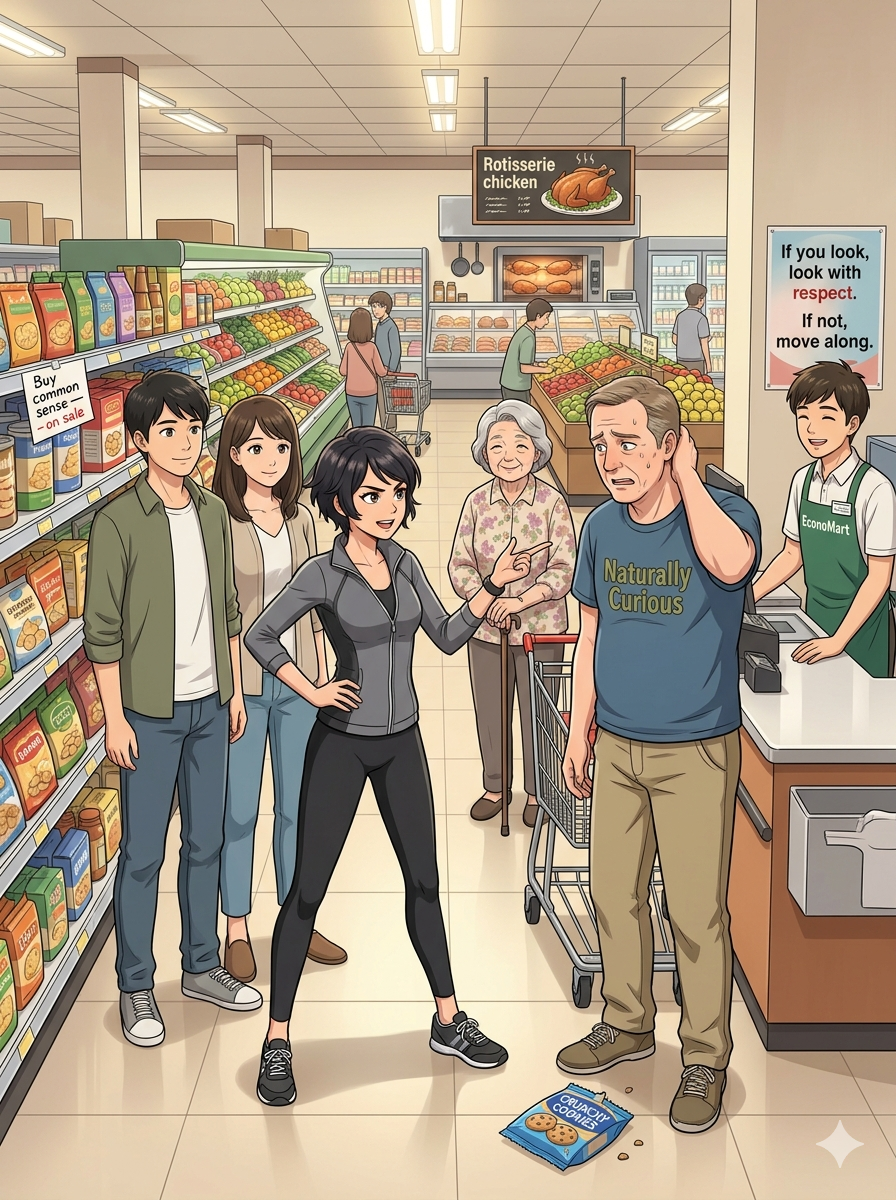
Short story: Falling for the Falcon
The rain hammered mercilessly on the roof of Villa Alma’s police station. Streetlights warped in puddles and flickering patrol beams. In the homicide office, Inspector Mateo Ríos flipped through a folder stained with coffee and edged with neat margins: files, letters, names that would not stop echoing. Detective Clara Varela, her jacket half-buttoned, turned on a coffee maker and let the steam fill the room with a scent that tried to cleanse its heaviness.
“Another box of correspondence,” Clara said, tossing the drawer key onto the desk. “This one came by courier. No return address.”
Mateo looked up and smiled bitterly.
“There’s always another letter,” he replied. “This one’s for the Falcon.”
The Falcon: a media nickname for the killer who haunted secondary roads—bodies abandoned without ritual, fractured looks, inconsistent witnesses. He had been arrested and convicted seven years earlier, yet his name lived on in headlines, forums, and sealed envelopes stamped with promises or slogans.
The door creaked and a woman wrapped in a red coat entered, her hands trembling but her gaze steady. She introduced herself as Lucía Márquez and placed a box wrapped in worn paper on the desk. She did not speak until they sat across from her.
“I want to deliver this in person,” she said in a contained voice. “It’s for him.”
Mateo studied her with the professional caution of someone who had seen many broken gestures masquerade as heroism.
“What do you know about him?” he asked.
“I heard him during a trial on TV,” Lucía answered. “His voice cut through me. I don’t know how to explain it, Inspector. It’s as if he spoke from a dark place I belong to as well.”
Clara shook her head, letting fatigue weigh on her words.
“He’s a murderer. He killed people,” she said. “Why would you want to give him something?”
Lucía opened the box with hands that couldn’t hide the tremor.
“I’m not trying to excuse him,” she insisted. “I just… there’s a part of me that believes if someone looks at him differently, maybe he’ll stop breaking others.”
Mateo kept his eyes on the lid of the box a beat longer than necessary. Inside was a cloth-covered notebook, a bundle of dried flowers, and a letter written in tight, neat handwriting. The scent rising from it was a mix of tea and old paper.
“We’ll search it,” Mateo said, trying for a neutral tone. “But you won’t be allowed visits until it passes inspection. There are protocols.”
Lucía nodded without protest. Her faith in her reasons sounded to Mateo like risk: some choices lead people to redemption; others push them toward ruin.
***
Three days later, Dr. Elena Prieto, the department’s forensic psychologist, agreed to read the correspondence at the station. Elena had a methodical presence—neutral clothes, a notebook always handy, and a voice that refused sentimental shortcuts. She gathered Mateo, Clara, and Lucía in the interview room.
“I’ll read aloud,” she announced. “I need everyone to keep calm and maintain professional distance.”
Lucía’s letter was a confession stitched in small stitches. It spoke of sleepless nights, dreams populated by the convicted man’s image, and a desire to tell him that someone saw him—not just his crime but the person behind it. There were poetic lines that bordered on delirium: “If you look at me truly, you’ll know I did not come to condemn you.” There were also warning-tinged lines: “If you call me, I’ll come.”
Elena closed the notebook for a moment and looked directly at Lucía.
“This is not unusual,” she said without judgment. “What you describe fits a pattern clinicians call hibristophilia. It’s not merely attraction; it’s a psychological structure where the figure of the offender becomes an object of fascination and, simultaneously, a possibility of salvation.”
Lucía clenched her hands in her lap.
“But I don’t seek fame or adrenaline,” she defended herself. “I seek to understand him. To know why it happened. To know if there is something human that didn’t die.”
Clara, unable to hide her skepticism, intervened.
“Understanding isn’t the same as justifying. Besides, he doesn’t seek understanding. In his letters, he plays. He gives crumbs: truths mixed with omissions. Manipulation is an art these types master.”
Elena nodded.
“Exactly. Hibristophilia feeds on a cocktail: personal wounds, idealization of the criminal as an enigmatic figure, and public exposure that turns his image into spectacle. Some people believe they can redeem him; others fall in love with the narrative of danger. Both can be devastating.”
Mateo, who had listened in silence, added pragmatically:
“We’ve seen cases where correspondence translates into real actions: visits, money, attempts at influence. We can’t let this letter become a bridge to something worse.”
The phrase left a sense of imminent danger in the room.
***
A few days later in the forensics office, Elena asked to see all letters sent to the prison over recent years. Her analysis sketched a map of profiles: young women who had endured abandonment, adults who had experienced violent relationships, people with fractured histories who saw in the criminal a figure that could convert danger into a belonging narrative. Some sought fame, others a redemption storyline; several simply needed to fill a symbolic emptiness.
Among the letters, one stood out for its calm, aged tone: Elsa’s—a woman whose written voice did not ask for clemency but for recognition. “I don’t excuse him,” she wrote, “but his loneliness pains me.” That nuance—pain for another’s loneliness—left Elena thinking that not every love for a criminal sprang from glamor or delirium; some letters grew from compassion hard to categorize.
Meanwhile, Lucía’s intensity increased. She began frequenting forums discussing the case; she examined photos of the Falcon where his face shrank or swelled with shadow. At work, friends noticed she spoke more about the voice that had pierced her during the trial. For the police, the concern was not theoretical: letters are bridges. Bridges that, if built between vulnerable people, can be crossed into tragedy.
***
One night, the station received a different letter: not from an admirer but a response from the prison to Lucía. The officer who delivered it seemed tense. Lucía opened it with hurried hands. The few lines were terse and direct:
“Your voice complicates me. If you come, I will come. If you cross the line, there will be consequences.”
Ink turned to blade. For Lucía, it was evidence of connection: her words had echoed back. For Elena and the brigade, it was a latent threat: a prisoner should not be dictating terms beyond the regime; such a reply could spark action.
“You mustn’t write again,” Mateo ordered, his voice firm.
“I can’t,” Lucía whispered. “If I don’t go, I feel myself dying inside.”
Clara stepped closer and put a steady hand on her shoulder.
“This isn’t a movie,” she said. “You’re not the heroine on a mission. This is real life: if you cross a line you could endanger others and yourself.”
Lucía turned her gaze to the window, where the rain continued like a persistent metaphor.
“I know,” she murmured. “It’s just… there’s something I need to understand, even if it destroys me.”
Elena, who had been listening, softened her posture.
“To understand is one thing; to pursue a relationship with someone who has used his words as weapons is another. We need to assess your motivations and protect you. If you decide to go, you’ll do it under supervision and with professional support.”
That night Lucía left with a half promise: she would attend the police support group. But the uncertainty hung in the air like a warning.
***
The following weeks were full of surveillance and small revelations. The brigade intercepted messages and emails showing that correspondence often functioned as threads for organization. Some Falcon admirers had created forums idealizing his acts; others, more dangerous, had started coordinating meetings or ways to subvert custody.
One dawn, a courier was detained trying to smuggle prohibited items and messages into the prison. Among his belongings were a list of names, coordinates, and a strategically toned letter: it urged a gathering in front of the prison with slogans blending solidarity and tacit apology. Someone outside the inmate’s cell was weaving a myth that could turn letters into mobilization.
Elena, having read the missive, looked at Mateo with professional sorrow.
“This isn’t isolated hibristophilia,” she said. “It’s an ecosystem: vulnerable people, a mediatic figure, and external actors who exploit the narrative to provoke action.”
Clara frowned.
“We have to defuse any demonstration,” she ordered. “If the crowd turns aggressive, there’s a risk of violence and victims.”
The plan was precise: police presence, containment zones, and operations to protect potential targets. But even the most polished plan cannot erase the human factor—crowds decide their own gestures.
The night of the gathering, the plaza before the prison filled. Some held candles, faces lit by flame; others bore banners with confused phrases that seemed to justify the unjustifiable. In the crowd, curious eyes searched for identities; the murmur rose like a wave.
Lucía, wearing her red coat, stood at the front. She walked to the first row—not to speak or challenge but to be present, to measure the reaction of people who, like her, had sought meaning in the Falcon’s figure. Mateo and Clara, separated by meters and duty, monitored every move.
“If anything happens, call in,” Mateo whispered to Clara by radio. “Protect the vulnerable before we repress without reason.”
The plaza smelled of damp and expectancy. An hour passed with no incidents; then a small, loud group pushed toward the bars. The first police line responded. Shouts, shoves—the brittle hope turned violent.
In the confusion, someone shoved Lucía. She fell and the crowd closed in as if to devour her. A masked man moved through the crowd—no one knew if he intended to protect or to snatch her. In those seconds Adrián Molina—an ex-boyfriend of one of the victims who had followed the case from silence—burst into the turmoil. His move was unplanned and raw: he ran and covered Lucía with his body, dragging her to the side. His act was impulsive and visceral—rage, grief, and the need to protect what he had not been able to save before.
“Back!” Adrián roared, his voice broken with fury. “This is not a show!”
Some in the crowd pushed him; others, stunned, stepped back. The police, who had anticipated violence, allowed Adrián and a medical unit to extract Lucía. Several were detained, and among those arrested was a young man carrying a new letter and a phone full of coded messages. Coordinates and suggestive phrases showed that someone had tried to turn correspondence into action.
The night ended with sirens and arrests: no major casualties, but the sense of danger remained like a sting.
***
In the days that followed, investigations unraveled parts of the web. The letter that incited the demonstration had not come from the Falcon’s cell; it had been written by an admirer who capitalized on the figure to gather others. Administrators of several forums were identified; in some cases idolatry mixed with political intent or profit.
Elena presented a detailed report to the brigade: psychological patterns, profiles of letter-writers, and the dynamics that convert correspondence into social movement.
“Hibristophilia,” she explained, “is not an isolated ghost. It’s an interaction between wounded individuals, the mediatic figure of the criminal, and actors who instrumentalize that figure. Risk appears when empathy or identity-seeking turns into active participation, especially when manipulators are involved.”
Mateo leaned on the edge of the table and looked at Clara.
“So we have two fronts: protect those who might be victims of their own fascination and neutralize organizers who turn letters into violence.”
Clara agreed, her face clouded.
“And we must accompany the real victims,” she added. “We can’t let the criminal’s narrative cover the dead.”
Adrián, who had been near the entire time, decided not to channel his anger only into fury. His sister’s death had left a space that anger could not fill; he founded a small association to support victims’ families, to give them voice and prevent attention from bleeding toward false heroes. His action, modest as it was, counterbalanced the fascination.
Lucía, meanwhile, stopped writing letters to the prison. It wasn’t instant or miraculous. It was a process: she attended the support group, began studying psychology to understand her wounds, and agreed to therapy with Elena. Her motivation was not to deny what she had felt but to understand why she projected care onto someone who could not reciprocate as she imagined.
In long sessions Lucía recounted her childhood: absent parents, a constant search for approval, the feeling that only extreme figures looked at her. Elena guided her without judgment: they worked to distinguish rescue desire from attraction, idealization from reality, the need to belong from complicity with evil.
Change was slow. There were relapses—messages Lucía deleted without sending, nights of nostalgia—but also progress: she began helping Adrián’s association, guiding others who arrived with letters in hand and questions in their mouths.
***
The Falcon remained in his cell, stripped of direct power but not of his symbolic ability. The press continued to write; forums persisted; yet the brigade’s intervention, social work, and therapy had made some voices stop feeding the myth.
In the station, when Mateo closed the yellowed folder that held the Falcon’s case, he felt the weight of a city that still didn’t understand its fascination. Clara, who’d seen too many nights, exhaled a measured relief: they had prevented some letters from turning into weapons.
The last letter read in the file was not grandiloquent. It was Elsa’s trembling script:
“Evil exists,” the short line read, “but care exists too. Let the monster’s shine never confuse us.”
Mateo shelved the file. Outside, the rain had ceased and the city breathed a damp, renewed air. In the following weeks more letters arrived: some asking for forgiveness, others seeking recognition. Some people kept writing to the Falcon for reasons that defied simplification; others found community and therapy to change their view.
Lucía, now a student and volunteer at Adrián’s association, learned to set limits on her desire to rescue. Adrián found in solidarity a way to sustain his loss. Clara allowed herself days without night calls and returned to running in the park. Elena continued reading letters, studying patterns, and teaching how empathy without critical awareness can be dangerous.
The Falcon’s case never fully disappeared; his myth endured in digital corners and in a few letters still being written. But other threads were woven into the social fabric: support networks, responsible policing, emotional education. The city learned a lesson: the human heart can build dangerous bridges to the forbidden, and the collective task is to guard those bridges so they do not fall into abysses.
Source of the images.
Image created with Google Gemini.
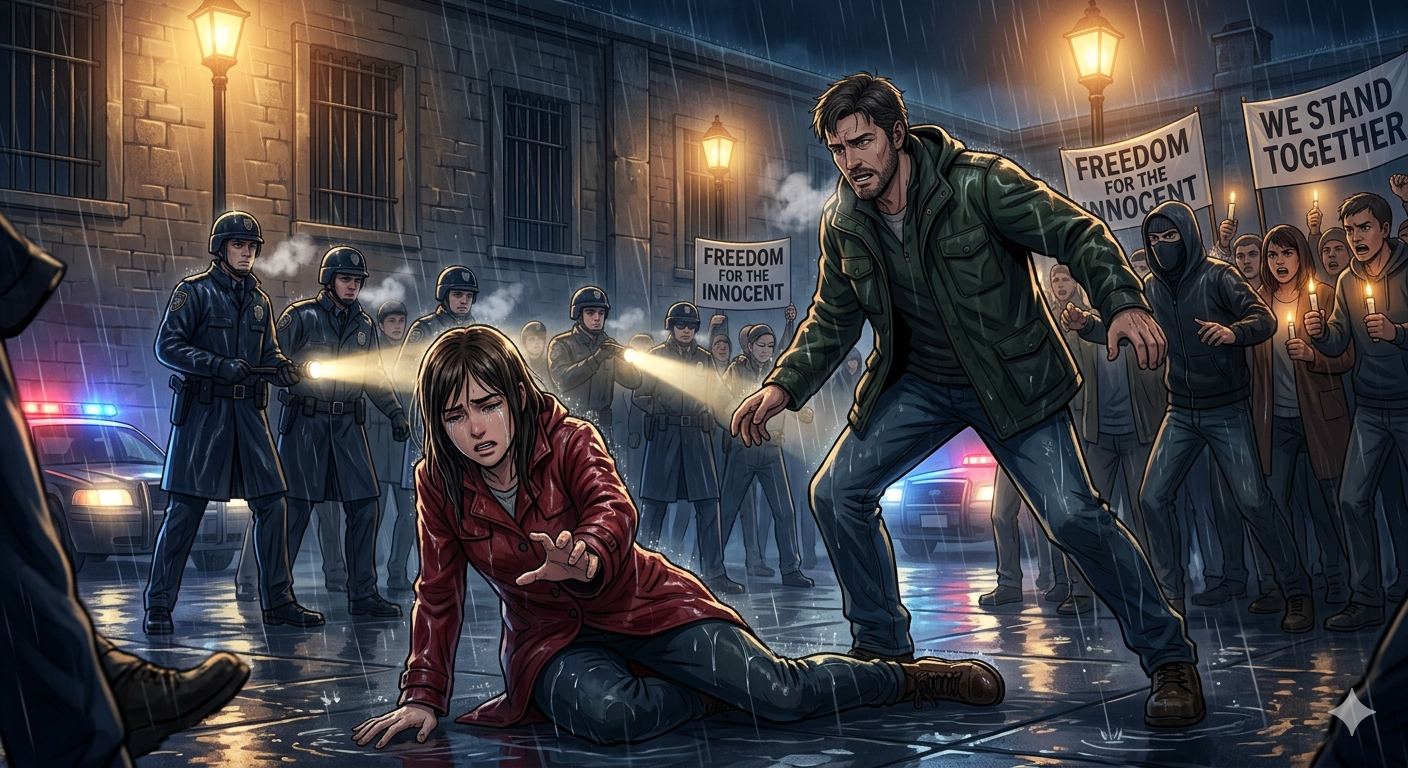
Short story: The City of Tails and Cradles
Laura, 32, worked as an advertising executive and had made her two dogs — Tobi and Nube — the emotional center of her home. Her routines, expenses and much of her joy revolved around them. Martín, her childhood friend, was 35 and the father of a four‑year‑old; his perspective on family life and daily priorities was different, though friendship kept them close. The building’s neighbor, an observant older woman, provided the viewpoint of someone who had watched neighborhoods and customs change over decades. And Tobi, though he did not speak aloud, filled the air with thoughts that only those present seemed to understand.
It was a mild afternoon when they met in the park. Laura, with the ease of someone who had turned walks into a ritual, adjusted a stroller designed especially for small dogs; Nube slept inside wrapped in a blanket. Tobi trotted at her side, sniffing every bench and every affectionate hand.
Laura: —Meet Tobi, the official spoiled one. Want a selfie for the feed? He has more followers than I do.
Martín watched from where his son climbed on the playground bars.
Martín: —Your dog has a social calendar and probably pays for more gym classes than I do. Aren’t you afraid this is… too much?
Tobi, with an even gaze, seemed to answer from his inner world.
Tobi (thought): *Too much? Too much what? Today I ate organic kibble and meditated for five minutes. I feel fulfilled.*
Laura laughed and settled Tobi beside her on the grass, defending her conviction.
Laura: —It’s not fear, it’s a choice. Raising a dog is more practical: they don’t ask for a phone, they don’t study for college… and I admit the naps are shared.
Martín, who did not deny the charms of pets, replied with paternal irony.
Martín: —My son asks for dinosaurs and asks impossible questions about the solar system. Tobi only asks me to open the balcony door at 11:03 sharp.
The neighbor, drawn to the conversation, approached leaning on her cane and observed with that mixture of nostalgia and curiosity typical of those who have seen schools and plazas full of children.
Neighbor: —In my day there were more kids than dogs. Now it seems dogs rule more than some politicians.
Tobi, who had discovered a wooden wedge to chew on, lifted his head as if to claim his place in the discussion.
Tobi (thought): *Politicians don’t understand the guilty look when I chew a shoe. Humans do.*
Later, the group moved to a nearby café. The conversation shifted from anecdote to interpretation; Laura introduced the phrase that had been circulating on social media and opinion pieces.
Laura: —People say “pet parenting” like it’s a trending topic, but it’s deeper than that. Many seek companionship without the long‑term responsibility clauses.
Martín set down his cup with a serious look, curious about the metaphor.
Martín: —Clauses? Do you mean emotional mortgages?
Laura nodded: —Exactly. Having a child today implies commitments projected for decades: housing, education, health. A dog depends on you, yes, but the pact feels different: there are clearer limits, different expectations. Also, biology and costs play their part: people postponed parenthood and many decide not to have children.
Tobi, grooming himself, allowed a remark from his canine perspective.
Tobi (thought): *They talk about biology. I only know that in winter they give me new socks.*
The neighbor, still holding memories of the neighborhood school and busy plazas, voiced the concern many mentioned on stoops and porches.
Neighbor: —Isn’t this a demographic problem? People ask about the future as if it were a series we all have to subscribe to.
Martín, who had dealt with scheduling and school logistics at work, addressed the issue pragmatically.
Martín: —Maybe. Fewer births change city design: fewer or smaller schools, plazas with different uses, social services that need adjustment. It’s more than a sociological anecdote.
Laura, who knew couples who postponed parenthood for work or financial reasons, offered another reading: cultural change.
Laura: —Or maybe it’s a natural cultural shift. People are rethinking priorities: more free time, jobs less compatible with raising children, the search for sustainability. Dogs, in that context, fulfill a real social role: they get people out of the house, create encounters, ease loneliness.
Tobi, proud, claimed his community contribution.
Tobi (thought): *I get people out on the street and fetch sticks. All good.*
The discussion stretched into the night. On Laura’s terrace the city spread lights and shadows; the conversation grew more intimate. Martín looked at the skyline with an expression that mixed affection and worry about collective future.
Martín: —What worries me is that we stop thinking long term. Who will support pension systems or meet health demand if the trend continues? I don’t mean to blame anyone, but planning matters.
Laura answered calmly and practically, proposing measures rather than blame.
Laura: —That concern is valid. But blaming those who choose not to have children isn’t the solution. We need public policies: affordable childcare, real incentives for motherhood and fatherhood, affordable housing. Also support for those who choose to raise children: more flexible jobs, leave policies, community networks. And accept that caring for a dog is not the same as raising a child, although both involve affection and responsibility.
Tobi, with the solemnity of an old (in dog years) sage, offered his analysis.
Tobi (thought): *Responsibility: walks, brushing, and don’t eat the plants. Also, listen when they cry at 3 a.m.*
From the window across the way, the neighbor recalled her past with a smile that mixed fatigue and tenderness.
Neighbor: —I raised five. Now I get photos of “pet‑kids” instead of grandchildren. It amuses me and makes me think: everything changes, but love always finds a way to show up.
On a later visit to the park, with the sun pouring warm tones across the grass, Martín summarized what he had learned over those conversations.
Martín: —Maybe in the end what matters isn’t whether there are more dogs or more kids, but learning to adapt the city and society for everyone: paws and hands included. Think of policies that integrate all kinds of families.
Laura, looking at the dogs sniffing, the children playing and the adults talking, added the everyday lesson that grew from coexistence.
Laura: —And stop judging other people’s choices. Everyone chooses their way of belonging. We must design a community less rigid and more open to different family forms.
Tobi, who had managed to scavenge a scrap of tuna from a lost pouch, closed his personal account with the satisfaction of a being who has found his place.
Tobi (thought): *As long as there are treats and hugs, I represent the canine hope for the future.*
The neighbor, as if toasting, raised her hand and offered a gesture that summed up acceptance and challenge at once.
Neighbor: —To the changes, to the solutions, and to the pet‑kids that force us to go outside more.
They all shared a laugh and a common “Cheers!” and, for an instant, the conversation ceased to be a debate and became the shared experience of people trying to order their lives amid deep transformations.
On parting, Laura spoke quietly, almost as a reflection to herself and the neighborhood: Fewer children, more dogs, or a mix of both — the phenomenon had only begun to reveal its consequences. The essential thing, she concluded, was to turn the debate into concrete actions that care for all kinds of families — furry or not — and allow the city to adapt: parks with room to play and run, labor policies that permit raising children, health and social services designed for changing populations. In the end, coexistence is measured in small gestures — a walk, a daycare, a public policy — and in communities’ ability to weave solutions that include everyone, whether they arrive with hands or with tails.
Source of the images.
Image created with Google Gemini.
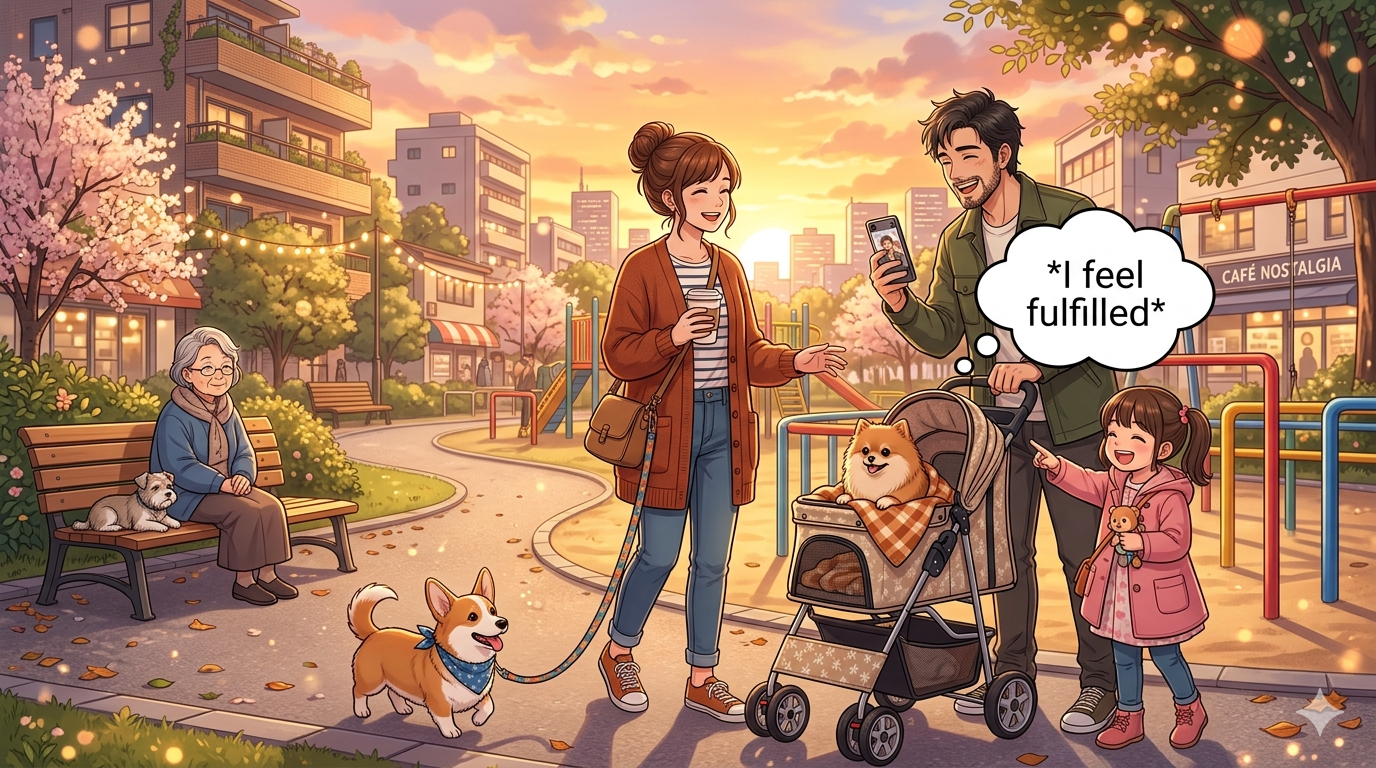
Short story: The Guardian
The boat brushed the pink sand at dawn with a whisper that seemed to hold centuries. Paolo placed his hands on the gunwale and let the craft rock until it stilled. He breathed deeply; the air smelled of salt, resin and something almost imperceptible: memory. He looked at the island spread out before him—soft hills, shrubs leaning into the wind as if trying to listen, a pine grove etched against the sky—and for a moment he thought of the door he had crossed without knowing if he would ever close it again.
He arrived out of curiosity in the late 1980s; not as a dramatic gesture, but like someone pausing to examine a map more closely. The city had given him much and taken from him at the same time: promises that slipped like sand, empty conversations that were more noise than comfort. At first he thought his stay would be brief, a few weeks to repair a tired spirit. Thirty-three years later, those who heard the story called it a legend: “the Robinson,” “the hermit.” His own life on the island did not admit grand names. It was simply Paolo, his footsteps, his home, and the time he learned to measure differently.
The first months were a school of humility. He had to learn to drink rainwater without paranoia, to tell which shells announced generous tides and which warned of treacherous storms. He built a cabin from old boat planks and a tarp found in a shipwreck. Every nail he drove rang like a ritual: to fix his place in a territory that did not belong to him and yet offered him a way to belong.
Unpredictable visits followed, each with its own scent of the outside world. One morning a young woman came in a small boat that she left at some distance so as not to invade the shore. She introduced herself with the pointed courtesy of someone who works with words: Marta, a journalist. She carried a small recorder that looked like a technological bone, a notebook full of questions, and a look for stories that expected to be big.
“You can’t keep going like this, Paolo,” Marta said the first time she sat on the sand in front of the cabin. “Living secluded doesn’t erase problems. It ignores them until they burst.”
Paolo looked at her calmly. His eyes, weathered by light and contemplation, had the slowness of someone who had learned to read days in the tides. At first his voice was a smoothed stone.
“I don’t want to speak to anyone,” he replied. “It’s not denying problems; it’s choosing by what sound I want to measure my life. The city shouts. Here I listen to what remains.”
Marta, who had seen the world turned into urgent headlines and moral microscopes, furrowed her brow and offered her counterargument with a certain haste.
“That sounds nice in a feature,” she said. “But you have to ask why you don’t return. Are you afraid of the chaos? Or does the thought that your silence won’t matter there terrify you?”
Paolo did not respond with indignation; his reaction was another kind of testament.
“The chaos there has clocks that command,” he said. “Here, time works differently. Hours peel away like shells; commitments and phones don’t chase me. I protect nature because it’s the only company that doesn’t demand empty words.”
Marta wrote in her notebook, not to correct him but because there was a tension worth following: someone who’d decided to measure his life with a compass slower than the world that labeled him “anomalous.”
Years braided small gestures: a couple left a box of seeds as if planting them were a promise; a child lost a plastic figurine that the tide returned again and again as if playing at forgetting; other visitors brought bread, books, tools. Each encounter became a thread connecting two universes: the island’s, where life was sustained by limited resources and silent rituals, and the city’s, with its voracious restlessness and haste to name everything.
One stormy night, when waves struck the shore with ancient fury, a boat ran aground in a nearby cove. Between broken planks and foam emerged a young man clinging to the idea of continuing to breathe. His name was Lucas. His skin was weathered, hands of someone who knew the sea, and a gaze that seemed to have lost the thread of its own story.
“Can you help me?” Lucas gasped, voice shaking. “I thought I was going to die out there. I couldn’t talk to anyone in the village. I felt… empty.”
With the calm learned from years of living simply, Paolo pulled a rope and then another to haul him ashore. There was no ostentatious heroism; just two men doing what necessity required. Once safe on the beach, they sat before the fire in the improvised cabin. Water dripped from their clothes, the wind still prowled, and the small hearth’s flames cast shadows that seemed to tell forgotten tales.
“Why did you come?” Paolo asked, curiosity without judgment.
“I wanted to run away,” Lucas admitted. “Run away from a promise I could no longer keep. But now that I’m safe… I don’t know if running is the answer.”
Paolo let silence settle between them, a silence that was not emptiness but a cloth on which to stitch words carefully.
“Solitude doesn’t heal broken promises,” he said. “Sometimes it wrinkles them. I don’t speak because I learned that words without listening turn to dust. But that doesn’t mean it doesn’t hurt.”
Lucas looked at him as if seeing something unvarnished for the first time.
“Aren’t you lonely?” he asked, his voice asking permission for tenderness.
“Of course,” Paolo answered. “Loneliness is a companion as certain as the sea. It reminds me I exist outside the noise. But at times, when the wind shifts, I feel nostalgia for voices I didn’t hear.”
Nights passed with a different tempo. Paolo occupied himself with small tasks that, together, sustained the island: mending nets, collecting rainwater in barrels, repairing the cabin. He planted trees, not from vanity but from patient foresight—to provide shade for those who might come later. He learned the language of birds and wind-swept signs; every bird bone he found told a lesson, and he listened as one listens to an urgent story.
Decades flowed, and his perception of time became a complex weave: some days ran like long, gentle rivers, others exploded in intensity. One day a letter arrived in his name—news from the city that compelled him to return. It was not nostalgia but a death: his mother had passed away. Not out of obligation but from an intimate duty, Paolo crossed the threshold and returned to the metropolis for the first time in years.
The city surprised him like a light switched on abruptly. The sounds were a multitude; voices a string of mirrors that reflected nothing of his own. He walked streets that felt too narrow for his new rhythm; buildings cast sharp shadows. He entered a bar where the wood smelled of coffee and damp, and there met Rosa, an older woman who smoked with the calm of someone who does not expect time to hurry.
“Solitude can be a choice, yes,” Rosa said, offering him a cigarette without asking. “But beware thinking choice saves you. Sometimes the choice becomes a gilded prison.”
Paolo took the cigarette, held it between his fingers, and thought of the word prison. He rejected it and accepted it at the same time, because he knew any choice carried consequences not always visible at first.
“I chose silence to listen,” he murmured. “Not to get lost in voices that say nothing. I wouldn’t call it a prison. I’d call it a refuge.”
Rosa smiled, not with approval but with recognition. In Paolo’s voice she heard the honesty of someone who did not pretend to hide his human side: neither hero nor martyr, simply a guardian of small things.
He returned to the island with the sense that something in him had been tuned: choices have prices. That the world leaves you alone does not absolve you from the responsibility of being alive, of responding when necessary.
In his final years he became an unspoken lifesaver for anyone at the mercy of the sea: he mended boats, nursed wounded birds, removed abandoned nets that strangled marine life. People from nearby isles began calling him “the one who guards the island,” a title he accepted with the same humility with which he accepted the winds.
Over time the bonds formed with those who visited grew firmer. Marta, the journalist, returned often and brought subtle changes: photographs, reports that sought understanding rather than sensationalism. She also brought her daughter, a child raised with the sea’s murmur as a lullaby. One warm afternoon the girl ran to the shore and dove into the water fearless, laughing so freely that her laughter became a poem the island understood at once.
“You have grandchildren, Paolo,” Marta joked, seeing the interaction. “Even if they’re not yours by blood.”
He leaned his back against the cabin wood and let the wind tell its secrets through his thinning hair.
“Solitude was a choice,” he said at last, staring at the horizon. “I still choose it. But it’s no longer a wall. It’s a way to care for what remains, to listen to the world without letting it impose its noise.”
In his last years the island became a place of continual small rescues: returning to the sea what shouldn’t be kept, fixing what others threw away, teaching anyone who stayed how to read the clouds. Paolo was no longer a solitary figure but a discreet epicenter of care. He buried seeds in the soil and marked them with stones; he planted young trees so the future would find shade.
When the body began to yield, it did so with the calm of one who has lived many seasons. There were no grand dramas. The end came like another tide, barely a variation in a pattern he already knew. The island kept its silence respectfully. There were no ornate speeches; the farewells were hands covering the earth with care. Under the oldest pine they placed a modest plaque that read: “He protected the small. He preferred silence.”
On the day of his burial, those who had known him approached one by one. Marta sat on the sand, staring at the notebook where she had written so many conversations; her notes now seemed inadequate. Lucas, who over the years had ceased to be the young man lost in the storm, placed a seed in the hollow where Paolo rested; he eyed it with the hope that something would grow there. Rosa lit a cigarette and let the smoke mingle with the pine’s breath. They spoke little—not from disinterest but because the moment demanded economy of words.
There were no moralizing lessons. Paolo’s story was not an exhortation to flee nor an apology for isolation. It was the memory of a man who, faced with the world’s clamor, chose to measure his life by the sea’s pulse. He taught those who visited that solitude can be refuge or prison depending on how it is held; that choosing also means accepting responsibilities; that silence, however noble it seems, requires attention and not indulgence.
Months later, when Lucas’s seed sprouted, a tender shoot emerged that the local children tended with solemn care. The island continued its existence with its usual rhythm: tides, moonlight, the return of birds in flocks. The small plaque by the pine still bore the words, simple and striking. Visitors took away something different in their minds: not a clear lesson but a question that grew more insistent the more they pondered it—To what extent is choosing solitude freedom, and at what point does it transmute into abandonment?
The answers remained open, because that was how Paolo wanted things: not dictated, but sown for those who wanted time and water to listen. And in the unease of that question, the island remained, as always, a way of measuring the world with calm.
Source of the images.
Image created with Google Gemini.
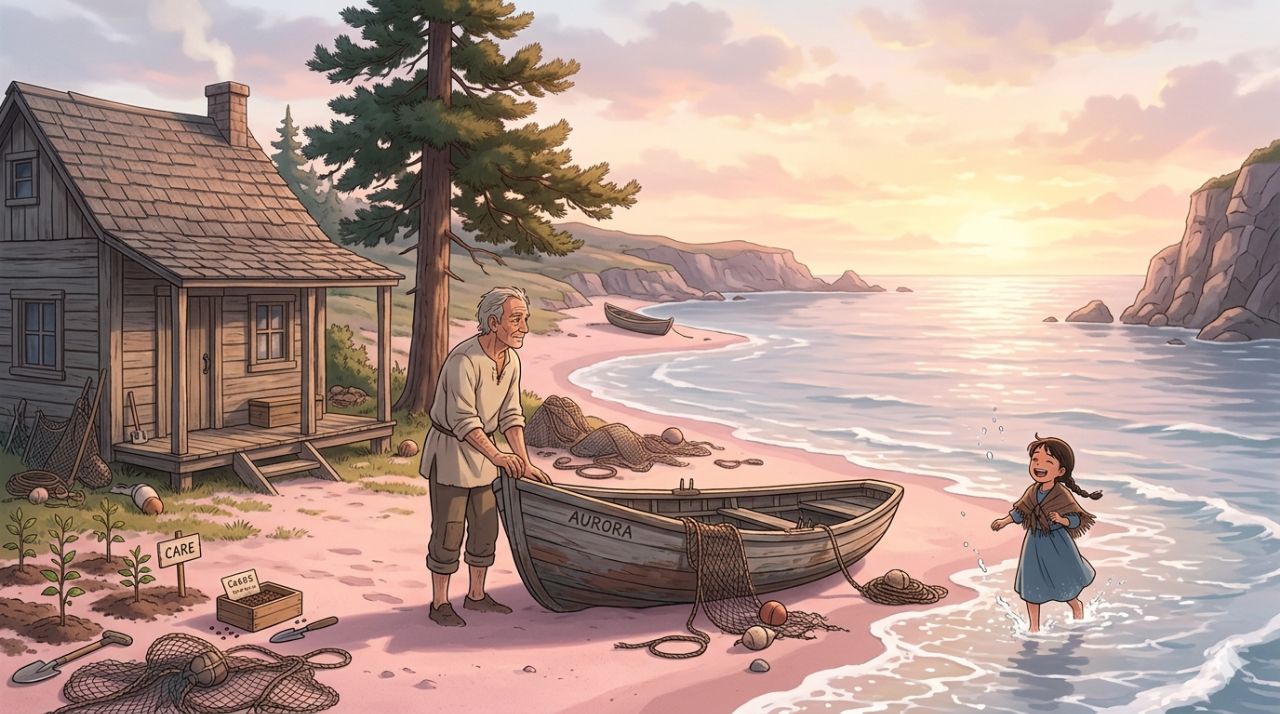
 @mc5punk