 @mc5punk
Short story: The Aisle of Respect: A Comedy to Ponder
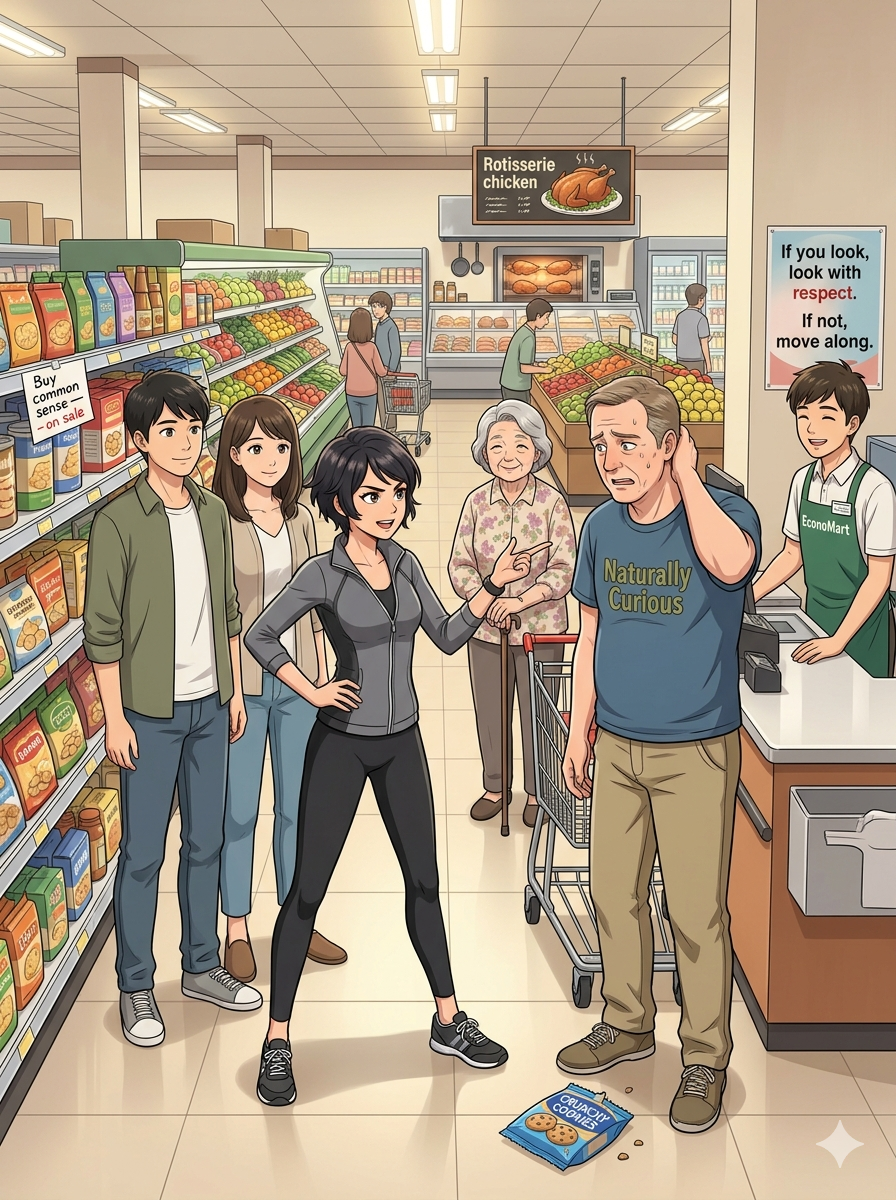
The line for rotisserie chicken at the supermarket "La Esquina" snaked between carts and promotions, and Doña Clemencia, the head of security, had already read the “No Smoking” sign three times as if she were reviewing a recipe so she wouldn’t forget a step. There was something ritualistic in her movements: checking the cameras, straightening packages, smiling with reserve. That afternoon the place buzzed with people: children with backpacks, grandparents with meticulous lists, and shoppers debating whether the brand-name coffee was actually on sale. Valeria walked in with purpose. She wore athletic leggings, a light jacket, and a tightly written shopping list: avocados, plain yogurt, whole wheat bread. Her practical goal was simple: go in, shop, and get home before the show started. But somewhere between the salad and dressing aisle, routine was interrupted by an uncomfortable look. The man wore a T-shirt that read “Naturally Curious.” He looked at Valeria with an expression that mixed surprise and moral entitlement, as if he had seen a work of art and fancied himself an authorized critic. It wasn’t a neutral glance; it was an inspection that weighed on her and left Valeria feeling as if her space had been invaded. “Ma’am,” the man said in a sports-commentator tone, exaggerating his inflection, “if they can’t look at you, then dress.” The aisle became louder inside than out for a second. Valeria felt the phrase like a blow that was really words. Then something in her straightened: that mix of indignation and humor that decides not to be a victim. Instead of staying silent, she pulled out her best weapon: organized sarcasm. “Oh really?” she replied, looking him squarely in the eye. “And where do you buy that ‘dress’? In the clearance section or at the boutique of other people’s morality?” The man blinked. He wasn’t prepared for his moral verdict to be met with a sharp question. His confident smile began to unravel. He searched the surroundings for an invisible accomplice to applaud him, but the patrons of public opinion don’t always find a safe audience. Voices and footsteps came from the back of the aisle. Marcos and Elena, a couple who had been arguing minutes earlier about whether the red apples were worth the price, saw what was happening and moved closer with the naturalness of people who refuse to tolerate someone else’s discomfort. Without theatrics, they positioned themselves on either side as if they were referees of a civility league. “Hey,” said Marcos in a tone that didn’t seek confrontation so much as clarify boundaries, “if you want to comment on fashion, go on Instagram. Here the only thing we comment on is prices and how not to make people uncomfortable.” Elena, with a calm that could split tension in two, added, “Besides, we sell respect here. It’s on promo: buy one, get one free if you wear it all day.” The man tried to justify his remark, feeling for excuses that sounded as flimsy as a slightly open cookie package. “It’s just… an observation,” he began, but his words turned watery in the face of collective firmness. At that moment Jorge, the cashier who had been watching from his register, stepped forward with a smile that was not complicity but local authority. “Sir,” Jorge said, nodding toward the continuing line, “if you want practice making comments, there’s a fashion critique club on Thursdays. Here we only criticize apple prices and coffee quality.” The chain of interventions had a curious effect: it deflated the man’s theatricality. Without an approving audience, his phrase ran out of fuel. He stumbled over his own speech and, in a clumsy move, dropped a package of cookies that rolled to the base of the shelf. No one shouted; the aisle exhaled. Doña Rosa, an older shopper with a cane and fingers hardened by city life, approached with steady steps. Her years had given her a precision of words. “Boy,” she said with the force of someone who can sum up decades in one sentence, “you don’t buy or receive respect: you learn it. And if you haven’t learned it, move along.” The response became a chorus of looks that, without more, invited the man to reconsider. A young man who had been recording discreetly with his phone put the device away. Not because he wanted to hide evidence, he later explained to friends, but because the scene no longer needed outside eyes: the community had spoken. Valeria retrieved her shopping bag and, with the air of someone who puts a period at the end of a paragraph, said quietly to Marcos, “Thanks… though next time I’ll let you guys intervene first; I tend to win the spontaneity lottery.” “Deal,” Marcos replied, smiling. “But bring the cookies if we agree to practice arguments.” “I’ll bring a sign,” Elena chimed in. “A small one that says: ‘Respect: wear it, don’t stare at it.’” The scene ended with soft laughter. It wasn’t comedy at the expense of the victim’s discomfort but a collective moment where the absurdity of the man’s attitude was funnier than threatening. Valeria paid for the avocados, pocketed her change, and headed for the exit. Before leaving, she stuck a printed note with tape onto the diet products shelf: “For anyone who thinks their look feeds opinions: buy common sense. It’s on sale.” Marcos read it and nodded; Elena took a photo of the note to send to a friend who organized community workshops. Days later the story spread on social media. Not as a grotesque spectacle to feed shame, but as an example of intervention: videos with messages of support, thankful comments for the solidarity, and practical suggestions. One user proposed installing small mirrors with the phrase “See yourself? — Value yourself.” Another shared a similar incident from her life, and several people suggested neighborhood civility workshops with concrete examples of safe ways to intervene. The comedy of the episode came from the ridiculous: a man who granted himself the right to judge someone else’s body and who, faced with collective response, was discredited by his own presumption. The deeper reflection was that respect is neither natural nor automatic; it is a practice learned and maintained with small, concrete acts that, when absent, allow uncomfortable or dangerous situations to flourish. Doña Clemencia, after the incident, added her own practical gesture. She used the office printer to make a sign and placed it by the register with supermarket-style lettering: “If you look, look with respect. If not, move along.” At first people smiled out of courtesy; then they started taking photos, sharing it in their stories, and mentioning it in neighborhood groups. The sign became a kind of daily slogan that, without dramatizing, made a minimal standard of coexistence visible. In the following weeks small initiatives sprang up: a group of neighbors organized a brief talk on safe intervention; a volunteer coordinated a workshop at the community center for young people on how to respond to harassing comments; a cashier at “La Esquina” printed cards with useful phrases for intervention — “Are you okay?”, “It’s none of your business,” “Move along” — and left them by the bags for anyone to take. Nothing heroic or institutional, just everyday practices that added up. Valeria continued to go to the supermarket in the same athletic clothes and with the same intact sense of humor. She didn’t seek the spotlight; she simply returned to her routine. But the difference was that whenever someone looked again with the wrong intentions, someone else would appear: Marcos, Elena, Jorge, Doña Rosa, the cashier who now knew a few phrases to use, a neighbor passing by. Not out of epic heroism, but because everyday solidarity is built with simple, repeated gestures. The lesson was clear, with no unnecessary adornment: comedy can spring from the ridiculousness of someone who believes they have the right to comment on other people’s bodies, and reflection arises when the community acts. Intervening — even with a clever joke, a steady look, or a phrase that sets a boundary — has more power than a thousand distant arguments. And as long as the supermarket exists — with its lines, its deals, and its signs — there will be chances to choose: look with respect or learn to look away. Source of the images. Image created with Google Gemini.
No comments yet