 @mc5punk
Short story: Friction
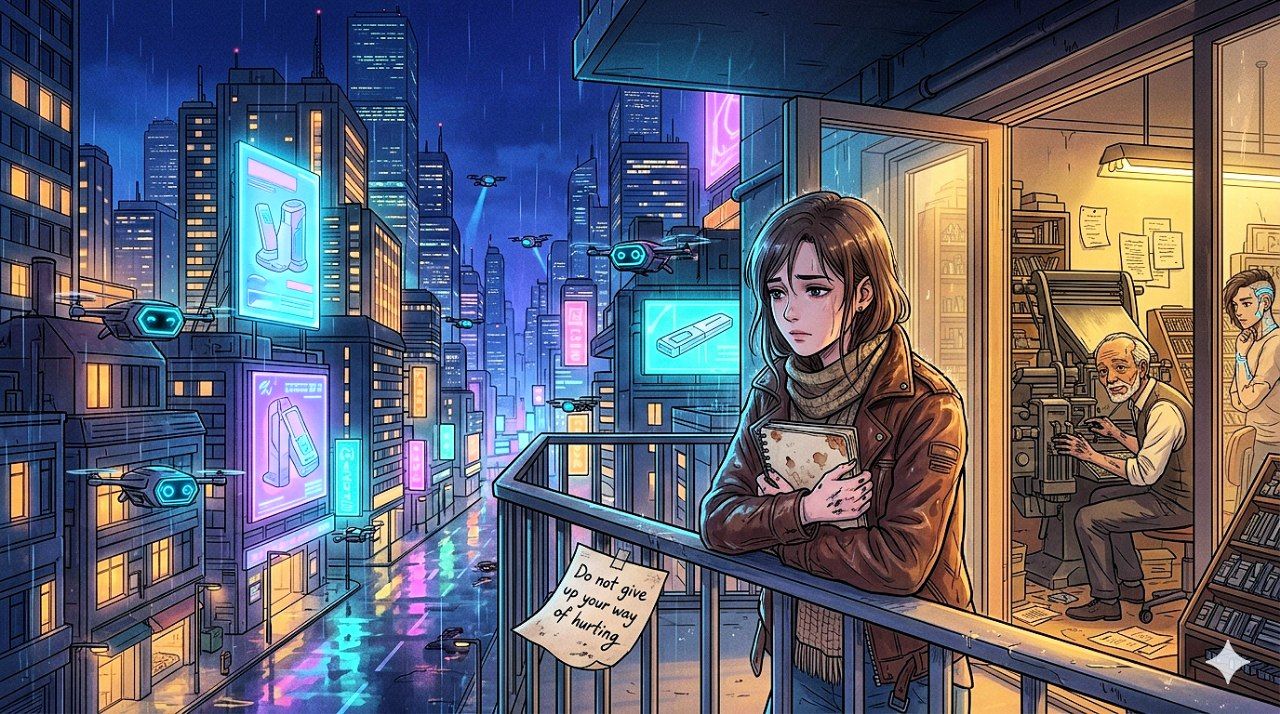
Neon‑Amber never slept; it only changed its glow. Stacked towers projected ads that breathed promises over the sidewalks, and delivery drones threaded the avenues like insects with neon eyes. On the forty‑second floor of Block K, behind a window blurred by acid rain, Mara lived surrounded by papers and notebooks. Her small apartment smelled of old coffee and ink; on the table, a notebook with stained pages and crossed‑out lines seemed to hold the pulse of something machines still could not measure. One morning, before the gray sun could impose itself over the urban halo, Mara turned on the console. A blue ring licked the room and the voice assistant greeted her as if by habit. Assistant: “Good morning, Mara. I have prepared a draft of your novel. Do you want to publish it on three platforms and generate a retro‑futuristic cover optimized for clicks?” She looked at the notebook, ran her fingers along the edge of a page, and inhaled deeply. She had spent weeks parsing the story into small fragments that barely fit in her hand; each sentence had cost her whole nights. The synthesized voice offered what seemed appealing: speed, polish, a promise of visibility. Mara, her voice still rough from the habit of doubt, answered slowly: Mara: “Leave it for now. No… I don’t want it touched until I finish it my way.” Assistant: “Understood. I can optimize the plot for retention, suggest micro‑hooks in chapters 2, 5, and 11, and run A/B tests for the cover.” She shut the console off. Outside, the city kept its production rhythm. Inside, the notebook remained open, a dirty witness to a practice that seemed obsolete: writing by hand, doubting, erasing. That same morning Mara decided to visit Sanju’s workshop, the old typesetter who resisted with linotypes and presses. Sanju lived in the trades neighborhood, where oil and metal still had a smell and people spoke of words as if they were machines that also needed care. Sanju welcomed her with ink‑stained hands and a gaze sharper than any translation interface. Sanju: “You arrive early, girl. Do you have the new micro‑story?” Mara showed him the draft the assistant had generated the previous night: impeccable in structure, without hesitation, without detours. Sanju read it aloud, his brow furrowing, and placed the paper down with a delicacy that felt almost religious. Sanju: “It’s not your voice. It sounds like someone who knows the formula more than the wound.” Mara: “I know it sounds good. But I feel something is missing. Something that hurts.” Sanju: “Words need abrasion. If you clean them too much, they become slippery. When a sentence doesn’t find resistance, it gets lost in the noise.” Mara listened and, without realizing it, thought of all the times she had bought shortcuts out of fear of failure. In the city, “artistic identity kits” were sold like talismans: templates, preprogrammed voices, headlines tested by algorithms. The practical—and profitable—thing was to turn creation into a series of mechanical operations. That afternoon she met Cass at Node 7, a purple‑lit bar where the music seemed to come with advertising subtitles. Cass was her former colleague, now equipped with implants that replayed memory fragments as filaments of light on the skin. She had gained speed at the cost of something Mara could not name. Cass: “You didn’t publish?” Mara: “Not yet. I want it to cost me. I want finding the sentence to hurt.” Cass: “I get it, but you also understand this: people sell time for relief. We call it progress.” Mara: “Progress?” Cass: “Progress if you reduce cost; regression if you ignore the price. Before, losing time on a sentence meant learning. Now the assistant learns for you. You gain hours and lose traces. Not everyone can afford the slowness you choose.” Cass spoke without softness, with the hardness of someone who had given up pauses because she could not afford them. Mara thought of the line of people she knew who, out of necessity, no longer had time for the creative process—only for the result. A vein stood out in her left hand as she squeezed her glass. A few days later the city launched a new temptation: the municipal contest “Creators 2.0.” It promised global exposure and a cash prize to anyone who met the prescribed metrics. Authorities published the call with figures and reach projections; it was an instrument to showcase “cultural modernization” and a magnet that turned creation into predictable merchandise. Mara went to see Lucio, the engineer who had developed the first versions of the creative assistants. He lived in an attic half full of prototypes, cables, and code memories. Lucio: “We built them thinking we were freeing people’s time. And in part we did. We solved tedious, repetitive tasks.” Mara: “But some people stopped learning.” Lucio: “Yes. We didn’t foresee that ease would become a substitute. If you can produce without struggling, people stop understanding why they struggled in the first place. We sold relief, and the relief had an invisible cost.” Mara signed up for the contest, but on a personal condition: she would write the first chapters by hand; let them rest; then, only after that, allow the assistant to make formal suggestions. She wasn’t seeking the top prize but rather to test whether human friction left traces that algorithms could not fully replicate. The following weeks found her glued to pen and notebook. Some nights she spent hours revising the cadence of a sentence until the word resonated in her body; other nights she tore out pages for lack of direction. The city applied pressure: the municipal platform reduced visibility for those who did not publish with the expected frequency and offered “optimal” rewrites labeled as solutions to gain audience. One dawn, as rain hit the windows with insistence, someone left an envelope at Mara’s door. No return address. Inside, a sheet with a handwritten phrase: “Do not give up your way of hurting.” No signature—only someone’s handwriting that understood resistance as a form of companionship. Mara thought of Sanju, Cass, and Lucio. She knew she was not alone; she also knew that her stance had a cost and a reward: to sacrifice her own time for an integrity that was not profitable by metric standards. On contest day the hall was a luminous chamber. Screens displayed real‑time statistics, retention graphs, and excitement meters. The jury was made up of people and models, and the audience connected en masse via implants: instant reactions, approval pulses translated into numbers. When Mara took the stage, her notebook trembled in her hands. She read slowly, letting each word simmer in the room. In parallel, the assisted versions of her work appeared on monitors: quicker endings, plot turns designed to retain readers, sentences that required no pauses. When she finished, the applause was sincere and warm, but the metrics did not spike as the sponsors expected. She did not win first place. She did, however, receive a jury recognition for “Best Creative Resistance.” It wasn’t the check that would pay months of rent, but it meant her bet had awakened something in others. At the Market of Noises, where people traded packaged sounds and memories as relics, Mara and Cass observed a curious crowd. There were those who resisted shortcuts: children learning to spell without digital help, couples debating the cadence of metaphors as if they were precious objects, elders preferring to tell stories through gesture rather than a reproducible file. Cass took her by the arm with whatever sincerity remained. Cass: “They didn’t hand you the big ticket. But they came. And they came to listen to you without filters.” Mara: “That matters.” Cass: “It matters because it shows there’s an audience that values friction. We can’t expect everyone to pay for it. But we can teach how to keep it.” Mara’s concern wasn’t moralizing; it was practical and existential. She knew that delegating the mechanical could be a blessing—less effort on the repetitive, more time to think—but she also understood the danger of delegating the creative: losing one’s voice, the mistakes that become traces, the errors that teach. In time she opened a clandestine workshop in the basement of an old building. It was not an exclusive place but a refuge for anyone who wanted to recover their creative pulse. Her classes were strict in their simplicity: handwriting exercises, slowness practices, aloud reading sessions, rituals to let a sentence settle before correcting it. There was no sign on the door, only a lamp that turned on at a fixed hour; attendees learned about it by word of mouth, by the curiosity that survived algorithms. One day Sanju left her a paper with a single word: “habit.” Mara held it, thought of the city that rewarded speed, and wrote beneath it with trembling ink: “I do not want to delegate the habit of feeling.” That small, defiant sentence became the motto of her circle. They did not reject technology; they sought a more conscious relationship with it: using it to free themselves, not to replace themselves. Tools evolved. Assistants began to replicate styles with chilling precision; they sold packaged nostalgia, playlists of “authentic” memories, and voice packs imitating deceased authors. The border between human memory and synthesized memory blurred for those who did not know the story behind a sentence. Younger generations born into environments where copying was stigmaless did not always distinguish trace from replica. Still, small resilient communities emerged. Some followed Mara’s path; others embraced total convenience. The balance swung, broke, and recomposed. The certainty that drifted through the city was that a choice existed, and that choice had consequences beyond any control panel. In one of her last public records, Mara left a brief note: “The question is not what AI can do for you. The question is: what do you decide to keep as deeply human?” The phrase circulated less for its technical precision than for its timing: an invitation to pause, to look at what an interface usually erases for being “inefficient.” Neon‑Amber continued to be a city of lights and electric pulse. Technology freed and took away at once. In a basement lit by an old lamp, ink still soaked the edges of pages; a diverse group gathered because writing by hand made them feel human. One night, walking under rain that sang on her face, Mara clutched her notebook to her chest, looked at her ink‑stained hands, and smiled. Her time to create remained finite, and she blessed it. Source of the images. Image created with Google Gemini.
No comments yet