 @mc5punk
Short story: The Revenge Pizza
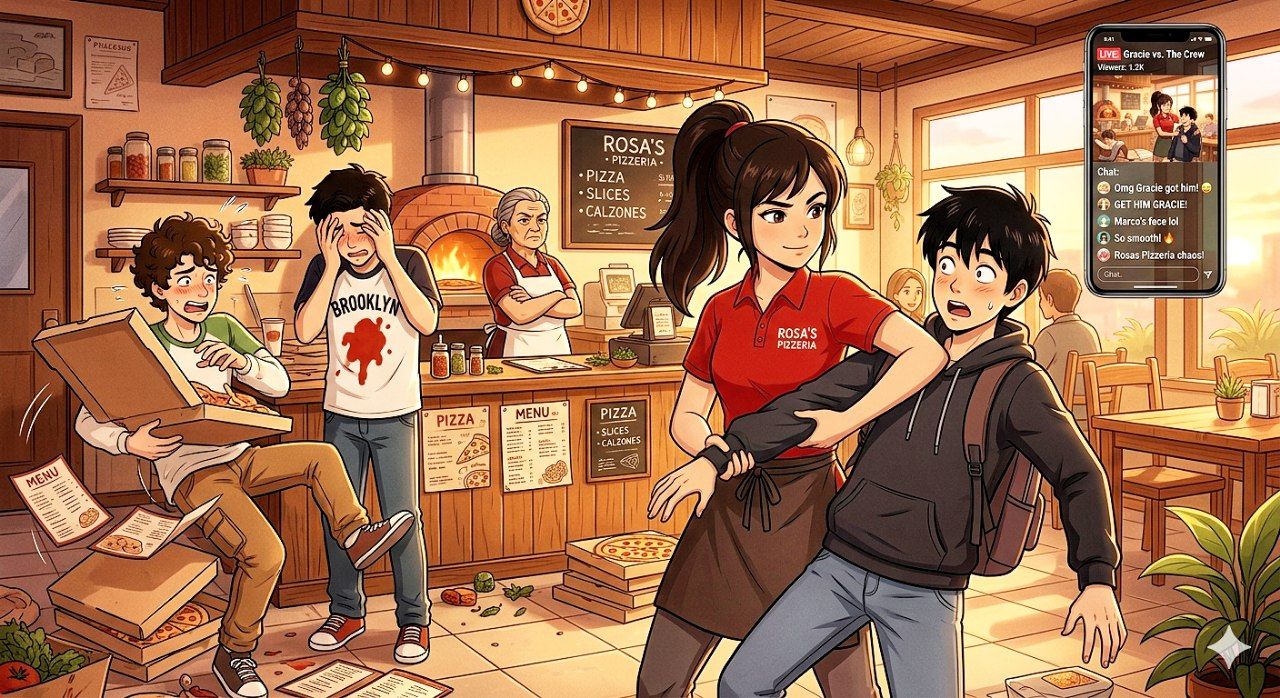
Gracie was a sixteen-year-old who split her time between classrooms and the oven of a small neighborhood pizzeria. That afternoon the shop smelled of roasted tomato, basil, and melted cheese; the counter had the soft sheen of late light and the bell above the door chimed on cue. Doña Rosa, the shop’s longtime owner, swept with the practiced motions of someone who had kept a family business running for years and watched the register with the calm attention of experience. “Be careful, my girl. You have an exam tomorrow, remember?” Doña Rosa said in the warm, protective tone she reserved for the young people who worked for her. “Yes, Doña Rosa. I’ll deliver and then study. Thanks for the push,” Gracie replied without stopping to arrange a couple of cardboard boxes; her smile was genuine, used to the household’s kindness. The bell rang again and five youths entered whom Gracie recognized by their gestures and laughs from the school corridors: Marco, a leader with pronounced eyebrows; Dani, always with a phone in hand; Lalo, who never missed an opportunity to exaggerate; Santi, quiet and nervous; and Carla, whose wavering expression made her steps uncertain. Dani held his phone pointed like someone who had already decided a scene would be content. “Today we’re going to make her trending. Ready?” Marco whispered with the confidence of someone who had already pictured the reward in likes and views. “I don’t know, Marco… This looks wrong,” Carla answered, the thread of doubt in her voice betraying her conflict between the need to fit in and the inner voice that knew what was right. “Relax, it’ll be just a prank. Who doesn’t love drama?” added Lalo, as if joking were the best alibi. Gracie watched them without fuss. She had trained calm into muscle memory on many afternoons at the municipal gym; the mat had taught her to move precisely, to pace her breath, and to separate adrenaline from judgment. She wasn’t wearing a fighter’s uniform—just her delivery shirt—but her posture revealed that discipline was as intrinsic to her as her smile. “Can I help you?” she asked, approaching the counter naturally. Marco offered her a calculated smile. “Yes, a large pizza. And then… some laughs with the delivery girl,” he feigned kindly. His words hung in the air like a crooked promise. They sat near the counter. Dani kept the phone recording; Lalo was already practicing an exaggerated pose; Santi stared at the floor; Carla toyed with her glasses. While Doña Rosa went into the kitchen to handle an order, the boys whispered their plan with the recklessness of those who believe virality erases responsibility. “As soon as she steps out, we surround her and record her,” Dani said with nervous enthusiasm. “Are you sure no one will see us?” Santi asked, cheeks flushed with tension. “I don’t like this,” Carla repeated, but her voice was not enough to stop the current. Gracie contained a small smile and, as if fielding yet another question about ingredients, recommended a house specialty. “Want a recommendation? The house special comes with extra basil,” she offered quietly. Marco returned the smile and ordered it for the group. “Perfect. You bring it to me, okay?” It didn’t take long for the moment Marco thought patience was part of the show. On the way out, he took advantage of a gap between the counter and the door to shove Gracie. It was a shove meant to be theatrical: just enough to unbalance her and provoke a reaction worthy of ridicule and applause. What Marco hadn’t calculated was the response born of years of training and, above all, the decision of a young woman not to let her dignity become a spectacle. “Don’t push me,” Gracie said, cold and firm. Marco pushed again, more arrogant than careful. That second shove was the spark: Gracie gathered the impulse with the calm that comes from knowing how to use another’s force. With a fluid movement, without fanfare or rage, she unbalanced Marco. Muscle and technique did the rest: she secured him in an arm lock that left him immobilized on the floor—respectful enough not to hurt him but decisive enough to show who was in control. Dani kept recording, disbelief written on his face. “No…! This wasn’t in the script,” he stammered, voice broken by surprise. Lalo, who tried to intervene to save his ego, ended up on the floor, his head spinning and his pride dented. Santi tripped over a stack of boxes and got tangled among cartons; Carla stood frozen, laughter and tears battling inside her. “Stop! Enough!” Carla cried, unable to hold back her sob. Gracie released the hold and remained on guard; her breathing was steady, her gaze calm. There was no hatred in her—only the clarity of someone who knows limits. “You wanted a show? Here it is: next time think about the consequences,” she said, the only sharp thing in an atmosphere that for seconds had been suspended. The livestream they’d turned on, thinking it would capture humiliation, did the opposite: viewers flooded the chat with support. “Who is this girl?” some commented. “Go Gracie,” others cheered. The narrative the attackers had imagined shattered into digital pieces, and reality imposed another reading: respect for the young woman who answered with skill and composure. Doña Rosa, who had come out of the kitchen at the commotion, crossed her arms with that domestic authority that didn’t brook nonsense. She planted herself in front of the kids with the look of someone who’s spent years running a restaurant—customers, discipline, and all. “What kind of foolishness is this in my pizzeria?” she asked sharply. “It wasn’t anything, ma’am,” Marco stammered, sauce stains on his shirt, his leader mask cracking under evidence. “Girl, are you okay?” Doña Rosa asked Gracie. “Fine and safe. Also hungry,” Gracie answered, as though tidying a small disorder and getting back to work. Lalo, trying to recover his comic figure, came out with a slice of pizza in hand and some cheese in his hair as an absurd trophy; Santi hid behind Dani. A plea came, trembling: Dani begged them to delete the video. “Delete the video, please,” he begged, voice trembling. Gracie stepped forward, firm but not angry. “Delete it now. And apologize to Doña Rosa,” she ordered. The weight of her words allowed no contest. That night, the social networks moved in her favor. The intended humiliation never arrived; most people celebrated Gracie’s composure. The school filled with looks unrelated to the prank Marco had planned; the pizzeria received calls from curious customers and from the local police requesting statements. Doña Rosa recounted the incident plainly: she had defended her shop and protected an employee. Marco watched his phone overflow with messages and reactions that hurt more than any scolding; Santi carried guilt that made his silence heavy. Carla could not live with the guilt. The next day she asked to use the school meeting to speak. The auditorium, full of murmur, fell silent when she took the microphone with shaking hands. “I was wrong. I ask forgiveness from Gracie and everyone I hurt,” she said, voice breaking at times. The courage to confess the truth cost her, but it opened space for repair. Gracie, listening from another part of the hall, knew that forgiveness didn’t erase the harm, but it opened a door for things to be made right. The pizzeria, far from suffering the scandal Marco had imagined, gained visibility. New customers came out of curiosity and stayed for the quality; the local press called for an interview with the young woman who had responded with character. Gracie accepted the attention on one condition: she would only speak if she could turn the episode into something useful. She proposed giving a self-defense class to neighborhood youths so technique would not be an excuse for fighting but a tool for prevention and confidence. In the school gym, mats spread out and curious young people assembled, Gracie demonstrated basic moves: how to fall safely, how to free oneself from a grip, how to use breathing to calm the mind before acting. She taught simply and patiently; her style was educational rather than militant. “It’s not like the movies. Don’t look for fights; look for preparation. If someone sees something odd, talk to an adult,” she said, and the words landed because they came from experience, not rhetoric. Marco attended that class, uncomfortable, head lowered. Maybe he expected revenge; he found a different lesson: responsibility. At the end he approached her privately. “I’m sorry. I let myself get carried away,” he muttered without pretense. “Fix what you can. Start by giving sincere apologies and learning,” Gracie replied, looking him straight in the eyes. She did not offer absolution but pointed him toward making amends. Over time, the pizzeria institutionalized the story. They added a new item to the menu Doña Rosa jokingly named “The Gracie”: more basil, a hint of garlic, and a presentation honoring the episode. They hung a sign on the wall that read, “Training and good food—no foolishness.” The community turned that instant into an anecdote that came with changes: Lalo ended up as a delivery driver and still tripped with comic timing; Dani decided to focus on ethical filmmaking and now produced shorts that didn’t exploit anyone; Marco took classes on responsibility and social media and learned that easy fame has a price; Carla organized talks on peer pressure and the importance of saying no. Gracie continued her life: classes, training, work. She signed shy autographs for those who recognized her at the pizzeria and taught that well-directed strength is an act of care, not a display. One day Lalo, with his perennial disorder, came to the counter with cheese stuck to his ear and asked with half a smile: “Can I have a free slice for services rendered?” Doña Rosa shot him a wink and a fond sentence: “Free? No. Wash dishes for a week.” Gracie watched the scene, allowed herself to laugh, and capped it with the lesson that had turned that night into teaching: “First theory, then practice.” The oven kept firing pizzas, the register kept ringing up sales, and the neighborhood remained a neighborhood. Something changed in how the youths looked at one another, and in how Gracie walked down the street: with the certainty of someone who knows how to defend herself and, more importantly, who knows how to use that ability to stay calm, set boundaries, and teach others to do the same. The End. Source of the images. Image created with Google Gemini.
No comments yet