 @mc5punk
Short story: The Silence of the Classrooms
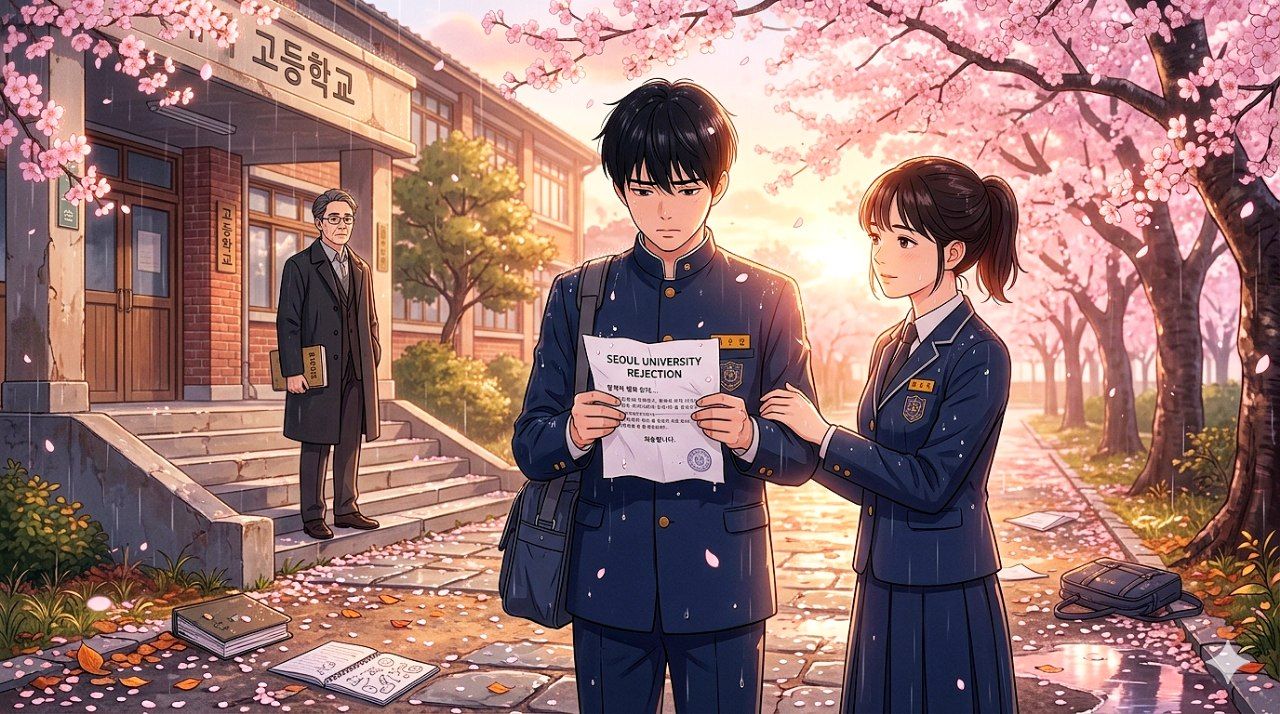
The letter arrived on a warm rainy afternoon, when the cherry trees were beginning to shed their petals as if surrendering to the passing season. Min-jun held it with hands that trembled not only from the sudden chill of the paper but from a mix of disbelief and shame that knotted in his chest. The printed lines, mechanical and final, confirmed what had already circulated in whispers: for the first time, the country’s leading universities in South Korea had rejected 45 students with excellent grades because of verified records of school bullying. The impact of that sentence hit Min-jun like a wave of returning memory. Scenes from adolescence came to mind: the laughs that once seemed harmless, the jokes that escalated into humiliation, the time a classmate was left motionless in front of others and he, without thinking, joined the mockery. That youth he had framed as strength now felt like a string of small betrayals. He had never imagined that his high grades might not be enough to open the doors he had dreamed of. The house smelled of hot soup and open books, a tidy home heavy with the expectations that had driven him for so long. His mother entered the kitchen with a cup in her hand; she did not need to read the letter to understand the silence that accompanied him. They sat at the table, and for a moment the clock seemed to rewind, restoring the years when Min-jun scribbled verses in a worn notebook while his mother sewed by the window. “Is that…?” she asked without lifting her eyes from the rice she was serving. “They rejected me,” Min-jun replied, placing the envelope on the wood of the table as if depositing part of his guilt there as well. The news spread beyond the neighborhood. Weeks later, Soo-yeon returned to the town. She arrived with her hair tied back and a calm that was not indifference but the serenity of someone who had assumed her own wound and turned it into action. Soo-yeon had witnessed, from different fronts, the awakening of voices that previously had not dared to speak; her commitment to preventing school bullying had made her a presence that knew how to listen before judging. “I read it in the news,” she said when they met. “They say it was forty-five. They say that finally… something more than grades was prioritized.” Min-jun looked at the garden where the shadows of the trees cast elongated shapes over the lawn. Soo-yeon’s words seemed to be a key opening a door that had been closed for years. “My grades were never the problem,” he answered, his voice weighed down by painful honesty. “I thought that achieving the best grades would be enough to justify everything else. Now I know it wasn’t.” Soo-yeon did not reprimand him. Instead she let her hand find his, and in that touch she conveyed a forgiveness that was not immediate absolution but the possibility of starting over. That small gesture contained more than words: it convinced Min-jun that repair, however slow, was possible. Professor Han, his former teacher, summoned him to his office a few days later. The place smelled of old paper and ink; the shelves held treatises on moral philosophy, jurisprudence, and ethics. The teacher spoke with the measured cadence of someone who had watched generations repeatedly commit the same mistakes; his voice did not seek to condemn but to ignite an understanding that would endure. “Education is not a trophy to hang on the wall,” the professor said. “It is a responsibility. The universities are sending a clear message now: grades matter, but character and respect matter even more.” Min-jun felt that statement as both a sentence and an opportunity. He lowered his head and admitted without theatrics, “I thought academic success would redeem me. I did not consider how much harm I had left behind.” Professor Han offered no hollow consolation. He spoke from experience and candor, recalling his own small youthful transgressions—those that never became public—and that in their way also required atonement. He proposed a concrete path: active repair, participation in workshops, collaboration with those harmed. “You can begin by repairing what you can,” he suggested. “Apologizing doesn’t erase, but it opens doors. Teach, work with those who suffer. Let your actions change your story.” Accepting that route meant Min-jun giving up shortcuts and immediate rewards. The first steps were awkward and disorienting. He had to learn to apologize without the words sounding hollow; to listen without interrupting; to remain in rooms where others’ narratives were painful and his role was, for the first time, secondary. He joined support groups, attended meetings with victims who looked at him cautiously, and took part in workshops where concepts like “empathy,” “responsibility,” and “restitution” ceased to be abstract and became daily practice. Some apologies were rejected outright; others were met with a slow opening measured in gestures rather than declarations. Min-jun discovered that repair is not a single act but sustained effort: small commitments that accumulate until they form a credibility that formerly did not belong to him. Nights brought nostalgia. In the stillness of midnight, when the city quieted and distant noises faded, he reviewed his notebooks: physics and math formulas he still mastered, poems he had once written with a carefree hand that now struck him differently. A sharp ache hit him whenever he thought of the other forty-four young people also marked for the same reason; he thought of how society, seeing those lists of rejected students with brilliant records, began to reassess priorities. In autumn, Min-jun returned to the classroom where he had once been a student. He did not expect admiration; he came intending to speak from the truth of his experience. The students watched him with curiosity and wariness. He spoke plainly, without embellishment or arrogance. He told his story with the pauses needed for each listener to place their own judgment in perspective: he spoke of the weight of guilt, of the daily labor to rebuild trust, of the times his will faltered. After the talk, a student stepped forward and asked in a low voice, “How did you learn to apologize?” Min-jun answered with the same frankness he had lived the previous months, “I was taught that apologizing without changing is theater. So I started by changing.” Soo-yeon, seated at the back, applauded quietly. It was not an applause of easy celebration but a confirmation that something in the collective memory had shifted; institutions had set boundaries, and the community was beginning to rethink its values. Time did not erase Min-jun’s scars. There were days he woke feeling he had regressed. Still, he learned to measure his progress in small consistencies: the hours spent accompanying those who had suffered, the earnest conversations he once avoided, the renunciation of shortcuts he had once felt entitled to. He understood that personal transformation is slow and that sustained coherence, more than a single gesture, defines the sincerity of repair. One afternoon at home, his mother looked at an old photograph in which Min-jun held a medal. Her eyes, part tenderness and part worry, let fall a sentence that summed up the family’s new perspective: “Your grades always made us proud. But I am glad that now you care more about how you look at others.” He replied with a smile that held sadness and tenderness together: “What I most hope is that someone who suffers today will remember in twenty years that there was someone who listened.” The public reverberation of the forty-five rejections was not fleeting; it became a foundational chapter for a generation that began to measure success by new rules. Some of those rejected undertook long processes that allowed them to reapply years later with morally rebuilt records; others discovered vocations outside the traditional university route and pursued them instead. Classrooms began, first timidly and then more clearly, to open spaces dedicated to ethics, bullying prevention, and community repair. Min-jun never sought to erase his past. He learned to live with it as one lives with a lesson that hurts but teaches. Beneath cherry trees that were no longer naive, he continued to go to the school where he had once been a top student and now dedicated hours to teaching what he had learned with cold clarity: the necessity of looking at others with respect, the value of listening, the strength of responsibility. His goal ceased to be a place on a brilliant transcript; his ambition transformed into something humbler and deeper: to deserve the trust of those around him. Over time, in the small town and in more distant classrooms, the story of the forty-five rejected students remained a turning point. Many remembered that moment not as a final punishment but as the spark that forced practices and priorities to be rethought. Min-jun, for his part, continued his daily work, aware that true education is not measured solely by grades but by how a person regards themselves and treats others. In that daily labor, in those repeated gestures that weave the fabric of trust, he found a possibility of redemption that did not erase the past but gave meaning to the future. Source of the images. Image created with Google Gemini.
No comments yet