 @mc5punk
Short story: The Home Guardian
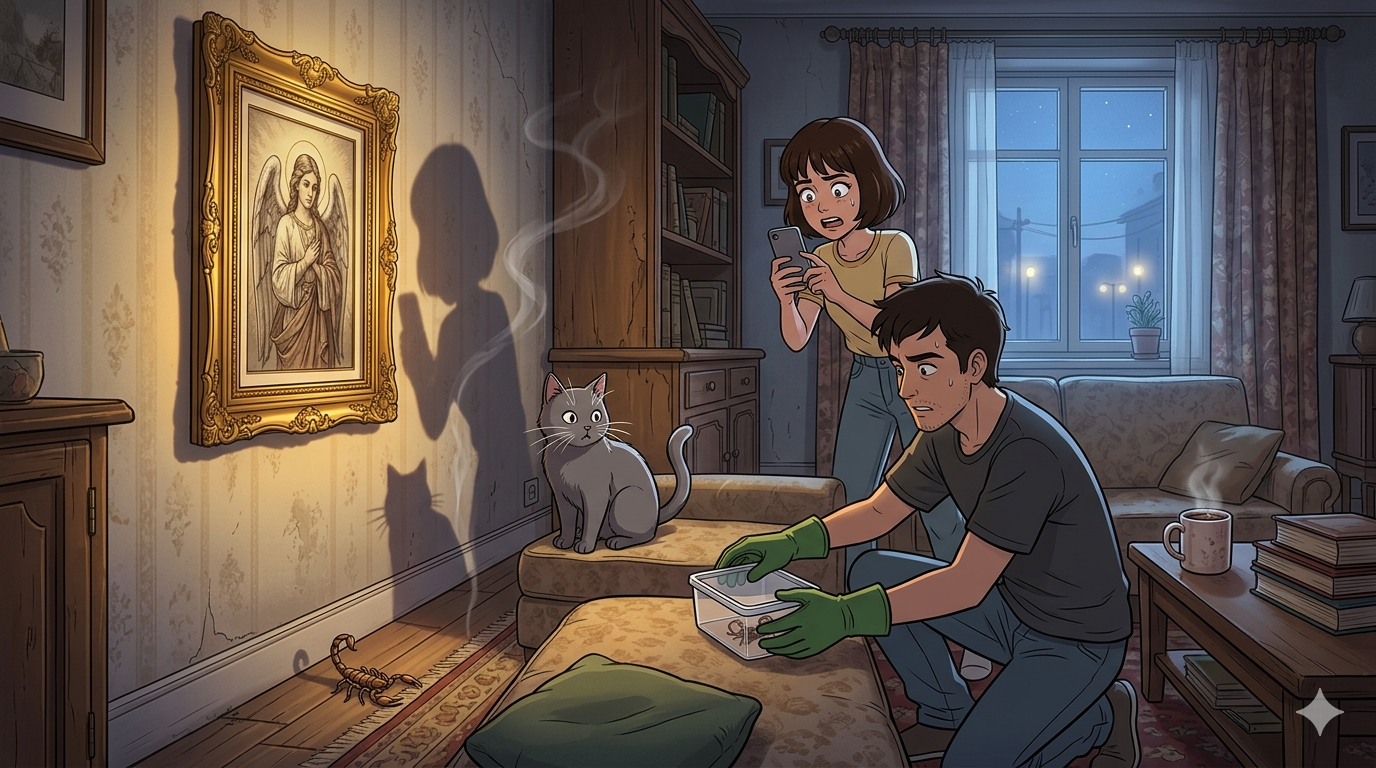
The house on Jasmine Street seemed to live in another era: varnished furniture worn by time, curtains that had learned to filter the afternoon light, and the persistent smell of freshly brewed coffee mixed with the stale incense Marta lit when she needed to think. In the living room, on a wall that had known more hands than paintings, hung a religious image in a gilded frame. The gold, now slightly dulled, cast a long shadow that, to Marta, had always given that corner an air of mystery. That afternoon the López family was gathered in that room. Marta, phone in hand, could not stop watching Lila, the family cat: compact, gray-furred, with whiskers that looked like they sketched philosophical theories in the air. Joaquín, her husband, fiddled with the TV remote out of habit rather than interest. Lila had planted herself in front of the frame with a focus that turned her into a living sculpture. "Mom, come," Marta said softly, calling Joaquín with a slight gesture. "Lila is… she looks like she's praying." Joaquín set the remote on the table like someone putting down a small treasure. He approached, curious but skeptical. The phone vibrated subtly as Marta filmed: Lila sitting, motionless, eyes wide and fixed on the image. The frame's light flashed on her fur, and for a moment the whole living room seemed to hold its breath. "Mystical, right?" Joaquín commented, trying to inject calm with a joke. "We could add heavenly music and upload it." Marta smiled without stopping the recording. Lila blinked slowly, as if evaluating the quality of a sermon after centuries of practice. Marta zoomed in, searching for the shot that best captured that odd feline solemnity. They already imagined the comments: #homeguardian, #felineMiracle, #whiskerprayer. Then, without warning, something changed. Lila tensed. Her tail, previously relaxed, began to move with the precision of a metronome. The cat's eyes never left the right corner of the frame. Marta frowned. The scene shifted from charming to alarming. "Do you see anything behind it?" Marta asked in a whisper, as if any noise might scare whatever was there. Joaquín leaned in and inspected the wall. At first glance there was nothing but an old stain, the corner of the picture, and the flaking texture of the paint. Still, Lila did not blink. Her whiskers trembled with an ancestral tension, as if guided by an old memory. A dry sound — minimal but distinct — broke the pause. Something small moved, a faint scrape and then a crack. Lila launched into a precise leap; her body described a perfect arc and struck the wall with the accuracy of one who has practiced a thousand times. There was a thud, a dull complaint; whatever had been hiding fell to the floor and writhed with urgency. "Mother, oh my!" Marta exclaimed, startled. "What was that?" The creature refused to be immediately identified in the dim light. Joaquín, pinching the edge of the phone to use the flashlight, knelt with the solemnity of an explorer discovering a relic. With the beam aimed, the family could see what Lila had been staring at: a scorpion of respectable size, lying on its side but still alive, legs poised as if in combat. "A scorpion!" Joaquín said, part horror, part strange admiration. "Home guardian, we owe you a dinner!" Lila, now proud of her discovery and slightly offended at being exposed, meowed in a tone that could be read as: "It was my job." She extended a paw and, with the delicacy only a cat possesses, tapped the scorpion's tail with a toe to check it was still there and to assert who ruled the house. Marta, always the pragmatic one, reacted immediately with a firm voice. "We're not going to kill it," she declared. "We'll take it outside, far away." Joaquín furrowed his brow, hesitated a beat, then nodded. He put on gardening gloves and grabbed a plastic lid to improvise a temporary cage. The domestic operation carried a comic air: the man who had joked minutes before now moved with the seriousness of someone holding responsibility. Lila watched every maneuver like a trainer evaluating her team's performance. As Joaquín approached with the lid, the scorpion made a final strike — a desperate swipe that hit the lid and caused a collective startle. For a moment the family contained laughter and fear in the same breath, a shared vulnerability. With extreme care, Joaquín carried the captive to the back door. The moon, round and discreet, seemed to witness the operation. In the garden they tipped the lid onto a bed of dry leaves and, with a precise movement, released the scorpion. It vanished into the shadows like a knight accepting his fate, knowing the night would shelter him. Joaquín returned to the living room with slightly trembling hands, but his eyes held a triumphant gleam. Marta reached for Lila and scratched the back of her neck. "Not all heroes wear capes," Marta murmured with tenderness and humor. "Some wear whiskers." Satisfied by the attention, Lila settled onto the sofa cushion as if reclaiming her throne after a victorious feat. Marta reviewed the video, smiling and trimming the segment where Lila appeared to pray before uploading the clip to social media with a playful caption and emojis so the world could enjoy the domestic heroism. The next day Marta's phone wouldn't stop buzzing. Messages, hearts and comments flooded the screen: astonished people, admirers, and some memes that portrayed Lila with a digital halo. Among the notifications appeared a different message: "That scorpion looks odd. Could it be venomous?" with a link to a local wildlife forum. Joaquín, driven by cautious curiosity, opened it and read an expert's description: a possible regional subspecies whose sting was painful but rarely fatal to adults if treated promptly. "Well," Marta said, accepting the reassurance with relief, "we were lucky. And we had Lila." That evening's dinner took on the tone of an epic ballad told as comedy. Joaquín recounted the capture like the climactic scene of an action movie, dramatizing each maneuver; Marta added sound effects to heighten the drama; Lila licked her paw between ovations, savoring fame like an actor receiving applause. Laughter filled the house, clearing away the leftover tension. Later, after the house had quieted and the lights were dim, someone knocked on the door. An elderly neighbor stood there with a box of homemade cookies and a story in his eyes. "I heard the neigh of the valorous cat," the man said, voice full of nostalgia and mystery. "When I was a boy, my grandmother said cats have pacts with the house. They protect those who live there." Marta smiled and offered him a cookie. Joaquín, more down-to-earth, shook his head and murmured: "Or maybe they just like weird bugs." The neighbor laughed and, before leaving, in a theatrical tone dropped one last warning. "Take care of the picture," he advised. "Sometimes what looks sacred is only a good hiding place." The following weeks passed calmly. Lila's fame faded to a pleasant memory; life returned to its routine of calls, work, and family chores. There were small domestic triumphs — a spider fleeing before the cat's stare — and fewer surprises. Then one afternoon Marta noticed something that alarmed her: the wall by the picture had developed a new, small dark crack, as if something were trying to emerge. There was no panic, only methodical planning. The family gathered tools, a stronger flashlight, and, of course, Lila. Joaquín, now seasoned in "domestic rescue ops," borrowed an inspection camera from a neighbor and fed its tip into the gap. On the tiny screen a shadow moved, quick and furtive, confirming the problem had not vanished. "Another one?" Marta murmured, alarmed but calm. "Maybe not just one," the neighbor replied, arriving with a bag of seeds and a conspiratorial smile. "The wall has a life of its own." Lila did not hesitate. This time she leaped with contained grace, careful not to break anything. She sniffed and with a short resonant meow pinpointed the exact entrance. It was as if the cat had studied the house's invisible blueprints. The family worked as a team: Joaquín enlarged the opening carefully so they could manipulate it without causing further damage; Marta placed a padded box on the floor for any eventualities; the neighbor held the flashlight at the right angle; and Lila supervised every move with the concentration of a general on the eve of battle. They discovered not an army of scorpions but a small colony of nocturnal insects that, moving together, had attracted one or two juvenile scorpions hunting for prey. The problem was less apocalyptic than imagined but enough to justify a cleanup and relocation operation. "Action and humor," Marta said between laughs as they worked. "We have everything." Gently and patiently they moved the insect colony into a planter far from the house and sealed the crack with appropriate materials. As a symbolic gesture they relocated the religious image to a different wall, higher and away from any potential hiding spot. Lila watched the move with feline disdain, as if the painting were a tasteless rival. That night, while online notifications still praised the feline heroine, Marta wrote a note and tucked it behind the frame: "No miracles here, only vigilance." Joaquín, with his usual humor, added in crooked handwriting: "And food for Lila, just in case." The house returned to its usual rhythm. Neighbors exchanged anecdotes and Lila's fame was reduced to a caricature-style postcard an artist from the area sent them: a caped cat with scorpions fleeing in an exaggerated panic. They pinned it to the kitchen wall as a memento of that night that mixed fear, pride, and laughter. Months later a fierce storm opened a small leak in the roof. The drip approached the new frame. Lila, who now patrolled with almost ritual professionalism, descended the stairs, leaped onto the table and planted herself in front of the drop that formed a faint ring on the wooden surface. Her posture was solemn and watchful, as if daring the rain itself. "Back in guardian mode again?" Marta observed with tenderness. Lila closed her eyes and let out a low meow that, if translated with human license, meant: "Always." In the dim light, with rain tapping out stories on the windows and the scent of hot chocolate filling the air, the family gathered once more around the table. They had survived a scorpion, fleeting viral vanity, and their own flair for drama. They had learned that a house's mysteries were rarely supernatural: often nature was merely seeking refuge. And when that happened, the most reliable and charming ally tended to be a whiskered cat with declared courage and an unbeatable sense of comedic timing. "Let's toast to the guardian," Joaquín said, raising his mug of hot chocolate with mock solemnity. "And to domestic miracles," Marta added, clinking her cup against his. Lila blinked in approval, and in the shadow by the frame a shape traced itself for an instant that could have been the silhouette of another adventure. No one in the house was surprised: they had learned to expect the unexpected, to work together, and to laugh when needed—because in their home, vigilance and humor walked hand in hand. Source of the images. Image created with Google Gemini.
No comments yet