 @mc5punk
Short story: The Great Loo Harem
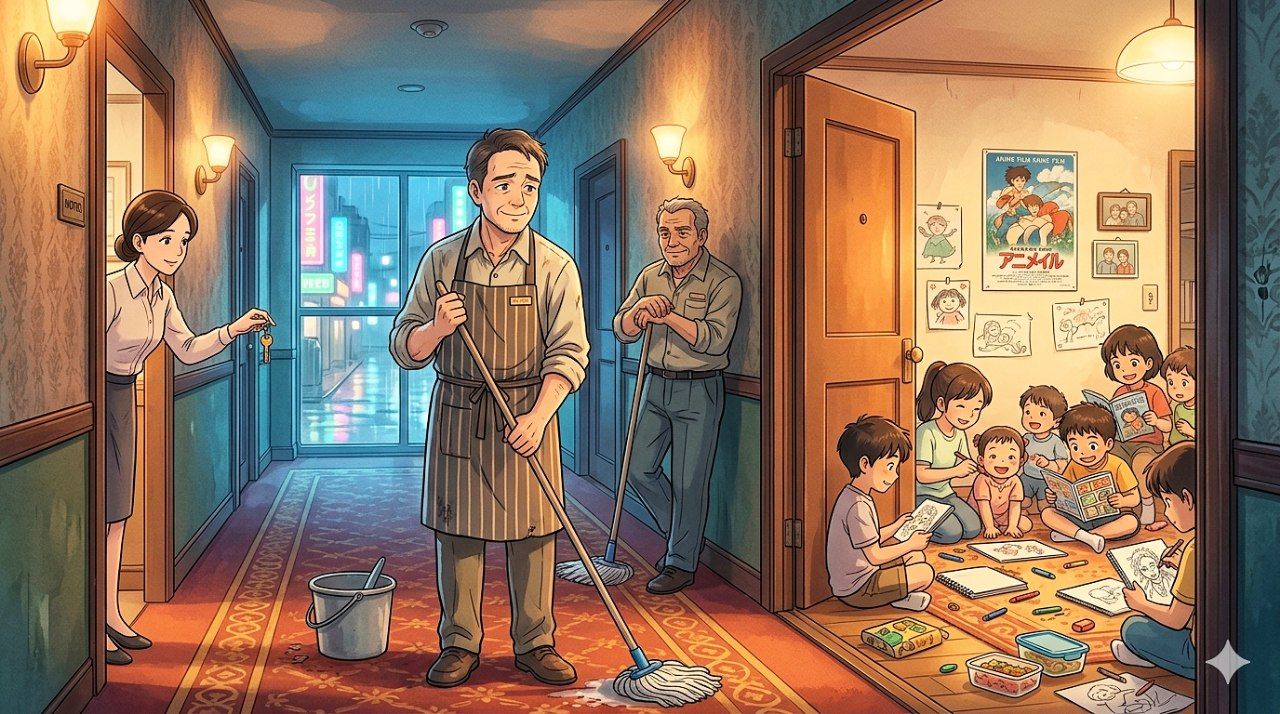
It was a gray, damp morning in Minato-Aurea. The streets smelled of recent rain and fuel; the neon lights still flickered as if they were sleepy. Kenji Arakawa gripped the broom handle with his gnarled hands and looked down the avenue from the back window of Hotel Amapola. His apron, once white, now bore maps of soap streaks and small constellations of dust. He brushed a hand over the ponytail that kept losing strands every time life or time demanded a change. “Suite three hundred again?” asked Haru, his shift partner, leaning the mop against the wall with the gravity of someone who knows every corner of the hotel. “That one smells like cheap perfume and broken promises.” Kenji smiled with that tired, proud smile. “At least it smells like life,” he answered, as if the phrase could ward off melancholy. “And today’s Sunday: the kids are coming.” Haru snorted and rubbed a small lucky talisman in his pocket. “I’ve lost count of how many Sundays you say the same thing,” he said. “Do you still do the old-hero voice for the stories?” “Always,” Kenji replied, taking a theatrical bow as he picked up a fallen tray—an actor with no cape but a mop. The truth about Kenji was bigger than his jokes. Years earlier, when life still felt like a manga waiting to be written, he had watched an anime that knocked him down and lifted him up on the same page: a fantasy of a hundred partners, endless dinners, community, and laughter. In his young mind the dream took a tangible shape: a sprawling household, parties, human warmth filling every corner. He swapped room listings for names, promised paper castles and shared futures. For a while the dream seemed possible; for a while, people believed him. As months and bills passed, the magic turned into debt. Faces blurred into farewells and broken promises. Love letters became payment notices. His once-grand harem dwindled to a number he no longer liked to speak aloud: eleven. Eleven children who filled the house with life and noise—and responsibilities that pushed him into late-night cleaning and long days at the hotel. That morning, after his shift, Kenji returned to his modest apartment with a backpack full of Tupperware and memories halfway between stories and expenses. Mika, the eldest, burst in from the kitchen clutching a sketchbook to her chest. “Dad!” she shouted. “We had to tell a story at school today. Can you do the villain’s voice again?” Kenji set down the food containers and planted himself in a chair with the dignity of a rookie actor. “The villain who ends up a friend?” he asked, making a mysterious face. “Yes—the one who steals cookies but then shares them,” Mika said, eyes bright with hunger and affection. “Then listen,” Kenji said. “Once upon a time there was a man who wanted to love a hundred people and learned instead to love eleven—each in his own way. And not less, but more. Because each of those eleven had a different laugh.” Laughter filled the small dining room. The scene looked like a postcard kept in the chest of memory: plates with food scraps, crayons strewn on the table, socks out of place, and a man narrating with exaggerated gestures. But the household comedy cracked when someone slid a yellow envelope across the table. The letter had that official tone that dries laughter in seconds: a child support notice. Kenji turned it in his fingers and let out a sigh like a minor chord. “Don’t worry,” he muttered to himself. “I’ll do whatever it takes.” The promise didn’t erase the numbers. That night Kenji stayed up, running through mental calculations that grew with every child: food, uniforms, transport, medicine. He remembered how he once believed the power of love would fix everything. It was a beautiful belief, useless in the face of a bill. The next day at Hotel Amapola, routine was a practiced choreography: rooms opened, beds unmade, shoes tracing maps on the carpet. Kenji polished tiles like medals; his skill at restoring shine to impossible surfaces had earned him a small local reputation. Some guests marveled at the immaculate bathrooms; others never noticed the humble craft of cleaning. While he scrubbed the toilet in room 412, Aiko, the receptionist, appeared with that weary but kind smile. “I always see you in the halls at strange hours,” she said. “Are you the one who entertains the kids with those weird stories?” “They call me Kenji the Dreamer,” he replied, chin lifted with mock dignity. “Though on pay stubs I’m Kenji the Realist with Debts.” Aiko placed a cup on his service tray and looked at his worn name tag—it had been polished as many times as his hands. “Why don’t you sell your old books?” she asked out of the blue. “You could make some money.” Kenji paused. His books were not mere paper; they were relics of promises, maps of his soul. They were the stories he used to tell his children, the voices he practiced at night. “If I sell my books,” he said, “who will do the silly voices? Who will remind them that villains can be good by accident?” Aiko laughed softly and rested a hand on his shoulder. “Then don’t sell them,” she said. “But promise me this: when you feel tempted to bet on another impossible dream, think about the one you already have.” “Promise,” Kenji answered. “I’ll try not to get into more impossible numbers.” The promise was simple; life had its ways of testing simple things. A month later the hotel manager announced staff cuts due to the slow season. The word cut fell like a hammer: who stays, who goes. Kenji felt the floor give beneath him. Losing that job would mean coming home with empty hands. That night Haru sat with him on the delivery entrance steps, the city spread out like an unreal blanket. “You are not the man who wanted a hundred partners, Kenji,” Haru said quietly. “You are the father of eleven miracles and a sink that shines. That changes the world too. Don’t sell it short.” Kenji looked at Haru’s hand—hands that had carried boxes, fixed bulbs, and listened to drunken guests’ confessions. The line landed deep; it wasn’t a solution, but it was a lighthouse. Back home he wrote a letter to his children. Not an apology but a chronicle of what he’d learned. “Dear ones,” he wrote, “I learned that love doesn’t pay bills, but it buys time. The time I spend telling you stories, mending socks, hearing your fights over the last bit of rice—that time is my wealth. I can’t promise paper castles or a hundred dinners, but I promise each of you a place at my table.” Mika read the letter aloud that night. Her eyes scanned the words, and for the first time in a long while Kenji felt that the debt didn’t measure his full worth. “Dad,” Mika said as she settled into his lap, “when I’m grown I want a story as crazy as yours.” Kenji hugged her hard. The embrace held a tangle of feelings: guilt, pride, acceptance. For a moment nostalgia turned into song. The weeks that followed were a back-and-forth. He worked extra hours when he could; Aiko—aware of his situation—gave him occasional reception shifts, not just for money but for company. Haru covered turns and shared pilfered service snacks. Community became, in its own way, a supportive little harem. One especially gray autumn the hotel had to cut more staff. Kenji received the news with the calm of someone already smacked around by life. As he left, Aiko stood in the reception doorway. “Don’t give up,” she said. “If you need it, I have more hours for you doing administrative tasks. Not glamorous, but it helps.” “Thanks,” Kenji said. “I don’t know if I can take two jobs at once, but I’ll try.” That night he walked the house. His kids slept in impossible positions, socks scattered, stuffed animals stacked at pillows. The walls were plastered with drawings and the school note asking for supplies. Kenji sat at the table and opened his notebook of old ideas. He reworked budgets, shuffled priorities, decided to sell a few things that weren’t books—he didn’t have the heart to sell the books. With each choice the great dream shrank and reshaped into achievable projects. One morning while cleaning the upper floor suite, a guest watched his work with genuine amazement. “You should have your own business,” she said. “This isn’t just cleaning; it’s restoration.” Kenji laughed, surprised at the label artisan. “It’s just work,” he said, “but thanks.” The woman left a generous tip and a remark Kenji boxed like a rare coin: “There’s dignity in leaving things clean so others can live better.” The idea stuck like indelible ink. Inspired, Kenji sketched small ventures: storytelling workshops for kids at the local library, affordable cleaning services for small shops, collaborations with Aiko to host community events at the hotel in the off-season. The dream of a hundred had become a series of modest, concrete initiatives—each small but capable, when added together, of keeping his family afloat. Months weren’t easy. Bills arrived on time like needles; there were late nights and days without extra hours. But there were also moments when the community repaid him in kind: neighbors offering clothes, classmates’ parents watching a child so he could take a double shift, and above all, his children’s daily presence—their laughter and their fights over the last bowl of rice. One winter evening after a particularly long shift, Mika greeted him at the apartment door with a blanket and a cup of tea. “I made this for you,” she said, handing him the cup. “Mom says don’t let nostalgia lead you, but I think nostalgia makes you tell good stories.” Kenji tasted the tea; it tasted like leaves and home. “Thanks, kiddo,” he murmured. “I promise not to chase more impossible follies.” Mika shrugged. “So what folly will you have now?” she asked. Kenji thought and smiled. Life had taught him that follies don’t need huge numbers: a folly could be starting a tiny book club in the living room, fixing one bicycle every Sunday so the kids could ride, or learning to bake a cake that doesn’t burn. “I want the folly where every night there’s a new story and they all end with laughter,” he said finally. “That will do.” Haru, listening from the kitchen, raised his cup in a toast. “That doesn’t sound bad,” he said. “Besides, who needs a hundred partners when you have eleven accomplices?” Aiko appeared in the doorway holding a key in her palm, watching them with affection. “If you ever need extra hours,” she whispered, “come to reception. Not for the money, but so someone can tell stories for you when your hands are full.” Kenji took the key with gratitude and surprise and tucked it with his keepsakes—old train tickets, faded photos, and future plans. Over time life stopped being an epic of impossible numbers and became a string of meaningful days. Kenji kept cleaning, telling stories, mending, and laughing. He didn’t get fifty-four heirs or paper castles; he lost the harem and gained a constellation of small gestures: patched socks, painted hands, voices asking for more cake. One afternoon while sweeping the building’s entrance a neighborhood boy approached, curious. “Why do you sweep so thoroughly?” he asked. Kenji bent down and showed him a corner he’d restored to shine. “Because someone has to make things right for others to enjoy,” he said. “And because sweeping is a way of caring for what you have.” The boy nodded, as if receiving a vital lesson the school didn’t teach. At night Kenji returned home to find his children asleep in impossible positions, the house a puzzle in which each piece fit. He kissed their foreheads one by one, calmly counting a wealth that didn’t appear on any balance sheet but weighed heavily in his heart. The irony wasn’t lost: the otaku dreamer who believed love was infinite discovered that love with diapers, bills, and night shifts was the most human kind of magic. In that blend of comedy, drama, and nostalgia, Kenji found a small, perfect truth: life wasn’t an anime, but with muddy boots and calloused hands it was far richer. Cleaning toilets hadn’t erased his dreams; it transformed them into something that could sustain those who mattered most. In the end Kenji didn’t try to reach the impossible again. His follies became domestic: modest projects, stories told at the table, and a home that—despite cracks—gleamed when he passed the mop. And that was enough. As Haru told him one ordinary morning while rolling up a rug: “You don’t need a hundred to change the world. Sometimes eleven smiles and a well-used broom are enough.” Source of the images. Image created with Google Gemini.
No comments yet