 @mc5punk
Short story: The Report
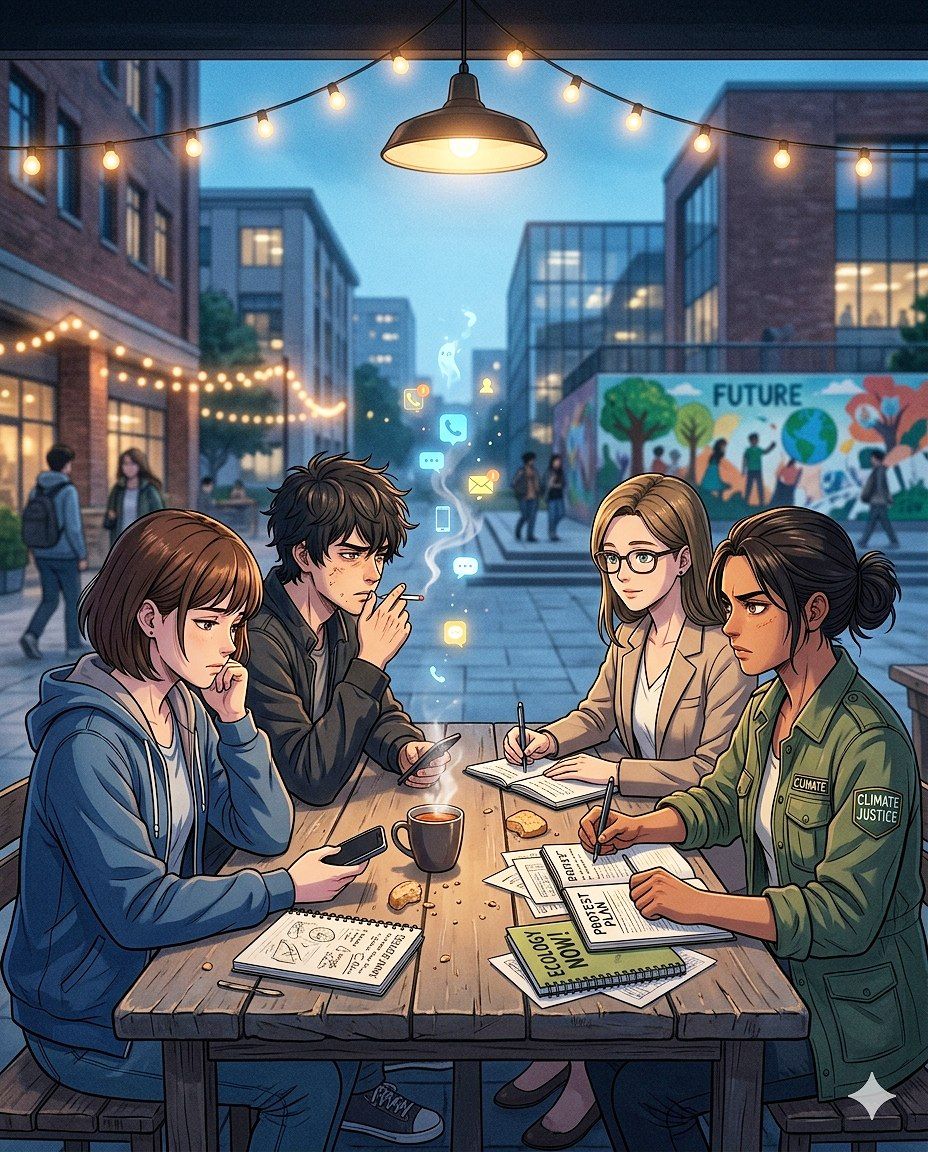
The news of the World Happiness Report 2026, backed by the UN, fell over the city like a cold, unexpected rain: for the first time in decades, youth ceased to be the most fulfilling stage of life. Headlines repeated figures and charts; university cafés and administrative corridors filled with conversations that smelled of alarm and shared guilt. For Luisa, Marcos, Ana and Valeria, it wasn’t just a statistic: it was the description of a desolation they already knew in their own flesh. Luisa was a social sciences student with an inquisitive gaze and hands that always found the pocket of her pants as if seeking comfort there. Every morning, her first interaction of the day was with a screen: notifications, stories, messages that demanded an instant response. That inertia had taught her to measure her worth by the daily sum of views and reactions; every like corresponded to a small gratification, every silence was a silence that scratched. Marcos studied anthropology and smoked with a furrowed brow when he spoke of the campus’s “invisible norm”: being online meant being socially alive. If you were absent, if you didn’t respond quickly, you could be left out of plans, jokes, the web that sustained belonging. He complained and yet fed the complaint with a melancholy irony. Ana, a trainee psychologist and facilitator at the student support center, often heard similar stories: adolescents arriving at counseling exhausted by constant comparison, female students receiving threats in public threads, young people asking for help without knowing how to name the hollow inside them. Her training allowed her to translate the pain into statistics and explanations: more than six hours of daily digital consumption, algorithms that prioritize retention over wellbeing, content that rewarded hyperstimulation and social comparison. But theory did not soothe the voices that cracked in the counseling room. The academic version of the problem said: in the United States, Canada and Australia, those under 25 reported satisfaction levels markedly lower than older adults; the decline coincided with the era of hyperconnectivity. Luisa knew it more intimately: the anxiety when the app showed someone had read her message and hadn’t replied; the self-criticism after comparing her body to curated images; the difficulty sustaining attention for a long reading or a conversation without the urgency of likes. Within the group, conversations shifted from irony to fear. One afternoon in the café, under yellow light and breadcrumbs on the table, Marcos let a question drop like a stone: —They say people who spend less than an hour a day on social media are happier —he murmured—. Do you think we’re too trapped? Luisa turned off her phone and looked at him with a mixture of shame and relief. —It’s not just the time —she said—. It’s how they change you. The algorithm offers you comparisons disguised as entertainment. It conditions you to respond quickly, to show the most marketable side of yourself. In the end, life becomes a showcase. Ana, used to naming problems to face them, added: —And those most harmed tend to be young women. Statistics show increases in depression and cyberbullying among adolescent girls and young women. It’s not a coincidence; it’s a repeating pattern. The words “social prison” were spoken by someone with a cutting kind of humor, but the term sank deep. A prison because belonging depended on being available; a prison because invisibility on the network could replicate in real life as a form of exclusion; a prison because giving up the device meant giving up the social map that dictated interactions, opportunities and recognition. That same week, the university held an info session about the Report. Ana invited Luisa and Marcos; in a room full of slides and young faces, they listened to researchers explain how algorithms prioritized content that provoked intense emotions—anger, surprise, envy—because it ensured longer attention. The six-hour daily threshold wasn’t arbitrary: beyond it, the mind began to reconfigure for instant reward, attention sustained by ever more extreme stimuli. Valeria attended the session; she was an activist working with communities in Latin America promoting mindful technology practices. She spoke with a clear voice, without melodrama, telling stories of neighborhoods where messaging had sustained distant family bonds, and of cases where virality had destroyed reputations in hours. Her stance did not demonize technology; it introduced nuance: the difference between relational use and passive use, between tools that connect and platforms that exploit. —Technology can strengthen human ties —Valeria said—. In many Latin American homes, messaging apps keep affect and daily life together that would otherwise be lost. But it doesn’t work by itself: we must decide how we use one another. Valeria’s words lit a new idea for Luisa. She remembered long calls with her sister, laughter that crossed the line like a bridge; she also remembered nights when a screen offered endless series and afterwards the same fatigue that follows overstimulation. In that hole of comparison and sameness, direct communication felt like a way out. Moved by unease and hope, Ana proposed a simple, radical experiment: forty-five minutes a day without screens, devoted to direct communication. It could be a call, a walk with someone, a letter, a meal without devices. Simple, measurable, human. At first, the experiment was awkward. Hands instinctively reached pockets; silences triggered anxiety; bodies craved the easy reward of a notification. But as days went by small transformations occurred: conversations lengthened, silences lost their guilt and gained density. Luisa called her grandmother without hurry, and the old voice returned stories that smelled of cooking and work, of loves not curated by filters. Her grandmother said, in her patient tone: —Before the television came, we used to talk all night. Not everything new is better, child. That phrase hit Luisa like a truth she had avoided confronting: progress does not erase the human fragments lost along the way. The campus was not immune to digital violence. One day, a hurtful post about a classmate, Camila, went viral. Insults multiplied in comments and screenshots spread through groups that amplified the damage. Camila closed her accounts and walked the university trying not to be seen. The impunity of anonymity and the speed of virality had turned a real person into a spectacle of cruelty. The institutional response was slow. The university activated protocols after complaints, but many measures felt like bandages on a deep wound: reactive moderation, generic support messages, promises of awareness campaigns. Ana, Valeria and some students organized immediate support: group sessions, psychological accompaniment, a safe space to hear Camila. In front of the group, voice trembling, the young woman articulated what she had felt: —It’s as if someone turned a spotlight on me and everyone stared. The humiliation doesn’t go away with time, it sticks. And when you return to networks, everything reminds you. You feel like disappearing. The words pierced everyone present. There were no statistics to console the memory of exposure. For Luisa, it was a call to action: technology was not neutral; platforms fostered dynamics that needed intervention and, above all, real empathy. The workshop group began taking practical steps. They organized device-free dinners, “conversation tables” to practice active listening, and digital literacy days in schools and communities. The goal wasn’t to prescribe total renunciation but to cultivate usage habits that prioritized human communication over the compulsion for visibility. On a small scale, these practices produced perceptible changes: lower anxiety among some students, more willingness to ask for help, longer and less superficial conversations. The process wasn’t linear. There were setbacks, relapses, days when social inertia dragged everyone back into comparison. But there were also victories: professors instituted “no-notification windows” during class; study groups agreed on norms not to share humiliating screenshots; awareness campaigns led the communications department to rethink how to moderate harmful content. Valeria secured partnerships with Latin American organizations advocating for tools that strengthen family and community ties, showing technology can serve affection when consciously designed and used. One memorable day the group painted a mural in the campus square dedicated to victims of digital violence and those who had resisted with concrete actions. The mural wasn’t grand; it was a collage of real messages, names written with care, and phrases of support. Local press covered the event with modest interest, and for Luisa that coverage was a faint echo but enough for other small communities to replicate the idea. That day, before microphones and cameras, Luisa spoke with a voice no longer seeking the reach of a viral message but the fidelity of testimony: —We don’t want to return to the past —she said—. We want to learn to use what we have without forgetting who we are. Happiness cannot be measured in seconds; it is the sum of gestures we hold for one another. Her words resonated with listeners; for some they were a call, for others a critique of how they had lived their digital relationships. What remained strong, however, was the sense that something was shifting: not by decree but through daily practice. In domestic conversations, parents began asking more about the quality of their children’s time than the number of followers; student associations pushed digital pauses during parties; faculties started including digital literacy modules in curricula. Meanwhile, public policies moved more slowly. Researchers insisted that effective solutions required a transversal approach: digital education from early ages, regulation of algorithmic practices that prioritize engagement at all costs, protection frameworks for cyberbullying victims, and accessible psychological support systems. Recommendations would remain in reports and commissions, and implementation would be gradual. The task, they concluded, was not to disconnect completely but to learn balance. Personally, the forty-five-minute experiment had sown a profound change in Luisa’s life. She no longer counted her worth in numbers. She learned to recognize the difference between the comfort of a real call and the hollow affection of an animated heart. She discovered that her grandmother’s voice had a texture no notification could reproduce. She experienced the visceral act of standing with someone humiliated, turning pain into collective resistance. Years later, as the Report continued to shape debates, the group kept the memory of a time of waking up and small decisions that, together, began to change the atmosphere. National figures might take longer to reflect those effects, but in their community a transformation could be felt: less fear in asking for help, more willingness for device-free encounters, university policies that protected intimacy, and digital literacy workshops in schools. The lesson that endured was both simple and complex: technology is neither enemy nor savior by itself; it is a tool whose ethics of use must be decided collectively. Wellbeing did not return by decree or fashion but by the daily work of reclaiming direct communication: calls that last hours, dinners shared without screens, the courage to report and accompany those who suffer, and the practice of boundaries that restore nights to memory and sleep. In the memory of that generation, the fight against attention standardization and constant exposure left a mark that was not only political but intimate: small resistances that became habits, support networks that replaced the spectacle logic with a care logic. In that transition, happiness—understood not as a data point on a graph but as the accumulation of shared gestures—began, once again, to feel possible. Source of the images. Image created with Google Gemini.
No comments yet