 @mc5punk
Short story: Bridges of Paper and Fiber
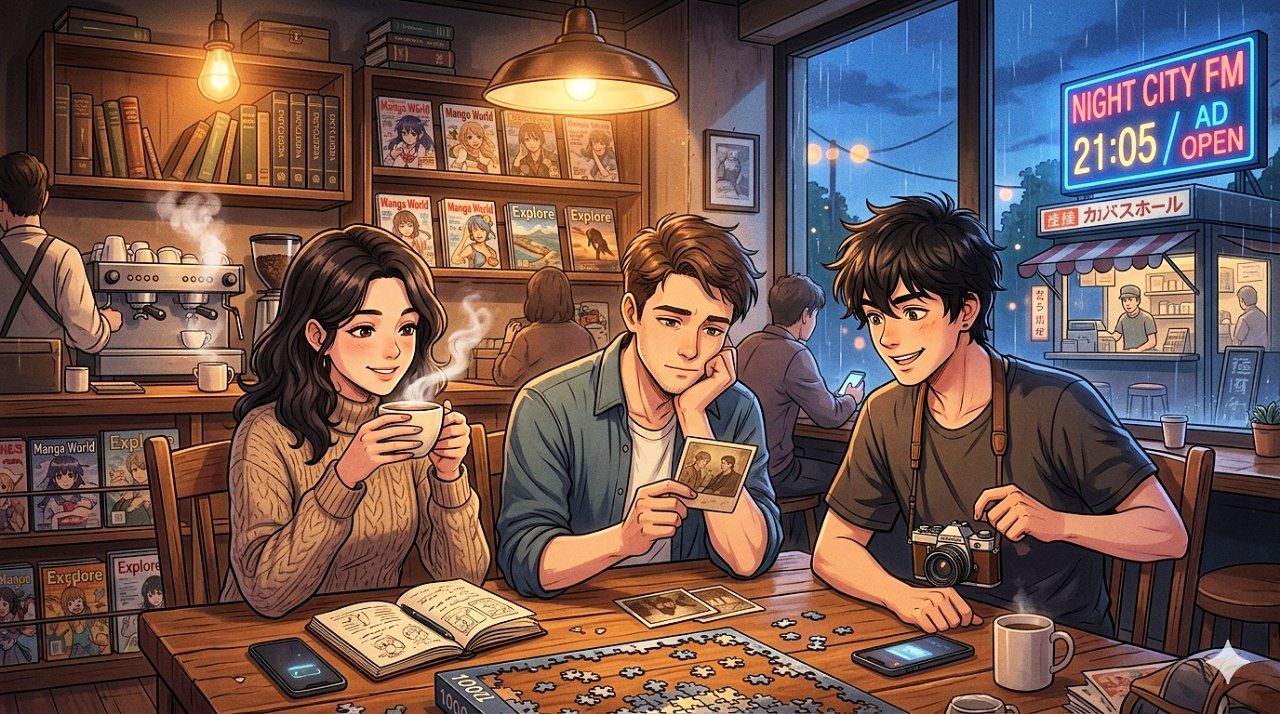
In the corner café —a dimly lit spot where the espresso machine sounded like an old locomotive— three friends met who, though born within a few years of each other between 1992 and 1999, seemed to carry two different libraries inside them. Valeria, Martín, and Leo had grown up with afternoons without notifications and with adolescences when high‑speed internet changed the rules of the game. That mixture often made them half nostalgic and half comedians of their own memories. Valeria put her cup on the table and held it like a ceremonial object. “Do you remember encyclopedias?” she said, with that smile that signals an anecdote. “They weighed more than my first boyfriend and filled an entire wall. You had to get up, walk to the shelf, open the volume and read. It was a ritual.” Martín rested his elbow on the table, amused. “My dad used them as shelves and TV stands. We made slides out of the covers. And the sound of turning pages… it’s irreplaceable. Today people just swipe and that’s it.” Leo, who wore a vintage camera around his neck as a whim, clicked his tongue at the others. “You’re dramatic. It’s fine to keep analog things, but who wants to wait when you can look anything up and fix it in seconds? Need grandma’s recipe? Google. Fix a lock? YouTube. Before you called Aunt Rosa and she’d answer with ‘use a hammer’ or ‘love and patience.’” “Yes,” Valeria replied tenderly, “but Aunt Rosa also had stories. The encyclopedia brought illustrations that spoke to you. They weren’t just facts; they were pieces of the world made into pictures and flickers. There weren’t five contradictory articles with sensational titles.” They laughed and a quieter voice at the table said, “We are the bridge.” Martín said the phrase as if naming a profession. “Sometimes I feel like I carry two manuals inside me: one taught me to wait, to look at the sky without fearing losing signal; the other taught me to update, to ask for help instantly when something breaks. We have the patience of someone who waits and the impatience of someone who refreshes the page.” Leo raised his cup in mockery. “You updated your patience to version 2.0. Offline when you want, online when you need. It’s like carrying a library and a newsstand in your pocket.” They shared a knowing laugh. Then Valeria grew serious, as if about to recount a little experiment of nostalgic science: “One time we turned off the router for a weekend. No networks. We took out board games, a thousand‑piece puzzle and an old radio. At first our hands didn’t know what to do. We looked to swipe and there was nothing. But after a few hours, conversations grew longer; we looked people in the eye and asked how they were without messages in between.” “And we fought over the last puzzle piece,” Martín said with unabashed amusement. “It was our first argument in years without memes or instant replies. There was an awkward silence that lasted as long as it takes to pretend everything’s fine, and then laughter returned without filters.” Leo closed his eyes remembering the scene. “And it was beautiful because boredom was allowed. Now boredom feels like a system error.” Outside the café a young man walked by with invisible earbuds and an electric bicycle made a strange noise. Valeria watched them and returned to a reflective tone. “We can explain to younger people why an SD card used to be worth gold, and also teach them how to edit a reel in forty seconds. It’s curious: we have two maps. One drawn by hand, with coffee stains and margin notes; and another in digital layers that updates without warning.” Martín pulled out his phone, not to check notifications but to show an old photo: a beach postcard with a payphone in the background. “My grandfather used to keep cameras in the glove compartment,” he said. “Photos had to be developed and waited for. They had a texture, a smell. Now you upload everything to the cloud and nobody worries about losing physical memory. It’s practical, but strange. Anecdotes get lost in the cloud.” “My mom still confuses ‘streaming’ with a cleaning service,” Valeria chimed in, laughing. “And my dad thinks ‘meme’ is the name of a weird cousin who sends jokes in the family group.” Conversation turned to going viral. Martín remembered the time he accidentally became a household spectacle: “I uploaded a video of my dog dancing and my mother called me hysterically: ‘How did you put the TV in your phone?’” Martín imitated, provoking bursts of laughter. “She was convinced I had shrunk the television.” Leo, always hunting for the comedic angle, added: “My aunt has been forwarding chain messages since before WhatsApp existed. She’s a walking relic. Sometimes I call her ‘a human with unlimited folklore coverage.’” Laughter once more eased the nostalgia. Valeria inhaled the coffee’s aroma and let out a confession. “What scares and comforts me is that we don’t have to pick a side. We can teach waiting and searching. We can show how to build a shelf without instructions and, at the same time, send a photo of the progress so someone can approve it with an emoji.” Martín looked through the window at how the city dressed itself in artificial lights. “We are the translators between generations,” he said. “We read paper maps and we make folders in the cloud. We’ll tell our children there were times when not everything was in the palm of your hand: that we went to video stores and rented movies in boxes, that we glued photos into albums with dried glue, that we waited until Saturday to watch our favorite TV show. And we’ll also tell them that at two in the morning we solved what seems urgent now thanks to a group chat.” Valeria smiled, softer this time. “We’ll tell them to turn off the screen and come tell us when something hurts. That never goes out of style.” She paused a second and added, almost in a whisper: “We’ll also tell them we were the last generation to know a completely disconnected childhood, but that we learned to adapt. That’s why we understand the value of both worlds: we know why it’s worth disconnecting and why, sometimes, speed saves you.” Night had settled when the three left the café. On the sidewalk a digital billboard cycled images at a relentless pace; next to it a small kiosk still sold glossy magazines. Leo, with his camera, took a photo of the kiosk and another of the digital billboard, placed them side by side and showed them to the others like an art piece. “This is the perfect photo,” he said. “The ad that yells and the magazine that whispers.” Martín regarded them with a mixture of pride and weariness. “Sometimes I feel responsible for keeping stories,” he said. “Stories that don’t get lost when memory becomes invisible. We keep anecdotes in objects: cassettes, memory cards, notebooks. But we also learned to upload files so they don’t burn in a fire. We’re the ones who teach not to leave everything only in the cloud nor only in the drawer.” Valeria shrugged with a wide smile. “And we’re a little clownish too, because we laugh at our contradictions. Yesterday I helped my grandmother uninstall an app and, when I got home, I went to find a ’90s song that only existed on a scratched CD. I had to climb into the attic, find the box and play it on a ten‑kilo stereo. It was wonderful and absurd at once.” At the building entrance Martín stopped and looked at his friends like someone gazing at an old photo that comes alive. “One day our children will ask what that strange era was like, half without the internet and half with it,” he said. “And we’ll tell them that sometimes we had to explain to ourselves how to live in two realities at once. That we knew how to wait in lines and read printed instructions; that we created stories on magnetic tape and also made virals that lasted the length of a sigh.” Valeria put her hand on Martín’s shoulder. “We’ll tell them how to prioritize: that a walk with no signal can be a cure, but that a message can save a day. That we knew when to disconnect and when to connect to help.” Before saying goodbye, Leo took his phone and, with automatic humor, took a selfie of the three. He showed it to his friends and, without much thought, wrote in the caption: “Bridges under repair: alternating traffic between nostalgia and notifications.” They laughed again, this time with the laugh that knows the mix of pain and joy. That laugh condensed the peculiarity of their generation: memory and meme, patience and haste, hardcover album and cloud folder. They walked with one foot on each shore, teaching others how to cross with open arms and with caution. As they climbed the building stairs, a neighborhood child leaned over the railing and asked with curiosity: “What are you telling stories about?” Valeria crouched to his level and offered the simplest explanation she could imagine: “That before, to know something, you sometimes had to get up and look it up in a book. And now, the answer arrives in seconds. We remember both paths.” The child blinked, both confused and fascinated. “And which is better?” he asked. The three friends looked at each other and, without hesitation, answered in unison: “Both.” That “both” echoed in the stairwell like a small truth. It was a practical and poetic conclusion: there was no need to choose a side to live well. You could read a book with a cup of tea and then upload a photo of the cover with a filter. You could wait and also look up instantly. Being a zillennial wasn’t a contradiction: it was a complex and valuable skill for navigating hybrid times. They entered the building and each took their own direction. The sound of their footsteps faded, and from the window of the top floor the neighborhood seemed to breathe to the rhythm of two intertwined eras. Outside, neon lights blinked like notifications; inside, the dimness kept albums, notebooks, memories in boxes with handwritten labels. At her apartment, Valeria opened a drawer and pulled out a notebook in which she had jotted small things since adolescence: songs, jokes, addresses of lost friends. She opened it at random and found a list titled “Things to Remember”: play until it gets dark; ask permission before using a neighbor’s bike; read the school encyclopedia because the illustrations taught geography in impossible colors. She smiled, took her phone and, without ceremony, uploaded a photo of the notebook to her story. She captioned it simply: “Bridges.” She added a map sticker and a cloud sticker. It wasn’t a contradiction: it was synthesis. That night, before sleeping, Martín received a voice message from his mother with a video file: she’d tried to use a new filter and needed help. Martín felt again that double perspective —the encyclopedia and the tutorial—, read the message, searched for the best solution in his memory and online, recorded a clear and simple reply, and sent it. His mother answered with a heart emoji and a short phrase: “Thanks, my dear.” Martín turned off the light, thinking about how his generation knew how to care for both shores. He fell asleep with the idea that they were neither odd nor lost: they were translators of eras, heirs of an analog childhood and artisans of a hyperconnected adulthood. In that dream, encyclopedias and servers danced a slow, domestic dance, like two old friends recognizing one another in a room lit by a lamp and a screen. The End. Source of the images. Image created with Google Gemini.
No comments yet