 @mc5punk
Short story: Digital Fatigue
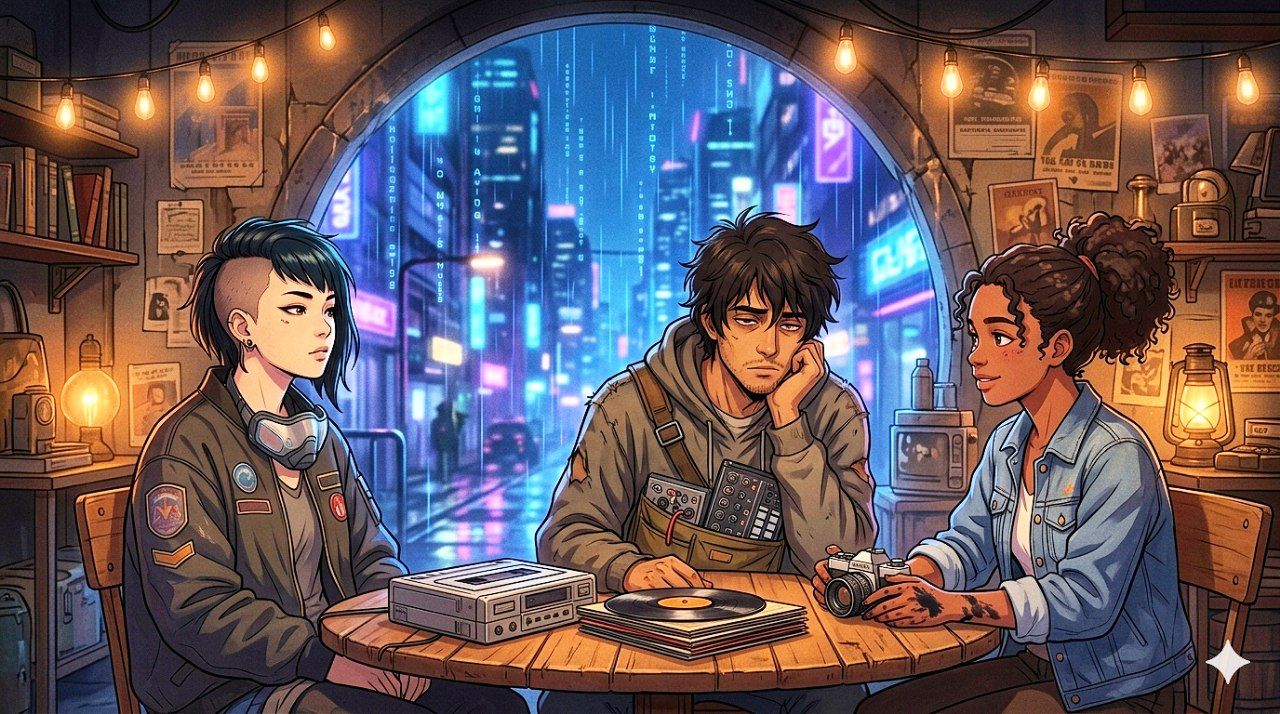
The holographic rain stained Neoterra in liquid colors, as if the entire sky had been replaced by a test screen. The ads suspended above the buildings did more than show images: they induced micro-emotions in two-second cycles, sending tiny dopamine jolts through public interfaces that measured passersby’s pulse and pupil dilation. In the underground cafés people connected to a thousand narratives at once; the collective murmur was an interface competing for every minute of attention. In one of those cafés, lit with warm tones trying to counter the surface’s cold glow, Iris, León, and Maya met. All were young, marked by the city and by the habit of measuring life in screens. Iris, twenty, wore her hair shaved on one side and had an augmented-reality mask hanging from her neck; her hands moved with the urgency of someone flipping between a text and their feed. León, twenty-two, worked as a night programmer and played synths by day; his voice had the texture of someone who had heard too many technological explanations. Maya, nineteen, printed photographs on paper with the devotion of an archaeologist of analog things. “I can’t,” Iris said, closing her digital notebook with her thumb. “I start reading and the feed calls me. Every paragraph feels like a finish line and my gaze is already somewhere else.” León looked at her with tired patience. “That’s not just bad habit, Ish. It’s digital fatigue. My neuroarchitecture professor called it reward training: the brain learns to expect a ‘ding’ every time the stimulus changes.” Maya rested the palette she’d been mixing ink with and let her gaze fall on an old photo. “Stories used to unfold,” she murmured. “They had time. Songs lasted their full length; novels took whole nights. Now we’re asked to decide in seconds whether to continue.” A delivery drone floated over the café, projecting brief ads: “Live now,” “Capture more,” “Share and win.” The holographic rain reassembled the ad into a loop: a promise repeating. Iris put her hand on her cup, feeling the vibration of the advertising pattern under her fingertips, and for a moment the voices dimmed. “Remember when they promised connection would mean community?” she asked. “Instead we built islands with hyperactive thumbs.” León let out a humorless laugh. “Connectivity sold us the illusion of closeness, but it also taught the mind not to stay. In the end, the attention economy created what consumes attention.” That night Iris dreamed of her grandmother, who had lived before the Great Relay—before networks filled every gap of life. In the dream her grandmother handed her a dusty cassette and said slowly, “Listen without pausing. Let yourself be inhabited by a voice that asks for no edits.” Waking, the idea felt like a physical need. Iris went to the night market and, among obsolete devices, found an old player. With trembling hands she turned it on and pressed play. Music spilled forth uninterrupted, sustained. It was painful because it demanded patience; it was beautiful because it claimed time. The next day Iris brought the player to the clandestine workshop where León and Maya worked. It was a place of tangled cables, vinyls hung like flags, and piles of photos that smelled of glue and memory. “I propose an experiment,” Iris said, placing the player on the table. “One hour without feeds, ads, or notifications. Just reading, listening, and talking.” León raised an eyebrow. “An ancient ritual. Sounds heretical, but I’m in.” Maya set a print on the table: the street from her childhood, without holograms, with a sky that looked like a watercolor. The texture of the photograph on the wood produced a different kind of silence. They invited others: Nico, who handled automated deliveries; Sara, a philosophy student; Andrés, who livestreamed his games and felt empty afterward; and more who came out of curiosity or desperation. They prepared a real sand timer because sand carries the weight of tangible time and promises a different measurement. The first minutes were awkward. Hands reached for pockets; thumbs spoke on their own. Eyes trained to jump from stimulus to stimulus now had to hold something without an instant reward. Gradually, thoughts lengthened. There were tentative laughs and looks that met without cameras between them. “At first I only think about what I’m missing,” Nico said. “Then I realize I can hold an idea for more than a minute without craving notifications.” Maya pointed to her photo. “Look at the light on that building,” she asked. “It’s not new, but now you can see it whole.” As the hours passed, stories began to unfold. Sara read a chapter of a novel that wasn’t fragmented. Andrés told the story of his grandfather without edits; the voice became a line nobody clipped. There were cries no one cut; laughs no one edited. Conversation became dense; sentences found room to settle. But outside the workshop, the city never slowed its consumption machine. A micro-influencer filmed the group’s exit in three-second fragments and uploaded it. Within an hour the post exploded: “Slow kids” trended. The novelty was rewarded by the algorithm, and the scene of slow introspection was transformed into a series of cuts fit for viral consumption. The young people watched their pause be turned into merchandise, a label someone else could exploit. León watched notifications scroll across his wrist with a mix of irony and fear. “Even slowness is monetized,” he said. “How do we keep something intimate from being devoured and packaged?” Iris breathed and replied without looking up. “It’s not the gesture that matters if it ends up as just another clip. What saves us is what we do when nobody’s watching.” Tension rose when an institutional invite arrived: a pilot program promising to “restore attention” through implants, behavioral nudges, and lab-designed microdoses. Public campaigns offered solutions to digital fatigue: focus chiplets, apps integrated with urban neuroarchitecture, subscriptions to keep your mind on one channel. Lines formed at installation centers; for many, the promise of a shortcut was an understandable temptation. Maya, who now ran a small print room, watched the queue with weary eyes. “I don’t want concentration to become another upgrade I have to pay for,” she said. “I don’t want fixing a bad habit to turn into an economic obligation.” Iris looked at her with resolve. “I don’t want patches. I want practice. To recover the patience to stay without being sold the experience as a service.” They decided to build something small but concrete: attention-recovery stations—spaces where the immediacy economy wouldn’t be law. Simple rules: no advertising screens, no recording or monetized streaming, plain food, paper books, uncut music, and conversations that weren’t edited. They didn’t aim to change the whole city, just to create refuges for those who wanted another rhythm. The first station opened on a decommissioned subway platform. They painted a handmade sign: “Slow Station — Free Entry.” Inside, the light was warm; the air less compressed. A volunteer served as a guardian, gently reminding forgetful visitors of the rules. “Breathe,” she said. “Stay.” At first traffic was sparse. Slowly, however, people who worked with screens began to come: students who wanted to write an essay without interruption; office workers who used the station to read aloud without speakers; a delivery worker who cleared his microtask list. One visitor brought a cassette with his uncle’s childhood stories; the unedited voice anchored others. The stations weren’t a universal cure. Some fell back into old habits after a few days. Others began to form rituals: longer attention blocks, bedtime disconnect routines, small acts of separation. It was a training of patience through repetition. A month later the city had shifted in small fissures. Ads still performed their visual surgery, but new modes emerged: book clubs discussing complete novels, concert halls refusing microediting, graffiti without QR codes. Young creators started producing content that asked for time: short films as long as a walk, poems recorded in one take, live streams that deliberately avoided cuts and sought resistance rather than virality. One night, under the holographic rain, Iris and León walked along an avenue. Projected ads replayed fragments of their own initiative: images of the Slow Station cropped and resold by agencies promising “authentic experiences.” Iris stopped and stared at the flashing projection. “Maybe this is inevitable,” she said. “Whenever something calm appears, the market grabs it.” León watched his reflection split in a neon puddle and answered cautiously. “We can’t stop the market, but we can maintain a choice: attention can be trained. Slowness can be an everyday act of rebellion.” Maya, now coordinating another station, approached with a new cassette in hand. “For when you want to remember how it sounds to listen to something in full,” she offered. “No ads. No pauses.” The Slow Station filled with diverse profiles: some with focus implants, others with ink-stained hands. The encounters promised no absolute transformation—just fragmented continuity, practices planted day after day. There was no epic finale or global solution; only small decisions repeated until they became habit. One night Iris sat on a bench beneath a blinking sign that read, “Connect more, live better.” She turned off her mask, powered up the player, and let a song fill her head with no intent to capture it. She didn’t record. She didn’t tag. She simply listened through to the end, letting each note occupy its space. León approached and, without speaking, laid his hand on hers. Iris didn’t check her watch; the city continued to measure time in seconds, but inside her chest a slower rhythm beat. Attention didn’t return whole or uniform—it remained fragmented—but in the gaps where speed did not rule, life reentered with depth. Young people learned to invest their attention with judgment: spend less on what doesn’t matter, save more for what hurts, for what heals, for what endures. Years later, the Slow Station would be remembered as a small movement that taught some people how to sustain. It didn’t change market laws; it reconfigured practices. In plazas and workshops, in margins of notebooks written by hand, in conversations that stretched without clips, a quotidian resistance was woven: not a rejection of technology, but a way of relating to it that prioritized the durable over the instant. And in that repeated gesture, something vital was preserved: the capacity to attend, to listen without seeking reward, to let a story take its time without demanding shortcuts. Source of the images. Image created with Google Gemini.
No comments yet