 @mc5punk
Short story: Hearts in Kobe
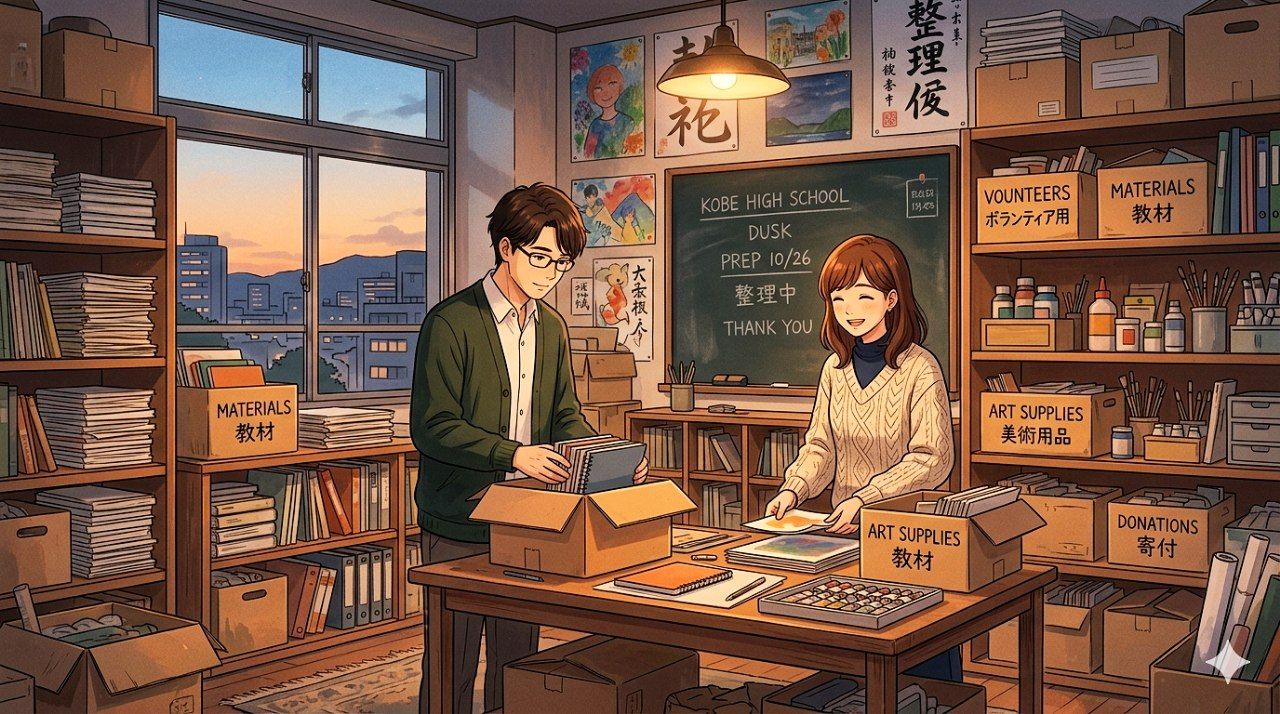
The municipal school in Kobe woke each morning to a murmur: backpacks bumping down the stairs, high-pitched laughter echoing in the corridors, and the bell, punctual, inviting the day to begin. The yellow walls bore marks of years: children's drawings taped up, science projects that looked like little works of art, and a blackboard that always held a pending phrase of encouragement. Haru Takeda, thirty-four, was a man with a calm gaze and measured steps. He had taught basic math and science for years. His students respected him for his endless patience and for the stories he used to make the trickiest problems into adventures the children gladly accepted. Aiko Sato, twenty-four, seemed the opposite: impulsive, effervescent, with a frank laugh that burst without warning. She ran art activities and the reading club. Her posters brightened the teachers' lounge, and she always had a creative solution for a torn mural or a puppet show that needed nimble hands. They officially met on the first day of the school year; but they truly recognized each other through small gestures: Haru returning a pencil to a shy student, Aiko leaving a cup of tea on the janitor’s table with a thank-you note for fixing a door latch. Over time, those gestures became reciprocal. “Are you coming to science club this afternoon?” Aiko asked one Wednesday at midday, checking a materials list on her phone. “Depends: will there be volcanoes?” Haru replied in a solemn tone, though his eyes lit up at the idea. “Of course. Want to be my dramatic assistant?” Aiko tilted her head, smiling defiantly. Haru feigned indignation. “Dramatic assistant? I’ll stick to safety supervision and the vinegar jar.” They laughed, starting a quiet complicity. Between faculty meetings, festival prep, and late-night grading, they forged a routine of small alliances: Haru lent his calm when Aiko grew anxious; Aiko rekindled Haru’s creative spark when math seemed too cold. They shared coffee in the staff room and sometimes, without noticing, stayed late organizing materials, letting the hours pass as if time were an ally. Their bond deepened into conversations that reached beyond the professional: confessions about childhood fears, stories of family, and soft desires. On nights when the school fell silent, Haru and Aiko would fix a projector or sort the library together, and in those moments the line between work and personal life blurred. One rainy afternoon, with the children stuck in the library, the materials room—shelves heavy with supplies—became a refuge. Aiko, who’d brought homemade bread, offered a slice to Haru. “Sometimes I feel this school is more of a home than any other place,” she said, seeking company. Haru looked at her with surprise and tenderness. “Then let’s take care of it,” he answered without much thought. For him, taking care meant being present, fixing what broke, and protecting those entrusted to him. For Aiko, caretaking meant decorating, creating safe spaces, and bringing color to routine. Over time they began to spend time outside work hours: weekend walks in a nearby park, swapping book recommendations, and, on rainy nights, conversations that stretched into the late hours. The relationship grew emotionally intense; every gesture gained meaning. What began as a close friendship turned into an intimacy neither wanted—nor knew how—to stop. The school, modest in its architecture, witnessed many of their encounters. They were not public nor intended to harm: two adults finding comfort within walls they both loved. But because the behavior was repeated and occurred in institutional spaces, curious and watchful eyes began to notice. One morning the principal received an anonymous report through the internal channel. Rumors spread quickly. Corridor conversations became messages circulating among parents and staff, and soon a file reached the Kobe municipal board of education. The investigation proceeded with the cold thoroughness of administrative processes: interviews, schedule reviews, testimonies. Local headlines fanned the drama. For Haru and Aiko, the news hit hard. “I never thought this would go this far,” Aiko said one night, her voice breaking. They sat in their usual café, but the words felt heavy. Haru took her hand carefully, fingers seeking an anchor. “It was never my intention to hurt anyone. But I admit we lacked prudence.” He sighed. “We should have talked with the administration earlier, been transparent in a responsible way.” The proceedings ended with a clear sanction: both were suspended for six months. The board explained that although the relationship was consensual and did not involve students, the repeated use of public facilities for private purposes violated the conduct rules expected of teaching staff. The principal also received a disciplinary warning for not reporting the situation promptly when he became aware of it. The verdict created a public rift: some parents and colleagues condemned their lack of boundaries; others expressed empathy for the human complexity of the case. For the two teachers, the sanction meant not only separation from their workplace but also the need to rethink who they were outside the school. The months that followed became an exercise in introspection, repair, and learning. Aiko returned to her childhood home by the sea to rebuild family ties and seek clarity. There she walked the beach and wrote long letters she often didn’t send. In one letter intended for Haru, she left it in her bag; days later he found it by accident among recipes and class notes. Haru turned to the community: he began volunteering at a cultural center, teaching children from nearby neighborhoods. He discovered that continuing to guide and care for others was itself a way of making amends. Meanwhile, both started individual therapy; they spoke in sessions about boundaries, power, and responsibility. Conversations with colleagues and administration were part of the process. They offered public and private apologies and proposed participating in workshops on professional boundaries once the suspension ended. Their willingness to engage in prevention policies and explain what they’d learned opened a path to reconstruction. Despite the seriousness of the situation, everyday life retained sparks of humor. One day Aiko accidentally sent a photo of a cat-shaped cookie meant for a friend to Haru’s chat. Haru, in his usual dry tone, replied, “We need that cookie at the reading club.” They laughed at the absurdity, and such small digital stumbles lightened the weight of the sanction. Meanwhile, the school implemented changes: clearer protocols about relationships among staff, mandatory workshops on ethical professional behavior, and more transparent communication channels for reporting and questions. The school community shook, debated, and gradually adopted practices aimed to prevent similar incidents. At the end of the six months their return was moderated: conditional authorization, classes under observation, and periodic meetings with administration to ensure compliance with the new rules. The reception was mixed—some tentative applause, some looks still seeking understanding. For Haru and Aiko it felt like entering a different classroom, one that had changed in their absence. In the first week back they met again in the materials room, the same place that had witnessed so many things. Cardboard boxes of recycled supplies, a whiteboard with upcoming festival projects, and evidence of the collective work the school continued to carry filled the space. Aiko grabbed a box labeled “Volunteers” and started sorting. Haru watched her for a moment, then rolled up his sleeves. “Do you remember when you hid star stickers on the desks of the laggards?” he asked with a crooked smile. Aiko pretended to be offended. “That was an effective educational strategy, thank you very much,” she replied. “But now I use stars to reward effort in the library. And no surprises in the hallways.” “Good,” Haru said. “We’ll keep stars in the classroom and important conversations off the clock, informing administration when needed.” They laughed and, with new naturalness, divided tasks. The complicity hadn’t vanished but transformed: now it included transparency, clear boundaries, and an explicit commitment to student well-being. In the following months both led voluntary workshops on coexistence and boundaries for staff, sharing their experience with therapeutic honesty. They gave talks that neither glorified what happened nor excused it, but offered concrete lessons: how to separate roles, where to seek professional help, and the importance of communication within the institution. They also worked with parents and students in sessions about trust and care: reflecting on how responsible adults shape the school environment and how professional ethics underpin community safety. Many saw their active involvement as sincere reparation. Personally, their relationship matured and became more discreet. While affection remained, it was accompanied by prudence and a promise not to repeat past mistakes. They communicated more clearly, planned meetings outside the school with transparency, and supported each other in therapy and professional projects. One autumn day, during preparations for the annual fair, Aiko and Haru sat on the makeshift stage in the gym. The lights were off, and the silence allowed a conversation that felt like a shared confession. “Do you think we’ll ever forget all of this?” Aiko asked, staring at the stage boards. Haru thought for a moment. “I don’t think it’s about forgetting,” he replied. “It’s about learning enough that it doesn’t happen again. Turning a mistake into a constant reminder of our responsibilities.” Aiko nodded. “And continuing to love without putting others at risk.” “Exactly,” Haru said. “Love comes in many forms. This school taught us that —and also the limits we must respect.” They sat in silence, listening to the echo of their voices. Outside, the trees were turning orange. Inside, the school continued its daily rhythm: children’s laughter, multiplication tables, paintings drying in art class. Their story didn’t end in perfect redemption or a punishment that fixed everything. Instead, it became a patient reconstruction of trust, rules, and self. Aiko and Haru continued their work with humility, offering their experience to help others avoid the same pitfalls. They regained some affection and accepted others’ reservations. Over time public memory faded among new news and other school stories; but the lesson stayed with the community: the importance of professional ethics, clear channels, and responsibility when caring for young lives. For Haru and Aiko, the sanction and reflection became an inflection point—not to erase the past, but to build a more attentive future. The End. Source of the images. Image created with Google Gemini.
No comments yet