 @mc5punk
Short story: City of Prayers
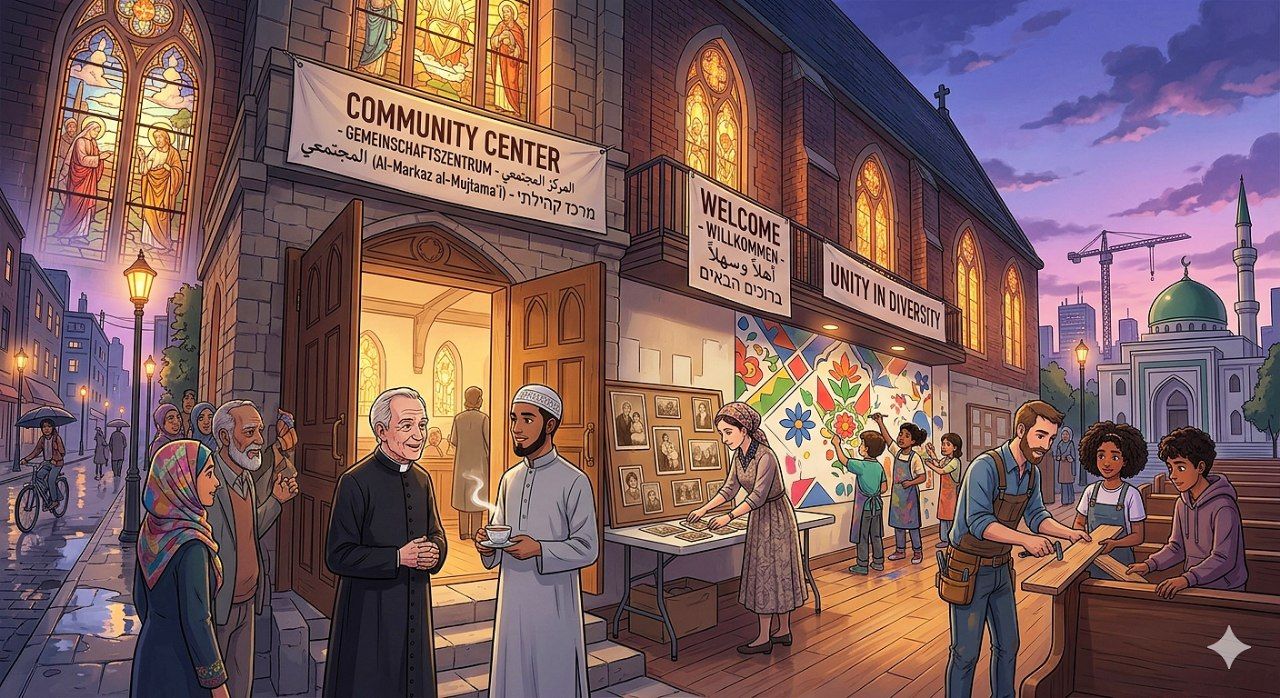
The sharp rain struck the stained-glass windows of the old Church of Saint Matthew as if trying to beat out the colors that once hosted hymns and promises. Inside, the nave smelled of wax, damp wood, and memories that creaked under the feet of those who still dared to enter. The pews, worn by generations of knees and silences, held the shape of bodies that no longer returned. On the choir stand, a hymnal with yellowed pages rested; only a few people still raised their voices on Sundays. Outside, the city was transforming: cranes and scaffolding sketched low domes, new arches, and facades bearing inscriptions in different tongues. Pastor Emil Weber walked among the rows, brushing his hand along the backs as if greeting old friends. He was seventy; the cassock fit him with the tired dignity of someone who knows his time is transitional. He leaned on the baptismal font, his palm trembling slightly. He looked into the holy water and saw his reflection, blurred as if the glass denied him certainty. Rosa, a lifelong neighbor, entered with the slow step of someone who has not yet decided whether absence should be mourned aloud. She held a handkerchief to her lips, as if to contain the emotion. “I remember when children used to run around at Easter,” Rosa said, her voice cracked by memory. “They came with painted eggs and hid behind the organ. There used to be laughter even in the choir. Now the squares are full of other voices. It’s not better or worse, Emil. It’s different.” Emil closed his eyes and let the sound of the rain be his only answer. His memories mixed: a baptism in winter, a summer wedding with flowers stolen from a neighbor’s garden, funerals that stripped the neighborhood’s conversations of pretense. On the sacristy radio earlier that day he had heard figures that weighed on him more than the drops: 36.6 million, 44% of the population — a decline in belonging that felt like a slow tide carrying away doors and bells. “I know,” he murmured. “But I feel we close more than a door. A way of naming God that was our custom is leaving. I don’t know if we are losing faith or simply the way we see it.” Outside, on the main avenue, a Star of David stood out among newly raised facades; around the corner, workers set the finishing touches on a mosque with inscriptions Emil could barely make out in their original script. The transformations in the urban landscape gave the city a new accent; the municipal hymn seemed to have fragmented into many songs. That same afternoon Yusuf appeared, a young imam from the Muslim community that had settled in the neighborhood in recent years. He arrived with a cup of tea and an honest shyness, his clothes still speckled from work at the mosque. His presence in the church was, for some, unusual; for Emil, it was a gesture of neighborliness that surprised him by its simplicity. “Father Emil,” Yusuf said respectfully, “I brought this. I saw the boards piled up in the shed and the door that squeaks. In the mosque we talk a lot about this neighborhood; many remember when this church ran soup kitchens for those who were hungry. We wanted to offer a hand.” Emil looked at him, taken aback by the deference. “Thank you, Yusuf. Your gesture moves me. Such generosity is not easily forgotten. If I accept, it will be because all of this is about more than walls. It’s about how we treat each other when the wind shifts.” The offer of help was not merely practical: it was a bridge in a time when bridges seemed to be breaking. Yusuf spoke of his community: young families, elders who read in low voices, women teaching sewing, children who brought promises of the future. He spoke of shared meals, study hours, the intention to be present. From a high window Miriam Rosenberg watched. She had been born into a Jewish family in the area and had seen neighbors emigrate or age without replacement. Her mother had told stories of a synagogue that burned in the past, once a beacon of life. Now another synagogue rose on the main street where a barbershop had closed decades ago, and Miriam felt a blend of relief and old melancholy in her chest. That evening the sacristy hosted several neighbors: Emil, Rosa, Yusuf, Miriam, and Klaus, a burly carpenter who had worked on the church for years and carried in his hands the smell memory of sawdust and glue. They gathered around a table and began to talk. The dialogue was slow at first, like testing an unfamiliar melody. “Aren’t you afraid that by losing Christian temples we’ll lose a part of our identity?” Klaus asked, with the blunt honesty of someone who had seen moves and closures. “This building isn’t just stone and wood; it’s a repository of baptisms, weddings, funerals. It maps our lives.” Miriam shook her head, eyes moist. “Identity isn’t a building, Klaus,” she said. “It’s a memory that travels in tables, in songs passed from grandparents to grandchildren. My grandparents used to sing in Yiddish in a synagogue that no longer exists; the synagogue was lost, but the prayers and recipes lived on in the home. Buildings change, but memory endures.” Yusuf, silent until then, spoke patiently. “Our people came years ago seeking a place to pray and be citizens like everyone else. We build mosques because we need a space to name God in our way. We didn’t come to erase anything; we came to exist here, to contribute, to set tables, to teach and to learn.” Emil listened, and for a moment the weight of his concerns lightened with the simple humanity of the words. “So what do we do with this empty nave?” he asked, his voice cracking with a mix of helplessness and urge to act. “Do we let it die in solitude?” Rosa, who had been silent until then, looked up with the resolve of someone who had seen as many farewells as celebrations. “Let’s not let it die,” she proposed. “Make it living memory. If there are fewer masses on Sundays, let the spaces host concerts, language classes, shared meals, neighborhood libraries. Keep the altar for those who still come to mass, but open the rooms to other uses. Not because we stop being what we were, but because we learn to be something more.” The idea surprised them. It didn’t mean giving up, they explained, but expanding: turning exile into hospitality. Yusuf smiled with a new gentleness. “We can organize readings between mosque and church,” he said. “In my community there are people who teach Arabic to children; we could exchange classes. We could run cooking workshops, joint choral music, and carpentry lessons with Mr. Klaus for young people. That way the pews stay and hands keep learning.” Klaus thumped the table with his palm, a gesture of approval. “If we do it, we’ll do it well,” he affirmed. “I’ll restore the benches; we can’t let them fall apart. But I also want to see children painting and new voices filling the choir, even if they sing in other languages.” The following weeks became a whirlwind of activity. Young people from the mosque painted discreet murals in the side rooms: geometric motifs and calligraphic lines. Miriam organized an exhibition with old photographs and explanatory plaques in German and Hebrew, telling stories of families who had made their lives in the neighborhood. Emil, who had feared losing the altar, cleaned the baptismal font until it shone for the baptisms that still took place; he also kept hours to welcome students who came to practice German. Klaus restored creaking benches; in the evenings, under the light of lamps, he taught adolescents to use chisels and sandpaper. Some young Muslims learned to intone melodies of the Christian office, while a small choir practiced a hymn in Aramaic and another in Arabic. The church filled with activity—not only ritual, but community life. The plan to open the church to shared uses met resistance: some conservative voices denounced it as a betrayal; others worried it would invite doctrinal conflicts. But there were encounters that eased fears. At one of the first shared tables, Miriam prepared dishes her mother used to cook, and Mrs. Aisha from the mosque brought a stew redolent with spices and memories. The meal became a simple act of reconciliation: dishes circulated, stories flowed, and laughter breached the silences. One afternoon during an interreligious gathering, a seven-year-old boy approached the altar with wide, moonlike eyes and asked innocently: “Why are churches closing if you still believe in God?” Everyone fell silent; the question struck with the clarity of childhood. Emil stepped forward and took the boy’s hand with tenderness. “Because the way of believing changes with time,” he said. “Sometimes people find God in solitude, other times in a neighbor’s kitchen, in shared laughter, or in the answered cry for help. The important thing is not the building, but that we have hands to help one another and voices to pray for others.” Miriam added calmly: “Sometimes we close doors so that others can open. It isn’t a final loss if we keep the thread that ties us: compassion, memory, care for one another.” The night the city inaugurated the new mosque, the neighborhood filled with a strange feeling: grief for what was leaving and celebration for what was arriving. The Star of David on the nearby synagogue lit later as a greeting. The church lights stayed on until midnight. Neighbors of all ages crossed thresholds they had once avoided. Someone recited a brief prayer in Hebrew; another intoned an Islamic supplication; Emil offered a low, almost whispering intention. It was a meeting of tears and smiles, memory and hope. Over time, the figures broadcast on the news—36.6 million; 44%—stopped sounding like a sentence and became cold reference next to the lived experience of daily life. What truly mattered was the human fabric: the woman who brought sweets to the table, the elder who found company to read the Gospel and the Tanakh in parallel, young people who debated theology late into the night, and families who shared civic celebrations with religious overtones. There were hard trials. On one occasion, during a music workshop, a theological debate escalated: a young Muslim challenged certain Christian interpretations, and a parishioner answered harshly. The meeting grew tense; the wound stung. But the community, already practiced in coexistence, sat down again. They formed talking circles, named grievances, and listened without interruption. From those disagreements came agreements: rules of dialogue, schedules for different uses, and a coexistence committee with representatives from all confessions. One golden autumn afternoon, as light passed through the stained glass in ochre and amber tones, Emil and Yusuf walked through the nearly empty nave. Silence accompanied them. “I never thought I’d say this,” Emil confessed, “but faith has made me grow. Seeing you makes me ask how I listen to God now. I used to seek answers in books and sermons. Now I find them in how people lend a cup of tea on the church steps, in how leftovers are gathered for a sick neighbor.” Yusuf nodded, eyes on the restored ceiling. “And for us it teaches neighborhood patience,” he replied. “Mosques aren’t islands; we must learn to live with the echoes of other prayers. Sometimes the truest spiritual path is to kneel before shared humanity.” They fell silent to listen: a soft chant from the nearby mosque, a snatch of a responsory practiced for Sunday, the thud of a ball in the square. It was a composite sound, plural, no longer striving for homogeny but for coexistence. For the first time in a long while, Emil felt his loneliness become communion. Nostalgia remained — a tender, unavoidable presence — but it had turned less bitter. It now felt like an old photograph held with affection: memories kept and shown, without the requirement that everything remain unchanged. The city changed, yes; architectures shifted. But the city itself learned to contain different ways of naming the sacred. As months passed, Saint Matthew’s became a living center: small Sunday masses continued, but during the week it offered German classes for newcomers, chamber music concerts, poetry readings in Hebrew and Arabic, and municipal assistance services. A multilingual library was created with religious and secular texts; social services were organized where volunteers from different confessions distributed food and clothing during times of crisis. On one of those days, Miriam watched a mixed group of young people laughing as they decorated a room for a communal celebration. “Look,” she said to Emil with restrained emotion. “It’s not that we lost truth; it’s that truth becomes larger when shared.” He looked at her and smiled with the peace of someone who has learned something difficult. “Maybe truth doesn’t grow,” he replied, “but our understanding of it does. We can no longer think of faith in the singular. The street has taught us to be polyphonic.” The story of that neighborhood did not reduce to sensational headlines or cold statistics. It was the tale of people who chose to share spaces, tables, and dialogues. It was the story of temples that closed their doors so other doors could open, and of temples that stayed open to receive whatever came. It was the story of neighbors who learned to cry and laugh together, to manage differences without relinquishing their own identity. From that imperfect coexistence arose a new reverence: not the certainty of a single absolute truth, but the humility of walking together, carrying memories and forging new ones. The city, with its domes and stained glass, learned to be a choir where different voices do not cancel one another but weave together. And amid it all, the baptismal font continued reflecting different faces: the elder born in the same house, the child who arrived from far away, the woman who handed out bread. Prayers changed language, but not heart. Source of the images. Image created with Google Gemini.
No comments yet