 @mc5punk
Short story: The Flag in the Classroom
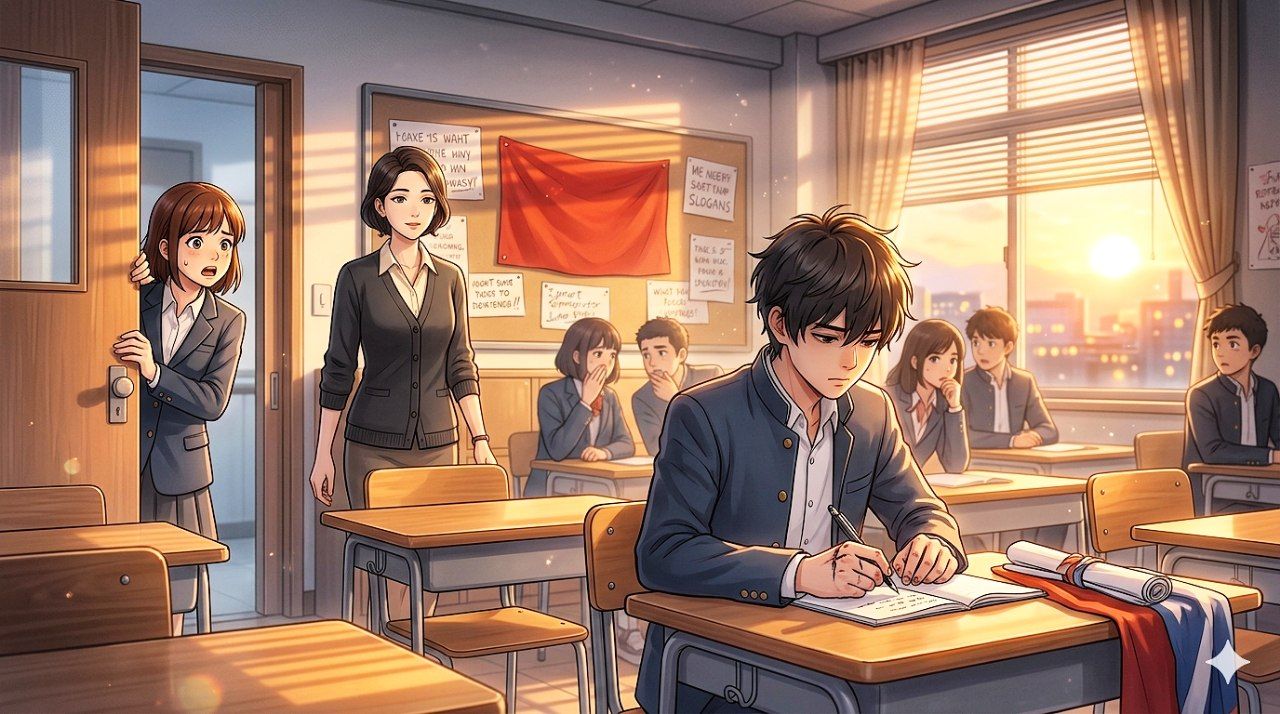
The hallway smelled of chalk and freshly printed papers; the silence seemed to hold the memory of all the conversations it had ever heard. It was the last hours of the school day and the oblique rays of the sun passed through the blinds, drawing luminous bands across the closed doors. In classroom 3‑B, a new flag hung pinned to the wall with two thumbtacks. Around it, cramped, crooked letters, written with markers, proclaimed slogans that sent a chill through more than one student. Mei arrived first and froze when she opened the door. Her surprise cut the air like a bevel. "What is that?" she whispered, unable to hide the tremor in her voice. The classroom, which a moment before had been a place of routine and jokes, had become a stage. Li Wei remained with his gaze fixed on his desk. His hands, stained with ink, clutched a pen as if it were a broken talisman. When he finally spoke, his voice was contained, stripped of theatrics and full of sincerity. "I put it up," he said, and the sentence fell like a stone thrown into a calm pond: ripples reaching everyone. Teacher Chen appeared in the doorway with measured steps. She wore calm on her face as a deliberate act; she did not want the situation to spill over. "Li Wei, come, please," she said without accusation, seeking explanation. "Explain why." Li Wei did not look up. There was an old fatigue in his tone. "It's what I feel. It's what I see. I wanted them to know." He spoke like someone repeating a speech learned through insistence; his voice, gritty, left a trail of urgency that asked no permission. "I didn't come to hurt anyone. I just... thought I should say it." Mei approached hesitantly, with the delicacy of someone afraid of breaking something fragile. "But you shouted in class," she said frankly. "Some people were scared." "No one listens to me," Li Wei muttered. "Not at home... either." The silence that followed amplified the confession; there was no excuse or rhetoric that could erase the sense of abandonment contained in the phrase. News of the flag spread with the same speed that small tempests usually travel: a whisper in a hallway, a message in a chat, the teachers' meeting called in the middle of the afternoon. Principal Huang acted with the seriousness his position demanded. The flag was taken down that same day; the hands that removed it did not want violence, but they could not feign indifference. The official record noted: inappropriate behavior. With administrative patience, an orientation process for the student was activated. Institutional language tried to contain the human with neutral terms. In the counselor's office, Li Wei sat before a woman who tried to hold his gaze without judgment. "Are you worried they'll think I'm a problem?" he asked, his voice barely a thread. The counselor, with the gentle tone of someone who has heard many stories, replied: "We're worried that you tried to resolve something that no one else helped you understand. At school we don't politicize. Here we must be safe spaces." Her words attempted to draw boundaries: protect the classroom from politicization and, at the same time, protect the boy from isolation. However, outside the school's walls the shadows lengthened and were more complicated than a simple decree. Taking down the symbol did not mean erasing the impulse that had produced it. And once something had been seen, a gesture had already traveled. What for some was just another case in the chronology of school life became, in the hands of those searching for causes and effects, something larger. From distant press rooms, institutional voices examined the episode with the gravity of those who weigh every word. A spokesperson issued statements that were recorded, archived, and retransmitted; the matter crossed media borders and entered the circuit of symbolic diplomacy. The school, oblivious within its walls to the ceremony of global labels, saw its small conflict projected as if it were a beacon in the fog. Mei read headlines on her phone during a recess that was no longer free of tension and felt a knot in her stomach. "Why does this have to go so far?" she murmured. Teacher Chen, beside her, explained in a calm voice: "Because we live in a place where even a shout can become a flag." That sentence —uttered softly, as if describing something inevitable— left everyone with the feeling that the world sometimes turns the intimate into the public. In the courtyard, students argued with the energy of those who already imagine themselves as citizens: "It's freedom of expression," one affirmed, his voice swollen with certainty. "It's provocation," another countered, with the gesture of someone who tolerates no irreverence. Li Wei watched from a corner, torn between conviction and shame. Deep down, no one truly knew the roots that had pushed him that morning to pin fabric and ink to the wall. That night, Li Wei walked along the river that runs through the city, the water carrying lights and reflections like multiplied fireflies. He thought of his grandfather, who had come from afar and told him stories of youth filled with loyalties and silences. He remembered a phrase often repeated at home that until then had seemed too vast: "Sometimes the things we think are small are what the world uses to hold up its big questions." The phrase resonated with new weight: his own gesture, in the eyes of others, was now part of a conversation beyond him. The next day the school organized an assembly. The principal spoke with the need to draw clear lines: "We will not allow the politicization of our classrooms. But we will not ignore those who feel they have no voice." He proposed workshops on critical thinking and coexistence; he sought to make the school a place for listening and learning, not for turning anyone into a martyr or a villain. The intent was to create a space where neutrality was not indifference but a framework for dialogue. Li Wei climbed onto the platform with steady breath, his gaze fixed on some indistinct point on the ceiling. "I didn't want anyone to feel bad," he said honestly, "I wanted someone to hear why I see things this way." He spoke of his family, of stories passed down in whispers, of the feeling of belonging and not belonging at the same time. He spoke of a history he carried within and that, for him, needed naming. His words did not convince everyone; some received them with suspicion, others with discomfort. But they opened a door: the possibility of understanding that behind a symbol there is a person with memories, pains, and reasons. Mei spoke afterward, her voice clear and without fanfare. "We have to learn to listen without turning into judges," she said. "If the classroom is neutral, let that neutrality include the opportunity to learn why someone thinks differently." Her words were a plea for applied humanity: a reminder that coexistence is built more with stories than with punishments. Meanwhile, on a distant podium, the spokesperson continued to articulate phrases with the precision of one who knows the value of official language. To the world, the episode acquired the scope of a symbol. For the students of 3‑B, however, it was a complex and less rhetorical lesson: they learned that small actions can create large echoes, and that those echoes, when they return, change the way people look at one another. Li Wei could not stop thinking about the flag. He did not hang it again on the classroom wall, but he did not erase it from his memory either. He attended the workshops the school proposed and, little by little, learned to translate his anger and nostalgia into questions instead of slogans. He learned to name his history without expecting others to accept it as absolute truth. He realized that the power of a symbol can lie as much in what it expresses as in what it conceals. Weeks later, in the library, Mei found Li Wei writing in a notebook with the quiet focus of someone who has discovered a path. "What are you doing?" she asked, curious. "I'm writing," he replied without looking up from the page. "Not slogans. Stories. If one day someone wants to understand, let them find words before symbols." Mei smiled. "Then maybe the next flag will be a page," she said, and in that sentence there was a shared relief. Li Wei closed the notebook and looked out the window. Outside, the city remained a map of lights and invisible borders; inside, those young people continued learning to carry the responsibility of small gestures —to recognize that, although they may seem minimal, they sometimes bear the weight of matters far beyond the walls of any classroom. The flag ceased to be merely a piece of cloth pinned to a wall and became a lesson about listening, memory, and the complicated task of living together when stories intersect. Source of the images. Image created with Google Gemini.
2 comments
Seems to be a nice lesson
Thanx 😁