 @mc5punk
Short story: The Secret of Sundays
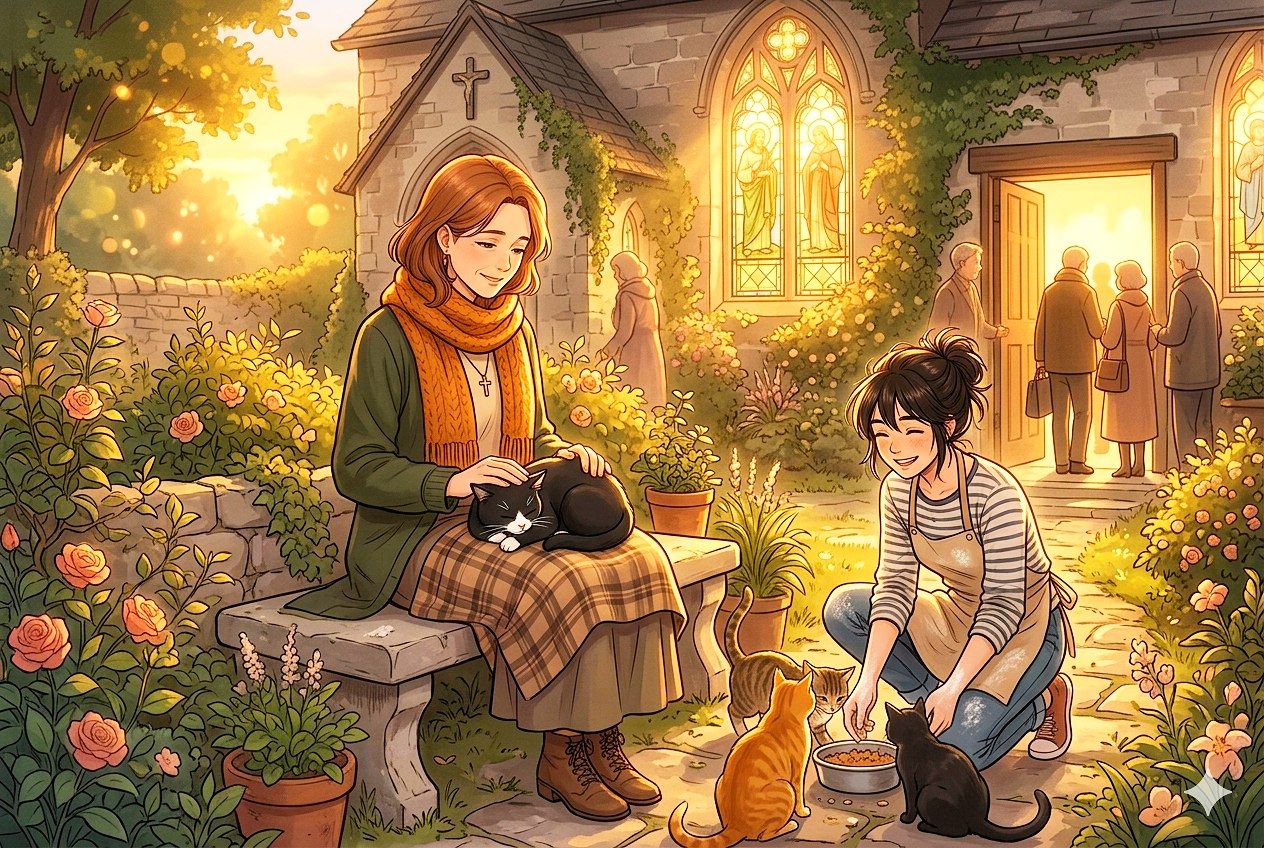
The church bell rang with a sweet, lingering sound as Marta closed the door to her apartment. The air smelled of fresh bread and cold; the blinds still let through slivers of light that cut the dust into glittering specks. She was thirty-eight and had a routine she had come to consider safe: wake up, make coffee, work from home, and spend the rest of the day between calls and the silent company of Calcetín, her black cat with a white patch on his chest. But Sundays were different. For months, every Sunday Calcetín disappeared for hours, as if he had an unmissable appointment. Marta had accepted the oddity with a mix of resignation and curiosity—until her curiosity became too heavy to ignore. "Today I'm following you," she told herself, fastening her scarf with more determination than usual. "If you get lost, at least I'll know what kind of adventure you're in." Calcetín looked at her from the edge of the sofa with the kind of gaze that evaluates whether a proposal is worth his time. He stretched with feline elegance, made an almost silent leap onto the rug, and slipped out of the house with a stealthy step, without a hint of haste. Humor arrived first, in the form of imagined scenarios that kept Marta company on the walk. She pictured feline unions, cat book clubs, nap-position contests, or perhaps a black market for gourmet kibble. Each theory was more absurd than the last, and she couldn't help smiling at the image of Calcetín wearing a tiny tie at a meeting. The contained laughter accompanied her until the corner where reality caught up: Calcetín slid through the church's side door with a punctuality that belied any joke. Marta froze for a moment, watching her cat cross the threshold and head straight to the last pew as if he had attended a thousand masses before. Instinctively, she looked for a seat in the shadows so as not to draw attention. Beside her, an elderly man with wrinkled hands and a curious smile watched her. "Does your cat come to mass?" he asked with the naturalness of someone who has seen inexplicable things many times. "It seems he does," Marta replied, holding back both laughter and bewilderment—"I didn't expect him to have that devotion on Sundays." The mass began. Voices rose in a murmur that slowly turned into song. The stained glass cast patches of color over the pews, over faces, and over the small black figure curled against the backrest. Calcetín closed his eyes slowly; his measured breathing matched the rhythm of the prayers. Marta felt something in her chest loosen with the music and words; the scene looked like a painting: light, shadow, and the almost imperceptible purr of the cat. But the mass also brought drama. In the quietest moment, a woman in the row ahead began to cry. It rose like a sudden wave: held-back sobs that became audible. Someone took the woman's hand; another offered a low prayer. Marta watched, and emotion swept through her without asking permission. She thought of her own Sundays: quick meals, half-watched shows, excuses for not inviting anyone over. Sundays had become days of waiting rather than companionship. Seeing that woman break down confronted her with her own vulnerability. How many times had she allowed loneliness to nestle in around her under the pretense of being busy? When the mass ended, people rose, greeted one another, and filed out. Calcetín, impassive, jumped down from the pew and began weaving between parishioners' legs with disarming familiarity. Marta followed him without quite knowing why—curiosity, relief, an impulse to reclaim what she felt belonged to her. The cat led her toward a small side door that opened onto a barely visible backyard garden. Beyond the door, the sun fell softly over a corner with potted plants, a couple of stone benches, and a pile of plates with leftover food. There, a young woman with her hair tied back and hands dusted with flour from what seemed to be homemade bread tended a bowl of kibble with almost ceremonial patience while three or four other cats approached respectfully. Calcetín nestled into her lap as if she were his secondary owner. "Ana?" a voice called from the doorway, and the woman looked up with a smile. "Yes, I stay here on Sundays. Can you help with the donations today?" Still astonished, Marta approached the group. Ana looked at her with the calm of someone used to strangers turning into confidants. "You're the owner?" she asked. "Oh, I've heard that a very punctual cat comes every Sunday." "Yes," Marta murmured. "His name is Calcetín." "Sometimes many people come," Ana said, like she was sharing a secret. "It's not just for the food. People and animals find something here they don't always find outside. A pause, a listening ear, a space where they can be without explanations." Marta sat on the edge of a stone bench. Calcetín, indifferent to any sentimental label, began meticulously licking his paws. The garden's scene—potted plants, a small crucifix, books stacked on a table—carried the calm of things tended by hands that insist on care. In that microcosm, hours seemed to take on another weight: less urgency, more meaning. Ana explained that the parish had opened the garden to anyone in need of company. Sometimes it was elderly people who came alone; sometimes teenagers seeking silence away from family noise. And there were days when the plaza's pets formed an unofficial procession to that corner. "Animals smell peace," Ana said with a smile, as if it were the most logical thing in the world. "And we're here to offer it." Marta remembered her own Sunday in the apartment: the coffee maker, the screen devouring hours, the growing to-do list. She realized she had let routine strip the edges from her life; she had expected free time to fill her emptiness on its own and had not actively sought companionship nor built small rituals to mark the day. Watching Calcetín receive pets and purr among strangers opened an inner door she hadn't known she needed. "I didn't do it out of rejection," she said quietly, honest with herself. "I thought that if I tried less, life would disappoint me less." Ana looked at her tenderly. "Sometimes we believe loneliness is a form of protection," she said. "But it can also be a wall that keeps us from going in and out. Here we've learned that any creature can teach others to drop their guards. A cat, a cup of tea, a timely word." The day moved on and the garden filled with small conversations: an elderly woman remembering Sundays from her childhood, a young couple looking for a place to sit away from the city's noise, a child delighting in chasing shadows with a stick. Marta found herself telling short stories from her life, laughing, listening. Her shoulders, tense for so long, began to relax. At one point, Ana suggested she stay the following week to help prepare the lunch packs they gave to those in need. Marta, who had come simply to follow her cat and solve a mystery, found herself accepting with the sincerity of someone recognizing a chance for change. "And Calcetín?" Ana asked. "Will he come to teach us all how to remain serene?" Marta laughed. "He just does what cats do best: find the most comfortable place and stay. But I suppose today he taught us not to fear what happens outside our door." Before leaving, Calcetín jumped into Marta's lap and curled up as if sensing the weight she carried. His purr was the simplest, most honest heartbeat that brought her back to earth. The church bell rang again, this time as both farewell and promise. "Come back next Sunday," Ana said, handing her a small bag of homemade cookies. "And bring whoever you like. There's always room." On the walk home, Marta looked at the neighborhood differently. Sundays had stopped being just a calendar date; they had become a possibility. She imagined small gestures she could introduce: a call to a nearby friend, a walk to the market, an open book at a café. She realized that companionship doesn't always arrive with permission: sometimes it is found on a church bench, with a volunteer feeding cats, or in the routine of an animal that chooses a safe place. Weeks later, Marta returned. She brought a donation box and a less guarded smile. Calcetín kept his habits: punctual, sun-loving on the bench, undisputed king of his small realm. Marta, however, wore a different light: the certainty that she could leave the house not just to get things done, but to seek encounters that nourished her soul. Final reflection: life consists of small ceremonies. No grand gesture is needed to turn loneliness into companionship; simply crossing a door, sitting on a bench, and allowing the presence of others—human or animal—can do the rest. Calcetín, with his knack for appearing where least expected, had been a bridge. Marta learned that there is no shame in asking for a place to stay; sometimes asking is the first step to being received. Humorous epilogue: One afternoon, as she was leaving, a parishioner winked and said, "Maybe we should print business cards: 'Calcetín, honorary assistant of the parish.'" Marta laughed and thought that if they ever printed cards, she would put on hers: "Available Sundays." Calcetín, as if understanding the joke, gave one last satisfied meow before disappearing between the pews, off to his next mass. Source of the images. Image created with Google Gemini.
No comments yet