 @mc5punk
Short story: The House of Returns
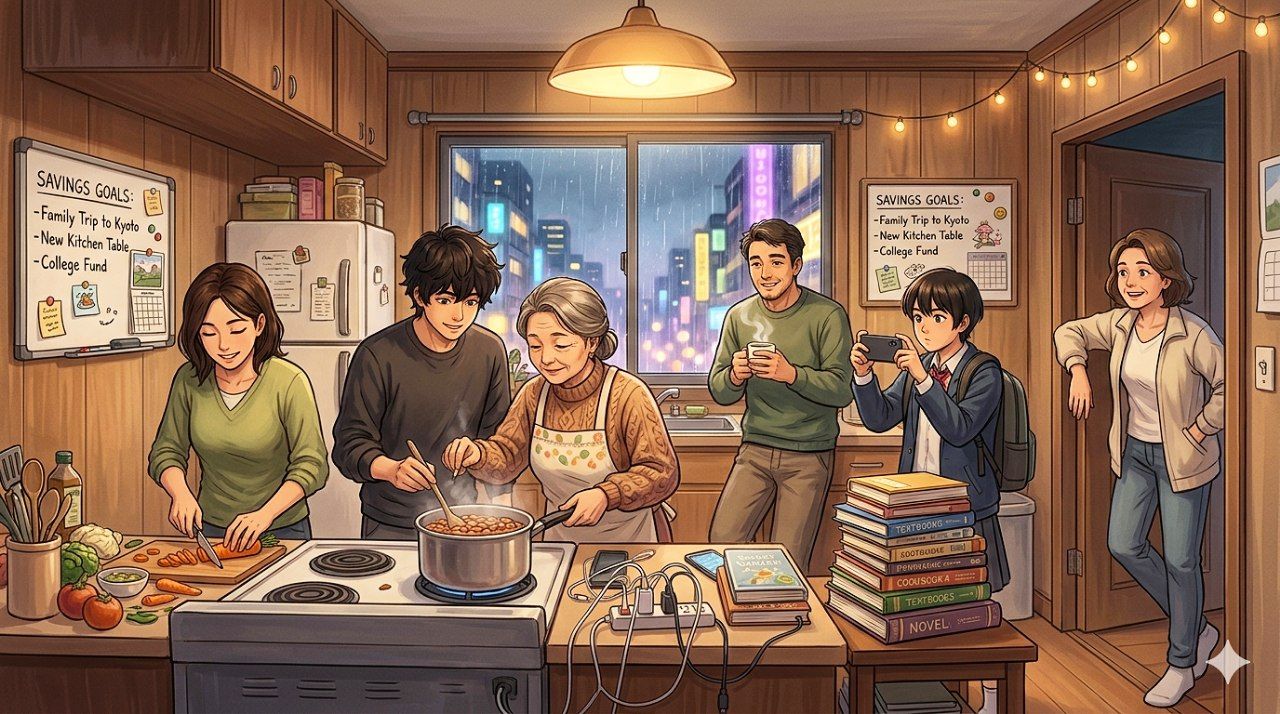
On the third floor of the building called “Sustainable Progress,” where the elevator made more stops than political promises, there was an apartment with a door that was always open and a doorbell worn by many hands. A multigenerational family lived there with its own logic: Doña Amalia, the matriarch; Carmen, her eldest daughter; Raúl, the practical son-in-law; Leo, a 28-year-old who had made coming and going a habit; Sofía, the 22-year-old cousin and student; and, from time to time, Tito, the neighbor-philosopher who left reflections like bread on the table. The living room was a geography of tangled charger cables, cups forever seeking their match, and stacks of books used to prop up the coffee table. One rainy afternoon, while water struck the balcony and the city organized its symphony of horns and umbrellas, the family gathered around the table for dinner. Carmen was chopping vegetables as if with each slice she could pare away a worry. “Leo, turn off that videogame and come help with dinner,” Carmen ordered, not raising her voice but with the authority of someone who manages time and bills. Leo didn’t immediately take his eyes off the screen; his fingers still searched for a key combo. Finally, he put the controller on the table with a sigh and came over. “Mom, I’m in the middle of a match,” he said. “Besides, I already paid my share of the internet and last night’s pizza.” Doña Amalia, sitting in her armchair with a blanket over her legs, smiled as one who has seen enough fashions to know every generation names its crisis differently. “My grandson isn’t lazy,” Doña Amalia declared. “He’s strategic. In my time, we also returned home when things got difficult. We didn’t call it a ‘temporary return’; we called it ‘humility.’” Tito leaned in the doorway like a late-night commentator, cleared his throat, and with his habit of turning data into proclamations, said, “According to the Pew Research Center, 18% of people between 25 and 34 in the United States live with their parents. And men are more likely to do so than women.” Sofía let out a laugh that carried the relief of someone who doesn’t yet pay the bills. “Can that be fixed with memes?” she asked, half joking, half protesting. Raúl, who had just come home with his tie half loosened, set down his briefcase and took a cup of coffee. He had a habit of lining up words before giving them order. “The problem isn’t only the statistic,” he commented. “It’s the context. Many young people don’t earn enough to cover rent, utilities, and basic expenses. Going back home becomes a practical decision, not always a moral failing.” Carmen frowned—the same frown she used to review bills and payment plans. “But perception weighs,” she replied. “The woman from the third floor thinks an adult man can’t live with his parents; she sees it as a lack of independence.” Doña Amalia shook her head, not to contradict but to add memory. “In many families—especially in Latinx and Asian contexts, and also among Afro-descendant families—several generations have shared a house by custom. That’s not shame; it’s support. When the neighbor talks about independence, I remember that independence can also mean supporting someone who stumbles.” Leo, who had been standing by the table, exhaled and spoke with the voice of someone who has learned to compress complex experiences into short sentences. “I didn’t stay out of comfort,” he said. “I left when I could, worked where they opened a door, and came back when the door outside closed. It’s not that I don’t want to be independent; independence today costs a fortune and sometimes you have to buy it in installments with the peace of being at home.” Tito, always ready with a polished irony, replied, “Do those installments include washing the dishes and helping pay for gas?” “Yes,” Leo answered calmly. “And washing dishes, and being there when Grandma doesn’t remember if she’s already eaten. That’s adulting too.” Sofía, studying social theory between classes, added her academic but affectionate perspective. “People confuse ‘living alone’ with ‘being grown up.’ Independence isn’t a place; it’s a network of choices. Living with family can be lack of drive or the most mature strategy to survive in an economy that pushes people toward endless workdays and precarious jobs.” Raúl nodded and let the idea land. “It’s also true that some responsibilities get postponed,” he said. “Buying a house, getting married, planning for retirement… everything can happen later. It’s not necessarily bad; it’s another timeline.” Doña Amalia, with the clarity that comes from years, intervened again. “Before, adulthood arrived with the first gray hair and the first mortgage. Now gray hair may come earlier and the mortgage later. But in my home there was always room for one more. Sometimes the most grown-up thing is opening the door and not judging.” The conversation softened as if the arguments were tired of fighting. At one point the rain stopped and the smell of wet earth drifted through the window. Outside, the city continued mixing work shifts, concerts, and startup promises that seemed to build castles out of cardboard. “What if we make a deal?” Carmen proposed. “In six months you look for a job that pays more and I’ll give you concrete goals: open a savings account, learn to cook three basic dishes, and contribute to the gas bill.” “Deal,” Leo said with a smile that contained relief and fatigue. “But if I leave and come back, how do I explain that to the woman on the third floor?” Tito wiped his hands as if removing a sticky joke. “Tell her you go home to update your emotional software,” he suggested. “Sounds more modern.” Everyone laughed. The laughter didn’t pay bills, but it made the burden lighter. That night, as the city’s lights blinked like notifications no one had time to open, Doña Amalia said something that lingered in the hallway. “Let’s not confuse statistics with sentences. Eighteen percent is a number; behind that number are stories, strategies, mistakes, and care. Some return out of necessity, others out of culture, others by choice. All those forms should fit in a home if the home understands that what matters is not the direction you leave in but who you take with you when you go.” The neighbor from the adjacent apartment, who had listened from her half-open door, pressed her lips not to deny but to think. On the street, a young man packing boxes opened the message he had written to his mother and for a moment chose to call her instead of looking for a storage unit. Weeks later, the deal made at dinner turned into concrete actions. Carmen opened a savings account with small automatic contributions so the money wouldn’t be forgotten at the bottom of a wallet; Leo enrolled in an evening administration course and began cooking on Sundays with Doña Amalia to save money and learn recipes missing from any tutorial; Sofía dedicated hours to her thesis and organized a small study group with neighbors; Raúl reviewed service contracts to find savings. One morning, when the house smelled of coffee and fresh bread, Doña Amalia taught Leo her method for cooking beans: patience, low heat, and conversation. Leo learned to measure salt without checking his phone, to listen to time, and to understand that cooking is also a way of ordering life. “See?” Doña Amalia said. “You don’t just cook food; you cook habits. You learn to wait.” A month later, at the now-official quarterly goal meeting (with a kitchen whiteboard), Leo showed his first savings: not a spectacular figure, but real and growing. Tito, who enjoyed turning the everyday into humor, exclaimed, “It’s the first time I’ve seen someone save money and not post it in seven stories!” Raúl, surprised by the gesture, proposed a rule: every three months declare an “adulting novelty,” an act of personal growth not tied to external comparison. Carmen was first—she signed up for an entrepreneurship workshop. Sofía promised to finish her thesis that semester. Doña Amalia, with a spark in her eyes, announced she would take painting classes again after forty years. The neighbor who had once murmured judgments began bringing homemade desserts on weekends, as if trying to patch a truce with the hurry of the neighborhood. Elevator conversations became less cutting: people were no longer measured by their postal address but by the decency with which they honored their commitments. Over time, some household members moved into their own apartments; others returned after failed attempts; some never left. Each departure and arrival came with conversation and agreement; no one left without notice, no one returned without explanation. Doña Amalia said that was more humane: exits and entries should be accompanied. Years later, Leo returned one afternoon holding the key to a small flat. There were no grand announcements or fireworks; nobody needed them. Carmen packed sheets and towels into a bag; Doña Amalia put a tablecloth she’d sewn when Leo was a baby into a box like a talisman. Tito stood in the doorway with his irony ready. “Are you leaving for good?” he asked with a half-smile. “I’m leaving to be better prepared,” Leo replied. “And I’ll come back when I need to.” The farewell was simple: contained hugs, promises to visit, and the familiar feeling that the door remained open for those who knew how to respect it. Leo left with a suitcase and the sense of someone who doesn’t abandon a safety net but stretches it, knowing the knots stay firm and ready to hold. The House of Returns did not become a museum of failures, nor a shrine of success. It transformed into a workshop where adulthood was rehearsed daily: paying a bill, listening to a bad day, teaching to cook, sharing care, learning to save, laughing at ads that promised freedom in installments. The 18% statistic stopped being an offensive label and became a map of people with names, stories, and diverse strategies. Outside those walls, social satire kept running: influencers selling “living alone” as the supreme achievement, banks offering mortgages like magical passes to maturity, and ads promising independence in monthly payments. But inside the third-floor apartment dignity was measured by gestures: shared dishwashing, grandmother’s stories, split bills, and decisions made together. Over time the family learned small but decisive lessons: asking for help is not surrender; returning is not stepping back; and independence can often be the product of collective work. The house stayed a place to rehearse where everyone practiced their scene until the music changed again. In that home, adulthood stopped being a solitary race and became an imperfect choreography in which some steps are taken alone and others are held by the hands of those who walk with you. Source of the images. Image created with Google Gemini.
No comments yet