 @mc5punk
Short story: The Light That Does Not Soothe
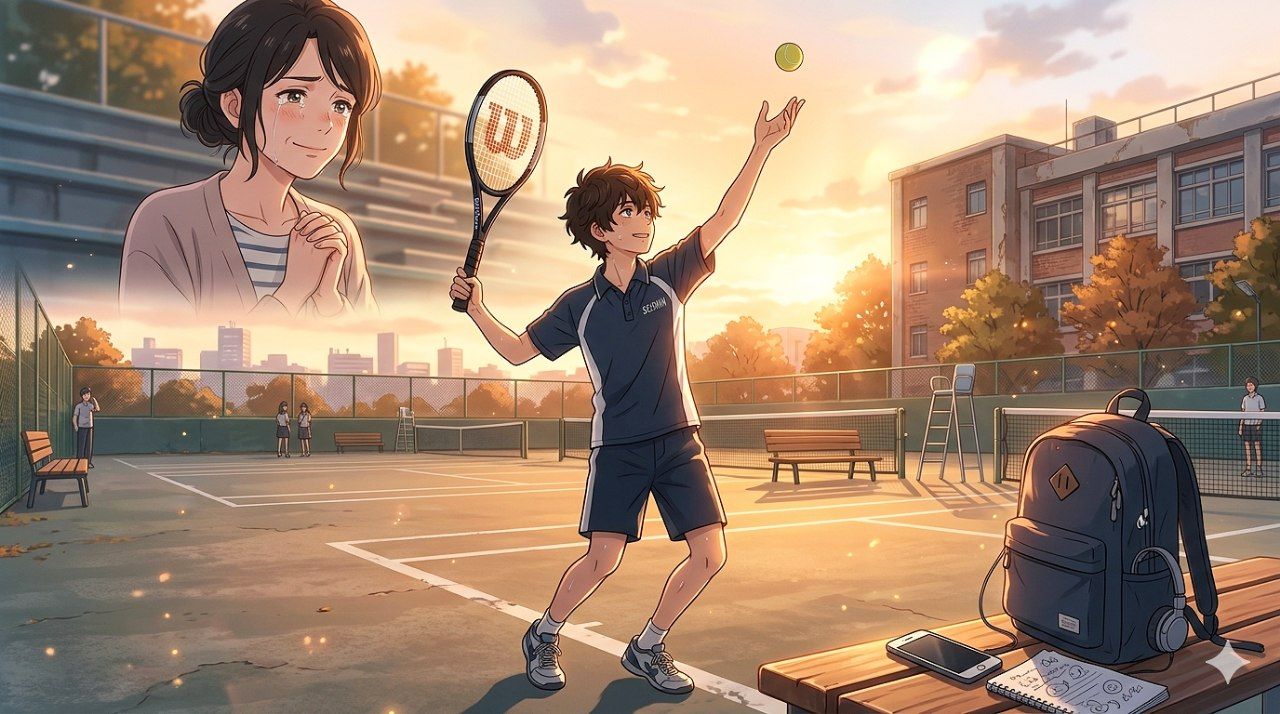
Elena had learned to move around the house with the stealth of someone who fears disturbing a foreign territory. That afternoon, when she opened Marcos’s bedroom door, she froze for a second as if two times that no longer shared a language had met at the threshold. The computer screen flooded the boy’s face with a bluish glow; his breathing was steady, hypnotic, and the headphones sealed his attention to the world. On the desk, a sweating bottle of energy drink sat beside a crumpled notebook, the course notebook that seemed to fall further behind with every notification. “Marcos,” Elena said quietly, trying to contain the worry burning her ribs. “I’ve been calling you for half an hour. Will you eat something?” The boy averted his gaze just enough to answer, without taking his eyes off the chat unfolding on the screen. “Not now, Mom. I’m about to finish a live stream.” Elena felt her voice shrink in front of that world that claimed her son. She stepped closer, leaving the door half closed, as if the room were an island and she didn’t know whether she should set foot on the sand. “It’s not just now,” she replied. “Every day you wake up late, you don’t do your homework, you isolate yourself. I’m worried.” Marcos clenched his jaw, a gesture that could only half-hide the unease he carried inside. “The whole group is online,” he answered. “If I disconnect I lose everything. Don’t you understand?” The reply was a small wall: incomprehensible to someone who did not measure identity in followers, likes, or viewers that mattered more than family words. Elena lingered by the door for a while, watching the light moving across her son’s face, thinking about the conversations she had imagined that always ended reduced to warnings. At school, teacher Clara prepared for class with a mix of fatigue and resolve. There was in her the sense of responsibility of someone who watches the ties that hold a generation together erode. She turned on the blackboard and, with firm strokes, wrote a phrase she wanted to cut through the classroom: “Presence is not the same as attention.” That idea was a wake-up call. “How many of you feel you control your time online?” Clara asked, her voice steady. “It’s not only about how much you look at the screen; it’s about what you stop seeing outside.” The room answered with a murmur: shrugged shoulders, looks that dodged the question. Marcos, who had arrived late as he almost always did, sat in the back row. Under the desk his thumb kept scrolling the phone; the motion looked natural, almost unconscious. Clara watched him without pointing, because she knew too well the weight of words spoken to an adolescent. “Young people who spend more time in front of a screen,” Clara continued, “are more likely to suffer depression, to engage in harmful behaviors, to become hooked on addictions, or to see their school performance drop. These aren’t statistics; they are lives.” The sentence struck the air and left a silence that lasted longer than usual. It wasn’t a sentence of doom but a warning. Clara didn’t seek to frighten but to awaken. She knew that behind every figure hid stories of loneliness and a sense of belonging sought in spaces that reproduce and amplify desires rather than sustain them. That night, in Elena’s house, the hours dragged. The TV ran cycles of images that passed without leaving a trace. Marcos finally emerged from his room close to midnight, eyes hollowed by tiredness and dark circles that mapped nights with no windows. His voice sounded rough, exhausted. “I don’t need therapy,” he said with a hint of irritation. “I’m just tired.” Elena looked at him with everything a mother can put into a single look: love, fatigue, fear. “I was a child, then a mother, but I will never forget you,” she murmured. “I heard Dr. Ruiz at the school meeting. He says it’s not about forbidding, but about setting limits and offering alternatives. I want to help you, son.” Marcos set his phone on the table with the disappointment of someone parking a temporary refuge. “And what if it doesn’t work?” he asked. “What if it’s easier not to feel?” That question, thrown into the home, sounded different because it came from someone who had already learned to anesthetize himself. Elena answered without drama, with the patience cultivated in years of caregiving. “It’s not about forcing you into anything,” she said. “It’s about finding other ways to be. If you let me, we’ll try it together.” The family decided to seek professional help. In Dr. Ruiz’s office, the room smelled of coffee and open books; the chairs were arranged in a circle as if encouraging conversation. The psychologist spoke with the calm of someone who has seen narratives fracture and learned to rebuild them with small pieces. “We can’t erase the digital world,” he said. “Experts call for safer platforms, and rightly so. But we also need homes that teach people to look differently: activities outside the screen, clear limits, real conversations. It’s not punishment; it’s learning.” Marcos listened and made a face. His look betrayed skepticism: he had spent so long feeding a digital identity that the idea of letting it go hurt. “Will that make the emptiness go away?” he asked. “Is there a guarantee?” The doctor shook his head, not minimizing the question. “It’s not an instant cure,” he replied. “It’s a net. A net of habits, relationships, and days when your mind gets used to feeling without filters. Depression and addictions don’t always come from a screen, but often the screen feeds them. Change takes time and company.” The proposal was simple in form: start with basics. Elena introduced rules that seemed small, almost ritual: device-free dinners, one daily hour when no one looked at screens, weekend walks, and activities that forced the body and attention into another register. Clara offered Marcos the chance to try a tennis class as a way to move without looking at a camera—pure coordination, sweat, and a rhythm that admits no second screens. The first tennis lesson was an almost ritual act of resistance. Marcos showed up out of obligation, with the distance of someone performing a foreign task. His movements were rigid; striking the ball was clumsy, closer to rehearsal than skill. Yet on the second or third hit something clicked: the ball struck the racket and returned with a dry, lively sound. For that instant, a fraction of a second, Marcos’s face loosened; a genuine smile surfaced without a filter or a camera translating it into metrics. “I’m not good,” he said, breathing heavily, “but it feels... weirdly good.” Elena clenched her fists to hold back tears on the court. She kept that smile as one keeps an unexpected treasure. The road was not linear. There were relapses: sleepless evenings where the screen returned as refuge, heated arguments over schedules and punishments, broken promises that stung at the kitchen table. Change did not come by decree; it was a daily work of persistence and adjustment. In school, Clara didn’t let the conversation run out of warnings: she promoted debates, invited students to think critically about platform designs and the mechanisms that capture attention. She spoke of collective responsibility—young people, educators, platforms, and parents woven into a network that produces effects, and therefore all have a role to play. “We cannot shift blame only onto the kids,” Clara said in a crowded class. “Networks are designed to trap attention. Calling for safer platforms is also demanding humane design. Asking parents to set limits is returning to the home the capacity to teach.” Over time, Marcos began to notice details that had been invisible before: the midday murmur of the city, the texture of grass when he fell on the court, his mother’s voice without filters or judgments, conversations with friends that didn’t need the blink of a screen to hold them. Those discoveries were modest—small flowers in a field that had seemed barren. One afternoon at the end of the semester, Clara proposed an exercise: write a letter to themselves five years from now. The task was met with the usual mix of mockery and surprise; some didn’t know where to begin. Marcos, without much fanfare, wrote with clumsy, sincere handwriting. When it was his turn, he stood and read aloud with his throat tight. “I want to remember how the sun feels,” he said, and the phrase passed through the classroom like a gentle ray. “I want not to depend on a screen to know who I am.” The silence that followed was not awkward; it was dense and resonant. In the corridor, Elena, who had come to see the chapter’s close, watched him with moist eyes. It wasn’t the promise of total healing; it was a seed planted. The months that followed were a mix of progress and setbacks. There were dark days when the screen glowed with its old seduction and depression whispered with an ancient voice. But hands reached out—those of a teacher who didn’t give up on a student, the psychologist who taught how to weave support networks, a mother who learned to set limits with tenderness rather than anger—and those hands made the difference. Marcos learned to seek the emptiness that scared him not with the sparkle of a screen but with the pulse of reality: a walk in the park, an afternoon in the library, the exhaustion of a well-played match. One ordinary afternoon, weeks after the court incident, Marcos tossed the ball without needing to check a camera; he didn’t look for a screen’s reflection to know he had hit it. Elena’s eyes met his in the stands, and for a second—brief, decisive—there were no notifications, only the shared heartbeat of two worlds attempting reconciliation. Elena then understood something that both hurt and healed: platforms can and should be reformed to be safer; experts can demand designs that respect human attention; parents can learn to set limits that are, at heart, life lessons. But she also realized that attention is a fragile good, a delicate emotional currency that requires constant care, patience, courage, and that soft insistence that only true love sustains. The story offers no absolute endings or infallible solutions. Instead it presents the image of a family reconstructing its daily fabric, a school that doesn’t abandon its students to drift, a community trying to place humane patches on a design that pushes toward solitude. Above all, it testifies to an intimate truth: changing course takes time, and along the way relapses are inevitable, but the hands that accompany someone make the difference between falling forever or getting up once more. Source of the images. Image created with Google Gemini.
No comments yet