 @mc5punk
Short story: The Breaking Point
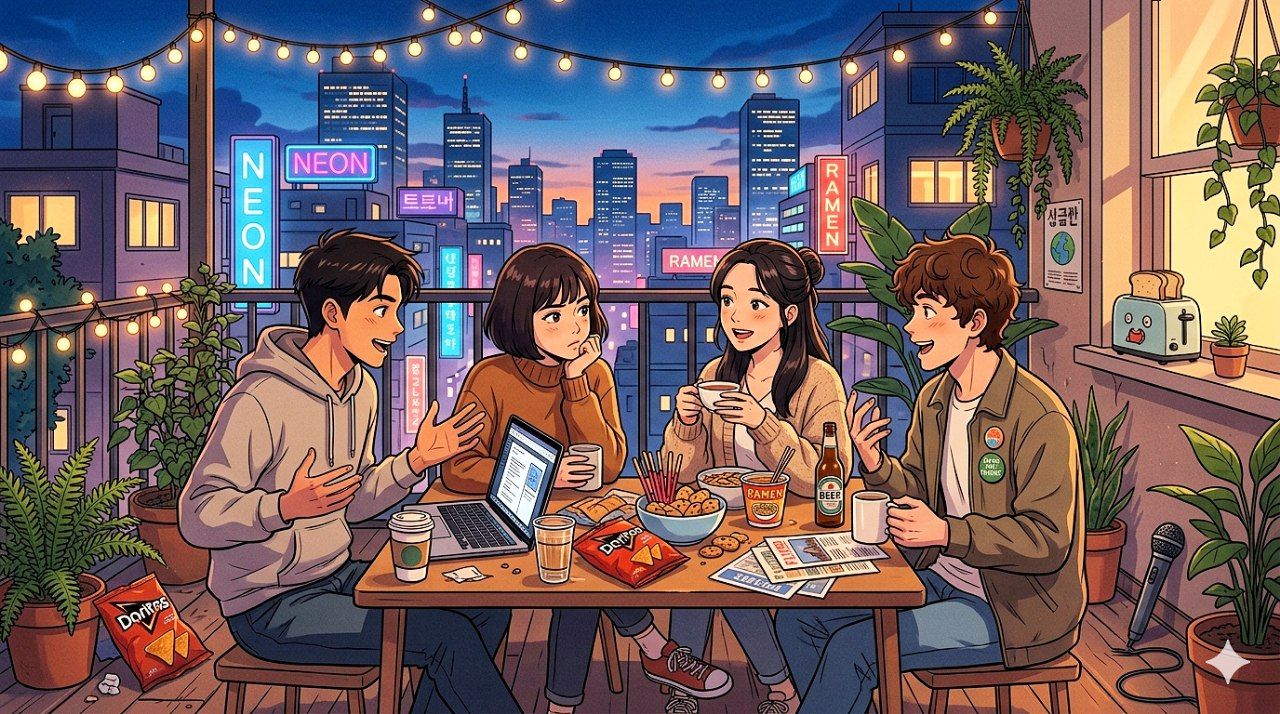
Ana had a habit of saying she could smell social change; those who knew her were no longer surprised when she pointed to a news item and announced, “this will hurt, but it will help.” That afternoon the terrace of the building she shared with Mateo had once again become a debate headquarters: a table with cups, two open laptops like antennas, a plant pretending to listen, and a box of cookies acting as a silent moderator. Ana, a 25‑year‑old sociology student, stirred her sugar with a solemnity that contrasted with the lightness of the afternoon. She looked at the city, the passing bicycles and the luminous billboards flashing promises, and let out a breath that was half resignation and half intellectual curiosity. “Do you remember when we thought everything would go in the same direction?” she asked, holding her cup like a small trophy. “That men and women would move forward together, the same struggles, the same expectations.” Mateo, 26, a software developer with a natural tendency to turn any topic into a technical analogy, put his laptop aside and fixed his gaze on Ana. “I remember,” he replied. “But it isn’t like that anymore. At the office most of the women talk about policies that used to be unusual; they’re more socially liberal. Many of the men, on the other hand, seem to cling to more traditional ideas. It’s strange to see it so pronounced.” Far from abstraction, Mateo’s observation came from daily life: meetings, shared memes, lunches and hallway conversations where the words “toxic” and “consent” were no longer rare terms but part of everyday vocabulary. Ana, who read these changes with the intensity of someone who works on the subject, pulled out her phone and showed a message from Ji‑won, her Korean friend. The screen showed a photo of Seoul from a lookout and a text that read: “It also feels different here. My friends don’t want to get married soon; my male colleagues talk about pressure and frustration.” Below, Ji‑won had put a ramen emoji, as if to underline that sometimes nothing is fixed with a bowl of soup. “And in South Korea?” Mateo asked, curious and secretly hoping to find a solution or at least an explanation he could reuse in his own environment. “You said Ji‑won had noticed something.” “Yes,” Ana answered. “She told me the differences are affecting basic things: relationships, decisions about having children. It’s not just politics or labels; it’s how people decide their lives.” That evening Ji‑won arrived on the terrace with double bags of snacks and tea, like someone bringing cultural reinforcements to an international gathering of domestic thought. She sat down on the couch, placed the bags among them and handed out small rice crackers that crunched as if they had their own social commentary. “In my family many men say they feel the rules changed without them knowing how to adapt,” Ji‑won said in accented Spanish, with the practicality of someone who translates complex experiences into clear phrases. “And my friends, after #MeToo and other conversations, don’t tolerate certain dynamics. That has changed how they see us and how we see ourselves.” Lucas, a 27‑year‑old neighbor and community activist, had stopped by the terrace under the pretext of dropping off flyers about a neighborhood project and stayed as if the universe had assigned him the role of unofficial mediator and provider of energetic comments. “Cultural moments like #MeToo were an earthquake,” Lucas said. “They didn’t just expose behaviors; they redefined what power and inequality are. For many young women it was an inflection point: they demand respect and expect equality. For some men, the reaction was confusion, rejection or retreat. And for others, the ‘this doesn’t apply to me’ phase lasted exactly until it did.” They talked at length. It wasn’t an academic debate: it was an inventory of anecdotes, misunderstandings, small victories and uncomfortable conversations that became necessary. Mateo spoke about his office, about how discussions on consent and equity were as normal as discussing a software update. He also mentioned, with the irony of someone recording everyday contradictions, that dating apps hadn’t clarified anything: they only multiplied indecisive profiles and “bios” that read “no drama” while the interests section had more entries than clarity. “In my group there are those who prefer not to get involved in serious relationships,” Mateo said softly. “Others believe starting a family is no longer worthwhile. All this affects concrete decisions: who to date, whether to have kids, where to live.” Ana nodded. She had the look of someone who had reviewed studies and heard enough testimonies to understand these changes weren’t passing trends but deep shifts in life’s coordinates. “And it’s not an isolated phenomenon,” she explained. “I see it in studies, in news, in conversations with friends from other countries. It’s consistent and repeats: young generations divided in expectations and priorities. It’s as if we all had the same map but used different scales.” Ji‑won poured tea into small cups, and her voice became more intimate. “In my country it’s clear,” she said. “Marriage rates drop, birth rates fall. It’s not simply apathy; it’s the consequence of gaps in trust, economic security and different expectations between men and women. Also, karaoke doesn’t help: nobody wants to commit after someone sings ‘My Heart Will Go On’ too seriously.” There was a shared laugh, because humor, even in the midst of gravity, acts as a necessary relief valve. Lucas added a reflection that combined skepticism and pragmatism. “We used to be a relatively aligned generation,” he said. “Today that alignment breaks internally. It changes how we organize relationships, politics, collective priorities. And if this continues, soon there will be more tutorials on how to negotiate household chores than on how to program.” The conversation turned more concrete. The changes they discussed weren’t just discourse: they translated into decisions as tangible as choosing who to spend nights with, whether to invest in a mortgage, or delaying parenthood because of economic insecurity. They agreed the gap, when manifested in life choices, had real social consequences: lower marriage rates, demographic decisions and a reconfiguration of community supports. At one point the discussion came back to how cultural movements like #MeToo, far from being a punctual event, created a before and after in how many young women perceive power, inequality and their personal experiences. Ji‑won said it clearly: those conversations didn’t just expose abuse; they taught people to name it and not tolerate it. “For us,” Ji‑won said, “it was a cleanup of vocabulary and boundaries. It’s not only about reporting; it’s redefining expectations. And that clashes with forms of masculinity that didn’t transform at the same pace.” Mateo reflected on the male reaction: not everything was malicious; part was bewilderment. Bewilderment that, without tools or alternative models, led to reactions ranging from withdrawal to clumsy attempts to adapt old roles to new realities. “Many guys grew up with implicit instructions,” Mateo said. “When those instructions become obsolete, some don’t know how to rewrite them. Others refuse to accept it and others try to reinterpret them.” Ana, with methodical calm, saw patterns: the fracture wasn’t limited to ideology. The gap affected day‑to‑day decisions—relationships, family, work—and therefore the structure of society. She gave examples: in countries where young women adopt more socially liberal stances and men maintain or shift toward conservative positions, life paths quickly fall out of sync. “In certain contexts,” Ana said, “those differences are no longer subtleties; they’re chasms. And when expectations about partners, work and family separate, old solutions aren’t enough.” They proposed acting locally and practically. Ideas sprouted—sometimes serious, sometimes half in jest—but all with the intent to build bridges without erasing differences. Mateo proposed something technical: communication protocols in relationships and workplaces inspired by agile development practices—emotional sprints, retrospectives without blame. His suggestion provoked laughter but also interest; the imperfect analogy had utility: routines for review and improvement. Ji‑won suggested support networks that replicated informal care structures: time exchanges where neighbors helped with children or chores in return for cultural companionship or language lessons. She proposed those agreements include playful clauses to avoid misunderstandings: “In case of excessive karaoke, the affected person may demand three hours of mandatory silence.” Lucas, with community mobilization experience, proposed negotiation and shared finance workshops, plus campaigns explaining, without lecturing, how inequality affects private decisions but produces public effects. He proposed playful formats: board games simulating household negotiation, forums for sharing real experiences—without judgment—and active listening spaces. The conversation stretched until the night stopped being a simple curtain and became a curtain with poorly synchronized LED lights. Amid the proposals practical details appeared: co‑living arrangements with clear cleaning clauses (signed with witnesses if possible), community daycare systems with rotating shifts, reading groups on masculinity that included men and women so learning wouldn’t be a monologue. Someone joked about a “manual for living together in times of transition,” which, while evoking complicated instruction booklets, would include charming illustrations and stickers. They laughed—laughter as a means to keep things light when the discussion threatened to grow too heavy. In a quiet moment, with the city whispering its usual mix of sirens and detours, Mateo asked softly: “What do we do?” The question wasn’t looking for a definitive answer; it wanted a map with steps. Ana, staring at a distant light, answered. “Listen. Recognize that it’s not just ideology; it’s life decisions. Create spaces where each person’s experiences are understood and not annulled. It’s not a quick fix, but ignoring it only deepens the gap. And also, more coffee. Coffee always helps.” Ji‑won rested her forehead in her palm, as if trying to fit the pieces of a puzzle that had changed the shape of its pieces. “Maybe the break is an opportunity,” she said. “If we acknowledge the differences and pursue collective solutions, we can build bridges. But it will take will, because what comes won’t resolve itself. And less poorly managed karaoke.” Lucas nodded and added, with his characteristic pragmatic optimism: “Then let’s start here. In our neighborhood, in our conversations. Small decisions that add up. And if it fails, we can always blame the toaster.” They outlined modest but concrete plans: monthly terrace meetings to exchange experiences and evaluate pilot projects, a roadmap for workshops, a local platform to publish helpful resources, and a time bank for caring. In the end, all initiatives seemed small compared to the magnitude of the phenomenon, but they agreed on one thing: the accumulation of local actions could, over time, change structural conditions. When they said goodbye, the city wrapped them in its polyphonic murmur. Ana closed the door with the feeling of someone who had planted a seed in uncertain soil; she wasn’t afraid of uncertainty but knew good intentions weren’t enough. Mateo, back at his apartment, opened his laptop and, with almost comic discipline, typed: “Implement active listening v1.0” and searched for memes to illustrate it; he believed humor was the social lubricant needed to keep conversations from getting stuck. Ji‑won returned to Seoul with an empty snack bag and the sense that, although the routes weren’t the same, perhaps they could learn to coordinate the traffic lights. The generation that had grown up thinking men and women would march in the same direction now found itself traversed by different trajectories. Some moved apart, others searched for signals to reunite, and most navigated with uncertainty and imperfect resources. That breaking point, far from being a simple fracture, presented itself as a map under construction: full of possible routes, unexpected detours and small places where people tried to reach agreements. The story didn’t end with a final solution. It ended, rather, with an inventory of steps: ongoing conversations, local projects, support networks and a good dose of humor so they wouldn’t lose their humanity. Because if anything was clear, as they said goodbye under the flicker of neighborhood lights, it was that change would be slow, sometimes clumsy, often funny—and, above all, necessary. Source of the images. Image created with Google Gemini.
No comments yet