 @mc5punk
Short story: The Day the Autonomous Forgot How to Read
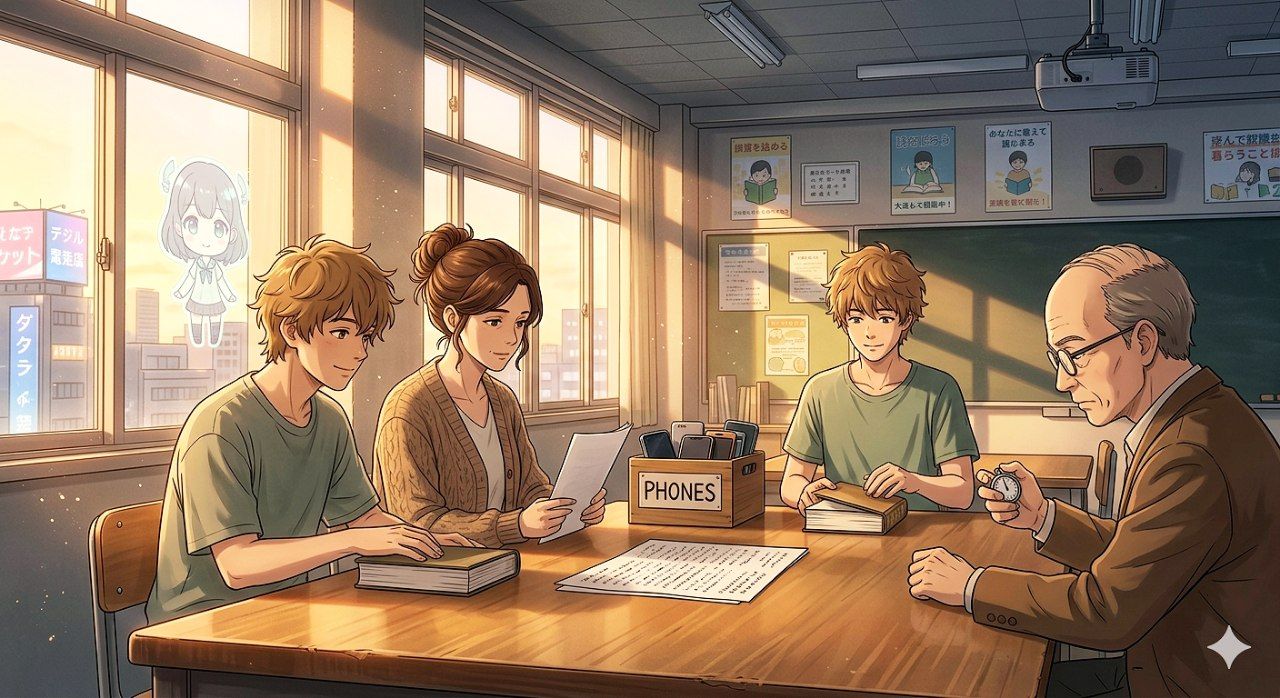
María held the sheet with the same disbelief one feels when looking at a restaurant bill after ordering only a salad. The paper crinkled slightly between her fingers as she ran her eyes over the lines again: categorical statements, figures, generational comparisons. According to the report, Generation Z was performing worse than their parents in literacy, attention span, and certain indicators of IQ. She left it on the classroom desk like an unexpected museum piece and looked up for faces that might tell her how to present it without turning the morning into a fatalistic sermon. Students kept arriving, but most wore the distracted expression of those who inhabit the world halfway: one eye on the class, the other on the screen. Luca, nineteen, in a faded green t-shirt, was the first to look directly at María. His phone vibrated and a notification promising “20 seconds of instant wisdom” flashed on the screen. He looked up with the carefree smile of someone who makes skepticism a fashion accessory. “Apocalyptic?” he said, with the smile of a living meme. “Couldn’t this be more of an evolutionary transition? Everything is learned now in 15-second clips. Why memorize dates if you can look up the battle in a second?” The irony in Luca’s voice dispersed the tension in the room; a few knowing laughs softened the initial shock. María allowed herself a small, weary smile—she knew well how quickly a generation found ways to justify its habits. Still, she couldn’t help replying with the seriousness of someone who had spent the night poring over figures. “The issue isn’t just searching,” she said. “When you must read a long text, your eyes skim the page as if it were an endless feed. They lose patience with complexity. Reading well isn’t only finding a fact; it’s holding an idea, running through it, questioning it.” Luca rested his elbows on the desk and pretended to adopt the pose of an exhausted intellectual. “Holding ideas?” he replied. “Sounds beautiful, but also slow. Isn’t it possible that the world has changed and we’re the ones resisting?” At that moment Dr. Fuentes entered in a gray coat and heavy-framed glasses that gave him the look of a tired owl. He carried a briefcase brimming with papers and a face that shifted between professional frustration and scientific curiosity. “I came to confirm your suspicions,” he announced, placing an envelope on the table. “Global assessments show measurable declines in literacy, attention span, and certain IQ indicators among Generation Z. This isn’t a rumor; it’s data.” Luca raised both eyebrows, as if trying to gauge the weight of the news. “Data?” he asked theatrically. “How much does a datum weigh? Does it come in PDF or TikTok?” Dr. Fuentes’s smile was ironic, half compassion and half fatigue. “It comes in a forty-seven page article,” he said. “And in charts that aren’t especially friendly for small screens. Experts attribute these trends to multiple factors: increased screen time, changes in educational systems, and transformations in social environments. Digital consumption has significantly altered how new generations process information and sustain attention.” Luca feigned horror, exaggerating every gesture. “Screens?” he murmured with a parodying dramatism. “So my digital loneliness is guilty? My toxic relationship with notifications? Do I need to go to therapy with my own smartphone?” Some students laughed; others kept their gaze fixed on their devices as if the phone were a safe harbor from the awkward conversation. María let out a bitter laugh that sought not complicity but truth. “It’s not personal, Luca,” she replied. “It’s systemic. When everything is offered in fragments, quick reward rewires attention habits. And when processes become instant, patience for complexity ages quickly. Literacy isn’t just decoding letters; it’s understanding contexts, interpreting nuances.” A student in the back raised her hand shyly, the kind of curiosity that wants to speak but fears judgement. Dr. Fuentes invited her to speak. “Could these changes also be positive?” she asked. “I’ve seen people learn languages with apps, coordinate huge projects on networks. Not everything digital impoverishes.” Dr. Fuentes nodded gravely. “Of course there are advantages,” he said. “The problem is that many educational solutions adapted to distraction rather than countering it. Platforms optimize teaching for short attention spans; short attention spans optimize the platform. It’s a cycle.” At that moment Luca’s phone buzzed again and the screen projected the animated figure of Viejito Tik, a digital mascot integrated into the school’s learning app. Its colorful image rose above the phone like a programmed bubble of calm. “Hello, humans!” said the avatar in a cheerful, synthesized voice. “According to my algorithms, average attention is 8.3 seconds. I recommend micro-lessons, micro-quizzes, and stickers to reinforce learning.” María brought a hand to her forehead—part exasperation, part astonishment. “See?” she whispered to Luca. “Even educational tools have internalized the problem. They don’t just teach; they incentivize immediate responses.” Luca looked at the avatar with a mix of tenderness and skepticism, like someone observing a relative who has adopted twenty-first-century habits. “Viejito Tik,” he said mockingly, “do you think reading a book could compete with a sticker?” The avatar blinked in its preset animation. “Compete isn’t the right word,” it responded in a tone calibrated not to offend. “It is better to optimize, gamify, and reward. But humans also need time for deep reflection. I detected that in update 4.2.7: sustained attention periods benefit the consolidation of knowledge.” The class laughed, but the laugh had a crack in it. Dr. Fuentes let out a laugh that sounded more like a stifled sob. “Even algorithms teach us humility,” he said. “We created machines that adapt teaching to distraction; now distraction is adapting humanity.” The classroom atmosphere shifted. The murmur of notifications, nervous laughter, and the hum of digital life faded for a moment, giving way to a dense silence. It wasn’t an uncomfortable silence; it was a silence seeking an anchor. Luca, who until then had played the provocateur, spoke with a voice that surprised by its seriousness. “What if we run a test?” he proposed. “A day without notifications, without memes, without stickers—just a real text. I don’t mean a summary or a synopsis with subtitles, but a long text with sentences you have to read more than once. If we read it together, maybe nothing explodes.” María looked at him, surprised, as if receiving an unexpected invitation from an old friend. “Are you serious?” she asked. Luca nodded, calm as someone proposing something unlikely but not impossible. “Yes. And if at the end we all yawn and get bored, we can proudly say we did something very retro.” Dr. Fuentes closed the report and stood, the decision visible in his posture. “I accept,” he said. “But I will bring coffee and a stopwatch. I want to measure how long the first wandering glance lasts. If this helps design better strategies, we must quantify everything,” he added with a half-smile, half scientist, half accomplice. On the day of the experiment, the morning light was clear. The class gathered as if for a ritual. The projector screen remained deliberately off; phones were placed in a box no one touched. In the center of the table lay a single sheet with a dense, carefully chosen text: long paragraphs, demanding vocabulary, ideas that required time. At first, reactions followed the expected script: nervous laughs, furtive glances at the clock, hands at the page edges as if fearing a slip. Some students skimmed, others blinked with the anxiety of those awaiting immediate reward. But something surprising happened: someone pointed to a phrase with genuine enthusiasm; another raised a hand with an unexpected connection to a film seen the week before. One incisive observation sparked another, and the conversation began to grow like a plant that had finally been watered in a suitable climate. Time passed without the usual rush. Voices spoke things that were not quick assertions but processes: uncertainties, comparisons, open-ended questions. María took notes, satisfied to see germinate a method she had not abandoned but had been waiting to try. Luca lost his ironic smile and gained a plausible attention: he read, underlined silently, returned passages with his reread. Dr. Fuentes, stopwatch on the table, recorded times in his notebook but allowed himself to listen without interrupting. Outside the classroom, Viejito Tik, separated from the human experience, sent an automated message: “Emotions detected: 12% more in-person social interaction.” The app, unable to feel, tried to quantify what was qualitatively taking place in the room. Dr. Fuentes jotted the statistic down quickly and then set it aside: numbers would serve the reports but could not explain the feeling born among the students. “We can’t base public policy on a single day,” Dr. Fuentes said seriously. “But perhaps the data were asking something different: not that we eliminate screens, but that we design spaces where attention can grow. Spaces where technology is a tool, not a tyranny.” María smiled with relief. She had spent nights thinking of pedagogical formulas, curricular adaptations that would not surrender to ease. Witnessing the dialogue born from reading was, for her, confirmation. “If this shows anything,” she said, “it’s that literacy isn’t just decoding letters; it’s reading the world, listening to others, and holding complexity. We can’t measure everything with quick tests. Some skills unfold slowly.” Luca closed the book carefully, as though placing a delicate discovery back in its case. He looked at his classmates with a mixture of pride and gratitude. “Then,” he murmured, “don’t reduce us to a number. We’re more than scores. We just needed a little silence to remember.” At day’s end, while the city’s digital billboards still promised “learning in 30 seconds or less,” a group of students walked down the sidewalk talking out loud. They didn’t look at their screens; they debated ideas, interrupted one another to explain, laughed with pauses and listened. Words once again occupied the time between them—not as data in transit but as shared territory. That night, Viejito Tik logged its routine: “Update pending: enable deep concentration modes. Recommendation: include analog breaks.” It was another line on a digital task list, but also a signal that something in the logic of teaching had shifted: technology itself now suggested zones of retreat, modes that respected cognitive slowness. In the days that followed, the experiment did not become an instant fix for all the problems the reports had identified. There were resistances, debates over resources, discussions about educational policy and the need for replicable evidence. Nevertheless, the seed had been planted: teachers designed shared reading sessions, apps included voluntary disconnection timers, and small school policies reserved spaces for extended reflection. Between charts and classrooms, between algorithms and lived experience, a certainty emerged: problems measured by figures are not solved only with more data; sometimes they ask for less noise and more room to read. And in that space between the immediate and the patient, the generation that some statistics described as a victim of distraction slowly found a way to reclaim attention as a craft worth learning. Source of the images. Image created with Google Gemini.
2 comments
This story hits hard. The irony of using an app (Viejito Tik) to tell us our attention spans are failing is such a perfect metaphor for 2026. We often blame the students, but as María notes, it’s systemic. We’ve gamified learning to the point where the 'reward' matters more than the knowledge. Beautifull
Totally true. Thank you very much ppr your comment, it is quite appreciated. A hug.