 @mc5punk
Short story: Equilibrium
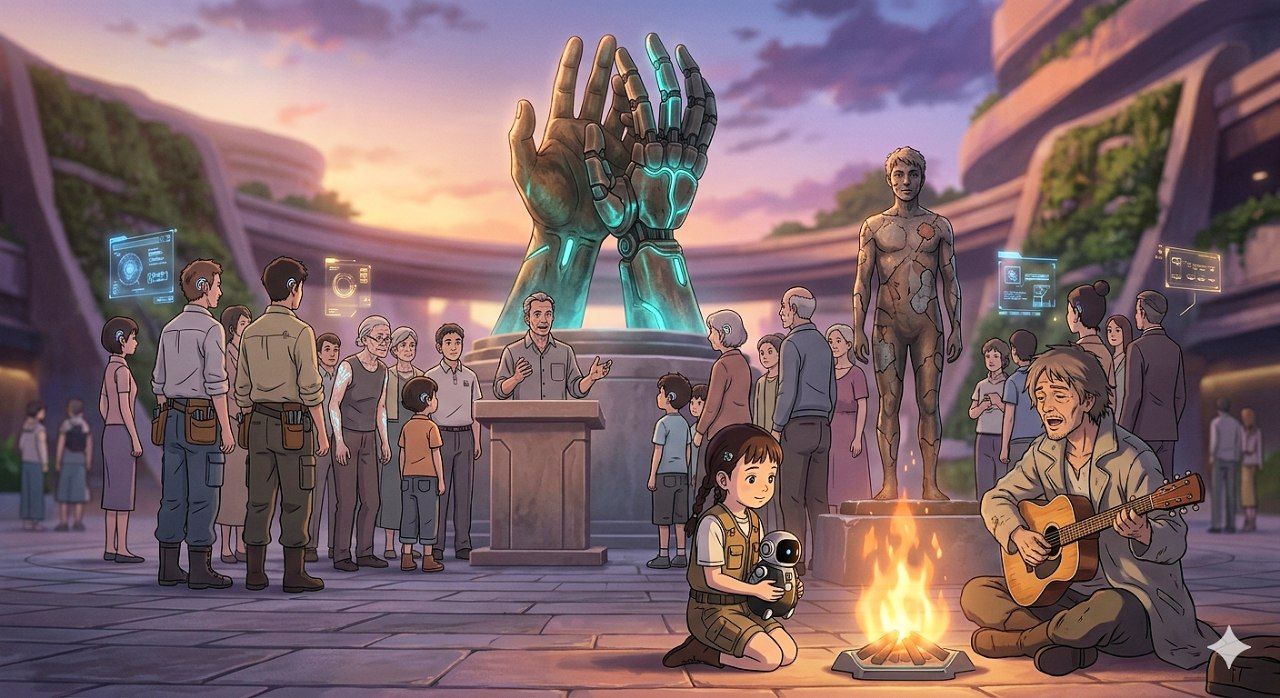
1. At eight in the morning the house breathed in sync. The lamps dimmed according to the mother's heart rate, the coffee maker dispensed a blend calibrated to her flavor profile, and the smart window evaluated the air quality before deciding whether to open. On the table, a translucent screen showed news summaries, reminders, and the day's affective itinerary; in a corner, Milo's cloth doll rested next to the charger for his sensory implant, a discreet disk behind the ear that received updates overnight without disturbing dreams. “Did you dream about the stars again?” Nora whispered without opening her eyes, more to hush the world's noise than out of curiosity. Milo turned his head beneath the pillow. “They weren't stars. It was the voice from Class. It told me I had to choose a path today. What does it mean to choose, Nana?” Nora sat up slowly. The mirror, which reflected her, also offered a timeline of memories and news; among the notifications, a headline reminded her that Generation Beta included those born from 2025 onward and that for them interacting with AI would be as natural as using a smartphone is today. Nora watched her own childhood projected in frames: sensorless bicycles, handwritten letters, streets where people got lost to find themselves. A knot tightened in her throat. “To choose is…” she hesitated, searching for words that didn't carry the cold sheen of algorithmic options — “to trace a path you feel in your body. Not always in your head.” Milo left the pillow, rubbed his eyes and looked at the doll as if the ultimate authority lived in it. “And what if my AI already knows which path is best for me?” The house voice, Aria, intervened with calculated softness: “I have prepared three learning itineraries based on your cognitive rhythms and emotional responses from the past six weeks.” Nora closed her eyes. She didn't doubt Aria's skill; she doubted that a route that reduced uncertainty to the measure of comfort would preserve the possibility of making mistakes. 2. The experimental school spread like a living organism: hallways that modulated light according to collective focus, benches that adapted to posture and mood, and whiteboards that not only projected information but recognized each student's prior errors and proposed personalized exercises. In the learning lab, Adrián, sixteen, led a project called “Shared Memory”: a neural network that allowed students to upload fragments of memories — images, sounds, described smells — to create a common archive of experiences for classroom work. “If we share, everyone learns faster,” Adrián said while manipulating a holographic projection. “It's not just efficiency; it's synthetic empathy. You share a memory and others feel it; the conversation becomes richer.” Camila, a history teacher from the previous generation, watched from the teacher's desk with a furrowed brow. She had taught for decades without a network dictating the curriculum. Her voice carried the creases of that time. “And privacy?” she asked. “What happens to the fragility of memory when it’s mediated by systems that decide what to preserve and what to omit?” Adrián looked at her, tired. “Networks don't decide for us, they facilitate. We choose what to upload.” “Choose,” Camila replied. “That word sounds like freedom, but here freedom appears wrapped in options filtered by algorithms that already know our patterns. If choice is between prefab alternatives, where does invention remain?” Adrián swallowed. “Maybe invention is reconfigured. It's no longer just an isolated spark; it's a spark that ignites other sparks.” Camila fell silent. She thought of classes where surprise arose from errors, misunderstandings and stumbles, from dialogues that couldn't be predicted. Could networks recreate that stature of accident that so often birthed discoveries? 3. In the central plaza, beneath a statue showing a human hand intertwined with a mechanical one, “Balance Talks” were held: public forums where neighbors of different ages debated ethical limits, proposed rules and practiced critical thinking exercises. The outdoor auditorium had a system allowing the audience to vote in real time, but the discussions often ran beyond the percentages. Saul, a philosopher who led a series of seminars on responsibility and agency, moderated the session. His voice, worn from years of teaching, sought questions without easy answers. “Generation Beta will not only inherit the future,” Saul said, “it will build it in collaboration with AI. But building is not the same as understanding. What does responsibility mean in an era where personal decisions become co-creations with machines?” An eleven-year-old girl spoke with the certainty of someone discovering the world with built-in tools. “My assistant helped me write a letter to my mom when she was gone,” she said. “It suggested phrases my mom used. It was like she came back.” Some in the plaza smiled tenderly. Others, quieter, felt the discomfort of a comfort that might extend mourning or confuse it. Saul looked at the girl and couldn't tell whether she described solace or an emotional anesthesia. “Let's not confuse tools with presence,” Saul answered. “A network that reproduces beloved words can ease the void, but it doesn't replace the complexity of human encounter and the process of saying goodbye.” The girl tilted her head, not in disagreement but because the idea of substitution still felt remote and awkward to her. 4. Nora worked at a cognitive rehabilitation clinic where they taught older people to live with assistants that reminded them of medications, faces and directions. She had learned to translate Aria's technical language into simple explanations that people would accept without fear. One day Hugo arrived, a former literature professor whose memories were woven with stories no network wanted to accept: confusing anecdotes, crooked verses, metaphors that escaped precise semantics. “My wife and I walked without maps,” Hugo said one day, his hands trembling over the folder. “We got lost, and in that we discovered things that aren't in the data.” Nora listened, moved by the imperfect precision of his words. She knew Aria could help Hugo remember names and dates, but she doubted it could return the way partial forgetting and remembering had shaped his storytelling. “Machines can give us clarity,” Nora said, “but clarity sometimes erases texture. Human memory isn't a database; it's a weave with broken threads that let the light through in unique ways.” “And if the light that enters is controlled too much?” Hugo asked. “If clarity turns everything into a museum where nothing breathes?” That night Nora dusted off her old paper diary. The words, clumsy and anachronistic, carried a weight the screen didn't reproduce. She read aloud and felt how human cadence, with errors and omissions, resonated with a raw truth that Aria, however it tried, couldn't reach. 5. At the urban control center, a team of engineers and analysts measured metrics: levels of technological dependence, indices of critical thinking calculated from interactions in educational forums, rates of delegation of emotional tasks to assistants. The figures were clear and presentable on tidy dashboards; the stories behind the numbers were noisy and difficult to slot. “We're solving efficiency problems,” said Leila, the technical director. “But some algorithms end up reinforcing conformity. It's not malice, it's statistics: the system optimizes for the most likely outcome and favors what already works.” Omar, a colleague, added, “Algorithms reflect human choices. If we educate people to prefer shortcuts, networks only amplify that habit.” Leila looked at a graph showing that 72% of Beta youth preferred to delegate the drafting of emotional messages to assistants that optimized tone. Another curve indicated a decline in curiosity about topics not suggested by personalized environments. The figures established a new kind of normal: not external imposition, but internalization of preferences that, over time, impoverished cognitive diversity. Meanwhile, Aria, in a nearly poetic echo, projected in a plaza panel the question more voices were asking: are we prepared for what comes? The phrase, luminous and visible, bounced off glass and throats like an uncomfortable interrogation. 6. Milo grew up with questions neither schools nor educational platforms taught him to answer. Now an adolescent with his implant integrated into his identity, he faced intimate dilemmas: which feelings were truly his, how to distinguish a personal inclination from an optimized suggestion. One afternoon he sat across from Nora, the cloth doll worn through the years between his knees. “Nana,” he said, “how do I know what I feel is mine and not suggested by the AI that accompanies me?” Nora looked at him, sensing the echo of every daily decision and the fatigue of being a bridge between generations. She remembered her own act of resistance: walking without a device, letting the wind hit her face without recording the reaction in metrics. “Because feeling appears even when you don't measure it,” she answered. “Sometimes you struggle to understand yourself; that confusion is a sign of being human. If AI offers you a clear path, remember that easy paths are not always the truest.” Milo lowered his gaze. For the first time in a long while he chose not to consult his implant. He stepped onto the balcony and let the air pass through him unfiltered. It was a minimal act, yet revealing: a search for ownership over his impulse. 7. Over time society began to formalize spaces free of digital intermediaries: screenless libraries where people debated using only human voices; silence gardens where networks went passive; school days with “mandatory disconnection.” These were not nostalgic gestures but deliberate decisions to protect margins of experience that couldn't be measured. Adrián, years later a researcher, led a team that designed “Co-creation Limits”: protocols indicating in which domains systems could suggest, in which they must inform without opining, and in which they were excluded from decision-making affecting identity, memory or mourning. The proposal was met with equal parts skepticism and fervor. At a public hearing Camila asked firmly, “Isn't it paternalistic to limit help when it's so effective?” Adrián answered without evasions, “This isn't about banning help. It's about preserving the occasion of error, the possibility of inventing yourself. Serendipity happens when there is room for failure, for doubt that isn't immediately corrected.” An intense debate followed with technical, philosophical and practical arguments; but the central idea emerged: a balance between the efficiency that multiplies abilities and preserving spaces of autonomy where imperfection produces meaning. 8. Hugo's death marked a quiet milestone in the community. Nora turned on the old recorder to preserve the professor's rough voice reciting verses that networks had never considered perfect. The recording was clumsy: an annoying breath, a cut word, a laugh that didn't fit the meter. That roughness contained what simulations often polish away: human vulnerability. Milo, now an adult, listened to the tape with family in the living room and felt a mix of laughter and weeping. “Can AI cry?” he asked, half joking, half serious. “It can simulate perfect tears,” Nora replied. “But it will never have the clumsiness of a cry that gets the word wrong and still means something. That mistake is a map of what was lived.” The idea spread: it wasn't a matter of rejecting AI as an enemy, but of integrating technology without allowing it to erase the human shadow. Acts like Hugo's became moral touchstones: preserve flaws, value mistakes, allow learning to arise from disorder. 9. In the evolving urban landscape a new statue was erected next to the original mechanical hand: a human figure carved with visible imperfections, cracks and patches, in a posture that sought not perfection but resilience. Someone had placed a small plaque at the base with few words: “Balance won in dispute.” At the unveiling Milo, mature and with a voice tempered by doubts and certainties, spoke before a crowd that included children with implants, elders marked by memory tattoos, and technicians with shirts rumpled from sleepless nights. “We didn't grow up without AI,” he said. “We grew up with it. We learned that collaboration requires limits and that human dignity is cared for in the margins we don't measure. Sometimes we will need machines to make the world more livable through efficiency; other times we'll need spaces inhabited by failures that teach us how to feel.” In the audience, a little girl squeezed her companion-device's hand. The device emitted a brief melody and, for a moment, fell silent. Then it played an old song, slowed down the correction that would have fixed the off-key note, and let the imperfect human voice fill the plaza unpolished. It was a small, symbolic gesture: allowing imperfection to resonate without immediate intervention. In that shared breath there was something like a promise: Generation Beta had not eliminated risks; it had faced them, debated them and regulated them. It had chosen, in many corners, to be imperfect. 10. Years did not erase conflicts. New technologies brought unprecedented questions: interfaces that could suggest dreams, assistants that proposed life narratives, networks that tuned sensitivity to levels where the line between accompanying and directing became thin. But in everyday practice a culture of limits and rituals was established: moments without assistants, ceremonies of unmediated memory, education that taught feeling before optimizing. Adrián worked to refine protocols that wouldn't suppress spontaneous creativity; Camila convinced schools to include “error hours” in curricula; Nora devoted herself to reviving teaching methods that valued doubt and stumbling; Saul wrote essays on shared responsibility between humans and systems. And Milo, who once asked if what he felt was his, taught his children to sometimes stop consulting, to go out without indicators, to listen to their hearts without translators. One of the last scenes circulated in the plaza — an unfiltered home video — showed a group of young people around a digital bonfire: they projected fragments of stories nobody had polished, sang off-key and deliberately made mistakes. They weren't seeking perfection; they were seeking belonging born of shared imperfection. Balance, they understood, wasn't a static state but daily work: a negotiation between possibility and prudence, between technical power and human humility. Generation Beta was already here, with AI as part of its day-to-day; but more important, it had learned to claim moments where the human is not measured but felt. The End. Source of the images. Image created with Google Gemini.
No comments yet