 @mc5punk
Short story: A Gesture That Saved
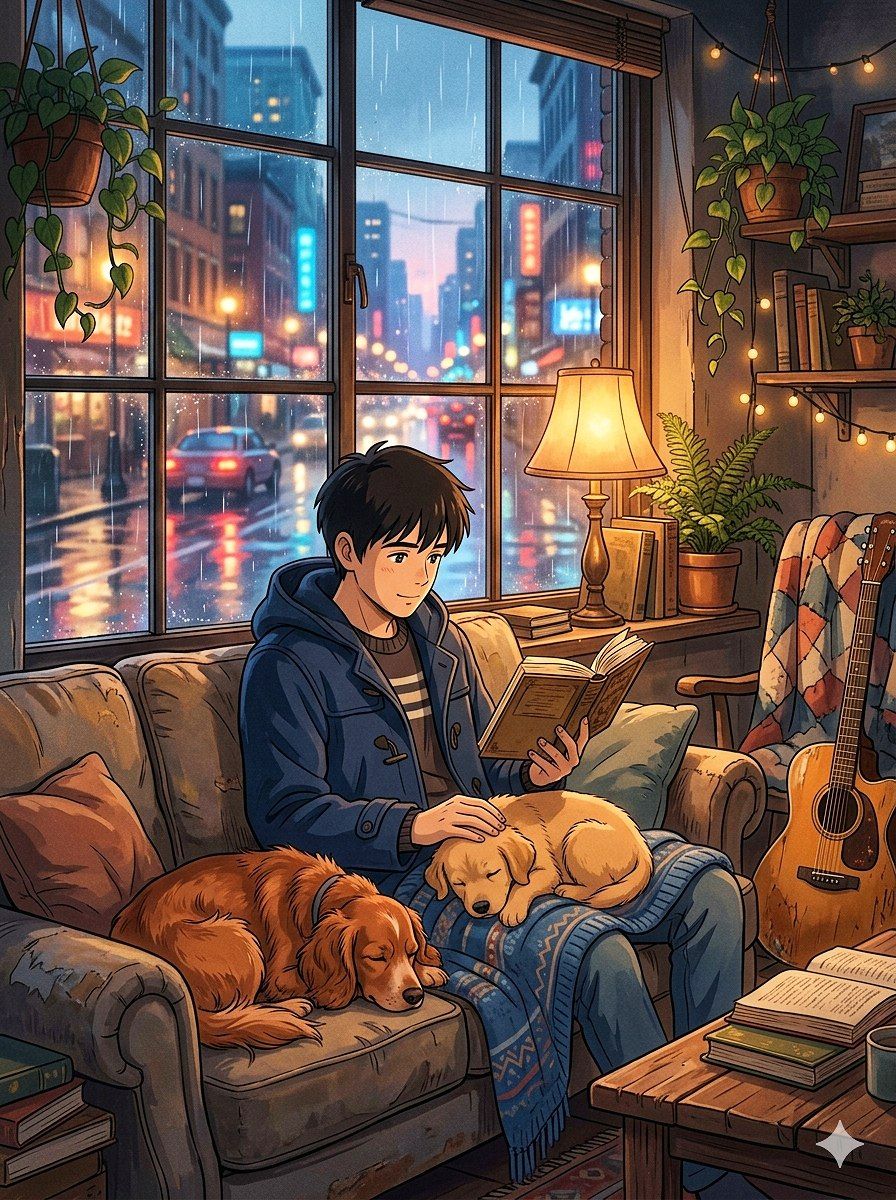
The rain hammered the roof of the old warehouse that served as the shelter when Mateo pushed the door and felt the cold, damp air that always accompanies places where second chances wait. The buzz of fluorescent lights mixed with the smell of disinfectant and hay gave the place an atmosphere both clinical and moving: lined cages, worn blankets, posters with photos of lost animals. In one corner of the place, a mother dog curled around her puppies with a patience that seemed to defy the world. Mateo wore a blue coat and carried a backpack with some empty boxes: he had just moved into a small loft downtown and was looking for company for the long afternoons. He had thought about adopting only one puppy; the idea of a small companion who wouldn’t fill his routine too much felt comfortable. He walked slowly toward the corner where the litter was. “Hi,” he said, his voice low out of reverence for the animals. “I came for the spotted puppy. Is he available?” Ana, the volunteer, had her hair tied back and eyes tired but full of tenderness. She pointed with a gentle gesture toward the mother who didn’t take her eyes off her pups. “He’s the most restless,” she replied. “But look at the mother. They arrived recently; I don’t know if separating them would be good.” Mateo approached. The puppy jumped between his mother’s legs and, for no logical reason, Mateo felt a childhood memory — a sofa, an old photo with a black dog — hit his chest. He crouched down and let the puppy lick his hand; the animal’s trust came over him like a promise. When he moved the puppy to look at him better, the mother tensed. It wasn’t an act of aggression but a primitive warning: protection against loss. Her eyes, large and amber, contained a weariness that tasted like nights searching for food and days enduring city cold. “If you take only the puppy,” Ana said in a soft voice, “she might be left devastated. Many mothers don’t get over the separation quickly.” Mateo swallowed; the possibility of harming another being to satisfy his own need felt unbearable. He looked at the mother and puppy together: the simple scene seemed sacred. “I can’t,” he finally replied. “I’ll take both of them.” Ana exhaled as if she had released a weight she had been holding. “Thank you,” she said. “Not everyone does.” The drive to the loft was quiet. Mateo drove through flooded avenues; the streetlights stretched across the windshield in liquid lines. Behind him, on the blue blanket in the back seat, the mother and puppy slept curled up together. Mateo watched their faces in the rearview mirror and thought that, in some way, they were taking care of him too. Mateo’s loft was modest but bright: wide windows overlooking the avenue, walls of white worn by time, a bookcase with books stacked in disorder, and a guitar leaning in a corner. The first night they crossed the threshold together, the day’s smoke stayed outside; inside, the smell of warm fur and clean blankets transformed every corner. Mateo set up a temporary bed near the couch; he put out water and food; he turned on a floor lamp that cast a warm halo over the living room. “This is fine,” he whispered, more to himself than to them. “Welcome.” The mother watched while the puppy explored the new territory with that mix of boldness and insecurity that young ones have. Mateo decided to call her Alma and the puppy Lino. The names came as if they had always been waiting: Alma for the gaze that had touched him and Lino for the way the puppy jumped: light and bright. The days that followed were a succession of domestic rituals that wove them into a family. Alma taught, with the patience of someone who knew the hardness of the streets, where to sleep, how to ask when hungry, where to hide her head when there was noise. Lino learned quickly: in the morning he ran to the kitchen; in the afternoon he curled at Mateo’s feet while he read; at night he sought Alma’s warmth. One afternoon, while washing dishes, Mateo saw Alma lying by the window, looking out at the street. The sunset light painted her coat in honey tones. “Do you think about the street?” he asked softly, as if he expected a human answer. Alma rested her head on the edge of the couch and let out a sigh that Mateo felt said more than a simple breath. “I think about the noise and the potholes,” he imagined Alma’s voice in his head. “I think about having hands that scratch behind my ears now.” Mateo smiled with a gratitude so deep it hurt in his chest: he had gone to rescue, and, without knowing it, he was being rescued. On cold nights, when nostalgia for his family came over him like waves, Alma curled up next to him and Lino became a warm weight on his feet. The apartment stopped being an empty loft and became a home with sounds and traces. Mateo and his dogs’ story began to circulate. A neighbor saw them walking in the park; another took a photo on a bench under an oak and uploaded it. The image — Mateo reading, Alma reclining, and Lino asleep at his feet — started getting shared: comments of tenderness, messages telling of similar losses, others congratulating the gesture. At first, the exposure was a balm: emails arrived offering help, donations for blankets, a veterinarian offered to check vaccinations for free. People with broken stories wrote from the other side of the screen to say thank you. One night he read an anonymous letter that said, “Thank you for not separating them. I lost my dog last year and seeing how you care for them gave me strength.” Mateo kept it by the kitchen frame; the rain-moistened handwriting felt like a relic that returned his faith. But virality also brought unexpected complications. Weeks later, the shelter received an inspection following complaints about adoption conditions, and someone thought a downtown loft couldn’t be a home for two dogs. Mateo was asked to present vaccination certificates, proof of adequate space, and a care plan that complied with regulations he didn’t know. Bureaucracy arrived with its cold language: forms, tables of minimum space measurements, fencing requirements, and documentation. Mateo felt engulfed by papers that seemed to try to measure tenderness with numbers and stamps. The night Ana handed him the list, the shelter office smelled of old paper and stale coffee. Ana spoke with gentle firmness. “We need you to prove you can care for them,” she said. “It’s bureaucracy. It’s not personal.” Mateo nodded, bearing a new weight on his shoulders but with the determination of someone who had decided not to back down. “I will do it,” he replied. “Tell me what’s needed.” The response came in the form of small community actions. Neighbors offered help to adapt the balcony; a blacksmith passing by the street made a small fence for the terrace; Dr. Morales, the neighborhood veterinarian, reviewed the medical records and patiently explained the steps to register the adoption. A group of shelter volunteers organized a collection to cover vaccines and deworming. It was the human network that turned the paperwork into a series of concrete gestures that spoke of both empathy and responsibility. At the same time, Mateo had to face critical comments on social media: some accused him of showmanship, others insinuated the story was staged. There were days when those voices pierced him with cold; on the other hand, messages arrived telling of people who found solace: folks who started to believe in kindness again after seeing Alma and Lino. Mateo began replying, honestly, to some messages; he shared how adaptation was going, the fears and doubts. He opened a small page where he narrated his experience: homemade toy repairs, simple safe recipes for dog food, exercises for socializing rescued puppies. He did it not to seek spotlight but so others could replicate something that seemed simple but required care. One winter morning, steam from his coffee mixing with the whistle of the kettle, he jotted two ideas in his notebook: collaborate with the shelter to facilitate adoptions and organize talks on responsible pet ownership in buildings with space restrictions. He saw it as a way for the story not to remain a pretty tweet but to lead to useful changes. Coexistence also brought its share of intimate drama. Alma sometimes woke startled by thunder or the rumble of a truck; she would stare out the window with a nostalgia that didn’t pass through words. Mateo learned to read those signs: he would place a blanket over her, speak softly, and remind her there were hands to care for her now. Lino went through a jealous phase when the first visitors came to the house; he barked loudly until Alma calmed him with her scent and presence. One autumn night, under the flicker of a lamp, they communicated in ways that needed no tongue. Mateo sat with his back against the couch, his guitar propped to the side, thinking about his father, about his sister who no longer lived in the city, about the absences he had dragged since childhood. “Sometimes I feel like I came to fix something,” he murmured, as if confessing to the walls. “But now I see they were fixing me.” Alma rested her head on his leg and released a hoarse sigh. “I didn’t come to be fixed,” the calm of her weight seemed to say. “I came because we needed shelter and you offered it. That’s all the world asks sometimes.” Mateo closed his eyes. The nostalgia that accompanied him didn’t vanish; it transformed into a companion less sharp and more lucid: the trace of what had been and the raw material of what could still be. The bureaucratic conflict was resolved thanks to community mobilization and the submitted documentation. The shelter certified the adoption, and the authorities accepted the loft adaptation plan. The story then ceased to be merely a flash of virality and began to become a case that inspired other shelters to relax some protocols when animal welfare and human good faith were demonstrated by deeds. As months passed, Mateo’s home gained its own life. The kitchen plants that once seemed to struggle to survive greened again with a little more attention; the guitar sounded more often; the books on the shelf moved slowly from the “to read” piles into shared readings on rainy afternoons. Alma and Lino grew: the first with serene dignity; the second with a mischievous character that forced Mateo to laugh more than he thought possible. Public recognition was kind and brief: radio interviews, small newspaper pieces, people who came to say thank you in person. Mateo learned to balance exposure and intimacy: he answered messages that seemed sincere and kept the sacred details to himself: how Alma curled up on stormy nights or how Lino licked his face to wake him. Months later, a letter moved him to tears. He opened it at the kitchen table, with afternoon sunlight pouring through the window. “A year ago I lost my mother and with her my last anchor. Seeing your photo —those three bodies together— made me cry in a way I didn’t expect. You helped me remember there is still tenderness. Thank you.” Mateo placed it in a box with other notes; each one testified that his gesture had produced something real in the world: not fame, but echoes of solace. He continued building a simpler yet fuller life: walks in the park that turned into rituals, volunteer visits to the shelter, and afternoons spent writing about what he had learned about responsible adoption. On a clear spring night, Mateo sat on the balcony with Alma at his side and Lino curled in his lap. The city below murmured with its lights and the windows of nearby buildings blinked like terrestrial constellations. “I didn’t think this would happen,” he said softly. “I thought I was going to rescue one, not that they would rescue me.” Alma rested her muzzle on his hands and closed her eyes with the serene trust of one who knows she has found something she hadn’t had in a long time: stability. Lino whimpered in his sleep and twitched his paws as if chasing a happy dream. “Sometimes the rescue is mutual,” Mateo thought. “We care for each other in ways we don’t always see in the moment.” The story continued to circulate, of course, but what remained at the center was not virality but the chain of small actions that virality made possible: donations that covered vaccines for other dogs, neighbors offering time at the shelter, children learning not to abandon animals, communities beginning to speak of shared responsibility. Later, Mateo organized a small gathering at the shelter to share his experience in person. Volunteers, recent adopters, and the curious came. He told them about administrative difficulties, nights of doubt, and the countless moments of tenderness: how Alma licked Lino’s paw when he was older; how the constant presence of the dogs had changed how he viewed his own absences. At the end of the talk, a shy little girl approached and held his hand. “Can you always adopt two dogs?” she asked. Mateo looked at her and smiled. “It depends,” he answered. “It depends on whether you can give them what they need: time, love, and a safe roof. But if you can, I assure you they will rescue you.” That night in the loft, while the city slept and distant noise became almost music, Mateo watched Alma and Lino sleep. In their faces there was something born from the decision: drama and doubt, yes, but also a nostalgia that had found a gentle, compassionate outlet. What began as the intention to adopt a single puppy had become a decision that transformed many lives: Mateo’s, Alma’s, Lino’s, and those of people who, upon seeing them, were encouraged to become better caregivers. In a world that often demands grand gestures, that chain of small acts proved that empathy, sustained by responsibility, can teach how to rebuild homes and weave community, one embrace at a time. Source of the images. Image created with Google Gemini.
No comments yet