 @mc5punk
Short story: The crisis of hope
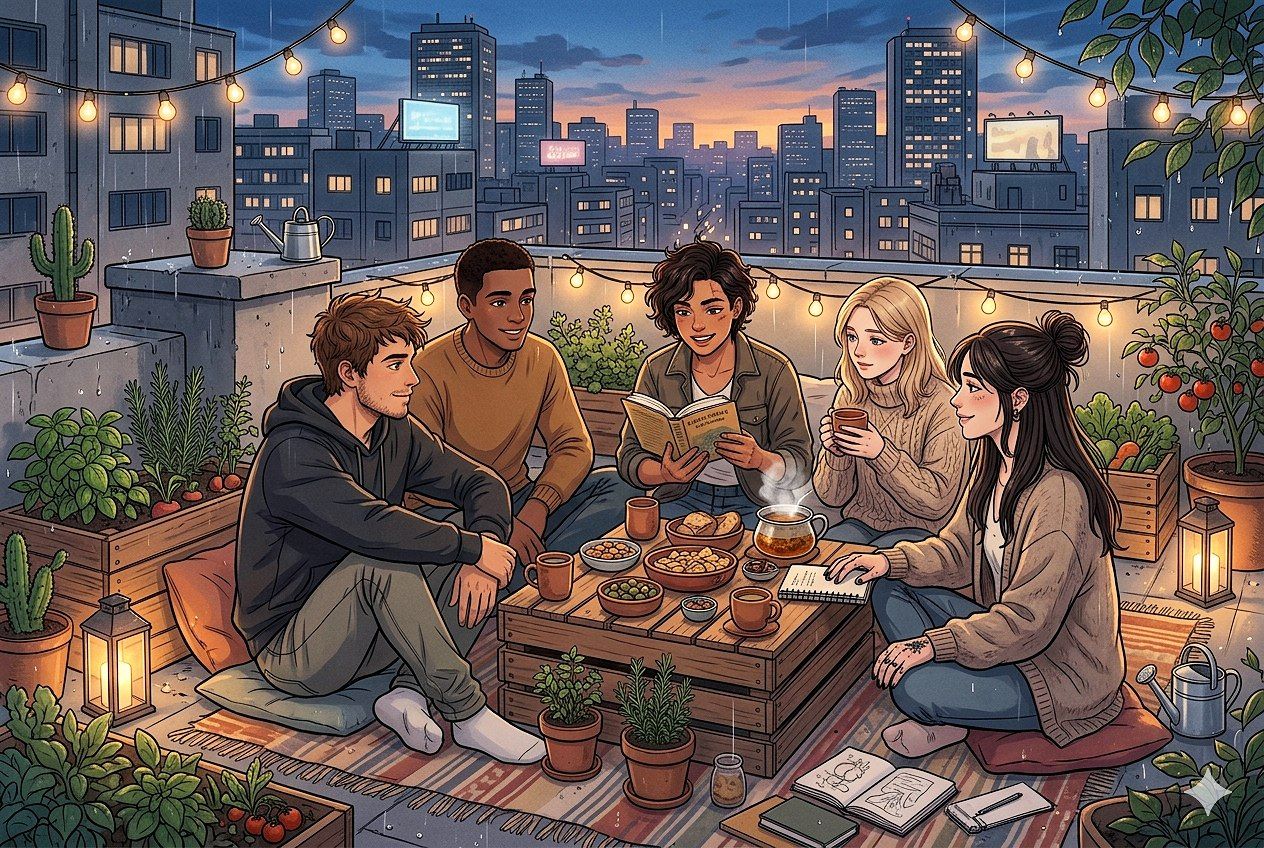
I. Rain struck the apartment balcony like a litany that blurred outlines. The building had the gray façade of exposed concrete, with brown streaks from leaks that marked the years and windows fogged by steam escaping from interiors too small for so many lives. Valeria’s kitchen was a narrow refuge: a wooden table with chipped varnish, an arm lamp that cast yellow light, and a shelf of books bent from being read again and again. From the window she could see the main avenue, a river of cars and billboards where the promise of success blinked without respite. Valeria was twenty-seven, with dark hair down to her waist that she sometimes gathered in a careless bun, hands stained with ink from the notebooks she used to jot down ideas and anxieties. Her brown eyes were deep, the kind that belonged to someone who stayed awake at night thinking of possibilities; her skin showed the small shadows of sleeplessness beneath her eyes. On the table a cup with the remnants of coffee cooled beside a phone covered in notifications that never quite arrived. A stack of bills formed a small paper mountain on the counter, insisting that survival shows no mercy. The news banner on the TV bluntly read: 91% of young people exhausted. The statistic fell like a sentence and, at the same time, felt too abstract to hold Valeria’s face. “I don’t want any more interviews,” she said, rubbing the rim of the cup with numb fingers. “They always ask me what I want to be in five years. What if I don’t want to be anything that requires selling my life by the hour?” Her voice sounded fragile, clinging to a mix of anger and fatigue, while the rain carried on its own dialogue with the world. II. Mateo arrived with his backpack soaked, short hair tousled and droplets glinting on his eyelashes like tiny lights. He was twenty-nine, slim but with muscles shaped by the bicycles he used to get around the city. His skin was olive, with a slight beard that gave him a tired but determined look. He entered without asking, leaving a scent of rain and coffee in the air. “They offered me a temporary contract,” he murmured as he set his backpack on a chair and wiped his forehead with his sleeve. “Poor pay, no insurance. They say it’s ‘good experience.’ Since when does experience pay the bills?” The question wasn’t only for Valeria; it hung in the kitchen like a cloud of smoke none knew how to disperse. Mateo always carried a small notebook where he jotted down ideas and projects: sketches of apps never finished, lists of courses he promised to take. His hands were narrow, his nails bitten from nervous habits. Valeria looked at him directly, with an expression that mixed compassion and reflection: she saw her own uncertainty in him. “I’m afraid to give up, but I’m also afraid to keep going,” she said, words falling into the air. “How brave is it to renounce a promise of stability that never existed?” The room seemed to shrink with the question. Outside, the city carried on, indifferent, with billboards showing young people smiling in glass-walled offices. III. The café where they met was a small corner place: brick walls, reclaimed tables marked by previous cups, hanging plants searching for light among cables. The smell of freshly ground coffee mingled with low conversations and the tick-tock of a large wall clock. The barista, a quick-eyed woman, greeted them like familiar faces. Ana arrived minutes later, wearing a mustard wool coat and round glasses that gave her a warm, intellectual air. She was in her early forties, jaw-length hair streaked with gray framing her face, and a smile that didn’t dismiss what her patients told her. Her hands, well cared for, showed light calluses from gardening tools—one of her hobbies beyond her practice. “Generation Z isn’t trying to escape work,” Ana said, settling her cup. “They’re looking for meaning. They want what they do not to consume their lives. We need to rethink success: stop measuring it by degrees and salaries and measure it by coherence with the life we want.” Mateo laughed, a short laugh that held sadness. “Coherence. Sounds like a luxury. How do you pay rent with coherence?” Ana tilted her head, wearing the expression of someone who had heard similar questions many times. “Not everyone can,” she admitted. “But we can ask ourselves what we’re willing to sacrifice and what we won’t. We can also ask what care looks like when the system doesn’t care.” For a moment, the café became a small community council, and the words settled on the wooden table as if wanting to take root. IV. That night Valeria dreamed of a different city: buildings that breathed, with living wooden facades and open windows that let the breeze through; offices with green walls and roofs that held community gardens. In her dream the light wasn’t the artificial glow that demanded constant productivity, but a warm luminosity where people worked reasonable hours and took midday rests. Workers tended mini greenhouses, and they looked tired from meaningful work, not from the burden of survival. She woke with the sense that something inside her wanted to change. But reality struck with sharp edges: a rejection email in her inbox, a bill with an approaching due date like a missile. The kitchen was cold and the city outside kept its old artificial shine. “Why is it so hard to find meaning?” she asked Mateo as they walked down the avenue, lit like a stage that never dims. “Where did they steal our energy?” Mateo fell silent for a long moment, staring at shop windows where products shone with labels promising instant self-help. “They stole it with broken promises and constant urgency,” he said. “When they ask you to give everything, you give it in pieces. You end up with no reserves to dream.” The answer was simple and devastating at once, like an equation that always yields the same result: less hope. V. In a conversation that became a Sunday ritual, other voices joined them. Lucía lived on the ground floor with a balcony full of pots; she had left a big corporation to start a small cooperative of sustainable designers and builders. She was thirty-two, short curly hair, strong hands tanned from manual work, and a faint scar on her left eyebrow that gave her character. Omar was twenty-five, medium height, brown skin and attentive eyes; his days stretched between jobs and nights of study as he worked to finish the degree he had postponed. Sofía, fair-haired with delicate features, preferred living minimally to buy time: her apartment was austere but orderly, with a notebook where she listed priorities and a small altar of objects that inspired her. Each story was a mirrored pane with cracks revealing the system’s fractures. “I thought climbing the corporate ladder would make me immune,” Lucía said, stirring her tea. “But hierarchy isolates you. It turns you into a name on a spreadsheet. I left because I wanted to feel that what I do is connected to something real.” Omar sighed, his voice the fatigue of someone holding down two jobs. “Mental health, fair pay, purpose: they sound separate, but they’re the same currency. If they force me to survive, they don’t let me live.” Their words mixed with the sound of wind slipping through shutters. VI. Ana proposed an experiment like a recipe for dark days: for one month, each person would identify a small thing that returned energy to them and protect it as if it were sacred work. Not grand solutions—there was no time or money for immediate revolutions—but concrete, repeatable gestures that could begin to rebuild fractured meaning. Valeria decided to write again, not to sell stories but to listen to herself. She reopened an old notebook and jotted scenes without worrying if they were “marketable.” She sat at the table under a lamp and wrote for half an hour before checking job postings. Her hands, decorated with ink lines, recovered small pulses of joy. Mateo promised to plant a pot on the windowsill and water it every morning before checking emails. He bought soil, a hardy cactus, and a tiny watering can. The action demanded routine and returned a responsibility that wasn’t monetary but vital. Lucía organized community skill-exchange nights: one person taught basic carpentry, another fixed bikes, another taught affordable cooking. The community room, painted warm colors, filled with laughter and shared tools. At first the actions seemed trivial, but over days they braided into a support that held each of them: small acts of care building a collective shelter. VII. Weeks later, on the community terrace where plants now grew in wooden crates, the question returned with more weight: “What would have to change in your environment for you to start living fully?” Ana asked, looking at the worn hands of those tending the earth. Valeria answered in a quiet but firmer voice than before: “That they stop telling us that surviving is enough. That jobs request life but don’t devour it. That success isn’t a single metric.” Mateo added, eyes fixed on the city below: “That time not be the exclusive currency of whoever can exploit it most. That caring be a right, not a privilege.” Omar closed with an image that echoed among them: “That there be a bridge between what we need to pay the bills and what we need to feel alive. A bridge not built on excuses.” The terrace smelled of wet earth and freshly baked bread; words mixed with the breeze and a growing sense of community. VIII. No grand transformations happened overnight. The world continued with its demands, its ads and sirens. But something changed among them: they stopped measuring their worth by how much they could endure. They learned to set small boundaries that, when combined, made a difference: more respectful schedules, a rule against emails after a certain hour, end-of-month gatherings to share even small personal achievements. On the International Day of Happiness they held a rooftop gathering at Lucía’s building: blankets spread, a table of shared dishes, clay cups, stories read aloud and soft music. It wasn’t a festival or a viral slogan; it was a minimal ceremony to remember that feeling alive isn’t an exclusive privilege of those with time and money. Valeria watched the city lights: windows that had been anonymous ads turned into small stories—someone cooking, another person reading, a couple laughing. For the first time in a long while she didn’t feel her hope dimming. She felt, instead, the presence of small cracks through which clarity filtered: projects that didn’t exploit, conversations that taught mutual support, decisions that returned energy. IX. The story didn’t end with a triumphant happy ending. It closed with a decision: to live with intention even as the world insisted that purpose be paid for in hours of wear. Because the crisis of hope isn’t fought with slogans but with concrete changes—in policy, in community, in how we value time—and, above all, with daily resistances that become habits. Valeria stopped asking what she would be in five years. She began to ask what she needed today to feel whole: an hour of writing, a shared meal, a nap without guilt. That question, repeated gently, began to be her answer. Mateo kept watering his pot each morning; Lucía continued organizing exchanges; Omar found moments he would not negotiate between shifts and study. The city kept its pace, but they had found, in the repetition of small acts, a way to reclaim the energy someone had tried to take from them. And so, slowly, they wove a more livable present: imperfect, but more dignified. The End. Source of the images. Image created with Google Gemini.
No comments yet