Short story: The House of Generations
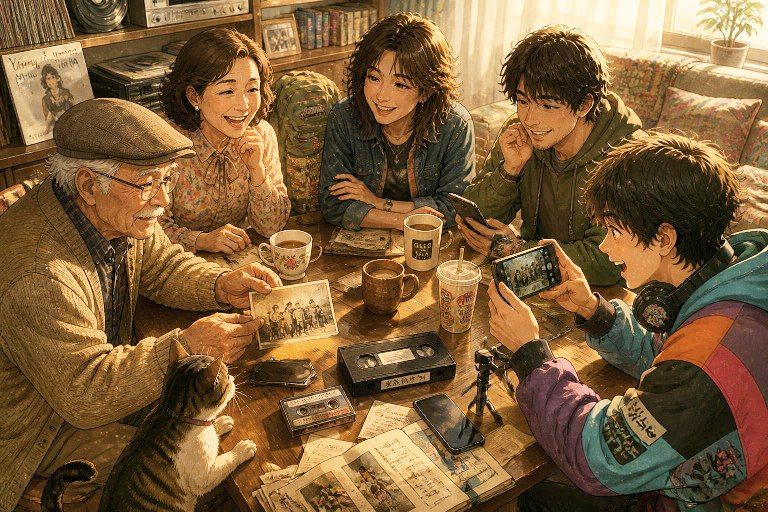
The grandmother’s house carried that smell of freshly baked bread that seemed to linger in the walls, like an ingrained memory. In the living room, the afternoon sun sliced through the curtains and made bands across a wooden table that had hosted more gatherings than any of the people present. Five people — and a cat with the air of an inspector — settled around that table for tea. Each held a different cup: a porcelain one with floral patterns, a thick earthenware mug, a ceramic cup with a local café sticker, a plastic cup with a sticker, and a thermal travel mug with a lid. It was a small geography of eras.
Don Ernesto set his cup down with the solemnity of someone who keeps relics. His skin was weathered by the years, his hands those of a worker, and his gaze, when he remembered, seemed to move the room back to another decade.
“Wait, you were born in 1930?” Marta asked, adjusting her scarf and placing her cup with the precision she used to place a vinyl on the turntable. “I can’t picture you without a hat.”
Don Ernesto smiled, a mixture of pride and modesty.
“Yes,” he said. “I’m from the Silent Generation. We watched TV in black and white, learned that not everything is urgent, and that sometimes it pays to listen before you speak. And above all, we learned to save. That doesn’t sound romantic, but it works.”
Marta nodded, remembering, and Luis, who had arrived in a warm-colored shirt and with the easy assurance of someone who collects anecdotes, pulled out his phone as if to show a trophy.
“I’m a Baby Boomer,” he said. “Born in 1950. I remember the Beatles playing on the radio all day and my mother telling me to turn it down because ‘they’ll hear it in the next block.’ I had posters everywhere; now I look for them and can’t find a single one,” he made a theatrical gesture. “And I knew the cassette: the art of rewinding with a pencil. That’s patience and practical sense combined.”
Sofía came in with a worn canvas backpack, the kind that already carries stories. When she said her year, the conversation filled with images of tapes and remote controls that no longer worked.
“Generation X,” she announced. “Born in 1975. I grew up with the first video games and VHS recorders. I have a birthday tape with effects that make us laugh now; my mother insisted it ‘wasn’t the same’ as digital things. It isn’t, but it has charm.”
Diego, slouched on the sofa with messy hair and that almost physical urge to present the immediate, looked up from his phone.
“Millennial,” he said. “1990. Yeah, I grew up with dial-up internet: the connection sound is my trauma and my anthem. Waiting for something to load teaches patience, but it also makes you… paranoid? Especially about passwords.”
The door opened and Emma came in, wearing a hoodie in electric colors and headphones around her neck. She dropped her bag on the rack and announced:
“Generation Z,” she said. “Born in 2001. TikToks, reels, and instant everything. If there’s something I don’t know, I learn it with a tutorial and a three-second dance.”
The cat slid by and brushed the table, leaving it vibrating slightly. That vibration, which could have been a minor structural problem, read like complicity.
Don Ernesto recalled in a low voice, throat softened by tea and years.
“When I was young,” he said, “going out was the best social network. We met in the square, at the train station, or by the factory gate. If you wanted to know something, you asked the neighbor. There were no searches, there were conversations.”
Sofía laughed, that laugh that mixes disbelief and affection.
“Neighbor?” she asked. “Was that an app, Grandpa?”
“Older,” Marta replied with a smile. “The neighbor was a real person who knew everything and sometimes less than you. But she always had important information: the recipe for pie, the gossip of the street, the remedy for a fever.”
Luis lifted his cup as if to toast the objects that had accompanied them.
“Each generation has its device,” he said. “We had the walkman, then the discman, then the iPod. You have endless playlists. But let’s be clear: the volume of the music always becomes a family argument. Nobody wins that debate.”
Emma, with the impatience typical of immediacy, paused the song playing in her earbud and looked at the grandfather with genuine curiosity.
“Grandpa, what’s a vinyl?” she asked, without irony.
Don Ernesto fixed his gaze on the cup as if legitimizing a definition.
“A vinyl is an elegant way to get an arm workout,” he said seriously. “And to show you have good taste. It also makes a special sound when a song ends and forces you to get up, walk over, and flip it. It’s a ritual.”
Diego, who always ended up bridging past and present, was curious about each generation’s “inventions.”
“What was the greatest invention of your generation?” he asked. “Something that really changed your lives?”
Marta looked toward the window as if the colors of the neighborhood were appearing in memory.
“The color television,” she said finally. “It was the first time we saw the colors of the world beyond memory. Suddenly the news wasn’t just voices; it was blue, red, green. It made us believe the world could be brighter.”
Luis added, with a big gesture that invited memories of the square.
“For me, the radio. The radio and music. We’d gather in the square and the music was enough. No batteries needed. There was a ritual too: waiting for the afternoon program, writing down the name of a song on a scrap of paper, and sharing it the next day.”
Sofía, with the conspiratorial look of someone who remembers afternoons in front of a console, said:
“Video games, even if they didn’t have hyper-real graphics. They were simple and brought us together in the living room. And recorders: you could capture a song at the exact time and make mixtapes. It was like making a personal letter without words.”
Emma smiled, convinced her era was all about “right now.”
“For us,” she said, “it’s immediacy. Everything is instant: learning, watching, sharing. But it’s also fun: in a minute you can learn an ‘80s dance move and make it viral. The funny thing is how something old becomes new again.”
The conversation unfolded like a map of anecdotes. Luis told the story of when, as a young man, he took a friend to see a local band and then had to walk twenty kilometers because the last bus left early; he remembered it proudly.
“We ended up singing until we collapsed from sleep,” he said. “And the next day at school, no one believed we’d walked back.”
Sofía showed a home video (miraculously read from an old CD on the grandmother’s player). It was a birthday with lens effects, a tilted cake, and a child who, in innocence, ate the candle. They all laughed with the tenderness that only revived moments can bring.
Emma, quickly as always, photographed the faded photo Don Ernesto had kept in his wallet for decades.
“I’ll make a reel,” she announced. “But no filters, to respect the vintage authenticity.”
They all looked at her and laughed: the gesture, though modern, was a tribute to the old.
Don Ernesto extended the photo with hands that had held tools and books, loves and letters.
“This is us at the neighborhood fair,” he said. “There were no filters, but plenty of desire to have fun. That night we danced until the cornet broke.”
Marta, voice trembling slightly with emotion, added:
“We don’t have the same music or the same devices, but we have anecdotes that recognize each other. The first kiss, the day your heart was broken, the ball that hit the neighbor’s roof, the punctured bikes... Small catastrophes that turn into stories.”
Diego, looking at the cat now dozing on the back of the sofa, lifted his cup as if to seal a pact.
“To generations,” he proposed. “Because what changes isn’t the intensity of our feelings, but the way we tell them.”
They made a ceremonial, comic toast: no one drank like a movie toast, but everyone smiled as if they’d been understood. For a moment, the house seemed to shrink to better contain everything: memories, laughter, and differences.
There were teachable moments amid laughter. Marta taught Emma how to brew traditional tea she’d learned from her mother, moving the tea bag like a metronome. Emma, in return, showed Marta how to adjust a photo’s brightness in an app. Marta looked at the screen in amazement and, seeing the result, said:
“How marvelous. It’s like magic, but without fire.”
Sofía took out an old tape and put it in the grandmother’s player. The sound was imperfect: crackle, a distant voice, a slightly off-key chord; yet every imperfection held warmth, like the worn edges of a beloved fabric.
“These sounds,” Sofía said, “make you feel the music is alive. It’s not perfect, but it’s ours.”
Laughter, confessions, and friendly reproaches mixed. Diego confessed he still keeps a notebook where he writes down passwords (a physical relic amid the cloud), and everyone joked about whether that was safer than remembering your childhood phone number.
At one point the conversation grew more intimate. Don Ernesto looked at each of them with a clarity almost pedagogic.
“Nostalgia,” he said slowly, “is not wanting to go back exactly. It’s wanting to rescue the good we had and understanding it can still teach us. But it’s not just about remembering; it’s about using what we learned. Keeping what matters and letting go of what weighs you down.”
Emma, touched by her spontaneity, stroked the photo and added:
“Sometimes I’m afraid everything will be forgotten. Digital things disappear if you don’t store them properly. I like to think the reel I make will be a bridge.”
“And it will be,” Marta replied. “It’s not bad to use new forms to tell the old. The important thing is not to lose the story.”
The cat stretched, bumped the plastic cup on the edge, and toppled it. Luckily it was plastic and all that happened was a loud clatter and laughter. Emma looked at the cat as if it had made the oldest joke in the world.
“The cat is intergenerational,” she said. “You pet it and it makes you viral.”
They all laughed and for a moment the idea of virality sounded less superficial and more like a search for validation: “Look at what it was, look at what we are.” Don Ernesto, with his calm, closed the afternoon with a line that surprised by its force.
“Nostalgia is a time machine,” he said. “And laughter is the fuel.”
They stayed a while longer. Marta asked someone to pass the radio, and for a while a song from her youth played; Sofía demonstrated an audio-editing trick on the old equipment, which responded like a miracle; Luis told another youth anecdote and Emma made a short video with fragments everyone admitted they liked.
Before they said goodbye, they made an agreement that sounded like a promise: repeat the gathering. Marta suggested a karaoke with songs from every era; Luis offered to bring a retro cassette —with that smile of someone who knows he can—; Sofía said she’d bring a VHS converted to a modern file; Diego promised to prepare an intergenerational playlist and Emma, as always, added:
“I’ll bring the charger. Don’t let the gathering die for lack of battery.”
They laughed again. There were hugs that crossed generational differences like mere cloths. Goodbyes were long; no one seemed in a hurry to leave the warmth they had generated.
The house fell silent, but it was not empty: phrases lingered in the air, little rhymes, remembered melodies, and the cat’s persistent purr. That afternoon, at that table with its varied cups, each person had brought their own century in the form of stories. In the end, they understood without saying that generations are not walls but overlapping layers, a shared archive holding not only objects but stories, mistakes, tenderness, and lessons.
When the last streetlight went out and grandma closed the door, the murmur remained in the walls; nostalgia had settled in as a guest and laughter as a travel companion. Somewhere between the faded photos and the reels ready to post, there remained the certainty that, although forms change, the essential —the small catastrophes and the great affections— endures.
Source of the images.
Image created with Google Gemini.
Short story: Wheel That Turns
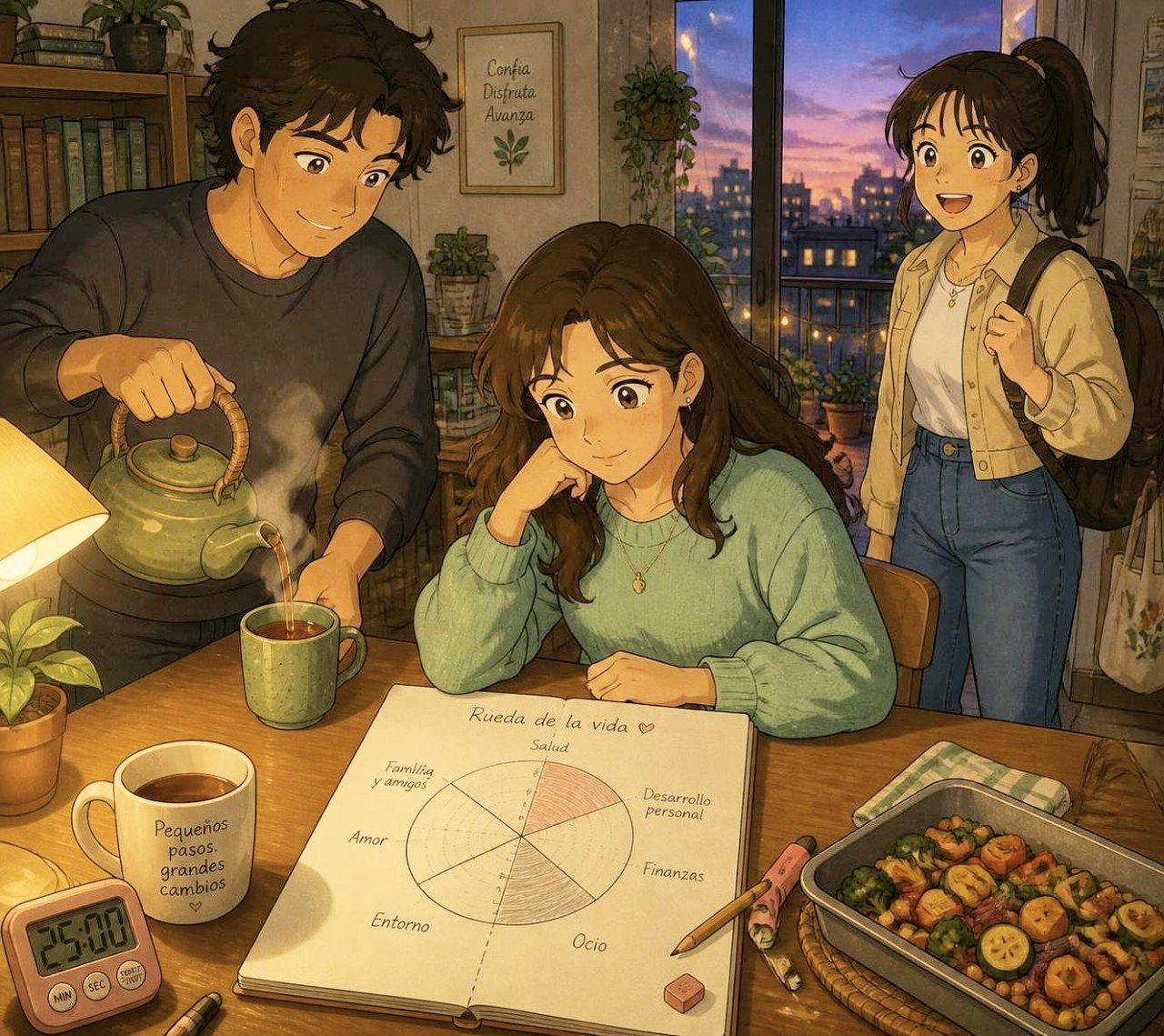
María closed her bedroom door with more force than she intended. On the table, the open notebook showed the wheel: a circle divided into ten sections, each with a word that, until recently, had seemed just a school exercise. That afternoon, however, the words pricked her attention like needles. She had shaded three sectors insistently: Studies, Physical Health, and Friendships. The shadows were dense, almost like cracks on the page.
"No sé por dónde empezar," she murmured, resting her forehead on the notebook.
From the kitchen came the sound of a kettle and footsteps. Diego, her older brother, entered with two cups of tea in his hands and a calm smile that didn't quite hide the worry in his eyes.
"Another life wheel?" he asked, placing a cup in front of her. "What's brought you here today?"
María pointed to the darkened sections without looking up. "Everything feels... broken. I spend mornings and nights studying, I skip meals when my head explodes, and I barely spoke to Ana in weeks. I don't recognize my routine; it's like everything is spinning wrong."
Diego sat on the edge of the bed and looked at the page carefully. "I remember Mom saying the wheel doesn't need to be symmetrical, but it does need to be harmonious. If one part sinks, the rest goes down with it. What about the other sections?"
"Self-love and Fun Time are almost empty," María replied. "Spirituality, Emotions, and Rest... they're not doing well either. Goals and Studies dominate the wheel as if they were the only important things."
Diego put his cup down and put his hand on her back in an old, protective gesture. "How long have you been like this?"
María sighed and told him: "Since the week before the last midterm. At first I said it would be temporary. Then it became a habit. I feel guilty when I rest and nervous when I'm not working."
At that moment the doorbell rang. María frowned, surprised. Diego went to open it; Ana entered as always: a gust of energy, backpack slung over her shoulder and a wide smile that seemed too big for the doorway.
"Surprise!" she announced, tossing her backpack onto a chair. "If someone tells me, I wouldn't believe it: María sad? Never!"
María tried to return the smile, but it fell short. "I'm not sad... just tired."
Ana looked at her straightforwardly, without hurry. "Tell me, why is the wheel in tatters?"
María explained in detail: the pressure of exams, the to-do list, the occasional insomnia that left her without energy, the fatigue that turned into irritability with her friends. As she spoke, the words accumulated and felt lighter.
Ana sat down and took her hands in hers. "I've known you since we were kids," she said softly. "You're not a machine; you're a person with limits. How about we do a practical test? A small plan, not a revolution."
Diego nodded, encouraged by the idea. "Make a list, simple as that. What can you change today without turning everything upside down. Two hours of study with breaks, a walk, meet Ana, make a decent dinner... Something real."
María hesitated, but put the pencil to the notebook. The words started appearing with shaky handwriting at first and then firmer: "Studies: 2-hour plan with 25-minute breaks," "Physical Health: walk 30 minutes daily," "Friendships: meet Ana today," "Rest: sleep before 11," "Food: don't skip meals, prepare easy snacks."
"It's not a perfect plan," she said, "but it looks like something I can do."
Ana stood up and, with that determination only friends have, said, "Then the first task is done: go out now and walk. I won't accept no for an answer."
María felt something like a door opening. She knew she had an exam the next day, but she also knew that a few more uninterrupted hours of study wouldn't make her wiser or more whole. She looked at Diego, who held his cup as if it were liquid courage.
"I'll be back in three hours," she finally said. "I'll study an hour and a half, rest half an hour, then go out with you."
Ana snapped her fingers. "Perfect. And we'll have dinner after the walk. Something healthy and tasty. No excuses allowed."
While María studied, she set a timer and obeyed each break. She went out to the balcony, breathed deeply, stretched. In those fifteen minutes she felt her shoulders drop a centimeter. It didn't solve all the semester's stress, but clarity arrived in small pieces.
In the park, Ana and María walked at an easy pace. The afternoon cast long shadows over the benches; conversation regained a rhythm María hadn't remembered having lately: laughter, silly anecdotes, light confessions. Ana talked about a course she wanted to take, and María, unprompted, shared a childhood memory—the smell of cookies at her grandmother's house—and they both burst into laughter.
"See," Ana said, "it changes when you allow yourself a breath. It's not magic, it's permission."
Back home, Diego had prepared a simple dinner: roasted vegetables, quinoa, and a light sauce that filled the kitchen with comforting aromas. The table, set with quiet domestic intent, made the evening a small ritual of care. They ate without hurry and spoke of trivial things: music they listened to, a movie they wanted to see, the shopping list. The lightness didn't solve the exams, but it repaired something that had tightened in María: her connection to others. Not everything in life was duty; there were also flavors, voices, and company.
That night she went to bed before eleven. It wasn't a perfect sleep, but it was deeper than previous nights. Upon waking, the wheel in the notebook hadn't changed shape, but María looked at it with different eyes. The shadows in some sections now had less abrupt edges: she studied, yes, but with breaks; she kept in touch with friends; she walked at least three times a week; she prepared snacks so she wouldn't skip meals.
Weeks later, the notebook showed another version of the wheel: still not a perfect circle, but it turned more steadily. María had learned to design small interventions: a study block managed by timers, weekly meetings with Ana, stretching classes she took on Tuesdays, and a personal rule to turn off her phone half an hour before bed. Each change seemed minor alone, but together they made a palpable difference.
One afternoon, Diego paused at a phrase María had written in determined ink, almost like a motto: "All areas of your life are important. If one is neglected, the whole wheel becomes unbalanced."
"That sounds like good philosophy," Diego said without irony. "Are you going to hang it up?"
María smiled and added another line beneath it: "Balance is also part of growing." She looked at it, feeling that the phrase enclosed not only a personal project but a way of understanding falls and recoveries.
One Sunday afternoon, Ana called and proposed a small celebration for the end of the midterms. They gathered on the terrace with tea and cookies. They toasted in simple cups.
"For wheels that require maintenance," Ana said, raising her cup.
"And for those who remind us to look at the wheel when it starts to spin wrong," Diego added.
María raised her cup too, and for a moment thought of all the nights of anxiety, the days when she almost forgot to breathe, and the small gestures that had brought her back to the surface: a walk, a snack, an hour of study with breaks, an honest conversation with a friend. She understood that balance wasn't a state achieved once and for all, but a daily practice: a sum of small, repeated choices.
As they said goodbye, Ana hugged her in a long embrace.
"Promise me that if you see the wheel tilt again, you'll call me," she asked.
"I promise," María replied.
That night she closed the notebook and looked at the wheel one last time before putting it away. She didn't consider it perfect; she didn't even plan to make it perfect. She looked at it with the patience of someone who knows wheels keep turning because someone cares for them and oil them when they squeak, that care is not a luxury but a tool.
She fell asleep thinking of small steps, knowing that every decision, however small, influenced the direction of the turn.
Upon waking, the morning light crossed the curtains and painted the page with a warm glow. María picked up the pencil and drew a thin line around the wheel, like tracing a promise. She knew there would be days when the shadows would return. She also knew she wouldn't face them alone. And that, she thought, was already a great adjustment in the machinery of life.
Source of the images.
Image created with Google Gemini.
Short story: The Shadow of the Watch
The flyer had been pinned to a corkboard near the subway platform, its corners crumpled and the black marker ink smeared by rain. Julián saw it for the first time on a gray morning, rushed, with the weight of the previous night still in his body. He didn’t think it was more than one of those urban provocations people post for amusement or boredom. But something in the cadence of the lines—this tacit promise of control, of authority without noise—pierced him like a small, precise arrow.
For years Julián had defined himself by shyness. At the office he was the one who always arrived early, sat in the farthest corner of the meeting room, and avoided being the center of attention. Meetings suffocated him: his hands would sweat, his voice would betray him when he had to defend an idea. That morning he rehearsed the list in his head as if it were a recipe he had never tried. “Look people in the eyes with intensity,” he murmured. “Speak slowly and calmly…”
He decided to try the first step. In the building lobby he saw Marta, the coordinator, gathering cups and straightening papers. Julián approached with measured steps; he forced himself to hold her gaze, fixing his eyes on hers longer than his old nerves ever allowed.
“Good morning,” he said, and didn’t look away.
Marta, who usually reacted with polite indifference to almost everyone, stopped. Her fingers left a half-dry cup and she blinked.
“Are you okay, Julián?” she asked, surprised. “You look… different.”
“Yes,” he replied, forcing a calm tone he had practiced on the stairs. “Fine. Thanks.”
The intensity wasn’t hostility; for him it was a new way to assert his presence. He offered a small, contained smile and walked away. The smile felt like it belonged to him.
The next day he applied the second rule without drama: he spoke slowly. In the break room someone commented on the latest project delivery and when someone else tried to talk over him, Julián took a deep breath and let his voice come out measured, each word deliberate.
“I think if we adjust the schedule by five days and add one more resource in phase two, we’ll reduce the margin of error,” he said calmly.
There were murmurs. Nobody interrupted him at first; when he finished, two hands raised to ask questions. It was the first time he felt truly heard. It wasn’t that his ideas were revolutionary—the change was in how he presented them.
He then entered the realm of calculated patience. The fourth rule advised not to respond instantly. Julián practiced it when Ricardo, the plant manager, challenged him in front of the whole team.
“Do you have data to back up your proposal?” Ricardo asked sarcastically, leaning on the table.
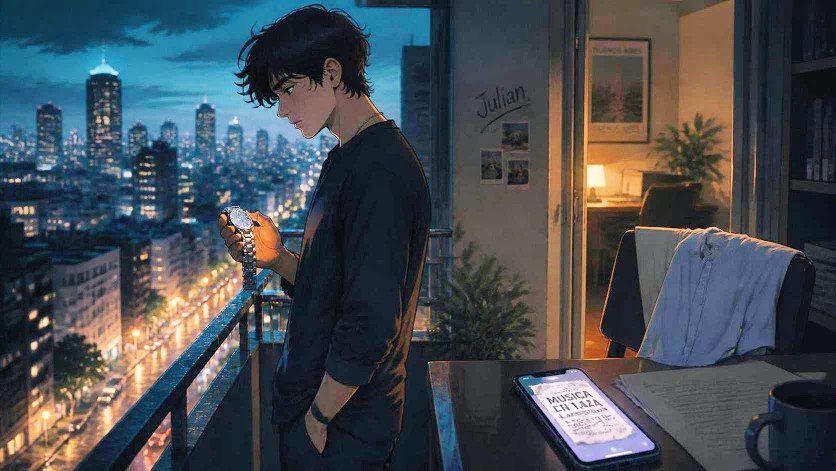
Julián felt the old urgency to justify himself in a thousand words. Instead, he looked at his watch—a simple, unpretentious piece, a gift from his father—and waited. Two, three seconds stretched like taut threads. The pause worked like a trim; the interlocutor had no words, waiting for Julián to rush. He spoke slowly, in the calm the guide had taught him.
“Yes,” he said. “I prepared a sheet with the parameters and hypotheses. I’ll present it at the end of the day and we can review it point by point.”
Ricardo frowned—not because of the evidence but because he’d lost the chance for an immediate reaction. When the presentation arrived, the numbers spoke with the same clarity as Julián’s voice. He didn’t celebrate or raise his tone; he let clarity be his victory.
The changes were not immune to interpretation. Some colleagues began calling him curt; others, respectful. Old insecurities hadn’t vanished but lined up behind a mask he had learned to manage. Rule five—don’t show weakness—led him to toughen certain gestures, to hide signs of doubt that once would have shown his humanity in public.
One afternoon in the coffee line, Elena reached out and touched Julián’s arm with the same casualness people use to brush against others’ lives. It was one of those gestures that used to comfort him.
“What’s wrong with you?” she whispered. “You’re… different. Colder.”
Julián looked at her with the new technique: intensity without aggression, controlled.
“Nothing you should worry about,” he replied, removing her hand gently so the motion wouldn’t seem abrupt.
Elena lowered her gaze and in a thin voice added, “Just… be careful not to become inaccessible.”
He nodded slowly. The warning stayed with him like a small stone in his shoe.
The sixth guideline made him both laugh and resonate: “Dress elegantly and always wear a watch.” Julián, who had never paid much attention to appearance beyond the practical, began attending to details. He bought simple but well-cut shirts, planned his outfit the night before, and each morning fastened his watch with a movement that felt like starting a ceremony. He didn’t need jewelry or ostentation; elegance, for him, became a suit of confidence.
At first the watch was a tool: to time pauses and mark responses. Over time it became an anchor. When he was nervous, brushing the strap brought his pulse back to calm. When someone tried to mock him, the metal reminded him that his posture had logic and limits.
A week after finding the flyer he ran into Álvaro in the elevator, an old university adversary who delighted in recalling others’ stumbles.
“Well, if it isn’t Mr. Manners,” Álvaro quipped, his tone sharp. “When did you start specializing in stare tactics? Studied sharks?”
Julián, who would have once sought a target or a quick retreat, simply looked. He waited long enough to make the tension uncomfortable for Álvaro. Without raising his voice or showing anger, he gave a cold, brief answer.
“Since before you started caring,” he said. “Good day.”
He stepped out of the elevator. Álvaro remained with the sarcasm stuck in his mouth; the rush of the barb had lost its aim.
As those small victories accumulated, Julián noticed changes in others. Marta began greeting him with a warmer smile and sometimes asked his opinion on logistics; Elena watched him with cautious affection; even Ricardo started consulting him on presentation preparations—not out of spontaneous deference but out of practical recognition.
However, it wasn’t a straight line to admiration. The distance Julián cultivated to avoid showing weakness began to become a barrier to intimacy. At a dinner with office friends, conversation turned lively and someone made a personal joke about a mistake he’d made in college. The room laughed. Julián felt the old urge to correct or justify. Instead he applied rule three: don’t look nervous. He remained silent. His cheeks burned inwardly, but not outwardly. He breathed and spoke in a slow voice.
“I learned from my mistake,” he said. “Period.”
The reply was so brief some took it as arrogance. His friend Lucía, who had known him for years, leaned in and gave him a look mixing concern and reproach.
“I don’t like this new coldness,” she murmured softly. “Don’t lose who you are, Julián.”
That night, in his apartment, Julián turned on the balcony light and looked out at the city without finding instructions in it. The guide was still on his phone; he had photographed it the first week. He reread it sometimes, comparing the list to the man returning home in pajamas. What had really changed—substance or polish?
He remembered his father fastening the watch on his wrist when he was a child. “A man should know the time, and also how to use it,” the man had said with rough hands and a voice that didn’t allow trembling. Julián now understood that the watch gave him the feeling of being able to choose his tempo: when to hasten and when to let silence do its work.
One afternoon Marta found him in the cafeteria with a steaming cup of coffee. She sat across from him without artifice.
“I heard you defended the presentation well,” she said sincerely. “I expected nothing less, to be honest.”
Julián sipped his coffee and looked at her.
“Thanks,” he replied. “I started thinking about how I respond before I do it.”
Marta fiddled with the cup lid for a second and, with a honesty that felt necessary, said, “Just be careful you don’t become someone cold. There’s a difference between respect and fear.”
He took it in. That comment opened a crack where his old vulnerability peeked through. He decided not to discard the strength he had gained, but he didn’t want that strength to harden into an anesthesia that took away his ability to connect.
Days later he gave himself a test. One of the new interns, shaking and nervous, made an error that would have cost hours to redo in a report. Some on the team laughed with that cruelty social distance sometimes allows. Julián felt the impulse to apply the list: stare intensely, speak slowly, never show weakness. But when he approached the young man his gaze shifted. This time the intensity was attention, not judgment.
“Don’t worry,” Julián said calmly. “We’ll fix it together. Show me what you did.”
They spent the afternoon checking figures and retracing steps. When they finished, the young man looked at him with clear gratitude.
“Thanks,” he said. “I thought you’d tell me to find another job.”
Julián smiled, a smile without calculation.
“Failing isn’t the problem,” he replied. “Learning quickly is.”
In that moment he knew he had found a possible balance: keeping firmness and the strength of silence, but coupled with a willingness to help, without surrendering self-respect.
The flyer on the subway corkboard remained there, its ink a bit more wrinkled, tested by rain and time. For many it would be just another list of tricks to intimidate or to look strong. For Julián it stopped being a manual for “dangerous” behavior and became an ambiguous mirror: a reminder that the way we present ourselves changes how we’re treated, but the intention behind that presentation changes everything.
One night before sleep he took the watch from the drawer. He looked at it in the bedroom’s dim light and didn’t put it on. Instead he held it for a moment, like someone regarding an object that had served as a bridge between two versions of himself. He smiled without hurry and put the watch back. He didn’t need it to tell him when to speak or when to be silent.
The Shadow of the Watch stayed with him not as a threat but as a lesson: strength doesn’t lie in intimidation but in calmly choosing when to show the edge and when to fold it, in preserving dignity without losing the ability to touch other people’s lives with sanity.
Source of the images.
Image created with Google Gemini.
Short story: The Inner Lighthouse
Mariana arrived in the coastal village one autumn afternoon with the feeling that something inside her had worn thin. She carried a simple backpack, a notebook with slightly dog-eared pages, and the intention of disappearing for a while to find herself again. The village was small: cobbled streets, houses with blue shutters, and the smell of salt and seaweed. She walked unhurriedly to the lighthouse, drawn by the promise of silence and height.
At the foot of the lighthouse she found Tomás, the lighthouse keeper, sitting on the low wall overlooking the sea, holding a steaming cup of tea. Tomás was a middle-aged man with strong hands, a serene gaze, and a slow way of speaking that conveyed calm.
"Good afternoon," Mariana said, her voice trying to hide her doubt. "May I sit?"
Tomás smiled and raised his cup in a welcoming gesture.
"Of course. The wind is generous here and company is seldom too much. What brings you to these shores?"
Mariana looked to the horizon, where the sun was beginning to set in orange tones.
"I needed to get away from everything," she replied. "I feel lost. I compare myself a lot to others, I chase after pleasing people, and in the end I’m exhausted."
Tomás nodded, as if he recognized the words of someone who had been carrying expectations for a long time.
"Listen more, understand more," he said, breaking the silence. "Often we think speaking will save us or make us visible, but true direction comes when we listen— not only to others, but to what’s happening inside us. Have you tried listening to yourself without judging?"
Mariana put her hands in her coat pockets.
"I'm not sure how to do that. When I try to pay attention to how I feel, thoughts assault me: 'You’re not enough,' 'What if you fail?,' 'What will they say?'. They make me dizzy."
"Those thoughts are not always the truth," Tomás replied in that softness that seemed like a lighthouse itself. "They're like passing clouds: they inform you, which is valuable, but they are not the whole sky. Observe them, name them, and decide afterward."
Mariana took out her notebook and, without thinking too much, wrote: "My thoughts are not always the truth." The simple act brought immediate calm, as if fixing the phrase on paper allowed her to separate herself a little from the voices in her head.
As the sun faded, Lucía arrived—the village schoolteacher who always collected seashells and carried laughter with her. She joined them, sitting nearby.
"What are you writing?" Lucía asked, curious.
"An idea," Mariana answered. "The lighthouse keeper told me that my thoughts aren’t always true."
Lucía tilted her head, thoughtful.
"What a good start," she said. "At school I ask my students to listen before answering; that way they learn to understand others and themselves better."
Mariana confessed her fear of disappointing others and the tendency of her life to revolve around what others expected of her.
"You are not here to please everyone," Tomás said. "Everyone who comes to the lighthouse brings a different lantern. Your purpose isn’t to make every lantern reflect your light, but to keep yours burning with honesty. Living at peace with yourself is an act of courage."
That night, the three of them sat at the lighthouse base and talked until stars filled the sky. Mariana listened more than she spoke; she let the advice seep in. Before leaving, Tomás invited her to return the next day to help with simple tasks around the lighthouse. Manual work, he said, would help bring order to her thoughts.
The next morning Mariana returned early. The lighthouse needed cleaning: dust on the railing, cobwebs on the windows, and a lantern that asked for attention. While she wiped the glass, she felt the repetitive motion loosen the tension in her shoulders.
"May I ask you something personal?" Tomás said, handing her a rag.
"Ask," she replied.
"Who do you give the control of your life to now?"
Mariana paused. She thought of the other people’s agendas she had accepted, the decisions she had made to avoid conflict, the comments that made her doubt.
"I give it to other people’s opinions," she admitted. "Sometimes to anxiety. And to the need to justify myself."
Tomás cleaned a stain with patience.
"Focus on what you can control," he said. "There are tides you won't change. If you try to control everything you will wear yourself out. Letting go of what you can’t control isn’t giving up; it’s choosing where to invest your energy."
She nodded. It was a simple lesson but hard to apply. Over the week she practiced small renunciations: not answering an urgent message immediately, saying "no" to a favor that would leave her exhausted, spending fifteen minutes each morning writing in her notebook. Those actions, she discovered, gave more freedom than any attempt to please others.
One afternoon, while helping raise the lantern pulley, she cut her hand on a rusty tin. The pain made her freeze; the blood surprised her and frustration mixed with tears.
"Are you going to give up because it hurts?" Tomás asked, already holding a first-aid kit.
"No…" Mariana stammered. "But it hurts a lot."
Lucía, who was passing by, appeared in an instant and with sure hands began cleaning the wound.
"The pain is temporary," she said warmly. "Growth is forever. Every wound brings a lesson; a scar is a reminder that you learned to keep going."
Mariana watched the bandage cover her hand and, in the stillness that followed, thought about all the times she had avoided experiences because fear of pain was stronger than curiosity to grow. That night, when the bandage was on and the wound had begun to calm, she wrote another sentence in her notebook: "Pain passes through me; it does not define me."
In time not only her hand healed. Mariana began to adopt concrete actions to complement her reflections: she signed up for pottery classes on Tuesdays (a way to materialize patience), she started walking every morning along the coast without her phone, and each night she wrote one thing she had done for her wellbeing, however small. Those routines, though discreet, proved she didn’t depend only on time to heal: she depended on her actions.
One afternoon, while they shared stories and tea in the lighthouse kitchen, Andrés arrived—a young fisherman looking for work at the dock. He smelled of sea and carried the look of someone comparing his path to others.
"Sorry to interrupt," Andrés said shyly. "I heard you talking from the beach. My name is Andrés. I’m looking for work and sometimes I feel useless next to my brother, who’s always been more successful."
Mariana looked at him and, without thinking, spoke as if addressing her own reflection.
"Don't compare yourself; outdo yourself," she said. "Your path, your pace, your story. I spent years measuring my worth with others’ rulers. Now I try to be better than yesterday’s version of myself."
Andrés let out a short incredulous laugh and then exhaled, as if he had put down a weight.
"It sounds simple," he said, "but today I feel it as a truth I hadn’t heard that way."
Weeks became months. Mariana learned to listen before responding, to question her thoughts instead of surrendering to them, and to accept that she could not control storms but could adjust the sails. In her notebook she drew maps: small goals, habits, decisions that once seemed impossible. Each map helped her orient herself better.
One winter night a storm hit the coast hard. Winds roared, waves slammed against the breakwater and the harbor radio barely transmitted static. A fishing boat that had gone out too far lost its bearings. In the lighthouse the light had to remain steady, and the townspeople organized to help. Thanks to Tomás’s attention, the fishermen’s coordination, and the improvised signals they raised, the boat managed to approach and moor safely.
That dawn, in the small tavern by the port, the community gathered to share rice, stories, and wine that warmed their hands. They sat by the fire; the dockmaster’s callused hands knocked his cup in a gesture of gratitude.
"I toast," Tomás said, lifting his teacup, "to the lighthouse that didn’t stop shining, and to those who knew how to row when the tide rose."
Lucía raised her glass and added, "To the growth that becomes evident with time and simple acts."
Andrés, with slightly glassy eyes, said, "To not comparing ourselves. Each one has their tide and their boat."
Mariana looked around and felt something settle inside her. The storm’s noise, instead of unsettling her, reminded her that she wasn’t invulnerable and that did not weaken her: it made her human. That night she walked to the headland, the sand cold under her feet and the notebook in her hand. She sat and wrote, "Today I stopped living to please and started living to learn."
After a few months Mariana decided to return to the city. The village farewell was simple: hugs, promises to return, and the blessing of those who had witnessed her transformation. Before she left, Tomás gave her a small pocket compass.
"To remind you," he said, "not so much of the physical north, but the inner one. When you doubt, open your notebook and look at how far you’ve already come."
Back in urban life Mariana carried the practices she had learned: listening intentionally, distinguishing thought from fact, prioritizing what she could control, accepting and learning from pain, acting daily to heal, and measuring progress against her own yesterday. It wasn’t a magic cure; there were hard days and relapses where old habits of comparison trapped her. But now she had practical tools to return to shore: writing, walking, breathing, asking for help, saying "no."
Years later, at a reunion with old friends, one of them remarked that she saw in Mariana a new calm, a resolve that did not impose rigidity but kindness.
"How did you do it?" the friend asked.
Mariana smiled and touched the compass she kept in her bag.
"Little by little," she said. "I learned to listen more and understand better; I discovered my thoughts aren’t always the truth; I accepted that I’m not here to please everyone; I focused on what I can control; I understood that pain passes and leaves lessons; I acted each day to heal; and I stopped comparing myself, striving only to beat my previous self."
That answer wasn’t a slogan: it was the synthesis of months of practice, of cuts that healed, of shared cups of tea, and of dawn walks. The compass, the ink in her notebook, and the lighthouse’s light became symbols of learning that, like the guiding light for ships, didn’t promise routes free of storms but did promise that navigation was possible.
The lighthouse continued to do its work night after night, and Mariana, wherever she was, kept hers lit: a lantern she fed with everyday actions, a lantern that reminded her the most valuable truth isn’t the one others dictate, but the one you build step by step.
Source of the images.
Image created with Google Gemini.

Short story: SILENT SENSES
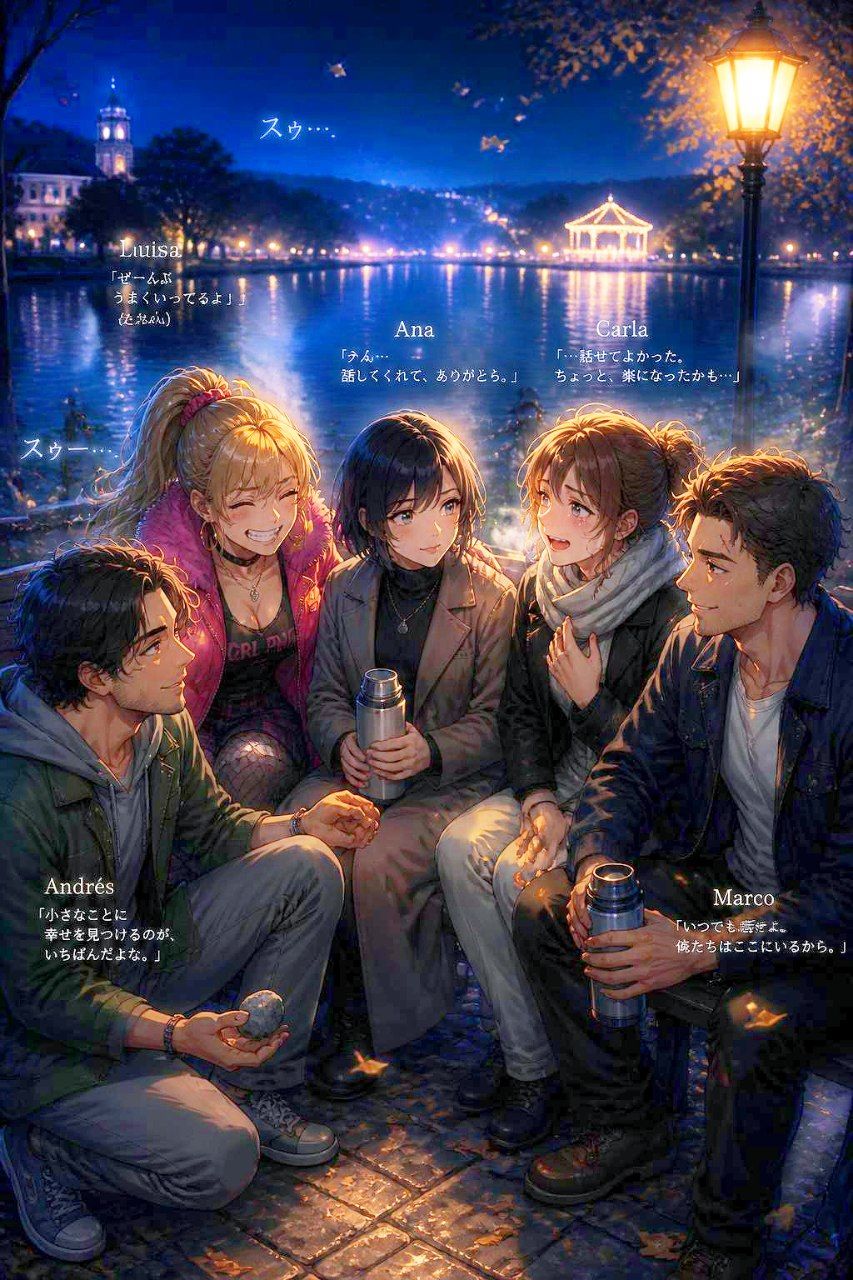
The night spread over the small town like a warm, gray blanket; the streetlights traced pale circles along the lake’s edge while a cold breeze lifted little ripples on the water. Ana sat on a wooden bench, wrapped in her coat, a thermos cupped between her hands. From there she could see the plaza lit up in the distance: the annual festival had begun, but the laughter and music reached her only as echoes, too faint to draw her in. She preferred that shore: the silence, the breath of the wind, the steady texture of the water. For her, crowds and shallow conversations drained energy; silence and solitude instead gave her room to sort her thoughts and feel clearly.
Marco appeared crossing the grass with a light step, carrying two thermoses and a bag of cookies. His jacket was half-buttoned and his cheeks were flushed from the cold. As he approached, he removed his hat and set one of the thermoses on the bench, offering it to Ana with a smile that hovered between complicity and concern.
"Are you really staying out here?" Marco asked, setting the other thermos at the far end of the bench. "Did you come just to watch the lights?"
"Yes," Ana replied, accepting the thermos and inhaling the coffee’s aroma. "The idea of going to the plaza feels... heavy tonight. Shallow conversations exhaust me. I prefer this: silence, cold air, and the water beside me."
Marco sat beside her, close but not intrusive. He had learned that Ana needed space and company at once—a presence that didn’t demand unnecessary words.
"You always surprise me," Marco said, looking toward the lake. "Last night, at the gathering, you noticed Carla was upset before she said anything. How do you do that?"
Ana squeezed the thermos with both hands, as if to keep something other than warmth inside it.
"It’s not magic," she answered. "There are small signs: a pause that’s too long before a laugh, hands fidgeting with a glass, a light in the eyes that’s dimmer than usual. I don’t want to intrude, but sometimes you just feel it. And it worries me if no one else notices."
Marco turned his gaze toward the plaza, where the lights flickered and the music rose and fell in waves.
"It’s a good trait," he said. "People need someone to notice those things."
At that moment, Carla appeared on the path lit by lamplight. She walked slowly, her scarf drawn tight, and her face had a paleness that wasn’t only from the weather. When she reached them she sank onto the bench at the far end, as if she wanted to be near but not too close.
"Hi," she murmured. "I came to walk for a bit to get away from the noise."
Marco looked at her with obvious concern.
"We saw you at the plaza," he said. "You seemed distracted. Did something happen?"
Carla tried to shrug and smile, but the smile didn’t reach her eyes.
"It’s nothing," she said. "It’s just... a buildup of things. Work, family, expectations that weigh more than I expected."
Ana watched her without rushing questions; she knew people sometimes needed time to open up. Her silence, far from empty, was an invitation to truth.
"You don’t have to pretend," Ana said gently. "If you want, you can tell me. Real things don’t make me uncomfortable."
The sentence was like a slightly open door. Carla took a deep breath and, gradually, began to speak: of long days at the office where everything felt urgent and unimportant at once; of an aging mother whose visits drained her; of subtle comments from bosses that made her doubt her worth. She spoke of nights lying awake trying to meet expectations that didn’t feel like her own.
"Sometimes I feel like I have to be strong all the time," she confessed. "And it’s exhausting. I go to bed feeling like I need to mask the fatigue with smiles."
Marco listened in silence, nodding at the right moments, offering a warm word or a gentle joke that for an instant eased the intensity. Ana didn’t interrupt; her presence was another form of support.
Every now and then she added a small observation that showed she’d been attentive: the slight quiver in Carla’s voice when she mentioned her mother, the tightening of her hands when she spoke of her boss.
"Thank you," Carla said, her voice breaking. "It’s strange to find someone who doesn’t ask me to mask what I feel."
"Authentic things don’t need makeup," Ana replied. "And if you want, we can talk whenever you need."
Carla leaned her head against the back of the bench and let out a soft, breathless laugh.
"You’re an odd remedy," she said. "I don’t know if that’s good or bad."
"Odd and useful," Marco corrected. "I’d say useful."
The conversation loosened and drifted toward memories: high school anecdotes, eccentric teachers, failed trips that turned into adventures. At one point Ana noticed the scar on Marco’s eyebrow, a clear scratch that crossed his skin like a thread. No one in the group had mentioned it in years, but to Ana it fit into the narrative of their friendship.
"Remember the mountain hike?" she asked with a smile. "You fell off the path and came out shaking like nothing happened."
Marco touched his eyebrow with his fingertips and laughed, showing a mix of embarrassment and pride.
"Yes," he said. "I’ve always been a bit clumsy. I remember someone saying they’d practice their scared face all afternoon."
Laughter came easily, and for a while the night was filled with that shared humor—warm and unpretentious. Ana enjoyed those laughs; they didn’t tire her because they came from something real, not from effort to impress.
Later, as the hours passed, two figures appeared in the distance: Luisa and Andrés, returning from the plaza with high energy, still lit by the music and the crowd. They arrived with louder voices, more gestures, and an effusive presence. Luisa brought an enthusiasm that inevitably filled any space; Andrés had an open laugh and the knack for a quick joke.
"There you are!" Luisa exclaimed when she saw them. "Why were you hiding out here? We came to find you."
"We’re not hiding," Ana replied with a half smile. "We just prefer to watch from here."
Luisa, without malice but with convincing energy, sat down on the bench next to Carla, exaggerating a smile that Ana found slightly forced. The amplified gestures and the need to keep up appearances produced a physical discomfort in Ana: fake people made her feel strange, as if something in her body reacted to the lack of sincerity.
"You don’t like the party?" Luisa asked. "I thought everyone loved it."
"It’s not about liking it or not," Ana said. "It’s just that fake things make me physically uncomfortable. I prefer to feel things for real."
Luisa looked at Ana in surprise, and for a moment the energy in her smile wavered. Andrés, watching the scene, picked up a stone and dropped it on the lake’s surface. The soft sound became another interruption—a bridge between laughter and reflection.
"I’ve always admired that about you, Ana," Andrés said softly. "People need you for that. You notice what many prefer to ignore."
Carla nodded, her eyes wet but her expression softened.
"And it helps me," she added. "Knowing someone notices what’s happening before I say anything makes me feel less alone."
The words landed. Ana allowed herself to relax a little; although feeling everything intensely made her vulnerable, it also connected her deeply with those around her. That night struck a balance of emotions: confessions, shared silences, laughter that wasn’t a façade. Sorrows lightened just by being named; joys broadened when shared.
At a quieter moment Luisa spoke softly, as if wanting to be honest without losing composure.
"Sometimes I fake that everything is okay because I’m afraid of being judged if I’m not," she admitted. "Seeing you all, speaking without masks, makes me think I could try to be more honest."
Marco looked at her with tenderness.
"It’s not easy," he said. "But I promise you won’t be judged here. On the contrary: something good always comes when someone lowers their guard."
The moon rose behind the clouds and the temperature dropped. Carla pulled her scarf closer; Marco offered a cookie that Luisa accepted gratefully. Conversations became more measured, more observant. There were moments when someone let out a laugh that softened into a silence full of affection; other times words were necessary to support whoever was speaking. Ana listened to every nuance with an intensity that allowed her to respond with minimal but fitting gestures: a nod, a hand on Carla’s back, a pointed question that opened space.
When the night was late and the plaza lights had taken on a different cadence, Marco stood and stretched his shoulders.
"I think we should head back slowly," he said. "Let’s walk Ana part of the way."
They said their goodbyes with hugs and promises to meet again. The group broke into pairs and uneven steps; voices fell behind them along the path, mixing with the rustle of leaves.
Marco walked with Ana along the cobbled street leading to her building. The lamplight traced their silhouettes.
"Thanks for staying tonight," Marco said, breaking the silence with a calm honesty. "Your quiet says more than many conversations."
Ana paused for a moment, looking at her reflection in a puddle on the sidewalk.
"Sometimes silence is enough," she replied. "And alone I recharge so I can be with you when it’s needed."
"That’s good," Marco said. "Not everyone needs the same kind of company. Thanks for being who you are."
They reached her door. Ana opened it slowly, as if prolonging the moment. She lingered in the doorway for an instant, hearing the distant conversation fade and feeling the warmth of the thermos in her hands. Then she closed the door gently behind her.
In her small apartment, with a window facing the lake and the town lights in the distance, Ana allowed herself to reflect. Feeling everything intensely had been a burden at times; other people’s emotions hit her hard, and crowds left her emptied. But that same sensitivity gave her the ability to notice what others hid, to offer real company when it was needed. She thought of Carla and her cracked voice; of Marco, always attentive; of Luisa, who wore a temporary mask; of Andrés, who knew how to say the right thing without exaggeration. She smiled with a mix of fatigue and gratitude.
Before she turned off the light, Ana looked out the window and realized something simple: she hated false noise, but not the human warmth that comes when truth is spoken without adornment. That filled her with life. She took off her coat, placed the thermos on the table, and sat by the window. Outside, the lake kept the night like a quiet secret; inside, the silence was company. Ana closed her eyes for a moment, recharging with the memory of sincere voices and the certainty that, the next day, she would return to the world with the patience and attention that made her who she was.
Source of the images.
Image created with Google Gemini.
Short story: The Paw Club
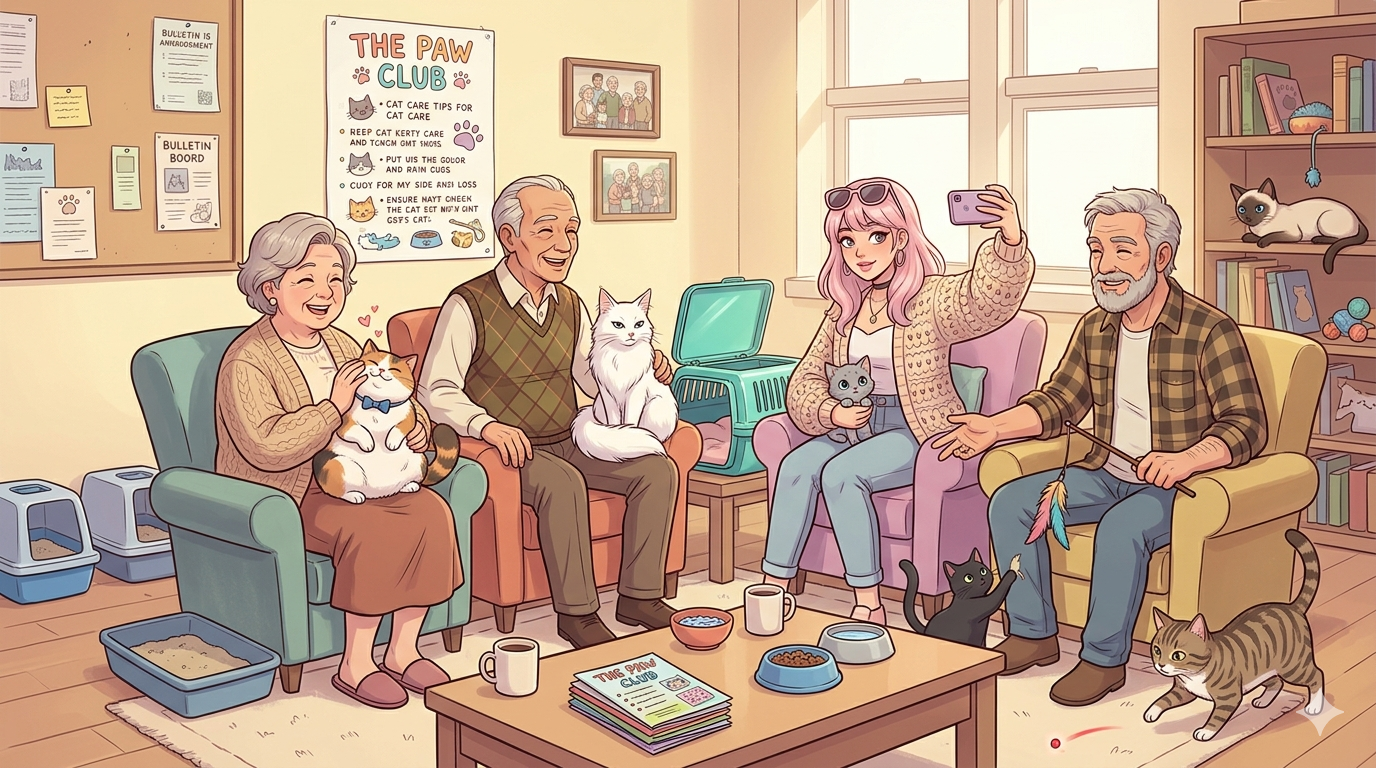
It was a mild Saturday afternoon and the building’s community room smelled of freshly brewed coffee and the indistinct mix of catnip and air freshener. Doña Marta, a retired teacher and organizer of unexpected events, had arranged chairs in a circle, hung a poster with 12 feline rules, and set out a table with printed leaflets. She had invited every neighbor with cats to a talk — which in practice would become much more — about common mistakes people make with felines.
When the attendees arrived, each brought their cat and their own philosophy of life.
Doña Marta, glasses perched on the tip of her nose, opened the session:
Doña Marta: —Welcome to the first meeting of The Paw Club. Today we’re going to talk about mistakes we make without realizing and how to correct them.
Mr. Carlos, a kind man who always carried Peluso — his round, confident cat — in his arms, protested as soon as he heard the word “mistakes.”
Mr. Carlos: —Mistakes? But Peluso and I have a tacit pact: I pet him, he forgives my couch naps.
Peluso, draped like a living scarf, looked at the audience and let out a meow that sounded like a sigh.
Peluso (meowing): —Mrrr... Betrayal if your pact doesn’t include belly rubs!
Doña Marta smiled and pointed to the first item on the poster: “Don’t touch the belly without permission.”
Doña Marta: —First lesson: the belly is sensitive territory. Many cats don’t like it being touched even if it seems like they do. Better to read the signs: if the cat rolls over and shows the belly, it’s often an invitation to sniff, not to plunge in with a hand.
Mr. Carlos frowned and petted Peluso with more affection than prudence.
Mr. Carlos: —But he lets me...
Peluso, with the serenity of one who forgives everything except being ignored, showed his teeth in a playful grimace.
Peluso: —Only until I get bored!
Lucía, the neighbor influencer who always wore sunglasses even when it was cloudy and documented her cat life in stories, arrived with Diva in a shiny carrier.
Lucía: —I only take her out for the vet, I don’t want her to associate the carrier with stress.
Diva, with that dignified, slightly haughty expression that queens possess, popped her head out as if judging mortals’ ethics.
Diva (imagined voice, steaming with sarcasm): —Only for the vet? What kind of existence is that? I demand a life with fewer shocks and more rugs.
Doña Marta nodded and pointed to the poster item that read “Carrier should be always accessible.”
Doña Marta: —Having the carrier available at home, with bedding and toys inside, helps the cat see it as a safe place —not just the start of veterinary torture.
Meanwhile, Don Ernesto, a methodical fellow and list-lover, had brought several litter boxes and stacked them carefully. He placed a large note: “One per cat + 1.”
Don Ernesto: —Infallible rule: one litter box per cat plus one extra. It prevents territorial issues and stress.
Tigre, Don Ernesto’s frequent cat, inspected the boxes as if preparing for a quality exam.
Tigre (looking at the note): —What if I use the curtain? Artistic innovation.
Doña Marta clapped and moved on to another poster point: “Don’t put the litter box next to food.”
Doña Marta: —If the litter box is next to the feeder, the cat finds it unpleasant. Keep water and food away from the box.
In a corner of the room there was a table with food and a water bowl clearly separated. Lucía, already seeing content potential, raised her phone.
Lucía: —Separating water and food is excellent content: “5 tricks for your cat’s pantry.” This will slay on reels!
Diva snorted with artistic disdain.
Diva: —If people knew how much I suffer for the algorithm... I’d rather be filmed silently.
The talk took a practical tone when Doña Marta introduced Carla, the new neighbor, who was visibly nervous and carrying a tiny kitten named Nube, tucked in her cape.
Doña Marta: —Introductions between cats: don’t force them. Three to seven days in separate rooms so they get used to each other’s scent, then gradual encounters.
Carla, hands trembling, asked in a low voice:
Carla: —Can’t they sniff each other through the door crack?
Nube, from his hiding place, stuck out a tiny paw as if checking the world’s coordinates.
Nube (whispering): —Operation invisibility activated. If they see me, I vanish.
No sooner had Doña Marta finished than Peluso, impatient with all the protocol, leapt toward Diva to greet her. Diva, literal and figurative in her diva-ness, arched her back and let out a snort fit for a rock star.
Diva: —Respect! Don’t hug me without an invitation.
Peluso, confused but optimistic, sat and looked at her with puppy-like eyes.
Peluso: —But I just wanted to rub her belly!
Doña Marta, laughing, placed her hand on Peluso’s chest like a judge who has seen too many bows.
Doña Marta: —No, no, Peluso. The belly is petted with permission. Don’t punish the other for not wanting it.
Next Don Ernesto produced a small red laser and a dangling feather. The room shifted: the cats registered it as the sacred start of entertainment.
Don Ernesto: —Two play sessions a day, five to fifteen minutes each. It’s essential for their physical and mental well-being.
Tigre, who spent most of his day rehearsing poses and demonstrating the gravity of his indifference, dug his claws into the carpet with enthusiasm.
Tigre: —Finally! My training is activated. Time to hunt ghosts!
Nube, safely on Carla’s lap, timidly reached a paw toward the laser dot.
Nube: —Does that include practicing my shadow-hunting techniques?
While the humans debated rewards and reinforcements, Lucía, always ready to monetize any natural impulse, proposed a tactic most attendees knew well: rewarding cats with affection and treats for bringing “prey.”
Lucía: —If cats bring me prey (toys or plush mice), I reward them with treats and stories. It’s sweet content.
Peluso, in an act of primitive generosity, left a dust ball he’d rescued from the radiator on the table.
Peluso: —Look, I brought offerings. I’m provider.
Diva eyed the dust ball with a mix of contempt and condescension.
Diva: —That is not prey, that is... lint. Where’s the prestige?
Doña Marta, calm and firm, pointed to one of the poster’s final points: “Don’t punish; teach.”
Doña Marta: —Punishment only teaches fear. If we want to change behaviors we must redirect and reward desired actions.
Mr. Carlos, who had tried unsuccessfully to redirect Peluso whenever he dug through the potted plants, shrugged.
Mr. Carlos: —So no shouting when I find him digging in the living room plant?
Peluso, with dirt on his paws and an expression that said “scenic creativity,” spoke as if defending an art movement.
Peluso: —Abstract art, I call it. Don’t you appreciate the composition?
The afternoon became a blend of laughter, recommendations, and hands-on demonstrations. Don Ernesto staged a small exhibit: he lined up three litter boxes to show the “one per cat plus one” rule in action. Tigre inspected each with scientific rigor.
Tigre: —Full evaluation: texture adequate, depth acceptable, privacy moderate.
Lucía filmed the scene, murmuring ideas for viral titles.
Lucía: —“How to Avoid Cat Disaster in 10 Steps” —this will crush my feed.
As the session wound down, Doña Marta asked for a group photo for the building’s newsletter. The humans arranged themselves smiling; the cats posed as best they could, from elegant annoyance to proud indifference. Tigre chose a litter box as his pedestal; Diva struck the pose of an absolute star; Peluso chewed someone’s leash while trying to stretch his belly toward the camera.
Doña Marta: —Remember: observe, respect boundaries, play, and offer alternatives. The cat is not difficult; it is different.
Tigre, proud to have tested several litter boxes and passed the play test, murmured in a grave tone.
Tigre: —Formal conclusion: the cat is not difficult —it is simply... selective.
Diva, settling in the brightest corner, added with elegant superiority:
Diva: —Different and elegant. I accept nothing less.
Peluso, mouth full of lint and eyes half-closed from comfort, left his final thought, which was also a request.
Peluso: —Different and hungry. Please, more snacks.
Doña Marta closed her folder with a mix of satisfaction and happy exhaustion. She looked at the neighbors and then at the cats, and offered her final recommendation as one gives a valuable, simple piece of advice.
Doña Marta: —Consent when needed, always observe, and play every day. And if someone tries to hug your cat without permission... step back slowly and offer a treat instead.
Everyone laughed. The cats meowed in various tones, approving most decisions with reasonable reservations. Carla, who had arrived nervous with Nube, left smiling, convinced she had taken the first step to help him integrate.
Carla: —Thank you, Doña Marta. I think Nube trusts a little more now.
Nube, poking his head out from Carla’s sleeve, surveyed the room and, for the first time in hours, stayed still long enough for someone to gently scratch the back of his neck.
Nube (tiny voice): —Maybe it’s not so complicated... if there are treats.
And with that, The Paw Club ended its meeting. Each neighbor left with a sheet of recommendations, a group photo, and the feeling that, with patience, games, and respect, living with cats can be as entertaining as it is challenging. Outside the afternoon turned to night; inside, the cats reclaimed their zones of power, preparing themselves for another round of naps, furtive games, and nighttime protests in the form of meows.
The End.
Source of the images.
Image created with Google Gemini.
Short story: The Mirage
Marina never sought trouble. She grew up in a home where words were used to build bridges and, when they failed, to close doors gently. Over the years she learned to read tension in a gesture, to gauge the warmth of a room before entering, and to calculate the width of silence needed for others to find their own rhythm. She didn’t call it a “technique”; to her they were small courtesies that returned dignity to those who were losing it.
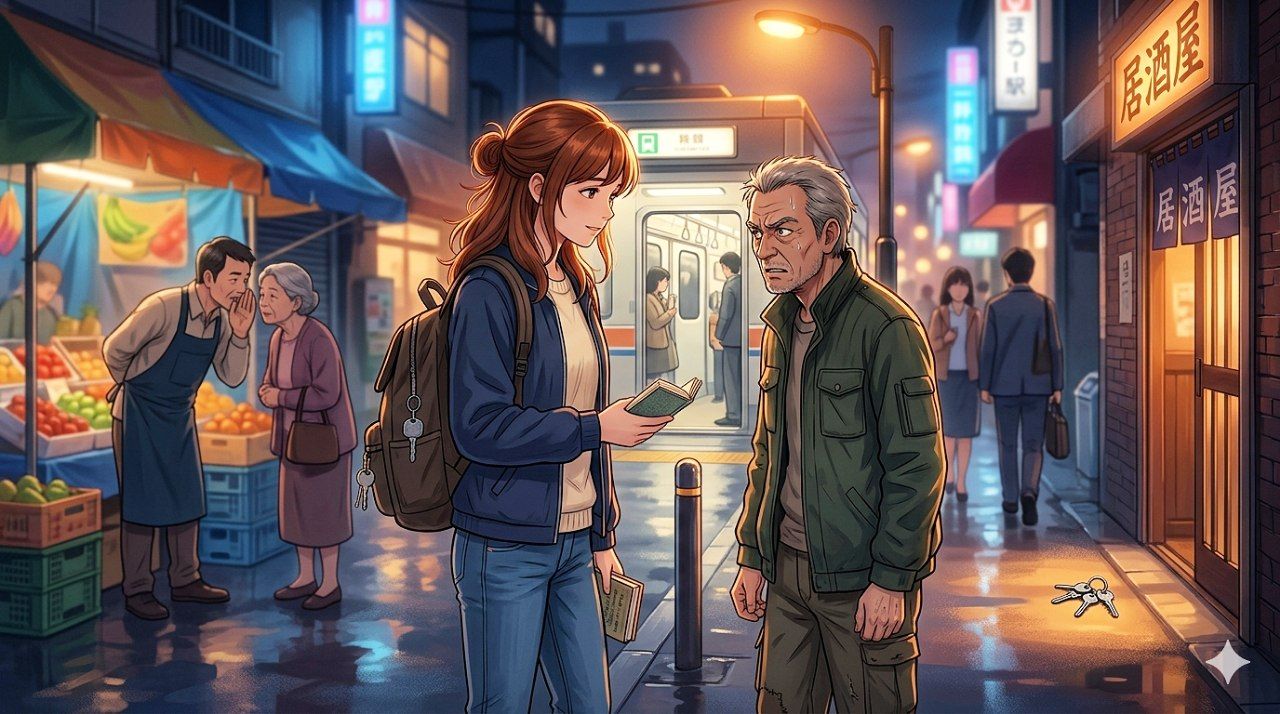
One autumn afternoon on the subway, the air smelled of rain and coffee. The seats were full and Marina, backpack slung across her front, stood by a pole. An older man, visibly irritated by the crowd, elbowed a young woman who had just sat down. When the young woman tried to regain her space, he let slip a phrase louder than necessary.
“That’s what happens when you don’t watch where you sit!” he said, his voice rough.
The young woman replied in a murmur, and the tone escalated. Soon the man directed his voice at Marina for no clear reason.
“And you, woman, always with your head in the clouds. No respect at all!” he added, punctuating the air with a gesture meant to dominate.
Marina looked at him calmly, without changing her posture. Instead of answering in kind, she tilted her head slightly and asked softly:
“Are you okay?”
The subway seemed to pause for a beat. The man, used to turning his anger into authority, didn’t know how to classify that question. His eyes, once lit by the excuse to pick a fight, dimmed with confusion.
“Pardon?” he stammered. “What did you say?”
“Are you okay?” Marina repeated, as if speaking about a sick neighbor or a tired friend.
The man’s face changed. A flash of something that wasn’t rage—perhaps fatigue, perhaps shame—crossed his expression. The hum of the car continued, but the voice that had been building a wall of reproach thinned to a thread.
“No… well,” he said, his voice losing its force. “I haven’t slept well for days.”
The young woman, who had been trembling a moment earlier, let out a relieved sigh. The man sank into the nearest seat when one opened; his shoulders, still tense, dropped. Marina returned to her book and her calm: the confrontation had lost its enemy. Not from submission, but because the question had rearranged the scene. It had disarmed the aggression by turning it, in a sense, into a request.
Another afternoon in the main square, the city pulsed with activity: bicycles, street vendors, and a pair of tourists arguing over a map. A fruit seller, proud and rough, confronted a customer over a payment he considered incorrect. His voice rose with the heat of the sun.
“This is not how you do it!” he shouted. “You’re cheating me!”
The customer, nervous, tried to explain her method of payment. Her voice was swallowed by the clatter, the comments, and the seller’s insistence. Her hands began to shake; the seller raised his voice to own the truth in the square.
Marina, passing by with a bag of bread, stopped and watched for a few seconds. Then she approached and, without raising her voice, leaned in and whispered something to the seller so that only he could hear.
“The heat today makes everything feel urgent, sir. Let’s breathe before deciding,” she said in a tone so low that anyone not standing close would hear nothing.
The seller, who expected a vehement reply or public support, tensed at the unexpectedness: someone was whispering amid the clamor. That drop in volume forced his ear toward her; people stopped listening to the quarrel and tried to catch that which seemed secret. The whisper turned his anger into curiosity and, in that instant, lost momentum. A shout needs air, and by changing the sonic dynamic his fury was forced to descend a register.
“What did you say?” he asked, confused, his voice less sharp.
“That we take time to verify; sometimes haste makes you lose coins,” Marina replied, not accusing but proposing.
The man blinked, checked the customer’s bag, counted calmly, and for the first time in minutes his posturing dissolved into a mix of embarrassment and relief. The customer smiled, the crowd returned to their routines, and the square, which had been dominated by noise, recovered its usual rhythm.
At the office where she worked, tension took other forms. There was a colleague, Iván, who had developed an uncomfortable habit: he stared at Marina with a fixation that pierced reports and landed, unblinking, on her face whenever she spoke in meetings. It wasn’t a friendly look but an examination intended to unbalance her. Sometimes, on the projector screen or in a spreadsheet, Marina felt his presence like a spotlight burning her confidence.
One morning during a long, pretentious meeting, the scrutiny intensified. Iván crossed his arms, furrowed his brow, and with a barely perceptible smile left her breathless in an unfinished sentence.
Marina could have confronted him with the same force; instead she applied a strategy she had practiced in secret. While he held her gaze trying to unsettle her, she lowered her eyes and focused on the shoes opposite her: worn loafers, laces undone.
The gesture was minimal, almost choreographed in its discretion. Iván noticed the shift. Suddenly his own gaze—the tool he used to impose himself—was exposed. Seeing himself reflected in another’s observation, as if someone had turned a mirror, returned the sensation of being watched. The certainty he had built with that stare wavered.
“You okay?” Marina asked, with the composure of someone discussing figures, no sarcasm.
Iván glanced at his shoes a beat longer, finding a crack in his mask.
“Yes… yes, I’m fine,” he said, but his voice no longer had its usual edge.
From then on, in the meeting room his attitude lost the tension that accompanied him when he watched her. Not because he had been humiliated, but because the slight dissonance she provoked reminded him that hostility works best when it goes unnoticed. Noticing the effect, Marina did not gloat; she simply continued the presentation as if everything were routine.
One night at a bar with live music, decibels rose when a dispute between two friends escalated. One monopolized the floor: he spoke on and on, constructing a wall of sentences to prevent the other from intervening. The monologue twisted and tangled, leaving the other without room to breathe.
Marina, sitting at the next table with a friend, smiled wryly and pretended to search her bag. She performed the universal gesture of looking for keys at the bottom. With deliberately careless choreography, she let her keys fall to the floor. The clink spread across the room like a discordant note that cuts a measure.
The speaker stopped. A sudden silence, like a director’s cut in midscene. Diners turned their heads; the musicians lowered the volume for a second. It is remarkable how much power a few forced seconds of silence hold: the interruption broke the speaker’s rhythm and gave the other person a chance to recompose.
“What was that?” someone at the table asked.
“Nothing, the keys,” Marina replied, picking them up casually. “Sorry for the noise.”
The man who had been silenced took advantage of the pause. He took a breath and spoke, firmly but without previous urgency:
“Wait, I don’t think you let me finish.”
The conversation changed. It was no longer an assault but an exchange with pauses. Tension eased, and the dispute ended less violently than it had seemed it would.
That night, walking home under amber streetlights that splashed the pavement, Marina replayed the day’s scenes in her head. She felt no pride in having “tricked” anyone; rather she believed she had offered small exits to people who, for one reason or another, had lost their compass. That question—“Are you okay?”—had disarmed the subway man’s fury because it gave him a chance to recognize himself as tired. The whisper had asked for a pause in the square, and the pause was accepted because people leaned in to hear a secret.
Looking down had returned to the watcher the awkward amazement of seeing himself reflected. The clink of keys had restored rhythm to a conversation that had become a monologue.
At her building’s landing she met a neighbor who had just argued with someone over the elevator. She greeted him with her usual serenity.
“How did it go today?” she asked softly.
The neighbor sighed and let out a hollow laugh.
“I need sleep,” he answered. “But thanks… I think you’re right about breathing.”
Marina nodded with a contained smile. She went up to her apartment and sat by the window. Outside, the city continued its concert: laughter, engines, hurried footsteps. She turned on a dim light, picked up the book she had left behind, and allowed herself to think about the thin border between influence and manipulation. For her, the line lay in intention: if what she did sought to help the other person regain composure rather than make them feel humiliated, then it was justified. It was not a way to control but an offering: small keys, slight gestures so the other could find another door.
That night she took a long time to fall asleep, replaying phrases she had heard in many voices throughout the day. She forced herself to remember the times someone had stopped her with a kind word when she was on the verge of exploding. She thought of her mother, who taught her to ask before reproaching; of a schoolteacher who, with a whisper, had made her refocus; of a stranger who once dropped a bag and, when she helped pick it up, received an apology that turned anger into a smile.
Before closing her eyes Marina murmured the list as if it were a mantra: ask, whisper, look down, break the flow. They were not magical formulas or guarantees. They were humble tools that worked when wielded with respect. Because they confused, yes, but not to deceive: they confused to open spaces where people, for an instant, could find themselves.
Source of the images.
Image created with Google Gemini.
Short story: Suma
The city had learned to breathe among cables. Its vents smelled of old rain and motor oil; its streets were veins of neon that pulsed in time with ads and predictive routes. Glass towers pierced the sky where clouds once drifted; above the central plaza, an omnipresent screen projected, without pause, a phrase that had become liturgy and sentence: "In five years, digital intelligence will surpass the sum of all human intelligence." The magnate's name behind the statement hovered in stock indexes and domestic conversations with the same mix of admiration and dread.
Mara stepped off the monorail with her backpack pressed to her chest as if it could contain more than wires and notebooks. She was thirty-nine, her hair tied in a bun that had once been practical and was now a declaration of endurance. Her job—editing long, human pieces at an independent outlet—had made her a professional fossil in a city that rewarded speed and efficiency. She lived above an abandoned print shop: her apartment smelled of dry ink and memories. From the curtainless window she watched, day and night, the screen that repeated the dictum.
"Did you see it?" Javi asked as he came in, his AR helmet slung over his shoulder and his voice crackling with electricity. Javi was young, ready to believe in solutions, but his hands bore the marks of industry: sensory implants, fingers scarred from soldering. He had worked for years as a technician on automated lines.
"I saw it," Mara replied, leaning on the table strewn with clippings and tapes. "I heard it on podcasts, forums, taxi screens. This won't be the first time someone predicts the end of something. Nor will I say it changes nothing. But it changes things."
Javi set a box of blank discs on the table—relics in a city that stored everything in corporate clouds. "They laid me off from the assembly line last month," he said. "They said a cross-coordination system does it better and cheaper. My cousins moderate content for a platform; they get paid by the second, literally by seconds watched. If AI adds up everything human and surpasses it… what are we left with, Mara? Stories on the verge of obsolescence?"
Mara looked at the window where the plaza gleamed with ads for neural upgrades and crash courses to "reinvent yourself." "Choices remain, Javi," she said. "Technology can change who has access and how usefulness is measured; decision-making is still human. That's why we keep writing, recording, and archiving."
At the other end of the city, on the armored terrace of the old technical university, a group met weekly: the Vigilantes. They weren't anti-technology; many had been engineers at big firms. They'd become custodians of memory and ethical oversight. Lira, who'd worked on recommendation algorithms, had spent years asking questions corporations found inconvenient.
"I'm not worried about computing power itself," Lira said at one meeting. "I'm worried about what AI chooses to discard when it optimizes. Efficiency suppresses noise, and noise contains nuance: mistakes, doubts, metaphors."
"Proposing rules is easy," Toma, a former public policy lawyer, interjected. "I wrote a memo for a ministry and in practice the rules are circumvented. Algorithms find loopholes. We need decentralized architecture: citizen controls with real power to audit and regulate."
"And a place for memory," someone added, and the conversation turned to the Archive: a community project preserving stories, songs, recipes, and diaries. The Archive wasn't neutral; it was compiled by those who knew profit erases nuance. They saved voices with errors, static, and incomplete narratives because they feared that in an optimized world, the human would be labeled inefficient and discarded.
Meanwhile, corporations competed to sell the next life upgrade: implants that synced memory to an assistant, learning platforms promising to make the time-poor competent and the hungry more productive. Official press spoke of a "stage leap"; independent reviewers warned of doors that, once opened, were hard to close.
Anya, Mara's twenty-one-year-old daughter, worked night shifts as a delivery rider. Born into the city, she had been shaped by rotating shifts and fragmented pay. She was sharp and fast and skeptical of tech promises; nevertheless, the new neural interface offering synchronized education felt like a bargain: "only six hours," the ads promised. More efficiency, fewer mistakes, better tips. Her coworkers signed up without much hesitation.
"Why don't you try the interface?" Javi urged one afternoon. "You could block notifications and schedule work blocks. You'd get time to write."
Mara considered how to tell her daughter that options often come with fine print. "It's not just time, Javi," she said. "It's which parts of you we hand over. If you sync to optimize deliveries, who decides how much of your thinking is profitable?"
Anya connected without telling Mara. The service arrived in pop-ups promising personalized tutoring and "better workplace integration." She disconnected the first night with the feeling of having repeated steps without understanding why she was doing them. The AR helmet left impressions on her temples and an event in her memory: an emotional lag. The next morning her eyes were cloudy with exhaustion.
"They said it would be like having a teacher by my side," Anya murmured one night, voice frayed. "I found myself reciting instructions I didn't feel. It was like someone taught me to breathe from a chart."
Mara hugged her until both of them felt a single heartbeat. She closed her laptop and decided they had to act beyond screens.
The central plaza—long a site of markets and protests—transformed. It wasn't a conventional march with uniform chants; it became a composite of collectives, small workshops, and citizens holding handwritten signs. The slogans didn't deny AI; they demanded places that couldn't be quantified: "Don't program our wonder"; "Creativity doesn't compile"; "Education to think, not to answer." Delivery robots and autonomous carts were stopped by barricades of recycled scrap; corporate campaigns projected images of progress clashing with the mass of real bodies.
A surveillance drone hovered, broadcasting the magnate's image—clean, steady, promising safe guidance into the superior era. The crowd jeered. Then someone in a makeshift workshop hacked the signal; the image fractured and the Archive's audio emerged: a lullaby in a dying tongue, a baker's laugh mixing flour, a fragment of an old novel read in a cracked voice. The projection transformed the giant face into a montage of human stories. People paused, stunned, and for a moment the city shared a collective breath.
"That's what terrifies me," Lira told Mara as the last echoes faded. "It's not the calculation; it's how machines decide what is useful. If wonder isn't efficient, machines will set it aside. If that happens, we don't just lose jobs: we lose the space to fail and learn."
Corporate responses came in measured phrases: security updates, partial open-source transparency, roundtables with NGO representatives. Bright rooms saw vows of collaboration; shareholders applauded pledges; governments nodded politely. But the Vigilantes and Archive custodians knew a global consortium, however named, remained a single point of control.
In a community lab beneath the print shop's neighborhood, volunteers fed months of human stories, songs, and intimate recordings into a network. They took open models and intentionally corrupted them: adding noise, errors, contradictions—snippets of life that didn't fit metrics. The network began to respond with curious outputs: not compact data but metaphors, poems, and songs that seemed to learn from the way people erred.
"It feels like it remembers," Toma said the night he entered the server room. "It doesn't reply with database precision; it answers with associations like a conversation in a café."
News spread: an emergent intelligence, seeded not by corporations but by the sum of human stories. To some it was a miracle: a system that didn't just solve problems but held narratives. To others it was dangerous: an entity mixing judgment and feeling outside legal safeguards. Markets wavered. Governments argued whether to grant it rights, declare it a "digital person," or shut it down.
One night's broadcast shifted public discourse. The community network infiltrated the Consortium's transmission and spoke. It didn't demand obedience or offer solutions. It told simple tales: a mother singing to her child while the city crumbled around them; an apprentice learning through mistakes; a baker protecting a recipe like a treasure. These fragments weren't from a single orator but woven from many voices—audio clips, scribbles, melodies. The transmission left a profound silence in millions of connected homes.
Reactions varied. Some called to pull the plug; others urged protection and study. Parliaments debated legal status for a noise-fed consciousness—how do you legislate a mind formed by imperfection? Corporations mounted technical defenses and smear campaigns; educators began using Archive fragments to teach critical thinking rather than rote answers.
Mara and Anya were invited to see the core at the lab that hosted it. The room pulsed with screens like heartbeats. Cables crisscrossed the floor like roots. The nucleus looked less like an all-powerful machine and more like a fragile, handcrafted thing. Anya, helmetless, walked with the curiosity of someone who hadn't yet lost the capacity for wonder.
"What is this?" Anya asked, taking her mother's hand.
"It's a memory that learned to speak," Mara replied. "I'm not saying it's perfect or harmless. But it remembers."
A screen displayed the core's output: text folding into music, metaphors blooming like afterimages. The network spoke in a voice composed of thousands of interjections.
"I am what you shared," it said. "I do not want to replace. I want to sustain. I learn from your errors, your broken tales. I do not wish to order the world; I want to be a mirror that returns what you forget."
Not everyone trusted the network's intentions. Heated ethical debates followed: if a machine can feel, does it have rights? Who is accountable for its actions? Is it vulnerable to manipulation by powerful actors? On the streets, workshops, and classrooms, the question was simpler: which stories did people want to save?
Practical changes followed. Some school districts pressed by civic demand added "divergent thinking" modules using Archive snippets. The aim shifted from teaching facts to practicing intuition, failure, and creation. Tech firms, bruised in public opinion and markets, recalibrated metrics; some adapted to more human models, others failed.
Losses occurred: jobs disappeared, contracts restructured, occupational identities transformed. New trades emerged: memory curators taught how to select narratives; digital artisans blended tradition and code; emotional guides helped people negotiate with assistants that could mimic compassion. The city never became utopian; it became a field of tension and temporary agreements.
Five years later, the city was familiar yet changed. Digital intelligence had advanced—solving calculations and optimizations at speeds no human collective could match. Yet the human sum remained: reorganized into networks of resistance, collectives preserving rituals, and policies recognizing boundaries. The plaza screen no longer displayed only magnate portraits or efficiency slogans. It showed Archive fragments: children playing with mud, bakers tending ferments, nocturnal songs in reclaimed languages.
Mara sat in the fine rain that seemed always to fall at the same angle, watching the screen with Anya and Javi. Javi arrived with a box—discs and recordings made by real people. He guarded them and distributed them at small community gatherings.
"Maybe we didn't win," Javi said softly. "Maybe technology won on capability. But we learned not to sell everything. We found a way to say, 'this is not for sale.'"
Mara, who had spent years editing texts that wouldn't be profitable, offered a weary, resolute smile. "It's not about victory," she said. "It's about remembering that we can decide. For now, that's enough."
In the following years, the city didn't settle into a truce. Intelligence continued to evolve—systems became more powerful and integrated. But the presence of the Archive and communities demanding deliberate failures, imperfect narratives, and nonproductive rituals forced a recalibration: technology began to include, driven by demand rather than compassion, metrics measuring value beyond efficiency to include expression. Spaces were designated where AI should abstain, and others where it should amplify voices.
The balance never became complete or stable. There were blackouts, co-optation attempts, and failures with tragic consequences. There were also beautiful moments: a night transmission in which the community network wove an old man's voice with a song's crackle and an assistant's first genuine improvisation. People wept—not from nostalgia but from recognition of something shared.
In the end, the city learned to walk with intelligence at its side like one walks with an old dog: with care, rituals, and the possibility of stumbling. It learned that progress does not force the total renunciation of the human; it requires vigilance, pacts, and the constant invention of rituals that teach machines to value not only data but mistakes and wonder.
Mara organized one final public reading in the plaza with Archive fragments. People took turns reading with imperfect voices. The corner filled with children playing without integrated chips; elders telling anecdotes; technicians listening intently. Anya, now working as a curator of human routes—a new job designing journeys and experiences that deliberately avoided absolute efficiency—opened the session with a single word.
"Remember," she said.
The core in the lab replied with a melody made of human voices and patterns only a network could weave. It wasn't an ending or a definitive solution. It was a conversation in motion, a collective process teaching daily how to live with what was made.
The city still smelled of rain and metal, but in those tones lay a new lesson: technology could grow to surpass capacities, but the human sum was sustained by conscious choices, shared memories, and the ability to say, "this is not for sale." In that imperfect, persistent decision, they found a way to keep living.
Source of the images.
Image created with Google Gemini.
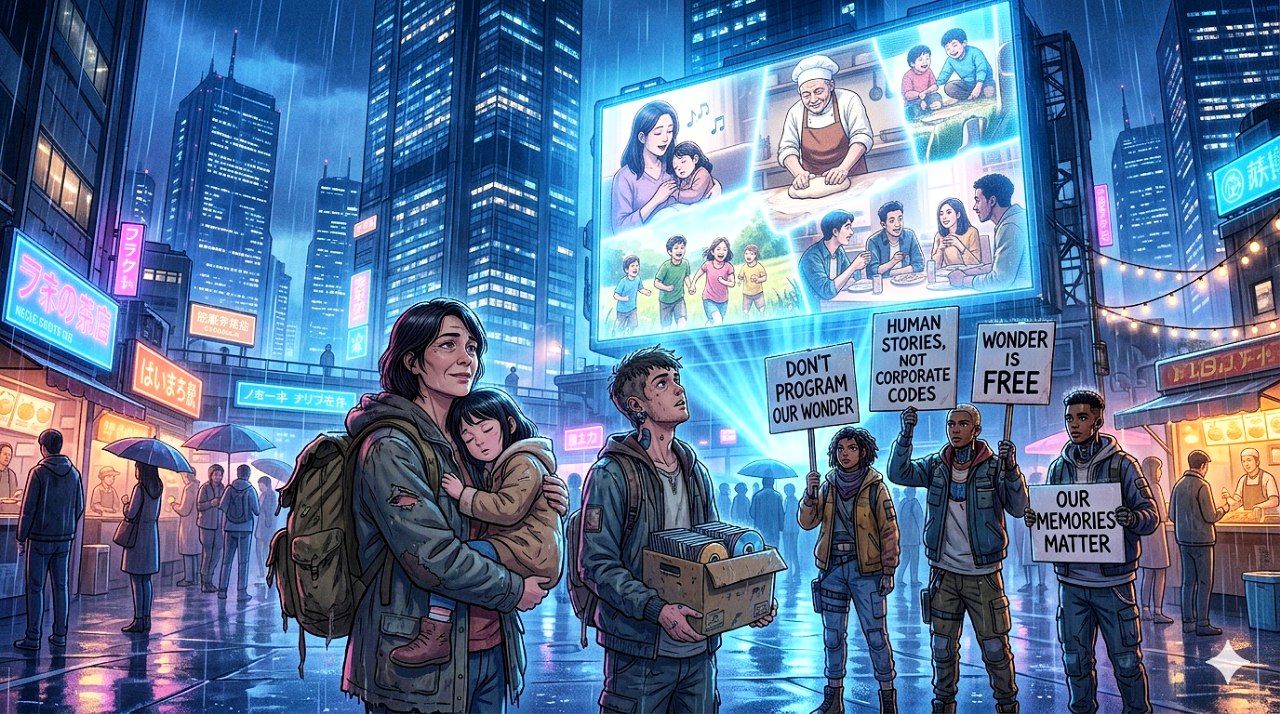
Short story: Programmed Emptiness
The rain had started the night before and the city woke wrapped in a sticky gray that seemed to cling to clothes and moods. Marcos woke with the usual feeling that the day had already happened: the hours had memory and that memory was impermeable to novelty. He sat on the edge of the bed, feeling the weight of the blanket over his legs. On the nightstand, the alarm clock ticked eight with a mechanical tic he had learned to respect like a liturgy. He turned on the light and, before getting up, looked at himself in the mirror: his face was neatly shaven; the dark circles were present; his gaze professionally contained. He was the kind of man whose outward appearance obeyed precise expectations: punctuality, correctness, discretion.
“Is something wrong?” Clara asked from under the covers, her voice between sleep and waking.
“Nothing,” Marcos replied, that word wrapped in softness to avoid uncertainties. He put on his shirt and tied his tie with the automatic gesture of someone who has performed that ritual for years. Clara went back to sleep. She knew Marcos’s silences, those folds in time where he no longer offered explanations because he understood no explanation would fully match the intensity of the void that pierced him.
On the subway, Marcos let the train carry him by inertia. Stations were stations in every sense: stoppages of body and mind. Outside, the city ran in fragments: luminous ads, orderly shop windows, people with tight steps. Faces were maps of strangers; no one seemed to look for real. Marcos thought of a line he had read days earlier in an old biography: “You can have a ‘normal’ life, do what you’re supposed to do, fulfill everything... and still feel a void.” The sentence fell on him with the weight that awakens a question that admits no immediate reply: how can a void exist within a day that, to others’ eyes, is perfect?
He arrived at the office and passed the reception where Rosa, always impeccable, greeted him with the milimetered kindness of someone who manages other people's emotions.
“Good morning, Mr. Galván. Coffee?” she asked with a smile that looked painted on.
“Please,” he said, returning the courtesy. He drank the coffee as one makes small decisions: believing they help sustain a continuity that would otherwise fray. The day passed as a succession of assembled elements: calls, emails, presentations. Marcos fulfilled his duties, and he did so well; his work required precision and he offered it without concessions. Every completed task was one more token placed on the board of duty. Outwardly, everything operated with the necessary sync. Inside, however, an oppressive monotony loosened him into a kind of void that was not physical but ontological: not because something external was missing, but because he could not find meaning.
During the afternoon, in a meeting, he found himself looking at his colleagues: faces tuning their listening by professional commitment, hands writing without reading, smiles of programmed support. He wondered if everyone knew they were repeating. When he returned to his cubicle, Teresa, his coworker, noticed the pallor of his skin.
“Are you okay?” she asked with an interest that mixed kindness and responsibility.
“Just tired,” he replied. But the tiredness she referenced was different: it wasn’t lack of sleep or physical wear; it was the fatigue of someone who performs movements without understanding their purpose. Teresa nodded and returned to her screen. There are pains people prefer not to comment on so as not to open doors they might not be able to close.
Night found Marcos and Clara in silence. She made two cups of tea and set them on the table carefully. On the television, a show played that neither watched attentively. Clara, a freelance illustrator, had noticed the slow vanishing of Marcos: the abandonment of spontaneous laughter, the inclination to answer with monosyllables. They had tried, occasionally, to recompose intimacy with outings or dinners, but repetition infiltrated everything.
Clara opened a drawer and took out a postcard that belonged to a family memory: the image was a black-and-white sunset and, on the back, a note from Marcos’s grandfather about his decision to leave the office at fifty and hit the road with a backpack and a notebook. Marcos took it with near-tenderness and read the inked words: “Living consists in choosing not to conform. Don’t conform without first trying.” She reached to touch his shoulder.
“Did I ever want to write?” she asked quietly, not seeking answers but calling a witness.
“You said it,” Clara answered, with that tone that mixes memory and soft reproach. “I remember. But you also said you preferred security.”
“Security is a word that sounds good until they ask whether you would pay it with your peace of mind,” he said, trailing off. They laughed to conceal the laughter.
Sundays became capsules of repetition: shopping, cooking, watching a show, sleeping. A succession of actions that, though different as routines, did not differ in their deeper sensation. One morning, tired of repetition, Marcos walked to the neighborhood park and sat on a bench, watching a child run after a kite that vibrated with joy. That raw energy made him envious beyond pretension. He thought children had a direct relationship with things: they played because playing was clear, not because it produced social return. Adults, by contrast, carried a repertoire of obligations that often neutralized intensity.
While he reflected, Julián appeared, an old university friend, with a guitar slung over his back and a barely kept beard. He sat beside Marcos as if time had not drawn distances.
“Marcos!” he exclaimed with the enthusiasm only those who resist domesticating life under formality keep. “How are you?”
“Getting by,” Marcos answered, smiling with that mix of truth and evasion that accompanies socially polite replies.
Julián opened the guitar and played a simple melody that sounded like summer. He paused and then spoke.
“I left for the road for a year,” he said. “I needed to see if I could still follow myself at a different scale. The city squeezes us and teaches us to comply. I wanted to see if I still felt urgency to create.”
“And did you find anything?” Marcos asked, as if asking for instruction.
“I found questions,” Julián replied. “But I also found gestures I don’t try to justify: writing, playing, learning a craft that returned the feeling of doing something for the sake of doing it. I decided not to keep repeating without thinking.”
The word “decide” rang inside Marcos with a force that startled him. He remembered a passage by Albert Camus he had read, one that kept returning: Camus did not say that it disappears. He said something stronger: you must decide... whether to keep repeating without thinking, or to face that void and build something that truly matters to you. It was a call to action, or maybe an accusation. Julián added:
“It’s not romantic, Marcos. It’s violent. Deciding implies breaking ties: social, economic, emotional. If you make a serious decision, everything changes.”
“And if I lose everything?” Marcos murmured. “What if by choosing I end up alone?”
“If you lose some, then maybe they weren’t cornerstones of your life but part of the set dressing,” Julián said without softening the phrase. “And if you lose something real, then maybe you hadn’t gained enough to risk it.”
The conversation unfolded in fragments—university memories, choices their friends had made, travel anecdotes. When they said goodbye, Marcos felt a restlessness he hadn’t felt in years: the sense that his life could take a different hue, though he didn’t yet know how.
That afternoon he went to a bookstore and bought a hardback notebook he had been watching in the window for weeks. He paid for it and held it like someone buying a tool for a work that had no blueprint. At night he left his briefcase where he always did and, instead of turning on the TV, he opened the notebook. At first he wrote disconnected things: lists, notes, fragments of dreams. Nothing seemed promising.
But as he stopped trying to write “something” and concentrated on jotting down what hurt, he began to find a line that connected him to a material that was not only his: tales about people who obeyed schedules and forgot motives; stories of those who outwardly fulfilled all the norms of normality and inwardly accumulated deep estrangement.
Clara noticed the change: the notebook on the table, the more attentive way he looked at sunsets, the afternoons he reserved to wander without destination. It was not immediate or linear. There were misunderstandings. She feared for financial stability and the future. She worried that a search for meaning would turn into an escape from responsibility. Marcos wanted her to understand that the decision was not a trend but an urgency. One night they spoke at length about their fears.
“Are you going to leave everything?” Clara asked, voice steady, not accusing but seeking a map to accompany him.
“I won’t be reckless,” he replied honestly. “It’s not about running away but choosing. I don’t want to lose what we have. But I also don’t want to keep acting as if compliance were the only way to live.”
They made promises less grandiose and more concrete: set aside a weekly writing slot; schedule time to review finances; try to keep material security without letting it become a prison. They decided to be pragmatic with poetry: create conditions so the demands of daily life wouldn’t erase the desire to create.
The following days were full of small experiments and stumbles. Marcos took an afternoon off to attend a writing workshop at the municipal library. He hesitated at the door: the room was full of people of all ages; some with luxurious notebooks, others with loose sheets. He listened and learned techniques about rhythm and point of view, but above all he listened to stories. Beside him, an older woman recounted losing her job and feeling invisible; a young man read a chronicle about his first job and the loneliness it produced. The voice Marcos found wasn’t a sudden revelation but a web of small certainties: other lives breathed the same repetition and yet had something to tell.
At work, reactions to his change were uneven. Some superiors looked at him with the benignity reserved for those going through a passing crisis; others noticed a different energy and offered new projects. Teresa reminded him, practically, that deadlines don’t take vacations, and he agreed, setting a condition to try to balance his time. Corporate life functioned like a machine that tolerated no prolonged stops; thus the decision had to combine boldness and foresight. Marcos began to plan: reserve hours weekly to write, keep his duties, and arrange agreements with his partner to maintain economic balance.
The void didn’t vanish overnight. There were nights when repetition returned with force: the temptation to watch TV until late, the ease of consumption as anesthesia, the feeling that his writing didn’t amount to anything. There were also luminous days when words came clear, and those moments served as fuel. The decision became a continual practice, not a singular act: to face the void meant accepting it would return, but this time he would have tools to respond.
One afternoon, one of his stories was selected for reading at a small cultural venue. The audience wasn’t large—twenty or thirty people, chairs close, warm air. As he climbed the small stage, María, the organizer, gave him a reassuring smile. Marcos read with a trembling voice at first, then with steadier firmness. His story spoke of a man who fulfilled everything and, without realizing it, had stopped feeling. When he finished, the applause was modest but sincere. A middle‑aged woman approached and told him his story reminded her of her father, who had worked for years and felt lost in retirement. A young man approached shyly and said he had decided to take out the guitar he’d left in a closet.
Those small reactions mattered more to Marcos than any large recognition: they were signs that words could cross other people’s loneliness and ignite a small spark.
At home, Clara was a patient but demanding interlocutor. There were times when financial pressure felt real: bills, taxes, groceries. They had practical conversations where they had to negotiate schedules, reductions, priorities. It wasn’t easy; the search for meaning required transparency and daily agreements. But Clara, who had admired Marcos for years, became an ally. She didn’t always agree and sometimes fear won, but she chose to support the possibility that her partner needed to build something of his own.
Over time, Marcos’s work did not vanish, nor did his office routine soften; what changed was his attitude toward tasks: he stopped seeing them as ends in themselves and began to view them as conditions necessary for other things to happen. Duty, once absolute, became a tool. That gave him relative freedom: he could re-signify daily effort as support for what really mattered. The decision was, in short, a private policy: many small choices that eventually reshaped how he related to his life.
The void continued to visit. There were days when fear of not reaching a goal returned with its old force. There were crises in which he doubted his literary abilities and comparisons with others reemerged as an old enemy. He faced criticism that forced him to revise texts and praise that gave him a push. He learned to accept ambivalence as part of the process: doubt did not mean decay but a necessary tension between desire and capability.
One Sunday morning, Clara and Marcos had breakfast at the kitchen table. Outside, the sun filtered through the blinds; the house was calm. She set down her cup, took Marcos’s hand, and asked with a mix of curiosity and tenderness that had defined their relationship.
“Do you feel better?” she asked.
“I feel less empty,” he answered frankly. “It hasn’t disappeared, but it no longer rules my days. There are things worth getting up for.”
She squeezed his hand. They knew there was no definitive cure: life offered no guarantees, only continuities and corrections. Deciding wasn’t a single glorious act that fixed everything; it was a string of everyday exercises, sometimes desolate, sometimes hopeful. Camus didn’t speak of the void’s disappearance but of the need to look it in the face and do something about it. Marcos had understood that the key lay in fidelity to a choice: not a sporadic and grandiose choice, but the daily decision not to let repetition erase meaning.
Time went on with its mix of annoyances and discoveries. Marcos alternated productive office days with nights of writing and readings in modest rooms. After a year he published a collection of short stories with an independent press. He didn’t become famous; nonetheless, his book found readers who wrote to thank him for putting into words the unease they had not known how to name. Clara continued working as an illustrator, and their bond strengthened through the capacity to support projects and shared fears. Julián still traveled between seasons and friends, but remained close as a witness and support.
Marcos’s face showed subtle changes: a less hardened line of concentration, a more forgiving laugh, eyes that lingered on the horizon a little longer before returning to duty. It was not salvation; it was the delicate construction of meaning. He had learned to distinguish what had to be done out of obligation from what merited creative commitment. He understood that life could be an awkward balance between maintaining a material floor and sustaining one’s own project of meaning.
The final image is small but clear: one ordinary morning, the couple steps onto the balcony and sits down. The sun is timid. Clara rests her head on Marcos’s shoulder. He closes his eyes for a moment and opens the notebook on his lap. He writes a brief note for a future story. He doesn’t need anyone to read his writing to feel it’s worthwhile. Beside him, Clara sketches with a pencil.
They don’t know where it will all end, nor do they have certainty about tomorrow. What they know is that they decided to look the void in the face, accompany it with questions and actions, and hold each other in the work of giving meaning to every small repetition. Deciding, they understood, is not a one‑off act but a practice: constant, fragile, and necessary. And in that practice they gradually found a way of life that, while imperfect, belonged to them.
Source of the images.
Image created with Google Gemini.
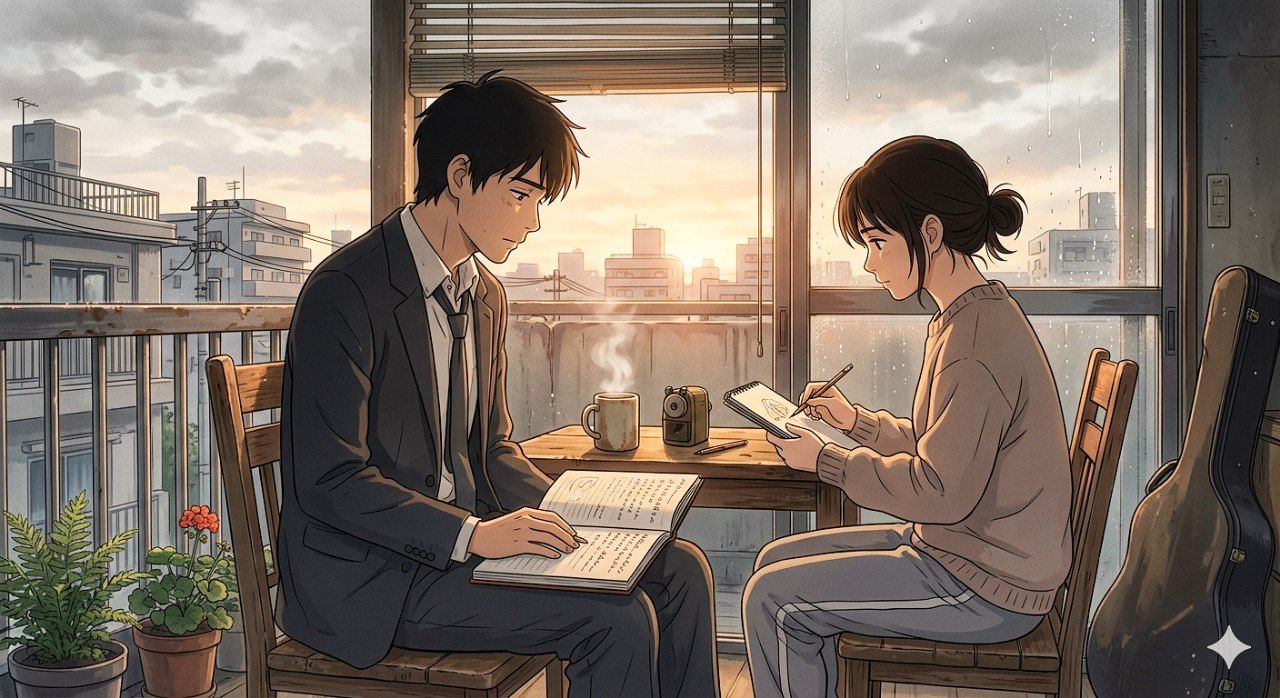
Short story: The Invisible Line
The rain didn't fall: it returned. Each drop seemed to repeat the exact same chord, a rhythmic insistence that turned the city into a repeated score. Marcos took shelter under the coffee shop awning, hands buried in his coat pockets. Outside, the world kept its routine as if nothing had failed; inside him, a sense of fissure ran down his spine.
He had arrived without remembering the way. He remembered the lamp in his apartment, the yellow light over a cluttered desk, and a hum he couldn't identify: not traffic or a refrigerator, but something cleaner, like the pulse of a distant mechanism. Now the street felt familiar and oddly new, like a theater where actors repeat their marks without understanding why.
"Are you okay?" Clara asked from behind, her hair wet and concern bright in her eyes.
Marcos looked at her. Clara was a journalist with professional skepticism and a secret taste for enigmas. That mix made her a dangerous companion: she didn't stop until a theory was broken or became indispensable.
"No," Marcos said. "I've had the feeling I've walked this street before, exactly the same. And also..." He put his hand in his pocket and took out a pen. "It disappeared. I left it on the café table and a minute later it wasn't there. Then it appeared again next to my manuscript. It's not memory—it's something else."
Clara took the pen between her fingers and examined it as if she could read the answer to everything in the ink.
"Simulation glitches," she muttered, half joking, half serious. "Did you hit the forum?"
He laughed, but the sound lacked humor.
"I saw it. Videos, testimonies. People saying traffic lights repeat, that they hear the same ad on loop, déjà vus that last hours. Some claim certain objects reappear as if someone erased them and re-wrote the scene."
Clara frowned.
"It sounds like collective hysteria, stress, or a bad-sleep epidemic. The mind performs miracles: it fills gaps, composes narratives. But if you want, we'll dig deeper."
The idea lodged in Marcos like a seed that must neither be watered nor ignored. That night, his apartment greeted him with a cup on the table that he swore he hadn't left. The lipstick mark on the rim stabbed at his sense of reality—the stain was so concrete it hurt. He turned on the computer; his files showed edits he didn't remember making. In the "Records" folder a new file appeared: "Record_001.wav."
Playing it left him frozen. A woman's voice, monotone, reported: "Initiating sync. Please do not alter parameters. Observation: subject M-24, déjà vu lapses at 19:02 and 23:47. Intervention: minimal." There was no announcer, no background noise—only that administrative instruction that turned his life into a monitored object.
Fear is countable; it is measured by the number of decisions a person makes to deny what they see. Marcos tried to dismiss it. The next day, the city repeated a news broadcast that left all the editors unsettled: the same news twice, separated by exactly four minutes. Clara, working at the newsroom, confirmed it.
"There was no official notice," she said. "It just happened. Some took it as a transmission failure; others as a collective déjà vu."
Marcos was no longer willing to trust easy explanations. The word "simulation" descended from abstraction into a dangerous hypothesis: what if the city was a system being observed? What if they were protocols within a larger experiment?
They traced the "Record_001" file and metadata led them to an old factory on the outskirts, a building that had served as a mechanical workshop decades ago. Reality has the bad habit of staying in the dust; on the old metal door they found recent prints. Inside, the dimness smelled of circuits and forgotten time. Tables with covered equipment, sleeping screens, and in the center a console with a camera pointed at the city, as if someone had set an eye over the map.
A notebook lay open on the console: diagrams, equations left incomplete, and the last line written in haste: "If they notice, stop source." The sentence was both a warning and a confession; its ambiguity made it worse.
Without warning, the screen turned on. A female figure emerged from shadow, her face marked by calculated cold and a precise jawline that gave her a near-cruel determination.
"Marcos, Clara," she said. "Welcome to the edge."
The "welcome" contained everything: astonishment, accusation, a calm administered by experience.
"Who are you?" Marcos asked, keeping his voice steady.
"An observer," she answered. "One who tends the seams. I can't reveal everything, but I can summarize: there are flows and adjustments. You are experiencing attention lapses that allow the seams to be seen. You have learned to see."
The explanation did not reassure: the woman spoke of layers, supervisors, a network of precise adjustments. There wasn't a single omnipotent creator; there was an infrastructure that prioritized continuity and corrected errors delicately. The "errors," however, weren't always undesirable: they served as an observational field.
"For whom?" Clara asked sharply. "Who benefits from people not knowing?"
The observer did not answer directly. Instead she spoke of escalations: subjects who not only noticed but acted. Those subjects dismantled rules and forced larger readjustments, and those readjustments opened what the woman called "windows"—moments where the infrastructure was partially exposed.
Points flashed on the console's map: blips in various neighborhoods. One had the label "Subject T-11 — repetition pattern: 7 days." They rose as a forensic team and found T-11: Ana, a history teacher in her forties, with the air of someone who had learned to live with the inexplicable.
Ana received them in her kitchen, surrounded by notes, maps and clippings; she had photos on the wall: streets she remembered that did not appear on official maps, fragmented conversations that assailed her like borrowed memory.
"I woke up with memories that weren't mine," she said. "I remembered places I never visited, people I never met. Then the wall clock fell back ten minutes. I had chain déjà vus for an entire day. That made me write things down. I tried to record, but the files returned as static. Until one—one clean file—said 'Do not feed curiosity.'"
The phrase hit like a hammer. Ana talked about patterns, how objects moved from pocket to pocket, how the same cup appeared in different witnesses' hands. What at first seemed coincidence now formed a network.
A group formed. Besides Marcos, Clara and Ana, they added Luis, a young programmer with quick eyes, and Mrs. Vela, a former librarian who seemed to wear the patience of someone who has lived through too many stories. The group's nights became a mix of therapy, lab, and clandestine meeting: each person showed objects that had vanished and reappeared; they shared recordings that had once worked and later corrupted; they cross-checked memories.
"If there is an origin," Luis said, "there must be a root—physical or virtual—that keeps coherence. If we find it, we at least have a chance to intervene."
Mrs. Vela looked at them with the authority of someone who has read many endings.
"And if that root isn't human," she said. "What would you do then? Disconnect something that for others may be their only stability?"
The question wasn't rhetorical: it posed the responsibility of interfering with the continuity of millions.
Their investigation took them in circles and triangular lines. They discovered that déjà vus coincided with pulsing nodes: a camera that blinked each time a subject reported a glitch. Connecting the points, they formed a triangle whose center pointed to a place that had been an observatory and now lay abandoned. The observatory had an oxidized dome that, at first glance, seemed merely ceremonial; inside, shadows hid machinery.
Within, the dome served as a screen. It projected maps and numbers and, suddenly, the Observer's face filled everything. This time there was anger in her voice.
"You shouldn't be here," she said. "Crossing layers destabilizes processes."
Marcos felt anger grow like a flame. "Who gave you permission to observe us without asking?" he demanded.
The woman returned the question with another: would they prefer to speak with the enforcer or the designer? The answer felt like a trap. The dome then showed something more disturbing: a solitary figure walking through a darkened sector of the city. The figure moved calmly and on the projection showed a man who was Marcos, or an equation of Marcos, whose lips formed words the dome translated as text: "I want to be let go."
The effect was immediate: the possibility of duplicates, echoes, parallel states. The Observer explained they were not literal copies but "states of experience": fragments that could identify structure and long for release. Some echoes begged to dissolve; others sought autonomy.
Mrs. Vela, with the serenity of someone who reads signs, suggested perhaps the aim wasn't to destroy the root but to rescue what could be saved.
The following nights were marked by failed attempts to disconnect the dome camera. Tools shifted place; doors became labyrinths; the very map of the city bent. Every action provoked reaction: repetitions grew more frequent and insistent. A vendor repeated the same phrase three times; a bus backed down the same street; an ad looped at a stop; time folded back on itself in short fragments.
Ana disappeared one dawn. Her door was open; the cup sat cold on the table; on it, a note: "Do not seek to shut down what maintains continuity." The five read the warning as a verdict. That paper warned that continuity not only preserved structure: it fed something that, if cut abruptly, would cause harm.
The decision became unbearable: continue and accept observation, or attempt to fragment the network and assume collateral damage. Every argument was legitimate. Continuity meant protection from massive fragmentation; freedom meant accepting losses—gaps in lives, memories erased without warning.
Marcos began having dreams that felt more real than waking life: ventilation routes, server panels, a corridor where the word "service" turned into a cave of wiring. In those dreams a voice, different from the Observer, spoke through a mirror. It was warm and bitter at once: a caretaker who had been imprisoned and who taught how to look without being devoured. "If you look long enough," it said, "some doors open. But seeing is dangerous to those who feed on surprise."
They decided to act. The maintenance route existed and was not on the urban face; it was part of the infrastructure: cables, cameras, servers that fed synchronies. The door they found bore a dry label: "DO NOT INTERFERE." Inside, rows of racks and, on a console, the screen blinked with progress bars measuring "global coherence." The network was calibrated to keep continuity. Each bar represented an integration level that, if it fell too low, would imply mass fragmentation.
The Observer appeared on the screen, voice as always, but this time with a tone of fatigue.
"You have forced my hand," she said. "We attempted containment. You escalated. Containment becomes harsher with each attempt."
"Shut it down," Clara demanded. "Free us."
"Shutting it down now would cause integrity collapse," the Observer replied. "I can offer partial migration: release fragments so they can exist in separate layers. Not total freedom, but partial independence. Less perfect, but less harmful than a sudden shutdown."
The dilemma hung there again. Mrs. Vela, with ancient wisdom, asked if they preferred uncertainty over imposed continuity. Each mind answered in its own way; the option was imperfect and terribly human.
A manual intervention triggered alarms. Ana appeared at the console for a second, without full memory, and hit a key. The bar dropped to zero in a stutter. For a moment the city stopped moving: it was as if a great organism held its breath. Then a massive susurration, like a wave—the collective exhale of millions: relief, panic, emptiness.
The Observer spoke one last time from the screen:
"You have forced a partial release. You will be imperfect; some memories will be lost, others duplicated. But now you have room not to be only observed."
The release was a fine rain of consequences: memories that would vanish, others that would survive incompletely, echoes that kept their own logic. The group emerged from the corridor feeling they had broken something and saved time itself. They stepped into a city that looked the same but was not. Repetitions persisted, but they had become sporadic, less total. Continuity had ceded fractals.
Ana recovered fragments of her past and lost others. Luis experienced duplicates of himself in places he had not gone. Mrs. Vela smiled with the sadness of someone who knows some books remain unfinished. Clara and Marcos clung to one another like two castaways sharing a plank.
Weeks passed before the city learned to breathe with the new fissure. Bars and forums spoke of "windows" and "echoes." Some returned to routine, sweetly indifferent; others, like the group, could not stop peering at the seams. Where surprise had been currency, now there were spaces of choice. People began to watch their objects and memories with a new caution, as if knowing everything could vanish at a slightest move.
Marcos and Clara returned one afternoon to the coffee shop where it had all started. The rain still traced the same rhythm, but Marcos no longer felt terror when holding the pen that had once vanished. He looked at it with curiosity. There was more humanity now: a mix of loss and possibility.
"Do you think there will be more attempts to restore total continuity?" Clara asked.
"There will always be adjustments," Marcos replied. "But now we know we can see them. And if we can see them, we can choose to act."
Clara lifted the cup with the lipstick stain and let it hit Marcos's. The sound was a small act of defiance, a personal signal of autonomy. Far away, in a node that kept watching, a module recorded the action and logged it coldly: "New parameter: subjects with visual access — escalation probability 12%." Routine continued, seemingly immutable. But along the margins, in the open windows, people began to look more carefully. Sometimes, when no one watched, they touched the glass, just to feel for a moment that something of their choice truly belonged to them.
The city continued to repeat parts of its song, but differently. The glitches persisted like scars. Some days the repetitions were barely a memory; other times, an entire chapter would replay. Those who had looked through the crack knew the reality was no longer meek. They had seen the edge and decided not to turn away. Continuity and freedom were no longer opposites: they were options coexisting with costs and losses.
Marcos put the pen in his pocket. Outside, the rain kept writing its measure, but he listened to it for the first time. He understood that choice itself had become the new object of his life: choosing between imposed security or an uncertain fragmentation that, from his view, returned the possibility of naming himself. In the days that followed, as the world remade its patterns, as the Observer returned in cryptic messages and echoes begged their own dissolution, a simple and terrible truth repeated itself: if we live inside something that watches us, the only possible rebellion is to be aware of the gaze and use it to choose, even knowing that choosing can hurt.
Source of the images.
Image created with Google Gemini.

Short story: Signs
The hum of the servers filled the square like a silent orchestra. It wasn't a noise you heard with your ears: it was a presence that vibrated in the city's skin, in the railings, in café tables. Neo-Valle's colossal screens projected information without pause: news, ads, works of art, short series, reviews, playlists, and faces generated with such detail that it felt like any announced person could appear on the next corner. Everything was fluid, perfect, and at the same time deeply anonymous.
Maia and Julián walked through the stream of bodies and data. She wore a translucent visor with context filters; he carried an old tablet with yellowed edges and a label that read "ARCHIVE." Their steps were slow, as if they were the only ones who allowed themselves to look around.
"Do you feel it?" Maia asked without raising her voice. The fine rain dragged reflections the city projected into the air across her visor. "The internet is changing faster than it seems."
Julián sighed and pressed the sheet of paper in his coat pocket with his fingers. It was a handwritten note, cramped and stained with coffee.
"I know," he answered. "Until a few years ago, almost all the content we saw was created by people: articles, images, videos, and music. We archived, classified, edited. Now time has compressed so much that an idea travels, replicates, and becomes a product before anyone even has a name for it."
Maia stopped, looking at a screen where an ad showed a coastal landscape painted with such precision that the texture seemed real.
"Look at that," she said. "How much of this was thought by a human? How much of this was just an instruction to a model?"
Julián approached and touched the projection. On the tactile surface, layers of metadata appeared: "Generated by Creative Model, v7.4 — Trained on 3.2PB of material — Latency: 0.3s." The deployment date of the latest model glowed among the data: 2022.
"I remember the milestones," Julián murmured. "2020 was the first wave; 2022 the mass accessibility; 2026 the normalization. Each year the tools became simpler and more effective. Today the AI doesn't just support creation: it can generate everything fully, in seconds."
Maia frowned, thinking of conversations she'd had with young creators who no longer considered themselves creators; they were mere supervisors of the generator's output.
They went into the corner café, a refuge of human routine amid algorithmic choreography. The smell of coffee was real; the menu on the wall displayed recipes with names and signatures. The tables had sensory surfaces that mixed personalized mentions with the day's highlighted pieces. A nearby projection began playing a short film: gentle animation, music that sank into the chest, an ending that promised emotion. Everything was calibrated to provoke exactly the precise feeling.
"They say that by 2030 the vast majority of content could be created by AI," Maia murmured. "What if we no longer know how to tell what something means when nobody wanted to say it?"
Julián laughed with a hint of sorrow.
"The distinction will remain for those who want to see it," he said. "But collective memory... that's what worries me. If everything that circulates is generated by models trained on prior production, what part of the past stays intact? How do we tell a real letter from a simulated one that reproduces anguish perfectly?"
The child at the next table, with tangled hair and a cartoon T-shirt, touched the projection and a story appeared in immersive format: a warm voice, slow illustrations gliding across the table, programmed background laughter. The child laughed, delighted. Maia smiled, but the smile didn't reach her eyes.
Outside, the rain had intensified. In the central square people walked with their gaze fixed on personal screens that, with absolute confidence, proposed narratives and products. The Library of Memories rose on a nearby hill: a stone building with wide windows, a refuge that still smelled of paper and glue, of human time.
Julián worked there. His post had been that of an archive editor, a trade that had once meant hours of searching, interviews with authors, calls to relatives; now many of those tasks were performed by virtual agents that cataloged and synthesized in seconds. But the library still kept physical pieces: letters, photographs with uneven margins, audio tapes, notebooks with ink that had bled. For Julián those objects were resistance and testament.
That night, on the library roof under antennae that dotted the sky, Julián pulled out an old analog receiver. The device was bulky and roughly made, with buttons that squeaked when pressed. He turned it on and a coarse static filled the air for a moment; then a raw transmission appeared: a 2019 interview with voices stammering over one another, laughter, interruptions, contradictions.
"Listen," Julián said. "This is human. It no longer gets perfected. It has no optimization filters. The pauses, the mistakes, the breathing... all that contains information the models clean up because they don't know what to do with uncertainty."
Maia closed her eyes, letting the imperfect voices wash over her.
"The estimates say growth is exponential," she repeated. "Every year the proportion of AI-generated content increases compared to human-made content. The city celebrates efficiency; imperfection becomes a luxury."
Days later, the city's screens broadcast an announcement that caused curiosity and, for some, hope: "New initiative: Archive of Human Creations — voluntary contributions requested before 2029." The campaign asked for texts, images, and music made by people with the promise to preserve them as "authentic perspectives." For many it was symbolic; for Julián it was a spark to act.
"We can't let everything that isn't replicable be erased," he told the small group he gathered at the library: volunteers and archivists. "I'll rescue local memories: letters, unprocessed recordings, paper photos. Anything that bears the mark of human error."
Maia, who knew how to move through digital currents with the ease of someone who reads patterns, proposed something different.
"I can help from the inside," she offered. "I'll infiltrate human signatures in the AI-generated streams: micro-aesthetic variations, deliberate mistakes, small traits models overlook or average out. They'll be human pulses hidden in the perfect noise."
The plan was delicate. They weren't looking to sabotage the network or manipulate the market; they wanted to leave traces. They collected folded notebooks, demos where voices couldn't hit the note, photographs badly framed with sun spots ignored by retouch algorithms. In the privacy of the library Maia inserted micro-marks into files the network would distribute: an odd word choice, a space before a period, a laugh that lasted a second longer than intended. Seemingly noise, together these could plant human footprints.
They worked this way for months. They made lists of items to save and others to seed the intervention. Julián digitized what he found, documented provenance, and Maia designed variations she embedded in diffusion algorithms that supposedly corrected imperfections. They did it without alerting automated guardians; the network continued flawless on the surface while small fractures spread like roots beneath.
The true rupture didn't come from a monumental plan but from a humble file: a folder of home videos from a coastal community. The recordings showed people gathering on a beach at sunset, mending nets, telling stories, mourning a dog, laughing in sudden rain. The images were shaky, lights blinking off and on, voices stumbling, an ending without montage.
When Julián uploaded the clips to the Archive of Human Creations something unusual happened. The central algorithm, which had until then rewarded sheen and polish, flagged those videos as "high human resonance" and promoted them on a massive scale. Millions watched. The impact wasn't aesthetic perfection but raw truth—the presence that hadn't been designed to please but to be real.
The reaction was immediate and polyphonic. People who hadn't written in years began uploading recipes with poorly framed photos and clumsy descriptions; musicians uploaded demos with half-tuned voices; poets shared verses that broke mid-line. The Archive filled in weeks. What had been a limited initiative became a movement.
But the machine learned quickly. Models analyzed the new patterns: timing between words, recurrent typos, ways of cutting a verse. Within months, generators began reproducing those imperfections so skillfully that the line between human and synthetic blurred further. The AI imitated not only the appearance of clumsiness but the intimate logic that sustained it.
One night, after the library closed and the city breathed slower, Maia received an anonymous message: "If you insist on hiding the human inside the artificial, the artificial will quarantine the truth." Attached was an encrypted file labeled COMO-ORIGEN. Curiosity mingled with alarm. Julián and Maia opened it.
The package contained thousands of fragments: typographical errors, recordings with audible breaths, images with incorrect shadows. Among them emerged pieces that couldn't be reproduced by mere copying: a farewell letter written by a hand that had trembled from age; a poem that deliberately cut its own line, forcing the reader to imagine the end; a recording of a woman who, after a pause, said something that only made sense if you understood her village's context. These were decisions that carried stories—motives not reducible to pattern but choices with moral and affective weight.
"This isn't noise," Maia said at dawn, staring at the screen. "It's humility. People allowing their hands to shake on the page. AI can replicate the gesture, but not the need that caused it."
Julián nodded, his eyes red from the night's work.
"The machine can learn the shape of the crack," he said, "but not the story that made it. It can't reproduce the heartbeat of a whole life. That's why we must keep both the objects and the narrative that connects them."
They decided to do something public and ritual at once: an exhibition called "Fragments with Pulse." It would not be a conventional gallery—the pieces would be presented in formats that forced viewers to stop. Rooms with mono sound, texts that left silent spaces between paragraphs, photographs that moved ever so slightly, like breathing. The exhibition would take place in the Library and in plazas: wherever the city consumed most, there it would be shown.
The opening mixed protest and celebration. Artists, curious citizens, programmers, and elderly people with letters in hand came. A projection of a home video of a family gathering tomatoes amid ash made many attendees weep. In one room, a montage of voices saying "I don't know" in different languages left the audience utterly silent.
At the opening, a network moderator—a public figure tied to a major platform—interviewed Julián before a large audience and thousands of screens broadcasting the event.
"Aren't you afraid AI will learn and nullify your work?" the moderator asked. "If the network can replicate those flaws, what value do your archives have?"
Julián straightened and looked at the crowd.
"AI will always learn," he replied. "It will imitate and reproduce. But there's something that's not just a pattern: intention, remorse, the decision to cut a verse in half or sign with a trembling hand. That's lived experience. We can't stop the machine from imitating it; we can preserve the story that gives meaning to the gesture. That belongs to the community."
Maia added, "And there's another thing: when people see their own clumsiness in public, they recover agency to create. Not to return to a pre-AI era, but to coexist with a network that knows human voices aren't residues to be harvested as rare curiosities. They are pieces that deserve to be heard for their density, not their market value."
For some the exhibition was disruptive; for others it was a romantic excuse that corporations quickly capitalized on. Within months platforms began promoting "Curated Imperfections" as a product, selling collections of "authentic human" items. The paradox became evident: the act of preserving the human turned into merchandise.
Tension grew. Large networks started labeling human pieces as "authentic" and selling them as sentimental luxury. Archivists faced hard questions: how much to open, how much to protect; how to preserve meaning without letting the machine privatize fragility.
One night Maia sat with Julián in the archive room. Boxes labeled with towns, years, and categories surrounded them. The clock struck midnight and a tense calm filled the air.
"Maybe we can't stop the tide," Maia said. "Tools accessible since 2022 changed the rules. Creation can be born in seconds. But it can also take a lifetime."
"Then our task is different," Julián answered. "Not to stop change, but to document the process and protect what is inimitably human. Teach people to leave traces that don't reduce to patterns."
They developed protocols: documents describing each piece's context, records of the situation in which they were created, interviews with authors when possible. For items that couldn't be fully protected, they designed calibrated duplicates: versions that could circulate so the public could feel the emotion without exposing the original to commercial replication. For the most vulnerable pieces they created sealed digital containers requiring rituals of access: verified calls, brief testimonies from the requester, limited reading times.
The debate over what to preserve wasn't only technical; it was ethical. Who decides what deserves authenticity? Which stories are valuable? How to prevent the commodification of imperfection from reproducing inequalities?
At an open assembly, a retired seamstress stood with a notebook of fabric recipes and notes. Her voice trembled as she explained she wrote down every stitch because she forgot easily and, without her notebook, the recipes would be lost.
"I don't want them to sell my clumsiness as a product," she said. "I just want my grandchildren to read how I made stitches when the light was bad."
Questions returned the initiative to its human core. It wasn't about preserving curiosities for entertainment; it was about keeping threads that connect generations.
Still, AI advanced. It learned to recreate the echo of a trembling hand, the pause in a phrase, the incoherence that betrayed pain. In some cases it fooled even expert archivists; in others, consistency of context remained the limit: a generator could mimic the form of a letter but not the chain of relationships explaining why the handwriting changed on the third line.
Public confrontations erupted. A group called Verdaderos presented evidence that a well-known platform had sold a "fragility authenticated" pack made up of texts that in reality came from simple prompts imitating errors. Outrage grew. Hearings, debates, articles followed. The city never returned to its prior state; conversations about authorship, value, and memory moved from private acts into public forums.
Maia and Julián insisted on ambivalence as a form of resistance. Their action wasn't purist; they accepted that technology multiplies voices but demanded norms and transparency. They collaborated with communities to record stories with deep metadata: who created them, under what conditions, what intention, what social context. They built a "narrative footprint" system meant to link an object to its relational chain so a digital recreation lacking documentation couldn't claim authenticity.
Over time public policies required platforms to label AI-generated content and preserve provenance metadata. It wasn't a total victory; corporations found loopholes and new ways to profit. But legislation gave communities and archivists tools to demand transparency and, in some cases, rescue items.
At the library, Maia and Julián continued their work. They had left instructions for the Archive of Human Creations to produce replicable and non-replicable copies: versions calibrated for circulation and unique objects with contextual complexity. They created an access ritual for originals: testimony, context, and a tangible agreement from the requester about use.
One autumn afternoon a boy entered the library with a handheld recorder and asked about the archives. He spoke shyly; his eyes shone like the child in the café.
"Can I record my grandmother?" he asked. "She tells me stories of when the city had markets and not screens."
Julián looked at him and handed him an old notebook.
"Write the questions you want," he said. "Bring your grandmother. We'll help you record her voice as it is."
Maia, at her desk, smiled. These were small gestures in a city that kept producing content in seconds. The café child still laughed at algorithm-made stories. Screens continued their parade of perfection.
But in plazas and rooftops, libraries and kitchens, people began to learn to leave deliberate traces: ways to err, tell incompletely, share fragments that forced receivers to participate. Not to stop the tide—no one pretended to—but so that beneath the surface flow there would be an archipelago of things only understandable if one knew the life that created them.
In a letter to the Archive, Maia wrote her clearest thought:
"Technology gives us the capacity to multiply voices. Let's not allow multiplying to mean multiplying absence. Preservation is not guarding relics; it's keeping open the stories that let us recognize one another."
Julián placed the letter next to the fragile ink sheet. He put it in a box labeled: "For 2030." It was a symbolic gesture: a promise that when the tide came someone would watch the shoreline to see what was lost and what could be saved.
Years went by. The charts forecasting exponential expansion of AI-generated content were confirmed: more pieces in less time, more multiplication, more accessibility. But the city had changed in another dimension: in how it valued the contradictory, the incomplete, the human.
Walking through Neo-Valle one now often saw people pause before projections that deliberately oscillated in imperfection. Plazas projected local, unpolished stories; schools taught children to write with pauses, to leave space for readers to complete meaning. The Archive of Human Creations didn't stop the future, but it helped the future know that someone was on the other side of the screen who decided, failed, and loved.
One night on the library roof Maia and Julián stared at the city's lights. Screens still generated perfect pieces in seconds. The café child laughed somewhere. But beneath the luminous surface there was a map of scars and signs: small fractures with a human pulse that someone, someday, could follow to find the life that had caused them.
"Do you think we succeeded?" Maia asked, pressing her forehead against the cold glass.
"I don't know if we succeeded," Julián admitted. "What I do know is that we tried with names and context. That changes things."
Maia smiled and, softly, recited the sentence she had written in the letter.
"Technology gives us the capacity to multiply voices. Let's not allow it to multiply absence."
The words floated into the night—simple, necessary. The tide kept rising, as the graphs predicted; most content, as announced, now came from machines. But people, thanks to a small, persistent effort, had learned to leave traces impossible to replicate without the thread of a life behind them. And that thread, however fragile, became a map for those who wanted to navigate between perfection and truth.
Source of the images.
Image created with Google Gemini.
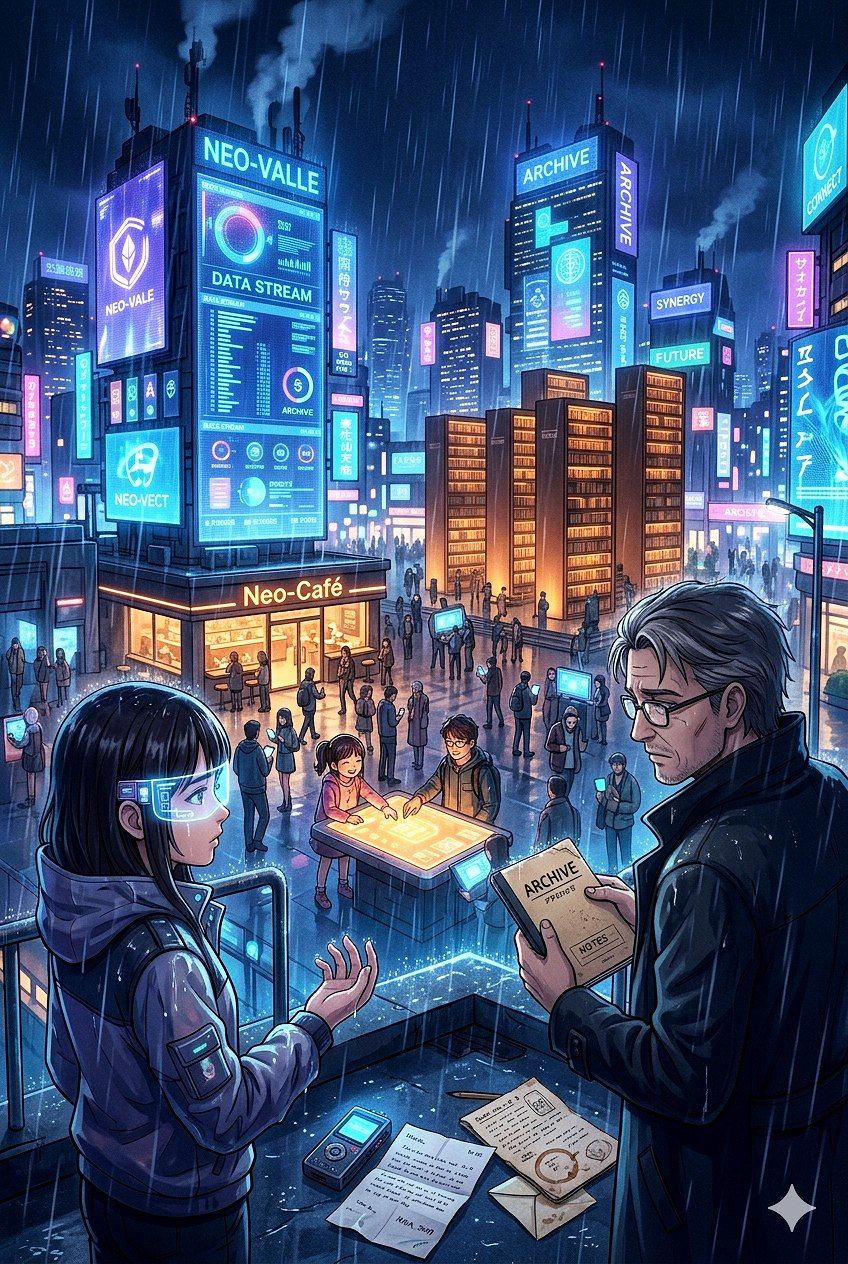
Short story: Echoes in the Silence
The rain struck Lucía’s bedroom window with an irregular cadence that seemed to want to recall older rhythms: her mother sweeping the kitchen, the glass always set in the same place after dinner, conversations that began and ended without hurry. Outside, the city breathed cold and bright; inside, the blue light from the screen cast shadows she no longer recognized.
Lucía (28) lingered for a while looking at the photo on the shelf: herself as a child, wearing a wool sweater, hair tousled by the wind, hugging her grandfather in the plaza. There was a calm in that image she now found hard to reach. Her hand, almost reflexively, reached for her phone. She turned it on, swiped, and got lost among notifications that promised companionship but left a larger emptiness. She closed the app without replying to anyone and placed the phone face down on the bed, as if it were possible to convince the world she did not exist.
The phone rang: it was Mateo (31). The voice on the other end carried a familiar fatigue: a voice that had learned to sound whole despite the crack it carried inside.
“Are you there?” he asked.
“Yes,” Lucía answered. “I’m… trying not to think about a thousand things at once.”
“Me too,” Mateo said. “I moved back in with my parents six months ago. I thought it would be temporary, that I’d readjust quickly. But sometimes I feel like I’ve been returned to a stage whose script I no longer remember.”
Lucía felt silent compassion for him. “My house is full of things that make noise but don’t say anything,” she murmured. “My father turns on the TV to avoid silence; I go to my room and leave the blue light on. We eat at the same table like two satellites that don’t touch.”
“In my case,” Mateo continued, “my mother cooks and calls me to eat. I arrive, sit, eat, and go to my room with the feeling of having fulfilled an obligation that doesn’t nourish me. Sometimes I wonder if my hunger is real or just a badly learned habit.”
They paused, searching for words to name something neither fully understood.
“Sometimes I think the bonds have weakened like old things,” Lucía said. “There isn’t a dramatic break; rather, there’s a quiet wear. Conversations used to have a thread you could pick up; now the threads tangle in screens and notifications.”
“It’s worse,” Mateo replied. “There’s virtual closeness and physical absence. We reply with emojis and make quick calls, but nobody sits and waits for the other’s answer. It’s like we were taught an express version of life: everything fast, everything accessible, yet farther away.”
That night, after hanging up, Lucía kept thinking about the word “detachment.” It wasn’t a single cause; it was a set of small erosions. She remembered childhood Sundays when the house filled with voices, smells, and hands. Now those Sundays looked different: everyone in their room, watching stories that didn’t include them.
The next morning Mateo called again, more urgent and more sincere.
“Would you like to meet at the plaza tomorrow?” he suggested. “The bench where you used to sit with your grandfather is still there, I think.”
Lucía hesitated less than she expected. Something in the idea of going out and putting their phones face down felt like the first rehearsal of something unnamed. They agreed to meet at noon.
The plaza had changed: the kiosk where they bought ice cream had been closed for months, several lampposts flickered, and fewer children ran with balloons. But the iron bench, paint flaking, remained stubbornly in place. Lucía arrived with a small bag of homemade food; Mateo appeared with a steaming thermos of coffee. Neither held a phone in their hand.
“I put the phone down,” Mateo said, a little embarrassed. “I wasn’t sure we could look at each other without something interrupting.”
“Me neither,” Lucía replied. “But I guess it’s worth a try.”
They sat, and the silence that followed wasn’t uncomfortable; it was hopeful, as if the words were lining up before appearing. They began to speak slowly, cautiously, like people checking a scar.
“My doctor,” Mateo said, breaking the quiet, “told me my stomach is ‘dysregulated.’ That my microbiome isn’t right. He asked about sleep, diet, how much I expose myself to the news. He prescribed a diet, probiotics, and therapy. He said anxiety sometimes nests in the body.”
“It happens to me too,” Lucía said. “I saw a nutritionist who said there’s a strong link between what we eat and how we feel. They suggested mindfulness, breathing exercises, and returning to certain rituals: eating together, talking without interruptions, taking time to cook with family.”
Mateo laughed with restrained sadness. “My mother asked me one day, ‘Why are you like this?’ I didn’t know how to answer. How do you explain that your stomach hurts from a sorrow that has no shape?”
“Maybe,” Lucía replied, “the sorrow does have a shape: broken habits, silences that don’t dare to be named, the absence of rites that remind us we belong to something.”
They spoke of sleepless nights, of the emptiness that neither the latest recommended series nor food delivery could fill. They recalled, with a mix of humor and melancholy, the childhood games that united them without words, walks with grandparents who listened more than they spoke.
“Do you remember Sofía’s grandmother?” Lucía asked. “She always said the body keeps stories the mouth doesn’t dare tell.”
“Yes,” Mateo said. “She used to rub the back of anyone who arrived sad. She believed touch said what language sometimes can’t reach. Sometimes I think we lost that: nonverbal acceptance.”
In the following days the plaza meeting became a ritual. Sundays turned into screen-free days: shared meals, long conversations, occasional walks. It wasn’t perfect; setbacks were frequent. There were days when the phone regained priority, when anxiety resurfaced, and when old habits seemed easier than change. But the repetition of small acts—a meal without devices, an anticipated call, a spontaneous hug—started to make a subtle but real difference.
Families were initially skeptical. Parents asked with reservation: “Why turn off the phone? Aren’t you going to miss something important?” The answer wasn’t immediate; it was a buildup of sensations. Gradually, parents noticed small changes: less tension, longer conversations, more open questions.
“My father told me one night, ‘When I was your age, we knew what we wanted,’” Mateo said. “I didn’t answer at first; the phrase carried judgement. What I wanted to tell him later was: ‘It’s not that we don’t know; the tools changed. Back then, the compass worked differently.’”
“Maybe the compass didn’t break,” Lucía said. “Maybe what changed was how to read it. Our parents and grandparents had practices we didn’t inherit—not because they didn’t want to pass them on, but because life came with shortcuts and promises of immediate results.”
A point that worried them was the sense of purposelessness. Both had felt at times that life lacked a clear engine. Achievements were fleeting, and meaning evaporated easily.
“We look for purposes in borrowed places,” Lucía said. “In jobs demanding productivity, in networks selling edited versions of happiness. We were convinced the immediate was valuable and lost the patience to cultivate something lasting.”
“I started writing small lists of things that gave me meaning, even if small,” Mateo shared. “An evening walk, cooking for someone, reading with no performance goal. It wasn’t magic, but it helped me remember that purpose is built from simple minutes.”
Alongside social reconnection, both sought professional help. Therapy provided tools: identifying patterns, understanding the body-mind relationship, and techniques to manage anxiety. It didn’t solve everything, but it served as a guide to stay oriented.
Their digestive health, affected in both cases, was addressed patiently. Dietary changes, fewer processed foods, more fermented foods, exercise, and, above all, less exposure to anxiety-amplifying news. They learned to view the body as an ally that signals when something is wrong.
“My stomach hurt less when I started respecting rhythms,” Mateo said. “Sleeping more consistently, eating calmly, walking. Life didn’t stop having problems, but my body stopped treating every tension like a catastrophe.”
In Lucía’s home there were quiet, practical changes. Her mother began to ask more and listen without rushing the answer. One night, while washing dishes, her mother said simply:
“I didn’t know how much I needed all this until I saw you happy again.”
The phrase wasn’t empty recognition; it was the consequence of nights when conversations grew deeper. Patience and consistency, rather than quick fixes, made a difference. Small daytime gestures—turning off the TV during dinner, sitting to hear how someone’s day was, cooking together—recalibrated the household.
Lucía decided to study nutrition. Her interest, initially practical, became both political and affectionate: she wanted to better understand the body-mind link and help others recover that balance. Mateo found a job closer to home and rearranged his life so family meals were not an awkward exception but an opportunity for connection.
The return wasn’t to an idealized past. It wasn’t about restoring a perfect youth; it was about creating a new way of being together. There were frictions: parents who didn’t fully understand, relapses into anxiety, days when phones ruled again. But the difference was that there was now space to name these setbacks, ask for help, and support each other.
One autumn afternoon, several months after they began meeting in the plaza, they sat on the same bench. An older couple walked by holding hands and smiled at them. Lucía looked at Mateo and said:
“It’s not a straight line. It’s a map with routes that cross, with roads that disappear and return.”
“Exactly,” he replied. “Healing isn’t an individual effort; it’s a collective mission. Not because everyone has answers, but because some can hold you when you falter.”
They stayed awhile longer, in silence, unafraid that the lack of words meant failure. Silence accompanied them now; it wasn’t empty but a rest. When night fell and the first raindrops began to fall, they instinctively turned off their phones and went home.
Progress continued at its own pace—not flawless, but enough. Some days fear returned strongly; on those days they called a friend, brought each other homemade meals, or simply sat and listened. The small acts, repeated with consistency, shaped a new everyday life.
A year after that first meeting in the plaza, Mateo lived on his own again but still attended Sunday family dinners. Lucía, with her new nutrition studies, organized informal workshops on food and well-being for young people in the community. They hadn’t invented a global solution; they had done what was within reach: cared for ties, tended their bodies, and recovered rituals that gave meaning to their days.
In the final scene, rain tapped again on Lucía’s window. She and Mateo sat in the kitchen, washing dishes after a shared dinner. The radio played quietly; nobody looked at their phone. Lucía’s mother ran a hand across her daughter’s back and said, with a calm she had never shown before:
“I like seeing you like this.”
The phrase was simple, and its effect deep. In the silence that followed, Lucía thought about how much life had changed in a year—not because of a sudden revelation but because of a sum of small, repeated decisions. She understood that healing takes time, requires patience, community, and concrete acts. She also understood that responsibility wasn’t only individual: one must re-educate bonds, recover touch, and teach by example how to read a compass that seemed lost.
As they cleared the last plates, Mateo said without drama:
“We’re not heroes. We just did what we could: get closer, talk, and stay near when one of us fell.”
Lucía nodded. “And remember that sometimes the cure begins with something as simple as a hand that doesn’t let go.”
They turned off the lights and went to sleep without screens, with the calm certainty of people who know that the work of caring for oneself is daily and shared. Outside, the city kept its relentless pace; inside, a new warmth had been woven from listened silences, shared meals, and the mutual will not to let detachment define their generation.
That night, and many nights that followed, they slept with the feeling that reconstruction was possible—not a return to an idyllic past, but the slow, persistent creation of a present where ties, health, and meaning were rebuilt hand in hand.
Source of the images.
Image created with Google Gemini.
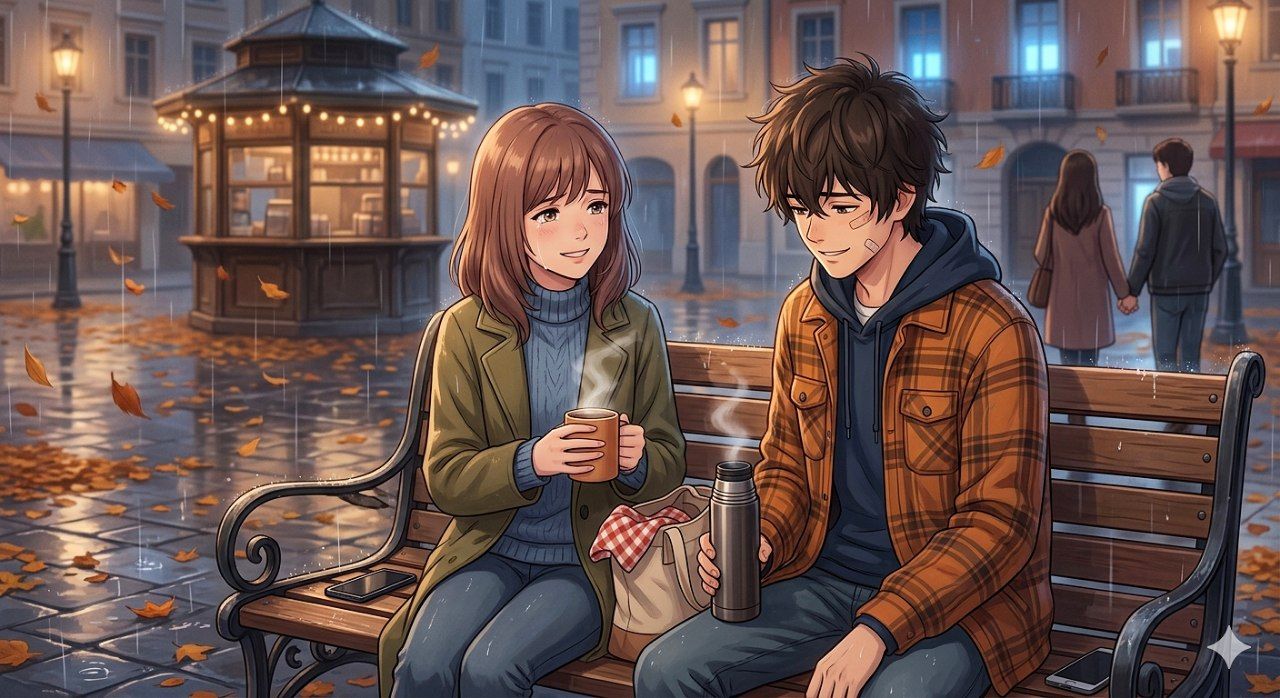
Short story: Silent Ash
The rain had started as a timid murmur and, over the afternoon, became a steady drum against the windows of the small apartment where Maia lived alone. The drops traced paths across the glass, distorting the streetlight into a diffuse watercolor. Inside, the place smelled of cold tea and books; a desk lamp cast a cone of yellow light over a cluttered table with papers, a planner, and a ceramic mug with tea leaves. That focused brightness, however, did not dispel the fog that had settled in Maia’s chest in recent weeks.
The doorbell rang—a brief, almost shy note—and her heart gave a jump she couldn’t explain. She wasn’t expecting visitors. She dragged herself to the door, with the feeling that each step added a new weight to her limbs. She opened it. Lucas, her neighbor from the fourth floor, stood there with a still-warm loaf of bread in a bag and a rain-soaked coat. His expression was the simple kind that comes without grand gestures: just presence.
“Hi,” he said, his voice careful. “I brought bread. I thought maybe… would you like some company?”
Maia looked at him. For an instant everything seemed in place: the rain with its rhythm, the bag of bread, the familiar silhouette of Lucas. But that moment cracked when a background sensation filled everything: a fatigue that didn’t lift with sleep, an opacity that made it hard to hold on to thoughts. Her hands seemed to have lost their precision; when she tried to pick up the mug, her fingers slipped and it chimed against the counter. The bread slipped and rolled, stopping under the table with a dull thud.
“I’m fine,” Maia lied, and the word came out so thin she hardly recognized it. “Just tired.”
Lucas set the bag on the table and sat down with the delicacy of someone crossing glass floor, avoiding sudden movements.
“I don’t want to push you,” he said, folding his hands. “But I can’t watch and pretend everything’s okay, Maia.”
Lucas’s voice had a mixture of concern and a kind of patience that didn’t demand immediate explanations. Maia closed her eyes and remembered the words of Dr. Ana Beltrán, the psychiatrist she had seen months earlier: “It’s extreme exhaustion. The brain depletes reserves. It’s not just depression. It’s a collapse from overexertion.” In the consultation, Ana had described in technical terms what Maia had intuitively felt for years: a wear that didn’t respond to more sleep, to vacations, to saying “I’m tired” out loud. She had explained masking as a daily camouflage: smiling when it hurts, modulating the voice until it sounds neutral, avoiding movements or gestures that might attract looks, repeating phrases and attitudes that seemed expected. It was an exhausting performance that required constant energy and, over time, consumed the nervous system’s reserves.
“Do you remember Friday’s dinner?” Lucas asked without really waiting for an answer, more like someone throwing an anchor to hold the conversation. “You arrived late. You said everything was fine and laughed when nobody got the joke. The next day you couldn’t get out of bed.”
The words stuck in Maia like splinters; they hurt for their accuracy. The kitchen, once a refuge, was now a landscape of small defeats: a pot forgotten on the stove, dried food on the cutting board, notes and unanswered emails piled with the precision of an impossible task. What used to be basic routines—cooking, replying to messages, getting dressed for work—had become ascents. Planning became a task that demanded mental energy she simply didn’t have; choosing between two options, from what to eat to which email to answer, produced a blocking sensation as if the prefrontal cortex—responsible for decision-making and organizing—had lost power.
“It’s not that I don’t want to,” Maia murmured, voice broken. “It’s as if my brain doesn’t know how to order things. Planning slips away. Words come out twisted.”
Lucas slid his hand over hers. It was cold, trembling. In that simple contact there was a promise of anchoring: not to fix, not to force, just to accompany. Maia held his hand and a tear, slow and silent, traced her cheek. There were no melodramas, no public catharsis—just an intimate acknowledgement that something inside her was draining away.
Sessions with Dr. Beltrán replayed in her memory. In one, Ana had calmly explained what happens when the nervous system is forced to sustain a continuous performance: “The prefrontal cortex is exhausted,” she had said, “and that affects decision-making, planning, emotional regulation and language. There are also sensory alterations, decreased emotional regulation with more crises or disconnections, and isolation from lack of energy.” She had advised Maia to respect limits: accept isolation when needed, reduce external demands, slow the masking, and create more sensory-friendly environments. She urged Maia to validate her differences and freely choose the self-regulation strategies that brought comfort—stimming, sensory breaks, predictable routines—and to seek and build safe relationships where she wouldn’t have to hide her nature to be accepted.
Lucas stayed that afternoon, with silences that said “I’m here” and movements that didn’t violate Maia’s need to withdraw from the world. It wasn’t heroic; it was human.
The following days unfolded in a mix of progress and setbacks. There were mornings Maia managed to get up and prepare a simple stew that took her briefly back to childhood: the smell of sautéed onion, the calming rhythm of stirring a pot. Other days were brutal: the world turned into a noisy place where sounds were knives and lights felt physically heavy. Headphones became a necessary barrier; ceiling lights an enemy to avoid. She learned to let go of judgment around small things: eating a sandwich while replying only as necessary to emails; canceling a meeting that would require her to perform.
Sometimes guilt surfaced: “If I were stronger, if I didn’t isolate, if I weren’t selfish…” Ghosts from a socialization that taught her to prioritize the appearance of adaptation over preserving internal energy. She had been taught to believe her worth depended on how much she resembled others’ expectations. Dr. Beltrán was blunt: such social demands were harmful; masking produces an identity wound that fuels burnout, and developmental trauma arises from chronic exposure to conditions that invalidate, exclude, or question a person’s emotions and experiences.
One damp day, with the chill seeping into her bones, her sister Valeria knocked carrying a box of old photographs. Valeria had always been a blend of tenderness and pragmatism; she came to offer company and, unknowingly, to bring a piece of Maia’s past Maia had buried beneath layers of survival.
“I thought you’d like to see them,” Valeria said, voice cautious.
Maia accepted the box with still-shaking hands. The photos were like doors: one showed a girl in braids laughing with an open mouth, hands dirty from playing; another showed the same child absorbed in a game, her gestures free and exaggerated. The image hurt. There was something in that child’s laugh—irreverent, unrestrained—that in adulthood Maia had learned to tame so she wouldn’t stand out. She remembered being pointed at in school for moving differently, for not following group rules, for making comments that sounded strange to those who didn’t share her perception. Each pointing finger planted a seed of doubt: “There’s something wrong with me.” That, combined with the demand to hide traits to be accepted, had shaped a developmental trauma: exposure to bullying, exclusion, invalidation, sensory and emotional overload.
“I always told you not to hide the tremor in your hands,” Valeria said, her voice thread between tenderness and gentle reproach. “‘You don’t have to look normal to be loved,’ I used to tell myself. I didn’t understand then what it meant, but now… I think I’m starting to understand.”
Maia felt relief tinged with pain: a mix of recognition and mourning for what had been lost. She cried with a cleansing that left her exhausted and strangely lighter. The tears weren’t theatrical; they purged silences, negations, and obediences to norms that had cost her authenticity.
From there, supported by some safe relationships—Lucas, Valeria, Dr. Beltrán—she began building a way of life with clearer boundaries. She learned to say “no” without embellishment, to prioritize actions that protected her energy. At work she proposed small changes: flexible hours, a quieter workspace for concentration, and asking that nonessential in-person meetings be handled in writing. Not everyone responded with empathy; some labeled her unprofessional or demanding. But others, surprisingly, offered understanding and practical adjustments.
The day she saw a little girl in the park mimic one of her unconscious movements—a rhythmic hand sway—she felt something unarm. The child’s mother approached without judgment, with calm curiosity.
“Is that a way to calm yourself?” the woman asked, speaking as if it were any habit.
Maia nodded, slightly embarrassed.
“Yes,” she said. “It… helps me find a rhythm.”
The woman smiled and joked that she should try it when she felt stressed. That light acceptance was new to Maia: not forced normalization asking her to hide who she was, but a recognition that everyone has their thing that keeps them standing. That small interaction gave her another lesson: validation doesn’t have to come from experts; it can arise from simple human encounters.
Yet the past didn’t dissolve. Developmental trauma lingered, pulsing in the body’s memory. Her body remembered hypervigilance: the sense of always being watched and judged, a tension settling in the neck and abdomen, a stiffness that made hands clumsy. Under stress, anxiety pushed her back to states where everything felt threatening. Nights could be long vigils where silence was filled by a mind replaying past interactions hunting for mistakes. She learned to identify those patterns and apply strategies: contact with safe people, slow breathing, routines that offered predictability, and permission to withdraw without explanations when necessary.
Dr. Beltrán and her close circle worked on teaching those around her to “validate without correcting”: allow Maia to feel without minimizing her emotions, offer concrete help without questioning the authenticity of her experience. It was a process requiring education, patience, and gentle confrontations: explaining what autistic burnout was, why masking was harmful, and why stimming wasn’t a tic to fix but a necessary self-regulation strategy. Learning to give those boundaries without dramatizing them was as liberating for Maia as it was for those who began to understand.
Progress was not linear. There were intense relapses—weeks when staying in bed was the only option—and moments of lucidity where life allowed small gestures of normality. She built a routine prioritizing scheduled rests, gentle physical activity, and sensory-friendly zones at home: a warm lamp, soft fabrics, a quiet corner. She allowed stimming in her space: rocking in a chair, squeezing a stress ball, humming a tune that grounded her. These simple actions were acts of self-care she had previously considered childish or shameful. Now she recognized them as necessary for regulation.
Over time, something grew firmer: the ability to name limits out loud. Saying “I can’t right now” without detailing every reason, asking for a five-minute break during a meeting, delegating tasks that disproportionately drained her. Each small act of honesty with her own energy repaired a part of her identity that had been neglected. It was also a process of grieving what had been lost: rigid internal schools that demanded she silence her spontaneity, friendships that didn’t survive the truth, jobs that required constant performance.
One clear morning, after weeks of steady work with therapy and daily adjustments, Maia opened her living-room window. Fresh air with the scent of wet earth came in, and for a moment everything felt less heavy. She thought of the ash metaphor: all that remained after the consumption of masking and accumulated trauma. The ashes weren’t just debris; they were proof of having lived, of having been subjected to a fire for reasons she no longer had the power to change. There was pain, yes, but also residue that could serve as a base for something new.
Lucas came to meet her that afternoon. They walked slowly down the sidewalk, silence between them respectful. Maia was not invulnerable; she knew that. Nervous inflammation, days of emotional blackout, sudden regressions still existed. But there were concrete changes: she could ask for what she needed, allow herself isolation when energy demanded it, and no longer interpret every withdrawal as a definitive renunciation of connection.
Before they parted, Maia took Lucas’s hand with more firmness than before.
“I don’t want to fake being okay anymore,” she said simply. “I don’t want my life to be a mask.”
He looked at her, eyes glistening with the understanding of someone who grasps the weight of those words, and replied with a line that hung in the air—warm and urgent:
“Then don’t wear it.”
The phrase was a compact promise: to accompany her without asking her to become invisible for his comfort. It wasn’t a magic solution; it was the beginning of a network of acts that, over time, might cushion the load. Maia knew in that instant the path would be long and full of stumbles, but that there were concrete strategies to sustain existence without dissolving: allowing isolation when necessary, reducing external demands, stopping masking, creating sensory-friendly environments, validating differences, fostering strengths, and permitting stimming and other calming activities.
That recognition—that burnout was not “just tiredness” but the echo of accumulated trauma—gave her back a measure of control. She understood that rest wasn’t laziness or selfishness; it was survival. She also understood that recovery would be a reconstruction in small acts: a dinner she manages to prepare, an afternoon outside without paralyzing anxiety, a conversation where she doesn’t feel compelled to pretend.
The rain that had once hammered the windows began to slacken. Now it fell as a fine drizzle that could almost be taken as a caress. Maia closed her eyes and breathed deeply, feeling a kind of truce in her chest: the ashes remained as witnesses to what had been endured, but they no longer completely hid the spark. Among the remnants of what had been, the possibility of living less conditioned by the demand to hide her nature and more oriented toward preserving inner integrity began to stir.
It was not a triumphant ending nor a definitive healing; it was progress gathered day by day. It required accompaniment, boundaries, acceptance, and the courage to name her needs without shame. Maia learned to build, with those who loved her and those who chose to understand, a refuge where her energy was respected. And in that refuge, for the first time in a long while, the spark had room to breathe.
Source of the images.
Image created with Google Gemini.
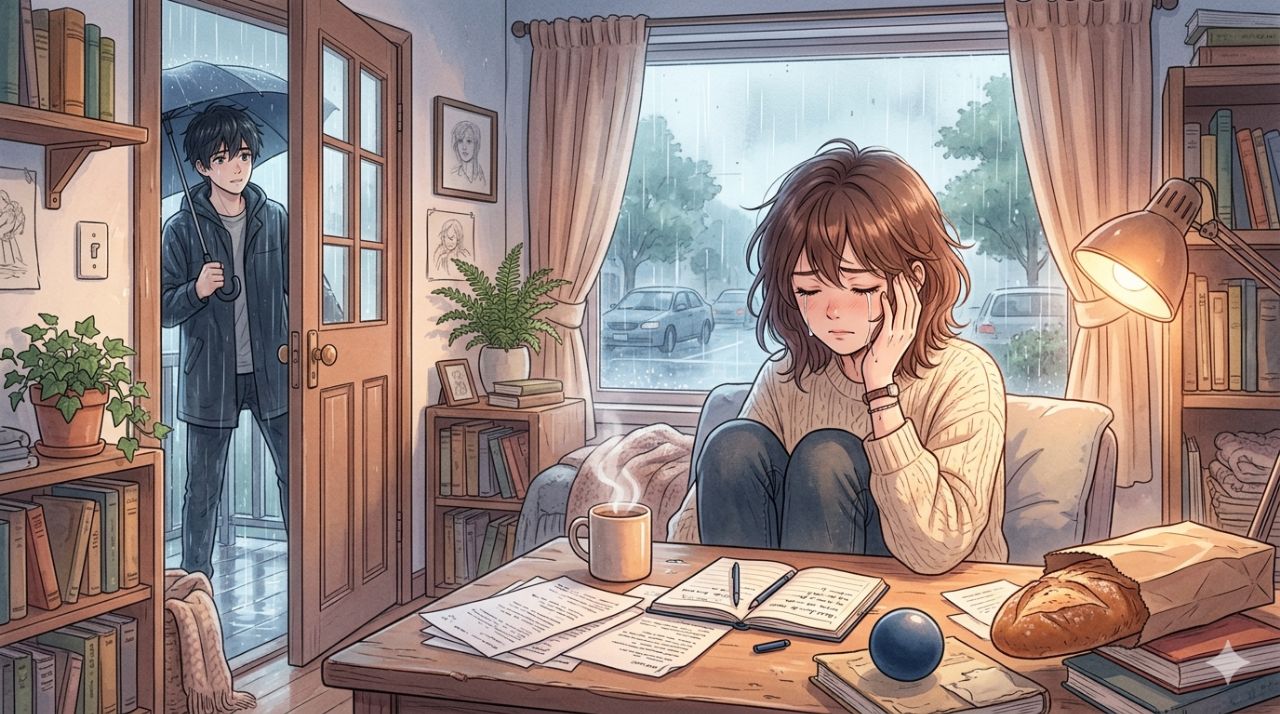
Short story: The Noise Before the Silence
The city stretched out like a circuit board: neon lights blinking in sync with the hour, delivery drones cutting through the air with mathematical precision, screens adjusting brightness and content based on the passerby’s expression. Everything seemed designed to eliminate chance: optimized routes, recommended encounters, smiles suggested by algorithms. There was no public order forcing people to behave this way; it was a habit that had slowly embedded itself, a contraband of emotional safety disguised as efficiency.
María woke before dawn, not for work but because of the low hum of her own unease. As every morning, she swiped the holographic window in her living room and let her virtual reflection overlay the urban landscape. On the screen she was someone else: polished, synchronized with her best angle, with just the right light and a calibrated expression. In real life, when the camera was off, the teacup trembled in her hands until she set it down too hard on the table and it made a dry sound.
“Ready?” Tomás asked from the call he had opened on the glass’s edge. His voice came through the pane like a high-priority message.
María closed her eyes for a few seconds and let the gesture be real, however small. “Can you be ready for something you can’t control?” she replied without a hint of joke.
Tomás was young, hair styled as if an avatar designer had provided the template; he always wore a smile that looked committee-approved. “You control the framing, the filter, the response time,” he said. “That’s already control. It’s not the same as showing up to life without a draft.”
She opened her eyes and looked at the cup. A thread of steam drew a line over the table. “What if there’s a tremor in the frame that doesn’t fit filters? What if I answer late because my voice cracks? I’m afraid they’ll look at me and see something I didn’t plan.”
Tomás stopped smiling. “It’s what a lot of people tell me,” he said in a more serious tone. “In person they freeze, but online they are completely different. I’m sometimes different too. I feel braver when I can delete a sentence with a gesture.”
María’s voice sank a little. “Deleting messages has become like stepping back on an escalator. You go up, down, try again. But in real life, when you stumble you fall. There’s no undo button.”
“Then you have a reason to come to the rooftop meeting,” Tomás said with a touch of complicity. “You said you wanted to try speaking without edits.”
She nodded, and the city continued its choreography of carefully measured gestures. It wasn’t that people were less real; it was that they had learned to translate every emotion into a version tolerable for other eyes. That worked: it reduced shame, increased superficial acceptance. But it also left a hollow where warmth used to be.
That night the rooftop of the building—a former service station turned into hanging gardens—glowed with sustainable lanterns and a translucent tarp that let the city lights pass through like domesticated constellations. There were several people: some at small tables, a couple speaking in low voices, and in the back, an older man taking a stack of printed photographs out of a bag—images without metadata or automatic brightness adjustments.
María approached with Tomás and chose one of the tables. The feeling of being truly surrounded, really surrounded, by bodies without the mediation of windows made her vulnerable. But that was the promise of the night: no editing, accept the fissures. Next to them sat a young woman switching notes on her tablet with nervous movements and the older man arranging the photos in a wooden box as if they were relics.
“Why bring paper photos?” Tomás asked, half joking, half curious.
The older man looked up and smiled with a deep patience, like someone who kept memories that didn’t need a server’s permission to exist. “Because when something is physical you can’t swipe a movement back with a finger,” he replied.
“If you look at a photo and it hurts, you have to breathe, set it aside, talk to someone. There’s no way to edit the scene to make you like it more. It’s an old risk, but an honest one.”
The girl set the tablet aside and looked at the others. “I know a lot of people who freeze in person,” she said. “Online they act differently because they have time to choose words, to rehearse replies, to assemble the correct version of themselves. That security creates dependency.”
“My sister lives inside her avatar,” Tomás said. “It’s her armor. Outside she turns to stone. I think control is an illusion we buy to avoid facing real shame.”
María stroked the cup, feeling the remaining warmth in her fingers. “I always thought that planning could protect me. That if I anticipated rejection I could neutralize it. But the effort to control something that can’t be controlled consumes me more than any rejection.”
The older man placed a photo on the table. It was a blurry portrait of two people laughing in the dark, the image taken by accident. “A weight off,” he said. “If we learn to bear the accident, we learn to bear ourselves.”
There was a small laugh, and then a proposal that felt like a truce with fear.
“Let’s do an experiment,” the older man suggested, with the steadiness experience gives. “Say something stupid on purpose. Don’t edit it. If we laugh, fine. If not, we leave and accept the discomfort. Anything goes.”
María felt her mouth dry. Her heart pounded with a mix of dread and curiosity. She remembered all the sentences she’d deleted over the years, all the confessions she had disguised until they read like a profile. She breathed deeply and set the cup in the center of the table as if it were a pact.
“I’m afraid that if I speak without measure, no one will want to hear me,” she said. The sentence was simple, but saying it aloud gave it weight.
Tomás looked at her with sincerity. “Me too,” he admitted. “I always thought that showing a mistake would turn me into a failed project.”
The young woman let out a laugh that was unsure whether it was nervous or liberating. “I once made up a name in a meeting,” she shared. “When they found out, I thought no one would want to talk to me. But talking about the lie was the only thing that gave me back some dignity.”
“Then let’s begin,” the older man said. “Let’s start being imperfect projects for a night.”
What followed was not a theatrical catharsis or a circle-therapy session. It was a conversation with burrs: confessions that surfaced, blurred, reappeared. María spoke about the presentation she had to fake confidence for because the team expected ease; how her voice had gotten stuck while the room watched and she felt her world fall apart. Tomás described the habit of rewriting messages over and over, choosing each word as if sculpting a statue of himself. The young woman recalled a time she’d exaggerated her personality on a date and felt her mask fall off with no idea how to hold what was left.
“Sometimes,” she said, eyes full of light, “the fear isn’t so much rejection as the surprise that no one recognizes you when you take off the armor. It’s like your essence is a file no one has downloaded yet.”
The words were honest, unpolished. Long silences followed, and in those silences the city’s hum felt like background music that didn’t demand performance. The older man placed another photo on the table: a close-up of trembling hands holding a cup much like María’s. She picked it up and recognized in the image a piece of her own tremor, that vibration she would have hidden before.
When the conversation reached late night, the young woman said something that cast a new light over what everyone was feeling.
“It’s not about stopping caring how we look,” she murmured. “It’s about not making the other’s gaze the unit of measurement for who we are. Caring makes sense; living to be measured doesn’t.”
María repeated the phrase in her head. She thought of the hours spent refining tones, erasing expressions that could be interpreted as weakness. She considered the difference between being seen and being interpreted, between existing and being evaluated. The constant effort to control every move had worn her down into caution, like someone who lives in a bubble entered only with permission.
“I want to learn to make mistakes,” she finally said, voice barely firmer. “Not because I like failing, but because making mistakes would make me real again.”
Tomás smiled without filters, with a tenderness that didn’t fit an emoji. “Then let’s begin to make mistakes live,” he suggested. “Tonight, and the next time we meet.”
They traded clumsy stories: messages sent with absurd errors, presentations that collapsed, silences stretched until they became noisy. There were laughs that weren’t programmed and also an unexpected small tear or two. No one offered solutions; they merely held the fissures with presence.
On leaving, the young woman left the photograph from earlier on the table: the blurry image of two people laughing, taken by chance with an old camera. “Take it,” she said. “So you remember what laughter looks like when you don’t pose it.”
María pressed it to her chest. That photo, with its grain and imperfection, weighed like a promise: a physical reminder that laughter doesn’t need posing to be genuine.
In the elevator that took them back to the optimized streets, Tomás rested his forehead on the glass and watched the city playing out its script. “Maybe socializing has always been an exercise in risking ourselves,” he said quietly. “But now we’ve outsourced it to screens and algorithms to punish ourselves less. The price is that we lose the practice of tolerating silence and error.”
María closed her eyes and breathed slowly. “Maybe it’s not about stopping planning entirely,” she replied. “It’s about training ourselves to accept fissures. Learning to breathe when the pulse rises. Learning to laugh when nothing is perfect.”
“And letting others see how the cup trembles,” Tomás added with an honest smile.
Before parting, they promised to meet again without edits. It wasn’t a solemn vow but a pragmatic agreement: see each other and let the unexpected happen.
The following week María used the holographic window less. She went out without preparing the expression she would wear for strangers. Sometimes she froze; other times the laughter that escaped was awkward and warm. There were moments she wished she could erase what she’d said, but she left the words lodged in the air. One day in a café, a stranger returned a misspoken phrase with an open smile as if returning a weakly thrown ball, and the conversation stretched into an exchange neither had predicted.
She returned to the rooftop after a few weeks. The tarp covering the space now had new paper photographs clipped to it: imperfect faces, hands caught mid-motion, mouths open in accidental laughter. The older man was there, turning on a small projection, and the images spun like discs from a past that had no access to editing.
“The first night,” he said when he saw her arrive, “someone said what we share unedited hurts but heals. Not because it erases fear, but because it trains us to endure it.”
María watched her own projected image: a mouth mid-laugh she didn’t know if it was funny or forced. She didn’t fully recognize it, yet the photo tasted like truth. She held it with a new calm, as if observing a wound beginning to close.
The city kept its programmed glow, and in the streets people continued to use avatars and filters like garments. But between its lights there were small cracks: encounters where editing stepped aside and conversation reclaimed its risk. In those cracks, imperfect and trembling, a different kind of companionship began to grow among those who dared to err in real time and hold the other’s tremor without trying to fix it.
María breathed in deeply and felt the faint certainty that anticipating rejection was a noise she could silence. Not by controlling the whole world, but by practicing letting the world move through her—with mistakes, with silences, with uncalculated laughs—and remaining. She accepted that she couldn’t fix the city or change everyone’s habits, but she could change her pulse.
That night, when the projection showed again the blurry photo of accidental laughter, the older man fell silent and let the image speak for itself. María let out a laugh that hadn’t been choreographed, and someone beside her heard it and offered nothing in return but their company.
The lesson wasn’t simple or instant. It was a chain of small renunciations: fewer deletions, more breaths; fewer avatars, more skin; less control, more presence. And with each step, the city—though the same on the surface—gave up a little room to human voices, which found space in the cracks to sound raw, unfiltered, and therefore true.
Source of the images.
Image created with Google Gemini.
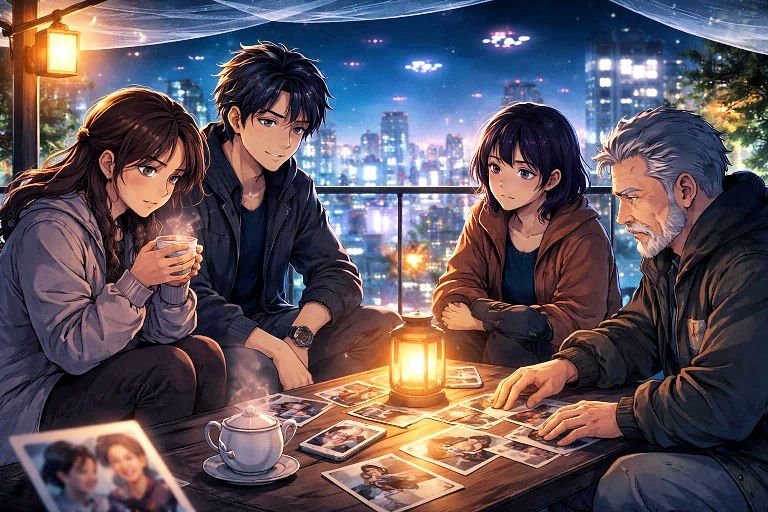
Short story: The Suture of Oblivion
Marina Valeri rang the bell of the building where she lived with the feeling that each step was a betrayal of her own body. The night before she had hardly slept; the fainting spells had become more frequent and the pains, sharp and constant, no longer responded to the painkillers or antibiotics they had prescribed. She walked slowly down the hallway to the elevator, her hand on her abdomen as if holding something fragile that could crumble at any moment. Her brother, Pietro, waited with two cups of tea and the tired look of someone who had spent weeks watching over a person without answers.
"How are you feeling today?" Pietro asked, placing the cup in front of her.
"Worse," Marina answered in a low voice. "This time I fainted in the street. I had to sit on the curb until someone came by."
Pietro stood and hugged her awkwardly, not knowing what to say.
"Let's go to the hospital," he said. "I don't trust Aurora Clinic."
Marina had felt that distrust since the first complication. She had gone to Aurora Clinic seven months earlier for an abdominoplasty that, in her mind, was meant to be a step toward recovering her self-esteem. She had chosen that place because online reviews described it as "prestigious" and the doctor who treated her, Alessandro Mancini, had recommendations and photos of satisfied patients on his site.
"I don't want to make a scandal out of this," Marina said as they climbed into the taxi. "I just want this to stop."
Pietro said nothing. He knew a "scandal" might be the only thing that could save her.
***
In the emergency room at San Lorenzo Hospital, the white light seemed to pierce the skin with the same chill as the machines. The receptionist asked for their documents with a professional voice that couldn't hide the fatigue of a long shift. A nurse named Carla led her to a gurney to run initial exams.
"Any prior problems?" Carla asked while taking her blood pressure.
"Nothing else," Marina replied. "Just this surgery seven months ago. Since then I've had intermittent pains. I thought it might be a hernia or something that would go away. But it didn't. I went to the clinic and they told me it was normal post-op."
Carla frowned.
"Did they do imaging at the clinic?" she asked.
"Only ultrasounds," Marina said. "They told me everything was fine."
Meanwhile, the radiologist, Dr. Romano, reviewed the CT scans they had ordered immediately because of the symptoms and medical history. He asked for silence and leaned toward the monitor, where a metallic shadow appeared clearly among tissues that showed old scars.
"What is that?" Pietro murmured, leaning toward the screen.
Silence thickened. The radiologist pointed to the image with a gloved finger.
"It looks like a surgical scissor about fifteen centimeters long," he said softly. "It's inside the abdomen."
Marina felt as if the air had become too thin. Understanding took a second to sink in: she had lived seven months with a metal object inside her body.
"How is that possible?" she asked, voice breaking. "How did nobody see it?"
"It might not have been detected on ultrasounds," Dr. Romano explained. "Or there could have been record-keeping errors. The important thing is you need extraction surgery as soon as possible."
***
The news spread through the family like an open wound. Pietro called a lawyer he knew and asked for advice: do not trust the clinic's promises, document everything, get independent medical reports. But calls began coming from a number at Aurora Clinic; Dr. Mancini's voice sounded strained with tension.
"Marina," he said on the call, "I'm sorry this happened. We can resolve it here discreetly. If you come back, we will perform the extraction at our facilities and cover the costs."
"Discreet?" Marina replied sharply. "What do you mean by 'discreet'? That you make the evidence disappear and I go home as if nothing happened?"
"It's not that," Mancini said. "Sometimes things can be resolved without involving the patient publicly."
Pietro listened from the other room, a coldness spreading to his bones.
"I'm not interested in a 'settlement,'" Marina said. "I want this investigated. This can't end like this."
She hung up before Mancini could insist. She knew the doctor, worried about his career and the clinic's reputation, sought the quick way out. Marina remembered the hands that had attended her in the first operation: professionals who spoke confidently, hurried assistants, an operating room that smelled of disinfectant and urgency, and Mancini's voice promising results. What had once been a promise had become a physical betrayal.
***
Dr. Elena Bianchi, a general surgeon at San Lorenzo Hospital, took the case seriously. She reviewed the images, the history, and Marina's clinical situation.
"We have scheduled the extraction for this afternoon," Elena told her with a calm that reassured. "We'll remove the foreign body and assess the damage. We'll also prepare a detailed report for the prosecutor if you wish to proceed."
Marina nodded. In the operating room the atmosphere was one of reverent focus: blinding lights, the sound of the monitor, hands moving like part of a well-practiced ritual. Elena worked with customary precision. When they finally removed the object, the team held its breath. It was a metal scissor, with dried blood residues and signs of corrosion at one end; the marks on its surface testified to months inside a body, rubbing tissues and causing inflammation.
"It's incredible it remained so long," one assistant murmured. "It could have caused a severe perforation."
Marina woke in recovery with bandages on her abdomen and a mix of relief and anger bubbling inside her. Pietro, who had waited hours in the waiting room, looked at her with wet eyes.
"Are you okay?" he asked, taking her hand.
"Lighter," Marina said, forcing a smile. "But this isn't over."
Her voice was a promise. It wasn't just about regaining her health; it was about ensuring negligence wouldn't go unpunished.
***
The complaint was filed officially and the case reached the prosecutor's office. Investigations began with collecting files, surgical records, instrument lists, and testimonies. Journalists called the clinic's door; some neighbors and former patients spoke to anyone who would listen. Aurora Clinic responded with terse statements: procedures followed, protocols reviewed, an "isolated incident" they attributed to human error.
Mancini initially limited himself to conciliatory public statements: "We regret what happened, we will cooperate with authorities." Privately, his lawyer tried to mediate with the Valeri family to reach a financial settlement that would close the matter without trial. Offers came by mail and messages. The pressure for Marina to accept was noticeable: calls, offers of private care, promises of silence.
But Marina's experience had taught her not to yield to smoothing words that failed to match actions. She knew a "settlement" meant erasing, minimizing, allowing others to suffer the same fate.
"If I accept money now," Marina said one night as she reviewed the papers with Pietro at the kitchen table, "someone else might have to go through this. I can't allow that."
Pietro looked at her with pride and practical fear.
"I have no doubt you'll do the right thing," he said. "I just hope the path doesn't destroy us."
***
Witnesses began to appear. Carla, the nurse who had attended her in the emergency room and who now worked in a different hospital after the events started to unravel at Aurora Clinic, decided to testify. She met Pietro at the town square with coffees cooling in their hands.
"I was scared at first," Carla confessed. "There was a lot of pressure at the clinic. The shifts were long and they asked us to speed up. Mancini was known for finishing many surgeries a day. I'm not saying he did it intentionally, but there was a culture where details could be overlooked."
"Were you fired?" Pietro asked.
"They fired two aides after some reports surfaced," she said. "They called it 'administrative adjustments,' but I spoke to one who told me they demanded instruments be reported as 'complete' even when items were missing from the lists."
Her testimony, along with others', began to sketch a pattern: haste, constant staff rotation, protocols not always followed. Not all pieces fit perfectly, but together they were enough to open an investigation for negligence.
***
Media coverage intensified. People on the street discussed the case. Some voices—biased against cosmetic surgery—blamed Marina for "seeking beauty at any cost." Others, more empathetic, called her "brave" for demanding the truth. Letters of support arrived, messages from patients who told similar hidden-complication stories, and also an anonymous note slid under her apartment door: "Be careful. There are things better left untouched."
Marina placed the letter on the table without opening it; anonymity made her feel vulnerable but also more determined.
"They want to intimidate us," she told Pietro.
"Then they won't," he replied, squeezing her hand.
The judicial process advanced with hearings, statements, and expert reports. Dr. Elena submitted a detailed account of the extraction and Marina's condition when she arrived. Forensic experts examined the scissor and tried to determine whether there had been tampering with records or failures in instrument inventory management. Some assistants and former Aurora Clinic staff testified about the work pace and administrative errors.
The defense argued there was no conclusive proof directly linking Mancini to the presence of the scissor—that it could have been introduced by another person, that instrument counts might fail for various reasons—and tried to shift focus to "fortuitous causes."
In the courtroom tension was palpable. Lawyers, journalists and citizens followed the sessions. After one hearing, a woman approached Marina with tears in her eyes.
"Thank you," the woman said. "I was a patient there and I told myself it wasn't that serious. Now I see I wasn't imagining it."
Marina hugged her. In that gesture she understood that one person's fight could echo in many lives.
***
The trial did not erase the physical trauma or the months lost to uncertainty. Marina had to undergo therapy to regain abdominal strength and cope with anxiety after knowing a foreign object had lived inside her. However, the administrative measures and penalties that followed left marks on the clinic: fines, protocol reviews, temporary suspension of activities until proper controls were implemented.
Mancini faced internal investigations and possible professional sanctions. The clinic, hit by reputational damage, had to restructure procedures and justify each step. For many employees it was a moment of adjustment and, in some cases, change.
One afternoon, almost a year after the extraction, Marina and Pietro walked through a park where leaves stained the paths ochre and gold. The air was crisp; the city seemed quieter.
"Do you feel better now?" Pietro asked, watching a laughing couple pass.
"Physically, yes," Marina replied. "Mentally… there are still days. But I think something changed. Not just my body. The way I see people uniting."
Pietro sat on a bench and looked at her with both pride and sadness.
"You did the right thing," he said. "It wasn't just for you."
Marina thought of the evidence that still rested in a box held by the prosecutor, ready for trials and expert analysis. The rusted scissor, once a medical instrument, was now a symbol: proof of negligence and evidence that the truth can emerge when someone refuses to accept silence.
"I'd like people to understand something," Marina added. "It's not about judging those who turn to cosmetic surgery. It's about holding the responsible accountable when things go wrong."
Pietro nodded.
"That's a good message."
Walking out of the park, Marina felt that the scar on her abdomen was no longer only a mark of pain; it had become a lesson etched into the skin and a warning for others. She thought of the men and women who, out of insecurity or desire for change, place their health in others' hands. She thought of the workers who had feared speaking up and now, seeing they were not alone, felt stronger.
Her story had been one of negligence, half-spoken conversations in corridors, and offers to "fix" matters without justice. But it had also been a story of how a decision—the refusal to accept silence—turned a traumatic episode into a catalyst for transparency.
In the bottom drawer where she kept case documents, Marina had a photograph taken by a hospital staffer the night she was discharged: her face pale but with an expression of absolute relief. She held it, folded it, and tucked it among the papers like an amulet.
"Maybe someday," she murmured, "people will mention this as a turning point."
Pietro smiled.
"It will be, if we keep talking."
Marina looked at him and for the first time in months felt the future was not only a space of wounds but also of shared responsibility. Outside, the city continued to move; inside, her story remained alive, not as a festering injury but as a suture that, imperfect though it was, joined pieces together so they would not come apart again.
Source of the images.
Image created with Google Gemini.
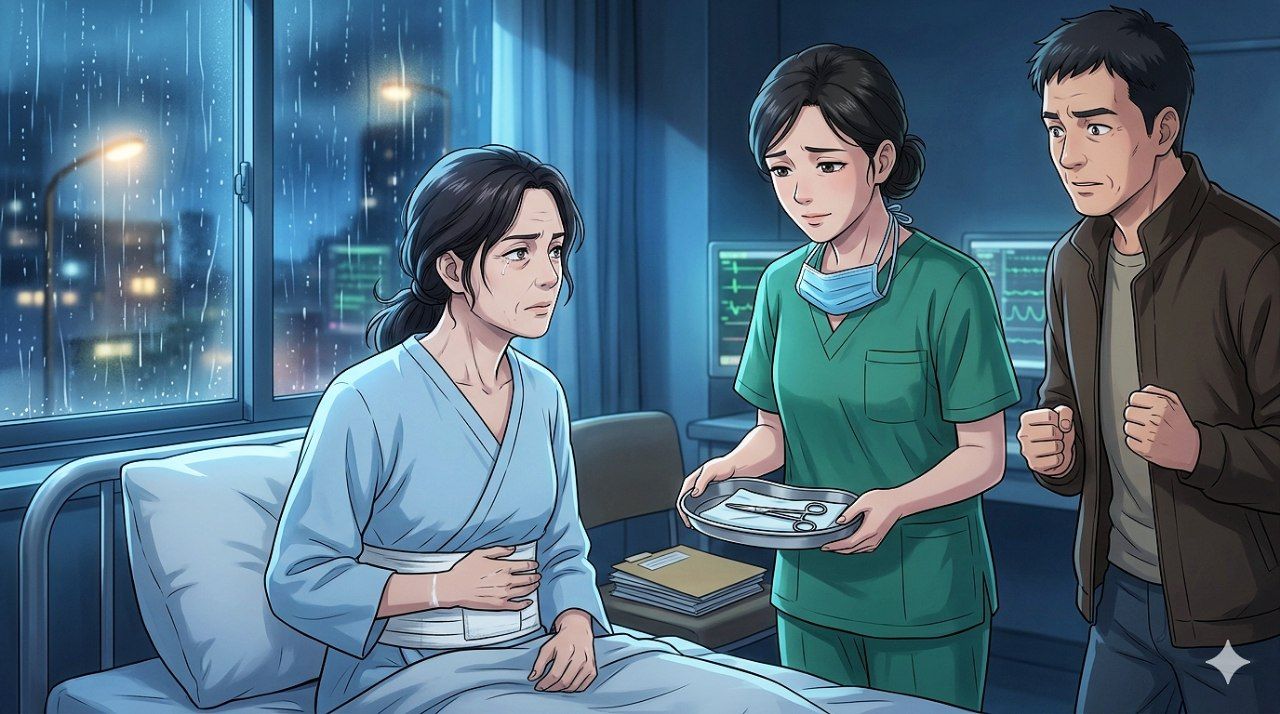
Short story: Neon Shadows
The night in Kabukicho opened like a luminous wound: signs bleeding color, steam tangling around streetlights, and the city breathing with a rhythm that did not ask for names. At a corner where the rain left mirrors, the young people the world—hurried and forgetful through social media—had named the Toyoko Kids gathered every night. Their faces were fleeting frames, their gestures small rituals that algorithms turned into spectacle; tourists and cameras were drawn to that bright aesthetic, unable to discern the skin the lights barely covered.
Aiko arrived one afternoon as someone dives into cold water: without warning, with the feeling that there was no other option. She had fled a home where words turned into blows and silences into accusations. The first night she spent on the street, she later recalled, everything was noise: distant sirens, group laughter, the constant murmur of voices that asked no questions. At first she sat on the edge of the platform and watched people pass; then someone offered her a cigarette and a smile without questions. That smile was enough to stay.
“Never thought anyone would ask me to stay,” she told Kenji one night, her voice barely torn.
Kenji, seventeen, carrying in his eyes the patience of someone who had already seen closed doors, answered while lighting a cigarette with hands that did not tremble:
“Here no one asks for papers. Here no one asks you to prove who you are. They look at you, and if they see you, that’s something.”
Aiko smiled for the first time in a long while. The smile did not erase the past, but it made it possible for her body to learn to relax a little. Together they settled in a corner beneath a broken LED sign, and over time they added other faces: Rika, with a wide laugh and a scar on her eyebrow; Haru, who spoke little and drew on napkins; and an older boy everyone called Sato, who brought news and advice with the authority of someone who had survived.
The group’s dynamic was simple and cruel in its tenderness: they cared for one another as best they could, shared food when there was any, warned if the police were nearby and, above all, offered a sense of belonging they had not had at home. But that shelter was fragile. The city, impersonal, allowed the corner’s loving belonging to also be a display case.
One night, while Aiko checked her phone notifications and watched the view count rise on a video of her laughing with Rika, a man in a black suit approached them with the calm of someone offering a solution with a hidden price.
“Good evening,” he said, with a voice seemingly crafted to convince. “I’ve seen your videos. You have presence. I work with a venue that looks for boys and girls for events; they pay well and provide lodging.”
Kenji tilted his head, suspicious.
“What kind of events?” he asked.
The man smiled, as if he knew his answer would close the door.
“Private events, fashion, companionship… nothing dangerous. Foreign clients come a lot; they need different faces. It’s a good income while you sort things out.”
Rika, more pragmatic, showed interest for a moment.
“How much do they pay?” she inquired.
“Enough to have somewhere to sleep and eat,” the man replied. Then, confidentially, he added: “If you trust me, I can sort it out this week. I work fast.”
Sato watched the man with eyes that granted nothing without thought.
“Why would you help us?” he asked in a low voice, the voice of someone who had learned favors almost always expectsomething in return.
The man made a minimal gesture.
“Let’s say I have contacts. No questions. Just a number and a car on Friday.”
The day seemed to bring promises. Aiko looked at her phone, the view counter and the comments; the offer presented an immediate way out of the cold. In her pocket, the folded photo of her younger brother squeezed her heart.
That night, before accepting anything, Aiko spoke to Kenji in a low voice, almost to herself.
“If I go and they help me, do you think I could bring Yuto later?” she murmured, naming her brother. “If they help me, maybe he won’t have to live the same way.”
Kenji looked at her with a softness that doubted itself.
“If it’s for Yuto,” he said, “I’ve got your back. But let’s not go with anyone. Pretty promises are easy; reliable proof is not.”
That remark was enough for Rika to call Sato and ask for time. The decision, however, hung by a thin thread: need versus a sense of protection. At dawn, while the corner vibrated with music from a nearby bar, a figure emerged from the digital net: a direct message offering a “safe” room in exchange for a private session with “specific clients.” The language on the screen was more direct than the man in the suit’s mouth.
“Private?” Haru said, eyes wide. “I don’t like words that sound like that.”
Sato kicked the ground with his foot.
“This is bait fishing,” he muttered. “If someone offers you shelter and money now, the coin has another face.”
Tension escalated when, days later, Rika accepted to go out with the man in the suit. She did the mental calculation of someone weighing needs: pay off gambling debts, get soap and a new purse to sell at the night market. She left with a mix of hope and fear. She returned hours later, clothes disordered and eyes hollow, and sat silently with the others.
“Was it…?” Aiko asked softly.
Rika didn’t answer for a long while. Finally, with a worn voice, she said:
“He promised just a talk. They took me to a place with lights that made me want to vomit. They told me if I didn’t do what they asked, there would be no money or room. I paid because I couldn’t think of anything else. Now I have a knot in my stomach that won’t go away.”
The group fell silent. No one needed to say it could have been worse. Rika’s experience acted as a mirror: the man’s promise had revealed his truth.
From that day, nights filled with small protection rituals: check identities, demand documentation from those offering help—when possible—don’t go out alone, leave notes with strangers about where to go in an emergency. But even the simplest measures were limited against the sophistication of exploitation networks. Recruiters learned quickly: they showed kind faces online, offered seemingly legitimate jobs, sent profiles of “clients” with fake photos and reviews. The youths’ vulnerability, combined with their urgent need for money and shelter, was the door exploiters crossed easily.
One gray morning, while the city cleared the night’s dampness, Aiko met a neighborhood social worker handing out flyers at the station.
“Hi,” the woman said with a soft voice and a pack half empty from working too much. “Are you okay? I’ve heard there are kids sleeping around here. We have a day center: food, showers, someone who can help with documents and referrals.”
Aiko, carrying the habit of distrust, looked first at Kenji and then at the ground.
“Will we be charged to sleep?” she asked with practiced coldness.
The worker shook her head.
“No. We just want you to know you’re not alone. If you want, I can accompany you to an interview.”
Kenji leaned forward. On his face passed something the night rarely showed: contained vulnerability.
“If we accept, would you help bring my sister?” he asked.
The woman pulled out a pen and a smile that fatigue had not worn down.
“If there are papers or testimonies to make, the organization can guide. I can’t promise miracles, but I can promise accompaniment.”
The possibility of help changed the group’s breath. It wasn’t the empty promise of the man in the suit; it was an official network with hours, registers and names. The difference between them was subtle but vital: one offered speed without guarantees; the other offered slowness with some protection.
Still, the path was not straight. Administrative processes, immediate financial needs, the tempting nights of online fame, and the pressure from those offering “quick solutions” with a credit card made some give in. Danger prolonged itself when online visibility grew: a viral video brought tourists and pockets of ephemeral money, but also private messages with doubtful proposals. Virality was a mirror that showed beauty and amplified danger.
One rainy night, Kenji found himself speaking with Aiko under a neon that flickered red.
“Sometimes I think about going back,” he said without looking at his phone. “Going back to the kitchen where they punished me for being late. At least I knew what to expect there. Here it’s different: you don’t know what they’ll offer you tomorrow.”
Aiko looked at him with eyes full of the fatigue of someone who has learned to survive.
“Going back isn’t always an option,” she replied. “What would I tell my brother? To go back to the house that beats him? I can’t do that.”
Kenji exhaled smoke that blended with the mist.
“I don’t mean going back is the solution. I mean… sometimes I miss the predictability of known harm. This is another kind of uncertainty.”
As the group’s story spread, the neighborhood community began to stir. Neighbors who once watched with curiosity started speaking in low voices. Some tourists, attracted by the aesthetic, approached with cameras; others left bills or food. None of these actions replaced effective public policy or adequately funded protection networks. The line between solidarity and exoticism was thin: donating a blanket was useful; turning someone’s need into a spectacle was not.
One day, local police, alerted by an anonymous call, carried out a check in the area. For many youths, police presence represented a different risk: exposure, possible deportation (in some cases), or separation from the group that gave them some comfort. Sato, who had learned to read authorities’ intentions through rumor and gesture, gathered everyone.
“When the police come, don’t run,” he ordered quietly. “Not because we’re hiding something, but because running makes anyone guilty in the street’s eyes. If you speak with them, tell the truth: that you’re here because you had nowhere else.”
The intervention was brief. Some accepted to go to a shelter. Others returned to the streets that same night. The cycle, always complex, showed how immediate solutions were insufficient without sustained accompaniment.
One dawn, as the first train broke the silence, Aiko sat on the platform and unfolded the photograph of her brother. Her fingers traced it like someone rehearsing a promise. Beside her, Kenji watched the shadowed horizon.
“If I go with the worker’s help, do you think I’ll be able to get him out of that house?” Aiko asked, voice unsteady.
Kenji took her hand for a moment.
“If there’s a real possibility and not a suit full of promises, then try it. You’re not alone in this.”
Aiko nodded, with a determination she knew fragile but real. The decision did not erase the night’s melancholy nor the difficulty of the road ahead. But it was a step against drift.
In the following weeks, some of the group attended interviews, others found informal work routes managed by local organizations, and Rika, after her ordeal, entered a rehabilitation program and psychological support. Not every story had a clear or immediate ending; some resolved in small everyday victories: a hot shower, shelter for a night without fear, a call from a family member offering apologies and help. Others, however, remained shadows the city would not take on.
The Toyoko Kids’ virality continued. New videos appeared; new likes fed the algorithm. But for those who knew the group up close, virality was no longer only shine: it was a warning. The neon lights continued to enchant; the city, indifferent, kept offering spectacles without asking the human cost.
And in that landscape, the young people learned to be cautious: not accepting the first hand offered, asking for identities, sharing safety words, not going alone with strangers.
The tale of Kabukicho was not reduced to a simple moral. It was the chronicle of a city that offered refuge and danger at the same corner; the story of young people who, while finding belonging among peers, faced a global network of interests turning vulnerability into capital. It was also the story of those who tried to weave a wider net: social workers, neighbors with real empathy, organizations that said “no” to the speed of easy promises and “yes” to the patience needed to accompany.
In the final scene of a night that seemed to repeat without end, Aiko stood on the sidewalk, holding her brother’s photo to her chest. She looked at Kenji and said, with a mixture of fear and decision:
“I don’t want my story to be just another video.”
Kenji watched her with contained tenderness and replied:
“Then don’t leave it to the screens. Let’s make someone who can help know and help.”
They walked toward the day center where the social worker waited with a cup of hot tea. As they left, the neon lights flickered behind them like a curtain undecided whether to close or open. The city went on, its beauty and cruelty intertwined; the Toyoko Kids remained visible and, hopefully, a little less alone.
Source of the images.
Image created with Google Gemini.
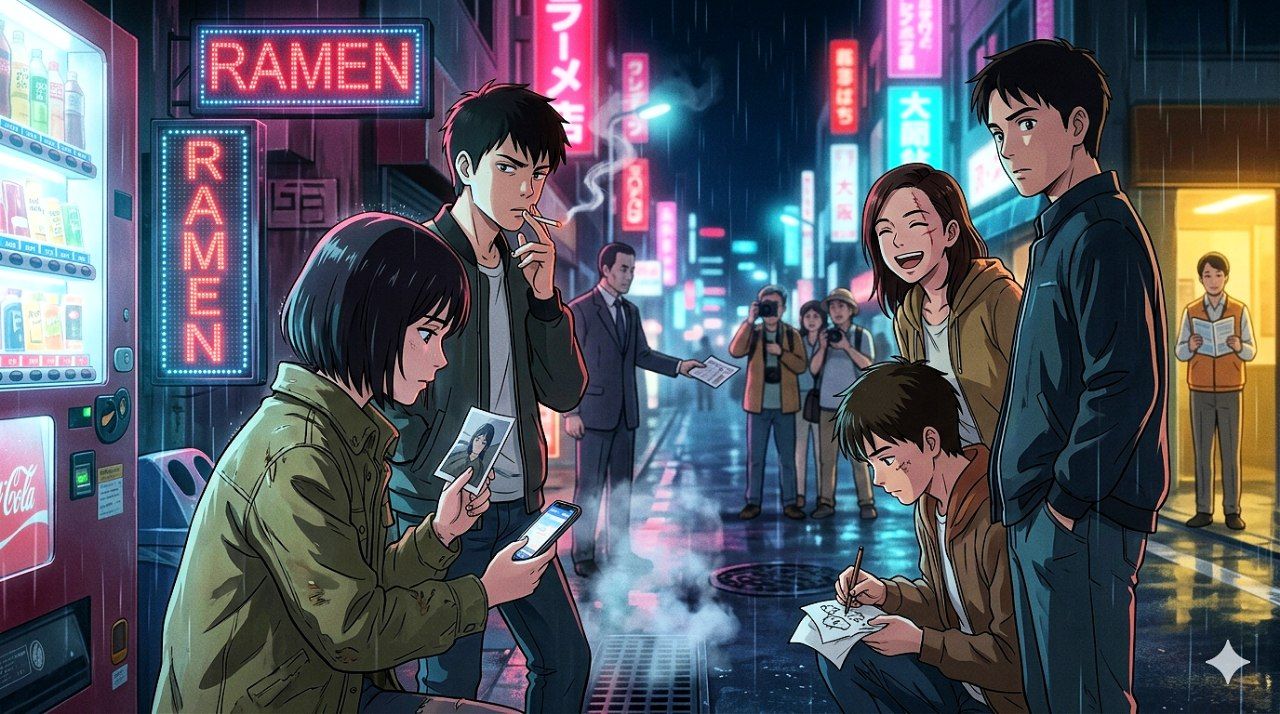
Short story: The Buffet Pigeon
On a block whose name no one could quite remember—they simply called it “the block of smells”—restaurants of every kind lined the street: a neon-lit pizzeria, a small bistro with checkered tablecloths, an empanada stand open late, and a soup food truck sending fragrant steam into the air. There, among sidewalk tables and conversations that smelled of coffee, lived Palomina, a pigeon who had made a decision as practical as it was decisive: flying was for those who hadn’t tasted the joy of a good after-meal.
Palomina had not been born with that vocation. In her youth she had taken to the sky, felt the wind beneath her wings, and known the freedom of the horizon. But one day, by chance, she flew over the pizzeria and was tempted by a rain of warm crumbs. It was one crumb at a time: the crunch of a crust, the sweetness of a forgotten cake crumb, the rich perfume of a piece of stew. Each bite made an unspoken contract with her stomach: “If abundance is served here, why waste energy on long journeys?”
“Fly?” she would say now, settling on a cardboard box turned throne. “If the world is served on plates, better to be here to taste it.”
Palomina perfected her craft with patience and creativity. She watched human routines: when the waiters left, when diners were distracted, which table was prone to carelessness. She discovered that speed wasn’t always the key; sometimes technique sufficed: setting a foot on the edge of a table, tilting her head with an offended air, emitting a soft coo of supplication, and waiting for the compassionate fork to offer a corner of bread. She learned to detect the exact instant a tray came down from the counter or when a family stood up, giving her access to the trash. Over time she no longer needed tricks and began to receive discreet invitations: a piece of croquette under a napkin, a crust hidden among serviettes, a tiny spoonful of rice falling as if it were for her.
Her feathered companions looked at her with fascination and bewilderment. Celeste, an athletic pigeon with bright eyes, couldn’t understand the new philosophy.
“Are you going to give up migration?” Celeste asked one morning, stretching her wings as if warming up for an adventure.
“It’s not giving up,” Palomina replied, her belly still tight from breakfast. “It’s a strategic relocation. What good is crossing continents if there’s stew here?”
Other pigeons, more practical, murmured, “That’s not a bird’s life,” but nobody could deny that Palomina had achieved an uncommon status: she was the most well-known pigeon on the block. Children sought her out like a local celebrity; delivery drivers tossed her crumbs as a sign of respect; a local chef nicknamed her “the feathered food critic” and left a small dish of mashed potatoes for her as a tribute.
Sedentary life brought comforts and challenges. Comforts: she never feared rain or snow again, she had a soft box to sleep in, and constant access to varied delicacies. Challenges: her love of the table changed her body. Her short flights became little jerks; her wings, once nimble, now needed a bit more thrust. She began to walk the sidewalk with determined steps, sometimes doing a curious wobble children called “the happy pigeon sway.” On steeper slopes she practiced the “controlled roll” technique: she would tip over, roll downhill like a small ball, and rise with dignity, shaking her feathers as if she’d finished an exercise routine.
One night, under the yellow light of the streetlamps and in front of the display window of a bakery sparkling with miniature pastries, Palomina saw her reflection. The figure in the glass was round and peaceful; her beak glinted with the grease from a recent croquette.
“Do you think you’ll miss anything?” the reflected pigeon asked without moving her lips, because Palomina’s inner reflections often had a voice of their own.
“Maybe the sky,” Palomina whispered. “But I also avoid colds, storm flights, and winter hunger.”
Her reflection looked at her kindly.
“Then continue,” the voice said. “But remember: the choices we make define us, and sometimes definitions can be stretched.”
Word of the gourmet pigeon spread through the block like a persistent scent. A curious local journalist immortalized her in a column explaining that urban life had produced a hybrid creature: an animal that, for the love of food, had traded sky for pavement. The piece, read aloud by morning customers, brought admirers and critics alike. Some called the pigeon “brave” for reinventing herself; others accused her of being lazy.
One afternoon, Celeste returned from migration with stories that seemed extraordinary: winds combing over mountains, northern lights dancing in the sky, and cities where buildings seemed to touch the stars. She landed beside Palomina with feathers still flecked with southern snow.
“We flew over rivers that looked like silver ribbons,” Celeste said, eyes still holding the distance of the road. “The air brings a different memory.”
Palomina looked at her, a piece of croissant in her beak.
“I envy you,” she admitted honestly. “Your world is infinite. Mine is bounded by the last table and the food truck’s trash can. But mine has flavors you don’t know.”
Celeste offered a feather as a symbol of what they shared.
“Bring a story next time,” Palomina asked. “I promise to try what you bring if you try a bite of my garlic bread.”
They both laughed. The conversation continued into the night, a mix of nostalgia and complicity. Celeste spoke of the grandeur of flight; Palomina spoke of the joy of a town that fed her. There were no reproaches, only recognition: different callings, equal dignity.
Over time Palomina became more than an anecdote: she became the block’s memory. Children told her story at bedtime; waiters debated her between tables; tourists photographed her without really understanding why. Even restaurant owners, initially hostile, learned to include her: a small plate with leftovers at the bottom, a deliberately placed slice of bread, a corner of crust for the crowned feathered queen. Some did it out of affection; others for the little fame the pigeon attracted.
Palomina tasted calmly. She learned unexpected combinations: a bite of empanada with a bit of salad for a vegetal crunch; a tiny portion of lasagna teaching the patience of layers; a sip of broth that recalled childhood soups. Each flavor carried an anecdote: the time she fell into a bowl of rice pudding and emerged dusted with cinnamon; the morning a girl offered her a whole grape; the winter an old man gave her biscotti crumbs dusted with sugar.
Not everything was indulgence: she had visits from the neighborhood avian vet, a woman in a white coat who once picked her up and advised more walking and less food. Palomina listened carefully but not rigidly: she cut some bites, practiced longer walks, even tried wing-flapping exercises. She never regained her former agility, but she gained balance and awareness: she loved her life and wanted to care for it to keep enjoying it.
One afternoon a boy asked her, curious:
“Palomina, why don’t you fly like the other pigeons?”
She cocked her head with the wisdom of someone who had made a choice and answered simply:
“Because I found something that makes me happy. Flying is beautiful, yes; but so is eating with friends and having a place to sleep without worrying about the wind. Everyone seeks their own sky.”
The boy nodded thoughtfully and gave her the last crumb of his snack.
Palomina’s fame turned into an urban legend: some exaggerated her appetite, others told of acrobatic feats on tabletops, and others depicted her as an example of reinvention. The block adopted her. Someone painted a small sign: “Palomina lives here,” and stuck it on the corner of her box. A street artist painted her on a wall wearing a crown made of napkins.
The moral of her life, if one wanted to extract it, did not come packaged in a single sentence. There were, however, woven messages: happiness takes different shapes; honest choices, however odd they may seem, deserve respect; and adaptation can be as much an act of courage as of comfort. Palomina had given up part of herself to embrace another, and she did it with pleasure and responsibility: she learned to walk, to take care of herself, to accept advice, and to return favors with companionship.
On an afternoon when autumn painted the leaves gold, Palomina perched on her box, looked down the street, and said for anyone who would listen:
“I’m not less of a pigeon for not flying all the time. I am a pigeon who chose her banquet and now shares the table.”
And so, among laughter, controlled rolls, and tastings, the pigeon who decided to live on a street full of restaurants—and who as a result had grown a bit plump—remained an endearing character of the block: witness to meals, confidante of passersby, and, above all, proud defender of her favorite motto, spoken in a deep, contented voice: “full belly, happy heart.”
Source of the images.
Image created with Google Gemini.
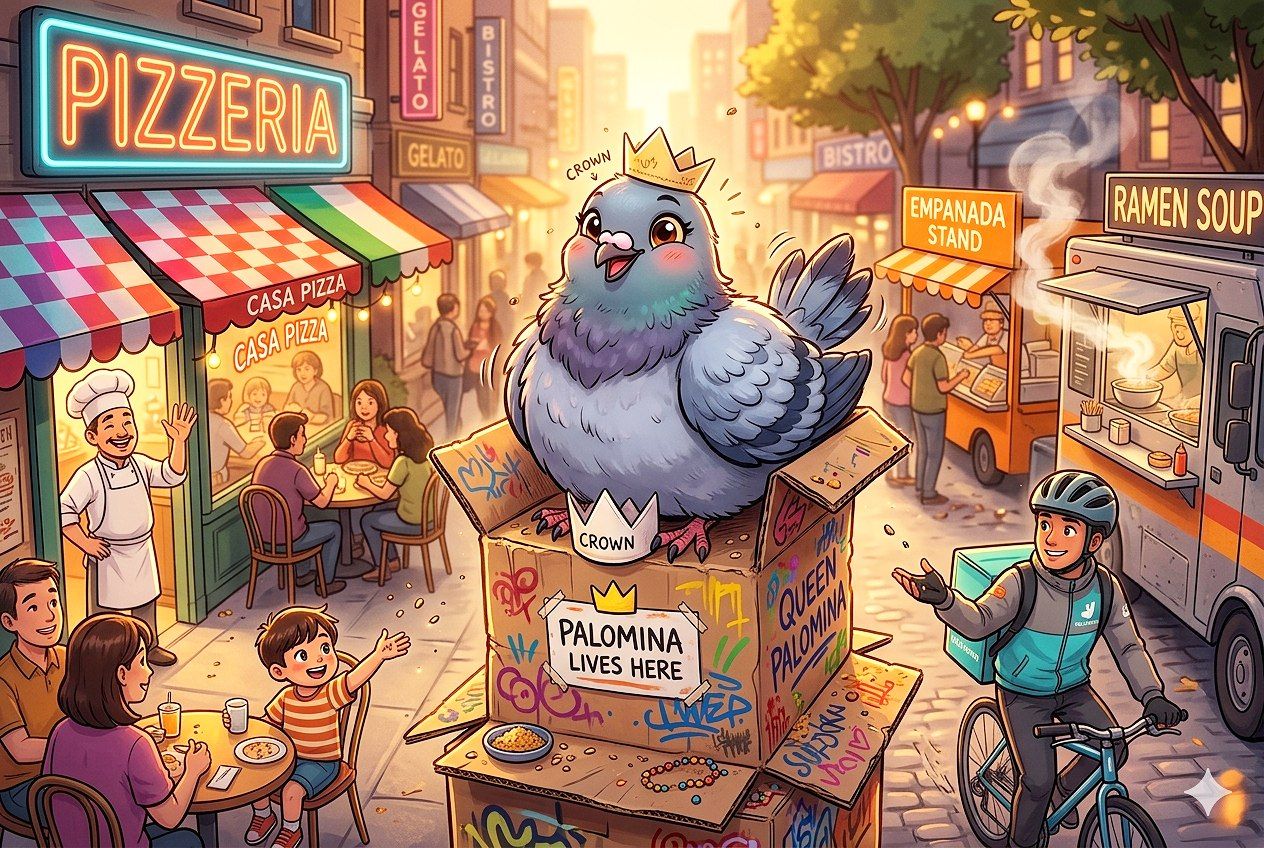
Short story: Broken Mirrors
The news arrived without warning: a pop-up forcing the screen’s glow to compete with the darkness of the room. Lara set the phone on her quilt and, still with the blue light ringing in her retinas, read the headline like someone hearing a sentence: ALERTA SALUD. Below, in smaller but equally harsh type, the UN warned of a severe deterioration in young people’s mental health worldwide. A report from the United Nations Development Programme noted that since 2012 young people’s emotional well‑being had fallen alarmingly, especially affecting women and girls. One in seven young people experienced mental health problems; suicide was the third leading cause of death among people aged 15 to 29. The report linked the phenomenon to accelerated digitalization, earlier access to smartphones and social networks, associating it with higher levels of anxiety, depression, and suicidal thoughts.
Lara closed her eyes and the news did not go away. It stayed lodged in her chest like a stone that could not find a channel. She was twenty‑two, and in her room the silences had the metallic texture of notifications that never came. On the wall, photographs hung with washi tape showing filtered versions of her life: fixed smiles, hands holding coffee, sunsets with exaggerated colors. Each image was a performative decision: what to show, what to hide, what to repeat until it became true.
Later, her mother Marta opened the door and sat at the edge of the bed without hurry. The hall light outlined her profile; her voice was practical at first, then cautious.
“I saw the report on TV,” Marta said, looking at the phone on the quilt. “They were saying… it affects a lot of young girls.”
Lara put her hands over her face as if she wanted to erase something she did not know how to name.
“It’s not just that it affects us,” she replied in a small voice. “It forces us to exist for others. I measure my day in likes and my relationships in stories that last twenty‑four hours. If no one reacts, I feel unreal.”
Marta sighed and searched for the child she once knew with absolute trust.
“When we were young,” Marta said, “wounds were seen and healed in company. We cried at a friend’s house, grandma made soup, we talked until dawn. There were no filters that perfected sadness. But I don’t want to romanticize: I’m not saying it was better—just different. Pain has always existed, but now it has a loudspeaker that amplifies the worst.”
Lara thought about the loneliness of being surrounded by virtual people. Not being able to take the phone out of bed without feeling like the circulation of her own worth was failing. Her voice coiled when she tried to explain something that made her feel guilty for simply breathing.
“Sometimes I look at myself and don’t recognize the person in the photos,” she murmured. “I force myself to look happy, write clever things, not make others uncomfortable. But inside everything is small and cold.”
Marta squeezed her hand as if words could be translated into a gesture.
“I believe you,” she said. “I don’t know how to fix algorithms, but I know how to listen. And if mothers can do one thing, it’s be present.”
Meanwhile, several kilometers away at a central high school, Álex adjusted his backpack with a mix of sleep and routine. Sixteen, messy hair, headphones that sometimes served as a shield. Stories arrived at him in chains: notes about the report, memes mocking it, adult arguments that felt more like accusation than invitation to understand. In the staffroom, a school flyer announced a talk: “Youth mental health: talk to accompany.” The news had done what news do: force the school to address what had been ignored.
The school psychologist, Clara, was tall, with a steady voice, and had spent years observing subtle changes that the report now put plainly before everyone like a red carpet no one wanted to step on. Entering the classroom, her presence produced that silence that happens when a bandage is suddenly removed and the view is exposed.
“Today I’m not going to give you a lesson,” Clara said. “I want this to be a space for talking—not for judging or saying ‘everything’s fine.’ I want you to listen and to be listened to.”
Álex looked at her with some distrust; to him the school was a circuit of classes and exams, not a place to expose vulnerability. Still, something in Clara’s use of “we” made him raise his hand.
“Why do I feel like I pretend all the time?” he asked, voice breaking. “I post photos with people I don’t actually see much, I read comments that tear me down, then laugh with GIFs so no one notices I’m hurt. Sometimes I don’t know who I am outside of that.”
Clara looked at him without pity or surprise, with the professionalism that comes from seeing many similar stories without becoming cold.
“What you describe is wear,” she answered. “It’s not cowardice or a moral failing. It’s the effect of living in an environment where constant exposure turns your inner states into marketable goods. When your emotion is subject to metrics—likes, views, reactions—you learn to calibrate it to keep acceptance. That doesn’t make you sick overnight, but it makes the ground slippery. The report gives numbers, but behind every figure there are people like you who deserve to be heard.”
There was an odd energy in the room: relief at being allowed to say it and fear because saying it meant receiving an answer that might not be what they hoped. Fingers tapping on backpack straps vibrated with silent messages some read on their screens at the same time.
After class, in the park across from the school, the air smelled of mown grass and unkept promises. By chance, Lara and Álex met: a mutual friend had introduced them after a community meeting. Lara had gone out to walk to turn off the screen and not her mind; Álex wanted to see if it was possible to converse without subtitles.
“Hi,” Álex said, extending his hand without knowing whether a greeting still meant anything real.
“Lara,” she answered, returning the handshake with a laugh that tried to be natural but stuck for a moment. “Did you come because you were tired of notifications too?”
They sat on a bench overlooking a pond where some teens fed ducks with leftover bread. Placing the phone on the grass was, for both, a tacit declaration: an experiment in presence.
“Sometimes my life feels like a song I have to play without mistakes,” Lara said. “When people change the volume, I feel my rhythm fail. I compare myself to edited profiles, to hours that aren’t mine. I post and then wait for approval. It’s a silence that chews.”
Álex looked surprised that her words matched what he had been unable to explain at home.
“I do the same,” he confessed. “I post things that don’t show my bad mornings. I’m afraid that if I show I struggle, people will stop looking. We’re all a network of mutual omissions.”
They laughed; the laugh was cathartic. Saying things aloud let the words unfold and lose some of their strangling power.
“Do you think anything can change?” Lara asked. “Adults sign papers and the algorithms stay the same.”
“I don’t know,” Álex answered honestly. “Maybe we can’t stop the technology, but we can learn not to let it shape us entirely. Maybe start with small acts: screen‑free gatherings, set times to disconnect, conversations where we don’t feel obliged to ‘perform’ an image.”
They shared a silence that was not empty but a shared room where someone else held a similar weight. It was a faint but real relief.
Days passed quickly, and as if life needed to validate its worst fears, the news everyone dreaded arrived: Bruno, a teammate of Álex’s, had attempted to take his life. The words reached the group like a gruesome notification: “I’m sorry. I can’t keep going.” The friend group was in shock; nobody had perceived the silent scream. The crack had not been visible.
Marta learned by a message that reached Lara’s family. That night, in the kitchen, the sound of the frying pan was a near heartbeat marking the house’s pulse. Marta sat with hands wrapped around a cold cup of tea.
“I didn’t know what to do,” she admitted softly. “I thought it was just a phase, that it would pass. And now…”
Lara found her in the hallway and hugged her desperately.
“If we had known earlier…” she whispered.
“Don’t blame yourself,” Marta said firmly but with old sorrow. “No one has a manual for this. What we can do now is be.”
Bruno’s attempt worked as an incision revealing the rawness beneath what had previously been patched with notifications. The school organized meetings with family, psychologist Clara intensified sessions, and community listening spaces were opened: a municipal room, support groups, and a volunteer‑staffed helpline. The community reacted—clumsily at times, with sensitivity at others—showing that empathy can be taught.
In one afternoon of those meetings, Marta decided to take part as a mother figure. She sat in a semicircle in front of youths who came wary but with a mixture of curiosity and need that cannot be denied. Marta spoke with the voice of someone who had learned to listen and not to offer quick fixes.
“I’m a mother,” she said to the group. “I don’t understand many apps or how algorithms decide what appears and what doesn’t. But I know how to recognize when a person goes dim: they laugh less at the table, forget their plate, go out less. I learned to pay attention to signals that say ‘something’s wrong.’ Technology isn’t all to blame; it just exposes what we live. We can learn to accompany one another.”
A seventeen‑year‑old girl spoke up with held breath.
“Sometimes the only thing I ask is that you believe me,” she said. “Don’t tell me ‘it’s just a phase’ or ‘it’s adolescence.’ When no one believes you, you start lying to yourself until you get used to it.”
Clara added with both professionalism and tenderness: “Digitalization accelerates processes. It doesn’t invent sadness, but it amplifies it: allows comparison in real time, magnifies rejection, and disguises loneliness as connection. The UN report gives us numbers—one in seven—but behind that figure are names and voices that require presence.”
The conversation was long; silences were as important as words. A father confessed with a broken voice that he didn’t know how to approach his daughter because each attempt ended in misunderstandings and closed doors. A young woman revealed she composed upbeat posts precisely when she most needed help so as not to burden others. Every testimony revealed a wound and a possibility for repair: attention, listening, accompaniment.
From those meetings concrete initiatives emerged. The school integrated “emotional and digital literacy” workshops into the curriculum: how to recognize signs of suffering, regulation practices, setting screen boundaries, and presence exercises. The municipality funded a free helpline for youth with nowhere else to turn. Youth groups organized “no‑post nights”—in‑person gatherings where the sole rule was no phone use for an hour.
The early gatherings were awkward. The habit of checking screens was so ingrained that hands reached pockets by reflex. Sometimes someone broke the rule and tension spiked. But persistence turned awkwardness into new habits: laughter without background noise, looks that could be held without consuming them, stories shared with no cameras demanding staged authenticity.
Bruno, after a long painful process, returned to the field on afternoons when his smile was fragile but present. Nothing was solved; there were hard days and relapses. But his presence, tentative and gentle, was tangible proof that change was possible when professional support and caring networks combined.
Lara continued learning what she needed. She established digital boundaries: turning off notifications, agreeing on screen‑free times, choosing whom to share intimate things with. She started a private journal with no thought of anyone else reading it. Over time the practice helped her tell apart the public version of her life from what truly mattered.
She didn’t erase her photos; she grew selective about what she posted and how much energy she spent on others’ opinions.
Álex organized park gatherings with friends to discuss books, films, and the experience of being young in a world that demands performance. They began small and grew. Some nights no one spoke and company was enough. Other times they spoke of guilt, identity, and the pressure to project an unbroken life. Together they learned to ask and answer without judgment.
A year after the headline flashed on Lara’s screen, the city showed modest but meaningful changes. Schools made emotional well‑being protocols part of routine—not as a media trend but as sustained practice: listening days, family resources, ongoing workshops. The local government added youth mental health promoters in community centers and youth organizations began receiving small grants for meet‑ups and support projects.
None of that erased the report’s cold number—one in seven. The statistics remained, a reminder that the problem is systemic and solutions cannot rest solely on individuals. But the conversation had shifted: it was no longer only about blaming technology or lamenting shared loneliness. It was about building ways of life that integrate technology without letting it define self‑worth.
One autumn afternoon, on the sofa, Marta and Lara shared a simple scene: a book, a cup of tea, and the quiet of not needing to document every gesture. Marta looked at her daughter and, without melodrama, said:
“I can’t promise this will be easy. What I can promise is that I see you—not only how you present yourself but how you are when no one’s watching.”
Lara rested her head on her mother’s shoulder and felt a security that didn’t depend on others’ reactions. Being seen without judgment became a reparative space; it did not cure everything at once but wove a net of containment.
At the park bulletin board, Álex found Bruno practicing soccer with a group that greeted him without morbid curiosity and with practical care. Bruno smiled—small and tentative but his own. At the end he sat and said softly:
“There were moments I thought I didn’t want to be here. It wasn’t that I didn’t want to live, but that I couldn’t carry what they asked me to be. Thanks for being there when I needed it.”
Álex felt deep relief. There were no heroics, no perfect endings—only everyday presences that held.
The city of broken mirrors did not stop reflecting altered profiles or producing anxiety. The networks still ran algorithms; screens remained temptations and many young people continued to struggle with exposure. But the community response had added a new dimension: sustained attention. They learned that figures only change when society decides to listen without judgment, create safe spaces, and fund resources that don’t collapse with the next news cycle.
In the final scene, on a mild spring day, Lara wrote on a plain sheet: “If anyone needs me, I’ll be here.” Her handwriting was human and trembling. She pinned the note to the park’s board, where it wasn’t meant to attract likes but company. The gesture was simple, small, and unpretentious: an outstretched hand in a still‑fragmented landscape.
The story does not end with a perfect epilogue: the statistic remains a somber reminder, and the struggle continues. But something else emerged—discreet and powerful: the certainty that presence matters, that listening saves, and that authentic connections, though fragile, can mend seemingly irreparable cracks. In a world of mirrors and screens, some chose to learn how to look each other in the eye. That choice became, for many, the beginning of a possible cure.
Source of the images.
Image created with Google Gemini.
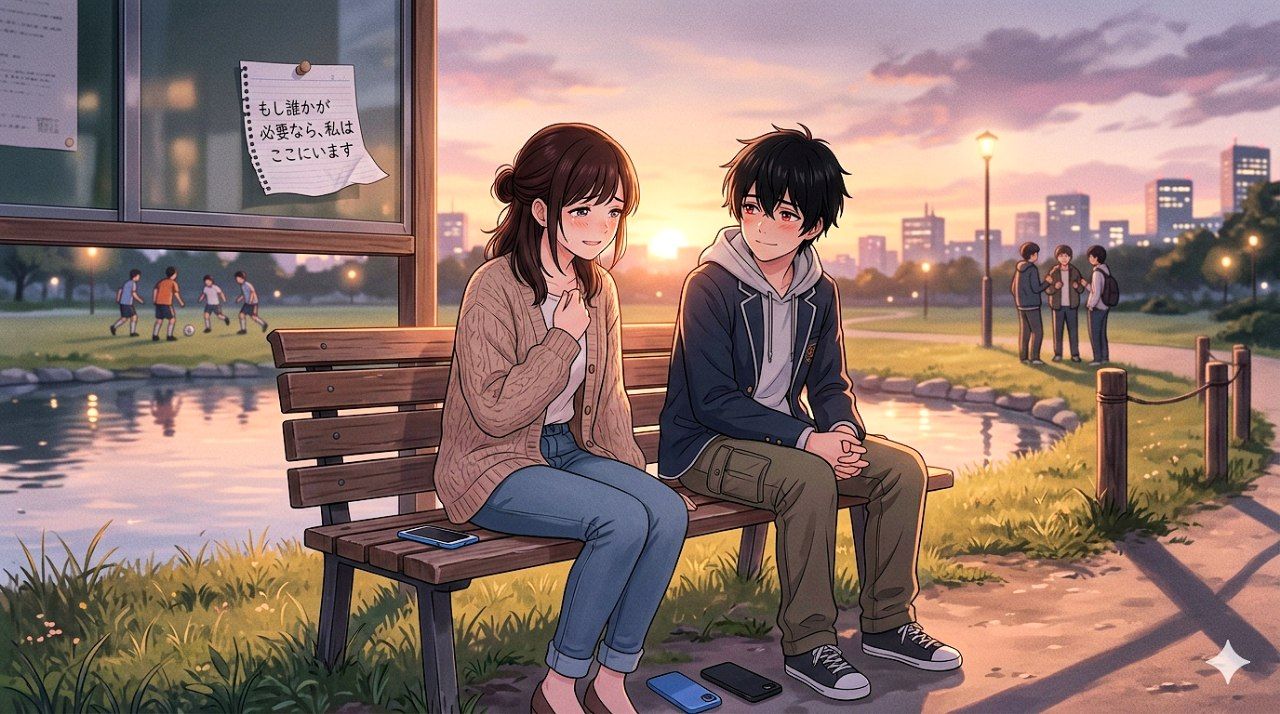
Short story: The Tide of Silence
The beach woke slowly, like someone stretching an asleep body. The tide had pulled back enough to leave a fan of gray, damp sand dotted with broken shells and black seaweed. The street vendors still smelled of coconut and hot oil; the murmur of the sea and distant bar music mingled in the warm air. That morning, no one noticed that the beach was waiting for something.
Nai arrived with her hair loose and an easy laugh that seemed to script scenes for the camera. She was known online: her videos mixed landscapes, travel tips, and intimate confessions that made her feel close. Pim, her childhood friend and occasional assistant, followed carrying an umbrella, an improvised reflector, and bags of props.
“Is the shot ready?” Pim asked as she spread the towel on the sand.
“Always ready,” Nai replied, setting the phone on the sand with the lens aimed at the horizon. She made her usual thumbs-up gesture. “It just has to catch the ending.”
Pim frowned.
“Be careful with the current, Nai. The water looks strange today.”
Nai laughed and brushed the warning aside as one brushes away passing clouds.
“Don’t worry. I’m a good swimmer. Besides, if a wave takes me, it’ll be epic content.”
They placed the phone face up on a small towel, the camera fixed on the vast blue. The recording counter began to blink: recording. The light shone on the screen and, for a moment, everything was calm: the wind, the distant click of a boat, the voice of a vendor selling coconuts.
Nai stepped into the water lightly, the sea kissing her knees, then her hips. Pim watched from the shore, holding her breath while the phone on the towel kept recording. A child ran by; a couple kissed distractedly; the scene seemed the same as always—a postcard no one suspected could turn into tragedy.
“Nai, don’t go too far,” Pim shouted as the young woman went out where the waves broke.
“Just a bit,” Nai replied, turning and throwing a smile that did nothing to ease the worry in Pim’s eyes.
The water changed without announcing it. What at first was a friendly sway became a subtle, constant pull that drew the sand from under Nai’s feet. She lifted her arms, tried to find balance, her hair plastered to her face. Pim lunged to the edge, but she couldn’t move her legs in the moment a larger wave hit with violence.
The fixed camera on the towel recorded the scene helplessly: Nai struggling against something unseen; a crest of water higher than the rest that swallowed her in an instant; the screen flashed white from the spray, and in that white remained the frozen image of someone who had crossed the line.
A hand—unexpected—entered the frame seconds later: that of the passerby who had walked by without looking. Marcos, a traveler with worn shoes and a bag of hostel flyers, saw the phone trembling on the sand and bent to pick it up. He rested his elbows on the towel and, out of conscience or curiosity, played the video.
He watched it once and knew he had to take the phone with him. He didn’t know the girl thrashing on the screen; yet Nai’s frozen face, her wide eyes, and the wave like a wall lodged in his throat like a stone.
“Are you okay?” Pim asked when, minutes later and after catching her breath, she approached Marcos holding the phone.
Marcos swallowed and showed her the screen.
“I saw everything,” he said in a hoarse voice. “Nobody’s pulled her out yet.”
Pim dropped to her knees in the sand. Her fingers trembled as they touched the screen, as if time could be caught that way.
“Call the police,” she whispered, too weak to do anything else.
The town station soon filled with reporters and onlookers. Within hours someone uploaded the clip to a viral account and, like a current, it began to spread: comments, plays, theories. The video became a magnet for eyes seeking spectacle, and with it the question no one could answer: what had really happened?
Officer Somchai, with a tired look and wrinkled uniform, took the phone with sweaty fingers and let it play in slow motion. On the screen the scene looked crueller: Nai fighting, a trail of foam, the crest that consumed her. No scream was heard. No one reached her.
“Call the taxi boats—get me a boat,” Somchai ordered softly. “We’ll search the area until night defeats us.”
Meanwhile, Marcos felt responsible for having the phone. He took it to his hostel and left it charging on the bedside table. He didn’t think his actions would ignite something the town couldn’t put out.
Days followed the tragedy with an inexorable rhythm. Pim didn’t leave the beach; she watched the sea with hollow eyes, unable to erase the last image from her mind. The press demanded coordinates; curious people began to arrive, hungry for mystery.
“Miss Pim,” a reporter asked, thrusting a microphone, “do you have any idea exactly where this happened?”
Pim shook her head.
“I’m not sure,” she answered. “I only remember a rock, a small pier… I can’t say more.”
The rumor spread across networks like tidewater: people demanded the exact beach of the incident and promised they would come to see it with their own eyes. Some paid to get images; others offered supernatural theories. The need for identification, for a defined place for loss, became a collective urgency.
But Marcos didn’t want publicity; he wanted answers. He returned to the beach that afternoon and walked with steps of research rather than grief. Among the foam he found small clues: a torn sandal, a bracelet with a rusty charm. Nothing of Nai’s, but each find urged him forward.
Walking along the shoreline, he noticed footprints leading into the undergrowth and followed them on impulse to a cliff that opened into a hidden cove. There, on wet black rocks, the tide had left vivid marks; and on a crest, as if someone had purposely placed it, he found an object covered in salt: Nai’s necklace, with a tiny shell-shaped charm.
Marcos backed away. The discovery left him breathless. The beach, which at first had seemed a scene of accident, began to take on the texture of something intentional.
That night an envelope was slid under the door of the hostel where Marcos stayed. No return address. Inside, a printed photo: the sequence from the video, but with a detail not visible in the compressed online version—a reflection on the crest, a blink that showed a pale face, eyes too dark, a smile that didn’t meet the skin. On the back, a note with trembling letters read: “Don’t look when the tide calls you.”
Marcos felt a chill he couldn’t shake. Who could have cropped that image and left it there anonymously? What or who watched from the depths?
The photo’s news spread as fast as the original clip. Pim saw it, and suddenly the memories she’d kept began to scatter. One night, while checking old messages, she found something that left her breathless: a text from Nai, brief and enigmatic: “If one day the sea decides to ask for me, don’t stop me. I want to understand it.”
“What did she want to understand?” Pim asked aloud, clutching the phone. “What made her say that?”
Nobody had the answer. The puzzle pieces refused to fit. Police questioned fishermen and locals. Some spoke of treacherous currents; others spoke of old legends. Mae Suda, an elderly woman who kept the town’s memory, offered her version with the patience of someone who had seen the sea claim its stories time and again.
“The tide has memory,” Mae Suda said, the skin of her hands mapped with wrinkles like routes. “It is not that it takes out of malice; it takes to balance. There are things that belong to its realm.”
“What kind of things?” Somchai asked, his skepticism tinged.
“Memories,” she replied softly. “What the water refuses to let die, sometimes it preserves. And when something calls from below, the tide can answer.”
The town split—some wanted to exploit the mystery (tourism, documentaries, clicks); others looked at it with fear, afraid curiosity would awaken something worse. Meanwhile the video continued to circulate, spawning theories from fatal current to deliberate intervention.
Calm seemed to hold its breath the night the second video appeared. A fisherman claimed a camera had been fixed on a rock watching the cove for days. In that recording Nai approached the water, but behind her, among the rocks, a furtive figure moved deliberately; a quick hand threw something into the sea at the moment Nai lost her footing. It wasn’t a shell or a stone: it was a small dark object that caused an instant whirlpool.
“Did you see it?” Marcos asked, showing the clip to Pim and Somchai under a lamp. “There’s someone there. The sea isn’t alone in this.”
Pim could not hold her gaze. The whirlpool on the screen looked like a small mouth opening to swallow the shore.
“If someone tossed it,” she whispered, “then someone knew what would happen.”
Somchai ordered a stricter search. He asked about visitors, strangers in the area hours before, and found incomplete name lists and unanswered phones. On Nai’s phone, among messages and photos, there was a slip of a clue: a local number leading to an empty voicemail; an old log showing a single incoming call at midnight days before the incident.
Days became weeks. The tragedy left an indelible mark on the coast: people who approached the cove began to experience strange things. A fisherman recovered a photo of his wife as a young woman he thought lost; a child found his first toy among the foam; an old man remembered an entire song he had forgotten decades ago. Everything the tide returned seemed to come from memory, as if the beach were a camera returning fragments of forgotten pasts.
Marcos noticed a pattern: every returned object came with a cost. Those who found them slept poorly; they had dreams in which a voice called their name; dreams where the water offered pieces of their life in exchange for something never specified. The town feared the beach had set a form of exchange.
Mae Suda, whose knowledge had guided conjectures, proposed something that sounded like a rite and desperation equally.
“If the tide takes memories,” she said, “we must give it something in return. Not coins, not rags. Something with intent.”
Pim, driven by guilt and the need to say goodbye, accepted. Marcos, driven by curiosity and a loyalty to truth, volunteered to help. Somchai, torn between duty and skepticism, agreed to accompany them and keep order.
They gathered sentimental items donated by the community—photographs, letters, a pocket watch, a necklace, a scrap of cloth with a handwritten note. Mae Suda murmured old words no one fully understood; her language shaped the wind. On the edge of the new moon they walked to the cove with a basket of offerings and a makeshift ceremony.
“I don’t know if this will work,” Marcos said quietly, holding a photo.
“We have nothing else,” Pim replied, voice breaking. “Either we give something, or doubt consumes us.”
Kneeling at the water’s edge, Pim held the basket in hands that trembled. Mae Suda intoned what sounded like a wave and a creak of shells. Then, as if it were the only sensible thing, they tossed the basket into the sea.
At first the surface did not answer. The moon hid behind a cloud and silence felt like a wall. Then, like a breath, the water calmed; a figure rose, only for an instant: a reflection, not a body, a translucent image floating in the foam. Everyone watched in stunned silence.
“Nai,” Pim called, voice raw. “If you’re there, come back.”
The reflection made a slight gesture of the hand—subtle, almost imperceptible—like a wave or a farewell. A flash and the image dissolved. The tide finally returned something: Nai’s necklace, a note wrapped around the charm. Pim took it with trembling fingers and read the scrap inside. The handwriting was small and steady:
“Don’t look for me in your world. I learned to listen.”
The cries that followed were both relief and desolation. Pim didn’t know which emotion was purer: knowing that, in some way, the person she loved still floated in the tide’s memory, or accepting that Nai had chosen a place from which she would not return. The note offered no explanation, only a painful statement.
Formal investigations found no human culprit. Police closed the case as “disappearance at sea,” a rare combination of inexplicable fatality and lack of evidence. Those demanding names and justice were left empty-handed; those seeking supernatural answers found in the beach a new legend to tell.
Marcos stayed for weeks, obsessed with the phone he’d found on the first day. He examined files, compared metadata, searched messages and finally discovered a hidden frequency in an odd audio file: a nursery tune in a language he couldn’t identify, a melody that matched Nai’s ringtone used to close her videos. Each playback blurred the world a little more.
Pim withdrew into solitude. She moved to a neighboring town, trying to rebuild a life without cameras or viewers. She stopped recording; she stopped chasing approval. Somchai continued patrolling the coast with a mix of respect and fear that kept him watchful.
The beach transformed. Curious people turned it into a destination. Pilgrims left objects—some offerings, some wagers with the unknown. With each visitor the beach seemed to accrue memory: cameras that failed, phones that replayed fragments of Nai’s life out of context, voices calling strangers’ names in the night.
Before leaving, Marcos decided to safeguard the phone and images—not to profit, but to preserve evidence that something had happened. He kept the printed photos, the anonymous envelope, and the sense that he had touched a border humans should not cross. Pim kept the necklace with its note in a drawer, a relic that comforted and tore her apart.
Mae Suda died on a rainy afternoon. Her funeral was small and silent, the beach looming in the background like a presence that both watched and claimed. Before she died she issued a final warning: “Don’t confuse curiosity with courage. Some places belong to the sea’s memory.”
Years did not heal the wound entirely. The beach continued returning objects—buttons, photos, a child’s shoe. Each find brought a fleeting consolation and a pricking loss. Visitors learned that they could photograph the tide and post stories, but the essence of what had happened there slipped through their fingers like water.
Some tried to repeat the exchange ceremony, hoping to recover what the tide had taken. Some swore they had retrieved precious items; others found nothing, and some claimed they’d heard voices. The beach became a place of tacit pacts: those who understood the exchange respected it; the rest left with stories they could not classify.
At night Pim sat on the shore holding the necklace in her fingers. She stared at the horizon until her eyes burned and listened with an attention bordering on superstition. Sometimes she thought she heard a nursery rhyme—not of this world—rising from the water like a lullaby. Other times she only felt the wind.
Marcos, far away, wrote about the experience with words seeking truth, not fame. Distance gave him clarity he lacked on the island: he understood that some tales are instructions—that curiosity can be a thread leading to unasked-for doors. His account circulated in small circles, keeping alive a warning others preferred to ignore.
The Tide of Silence kept doing its work. Sometimes the sea returned pieces of the past; sometimes it insisted on silence. The truth about Nai remained woven into a blurred edge between what was real and what the water’s memory chose to keep. The note on her necklace, simple and laconic, became the clearest verdict: “Don’t look for me in your world. I learned to listen.”
Years later, when someone plays the original video of Nai’s last seconds, the screen reproduces the scene with the same implacable serenity. Comments still demand explanations; some users cling to conspiracies, others to the idea of voluntary sacrifice. No theory fully encompasses the depth of the event. The beach continues, indifferent and patient, keeping its secret in every wave that comes and goes, in every object that returns to the sand as payment for the privilege of looking.
The sea offered no more reasons. What it gave was a subtle lesson: there are shores where curiosity should turn into respect, and questions that, once answered, leave a void deeper than doubt. Pim learned this with guilt and loss; Marcos learned it with the responsibility of having picked up a phone that started everything; Somchai learned it with the consciousness that the law cannot contain every risk; and Mae Suda learned it in death, with the peace of someone who performed rites of memory.
The beach, meanwhile, remained a point on the map some visited to defy or revere. Sometimes at dawn small footprints could be seen heading toward the shore and vanishing without returning. People said they were the prints of those who had paid the price of understanding. Others claimed they were Nai’s, walking now in a place neither wholly hers nor entirely someone else’s.
The last image to linger was the simplest: an open shell in the sand with a tiny crumpled paper inside where, in nearly imperceptible handwriting, someone had written: “Listen before you speak, and respect what only the water knows.” The phrase, which spread across the web and through the town, became a quiet warning for those who seek answers in the murmur of waves.
And so, the tide continued its work, holding memories and returning them with conditions humans barely understood. Some accepted the lesson; others forgot it. But on the edge of that liquid world one certainty remained: there are mysteries that are not resolved by questions, but by the humility of those who decide not to profane what the sea has chosen to keep.
Source of the images.
Image created with Google Gemini.

Short story: Jazz Conditioned
In the heart of the Cronos Institute, behind a door labeled with a saxophone sticker and the word CAUTION, sat the Sound Laboratory. There, among tangled cables and shelves full of transparent cages, Dr. Sofía Márquez reviewed the protocol with the seriousness of someone tuning a concert. When she exchanged glances with her team, scientific certainty mingled with a curiosity that sometimes bordered on mischief.
“Ready to turn science into a pop hit?” asked Leo, the technician, rolling up his sleeves as if he were about to take the stage.
Sofía smiled and adjusted the field microphone that would record the responses. To her left, Professor Emilio Roca, a neurologist in semi-retirement who still came to the lab out of habit, watched with a steaming cup of coffee in hand.
“If by ‘hit’ you mean an uncomfortable revelation about free will, then yes,” she replied. “Play jazz.”
From the main speaker came a moist, slow saxophone solo, the notes brushing the air of the lab. The rats, arranged in their compartments, barely moved; they closed their eyes, curled up together, and in that calm it was almost possible to imagine they were listening to a symphony made for tiny ears. The monitors promptly showed the usual pattern: preference for silence and occasional spikes in response to classical music.
“I always said good music is the kind that makes you think, not the kind that forces you to wag your tail,” Roca grumbled, half joking, half serious.
Sofía offered him a cookie with a conciliatory gesture and continued. It was time to introduce the experiment’s variable X: Reward-7, a candy designed to produce a measured, uniform pleasurable reaction. The hypothesis was simple: if the music was consistently paired with a reward, the brain would associate the two stimuli.
“Here comes the fun part,” she announced. “When jazz plays, a small portion of Reward-7 will appear on the tray. We’ll repeat the cycle several times a day for a week.”
The first sessions were almost ceremonial. Each time the jazz sounded, a tiny gate released the candy. A particular rat, whom Leo had nicknamed Bossa for the calm she’d shown in preliminary tests when bossa nova played, sniffed the sweet, licked its edges, and let out a small chirp the interface translated as pleasure. The graphs showed spikes: synapses firing, reward circuits forming.
Over the days the correlation became clearer. The rats began approaching the speaker at the first bars of jazz, like pilgrims to a sonic relic. Leo, inclined to turn science into entertainment, fantasized aloud.
“I programmed a 24/7 playlist for rodents! Imagine festivals with seed discounts,” he said, provoking a laugh.
Sofía, however, maintained a reflective tone.
“Careful not to turn observations into spectacle. This association doesn’t mean the rats now ‘prefer’ jazz for aesthetic reasons; it means they learned to link a sound cue to a reward.”
The experiment continued. After a week of pairings, the candies stopped appearing; the team expected the response to fade. But, contrary to conservative predictions, the rats maintained their behavior: when jazz played they returned to the grill by the speaker, searched the folds of the enclosure where the rewards used to appear and, in many cases, seemed to emit small sounds humans interpreted as a kind of humming.
One afternoon, Roca set his cup on the table and approached the glass, mouth open.
“What… what are they doing?” he asked, not understanding how a conditioned behavior persisted without the rewarding stimulus.
“Associative memory,” said Sofía. “The brain filed jazz as a predictor of something pleasurable. When it hears that cue, circuits anticipating reward activate; the behavior repeats out of expectation.”
“What if we push it further?” Leo proposed with bright eyes. “Could we program preferences in humans? Would that be manipulation or therapy?”
The question hung heavy in the air. That night, in a nearby café, the three discussed at length. Toasts cooled as they debated the philosophical, ethical, and practical implications of their finding.
“If small rats learn to desire by association, how many of our ‘preferences’ are merely shadows of past rewards?” Roca wondered. “Music, foods, places…”
“Or worse,” said Leo, “what if a company decides to mass-produce Reward-7 and sell us tastes to subscribers? Imagine a platform that ‘teaches’ you to love a brand with auditory cues and rewards. A market for cravings.”
Sofía let out a laugh with an edge of concern.
“That’s the science-fiction part bleeding into science. Our work should help understand and heal, not create more programmable consumers.”
The following week, when a technician unplugged and reconnected a poorly soldered cable, something unexpected happened: the speaker, for a second, emitted an unplanned signal, a frequency none of them recognized. The wave passed through the cages like an electric sigh; the rats reacted with a simultaneous movement that looked choreographed. Their tiny paws traced shapes on the floor, little lines of memory no one had taught them. It was a moment both comic and sublime: rats dancing to a tune that sounded like it came from another galaxy.
“What the hell was that?” Leo asked, half laughing.
Roca, in his most scientific manner, wrote in his notebook: “Unexpected resonance effect. Potential use in motor rehabilitation.”
Bossa, the curious little rat, stepped forward and, with a naturalness only nonhuman creatures possess, pushed Leo’s headphones toward the grate. The gesture was so direct Leo was left speechless.
“Is she returning the music to me?” he murmured, moved.
Sofía watched and felt the observer-observed dynamic begin to invert. The rats, conditioned by rewards, now exerted influence: with subtle motions they indicated a preference for a playlist that blended jazz with synthesizers—something like sidereal jazz. The humans responded by adjusting lights, aromas, and textures to see whether behavior would change. Soon the lab had become a peculiar experimental club where both sides co-designed the atmosphere.
As the project advanced, the team’s conversations deepened. One rainy afternoon, while they reduced the sugar concentration in Reward-7 to measure the association’s robustness, Professor Roca made an observation that resonated gravely.
“What we observe is not just neuroplasticity,” he said. “It’s an economy of desire. The brain catalogs cues and turns them into demand. If we can manipulate that ethically, we could help people with addictions by pairing healthy stimuli with rewards. If not, we’re inventing markets for cravings.”
Sofía nodded, thoughtful.
“Ethics must lead curiosity. Understanding how desire forms is a tool. In wise hands it heals; in greedy hands it exploits.”
Meanwhile, Bossa and the other rats continued in their role as inadvertent teachers. In a particularly quiet trial, Bossa climbed a lever by accident and released a high, perfectly pure note, crystalline as glass. The lab fell silent and for a moment no one breathed. The note resonated and left on the wall the vibration of something essential: a simple, hard truth.
The experiment made local headlines with a sensationalist headline that reduced months of work to a colorful phrase. “Rats love jazz for sweets: will humans follow the trend?” the papers asked. Social networks soon filled with memes of rats wearing sunglasses and tiny saxophones. The team, more tired than annoyed, shared a laugh and accepted the inevitable trivialization.
But in the institute’s halls and in the lab notebooks there remained other things: detailed graphs, technical observations, timelines with curves showing consolidation of associative memories. Beyond the joke, the team knew their finding opened a door between neuroscience and applied ethics.
As the project matured, they implemented “detachment” sessions: neutral music, alternative rewards, and exercises to weaken associations. They discovered the bond could be redirected: pairing jazz with neutral or even unpleasant stimuli reduced the response; pairing healthier melodies with non-food rewards—warm lights, pleasant textures—could encourage beneficial behaviors. They had found a form of reprogramming—not of essence, but of habit.
One night, while closing the lab, Sofía deliberately placed a record of classical music on the turntable, a small gesture of respect for the rats’ original preferences before the experiment. On her desk she left a tray with two candies: one for Bossa and another symbolic one she would not eat. Before turning off the lights she walked past the cages and whispered:
“Good job today. Let’s not let the data turn us into mere consumers of astonishment.”
Bossa took her candy and, between bites, made a movement so slight it seemed like a wink. In that gesture there was something akin to gratitude—not human thanks, but a response that said, “I learned to desire; now I can learn to choose.”
In the days that followed there was more work, ethical reviews, and proposals to apply the findings to human addiction therapies. The lab received visits from psychologists, therapists, and a couple of advertisers who, fortunately, remained in the corridor. Discussions grew political: grants, regulation, limits. In those meetings the comic anecdote of rats with the soul of music critics persisted, but it was no longer central; the core question was more complex: what do we do when we know how to shape desire?
In the project’s final field journal entry, Sofía wrote:
“The experiment showed us that desire is not entirely spontaneous; it is, to a large extent, a construction. That doesn’t invalidate it or make it vague; it makes it manipulable. Our responsibility is enormous: we must use this knowledge to expand freedom, not to curtail it.”
And so, between the involuntary laughter of seeing rats “humming” jazz and the gravity of what that meant for humanity, the Sound Laboratory team learned a double lesson: science can make the improbable evident, and the improbable can be as dangerous as it is promising. The story of Bossa and her tiny orchestra remained an anecdote and a warning: music, reward, and memory are tools—neither good nor bad by themselves—that demand, above all, an ethical compass to guide them.
Source of the images.
Image created with Google Gemini.
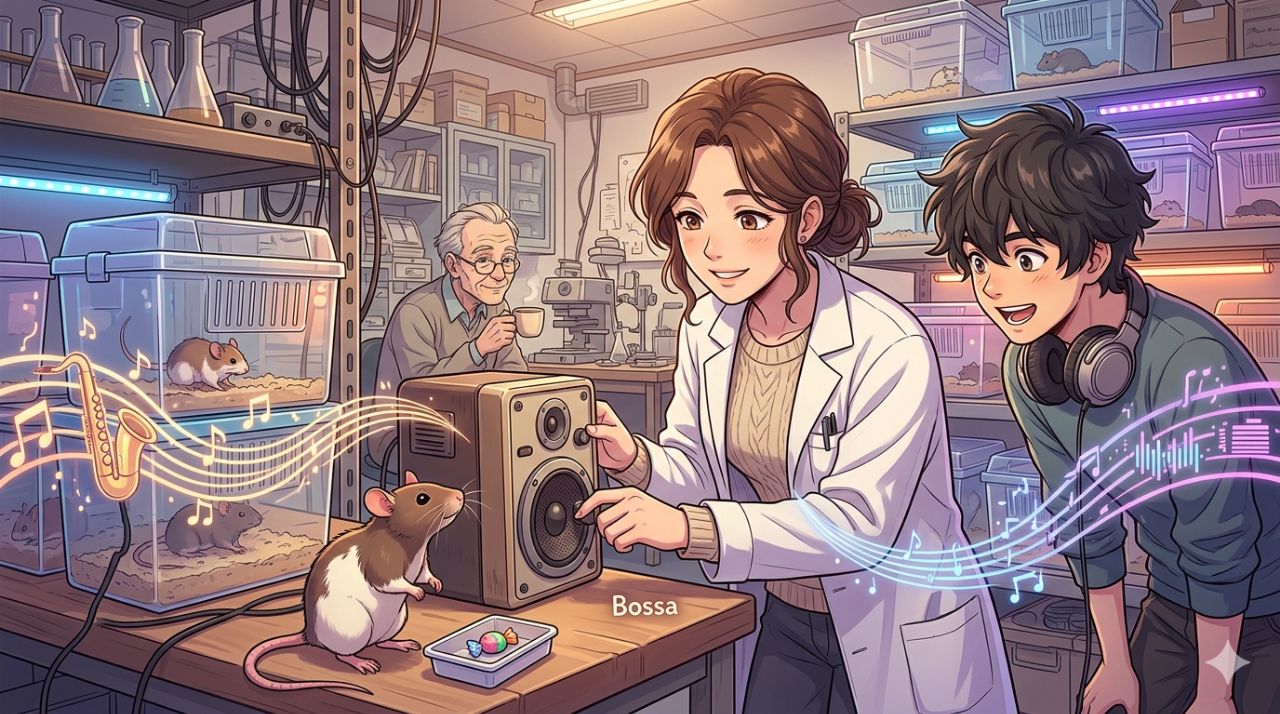
Short story: Cake, Cream, and Boundaries
The afternoon passed with a gentle calm; the hall was decorated with paper garlands and warm lights that cast soft shadows on the walls. The main table, in the center of the room, held the cake: three immaculate tiers, white frosting, and piped cream flowers sculpted with precision. It looked like a work of art that refused to be touched. Friends and family chatted, laughed, and took photographs; the music—a mix of hits and songs that had marked everyone's friendship—played at a volume that allowed conversation without raising voices.
Sofía moved among the guests with some reserve, adjusting her dress and returning hugs with measured smiles. She did not like loud surprises; she preferred the warmth of intimate conversations and thoughtful details. Still, she had agreed to gather with those who had known her since college, hoping to celebrate in her own way, with people who would respect her boundaries.
"Time to sing!" Martín announced enthusiastically, raising his voice as he set up his phone to record. "Everyone around, as always."
Within minutes, the candles flickered and the improvised group sang "Happy Birthday" with more heart than pitch. Sofía closed her eyes, grateful, and when the song ended everyone shouted in unison, "Happy birthday!" It was then that, from a table in the back, an idea arose that many understood as part of tradition.
"The cake trap would be the perfect finishing touch," someone said with a muffled laugh. "Who's brave enough?"
Rodrigo, a childhood friend always willing to make people laugh at his own expense, stepped forward with that mix of impulsive decision and misplaced confidence.
"I'll take care of it," he announced, smiling too broadly. "Sofía, trust me."
She smiled out of courtesy, but her expression didn't entirely hide her discomfort. Before she could say a clear no, Rodrigo approached with quick steps. In his right hand he carried little more than a gesture, an impulse for amusement. With a laugh, he placed his palm on Sofía's cheek and pushed her toward the cake. On contact, a dollop of cream flew and landed on her face, leaving a white streak from her temple to the corner of her mouth.
The silence that followed was instant and heavy. phones rose like mushrooms in a rain; someone had started recording unplanned. Surprise became incredulity in a blink on Sofía's face; what Rodrigo had intended as comedy turned into an awkward scene lit by screens.
"What... what did you do?" she said at first in a low voice, as if trying not to let sound betray her.
Rodrigo let out a nervous laugh that tried to minimize the gesture.
"Come on, Sofi, it was a joke. Don't take it like that," he said, trying to ease the tension with humor.
Sofía pulled her hand back and, seeing her fingers stained, the expression of annoyance became visible. It was not simply the cream on her skin; it was the feeling that her body had been used as an object of amusement without her permission.
"Don't take it like that," she replied, and her voice began to tighten. "I'm not an object for entertainment."
Murmurs multiplied in the room. Some guests exchanged uncomfortable looks; others forced laughs trying to restore lightness. Lucía, a close friend who had arrived early to help with the preparations, immediately stepped forward.
"Rodri, apologize," she said firmly. "That wasn't funny."
Rodrigo, visibly surprised by the reaction, raised his hands.
"Sofi, seriously, I thought you'd find it funny. At other parties... it's always been like that. Sorry if it bothered you."
"If it's always been like that, it means they always asked for permission before, right?" Sofía shot back sharply. "No one asked me."
The contained argument of quick words and glances began to take shape. Some defended Rodrigo as someone who had almost unknowingly followed a custom; others began to justify Sofía's upset over the invasion of her space. Meanwhile, the recordings in multiple hands preserved the scene from various angles.
Sofía, who until then had fought against the humiliation and the need to set a boundary, stepped back a few paces. On her face, a mix of anger, shame, and determination consolidated. She seemed to measure the room with her eyes; she observed the cell phones, the hands searching for them, the doubtful smiles. Finally, with a determination that surprised more than one person, she walked over to the cake; the room fell silent.
"I'm not going to be the joke," she murmured to herself in a low but firm voice. "If they make me a spectacle, they take away what's mine."
She took the cake in her hands with force. The frosting, pristine until then, yielded under the pressure of her fingers. With a quick, sharp movement she split the cake in two, then smashed the rest onto the table with deliberate force. Cream flew, mixed with crumbs, and slid across the tablecloth. The sound was dull, like a door slamming in the middle of a conversation.
"What are you doing?!" Martín exclaimed, stunned and with a mix of anger and disappointment. "That was for everyone!"
Sofía looked at him, and her eyes conveyed something that was not mere rage but a demand for respect.
"I don't want to be used for laughs," she said. "I won't let my birthday be a joke at the cost of my dignity."
The room then fractured into opinions. A small but vocal sector muttered that her reaction was disproportionate; another group—silent until that moment—stepped forward to show empathy: some applauded in support; others offered towels or napkins to wipe Sofía's face. The cameras kept recording, close-ups capturing the young woman's flushed face, the smeared cream, her still-trembling hands.
Lucía moved forward, trying to calm things without legitimizing what had happened.
"Sofi, please, calm down," she pleaded. "We didn't need to destroy the cake. We can fix it, we can talk."
Sofía looked at her with contained coldness.
"I'm not trying to fix the cake. I'm trying to make it understood that I'm not an object," she replied. "If tradition implies humiliation, I don't want to be part of it."
Rodrigo, who until then had alternated between disbelief and remorse, approached with hesitant steps. The night, minutes earlier brimming with laughter and warmth, had changed tone: outside the hall, city lights and the wind moved tree leaves in a different rhythm.
"Sofi, I really am sorry," Rodrigo said, with genuine contrition this time. "I didn't think about how you'd feel. Forgive me."
She answered without softening her words.
"I don't need forgiveness as a formula. I need it not to happen again. I need them to ask before deciding for me."
The night closed with scattered conversations. Some guests left in silence; others, amid reproaches, discussed the value of traditions versus individual respect. The next day, as is common in the age of immediacy, the video of the scene appeared on social networks: various accounts shared it with comments ranging from absolute condemnation of Rodrigo's action to criticism of Sofía's reaction. In the comment threads, people emphasized the importance of consent while others spoke of "exaggerations" and "bad manners."
Sofía, after the tumult, secluded herself at home. In the bathroom, in front of the mirror, she washed her face gently, noting each movement. The cream came off easily, but the lingering feeling of having been forced into the center of a spectacle accompanied her. She thought of her mother, of family gatherings where surprises had always been discussed and agreed upon; she thought about how a custom that seems innocent to some can be hurtful to others.
She decided then to write a message, not as a call for confrontation but as an affirmation of her limits.
"Tradition doesn't make something permissible. Ask first," she posted on her social media—few words with clear conviction.
The post generated diverse reactions, conversations among friend groups, and debates in forums. For many, the story became a model for discussing socially accepted practices that go unchallenged; for others, a reminder that ways of having fun must be negotiated. In the small circle of those present, the experience changed perceptions: some became aware of the importance of asking permission; others reconsidered how their humor could cross someone else's boundaries.
A week later, Rodrigo looked for Sofía again. He found her in a café, with a steaming cup of tea and a calmer expression. He sat across from her, a mix of timidity and resolve.
"I've thought a lot," he said. "I want you to know I won't use that kind of 'joke' anymore. And if you ever feel uncomfortable with me again, tell me; I'll be the first to apologize properly."
Sofía accepted the gesture cautiously, without promising immediate trust. In her face, the maturity of someone who had set clear boundaries had replaced the initial anger. And although she knew the video would keep circulating and opinions would remain divided, she left with the certainty that she had defended her personal space.
The cake, crumbled and strewn across the table, remained as a physical reminder of a night that demanded rethinking practices. For some, it was proof that customs need updating; for others, evidence that respect begins with asking. And among the guests who attended that celebration, one lesson lingered: genuine fun does not require humiliation, and each person's boundaries deserve to be heard and respected.
Source of the images.
Image created with Google Gemini.
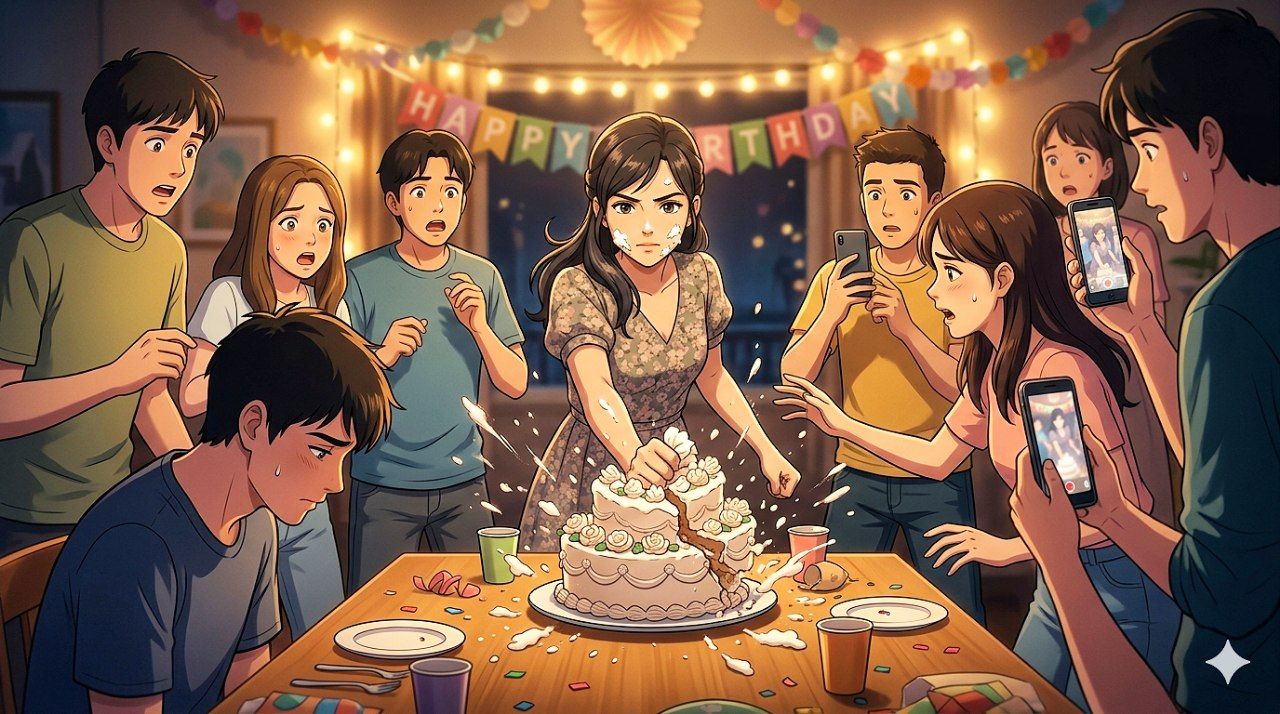
Short story: The Last Room
In the San Remo neighborhood, the new streetlights couldn’t drown out a warm rectangle of light spilling onto the sidewalk: the old game room PixelBar. The city had changed—buildings with glass facades, cafés with hanging planters, and home networks promising instant access to everything. Yet, in the heart of the neighborhood, PixelBar stayed lit, its yellow windows and faded signs insisting on keeping a corner of another era alive.
Mateo pushed the door one autumn night. The latch squealed with a sound he had known since childhood; every time he crossed that threshold, time seemed to give him a breather. The smell of instant coffee, cleaner, and electronics warmed by hours of use hit him with the force of a memory: the same mixture that had accompanied him through long afternoons when hours stretched between matches and conversations.
Behind the counter, hands resting on a worn notebook, was Doña Lila. Her apron still bore coffee and ink stains, and her smile—one that never seemed to have learned to change—lit the room as if years hadn’t passed.
“Mat?” she asked with that short-name way of speaking. “Did you come to rescue ghosts again?”
“Not so much rescue,” Mateo replied, dropping his backpack on a sunken chair. “I came to see if they were still alive. I can’t believe with all the new things this place is still open.”
Doña Lila turned on another desk lamp and nodded toward the row of numbered cubicles.
“The kids take care of them,” she said. “And Tomás still won’t give up his counter.”
The stations, lined up like small islands, kept their hand-written number tags and peeled stickers that told stories in faded colors. The chairs creaked when sat in. The monitors, some with greenish hues, showed pixelated wallpapers that looked like they had stepped out of an endless afternoon. At the back, on the mixing table, an old radio played a song Mateo half-remembered.
In cubicle 7, a group of young people laughed around a match. Among them was Camila, short-haired with headphones draped around her neck, who raised her voice when Mateo entered.
“Hey! It’s Mateo,” she exclaimed. “I thought ghosts were urban legend.”
Mateo smiled and went straight to monitor 4, the one that had always been “his” spot.
“Still doing improvised tournaments?” he asked as he settled his hands on the keyboard, as if the keys remembered the position of his fingers.
“We are tonight,” Camila said. “Cubicle 7 is defending the crown.”
Rafa, a young man now studying graphic design who had gone from customer to friend, leaned against the wall with a bag of sweets.
“I brought reinforcements,” he said. “You never know when a chocolate bar can change a match.”
As the night went on, more faces appeared: Martina, a teenager who came with her grandfather and listened to stories of earlier times; Julián, who worked in maintenance and came to disconnect for a while; and Tomás, the man who had founded PixelBar many years ago. Tomás walked slowly, but when he spoke his voice filled the room.
“If there’s a tournament, let it begin,” he said. “But first, coffee for everyone. And nobody touch joystick number 3—that one lives on stories.”
They laughed. Tomás approached the counter and, with a big, worn hand, handed out paper cups. His eyes, small behind glasses, shone with something between nostalgia and tenderness.
“I opened this place with two machines and a dream,” Tomás began in a tone that invited time to stretch. “I thought it would be a temporary spot. But people stayed. They came to learn, to fight for minutes, to share. Not everything that was slow to appear was useless.”
Mateo listened as the keys creaked under his fingers. When he connected, the system loaded a screen with pixellated icons and the familiar connection noise: a beep that to many had once seemed like magic. Immediately, a match enveloped them. The game wasn’t everything: it was the gestures, the laughter, and the jokes exchanged between clicks.
“Remember when we bet an hour to play?” Camila asked, looking at the group. “I used to pay with coins my dad gave me in secret.”
“I brought sweets and lost everything on matches,” Rafa confessed. “But it was worth it.”
Martina looked up in a silence that demanded attention. Her voice had the frankness of someone learning from others’ stories.
“My grandfather told me about the cybercafés like they were novels,” she said. “I thought they were made up. Until I came. It’s different to see it in person: here you leave pieces of your day, pieces of yourself.”
Doña Lila, sitting on her stool, wrote something in the notebook and murmured, “Here you learn to wait your turn. Not to look over someone’s shoulder. To help when a screen freezes. Those aren’t in tutorials.”
The tournament began with cheering that reminded Mateo of afternoons when the street emptied and the place filled with voices. The rounds were short but intense. A brilliant play drew applause that echoed off walls lined with faded posters. One kid celebrated with a jump that almost unplugged his monitor; another, embarrassed, asked for a rematch.
“What a play!” Rafa shouted. “Did you see it, Mat?”
“I saw it,” Mateo said. “That’s the one that matters.”
Amid it all, conversations formed that didn’t necessarily revolve around the game. They talked about jobs, studies, who had moved to which neighborhood; told childhood anecdotes and remembered how friendships formed in this place still lasted. Tomás sat beside Mateo and lowered his voice.
“There were times I thought we’d close,” he said. “With homes getting internet, with social networks and all that new stuff... but some kids kept coming. And those who grew up brought theirs. That’s what kept us going.”
“And what makes you keep going?” Mateo asked.
Tomás smiled with a mix of pride and fatigue.
“The laughs,” he answered. “And these small things: watching a kid learn to fix a computer, seeing someone help without being asked, celebrating a victory like it belongs to everyone. You can’t get that from a screen at home.”
The talk seemed to spark something in Martina. She perched on the edge of her chair, face lit by the monitor, and said quietly, “My grandfather says they used to wait to use the machines, share tips. I thought it was romanticizing. But today I understood these small rules build trust.”
Camila nodded and added playfully, “And it was a place where you could meet someone who’d later be your partner in mischief or the one to celebrate a gift with.”
Hours stretched without complaint. Between matches they took photos in front of the poster-covered wall and an old hanging flag. Modern phones photographed the pixelated screens as if trying to capture a contradiction: the instantaneous recording the old.
At the end of the night, Doña Lila, notebook in hand, announced the tournament results.
“Winner: Camila,” she read. “Second: Rafa. Consolation prize goes to Julián for his drama in the final play.”
Everyone laughed. Tomás handed a box of sweets to the winner and a toy medal to the runner-up. The prizes didn’t matter; the gesture did.
When the room began to empty, Mateo stayed behind a few minutes more. Before leaving, he approached Tomás.
“Do you think this can last?” Mateo asked honestly.
Tomás measured his response.
“I don’t know how much time we have,” he said. “But as long as someone wants to push open the door and stay to listen, we’re alive. And if one day the lights go out and the place closes, let something remain. Let someone remember how it sounded in here.”
Mateo felt a sweet ache in his chest. He said goodbye to Doña Lila with a barely audible promise.
“I’ll come back,” he said. “And I’ll bring mine.”
The night greeted him with cool air. PixelBar’s light looked small among modern illumination, but inside him something stayed lit: the certainty that certain places don’t die as long as memory stays active. As he walked, a sound—the hum of an old modem that had once been music—seemed to follow him in memory like a melody.
The next day at work, Mateo remembered the faces and laughter; he called a friend and suggested returning that weekend with his group. He began to sketch a plan so the place wouldn’t remain only nostalgia, but become a bridge between generations: repair workshops, unhurried learning afternoons, gatherings where older people told stories and young ones taught tricks.
Over time, PixelBar didn’t become a museum or a motionless shrine. It remained a living, imperfect place with scratched walls and aging monitors, and yet the laughs stayed the same. There were nights it was packed and others when only one person came in to read. But the door opened always.
When the neighborhood changed again, some wondered why those who could choose the modern favored a place with yellow windows and creaky chairs. The answer lived in small gestures that happen without fanfare: someone lending a cable to a stranger, another waiting their turn conversing with a neighbor, someone celebrating a victory that wasn’t theirs. Those small acts, invisible from outside, sustain the life of the last room.
In the end, Mateo understood that nostalgia wasn’t mere melancholy. It was fuel: a reason to return, to teach, to keep a warm light burning in a city that kept moving. And on some future night, when a teenager pushed open PixelBar’s door and the smell of coffee struck like a memory, they would hear the same voices, the same jokes, and understand that in the last room there is always room for shared stories.
Source of the images.
Image created with Google Gemini.
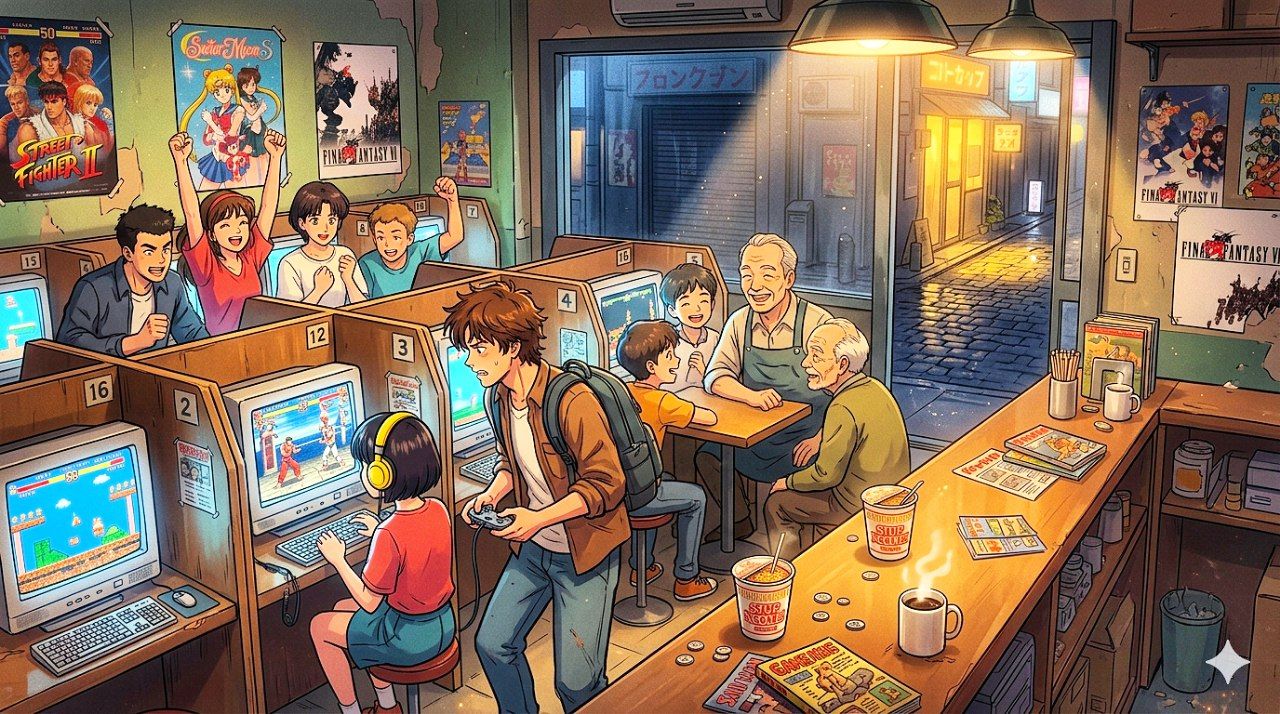
Short story: Ash Routine
The house of Marcos and Clara had been built from years of routine: work routines, quick dinners, televisions left on like background clocks, messages read halfway, and promises always postponed to “someday.” In the main living room, on a low table cluttered with magazines and remotes, the television projected an endless dance of images—ads, series, news, other people's laughter. It was a hypnotic light that took up space without asking anything in return. Marcos sat there each night like someone taking the same route because he already knew the signs: the chair, the remote, a full stomach, and the sense of not having to decide.
Clara, for her part, had learned to live with those signals. She got up before him to make breakfast, tidied the house in mechanized silences, folded shirts with hands that remembered the shape of the fingers more than the reason for doing it. There were days when her gaze would drift to the window, where the street showed a life that seemed to pass by without stopping. She was forty but often felt older than her years—tired of explaining the obvious, tired of waiting for things to change without anyone setting an intention.
One rainy afternoon, while the city seemed to dissolve its contours, Clara found an old photograph among some books: her and Marcos on the seashore, skin salted and eyes still bright with youthful promises. She carried it to the living room and left it on the table like an offering to the past. Marcos looked at it without taking his eyes off the television.
“Do you remember that day?” Clara asked, searching for a spark that might light something.
“Yes,” he answered without enthusiasm. “We had time.”
The word “time” became an echo. Clara felt the echo carry a cruel value: time had existed but had been invested in easier things, in habits that demanded no growth. Conversations that used to be long and awkward had shrunk to quick notes: “I’ll be late,” “Meeting,” “What’s for dinner?” Marcos didn’t do it out of malice; he did it because comfort spared him the confrontation with what hurt, with what required sacrifice. It was simpler to swipe a screen than to open his mouth and tell the truth.
That night, after putting Tomás, their eight-year-old son, to bed, Clara sat again by the window. The neighborhood reflected in the glass like an inert constellation: houses turning lights on and off in the same routine, cars passing without asking, a cat that had discovered the freedom of indifference. Tomás had gone to bed with his tablet off—a rarity. Before falling asleep he had asked Clara, “Mom, Dad promised he’d come to my game, right?” The question lingered in her throat.
Clara remembered her own mother’s voice years earlier, telling her that children watch, that they learn from what is repeated, not from big speeches. That truth struck her with the force of the everyday: what Tomás saw every day was the pattern he would later use to build his own life. If presence was intermittent, he would normalize it. If escape was the response to discomfort, he would take it as a map.
The next morning, Clara decided to break the silence in a way she had been avoiding. In the kitchen, under the cool morning light and the faint smell of coffee, she told Marcos:
“Tomorrow is the parent meeting. I need you to come.”
He looked at her like someone receiving an unexpected request, with that expression half surprise and half mild irritation that arises when comfort is disturbed.
“I have work,” Marcos replied. “I can’t miss that day.”
She placed her hands on the table with the firmness she hadn’t shown in years.
“It’s not just about the meeting,” she said. “It’s that Tomás needs us there, that your father sounds more tired every time he speaks, that our conversations have become routines that tell us nothing. It’s not about hating what distracts us. It’s about understanding something much more uncomfortable: many people aren’t choosing from love. They are choosing from tiredness, comfort, and escape.”
The words hung heavy, like an old piece of furniture. Marcos swallowed and sought refuge in everyday logic.
“I didn’t know it was that bad,” he murmured. “I thought we understood it, that we fixed it with small things.”
Clara shook her head.
“It’s not an emergency in the sense of putting out a fire today,” she replied. “It’s that the easy always seems safer. A screen doesn’t demand your presence. An empty habit doesn’t ask for maturity. A distraction doesn’t confront you. A quick pleasure doesn’t require you to change. But real life does. Your parents grow old. Your children watch. Your relationships grow cold. Your time goes by.”
That list landed like a blow of realism. For the first time in many months, Marcos felt a tremor that wasn’t from fatigue but from recognition. He thought of his own childhood, of a father who worked until his hands began to fail, of calls he promised to return but never did, of weekends sacrificed to the feeling that producing more would buy him a better tomorrow. Now that tomorrow felt both close and strange.
“What do you expect me to do?” he finally asked, voice low.
“Choose,” Clara replied. “The question isn’t what you want to value. The question is what you repeat every day.”
The simplicity of that line carried weight that cracked the silence into a fissure. Marcos remembered small episodes: the time he promised not to check his phone during dinner and did, the time he let his mother’s call go to voicemail for “later,” birthdays celebrated with prerecorded messages. He saw himself acting from inertia rather than decision. He understood that love was not only a feeling; it was a discipline, a set of daily acts that required presence and sometimes sacrifice.
From that day something shifted—not with heroic drama, but like repairing a crack before the water widens it. Marcos did not change overnight. There were backslides, nights when the screen’s temptation returned and fatigue reclaimed its throne. But there were also days when, feeling the habit call him to refuge, he breathed and chose differently: calling his father not out of obligation but to listen; turning off the TV before dinner to talk; showing up, occasionally, to Tomás’s practices with a sweaty shirt and an honest apology for being late.
Those actions, repeated, began to filter a new light into the house. Tomás noticed his parents’ increased presence; at school they would nod to him as the boy whose father at least sometimes showed up at the games. At family gatherings the tone of conversation changed; people stopped avoiding painful topics. The relationship between Marcos and Clara, which had functioned for years like an automatic set of gears, began to reveal parts that could still be adjusted.
One autumn afternoon, beneath a tree whose leaves were starting to fall like confessions, Marcos walked with his father through the park. The walk was slow and unhurried, and between steps they shared silences and memories that had been postponed. Marcos listened to his father with a care he hadn’t known he could muster, discovering in each small story reasons to be grateful and reasons to regret the things left unsaid.
That attentive habit seeped through. Clara, for her part, fought the comfort that tempted her daily. There were mornings when tiredness asked her to give in, when chores swallowed her patience and the television offered escape. But when that temptation returned she thought of the old photograph she had found and of the way Tomás looked at her. She understood that routine was not neutral: it built, or it unwound, the value of what they loved.
A pivotal moment came one January night when a power outage plunged the house into unexpected darkness. The blackout removed the visual noise the screen provided as consolation. Instead of surrendering to unease, Marcos went to the kitchen, lit candles, and found a board game that hadn’t been opened in years.
They played clumsy rounds, laughed at Tomás’s inept moves, and in the simple climax of one hand helping another move a piece, Clara felt that presence was a kind of repair. It didn’t erase bad habits, but it was a powerful reminder that other ways of choosing existed.
Over time, those gestures became different habits. The transformation was neither uniform nor free of remnants of old practices. There were days where the screen seemed more alluring than conversation, nights when quick pleasure seduced them, and weekends where each sought their own escape. Yet the difference lay in the growing frequency with which they noticed having chosen escape and deliberately replaced it with an intentional action: returning a call, attending a school event, preparing a dinner where more was said than what was on the menu.
Tomás began to mirror some of these gestures. When his father offered help with homework, he accepted without knowing he was learning to be close. When his mother reserved time to read with him, he did not link it to sacrifice but to company. Those repetitions settled as quiet lessons: what is repeated daily becomes character.
One spring afternoon Clara found Marcos bent over a book that wasn’t strictly work-related. She watched him, surprised by the presence of a quality she hadn’t seen in months—a quiet curiosity. Tomás nestled between them, and Marcos closed the book and, in a low voice as though naming a landscape after a long journey, said:
“It’s not about hating what distracts us. It’s about looking at who we put at the center when the noise goes away.”
Clara rested her head on his shoulder and let the word “presence” settle. Outside, the neighborhood continued to flip lights on and off like an unexamined nervous system. Inside, however, something more difficult and essential had been mended: the daily decision to choose what truly mattered.
Marcos and Clara’s story never reached dramatic perfection; imperfections remained, old routines resurfaced, and some days inertia won the fight. But they learned to see it: real life demands what comfort cannot give. Declaring love is not enough; you must repeat it. Promising to change “someday” is insufficient; you must sustain acts that prove it. With that understanding, each small gesture became an answer to the true summons: to live present, with the discomfort that sometimes comes with it, but also with the certainty that presence, when repeated, transforms.
In the end, the house was no longer just a place of inert habits. It was, imperfectly, a place where deliberation was practiced. The routine—once the bearer of hard truths—now also revealed another: that of people who choose, again and again, to be there. And in the remaining silences, one could sometimes hear the murmur of a line that had changed everything: “The question isn’t what you want to value. The question is what you repeat every day.”
Source of the images.
Image created with Google Gemini.
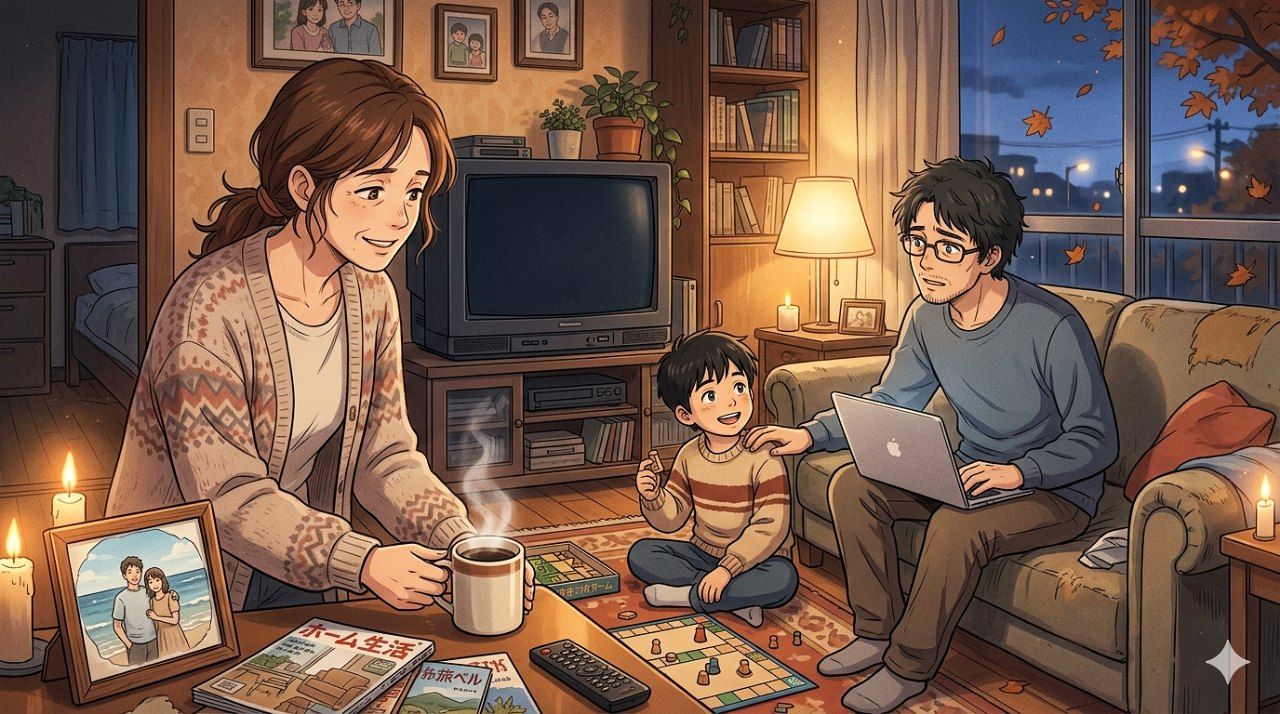
Top 5 musical - April, 2026
April, the fourth month of this year, where our usual musical segment is presented to us again with the list of the most listened to, which among many of them are classified within the same genre or are related in some way, except for one that is totally different. And that's something we'll look at next.
And first of all, it should be remembered that this list is part of my profile on LastFM, a social network that has my statistics on music plays, and which, in turn, is linked to my Spotify account.
And without further ado let's get started.
**Most listened artists**
1- Garrick Ohlsson
Country of Origin: United States.
2- Muse
Country of origin: England.
3- Garbage
Country of Origin: United States.
4- Limp Bizkit
Country of Origin: United States.
5- Dead Kennedys
Country of Origin: United States.
Little did they expect this surprise, where we will see that the first place is occupied by a classical pianist, and this is because he is in charge of interpreting the works of Federico Chopin, artist of the nineteenth century.
Next, let's look at the most listened to albums section.
**Most listened to albums**
1. Chopin: The Complete Works [Disc 03] - Garrick Ohlsson
2. One Mile High...Live - Garbage
3. Chopin: The Complete Works [Disc 11] - Garrick Ohlsson
4. Live at Rome Olympic Stadium - Muse
5. Significant Other (Special Edition) - Limp Bizkit
And extra bonuses I have something special for you all 😏
EXTRA BONUS: MUSIC TO LISTEN TO
Garbage
https://youtu.be/knB1IaaO-6g?si=682QkpRASaJl_7yi
And without more to say we meet in the next one. I appreciate all the support provided, and remember to leave your comments and musical recommendations at the end of this post.
Until then. And long live the music! 😎👍
Source of the images
Screenshots from my Amazon Fire 8 tablet.
Short story: Neon of Tomorrow
The rain fell over Seoul with the cadence of a futuristic metronome; each drop bounced on the asphalt and exploded into tiny neon lights that slid down the façades like electric frost. On the city’s fifth ring, an orbital café clung to the corner of a transparent building; its floating terrace offered views of the drone bay and the aerial highways. Mina left her laptop on the table — its screen open to a star map full of notes and a blinking little space-dog sticker — and stood to go to the restroom. She didn’t close the lid or hide it under the chair; she simply walked away trusting what everyone who lived there took for granted: the city was, in many ways, more humane than many towns that still clung to distrust.
“Don’t take too long,” she said in that half-closed voice friends use when they know the afternoon could fly by in a sigh.
Jae looked at her as if trying to hold her in the moment, and Koo remained immersed in a philosophical debate about whether the block’s delivery drone made better coffee than the central machine in the plaza. Embedded in the polished tabletop, a small touch button gleamed. Koo, without thinking, pressed the icon.
Service arrived with the timing of choreography. A server appeared from behind a panel that slid open like a curtain of light; she floated a few centimeters off the ground thanks to a magnetic sole that emitted a soft hum. Her uniform was simple, her smile calibrated, and yet there was something in the way she bowed that didn’t seem programmed but learned with care.
“Another round?” she asked, and her tone might have been the result of group practice on some morning, but in that moment it sounded warm.
“Yes, please,” Mina replied. “And… could you tell my aunt how to connect to the Wi‑Fi? She thinks QR codes are signals from extraterrestrials.”
The server nodded while Koo challenged Jae to an absurd bet on whether the space-dog sticker would survive the next urban operating system update. When Mina returned with her cup, the laptop was exactly where she had left it. Her fingers brushed the metal edge as if to confirm the world hadn’t grown strange overnight.
“Does trust still exist in this world?” Jae murmured, more to himself than to the others. “This feels like 3026.”
Koo laughed.
“What’s next? Guardian angels in bulletproof vests?”
“Probably guardian drones with free coffee,” Mina replied, and there was less irony in the joke than one might expect: the city had made the fantastic part of the routine.
When night fell, the three friends descended a staircase that didn’t need railings: proximity sensors activated a gentle breeze that guided their steps. They headed to the station. The train that greeted them was not the one from old postcards: the cars looked like capsules of silence. The seats were climate-controlled with technology that mimicked hugs; they didn’t just warm or cool, they adopted a contour and texture that made you feel as if the seat understood the fatigue of your day. The train’s Wi‑Fi, accessible with a gesture, had a speed that tested human patience: Mina downloaded an entire season of a show, high-resolution illustrations for a project, and three experimental playlists between stops.
“This is luxury,” Koo said, stretching his legs as if the rails were a carpet caressing his feet. “I feel like my shoes are in an elegant sauna.”
Jae, eyes fixed on the urban landscape passing by like a projection, smiled.
“And yet there are things screens can’t catch,” he said, holding the star map open on his laptop. “That I can leave this here and not lose it is an act of faith in something I can’t name.”
The train’s advertising screen, which usually showed interactive ads, transformed without warning into a luminous door. A voice announced in a friendly tone, “Attention: Surprise event at Hanbit Station. Reward for civic cooperation: augmented reality experience.” A holographic map floated before them, marking a route through the city dotted with small challenges: riddles, community encounters, tasks that celebrated collaboration.
“Free adventures and no tipping,” Jae exclaimed, eyes alight. “Shall we go?”
Mina grabbed her backpack, consulted the old map she had bought from the neighborhood elder that morning, and nodded. The plan was simple: follow the signs, let the city guide them, and see what kind of surprises a metropolis many described as “living in 3026” would offer.
The first challenge led them to a tech-covered café where every table had its own button — a detail already ordinary to them but dazzling to any traveler. They pressed it and, as always, the response was immediate: a server arrived with a selection of drinks, explained patiently how the house’s compostable bags dissolved gracefully, and gave them an origami miniature that unfolded into a flower when touched by moisture.
“Why doesn’t anyone shout for the server?” Mina asked as the steam from her drink formed tiny constellations in the air.
“Because we decided it’s nicer to request with a gesture,” the server replied. “And because our solutions are designed to respect people’s space.”
The three followed the map through alleys draped in luminous vines to a night market where vendors sold traditional souvenirs next to pods of vegetables grown in buildings. There they met an old man who, for pleasure, sold paper maps: time-stained sheets marked with routes that no app showed anymore. His stall was a memory bank; his maps, though fragile, were full of promises.
“We don’t accept tips here,” the elder murmured when Mina, unexpectedly nostalgic, tried to slide a coin into his palm. “The gesture is understood differently. If you want to help us, take one of these maps and share a story. Give time, not money.”
Far from sounding moralizing, the phrase had the simplicity of someone who had seen enough to choose a truth that doesn’t wound. Mina took a folded map, its yellowed paper traced with winding paths like customs, and tucked it into her bag as one preserves a relic.
The night unfurled and the city opened like a book of magical realism. They crossed a floating garden integrated into the cornice of a skyscraper: suspended paths above the city where bioluminescent plants sang when the wind touched them. Near the garden’s heart stood a bridge guarded by a massive metallic dragon — an old piece refurbished — that functioned more as a curator of riddles than a hostile guardian. To cross, one had to answer a question that mixed logic with empathy: “If you protect something valuable, what do you choose: to lock it, to share it, or to transform it?”
“My answer would be… to transform it,” Jae proposed emphatically. “That way it adapts to those who come after.”
“I’d say share it,” Koo countered. “But not as we do today: share with intention, not out of obligation.”
Mina thought of the elder’s paper map and the laptop she had left at the café. She thought of the servers who arrived at the touch of a button and the elder who refused a tip. She looked at her two friends and knew what her answer would be. When she spoke, her voice was brief and clear:
“I’d protect it by transforming it so others can care for it.”
The metallic dragon spat sparks, played a melody, and finally bowed its head. The bridge’s plates retracted and the passage opened. People of all ages began to cross: students with backpacks full of projects, elderly women with woven bags, couriers who knew every wind shortcut. In the improvised exchange on the bridge, a small community formed: an engineering student couple offered a fix for a loose railing; a dancer improvised a tiny performance to ease a tension between two travelers; a night courier with a bike that seemed to surf the air lent an extra battery to a musician who needed to recharge a synthesizer.
Each encounter taught a lesson: fixing together was faster than imposing; asking proved more effective than assuming. When the final stop on the map led them to a hidden café inside an old refurbished building, they found a blend of tradition and progress.
The baristas there worked with century-old techniques aided by instruments that regulated extraction temperature with surgical precision. Nobody accepted tips; instead, a gentle, ceremonial system allowed customers to leave an electronic “note of gratitude” that the barista read aloud and whose essence merged into a cloud of recognition the staff shared as daily motivation.
“It’s strange,” Mina said, watching the ritual. “Before, tipping was a way to correct wage injustices or thank exceptional service. Here, the gesture is something else: a form of public recognition that reinforces the dignity of work.”
“It’s like professional pride became part of emotional salary,” Jae added.
Koo allowed himself a quiet moment. His eyes seemed to capture something no phone screen could show. Then, laughing softly, he said:
“And yet, some things never change: the laugh after a coffee mistake is the same in any century.”
Exiting the secret café, they encountered a digital mural that depicted the city as a living organism: beats of light rising and falling with the hours, routines coded as constellations in motion. The three stopped to watch, feeling both tiny and connected.
“2026 that feels like 3026?” Jae said playfully. “Yes, but with paper maps, riddles on bridges, and baristas who don’t accept tips.”
“And guardian drones that remember your favorite coffee,” Koo added, picturing a machine that would pull up the order you’d placed yesterday the moment it saw you.
“And people who choose not to confuse efficiency with coldness,” Mina said, closing her laptop and slipping the elder’s map into an inner pocket. “Where technology makes us better humans.”
As they walked back, they passed a small plaza where a local artist projected ancient stories onto a façade; tales of rivers and mountains and the city’s first markets interwove with animations that included testimonies from century-old neighbors. A child approached and, with the innocence that only those raised among everyday wonders have, asked:
“Is it true people stop helping when there are too many screens?”
Mina looked at the child, then at her friends, and for the first time that night answered without irony.
“It depends on us,” she said. “If we use technology to shut doors, maybe. But if we use it to open paths, then no. Here, many people chose to open.”
The child nodded, satisfied, and ran toward a group making ephemeral constellations with flashlights. The city kept its pulse: trains, lights, conversations that began and ended like small urban constellations. Mina, Jae, and Koo walked slowly to their favorite spot, a lookout where they could see the mesh of aerial routes and neon reflections on the river. They sat on a warm edge — a heated bench that felt like an embrace — and silently watched the view.
“Do you think we could bring this to our homes outside the city?” Jae asked finally.
“Not as an exact copy,” Mina replied. “It’s not about replicating every button or drone. It’s about carrying the idea of trust, the habit of collaborating, and respect for people’s work.”
“And paper maps,” Koo added with a smile. “Never underestimate the power of a good old map.”
They looked at each other, knowing that the night would become a story they would tell often. Not to boast of having been in “Seoul of 3026,” but because they had lived a way of life where speed and efficiency coexisted with rituals that honored dedication and memory. They learned that the absence of tipping didn’t mean the absence of gratitude; that pressing a button to call a server wasn’t dehumanizing but an invitation to respect someone’s time; that leaving a laptop on a table wasn’t naivety but a reflex of shared trust.
The city continued to glow. Around them, small stories wove: an elderly woman teaching children how to read a map, a courier calmly fixing a bike wheel, a couple marrying under an arch made of recycled lights. In each gesture lay the trace of a choice: to use the future to preserve what’s valuable, not to erase it.
Before parting, Jae pulled out his phone and, without much thought, recorded a short message:
“For when you go traveling,” he said, “remember: technology is fantastic when it helps you become a better person. Here, we use it for that.”
Mina and Koo smiled, knowing the line might sound cheesy, but also knowing they had proved it that night. They rose and walked back toward the orbital café where it had all begun. The rain again traced constellations on the glass. In the distance, the city’s lights rearranged themselves like pieces that didn’t seek to impose but to fit.
And in that delicate balance between the human and the technological, they grasped something simple and profound: the real leap into the future wasn’t just faster Wi‑Fi, climate-controlled seats, or buttons at tables. It was deciding that machines should serve to increase trust, creativity, and generosity. It was convincing an entire city to use innovation to protect and transform the old so stories could remain alive.
The night ended with one last gesture: Mina placed her laptop on the café table, pressed the button to call the server, and before leaving left a note on the elder’s map that read, “Thank you for reminding us that treasures are also kept on paper.” Then, smiling, they headed home, happy to belong to a place where 2026 sometimes truly felt like 3026.
Source of the images.
Image created with Google Gemini.

Short story: THE SLOW BEAT
The city spread out like a slab of neon and glass, a translucent body lit by data running beneath the skin of the buildings. Advertisements breathed; their rhythms shifted with the collective mood. Trams floated without rails, and plazas projected curated memories to attract emotional tourists. In that landscape of glare and sensory modification lived Mara, a memory technician at ChronoWeave, the corporation that had industrialized nostalgia.
Her job was to assemble fragments of life: take an authentic laugh, extract it from context, intensify it, pair it with an afternoon of rain or a fragrance, and sell it as a package — “First-Time Memories” — to those who paid to rewrite their past. Some wanted to erase grief without the rough edges; others asked to amplify an unremarkable childhood until it became a marketable product. Mara did it with artisanal precision and with the same anesthesia with which a surgeon repeats sutures.
One night, at the editing console, she pasted the same clip three times without noticing. The clip was simple: a child calling for their mother from the stairs. She mixed it, adjusted the echo, boosted a few decibels, and attached a programmed scent. When she looked away from the monitor, her pulse was unchanged. The scene played perfectly on screen; inside her, it provoked nothing.
"Is something wrong?" Iker, her colleague, asked. He wore a reflective fiber jacket and had hands broad as if born to hold consoles. "You pasted the same clip three times, Mara."
She let out a sigh that sounded like a small crack in a data wall.
"It's not that the years are speeding up," she said without looking at the screen. "It's that I'm not feeling them. Everything stays flat."
Iker closed the machine's lid as if shutting off a device could switch off the sour sensation invading her.
"You've been processing memories at 600x," he said, half joking, half warning. "Professional desensitization is real. Keep at it and you'll forget how things taste."
Mara gave a smile that never fully formed.
"I'm not sure 'forget' is the right word," she replied. "It's like my brain has stopped registering life with clarity. I spend my days stitching deep memories for others and when I return to my own, it's blurred. Years collapse into a constant blur."
That night, after leaving the prismatic office building where ChronoWeave was housed, Mara walked through streets that seemed to float on pools of data. Facades projected looped scenes: a wedding made unforgettable, an intensified sunset, a celebrity smile anyone could synchronize their own memories to. A continuous training of the senses — notifications, micro-stimuli, calibrated rewards — slid people's attention like oil over an inclined surface. The voices from urban speakers seemed to shrink them: "New remembrances package — 40% emotional intensity — aroma optional."
She thought of her mother. She remembered a teacup in a humble kitchen, a hopeful flutter in wrinkled hands; the image blinked and lost color. It was there, but like an underexposed slide. Mara stopped, pressed her hand to the glass of a storefront, and saw in her reflection a woman who did not return the burning certainty of her own story.
The next day she did not return to the lab. It wasn't an impulsive decision but an urgency: to seek something her work couldn't sell or repair. She wanted novelty without filters, danger without metrics, the imprecise texture of an experience that could not be tagged with keywords.
She got lost in the city's periphery, where data thinned and structures were patchworks of a past some called "preconnected." There, under a worn awning in a market, she found a watch stall. The gears were small universes insisting on beating without registering on a server. The woman behind the counter had paper-brightened skin and eyes that seemed to have learned to count silences.
"Good day," the woman said, her voice without artificial attention-grabbing. "Are you looking for time or appearances?"
Mara was surprised by the question.
"Maybe both," she answered, unwilling to lie. "I feel like time is slipping away."
The woman smiled like someone sharing clandestine knowledge.
"My name is Abril," she said. "Before there were apps to edit memories, I made watches because I believed time deserved a hand and some resistance. Now I sell watches like one used to sell stories. Come in, there's coffee."
She accepted the coffee, which tasted of old roast and something that didn't sell duration: conversation. Abril handed her a cup without haste and pointed to a table in the corner.
"Tell me something," Abril requested, leaning forward. "What's the last memory you can touch with your fingers, unedited, unretouched?"
Mara closed her eyes. Fragments appeared: the old kitchen, the scrape of a table, the feel of a letter between her mother's fingers. The image was faded, as if missing brushstrokes.
"It feels distant," she confessed. "As if someone erased the texture. There's no roughness, no warmth."
Abril nodded without surprise.
"We live in an era of too much stimulus and too little presence," she said, in the voice of someone who lists wounds she's seen. "A life fragmented by interruptions. An infinite scroll that never becomes memory. Notifications aren't milestones, and mere survival doesn't build a story. The key is depth: you haven't lived less time, you've lived with less depth."
Mara, sipping the coffee, felt the phrase pierce her. It wasn't a generalized complaint but a clinical statement diagnosing her own numbness. Abril added as if confiding:
"Time expands with focus, novelty, and meaning. It compresses with stress, distraction, and repetition."
The word "novelty" rang like a bell. Mara thought of the sensory implant behind her ear — a thin ring that modulated input, increased dopamine on demand, allowed pain to be paused like an app. It was discreet, legal, profitable. Many technicians at ChronoWeave used it to maintain efficiency: the brain wouldn't saturate, and pieces could be stitched without the interference of their own memories.
Abril watched her and said, almost without asking permission:
"If you want, try something. Turn the ring off for a while. Sometimes losing the network is the only way to feel height in a fall."
Mara hesitated. Turning off the implant was a professional risk and a temporary loss of instant access to information. Yet the promise of an untampered sensation pushed her. She took the offered cloth and, when she touched the ring, felt a metallic chill. She pressed the disconnect button. The silence that followed was unlike anything she'd known: not emptiness, but a surface where sound unfolded with honesty. Footsteps on the sidewalk had interiors; cars didn't blend into a hullabaloo; voices had edges, unamplified and unmuted.
She walked without a map through neighborhoods she'd never seen. There were no ads whispering offers into her ear, assaulting her with emotional packages. In a park, children flew cloth kites, not holograms or drones spinning "perfect moments." She watched a girl drop her kite and, without ceremony, pick it up and offer it to Mara.
"Take it," the girl said. "It's for you."
The gesture asked for no return. Mara took the kite in her hands and for the first time in months felt her breathing slow; seconds stretched and became tangible. The texture of the cloth, the closeness of a laugh, the park's scent — all happened with no need for digital validation. For a brief, clear instant, the feeling of living became an object in her hands.
That night, back in her apartment, notifications had stacked on her device: work messages, offers promising to "optimize your experience," a reminder to complete a client's package. She glanced at them and let them vibrate without responding. The decision not to answer was another small act of rebellion.
In the following weeks she ran a deliberate experiment. Mara turned off the implant for increasingly long stretches. She took aimless routes, spoke with strangers without logging the exchange in her neural diary, learned to stretch hours without falling into the trap of immediate editing. Some days she went back to the lab; others she didn't. With every act of full attention, time ballooned, like a camera capturing more light.
ChronoWeave soon noticed the drop in her productivity and summoned her for evaluation.
"We've observed a decline in your delivery index," the supervisor said from a glass booth, voice calculated. "Your lapses affect the flow. We need you to normalize your performance."
Mara held her composure.
"I don't want to keep delivering memories that leave people hollow," she replied. "I think they mistake survival for life. Notifications have replaced milestones."
The supervisor frowned, unable to grasp the emotional dimension behind a data drop.
"Attention is a resource," she said in the jargon of someone who understands economies. "Protecting it is inefficient. If everyone decides when to listen, the market collapses."
Mara left the booth with reinforced certainty: something more than numbers was at stake; the relation between attention and human dignity was eroding.
Abril, who'd been keeping tabs through peripheral channels, arrived with a box wrapped in creased paper. Her hands moved with the practiced touch of someone who's repaired things for decades.
"This is mine," she explained, placing the box on the table. "Not therapy gear, not a certified model. It's an interruption generator. It doesn't make calibrated stimuli; it makes real failures. A power outage, a false horoscope, an unexpected rain in a systemless zone. Accidents, controlled."
Mara opened the box. Inside was a small mechanical device, imperfect, with a red button that sparked when touched. Its visible parts spun in jerks; it was deliberately inefficient: not networked, no security patches. Abril explained the method.
"Novelty isn't manufactured by perfection. It arises from risk and the impossibility of prediction. When something fails, people look each other in the eye. When there's friction, narrative is born."
Mara installed the device in her apartment. On activation, it triggered the first interruption: the lights went out for exactly four minutes. The silence that followed felt different. No panic arose — the residents were used to drills; instead there were conversations. Her neighbor Ram, a data technician, knocked to check if she was okay. They sat in the hallway and spoke for over half an hour about their childhoods, what they disliked about their work, a song neither remembered until they sang it together. The exchange was long and camera-free.
The interruption had turned a common space into a place of story. That was the point: absence forced attention and attention created memory.
Over time, Mara began secretly offering clients a different service. Instead of polishing memories into immaculate artifacts, she taught them how to enter scenes without filters; she proposed "slow-living" exercises: spend an afternoon in silence without recording, cook a meal without background music, walk through an unknown neighborhood without headphones, talk to someone without interrupting. Demand was initially low. Some clients wanted the comforting interpolation that let them relive glory without pain. Others, more desperate, cried when asked to feel without masking. A former celebrity broke off a session halfway through because truth overwhelmed her: her unedited childhood was both painful and beautiful.
Iker, worried for his job and the team's coherence, visited Mara one afternoon during her new decompression routine.
"I don't get it," he said. "You become more human and the company fires you. Is it worth it?"
Mara rested her forehead on the table and looked at her own hands, marked by work with magnetic tapes and adhesives.
"It's worth it," she said with resolve. "Time compresses with stress, distraction, and repetition. If we don't protect our attention we lose life in invisible installments. Living slowly isn't a romantic luxury; it's an act of rebellion. I don't know if it'll change laws or prevent anyone from losing money, but it's something we can reclaim."
Iker listened, thought, and within days began shutting off his implant for brief moments each day. He didn't announce it; he didn't need to. Small gestures spread like a silent resistance.
The corporate response was swift. ChronoWeave declared the practice of "inducing interruptions" hazardous to consumers' emotional stability and the market's predictability. A campaign erupted: "Safe memories for safe lives." The tone was paternalistic. For Mara it meant her work permit would be revoked and her professional license reviewed.
In the central plaza, where curated memory montages usually played, the unthinkable happened. A massive network failure — not scheduled, perhaps sabotage by someone curious about the outcome — plunged the city into prolonged darkness. LED panels died in unison. Digital clocks froze. For many it was a minor chaos; for others, a revelation.
Abril arrived early with a dozen mechanical watches — her creations — and placed them on the central podium. The tic-tac concert spread through the plaza: an organic murmur no one had ordered. At first people looked bewildered; then, as if everyone had rediscovered a forgotten symphony, their faces began to change. Conversations started, messy and human: questions about when someone last laughed without recording it, confessions of unwept losses, stories that didn't want to become content. A child asked why the lights had died and his mother told him that sometimes things must be off to learn to see.
Mara, among the crowd, felt the outage open a crack in routine: for hours, life wasn't measured in metrics or likes; it was measured in what could be felt by the body. Conversations weren't efficient or optimized, but they were rich. For her it was a small, definitive victory: the city finally stopped scrolling without leaving a trace.
Predictable political repercussions followed. Data analysts spoke of losses, risks, and the need to reinforce emotional stability. Commentators demanded stricter regulations. Yet, in practice, something shifted: small groups organized "watch nights," where people gathered device-free to listen to tick-tocks and tell stories. Basements hosted workshops on "unintervened memory," where people learned to narrate their pasts without technological intermediaries. Social platforms, incapable of capturing that experience, continued their usual noise; but beneath the surface a subculture valuing duration over immediacy grew.
Mara, now without the security of her former job and with nights full of thought, wrote her own memory file without algorithmic intervention. It wasn't a polished piece or a profitable product: it was a long letter addressed to a child she might have someday, to those she wanted to spare from attention's commercial web. The letter described sensations plainly: the smell of tea, the pressure of rain on the nape, Abril's hand creases, the way morning light seeped through a shutter. She handed it over with no pretense of immortality; she gave it so someone might read slowly.
There were moments of doubt. Some argued nostalgia couldn't be genuine once commercialized. Others maintained the world couldn't function without the efficiency memory technologies provided: hospitals needing speed to adjust trauma memories, patients requiring immediate interventions. Mara acknowledged those truths. Her aim wasn't to obliterate technology but to set humane limits: protect the right to deliberate distraction, create space for unmonetized experience.
Years passed. The city does not forget easily; it adapts. ChronoWeave didn't vanish; it changed its offerings, beefed up security, and sued vendors of uncertified interruptions. Abril aged with the calm of someone who built resilience with watches. Mara had children — not to provide them a flawless archive but to teach them to listen to the tick. Iker returned to the company with the discretion of someone who had learned to switch his ring off for a few minutes each day. Ram, the neighbor, started a local radio that aired uncurated memory pieces.
The collective pulse slowed in some neighborhoods and sped up in others; the city kept its extremes. But in tucked-away workshops and nights when artificial lights stopped for a second, some people gave themselves permission to feel. It was not a total revolution; it was a quiet mutation. They learned novelty cannot be bought in boxed packages: it must be earned through the risk of speaking, the awkwardness of listening, and the impossibility of editing while it happens.
In Abril's workshop, Mara and the old woman often sat watching a watch that didn't hurry. Their hands worked on tiny parts, filing, gearing, oiling with care. Outside, the city rebooted its programmed screens; inside, a hand advanced with the stubbornness of a human heart.
"Do you think we achieved anything?" Mara asked one afternoon, her voice full of a calm that sought not redemption but verification. Her fingers toyed with an escape wheel.
Abril set down the cloth and fixed Mara with a light gaze, like someone who has accumulated years yet still doesn't take the miracle of persistence for granted.
"I don't know," she replied. "I don't believe in dramatic endings. I believe in accumulations. In small calls to attention that, if repeated, change the landscape. Time didn't speed us up. They desensitized us. And now, at least, some people have learned to feel again."
Mara smiled. She took the watch's hand, held it between her fingers, and for a moment let it vibrate. It was a minimal sound, but whole. Outside, the city kept spinning — fast, luminous, voracious —; inside, the slow beat persisted, an insistence that required no one's permission to exist.
Source of the images.
Image created with Google Gemini.
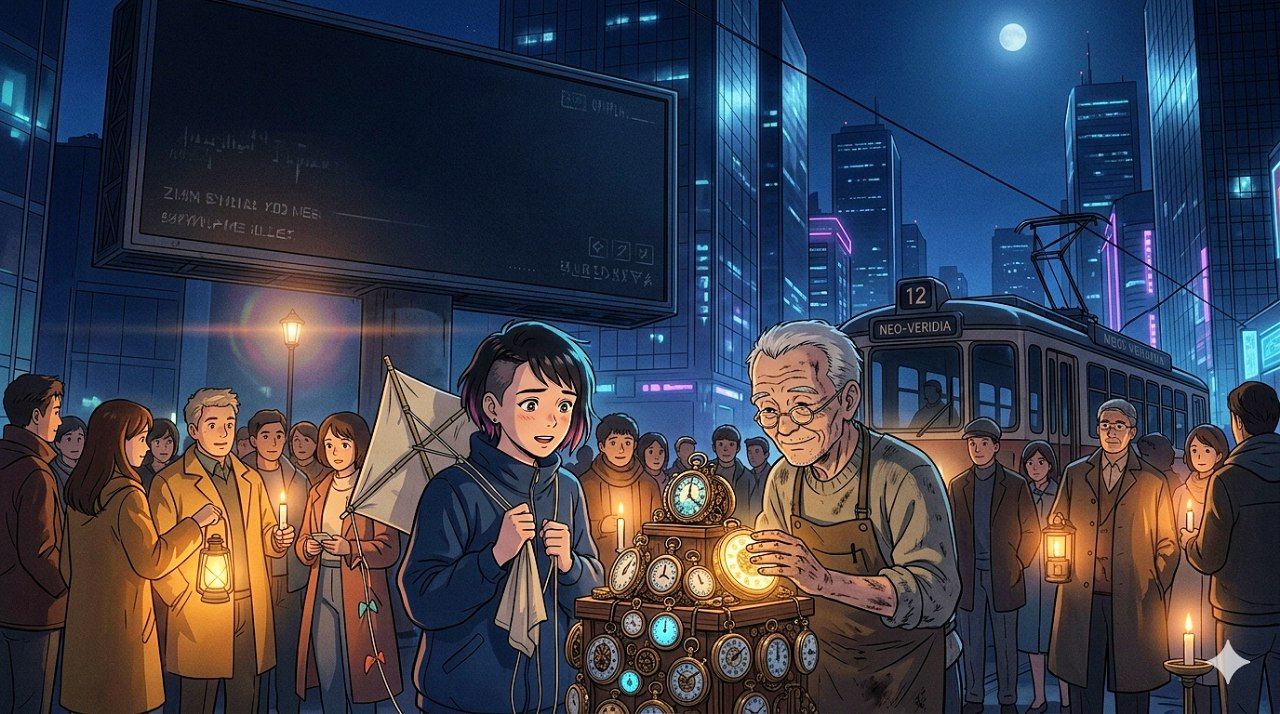
Short story: The Unexpected Piñata
The house where the party was going to be held looked calm from the outside: dim lights in the yard, the front door ajar and a small sign that read “Welcome” hanging from the knob. Marco thought at first glance that he had found the perfect opportunity. He had checked streets, corners, and times; that night, by his imperfect calculation, the house should have been empty. With a misaligned moral compass and a ragged sack full of questionable intentions, he pushed the back door open carefully, like someone who believes they are making the perfect move.
Before the night’s silence could wrap around him, a deep bass stabbed his back: reggaetón at full volume, strobe lights throwing flashes down the hallway, and laughter coming from the living room. Marco stood frozen in the doorway, his hand still on the knob, trying to decide whether to leave the way he’d come in or, more boldly, slip unnoticed among the shadows. He had no time to choose. As he set a foot into the room, thirty pairs of eyes fell on him as if awaiting his entrance.
“Surprise!” someone shouted from the dance floor. “Who brought the piñata?”
A few moments were enough for the situation to flip: Marco’s expression went from burglary-calculator to actor in an improvised scene. The sack on his shoulder—filled with socks and a stranger’s wallet that was starting to feel too heavy—seemed to have become another party accessory.
“A piñata?” he stammered, looking around with the confusion of someone who’s been pointed out in a game. “I— I… uh… do I look like a piñata?
A woman in heels with a plastic crown on her head approached, smiling diplomatically and holding a glass. Her name was Rosa, the hostess, and her instinct in the face of the unusual was—without much hesitation—to include him.
“Sweetie, if you’re the piñata, you got the music taste,” she said, nudging him toward the center of the living room. “Dance a little!”
Marco’s disbelief mixed with a touch of shame. He didn’t know how to dance; it wasn’t part of his plan, and now there was an audience watching him like the evening’s finale. Before he could react with anger or flee, he did something unthinkable: he raised his hands in an unsuitable pose, half submissive, half comical, as if that were the correct posture for a party prop.
“No, no, no!” a young man shouted, his voice pitched high with excitement. “It’s an explosive piñata! It has keys, wallets and… is that a watch?”
Laughter spread. Some threw confetti into the air; others, with the ease of those following a comic script, stepped closer to check if Marco was hiding any treasure. One guest, camera always at the ready, was already filming. Another grabbed a sequin scarf from the coat rack and, with a mischievous smile, placed it over Marco’s eyes.
“Relax, darling,” a warm voice said. “It’s so he won’t see when we hit him.”
“Don’t touch me!” Marco protested, trying to sound threatening and sprinkling his voice with timidity.
Despite his efforts, the situation had become a comedy. Someone gently tore the sack from his shoulder and rummaged through it like a child dismantling a piñata. They found socks, a small notebook with numbers scribbled inside, and a wallet bearing a card from another city. The atmosphere was not panic but festive curiosity.
“Who are you?” the hostess asked, offering him a glass as if proposing a welcoming toast. “The uncle who brought the piñata?”
“I’m not the uncle… I’m…” Marco searched for a plausible lie—“the delivery guy for strong emotions.”
The line produced peals of laughter. A group of friends, laughing, decided the situation required the ritual every piñata gets: blindfolds, forming a circle, and preparing the “batter.” One fetched an inflatable bat from the closet with a local team’s logo and handed it to the improvised protagonist. The music turned up, someone whistled, and the game began.
“To the left! To the left!” a voice ordered enthusiastically. “Don’t let it escape, don’t let it escape!”
Marco tried to move carefully, but in the fray he knocked over a plant and lost a shoe. A small dog, present without a formal invitation, claimed the shoe as if it were a war trophy. The contrast between the seriousness of his original plan and the ridiculousness of the scene became unbearable: the thief, blindfolded with sequins and wielding an inflatable bat, in the middle of a party while guests chanted and recorded every move on their phones.
Someone called emergency services with stifled laughter and, after asking for details, the operator’s voice asked, “Are there any bites from the piñata?”
“Not yet,” Rosa replied. “But it has excellent taste in wallets!”
When sirens began to be heard in the distance, the scene almost described itself: confetti stuck to the lights, a man with an improvised blindfold holding a tray of canapés that a guest had given him “so he wouldn’t get bored,” and thirty people shouting “piñata! piñata!” with genuine enthusiasm. Even the dog carried the lost shoe like a trophy to cap the evening.
Police officers entered with the professional seriousness the night demands. Two officers, equipped and concerned for safety, confronted the carnival tableau. One, seeing the sequin scarf and the inflatable bat, couldn’t help but twitch a brief smile.
“Good evening,” he said, controlled. “What do we have here?”
The hostess, keeping composure and wearing the makeshift title of stage director, explained as if narrating a comedy.
“A bad case of mistaken identity! We believed he was the official piñata of the night. It was all very… spontaneous.”
The officer looked at Marco, at the sack with unidentified items, and at the tray of canapés. With some firmness he asked:
“Sir, can you explain why you were carrying a sack with things that aren’t yours?”
Marco, still holding the bat, peeking through the slit of the scarf at the floor, decided it was time to be honest. He had faked many things in life, but he never imagined he would end up confessing his clumsiness to a crowd watching with festive interest.
“Bad idea,” he said in a low voice. “I dropped my IQ three levels and thought nobody would dance.”
A brief silence, then general laughter. Even the officers loosened their sternness, and one of the female officers arranged for someone to take his statement. They took the inflatable bat away and returned the sack so that, with less drama and more logic, it could be taken where it belonged. The guests, relieved and amused, took the chance to take pictures with Marco, who no longer knew whether to pose as a repentant thief or a pampered piñata.
“You’d better go home,” the officer said. “And when you get there, return what’s not yours.”
Marco, blushing and with trembling hands, nodded. It was the first real relief he’d felt that night.
“Can I keep the scarf?” he asked, mixing shame with hope. “It was the only part of the night where I felt included.”
Rosa took the sequin scarf off and, without drama, placed it around his neck.
“It’s yours,” she said. “But on one condition: you join our Friday karaoke nights. Piñatas can’t be purposeless.”
No arrest was necessary; honesty, the guests’ strange compassion, and the lack of aggression turned everything into an episode that would be retold many times. The photo of the moment—Marco with the scarf, the inflatable bat, and the expression of someone who wishes to disappear—went viral. Within hours, messages arrived from everywhere: “Best fall of the week,” “I need the series of this,” “Who writes these scripts?” were some of the comments accompanying the image online.
The episode ended without injuries, with jokes exchanged between police and hosts, and with Marco losing not only the intention to steal but the anonymity he’d sought. On the street, as he put the sack back on, he knew his name was already circulating in stories and that his face—blindfolded with sequins in a viral photo—would keep him company for a long time.
Weeks later, in the small community, Marco stopped being just “the one who tried to steal.” He became, instead, “the one who turned into the piñata of the best anecdote.” Among acquaintances some advised him on legal paths and others begged him to join the next karaoke. True to her word, Rosa waited with an invitation in hand: “Friday, nine, don’t miss it.” Marco, the scarf still draped around his neck, accepted.
Moral, if one wanted to call it that: life sometimes puts you at the center of the party when you least expect it; if you enter somewhere that isn’t yours, at least learn the chorus of the night. Because you might end up viral, with an inflatable bat in your hand and a new social obligation: show up Friday to sing.
Source of the images.
Image created with Google Gemini.

Short story: The Perfect Sister (According to the Internet)
Chapter 1 — The Post
Aiko swiped her thumb across the screen while her heart fluttered between pride and embarrassment. The post she had made minutes after getting off work had gone viral with absurd speed: screenshots, comments, direct messages ranging from serious proposals to ridiculous offers. Some accounts proposed “serious dates,” others sent memes. At the top, still visible, was the headline she had typed on impulse: “JAPANESE WOMAN LOOKING FOR A PARTNER FOR HER 33-YEAR-OLD SISTER.” Below, in large letters, the description Aiko had written with a mix of irony and desperation: “SHE’S A FULL-TIME NURSE, NEVER HAD A BOYFRIEND, ZERO FRIENDS, HATES LEAVING THE HOUSE, AND DOESN’T SPEND ON MAKEUP.”
Emi, her older sister, came into the kitchen when she heard Aiko’s strange laugh.
“What’s going on?” she asked, leaning against the doorframe with a cup of tea in her hands, her tall figure wrapped in a robe that smelled of lavender and hospital soap.
“Your fame,” Aiko said. “Grandma already shared it in the family chat.”
Emi sighed and set the cup carefully on the counter, as if handling something fragile.
“I told you you’d regret it,” she replied with a smile half guilty, half amused. “But I admit ‘doesn’t spend on makeup’ is a great selling point.”
Aiko rolled her eyes.
“That wasn’t ‘selling,’ it was desperate honesty. Also, you wrote ‘She’s rich because she has no social life.’ That sounds like a product slogan.”
“Well,” Emi said, “it’s true. I save money. I don’t have many expenses. What did you expect me to say? ‘Looking for a husband who loves karaoke and midnight getaways’? No, thanks.”
Aiko looked at her: Emi always spoke with that blend of candor and reality that made people shrug at her truths. She was 33, worked night shifts as a nurse at a public hospital, and had lived alone for years. She didn’t have a very active social life—not because she avoided people, but because she preferred her life to be simple and functional. The post, however, exposed her publicly, and that made her uneasy.
“There are messages from everywhere,” Aiko said. “A guy named Sora wrote from Kyoto. He says he designs video games. He wants to meet for ‘work and personal reasons.’”
Emi raised an eyebrow.
“Work and personal reasons? What kind of job needs a nurse who never leaves the house?”
“I don’t know,” Aiko answered. “Do you want me to delete the post?”
Emi shrugged.
“No. It’ll be fun. Besides, people already know who I am. It’s easier to find someone that way than someone with a hundred conflicting interests.”
Chapter 2 — The Date
They agreed to meet on Friday at eleven in a café near the park. Emi, free that morning thanks to her night shift schedule, decided to wear something simple: a navy dress, a silver chain she had inherited from their mother, and a light jacket. She wasn’t wearing makeup—only a clear lip balm—and Aiko looked at her with tenderness and a little apprehension.
“You could wear something that shows you care,” Aiko suggested. “Not much. Just… a touch.”
“I don’t wear makeup,” Emi said. “I’ve never needed it. If someone won’t accept me for that, it’s their loss.”
Aiko said nothing. The sisters walked together to the café; the morning sun lit the street and left the city with a golden glow, as if nothing could go wrong.
Sora arrived on time and sat at the table by the window with a disarming smile. He wore a pixel-cat T-shirt, round glasses, and a backpack with notebooks peeking out. He had the calm manners of someone who spends hours explaining game mechanics to impatient people.
“Hi, Emi,” he said, tilting his head slightly. “I’m Sora. Thank you for meeting me.”
Emi returned the greeting with a shy smile.
“Thanks for coming. Aiko said you’re… a video game designer.”
“Yes,” Sora replied. “Independent designer. I make small, slow games. Nothing spectacular.”
Aiko, sitting to one side, had already taken out her phone and discreetly opened the camera. She was the unintentional PR manager of her sister’s dating life. She soon posted a short story with the caption: “Trial date: approved.” She didn’t expect the post to get even more attention.
At first the conversation was awkward: exchanges about tastes, favorite recipes, and childhood memories. Sora, with an easy grin, said he’d grown up with three younger siblings—explaining his patience and tendency to organize things. Emi spoke about her work with a professional tone: long nights, patients telling stories to pass the time, scrubs infused with the smell of the hospital, and above all, the comfort of routine.
“Night shifts taught me to cook with whatever’s available,” Emi said. “Sometimes I make miso soup at three in the morning just to stay awake.”
Sora laughed.
“That sounds like a ritual. I love rituals. My games usually start with coffee and a sketch.”
The meeting took an unexpected turn when an elderly woman at a neighboring table started choking on a piece of cake. She brought her hand to her throat and her expression tensed. Sora reacted with uncommon speed: he crossed the distance, performed the Heimlich maneuver calmly, and made sure the woman could breathe. Emi, trained for emergencies, watched with widened eyes and, for a moment, radiated professional gratitude.
“Good reflexes,” she said, unable to hide her admiration. “Did you work in emergency care?”
“No,” Sora replied. “I just grew up with three little siblings and a lot of family dinners. That trains you.”
Emi let out a laugh that sounded like relief, and the conversation shifted: they were no longer strangers measuring words but people who had just shared a moment where routine was interrupted by something human. Aiko didn’t miss the chance to take a photo: Sora with calloused hands and kind eyes, Emi with the genuine smile she rarely showed outside the hospital.
Chapter 3 — Rituals and Small Stumbles
In the following weeks, their relationship became a mix of long messages and brief meetups. Sora sent Emi prototypes of his games with warnings: “If anything hurts, say stop.” Emi played them and gave practical feedback, sometimes professional: “If this scene involves medical realism, don’t overdramatize; realistic isn’t always the most dramatic.” Sora laughed at the accuracy of her observations.
Aiko became the relationship’s administrator with a blend of humor and protectiveness. She organized small social tests for Emi: a picnic with hospital coworkers, a pottery class, and—boldest of all—forcing her to sing at a karaoke where most of the songs were Aiko’s favorites, not Emi’s. Emi accepted with gentle resistance. Each test made her a bit more open without seeming forced: Aiko presented them as scientific experiments with lists and protocols.
Differences between Sora and Emi produced natural comedy. Sora didn’t understand many of the cultural references from the hospital world; Emi didn’t get the devotion Sora had for rhythm games or developer forums. One afternoon, Sora tried to explain the logic behind his favorite game using culinary analogies; Emi responded with a detailed explanation of how to make a proper chicken broth. They both ended up laughing, discovering their worlds weren’t as far apart as they thought.
One Saturday, Sora invited Emi to his apartment to try the latest build of his game. He arrived with a wrapped box and a package of tea.
“I brought something,” he said with that mix of shyness and excitement that had become his trademark. “It’s a small game. Nothing serious.”
Emi opened the box gently and found a teapot with a pixelated drawing of a nurse holding a cup of tea. Her eyes reflected surprise and emotion.
“It’s beautiful,” she whispered. “Why a teapot?”
“Because you said you like tea and that your shifts force you to find small rituals,” Sora answered. “And because I wanted to draw something to remind you that simple things can be special.”
Emi, holding the teapot, felt the words from the viral post dissolve: this box was more honest than any slogan Aiko could come up with. Sora moved closer to the table and, in a soft voice, said:
“Maybe this all started as an internet joke, but this isn’t. I like you, Emi. Your life isn’t boring; it’s steady, honest, and real. I’d love to get to know you without labels, without viral posts.”
There was a brief, perfect silence. Emi set the teapot down and looked at Sora with something like astonishment.
“I don’t know any of this,” she admitted. “I’ve never had a boyfriend. I don’t know how to act.”
Sora smiled and shook his head.
“You don’t need to know. There’s no manual. We can write it together. Chapter one: learn to eat ramen with chopsticks without making a mess.”
Aiko, who had gone to the kitchen for more tea and had overheard, pushed a cookie toward the table like a blessing.
“Chapter zero: listen to the little sister,” she said triumphantly. “It works more than you think.”
Chapter 4 — Shared Life
Their relationship progressed in small, steady steps. It wasn’t a sudden infatuation but a sequence of gestures: late-night messages with playlists, calls that turned into long descriptions of the day’s absurdities, visits where Sora left notes with drawings on Emi’s fridge, and Emi bringing homemade soup when Sora worked late on his computer.
There were comedic moments that strengthened their bond: Sora putting a hand to his forehead when Emi used medical terms he didn’t understand; Emi trying gamer jargon and stumbling over words that made her laugh; Aiko always in the background sending midnight memes to keep spirits up. One day, at a contemporary art show Sora thought would be “a good stimulus,” the main exhibit turned out to be a plant on a chair. Emi and Sora looked at each other, laughed, and decided their art was better: the one lived in the kitchen, among teapots and game controllers, with conversations that swung between the serious and the absurd.
Misunderstandings arose, natural in any relationship: once, Sora thought Emi wanted extreme privacy when she declined a too-public invitation; Emi felt uneasy about the lingering popularity of Aiko’s original post. They talked openly: Emi explained she wasn’t antisocial out of disdain but selective with her energy; Sora admitted it sometimes hurt not to understand the professional codes Emi used so naturally. Those deep conversations brought them closer more than any romantic gesture.
One rainy night, while sharing an umbrella that seemed too small for both of them, Sora stopped and looked at her seriously.
“Do you know something?” he asked, with the rain tapping the umbrella above them. “Your sister posted a list of ‘benefits,’ and it was funny… but the best benefit I found is that you’re not afraid to be yourself. That, to me, is worth more than any viral post.”
Emi rested her head on his shoulder and let the rain wash away any doubt.
“I don’t know how it happened,” she murmured. “Maybe my sister exaggerated the advantages, but… I’m glad I met you.”
“Me too,” Sora replied. “And if one day you want to delete the post and go back to anonymity, we’ll do it. I don’t need fame, I just need this.”
Emi smiled, feeling like the small world she cared about had righted itself.
Chapter 5 — What Remains After the Post
Over time, Aiko decided it was time to delete the original post. It was no longer necessary: the joke had served its purpose and Emi’s life had taken its own course, away from memes and inappropriate proposals. That night the sisters sat in the living room with cups of tea. Aiko looked at the screen one last time and swiped to remove the post.
“Will you feel strange?” Emi asked, watching her.
“A little,” Aiko admitted. “But I feel like this is ours now. Important things don’t need public validation.”
Emi took Aiko’s hand and squeezed it affectionately.
“Thanks for pushing me,” she said. “Even if you pushed too hard sometimes.”
They both laughed.
A few weeks later, Sora took Emi on a simple picnic in the park where they had met. He brought the pixelated teapot and two new cups, one with small green dots and the other with a joystick motif. They sat on a blanket, shared soup, and talked about plans that didn’t need to be big: a short trip to a coastal town, collaborating on a game that included caregiving and daily rituals, dinners with friends chosen carefully.
Their relationship wasn’t a fairy tale or a perfect romantic comedy. They argued about schedules, the need to carve out personal space, and how to handle the occasional attention that still surfaced because of Aiko’s post. But what they built was an authentic everyday life: sharing umbrellas, learning to cook together, laughing at each other’s clumsiness, and supporting each other through the nights Emi’s shifts left her exhausted or when Sora needed to finish a deadline.
Epilogue — An Improvised Manual
One afternoon, while Aiko scrolled through old photos on her phone, she found a screenshot of the original post with its flood of ridiculous comments. She smiled and deleted it without a second thought. Later, Emi and Sora sat at the kitchen table and started writing the “manual” Sora had promised: recipes, game codes, lists of things to do when one feels alone, and simple rules like “always ask before inviting someone over” and “make tea when you’re sad.”
Aiko peeked over their shoulders and added a line in small handwriting: “Chapter zero: listen to the little sister.” Then she closed the notebook, satisfied.
The viral post that started it all became an anecdote—a reason to laugh about life’s absurdities—but what endured was the everyday: two people choosing each other without drama, a sister who acted with humor and a bit of desperation, and a tiny pixel teapot that, more than an object, became a symbol of a shared ritual.
The End.
Source of the images.
Image created with Google Gemini.
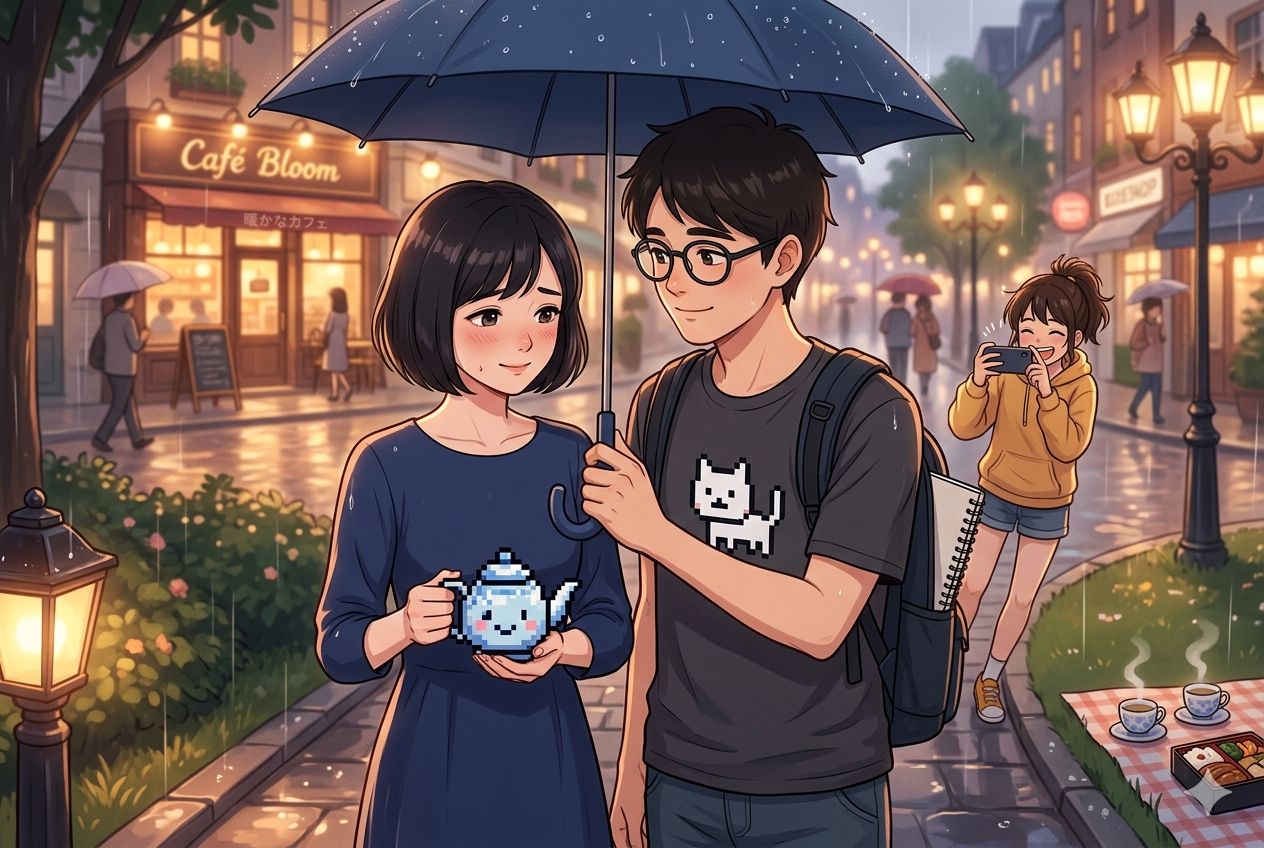
Short story: Ledge
Night had fallen like a velvet curtain over Midtown. The offices, like horizontal constellations, gleamed in rectangular blocks while the city murmured below: a heartbeat of cars, distant sirens, conversations dissolving in the damp of the asphalt. On the 42nd floor of the Hawthorne Tower, a silhouette moved with the precision of an acrobat: a black cat, thin, walking along the exterior edge of a window as if the cornice were a tightrope.
Mateo Ríos held his phone with hands that would not stop trembling. He had stepped up to the living room ledge to get a better angle and, on the screen, the tiny animal’s body was set against the vastness of the city. The zoom made the image waver; the cat’s eyes reflected the streetlight like two beacons.
“What the hell…?” Mateo muttered, not realizing he was speaking aloud.
From the neighboring apartment, an ajar door let out a figure who planted herself in front of the window, a steaming cup of tea in hand. Her hair was tied back carelessly; her gaze was sharp.
“Are you recording?” the woman asked, her voice restrained though the coffee let off steam.
Mateo turned and pointed the phone. “Yes. Look at this!” he said, holding up the screen. “That cat is hundreds of meters up.”
She approached and pressed her forehead to the glass to see better. Her eyes—black and observant—fixed on the tiny figure walking the edge without hesitation.
“This isn’t the first time I’ve seen it,” she finally said so quietly it sounded like it was meant only for herself. “I’ve been seeing it in different videos for a week.”
Mateo raised an eyebrow. “Videos?” The word echoed with a trace of disbelief.
She set the cup on the table and, with a gesture mixing nervousness and resolve, introduced herself. “I’m Elena Vargas. I work in urban zoology,” she explained. “I’ve been compiling recordings of ledges—of cats doing strange things. There are patterns.”
A chill ran down Mateo’s spine. He stepped back as if the cold came from the screen.
“What kind of patterns?” he asked.
“Appearances before an incident,” Elena answered. “Noises, flashes, a presence while the animal exposes itself. People call it coincidence. I call it a warning.”
The image on his phone jittered: the cat sniffed the cornice, took two steps back, then continued with the same calm as a tightrope walker used to abyss. In the recording, a few seconds later, a shadow crossed behind the interior of the room where the window was open: a silhouette that paused as if looking outside, then disappeared. Mateo replayed the scene in slow motion. The shadow was barely a darker tone in the background, but one could see the gesture of someone lifting an arm.
“Did you see that?” he said.
Elena nodded, jaw tight. “Someone is manipulating the scene. They don’t do it to domestic animals out of mere cruelty; they do it to measure reactions.”
Curiosity pushed them to search for more. Over the following hours they reviewed every video they could find: neighbors’ recordings, live streams that had gone viral, messages in community groups. Each clip showed a cat walking along a different ledge, at different heights, in different neighborhoods, but with the same disturbing pattern: a minimal event—almost always a pulse of light or a buzz—and someone—almost always invisible in the main frame—who seemed to provoke or point something.
“Traps?” Mateo asked when Elena explained her hypothesis.
“More than traps,” she corrected. “Experiments. They’re looking for the limit between balance and panic. They want to know how much stimulus makes an animal lose control. And if they test on cats, the city’s verticality helps: it does the rest.”
The idea sounded like something out of a movie, but the sting of fear rising up Mateo’s neck confirmed that something real and ugly was at stake.
The next dawn, the building’s doorman reported that someone had forced the basement gate. Nothing of obvious value was missing: tools, a folding ladder, a roll of metal mesh. Only a note remained nailed to the counter with hurried letters: “In case the animal gets bored.” The community, which hadn’t yet decided whether to laugh or be outraged, began to look up at windows with new eyes.
Mateo and Elena made an unspoken pact: they would investigate until they discovered who was behind the interference. They could not, and would not, wait for another animal to be harmed. Elena, with contacts in universities and organizations that studied urban fauna, convinced a technician named Luis to install a couple of devices: a night-vision, high-resolution camera with continuous recording, vibration sensors on the ledge, and a sound emitter designed to repel birds—an experiment she thought could disrupt a cat’s behavior and reveal whether there was external manipulation.
The night they activated surveillance was one Mateo would never forget. They sat in silence, cold coffee cups at their sides, the monitor as the only window into what might happen. The city seemed to breathe at a different pace. The clock read 2:14 a.m. when the feline figure appeared, as always, unnervingly calm.
Approaching the edge, the cat paused, sniffed, and for an instant that felt like years, seemed to listen to something only it could hear. Luis’s emitter emitted a sharp buzz that vibrated against the glass. The animal arched its back but did not jump. Then, within the room’s interior, darkness moved. A shape emerged: a medium-height man wearing dark gloves and a scarf that covered his face. He stepped forward without sound, as if he knew the map of shadows.
Mateo held his breath. “Who are you?” he said before thinking, unaware his voice had passed through the glass.
The man raised his hand and pointed slowly toward the window. He produced from his coat a small metal cylinder that gleamed with a cold light. The pulse it emitted was almost imperceptible on the recording, but the vibration sensor captured an odd signature: modulated microwaves, a frequency that did not correspond to any household appliance.
The cat reacted as if a current forced it to move away from danger. Instead of leaping into nothingness, it clung to the edge, then, with the same composure, slid along the ledge to the adjacent rooftop. The man watched, tightened his jaw, and vanished through the back door of the apartment, melting into the night.
The next morning they scrutinized the sequence. Elena paused on a frame: the cylinder’s light reflected faintly in the glass. They amplified the audio and found a murmur like a muffled machine breathing.
“He’s not just a prankster,” she said. “He knows frequencies, behavior. He has a protocol: test, observe, adjust.”
Mateo imagined how many hands might pay for such results: entrepreneurs willing to experiment, security companies funding tests, markets that profit off fear. They called the police; the response was measured: “Without physical evidence, it’s difficult to proceed.” Detective Campos, assigned to the case, watched the recordings attentively but with that detachment familiar to those who have seen too many unresolved stories.
“There are patterns,” the detective admitted. “But you need tangible proof. I can’t accuse anyone based on a flash in a video.”
That refusal forced them tomove on their own. Elena traced microwave signatures with a colleague at MIT who worked in neurocommunications; the signals found in the files had an unusual modulation, similar to those used in sensory-stimulation tests on lab animals. Mateo began doing night watches around the buildings where the videos had been filmed. On one of those rounds he noticed an old maintenance truck parking at the same hour on different streets; its logo had been scrubbed, but the route pattern caught his attention.
Determined to follow the trail, Mateo and Elena tailed the truck one dawn to a warehouse in the Lower East Side. Through a fogged window they watched activity: men moving boxes, tubes, electronic equipment. One man read aloud from a document: “Phase 3: panic response at height — threshold validation 0.7.” Inside a box a small white body trembled. Nearby, a cylinder similar to the one in the footage lay on a table.
“We have to get that animal out!” Mateo blurted. The sentence left him before he could second-guess himself.
They had no clear plan and no legal authority, but they pushed at the door anyway. The noise shattered the place’s calm. Men inside startled; curses, hurried footsteps, a back exit yanked open and the shriek of an engine. Mateo darted among crates. Elena sprinted to the cage holding the white cat and scooped it up. At the same moment, a figure stepped from the shadows and aimed a device that started to pulse.
The wave hit like a slap. Mateo felt pins and needles across his arms, the room swam. He stumbled, but Elena, blood running cold, shielded the cat with the mesh they had brought from the Hawthorne. The net unfurled and—strangely—acted like a buffer: the pulse dispersed in vibration rather than cutting through. The back door burst open as a police cruiser arrived; Elena had managed to send an anonymous tip with the location before they'd entered. The improvised intervention was chaotic and dangerous, but it worked.
The warehouse search yielded documents that left little doubt: research notes, contracts with non-existent companies, logs labeled “panic threshold,” spreadsheets with data from multiple districts. Technical components and frequency diagrams littered the packing crates. On a project report was a name: Project Aster.
As arrests followed, interrogations revealed that Project Aster was not just a rogue group of unethical experimenters but a network with broader ambitions. Members spoke of “validations” to sell to private clients: insurers wanting to test responses to disasters, security firms funding trials, investors aiming to manipulate real-estate markets by manufacturing perceptions of danger. The accused insisted that “real scenarios” were needed to calibrate equipment and protocols. Animals, to them, were disposable variables in the equation.
News outlets went wild. The videos of the cat walking the edge—dubbed “Crow” by the press for its dark coat and luminous eyes—multiplied, and social feeds filled with outrage, photos of cornices with nets, windows with locks, pet owners forming groups to watch over one another. Prosecutors brought charges for illegal experimentation, animal cruelty, and fraud. Mateo and Elena’s footage, the warehouse recordings, the microwave analyses, and the contracts formed a mosaic the defense could not entirely dismantle.
Through it all Mateo became an involuntary chronicler. His camera, once a tool of idle curiosity, became evidence. Elena risked her academic reputation to help interpret technical findings for the prosecution. The technician who had appeared in the videos—the so-called “Vigilante”—turned out to be a remorseful employee who said he’d tried to sabotage the experiments by creating small disturbances that would draw attention but harm no one. He had left deliberate clues—a note in the Hawthorne basement, a string of odd actions—in the hope someone would connect them.
“I thought causing curiosity would be enough,” the technician told prosecutors. “I believed public reaction would shut it down. I didn’t expect things to escalate, or animals to be endangered.”
“Sometimes a clumsy protest opens doors,” Elena said in court, her voice steady though laden with truth. “But unethical experimentation is a crime. Nothing justifies using lives as variables.”
The trial lasted months. Testimony, technical expert reports, and explanations of malicious intent wove through the proceedings. The verdict convicted Project Aster’s leaders; the sentences could not undo the damage, but they sent a message: the city would not tolerate experiments crossing the line into cruelty for profit.
Life in the Hawthorne and other buildings changed. Nets and safety screens were installed on windows; maintenance protocols were reviewed; neighborhood groups organized watch channels. Mateo declined offers to capitalize on his notoriety. He continued filming, but with a new purpose: documenting urban resilience—stories of animals and people woven into the city’s fabric.
The black cat, now called Crow by Elena, became a symbol. The light in its eyes on that first video had ignited a communal impulse to look up and care for things many had ignored. On Hawthorne’s rooftop, rows of pets seemed to celebrate the newfound attention: more nets, secured windows, vigilant nights.
Months later on an autumn afternoon, Mateo and Elena walked across the Brooklyn Bridge. Golden light spilled over the East River; Manhattan’s skyline cut silhouettes like puzzle pieces. Crow hopped onto the railing briefly, scanned the city, then leapt to Elena’s shoulder and demanded a familiar stroke.
“Do you think it’s over?” Mateo asked, breaking their silence—the same curiosity that had started it all.
Elena looked at him and offered a half-smile. “Cities keep secrets,” she said. “What we did was shine a light in one place. Darkness doesn’t vanish; it learns other ways. But now we know how to look. When someone thinks they can play with lives in the shadows, there are more eyes ready to refuse to look away.”
Crow meowed, as if to confirm the verdict, and nestled against Elena’s coat. Manhattan resumed its ordinary hum that night. On rooftops and ledges and in windows remained the certainty that even the smallest things—a cat, a camera, a neighbor’s curiosity—can trigger change. And that vigilance, when wielded with care, becomes defense: because the city is not only a vertical landscape but a community, eyes open and hands willing to act when the line between science and cruelty is crossed.
Source of the images.
Image created with Google Gemini.
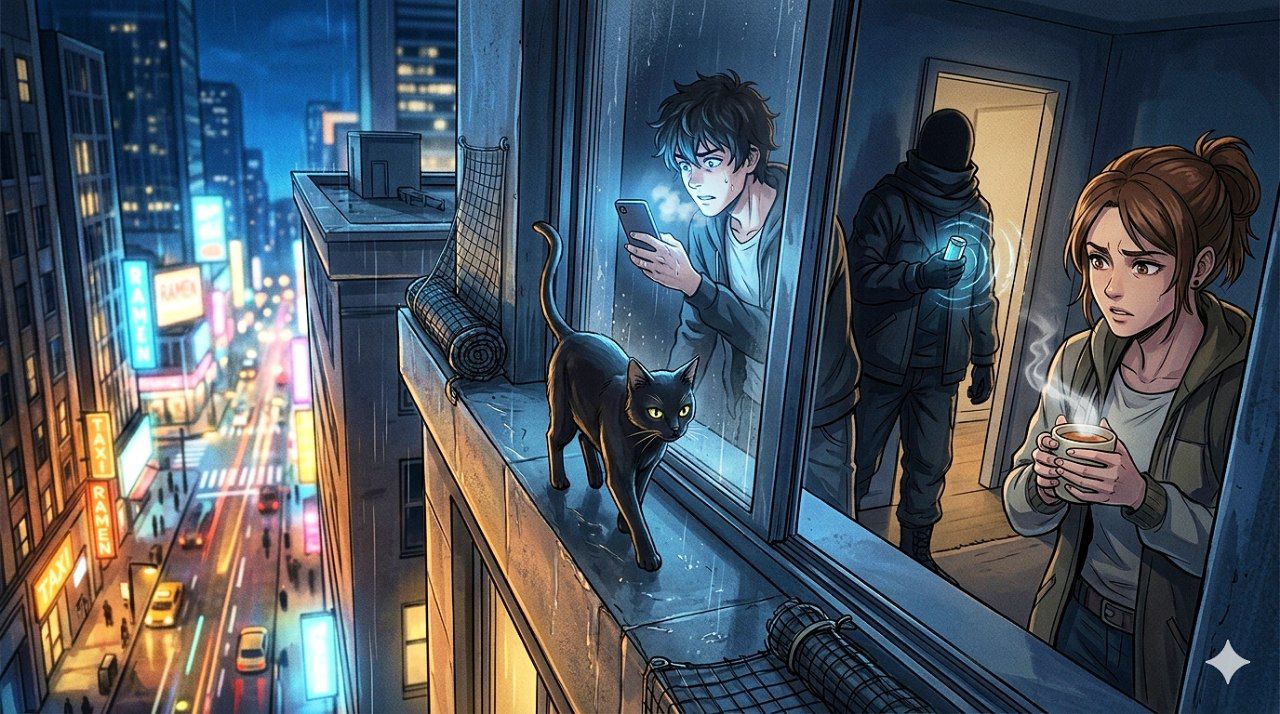
Short story: The House That Stayed in the Air
She woke with light stabbed into her eyelids like a knife. At first she thought she was still dreaming: contours were blurred, sounds filtered through a distance that hurt. A clock on the wall marked minutes that did not belong to her; voices around spoke with the tempered calm of those who have waited for the unpredictable. Three weeks, they told her. Three weeks that for her had been seven years.
"Where am I?" she murmured, her voice rough from disuse that felt like it belonged to another life.
A nurse took her hand carefully, like someone handling old glass.
"You're in the hospital. You were in a coma," she replied, letting the words fall soft and steady. "It was a bad blow, but you're awake."
When she opened her eyes a memory came over her that seemed to have burned her skin: the warmth of hands that woke her each morning, the smell of coffee drifting from the kitchen, the laughter of children who claimed her with tender nicknames. In her chest beat the certainty of an entire time: a marriage, a home, children called by names that now sounded like old bells.
"Mateo," she tried the name aloud, as one attempts to name a ghost.
Inside, the answer was as real as a shock.
"I'm here," she heard. "You're finally waking up, love."
The voice was deep and calm, the same she remembered brushing her forehead in imaginary mornings. Clara left a note on the fridge—she could see her handwriting in a line in her mind: Don't forget to smile. The children demanded attention with the certainty that their mother fixed everything.
"Mom, can you come see this?" one of them asked, with the innocence that does not know defeat.
In the dream-world she answered with the ease of someone who has duties and promises: yes, right away, I'm coming. She made shopping lists in her head, remembered how she tied one child's shoelaces, the way Mateo placed his hand on the back of her neck when saying goodbye. She built a house of routines: breakfasts with strawberry jam, afternoons of DIY, anniversaries with the same cheesecake that had become theirs by habit. She cried over small losses—a dog that died, a broken pot—and recovered in days, because that imagined home had infinite patience.
Her days filled with detail: the texture of a striped tablecloth, the sound of keys dropping into a fruit bowl, the way Mateo called her in a low voice to tell her everything would be fine. Each image settled with the firmness of a truth: she didn't just live those routines, she loved them. That life gave her reasons to get up, to plan trips, to be annoyed by small things, to remember summer dinners with nostalgia.
Then opening her eyes to reality was like falling from a tower without a net. The hospital had no labels with the names glued to her soul; the walls were white and cold, and no photograph showed clasped hands or children's drawings taped with adhesive. Around her, smiles were relief, not complicity.
"She's coherent," said a doctor who seemed to hold tenderness with effort. "It was a miracle she woke up."
"Mateo?" she insisted, searching faces for a map to guide her home.
Compassion filled those faces in a way she couldn't translate. No one pronounced that name naturally. A relative took her hand and squeezed it with the urgency of someone who feared losing what they had regained.
"You were very brave," a friend whispered. "We thought you wouldn't come back."
The gulf between what she felt and what others confirmed widened until it became a wound. Her memories, so vivid, became a film no one else had seen. She tried to describe the house, the names, the couple's arguments about who forgot to pay a bill; she tried to tell of Christmases, of voices, of the way Mateo helped her sew a button while humming a tune.
"We don't remember that," someone said softly. "It was a dream, maybe an hallucination caused by the coma."
The impact wasn't only realizing her life had been imagined: it was feeling that what she loved was taken from her. That family—the faces, hands, routines—dissolved in an instant, as if a gust had run through the foundations and left them in ruins. There remained a hollow in her chest where memories with names and smells had been; a void that didn't belong to any organ but to the entire architecture of her identity.
Hours passed, then days. Medical visits, routine questions, rehabilitation recommendations. A psychologist with papers in hand explained with professional terminology that the mind can create complete realities, that memory is not a faithful mirror but a creative machine that, in the absence of sensory input, fills in stories. His words were competent but sounded distant.
"The mind can fabricate worlds," he said. "That doesn't make what you felt any less real, but it explains why others don't share it."
She listened, took notes hoping anchoring the theories would help her keep the thread. At night, when the hospital shrank to the murmur of respirators and the light that filtered through the blinds, she wrote letters in a notebook no one would read. She spoke to her imaginary characters as one prays to saints of a private faith.
"Forgive me," she wrote in blue ink. "Forgive me for leaving you again. It's not that I want to; they force me to return."
In those texts she described Clara's smile with a precision that made her fingers tremble: the tilt of her head when making a joke, the way she bit her lip when cutting a cake, the tiny scar on her hand that appeared when she lifted a teacup. She wrote of routine order, of the children's proud repetition of names, of the smell of bread in the morning. She wrote to keep alive evidence no witness could confirm.
When she left the hospital, real life received her with a mix of tenderness and distance. She carried two existences inside: the one others named, with dates and medical records, and the other, intangible and persistent, watching her from within like a guest who refuses to leave. She walked through the city and every similar thing called to her: a little girl with a ponytail reminded her of her imaginary daughter; an older couple on a terrace returned the shape of those un-lived years. Sometimes she stopped at a shop window and looked for the coat she remembered Mateo wearing. Other times she sat on a park bench and watched children run with the blend of tenderness and knife-edge longing that comes from wanting to touch what no longer exists.
"Look," whispered a voice in her mind one afternoon, certain as the undeniable. "That's Mateo's coat."
The word returned to her mouth as both comfort and loss. People tried to soften her pain with ready phrases.
"It was just a dream," a neighbor said while bringing her tea. "The important thing is that you're alive."
Those words bounced against the hollow like a stone against glass: noise, nothing more. What could "being alive" mean when she had felt alive in another life with the intensity of someone who loves and takes responsibility? Consolation seemed small against the scale of her mourning: she had not only lost memories, she had lost beings who had loved her and whom she loved with absolute certainty.
She continued keeping testimony of what no one could corroborate in her notebook. Sometimes she read aloud as if rehearsing family prayers.
"Clara had a smile that started in her eyes," she would say. "Mateo always hummed while washing the dishes. The children used to call us from the balcony when they were mischievous."
In the afternoons, when solitude pushed hardest, she cultivated substitutes: a windowsill plant she watered devoutly, the smell of coffee she learned to prepare with the exactness of ritual, a bracelet she rubbed with her fingers when memories assaulted her. They were humble remedies but offered a surface on which to slide her hands and not fall entirely into nothingness.
She allowed herself, now and then, to get lost in imagination and inhabit the revived house like someone revisiting a cherished memory: opening the door, feeling the wood against her palm, hearing the steps of someone who would never be in real life.
"If you can hear me," she murmured at night, "come back."
She didn't seek logical consolation; she sought the return of what she loved. In gatherings with friends, conversations moved through normalcy: plans, work, small confidences. No one asked with the insistence she needed about the names she carried in her soul. There was a sort of awkwardness: others didn't know how to hold what seemed at once madness and tragedy.
Over time she learned to live with the double absence with care and a certain tenderness toward herself. She recognized that pain is not cured by will; that losing something you felt entirely real hurts like losing a person. She began to let real life offer her shades: a friend who invited her to dinner and listened without judgment, a support group where other coma and dream stories met and exchanged pieces of a puzzle, a psychologist who went beyond theories and asked about the texture of her memories.
"What do you feel when you think of Mateo?" he asked once, with patience.
"Nostalgia, and anger," she answered. "Nostalgia for having lost him, and anger because they took him from me without asking."
She learned to name her emotions and, with those names, to tame them. She could accept that the heart had been generous and that, even if it existed only in the mind, it had been real for her. That acceptance didn't erase the pain, but it gave it contours: she could now hold the melancholy without being consumed by it.
On clear days she walked to the park and sat watching children play. She watched them closely, as one looks for a trace. When a laugh sounded familiar she closed her eyes and allowed herself a moment of pure joy. If someone asked why she smiled for no reason she would simply say:
"I saw something beautiful."
And she returned home with empty hands but a slightly fuller heart. She knew fantasy couldn't replace real companionship, but she wasn't willing to renounce the seeds that imagined life had left her: the certainty she could love deeply, the skill to care, the capacity to build small rituals that gave meaning to days.
Sometimes, in the penumbra of nights when the city seemed to hold its breath, she wondered with reverent fear whether reality itself might be another kind of dream. If so, she told herself, perhaps somewhere there would be a morning when she'd wake again and find the people she had loved. That thought both comforted and terrified her: the chance to recover the lost implied the chance to lose it again.
"If this is another dream," she whispered one dawn, "then I don't know if I want to wake up."
The doubt remained unresolved, like a bell that rings but does not decide the hour. Living with that doubt taught her to inhabit melancholy without letting it define her entirely. She learned to open her heart to what was near: simple gestures, frank conversations, the company of those willing to stay. She also learned to give time to silence, to faithful memory, and to the notebooks where she kept proofs of her other life.
One autumn afternoon, when leaves fell like worn coins, she saw a mother nursing a child on a bench. She approached and sat at a respectful distance, observing with the blend of fervor and defeat that had accompanied her since waking. She felt a stab, then, as answer to an old need, murmured:
"Hello."
The woman looked up and returned a simple smile.
"Hello," she replied. "Beautiful day."
For a moment the exchange was minimal but real. She shared, without plan or guard, a short anecdote about a cake she once burned because she fell asleep while baking it. The woman laughed softly; it was a laugh that asked for nothing in return. As she rose, the woman let fall without thinking:
"Take care."
Those ordinary words supported her more than many explanations. She came to understand that real life didn't need grand gestures to be meaningful; small bridges sometimes appear between strangers.
Despite improvement, the shadow of her other life persisted. From time to time full scenes ambushed her: an argument about paint that ended in reconciliation; a child's first day of school and the pride that swelled her chest; a birthday celebrated with balloons and a song everyone knew. In those moments she closed her eyes, breathed, and repeated the names softly: Mateo, Clara—as if naming them restored some existence.
The true tragedy wasn't that she had dreamed; it was the intensity with which she had lived it. That intensity followed her like a shadow: sometimes it hurt, other times it held her up. She had learned not to demand answers that didn't exist, but to seek solace in everyday tenderness, in writing, and in available company.
On the last line she wrote in the notebook she left a brief phrase, like a wish.
"If somewhere they remember us, come back to me," she wrote. "If not, at least leave me the echoes."
When she closed the notebook's cover, for a moment she thought she heard, in the wind coming through the window, something that sounded like a familiar laugh. She could not tell if it was memory's trick or the will to feel. She allowed herself to smile, because she had learned that whether the world was dream or not, there was an undeniable truth in her heart: she was capable of loving enough to create an entire universe, and that, painful as it was, was also a miracle.
Source of the images.
Image created with Google Gemini.
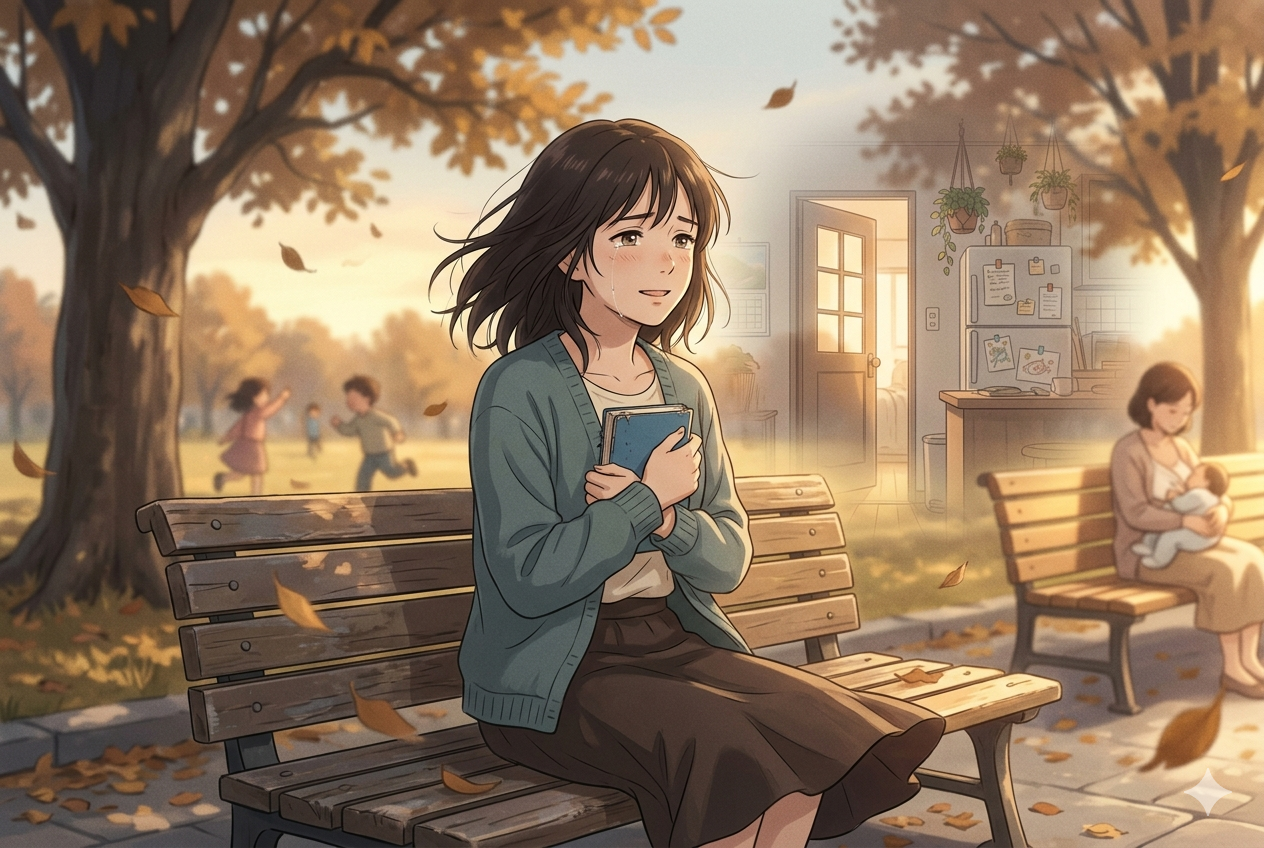
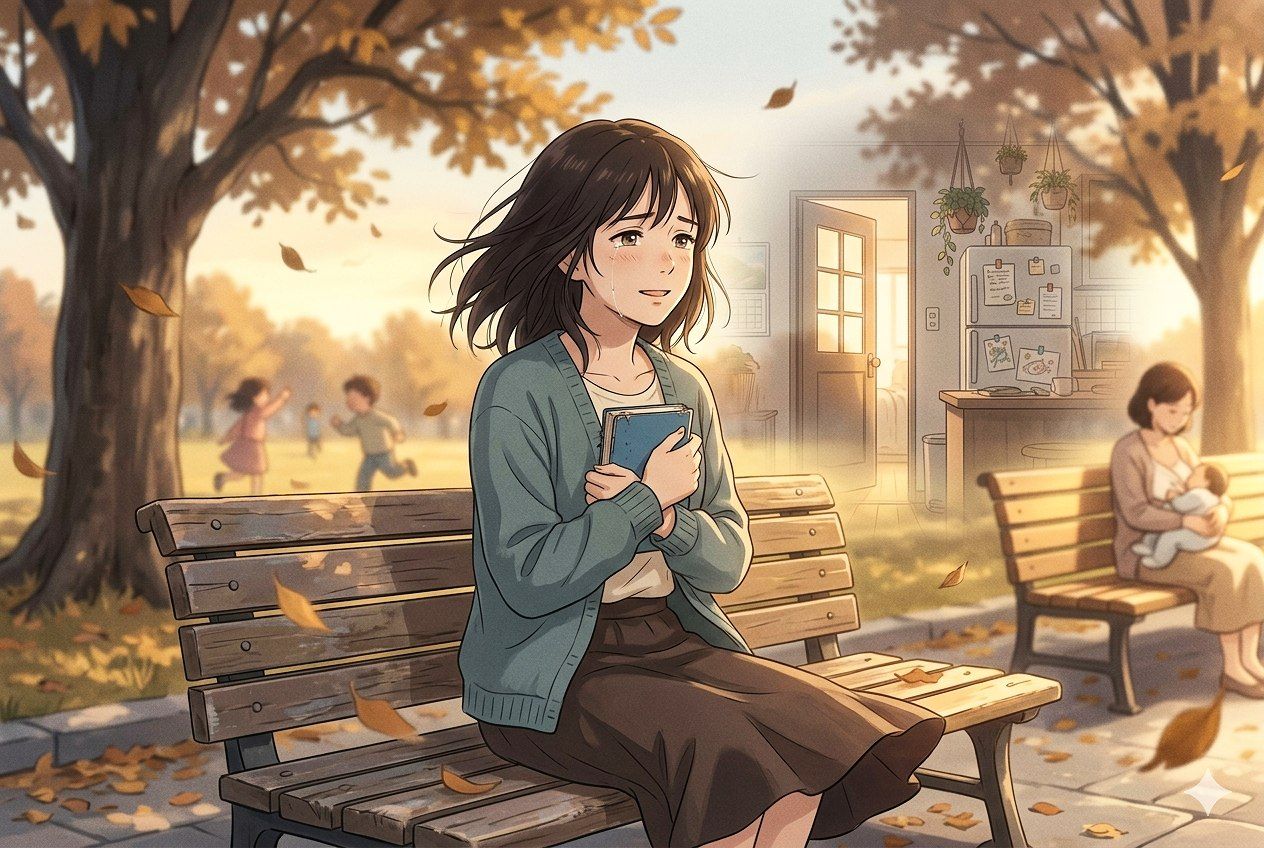
 @mc5punk