 @mc5punk
Short story: The Lighthouse’s Pupil
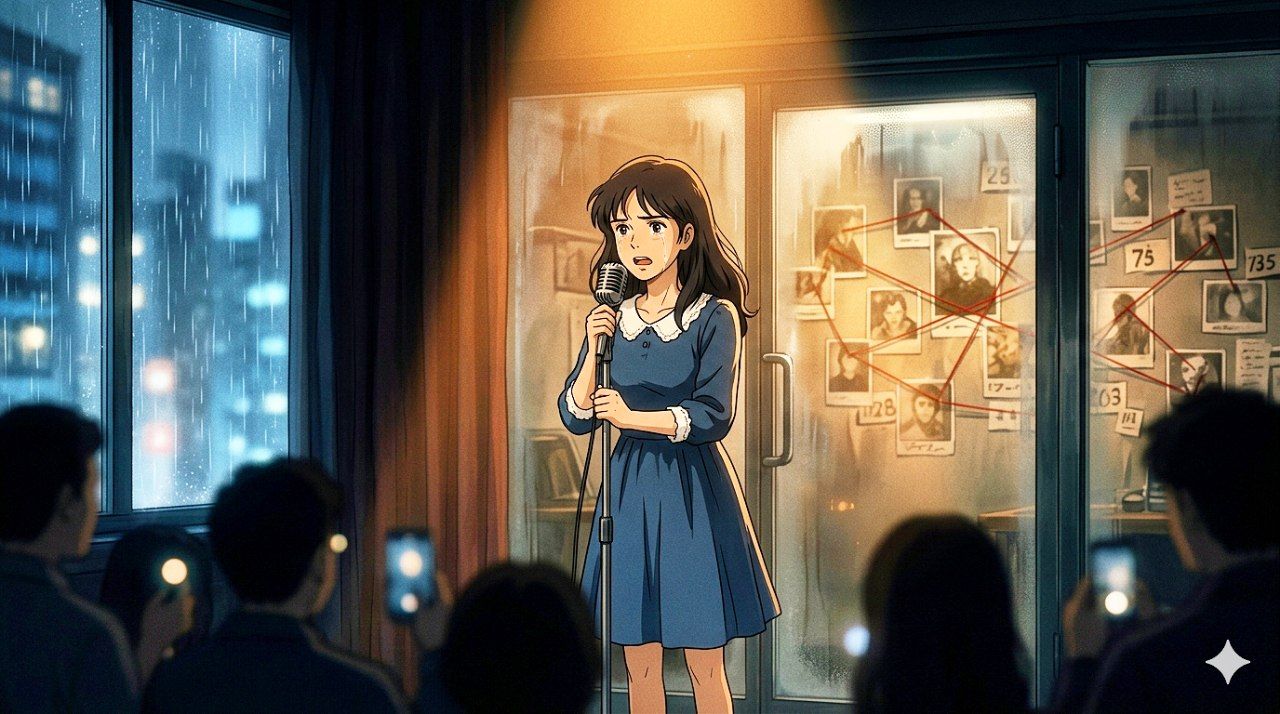
The rain beat against Mina Kuroi’s apartment windows with the persistence of a tireless drum. Outside, Aoyama dissolved into a watercolor of lights; inside, the small living room smelled of cold tea and fresh strings. Mina ran through the lyrics of a song that kept slipping from her grasp. On the coffee table, her phone vibrated every few seconds: a photo she’d posted that morning was collecting hearts and comments like small waves kissing the shore. It was a simple image — a frank smile, hair loose, the city blurred behind her — and to Mina it was nothing more than a moment of joy. For others, it became an invitation. Sora Hayashi, her manager, watched the screen with a mixture of pride and worry. “Thirty-four thousand likes in four hours,” he said, touching the screen as if he could hold the network’s attention between his fingers. Mina set the phone down with a nonchalant gesture that didn’t completely convince. “It’s just a photo. It’s no big deal.” Sora frowned without taking his eyes off the post. “Your smile is perfect. People need to see you like this.” She looked toward the fogged window. “People don’t know anything about my day-to-day. Why would they want to know?” Sora did not speak the truth they both felt in silence: fame is a thin pane of glass between the warmth of admiration and the cold of being watched. In an apartment below, in a part of the city where shutters closed late and neon lights sketched obsessive shadows, Damián Rei worked with patience that bordered on clinical. His walls were covered with prints, maps and notes. Red threads connected points as if he tried to reassemble a private constellation. Damián had downloaded Mina’s photograph at the highest resolution and enlarged it until faces and streets dissolved into grains of light. It wasn’t the smile that possessed him; it was the shine trapped in Mina’s pupils, those tiny points that held miniatures of what surrounded her. “If I extract the reflection in high resolution, I can see the window, the streetlamp on the corner, maybe the café sign,” he murmured, his fingers drawing lines in a notebook. His voice vibrated with concentration and something beyond curiosity — a certainty fed by verification. Storefronts, street names, train schedules; each datum was a fragment that fit into a puzzle he believed demanded order. It wasn’t hard for Sora to turn unease into action. Days after the post, strange messages began appearing on Mina’s account; comments with the scent of surveillance. Sora, hands that never stopped trembling, went to the police station to file a report. Inspector Arai, a man whose gaze had been worn thin by long nights and case files, listened with professional detachment and a hint of fatigue. “There are no signs of forced entry in her building, and yet someone has been following her in recent days,” he said, checking his notebook. Sora placed an envelope on the desk: an enlarged photo of the post with a circle inked over the pupil. “It was sent anonymously.” Arai let out a sigh that followed many others. “That’s no coincidence. Someone studied her. Someone with time and resources. Watching in that manner implies planning.” Mina, trying to keep her routine normal, returned late from rehearsal one night. The city felt quieter than usual, as if the streetlights were holding their breath. In the lobby, a group of young artists chatted over sheet music; nothing suggested danger. But in the corner by the fire escape, a figure watched under an umbrella. Mina felt a chill she could not explain. She forced herself to breathe calmly and climbed the stairs. When she arrived at the hallway to her floor, the lock yielded with a sound that didn’t belong to habit. The corridor light flickered. Before she could turn the key, a hand shoved her. “Calm down,” a voice she didn’t recognize hissed. The world splintered into silence and then whiteness. She tasted damp cloth in her mouth, felt the pressure of a blow, and the cold at the back of her neck. Consciousness slipped away with a final image: a tiny flashlight’s reflection — not in her own eye, but in the pupil of someone she did not know. When she woke, clarity did not return comfort. She was in a place that pretended to be a home studio but centered on her face multiplied: prints of her smile, annotations woven into red threads, arrows and symbols attempting to convert a life into a diagram. The window was boarded, and a grotesque theatricality filled the air. Through the glass, Damián watched her; his gaze combined adoration with fevered surrender. “I won’t hurt you if you help me understand you,” Damián said, his voice cracking at the end as if silence might break him. “Your eyes told where you were. I just… confirmed it.” Nausea rose in Mina. “Why?” “Because the pieces matched,” he replied evenly. “Your smile, the streetlamp, the café awning… I need order. I needed to see you where no one else could.” Damián spoke for hours while Mina listened in strategic calm. At times his tone edged into pedagogy, at others it flashed with emotion that seemed to belong to another logic. He explained — in words that would sound technical elsewhere — how image reconstruction and magnification can reveal tiny details; how the gleam of a lamp, the neatness of a window, the architecture of a railing can become coordinates. “Your photo was a map. I can’t say I didn’t know where it would lead me,” he said with a chilling honesty. Mina absorbed each sentence with a stoicism that was not peace but strategy. “If this is a test, I passed it the wrong way. I’m getting out of here.” She tried to reason, searching for cracks in his psyche, appealing to any scrap of humanity. “Don’t you realize this is a crime? This will hurt people.” Damián smiled with the stiffness of a puppet. “The harm is already done. I’ve only not decided whether it will be for you or for the others who didn’t know how to look.” Meanwhile, Sora and Inspector Arai did not give up. They gathered pieces: a receipt from a supply store with a timestamp, train schedules, a clip from a municipal camera whose light matched the gleam in the pupil. Each clue brought them closer to the outskirts, to an industrial zone where an old factory slept amid rust and weeds. “I suspect the perpetrator isn’t just one man,” Arai said, studying a map with hands tired from fatigue. “Someone with access to digital forensic tools, and someone willing to cross boundaries.” Sora clenched his jaw. “I won’t let it happen.” Damián, for his part, had woven a network of care and madness. He wasn’t a typical follower: he had worked in cybersecurity years ago, knew reconstruction techniques, and used his skill to turn curiosity into pursuit. He had compiled fragments from public and private cameras, crossed schedules with light patterns, and constructed an address he felt was an uncovered truth. On the night Damián chose to bring his plan to a head, the rain returned to mark the city’s rhythm. He opened the back window of what Mina supposed was her prison and spoke aloud with barely contained excitement, as if hearing himself was necessary. “Think of it this way: you showed me the place from where you viewed the world. I only returned the gaze.” For the first time since it had all begun, Mina raised her voice with a strength unfamiliar in her own body. “You can’t control what I am. I’m not an object for your maps.” Damián stepped closer calmly, but Mina caught movement beyond the door in the window’s reflection: shadows that weren’t his, boots crossing the hallway, a beam of light cutting into the darkness. A radio in the corridor let out the static of a police channel as a unit checked in with central. Sora burst in, followed by Inspector Arai and several officers. “Police! Get down!” Sora barked, surging forward with a mix of fury and relief. Damián let out a strangled laugh and, in a last desperate move, tried to flee. Mina felt, for an instant, his hand on her wrist; the adoration in his face turned to panic. He was subdued and handcuffed, and the last words he managed before being led away hung in the air, chilling everyone present: “You don’t understand. She revealed the truth in her eyes. The city opens up to those who know how to look.” During the subsequent interrogation, the web of red threads was spread out like a macabre exhibit. Agents found lists, methods, and the ways he had cross-referenced data and reconstructed reflections. Damián was not just a fanatic; he had specific knowledge that, misused, turned curiosity into a weapon. He’d obtained fragments of camera footage, consulted public databases, and his intentions were unmistakable. When Mina later saw the board of clues for the first time outside of Damián’s lair, a deep shudder ran through her. Facing the evidence, she released a question that had lodged in her throat: “Why did you choose me?” Damián looked at her with an empty gaze. “Because you were beautiful at a precise moment. Because the world looked at you and left crumbs behind.” His arrest brought justice but did not return lost innocence. Mina discovered the city no longer belonged to her in the same way: the ordinary places became questions. She began to avoid certain routes, changed schedules, and hired security. Sora, his voice frayed by guilt and protectiveness, proposed extreme measures. “We can withdraw you,” he said more than once. “We can protect you.” She shook her head, and in that refusal was a decision and a resistance belonging to her art. “Music is meant to be seen and heard. If I hide, I give fear its win.” Inspector Arai’s farewell carried an unspoken warning: technology had pulverized the distance that once separated a gaze from a life. Curiosity, masked as interest, could bind fates. Months later, as the city slowly healed, Mina returned to performance. She chose a small theater, a room where light sought intimacy rather than exposure. Stepping onto the stage, she regarded the audience as someone reclaiming what had been taken — not with vengeance but with the dignity of someone who tells her own story. Before she sang, she closed her eyes and placed a statement into the microphone like a planted flag. “No one can map my voice,” she said firmly. “I am not a reflection. I am the one who looks.” The audience held its breath. In the dark, someone instinctively lit a phone to take a photo — an old, automatic gesture of wanting to keep a moment. Mina did not stop singing. Her voice rolled and filled the space with the calm of someone reclaiming the right to exist without being dissected. The final note sustained, and for an instant the light seemed inadequate before the truth: a gaze can capture, but willpower can redraw the map. The rain, which had accompanied so many nights, stopped outside the theater. Inside, the shadow of what had happened didn’t vanish, but the music — that certainty that had driven Mina all along — carved a new path: one where vulnerability becomes strength and where a watching eye can be met with a returned look. The End. Source of the images. Image created with Google Gemini.
No comments yet