 @mc5punk
Short story: The Guardian
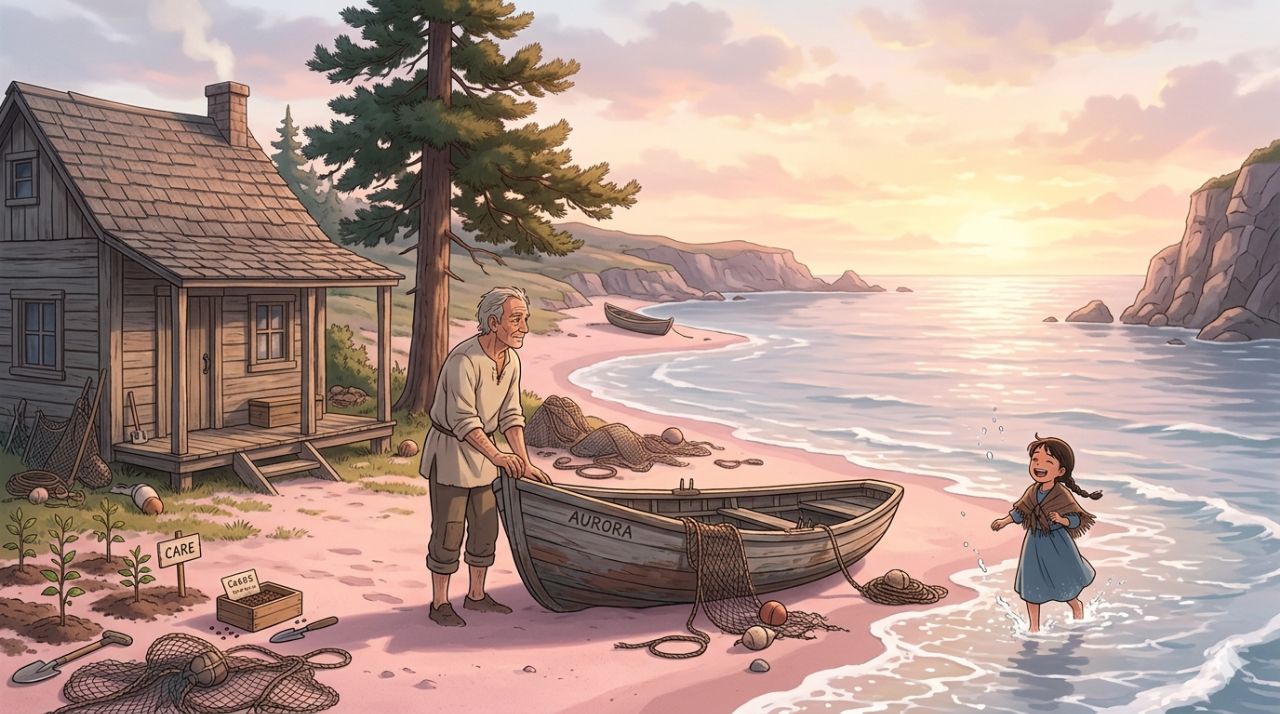
The boat brushed the pink sand at dawn with a whisper that seemed to hold centuries. Paolo placed his hands on the gunwale and let the craft rock until it stilled. He breathed deeply; the air smelled of salt, resin and something almost imperceptible: memory. He looked at the island spread out before him—soft hills, shrubs leaning into the wind as if trying to listen, a pine grove etched against the sky—and for a moment he thought of the door he had crossed without knowing if he would ever close it again. He arrived out of curiosity in the late 1980s; not as a dramatic gesture, but like someone pausing to examine a map more closely. The city had given him much and taken from him at the same time: promises that slipped like sand, empty conversations that were more noise than comfort. At first he thought his stay would be brief, a few weeks to repair a tired spirit. Thirty-three years later, those who heard the story called it a legend: “the Robinson,” “the hermit.” His own life on the island did not admit grand names. It was simply Paolo, his footsteps, his home, and the time he learned to measure differently. The first months were a school of humility. He had to learn to drink rainwater without paranoia, to tell which shells announced generous tides and which warned of treacherous storms. He built a cabin from old boat planks and a tarp found in a shipwreck. Every nail he drove rang like a ritual: to fix his place in a territory that did not belong to him and yet offered him a way to belong. Unpredictable visits followed, each with its own scent of the outside world. One morning a young woman came in a small boat that she left at some distance so as not to invade the shore. She introduced herself with the pointed courtesy of someone who works with words: Marta, a journalist. She carried a small recorder that looked like a technological bone, a notebook full of questions, and a look for stories that expected to be big. “You can’t keep going like this, Paolo,” Marta said the first time she sat on the sand in front of the cabin. “Living secluded doesn’t erase problems. It ignores them until they burst.” Paolo looked at her calmly. His eyes, weathered by light and contemplation, had the slowness of someone who had learned to read days in the tides. At first his voice was a smoothed stone. “I don’t want to speak to anyone,” he replied. “It’s not denying problems; it’s choosing by what sound I want to measure my life. The city shouts. Here I listen to what remains.” Marta, who had seen the world turned into urgent headlines and moral microscopes, furrowed her brow and offered her counterargument with a certain haste. “That sounds nice in a feature,” she said. “But you have to ask why you don’t return. Are you afraid of the chaos? Or does the thought that your silence won’t matter there terrify you?” Paolo did not respond with indignation; his reaction was another kind of testament. “The chaos there has clocks that command,” he said. “Here, time works differently. Hours peel away like shells; commitments and phones don’t chase me. I protect nature because it’s the only company that doesn’t demand empty words.” Marta wrote in her notebook, not to correct him but because there was a tension worth following: someone who’d decided to measure his life with a compass slower than the world that labeled him “anomalous.” Years braided small gestures: a couple left a box of seeds as if planting them were a promise; a child lost a plastic figurine that the tide returned again and again as if playing at forgetting; other visitors brought bread, books, tools. Each encounter became a thread connecting two universes: the island’s, where life was sustained by limited resources and silent rituals, and the city’s, with its voracious restlessness and haste to name everything. One stormy night, when waves struck the shore with ancient fury, a boat ran aground in a nearby cove. Between broken planks and foam emerged a young man clinging to the idea of continuing to breathe. His name was Lucas. His skin was weathered, hands of someone who knew the sea, and a gaze that seemed to have lost the thread of its own story. “Can you help me?” Lucas gasped, voice shaking. “I thought I was going to die out there. I couldn’t talk to anyone in the village. I felt… empty.” With the calm learned from years of living simply, Paolo pulled a rope and then another to haul him ashore. There was no ostentatious heroism; just two men doing what necessity required. Once safe on the beach, they sat before the fire in the improvised cabin. Water dripped from their clothes, the wind still prowled, and the small hearth’s flames cast shadows that seemed to tell forgotten tales. “Why did you come?” Paolo asked, curiosity without judgment. “I wanted to run away,” Lucas admitted. “Run away from a promise I could no longer keep. But now that I’m safe… I don’t know if running is the answer.” Paolo let silence settle between them, a silence that was not emptiness but a cloth on which to stitch words carefully. “Solitude doesn’t heal broken promises,” he said. “Sometimes it wrinkles them. I don’t speak because I learned that words without listening turn to dust. But that doesn’t mean it doesn’t hurt.” Lucas looked at him as if seeing something unvarnished for the first time. “Aren’t you lonely?” he asked, his voice asking permission for tenderness. “Of course,” Paolo answered. “Loneliness is a companion as certain as the sea. It reminds me I exist outside the noise. But at times, when the wind shifts, I feel nostalgia for voices I didn’t hear.” Nights passed with a different tempo. Paolo occupied himself with small tasks that, together, sustained the island: mending nets, collecting rainwater in barrels, repairing the cabin. He planted trees, not from vanity but from patient foresight—to provide shade for those who might come later. He learned the language of birds and wind-swept signs; every bird bone he found told a lesson, and he listened as one listens to an urgent story. Decades flowed, and his perception of time became a complex weave: some days ran like long, gentle rivers, others exploded in intensity. One day a letter arrived in his name—news from the city that compelled him to return. It was not nostalgia but a death: his mother had passed away. Not out of obligation but from an intimate duty, Paolo crossed the threshold and returned to the metropolis for the first time in years. The city surprised him like a light switched on abruptly. The sounds were a multitude; voices a string of mirrors that reflected nothing of his own. He walked streets that felt too narrow for his new rhythm; buildings cast sharp shadows. He entered a bar where the wood smelled of coffee and damp, and there met Rosa, an older woman who smoked with the calm of someone who does not expect time to hurry. “Solitude can be a choice, yes,” Rosa said, offering him a cigarette without asking. “But beware thinking choice saves you. Sometimes the choice becomes a gilded prison.” Paolo took the cigarette, held it between his fingers, and thought of the word prison. He rejected it and accepted it at the same time, because he knew any choice carried consequences not always visible at first. “I chose silence to listen,” he murmured. “Not to get lost in voices that say nothing. I wouldn’t call it a prison. I’d call it a refuge.” Rosa smiled, not with approval but with recognition. In Paolo’s voice she heard the honesty of someone who did not pretend to hide his human side: neither hero nor martyr, simply a guardian of small things. He returned to the island with the sense that something in him had been tuned: choices have prices. That the world leaves you alone does not absolve you from the responsibility of being alive, of responding when necessary. In his final years he became an unspoken lifesaver for anyone at the mercy of the sea: he mended boats, nursed wounded birds, removed abandoned nets that strangled marine life. People from nearby isles began calling him “the one who guards the island,” a title he accepted with the same humility with which he accepted the winds. Over time the bonds formed with those who visited grew firmer. Marta, the journalist, returned often and brought subtle changes: photographs, reports that sought understanding rather than sensationalism. She also brought her daughter, a child raised with the sea’s murmur as a lullaby. One warm afternoon the girl ran to the shore and dove into the water fearless, laughing so freely that her laughter became a poem the island understood at once. “You have grandchildren, Paolo,” Marta joked, seeing the interaction. “Even if they’re not yours by blood.” He leaned his back against the cabin wood and let the wind tell its secrets through his thinning hair. “Solitude was a choice,” he said at last, staring at the horizon. “I still choose it. But it’s no longer a wall. It’s a way to care for what remains, to listen to the world without letting it impose its noise.” In his last years the island became a place of continual small rescues: returning to the sea what shouldn’t be kept, fixing what others threw away, teaching anyone who stayed how to read the clouds. Paolo was no longer a solitary figure but a discreet epicenter of care. He buried seeds in the soil and marked them with stones; he planted young trees so the future would find shade. When the body began to yield, it did so with the calm of one who has lived many seasons. There were no grand dramas. The end came like another tide, barely a variation in a pattern he already knew. The island kept its silence respectfully. There were no ornate speeches; the farewells were hands covering the earth with care. Under the oldest pine they placed a modest plaque that read: “He protected the small. He preferred silence.” On the day of his burial, those who had known him approached one by one. Marta sat on the sand, staring at the notebook where she had written so many conversations; her notes now seemed inadequate. Lucas, who over the years had ceased to be the young man lost in the storm, placed a seed in the hollow where Paolo rested; he eyed it with the hope that something would grow there. Rosa lit a cigarette and let the smoke mingle with the pine’s breath. They spoke little—not from disinterest but because the moment demanded economy of words. There were no moralizing lessons. Paolo’s story was not an exhortation to flee nor an apology for isolation. It was the memory of a man who, faced with the world’s clamor, chose to measure his life by the sea’s pulse. He taught those who visited that solitude can be refuge or prison depending on how it is held; that choosing also means accepting responsibilities; that silence, however noble it seems, requires attention and not indulgence. Months later, when Lucas’s seed sprouted, a tender shoot emerged that the local children tended with solemn care. The island continued its existence with its usual rhythm: tides, moonlight, the return of birds in flocks. The small plaque by the pine still bore the words, simple and striking. Visitors took away something different in their minds: not a clear lesson but a question that grew more insistent the more they pondered it—To what extent is choosing solitude freedom, and at what point does it transmute into abandonment? The answers remained open, because that was how Paolo wanted things: not dictated, but sown for those who wanted time and water to listen. And in the unease of that question, the island remained, as always, a way of measuring the world with calm. Source of the images. Image created with Google Gemini.
2 comments
"This is a beautifully crafted short story, @mcSpunk. The way you described Paolo’s connection to the island and his 'blueprint' for a new life really resonated with me. As an engineer, I appreciate the theme of building something meaningful from scratch, whether it's a physical structure or a new chapter in life. Your storytelling style is immersive. Looking forward to reading more of your work!"
Thank you very much for your comment, I really appreciate it, I wish you all the best. A hug.