 @mc5punk
Short story: The Night of the Net
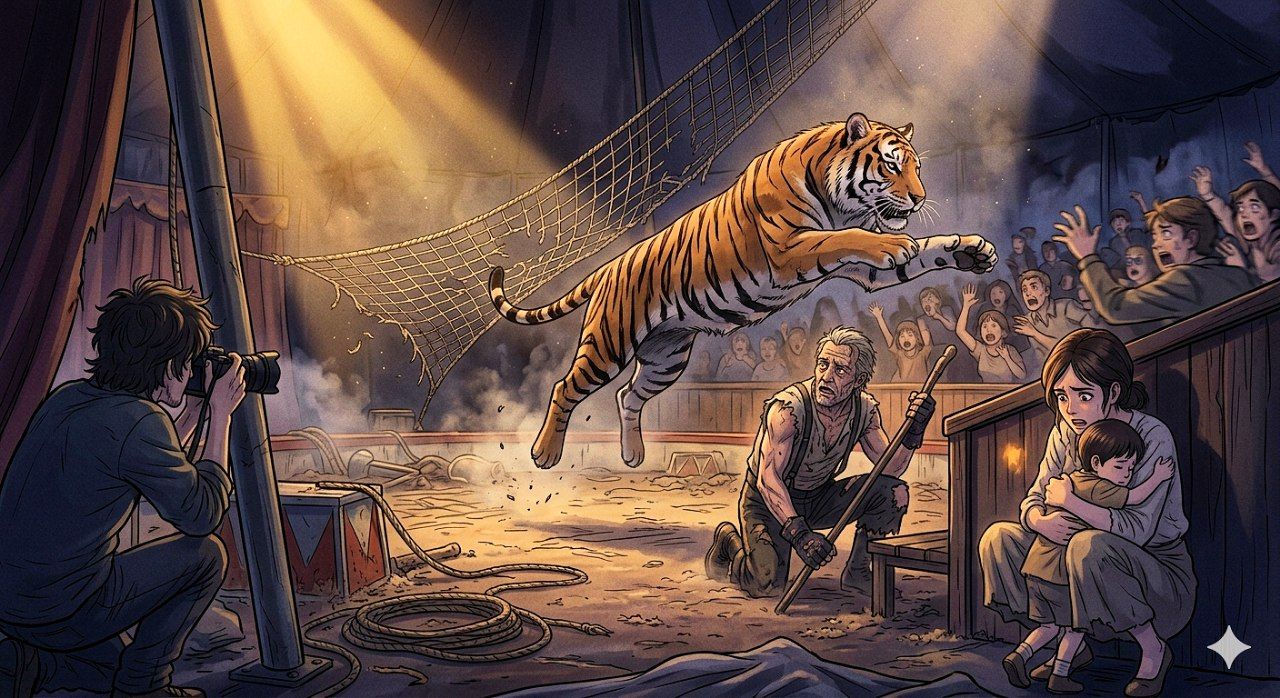
The big top smelled of dust, burnt sugar, and old electricity; a mixture that stuck in the throat and made the lights seem dimmer than they were. The crowd pressed into the stands, low voices hoping to laugh at routine rather than fear. Marta moved with the determination of someone who needed a single image to justify months of unpaid bills: she adjusted the camera at her neck, tested the lens, and sat in a middle row from which the ring was perfectly centered. Beside her, Lena held Damian’s hand as if calm could be trapped there. Damian had wide eyes and the easy smile of someone who still believed circus animals were faithful friends. "Are you going to take more photos?" Lena whispered. "Yes," Marta answered without lowering the camera—"just a few more." The spotlights flared in a choir of color. The curtain opened to a burst of applause. Ivan Morozov appeared first, his figure cut against the light, hat tipped back. He was a man who had learned to speak with animals through a mixture of blows and tenderness; the scars on his hands mapped his long nights. At his command three tigers emerged: muscular, slow, owners of every step. The show began like a choreography rehearsed a thousand times: jumps through hoops, measured steps, the metallic echo of the staff on the floor. The safety net—hung several meters above the stands—looked like a theatrical accessory, an ornament that marked distance. Its material gleamed under the lights, barely taut, more symbolic than effective. Marta shot photos by habit, hunting the frame that would carry her name to the front page. Ivan moved his hands with the precision of someone fluent in the language of big cats. Tigrán, the eldest, walked with a majesty bordering on insolence; at times his gaze fixed on the audience and seemed to measure the truth of every face. "Marta, will you move a bit closer?" an assistant shouted from behind, but Marta shook her head; she preferred the distance the lens provided. The music swelled, the ring filled with artificial smoke, and tension rose on its own, uninvited. Then something shifted: a low growl, more a warning than a threat. Tigrán froze as if feeling an insect on his skin. His ears tightened, his back arched just a little. Ivan noticed the pause and issued the signal that always worked: a word, a flick of the staff. "Come back, Tigrán," Ivan murmured—more to himself than to the tiger. The tiger turned his head. His eyes, unblinking, fixed on the net that separated them from the audience. For a second no one understood: the pause seemed part of the spectacle. Then, with the violence of the unexpected, Tigrán leapt. It was not a choreographed jump; it was a leap that tore the scene apart. The net vibrated, threads stretched, and one snapped with a crack louder than any applause. The net, until then a decorative line, became a torn membrane and the space filled with compressed air. The first row jolted; raised phones tried to capture the anomaly but only managed blurred fragments. Lena pulled Damian back, shielding him with her body. "Back!," she shouted at a man still trying to stand—"get the child out of here!" Ivan ran into the ring with steps that seemed to drag more than his own weight. His staff struck the ground again and again, calling the tiger back to the discipline taught with both rewards and punishments. But Tigrán refused to obey. The roar, when it came, was not a sound but pressure: an animal who no longer recognized the rules of the trick. Chaos erupted like a wave that sweeps everything away. The stampede began at one point and dragged the entire crowd: chairs flying, people stumbling, pushes turning the air into a mass beyond control. Someone shouted "doors!" and the throng obeyed, but the exits were only blurry points among shadows. Marta felt the camera tug at her strap; she never tried to photograph the immediate violence of the stampede. Her fingers fumbled into her jacket and stashed the camera; the image she wanted was no longer a heroic leap but a tent unraveling under its own stupor. "Watch out!" a man barked while shoving others toward the exit—"don't fall!" A mother lost her child in the confusion and the wail that followed was a hinge opening raw terror. Dust rose, veiling ring and stands; everything blurred except the certainty of fear. Tigrán’s passage down the ramp seemed to measure time: every paw left an echo, every breath a statement. When the crowd surged for the exits, Ivan remained in the ring, nailed there by a mixture of guilt and duty. His hands, caked with dust and minor wounds, gripped the staff as if it were the last thread of order. "Ivan!" someone yelled from the stands—"do something!" Ivan did not run with the ferocity of someone conquering danger; he moved with the slow, deliberate gait of someone who knows life and death do not always have a clear opponent. He approached the torn net and examined it like a man checking his own wound, and he touched it. Police and emergency services arrived later than the clock seemed to allow. Distant sirens cut into the night promising containment. Among those left behind, Marta, Lena and a few others tried to piece the scene together: pale faces, bruised hands, families reunited in hugs that felt improvised. Marta stepped toward Ivan when the first swirl of panic subsided. There was something in his movements that made her look away from the evident brutality: a blend of broken tenderness and overwhelming responsibility that accompanies those who live with animals. "Why—why did it do that?" Marta asked without preamble. Ivan exhaled long, letting the question settle into his voice like dust that won't sweep away. "The net was worn," he said. "The tension wasn't the same. But that's not just a technical excuse. Sometimes you read a tiredness in the animals you can't understand. We ask them to perform until the thread breaks." Lena, holding Damian still quivering in her lap, looked at Ivan, trying to wrest anger from fear. "Shouldn't everything have been checked?" she demanded. "We can't leave our children at the mercy of a leap." "We checked," Ivan replied in a rough voice—"but safety isn't only metal and knots. Sometimes attention doesn't see what time erodes. And sometimes it's the very nature of the training—what we ask the animal to do makes us responsible." When officers set up and uniforms filled the place, calculations began: damages, witness statements, whispered accounts. Murmurs multiplied into contradictions. Television recycled footage until repetition made it banal. The images looped: the jump, the net wavering, the faces gone slack. What couldn't fit into rerun was the sensation left in bodies: smallness, a suspended guilt. That night a bar filled with people untouched by the chaos; they debated with the casual detachment of those seeking clear signs: "human error," "out-of-control animal," "circus negligence." Words clashed and scattered like puzzle pieces without a form. Marta went home with empty hands and a stomach full of questions. Her camera remained in its bag, incapable of capturing what now burned inside her. She had come for a perfect image and found instead a deep void demanding attention she couldn't frame. The next day the big top was half-empty. Shows were postponed indefinitely, rumors filling the city. Talk turned to compensation and fines, to removing animals and investigations; there was so much talk that truth was smothered under layers of conjecture. Ivan was questioned by authorities and taken to the station for hours. When he returned, his hands looked smaller than before. He sat on an empty bench and let the morning sun warm his face. In his hand he rubbed an old chain—one that had belonged to another tiger—fingers tracing scars as if reading decisions past. Marta went back that afternoon, pulled by an impulse she could not name. She found Ivan in the same spot, the net behind him hanging like a memory not yet stitched. "I didn't come to ask official questions," Marta said, sitting beside him—"I just wanted to know what you see when animals behave like that." Ivan regarded her for a long moment. Dust danced slowly in the light around them. There was exhaustion in his face and a painful clarity. "I see things I don't want to," he confessed. "I see that we've put them in roles that aren't theirs. We ask for smiles and acrobatics, and when something goes wrong we only stare at the mistake. We don't see how they leave pieces of themselves with every clap. When the net breaks, what jumps out isn't just a tiger—it's the remnant of everything we've demanded." Marta touched a frayed thread. It was a thin fiber but had held years of tension until it finally failed. "People will call it an accident," Marta murmured. "They'll say negligence or a loose animal. But there's something else, isn't there? Something that repeats." "It repeats," Ivan said. "Because we prefer to forget that the border between us and the wild is held by a single thread of respect. What happens when it snaps isn't merely a bad show; it's a reminder that balance is fragile." Lena and Damian did not return to the circus for weeks. Lena flinched whenever a trailer with cages passed by. She bought tickets to other attractions and insisted they never sit where her son's heart might race for amusement. The press covered the incident with headlines that swallowed nuance: "Tiger Escapes During Performance" printed large while interior pages debated the ethics of animal entertainment. The circulating images were fragments: the leap, the lolling net, a mother's distraught face. But none of the reruns contained what remained in people's bodies: a core of responsibility. Ivan did not quit right away but began to change things subtly. He spent more time offstage, talking to other handlers, demanding more frequent inspections, questioning training practices. Some looked on with contempt; others with quiet respect. At night, in his small room behind the tent, he sat in dimness and traced his scars as lessons rather than badges. Marta made a difficult decision: she began photographing absence. Not grand moments but the empty spaces left behind: a broken chair, a net hanging slack, a forgotten toolbox. Her photo series exposed what people preferred not to see—the edges of the show, where shame met routine. Months later she opened an exhibit. One large photograph displayed the torn net, lit so no trace of spectacle remained. Beside it, a smaller print showed Tigrán in a forest gloom: his silhouette against the underbrush, free and distant but forever glancing back. Some viewers were moved; others annoyed. For some it was reclaimed beauty; for others, proof that freedom sometimes comes too late. One cold winter evening Marta received a letter with no return address and only a few handwritten lines: "The net broke a long time ago, in silence. Thank you for remembering what someone wanted to forget. —I.M." The initials matched Ivan's. Marta held the letter and thought about how stories get rebuilt. Change arrived slowly, in small pieces. Investigations, fines, public debates followed. Some circuses reduced their use of animals; others defended their tradition as fiercely as they defended their livelihoods. The public argument continued, mixing ethics, economics, and nostalgia. But for those who had been there that night the debate took on another shape: it became the small, daily choices each person made afterward. One afternoon, while Marta edited negatives, Lena called to thank her. Damian had slept without nightmares for weeks; he no longer trembled when circus music played on the radio. Marta felt her work had achieved something beyond recognition: it had opened a crack where accountability could enter. Ivan sold some training gear and devoted more time to rehabilitating animals retired from exploitative shows. He did not recover everything he had lost, but his scars became lessons. The final scene took place in the empty ring. Marta walked the tent alone one afternoon. The circus seemed like a sleeping animal: it breathed in slow pauses, the canvas sagging with wrinkles that told of old habits. She approached the ramp where Tigrán had leapt and looked at the hole in the net—now partially mended but with loose threads that still recalled the incident. She shouldered the camera not with the hunger of a perfect shot, but with the weight of someone who knew the image no longer belonged solely to her. She focused and fired—not to sell the picture, but to document the memory of a place: how an object, a thread, a negligence could turn a night of fun into a moral demand. As she turned away from the tent, she saw a dark shape moving among the trees. Tigrán, or perhaps another tiger carrying his story, crossed the gloom with measured steps. For a moment the animal looked back, as if to assess whether the past still warranted return. Then it slipped into the darkness—free as the night and as distant as the guilt we are slow to own. The End. Source of the images. Image created with Google Gemini.
No comments yet