 @mc5punk
Short story: Chronicles of Marazul: Escapes, Choices, and Broken Stars
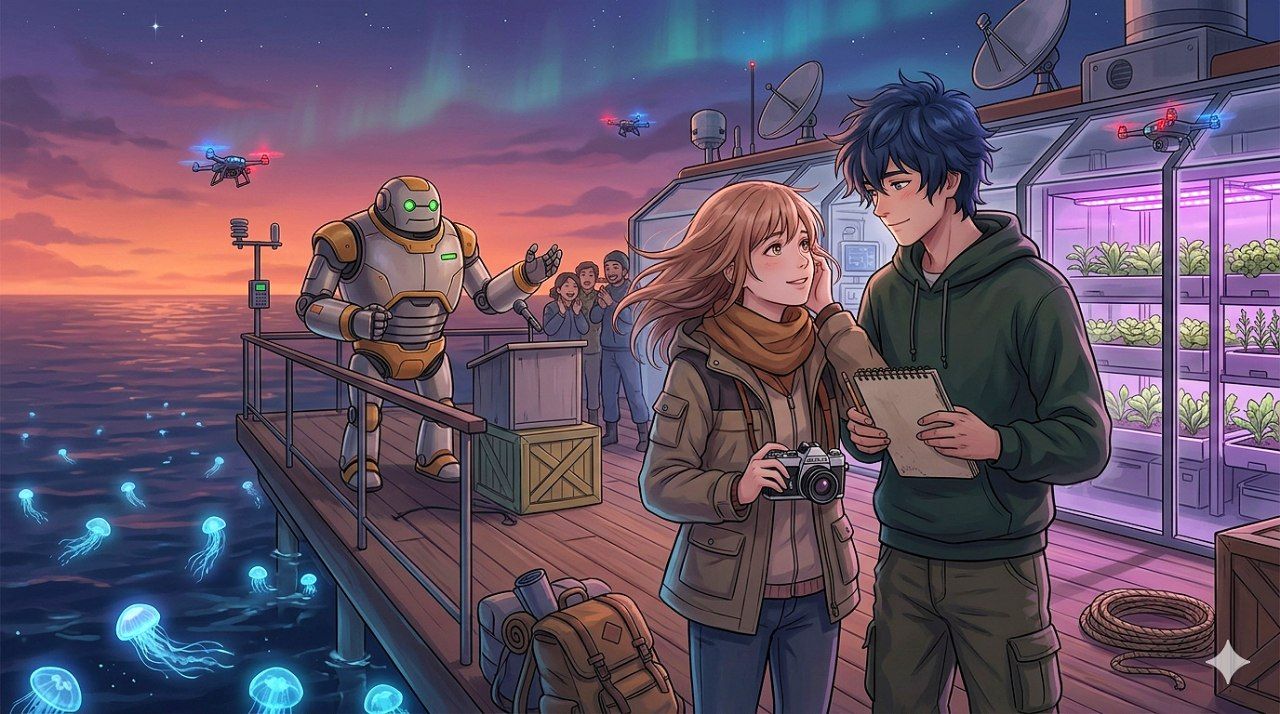
The rain in Marazul always felt like an old friend who wouldn’t leave: persistent, musical, able to turn a terrace into a darkroom where thoughts develop like negatives. It was under that rain that Laura and Mateo first met. She arrived late and soaked, a camera hanging from her neck and the face of someone who had found perfect light; he was sheltering at the table by the window with a notebook full of mind maps and a cup of tea that already looked like art. When the thunder died down they talked until the café closed, as if the city itself had wrapped them. “Can you imagine living in the same place forever?” Laura asked, pointing at the raindrops sliding down the glass without looking. “It depends,” Mateo replied. “Always as a tourist or as someone who knows the best empanada stand?” Laura laughed—spark number one: she was a freelance photographer specializing in urban portraits; he was an experience designer who turned small brands into stories. They shared messy playlists, favorite running routes, and an uncanny ability to argue about books they hadn’t finished. Slowly their relationship became a constellation of short trips, crossed projects, and dinners that stretched into the night. They had rituals: a Sunday of virtual reality to play astronauts and a Tuesday for pizza and exhibition reviews. Then, amid backpacks and the voice of a travel guide, the question that always seemed imminent surfaced. “Do you want kids?” Laura blurted while zipping her backpack. Mateo froze, like a life-software update installing in the background. “Not now,” he answered with the candidness of someone not hunting the perfect phrase. “I like the idea of leaving at any time, prioritizing what makes us well. I imagine accepting residencies abroad without months of paperwork, or canceling a contract because I found another opportunity that lights me up.” Laura squeezed his hand. “Me too,” she said. “I want to devote more time to photography, to residencies. I don’t want having children to be the only measure of what we can build.” The topic didn’t exhaust itself; it expanded. They did what curious people do in the information age: they read, searched studies, articles and testimonies. They discovered they weren’t alone: in several countries more couples were choosing not to have children to prioritize quality of life, flexibility, and personal stability. Reasons varied: freedom to travel, financial cost, worries about the planet’s future, professional desires. For Laura and Mateo, motives mixed like a color palette: a bit of ambition, some fear, a lot of curiosity. One Friday night at their usual bar they ran into Clara and Pablo—old friends—and Sofía, their daughter, who at six had the clarity of poetic justice. “And you?” Pablo asked between sips. “Do you picture yourselves surrounded by toys in a few years?” Clara, who’d experienced a difficult pregnancy, looked at them with tenderness and a hint of irony. “Sometimes I feel motherhood is like a physics experiment: invisible forces thrusting you into new orbits. I won’t deny its charms, but there were sacrifices. If you choose not to have children, it doesn’t mean you’re bad; it’s simply another orbit.” Sofía, with the solemnity of a little explorer, announced: “If you don’t have kids, will you adopt me as a traveling cousin?” They all laughed. The laughter held a blunt truth: life doesn’t come in only one format, and relationships can be reinvented. The story took unexpected turns when, during a residency in Lisbon, Laura received a strange notification: an email from an unknown sender with an attachment titled “Project: Nemesis.” Opening it she found an oddly beautiful proposal: a collective of scientists and artists offered an exhibition combining photography, synthetic intelligence, and bioart; residencies on a floating station off the Azores were available. The proposal included a paragraph that sounded like a poorly told joke: “We seek creators willing to live without parental encumbrances during the mission period. Preferably no children requiring physical custody. IRL (in real life) incompatible with intercontinental missions.” Mateo whistled a note of equal parts fear and excitement. “What do you think?” Laura asked. “That they’re asking us to be space pirates with a passport,” he said. “I’d love it.” They applied. The selection panel—an eclectic group of engineers, poets, and a baritone-voiced robot named Gideon—loved Laura’s photography and Mateo’s knack for designing experiences. They were offered a spot. The station wasn’t a spaceship exactly, but a semi-autonomous platform on an ocean ridge, equipped with labs, a 3D-printing workshop, hydroponic gardens, and an unusual microclimate observatory. Part art, part research, the project studied how human creativity transforms under constrained mobility. Rules were clear: three-month rotating stays, total mobility, and yes, a preference for participants without family obligations. “At first it struck me,” Laura admitted the night they received confirmation. “Are we being selfish for accepting this just because we can?” “We’re humans making choices,” Mateo replied. “Besides, if we don’t do it, another couple will. This isn’t a universal moral meter.” The station, christened Nemesis by its designer—the artist-scientist Anouk—was a small metal crown floating elegantly over shifting latitudes. There, between microclimate experiments and hurried dinners to watch marine auroras, their relationship gained new textures. There was comedy: a morning when Gideon turned into an existential poet and declared it preferred the café humans’ coffee because “human coffee is a solid metaphor”; drama, when a prolonged storm cut communications to shore and an old fight between Laura and Mateo exploded across the mess table; romance, on a night the deck was lit by bioluminescent jellyfish and they silently promised to stay curious about each other; and science fiction, always present, with the station sending little probes that collected microbe-sonnets in ocean foam bubbles. One memorable argument came months later, after anonymous criticism on social networks hit Laura’s inbox. “‘How selfish,’” she read aloud, voice trembling. “‘Don’t you think of society?’” Mateo switched on a soft light. “Society is an umbrella with holes,” he said. “We’re trying to build our own roof. I don’t deny privilege, but there are also legitimate uncertainties: the cost of raising a child, the climate future, labor volatility.” Through the station and its comings and goings they met other couples with similar choices. Some held the decision as political conviction; others out of fear; others to devote life to art or science. Together they created a nomadic community that traded everything: recipes, tools, songs, and tips to repair drones with duct tape. They discovered that choosing not to have children was not a refusal to care; it became expanded care: borrowing someone’s niece for a weekend, transporting a sick friend to the nearest hospital, offering free workshops to local youth in the cities they visited. Doubt persisted. One autumn afternoon in the station kitchen Mateo whispered, “Sometimes I dream the system fails and we never get back to Earth.” “That’s dramatic,” Laura replied, her smile brief. “If that happens, what will we have missed?” “Seeing everything,” he answered. “But I also feel that if it happens, I’d rather it take both of us by the hand, not tied down by obligations that keep us from being who we are.” The mix of humor and catastrophe sustained them. Between Gideon’s absurd jingles and the moral weight of choices, they learned to laugh at fears and face them tenderly. At Nemesis they had a near-cinematic episode: a breach in the hydroponic tank threatened food production. Tension forced the community to improvise a repair opera: Laura documented the desperate choreography—ropes, hand pumps, laughs barely masking panic—and Mateo organized logistics like a festival director in a storm. They saved everything with ingenuity, improvisation, and a can of oil that miraculously sealed the leak. That night, sharing rationed soup, they realized that living without children had made them more dependent on their chosen network. Their itinerant photography press—started as a side project—grew into an ambitious archive documenting societies in flux, nonconventional families, and new forms of intimacy. Invitations arrived: an exhibit in Tokyo, workshops in Dakar, and an unexpected sale that funded a mobile studio. Every choice was made with the freedom their decision enabled: accepting residencies, canceling contracts, saying no. Domestic drama didn’t vanish: arguments about financial futures, fears of aging, hurtful messages from relatives who didn’t understand. One day Mateo’s mother, voice breaking, said on the phone, “I don’t want my grandchildren not to exist. Who will tell me stories at the end of my days?” Mateo counted to three before answering. “I’ll tell you ours,” he said. “You’ll come with us and see places you never imagined. I won’t take grandchildren away, but I promise stories that will make you smile.” There were tears in that call and partial understanding. Family was rebuilt in their own way: more frequent visits, shared dinners, a promise that although they wouldn’t be parents they wouldn’t be absent. Love, in its practical variant, was repeated gestures: grocery runs for grandma, helping repaint the house, babysitting Sofía in the afternoons when Clara needed time to recover. Romance remained the guiding thread. Scenes any novel would call iconic occurred: a kiss on the station bridge while bioluminescent streaks crossed the horizon; an awkward dance on deck to the rhythm of an intercepted old radio song; the night Mateo, after receiving a lucrative design offer, turned it down for a residency in Dakar because he knew it would ignite Laura. She looked at him, handed him back his camera and said, “You’re a beautiful fool,” and kissed him. Comedy persisted. At a port city festival their exhibition was mistaken for a retro appliance show; their pieces were bought by a collector who thought he was buying multiple vintage toasters. In another trip Gideon developed its own sense of humor and threatened to rewrite their work synopses too literally until they gave it a nightly stand-up channel where it joked about emotional screws and the nostalgia of analogue cameras. Years later, with scattered gray and a library of memories, Laura and Mateo sat on the terrace of the same café where they’d met. Marazul had changed: cafes with flamboyant names, public bikes, murals narrating migration stories. On the table, steaming soups and the comfortable silence of people who had shared life. “Do you regret it?” Laura asked, not trying to force an answer. “Sometimes,” Mateo answered honestly, “but not today. I saw Sofía dance in a Dakar square and realized parenthood isn’t limited to DNA.” Laura smiled and took her long-time partner’s hand. “We did what we wanted with the freedom we chose. It wasn’t always easy, but it was ours.” Later they met Clara, Pablo, and Sofía for lunch where children sprinted between tables and adults spoke of policies and seaweed. The conversation was light yet intimate. “I’m glad we learned not to judge,” Pablo said. “Having kids isn’t a badge of goodness.” “Nor the opposite,” Clara added. “Every life deserves respect.” Sofía, now dignified as a small explorer, handed them a drawing: a ship with cameras on the mast and a couple with suitcases. Laura hung it in her mobile studio. Their archive, a photo series titled “Orbits,” earned recognition: portraits of couples in transit, dismantlable homes, grandmothers growing cabbages on balconies. Critics said their images spoke of freedom and loss, brave choices and inevitable consequences. In an interview Laura replied simply, “It’s not a statement against motherhood or fatherhood. It’s a chronicle of freedom: ours.” Mateo wrote an essay mixing design, ethics, and the future: cities adapted for mobile people, policies supporting itinerant work, and expanded care networks. He addressed fears that led many couples to forgo children: cost, climate uncertainty, keeping life open to the unexpected. Beneath the story lay an idea even the wildest science fiction couldn’t erase: choice, in all its complexity, deserves space. Sometimes choice becomes a floating station off the Azores; other times an elderly woman learning to take photos with a phone; a child calling friends “cousins” who are only close companions. The community Laura and Mateo helped build did not erase loneliness nor judgment, but it offered networks, celebrations, workshops, and above all, a different form of care. On the tenth anniversary of Nemesis, they held an exhibition of old and new pieces. Gideon, now a legend with its stand-up channel, opened the gala reciting a synthesized poem: “We are radiant as stars that flee gravity, we travel with suitcases full of memory and, without cradles in sight, we weave human nets so someone, on some shore, remembers who we were.” Applause, laughter, tears. Laura and Mateo looked at each other and knew—without words—that their decision had been more than renunciation; it was a wager on a way of life with great risks and beautiful rewards. Marazul continued to rain, change, and gift sunsets. Their story had no single moral: it offered, instead, an invitation for each person to choose with full awareness. In their editorial’s archives remained images: migrating couples, project-based families, children adopted by traveling uncles, grandmothers using drones to send medicine to small islands. The world did not split because of their choice; it went on, complex and contradictory. Finally, on a clear day under a map-worthy sky, Laura looked at Mateo and whispered, “If we ever change our minds, we’ll know. Meanwhile, we keep building this extraordinary life.” He kissed her, and the kiss tasted of open routes, deckside laughter, three‑a.m. debates, and the peace of two people who’d chosen to prioritize their quality of life without giving up tenderness. Outside, a flock of starlings drew a choreography across the air, reminding them that for some, migration is living; for others, staying is too. In any case, life remained theirs, and they chose it, again and again. Source of the images. Image created with Google Gemini.
No comments yet