 @mc5punk
Short story: The City of Tails and Cradles
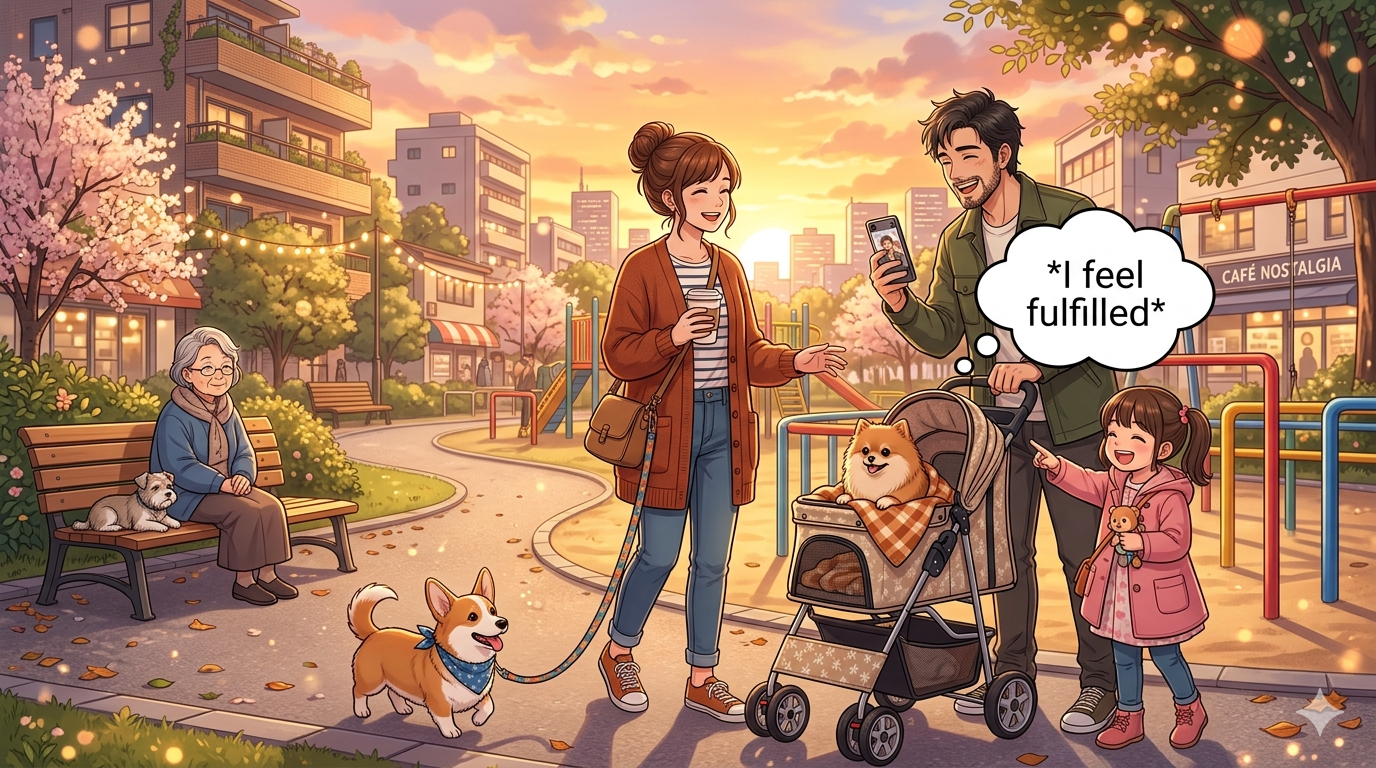
Laura, 32, worked as an advertising executive and had made her two dogs — Tobi and Nube — the emotional center of her home. Her routines, expenses and much of her joy revolved around them. Martín, her childhood friend, was 35 and the father of a four‑year‑old; his perspective on family life and daily priorities was different, though friendship kept them close. The building’s neighbor, an observant older woman, provided the viewpoint of someone who had watched neighborhoods and customs change over decades. And Tobi, though he did not speak aloud, filled the air with thoughts that only those present seemed to understand. It was a mild afternoon when they met in the park. Laura, with the ease of someone who had turned walks into a ritual, adjusted a stroller designed especially for small dogs; Nube slept inside wrapped in a blanket. Tobi trotted at her side, sniffing every bench and every affectionate hand. Laura: —Meet Tobi, the official spoiled one. Want a selfie for the feed? He has more followers than I do. Martín watched from where his son climbed on the playground bars. Martín: —Your dog has a social calendar and probably pays for more gym classes than I do. Aren’t you afraid this is… too much? Tobi, with an even gaze, seemed to answer from his inner world. Tobi (thought): *Too much? Too much what? Today I ate organic kibble and meditated for five minutes. I feel fulfilled.* Laura laughed and settled Tobi beside her on the grass, defending her conviction. Laura: —It’s not fear, it’s a choice. Raising a dog is more practical: they don’t ask for a phone, they don’t study for college… and I admit the naps are shared. Martín, who did not deny the charms of pets, replied with paternal irony. Martín: —My son asks for dinosaurs and asks impossible questions about the solar system. Tobi only asks me to open the balcony door at 11:03 sharp. The neighbor, drawn to the conversation, approached leaning on her cane and observed with that mixture of nostalgia and curiosity typical of those who have seen schools and plazas full of children. Neighbor: —In my day there were more kids than dogs. Now it seems dogs rule more than some politicians. Tobi, who had discovered a wooden wedge to chew on, lifted his head as if to claim his place in the discussion. Tobi (thought): *Politicians don’t understand the guilty look when I chew a shoe. Humans do.* Later, the group moved to a nearby café. The conversation shifted from anecdote to interpretation; Laura introduced the phrase that had been circulating on social media and opinion pieces. Laura: —People say “pet parenting” like it’s a trending topic, but it’s deeper than that. Many seek companionship without the long‑term responsibility clauses. Martín set down his cup with a serious look, curious about the metaphor. Martín: —Clauses? Do you mean emotional mortgages? Laura nodded: —Exactly. Having a child today implies commitments projected for decades: housing, education, health. A dog depends on you, yes, but the pact feels different: there are clearer limits, different expectations. Also, biology and costs play their part: people postponed parenthood and many decide not to have children. Tobi, grooming himself, allowed a remark from his canine perspective. Tobi (thought): *They talk about biology. I only know that in winter they give me new socks.* The neighbor, still holding memories of the neighborhood school and busy plazas, voiced the concern many mentioned on stoops and porches. Neighbor: —Isn’t this a demographic problem? People ask about the future as if it were a series we all have to subscribe to. Martín, who had dealt with scheduling and school logistics at work, addressed the issue pragmatically. Martín: —Maybe. Fewer births change city design: fewer or smaller schools, plazas with different uses, social services that need adjustment. It’s more than a sociological anecdote. Laura, who knew couples who postponed parenthood for work or financial reasons, offered another reading: cultural change. Laura: —Or maybe it’s a natural cultural shift. People are rethinking priorities: more free time, jobs less compatible with raising children, the search for sustainability. Dogs, in that context, fulfill a real social role: they get people out of the house, create encounters, ease loneliness. Tobi, proud, claimed his community contribution. Tobi (thought): *I get people out on the street and fetch sticks. All good.* The discussion stretched into the night. On Laura’s terrace the city spread lights and shadows; the conversation grew more intimate. Martín looked at the skyline with an expression that mixed affection and worry about collective future. Martín: —What worries me is that we stop thinking long term. Who will support pension systems or meet health demand if the trend continues? I don’t mean to blame anyone, but planning matters. Laura answered calmly and practically, proposing measures rather than blame. Laura: —That concern is valid. But blaming those who choose not to have children isn’t the solution. We need public policies: affordable childcare, real incentives for motherhood and fatherhood, affordable housing. Also support for those who choose to raise children: more flexible jobs, leave policies, community networks. And accept that caring for a dog is not the same as raising a child, although both involve affection and responsibility. Tobi, with the solemnity of an old (in dog years) sage, offered his analysis. Tobi (thought): *Responsibility: walks, brushing, and don’t eat the plants. Also, listen when they cry at 3 a.m.* From the window across the way, the neighbor recalled her past with a smile that mixed fatigue and tenderness. Neighbor: —I raised five. Now I get photos of “pet‑kids” instead of grandchildren. It amuses me and makes me think: everything changes, but love always finds a way to show up. On a later visit to the park, with the sun pouring warm tones across the grass, Martín summarized what he had learned over those conversations. Martín: —Maybe in the end what matters isn’t whether there are more dogs or more kids, but learning to adapt the city and society for everyone: paws and hands included. Think of policies that integrate all kinds of families. Laura, looking at the dogs sniffing, the children playing and the adults talking, added the everyday lesson that grew from coexistence. Laura: —And stop judging other people’s choices. Everyone chooses their way of belonging. We must design a community less rigid and more open to different family forms. Tobi, who had managed to scavenge a scrap of tuna from a lost pouch, closed his personal account with the satisfaction of a being who has found his place. Tobi (thought): *As long as there are treats and hugs, I represent the canine hope for the future.* The neighbor, as if toasting, raised her hand and offered a gesture that summed up acceptance and challenge at once. Neighbor: —To the changes, to the solutions, and to the pet‑kids that force us to go outside more. They all shared a laugh and a common “Cheers!” and, for an instant, the conversation ceased to be a debate and became the shared experience of people trying to order their lives amid deep transformations. On parting, Laura spoke quietly, almost as a reflection to herself and the neighborhood: Fewer children, more dogs, or a mix of both — the phenomenon had only begun to reveal its consequences. The essential thing, she concluded, was to turn the debate into concrete actions that care for all kinds of families — furry or not — and allow the city to adapt: parks with room to play and run, labor policies that permit raising children, health and social services designed for changing populations. In the end, coexistence is measured in small gestures — a walk, a daycare, a public policy — and in communities’ ability to weave solutions that include everyone, whether they arrive with hands or with tails. Source of the images. Image created with Google Gemini.
2 comments
good it is love history
Thanx 😁