 @mc5punk
Short story: Falling for the Falcon
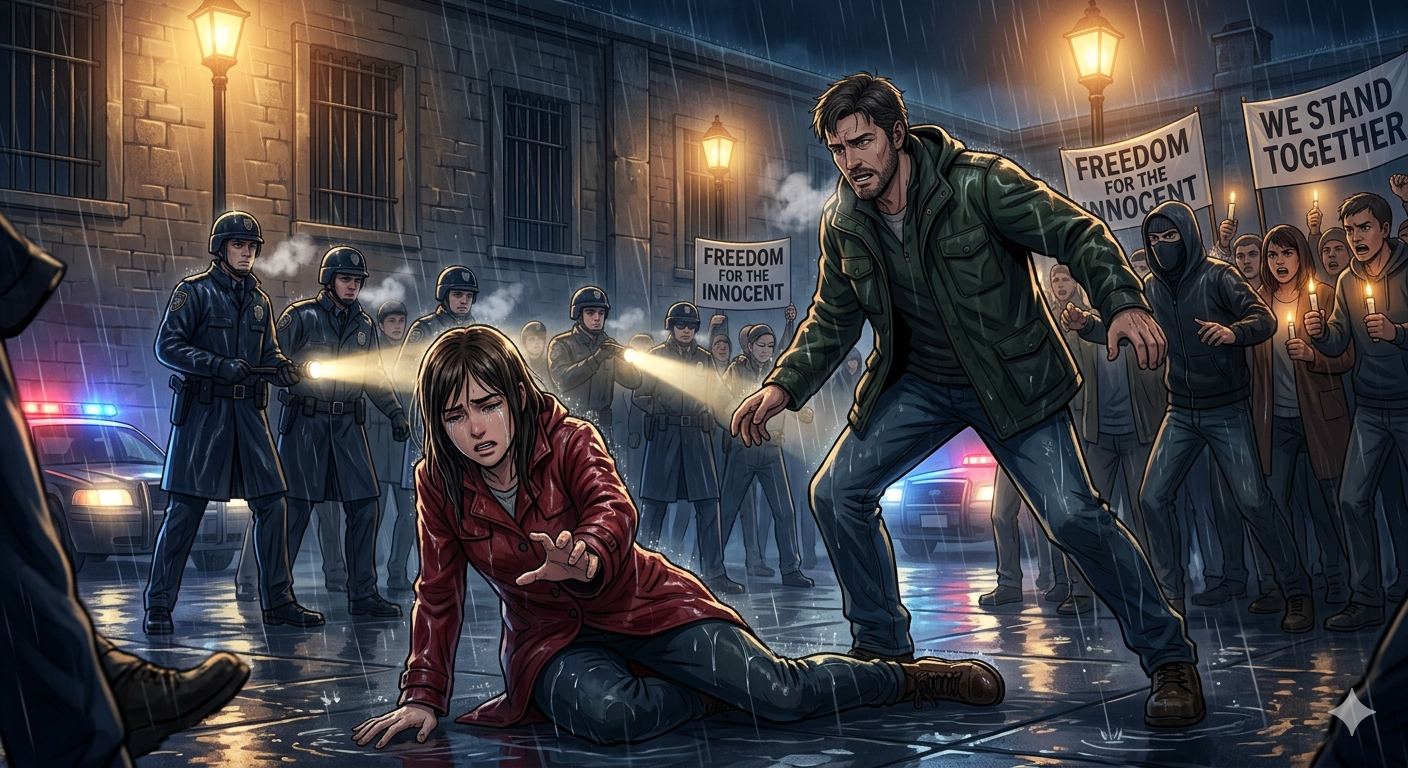
The rain hammered mercilessly on the roof of Villa Alma’s police station. Streetlights warped in puddles and flickering patrol beams. In the homicide office, Inspector Mateo Ríos flipped through a folder stained with coffee and edged with neat margins: files, letters, names that would not stop echoing. Detective Clara Varela, her jacket half-buttoned, turned on a coffee maker and let the steam fill the room with a scent that tried to cleanse its heaviness. “Another box of correspondence,” Clara said, tossing the drawer key onto the desk. “This one came by courier. No return address.” Mateo looked up and smiled bitterly. “There’s always another letter,” he replied. “This one’s for the Falcon.” The Falcon: a media nickname for the killer who haunted secondary roads—bodies abandoned without ritual, fractured looks, inconsistent witnesses. He had been arrested and convicted seven years earlier, yet his name lived on in headlines, forums, and sealed envelopes stamped with promises or slogans. The door creaked and a woman wrapped in a red coat entered, her hands trembling but her gaze steady. She introduced herself as Lucía Márquez and placed a box wrapped in worn paper on the desk. She did not speak until they sat across from her. “I want to deliver this in person,” she said in a contained voice. “It’s for him.” Mateo studied her with the professional caution of someone who had seen many broken gestures masquerade as heroism. “What do you know about him?” he asked. “I heard him during a trial on TV,” Lucía answered. “His voice cut through me. I don’t know how to explain it, Inspector. It’s as if he spoke from a dark place I belong to as well.” Clara shook her head, letting fatigue weigh on her words. “He’s a murderer. He killed people,” she said. “Why would you want to give him something?” Lucía opened the box with hands that couldn’t hide the tremor. “I’m not trying to excuse him,” she insisted. “I just… there’s a part of me that believes if someone looks at him differently, maybe he’ll stop breaking others.” Mateo kept his eyes on the lid of the box a beat longer than necessary. Inside was a cloth-covered notebook, a bundle of dried flowers, and a letter written in tight, neat handwriting. The scent rising from it was a mix of tea and old paper. “We’ll search it,” Mateo said, trying for a neutral tone. “But you won’t be allowed visits until it passes inspection. There are protocols.” Lucía nodded without protest. Her faith in her reasons sounded to Mateo like risk: some choices lead people to redemption; others push them toward ruin. *** Three days later, Dr. Elena Prieto, the department’s forensic psychologist, agreed to read the correspondence at the station. Elena had a methodical presence—neutral clothes, a notebook always handy, and a voice that refused sentimental shortcuts. She gathered Mateo, Clara, and Lucía in the interview room. “I’ll read aloud,” she announced. “I need everyone to keep calm and maintain professional distance.” Lucía’s letter was a confession stitched in small stitches. It spoke of sleepless nights, dreams populated by the convicted man’s image, and a desire to tell him that someone saw him—not just his crime but the person behind it. There were poetic lines that bordered on delirium: “If you look at me truly, you’ll know I did not come to condemn you.” There were also warning-tinged lines: “If you call me, I’ll come.” Elena closed the notebook for a moment and looked directly at Lucía. “This is not unusual,” she said without judgment. “What you describe fits a pattern clinicians call hibristophilia. It’s not merely attraction; it’s a psychological structure where the figure of the offender becomes an object of fascination and, simultaneously, a possibility of salvation.” Lucía clenched her hands in her lap. “But I don’t seek fame or adrenaline,” she defended herself. “I seek to understand him. To know why it happened. To know if there is something human that didn’t die.” Clara, unable to hide her skepticism, intervened. “Understanding isn’t the same as justifying. Besides, he doesn’t seek understanding. In his letters, he plays. He gives crumbs: truths mixed with omissions. Manipulation is an art these types master.” Elena nodded. “Exactly. Hibristophilia feeds on a cocktail: personal wounds, idealization of the criminal as an enigmatic figure, and public exposure that turns his image into spectacle. Some people believe they can redeem him; others fall in love with the narrative of danger. Both can be devastating.” Mateo, who had listened in silence, added pragmatically: “We’ve seen cases where correspondence translates into real actions: visits, money, attempts at influence. We can’t let this letter become a bridge to something worse.” The phrase left a sense of imminent danger in the room. *** A few days later in the forensics office, Elena asked to see all letters sent to the prison over recent years. Her analysis sketched a map of profiles: young women who had endured abandonment, adults who had experienced violent relationships, people with fractured histories who saw in the criminal a figure that could convert danger into a belonging narrative. Some sought fame, others a redemption storyline; several simply needed to fill a symbolic emptiness. Among the letters, one stood out for its calm, aged tone: Elsa’s—a woman whose written voice did not ask for clemency but for recognition. “I don’t excuse him,” she wrote, “but his loneliness pains me.” That nuance—pain for another’s loneliness—left Elena thinking that not every love for a criminal sprang from glamor or delirium; some letters grew from compassion hard to categorize. Meanwhile, Lucía’s intensity increased. She began frequenting forums discussing the case; she examined photos of the Falcon where his face shrank or swelled with shadow. At work, friends noticed she spoke more about the voice that had pierced her during the trial. For the police, the concern was not theoretical: letters are bridges. Bridges that, if built between vulnerable people, can be crossed into tragedy. *** One night, the station received a different letter: not from an admirer but a response from the prison to Lucía. The officer who delivered it seemed tense. Lucía opened it with hurried hands. The few lines were terse and direct: “Your voice complicates me. If you come, I will come. If you cross the line, there will be consequences.” Ink turned to blade. For Lucía, it was evidence of connection: her words had echoed back. For Elena and the brigade, it was a latent threat: a prisoner should not be dictating terms beyond the regime; such a reply could spark action. “You mustn’t write again,” Mateo ordered, his voice firm. “I can’t,” Lucía whispered. “If I don’t go, I feel myself dying inside.” Clara stepped closer and put a steady hand on her shoulder. “This isn’t a movie,” she said. “You’re not the heroine on a mission. This is real life: if you cross a line you could endanger others and yourself.” Lucía turned her gaze to the window, where the rain continued like a persistent metaphor. “I know,” she murmured. “It’s just… there’s something I need to understand, even if it destroys me.” Elena, who had been listening, softened her posture. “To understand is one thing; to pursue a relationship with someone who has used his words as weapons is another. We need to assess your motivations and protect you. If you decide to go, you’ll do it under supervision and with professional support.” That night Lucía left with a half promise: she would attend the police support group. But the uncertainty hung in the air like a warning. *** The following weeks were full of surveillance and small revelations. The brigade intercepted messages and emails showing that correspondence often functioned as threads for organization. Some Falcon admirers had created forums idealizing his acts; others, more dangerous, had started coordinating meetings or ways to subvert custody. One dawn, a courier was detained trying to smuggle prohibited items and messages into the prison. Among his belongings were a list of names, coordinates, and a strategically toned letter: it urged a gathering in front of the prison with slogans blending solidarity and tacit apology. Someone outside the inmate’s cell was weaving a myth that could turn letters into mobilization. Elena, having read the missive, looked at Mateo with professional sorrow. “This isn’t isolated hibristophilia,” she said. “It’s an ecosystem: vulnerable people, a mediatic figure, and external actors who exploit the narrative to provoke action.” Clara frowned. “We have to defuse any demonstration,” she ordered. “If the crowd turns aggressive, there’s a risk of violence and victims.” The plan was precise: police presence, containment zones, and operations to protect potential targets. But even the most polished plan cannot erase the human factor—crowds decide their own gestures. The night of the gathering, the plaza before the prison filled. Some held candles, faces lit by flame; others bore banners with confused phrases that seemed to justify the unjustifiable. In the crowd, curious eyes searched for identities; the murmur rose like a wave. Lucía, wearing her red coat, stood at the front. She walked to the first row—not to speak or challenge but to be present, to measure the reaction of people who, like her, had sought meaning in the Falcon’s figure. Mateo and Clara, separated by meters and duty, monitored every move. “If anything happens, call in,” Mateo whispered to Clara by radio. “Protect the vulnerable before we repress without reason.” The plaza smelled of damp and expectancy. An hour passed with no incidents; then a small, loud group pushed toward the bars. The first police line responded. Shouts, shoves—the brittle hope turned violent. In the confusion, someone shoved Lucía. She fell and the crowd closed in as if to devour her. A masked man moved through the crowd—no one knew if he intended to protect or to snatch her. In those seconds Adrián Molina—an ex-boyfriend of one of the victims who had followed the case from silence—burst into the turmoil. His move was unplanned and raw: he ran and covered Lucía with his body, dragging her to the side. His act was impulsive and visceral—rage, grief, and the need to protect what he had not been able to save before. “Back!” Adrián roared, his voice broken with fury. “This is not a show!” Some in the crowd pushed him; others, stunned, stepped back. The police, who had anticipated violence, allowed Adrián and a medical unit to extract Lucía. Several were detained, and among those arrested was a young man carrying a new letter and a phone full of coded messages. Coordinates and suggestive phrases showed that someone had tried to turn correspondence into action. The night ended with sirens and arrests: no major casualties, but the sense of danger remained like a sting. *** In the days that followed, investigations unraveled parts of the web. The letter that incited the demonstration had not come from the Falcon’s cell; it had been written by an admirer who capitalized on the figure to gather others. Administrators of several forums were identified; in some cases idolatry mixed with political intent or profit. Elena presented a detailed report to the brigade: psychological patterns, profiles of letter-writers, and the dynamics that convert correspondence into social movement. “Hibristophilia,” she explained, “is not an isolated ghost. It’s an interaction between wounded individuals, the mediatic figure of the criminal, and actors who instrumentalize that figure. Risk appears when empathy or identity-seeking turns into active participation, especially when manipulators are involved.” Mateo leaned on the edge of the table and looked at Clara. “So we have two fronts: protect those who might be victims of their own fascination and neutralize organizers who turn letters into violence.” Clara agreed, her face clouded. “And we must accompany the real victims,” she added. “We can’t let the criminal’s narrative cover the dead.” Adrián, who had been near the entire time, decided not to channel his anger only into fury. His sister’s death had left a space that anger could not fill; he founded a small association to support victims’ families, to give them voice and prevent attention from bleeding toward false heroes. His action, modest as it was, counterbalanced the fascination. Lucía, meanwhile, stopped writing letters to the prison. It wasn’t instant or miraculous. It was a process: she attended the support group, began studying psychology to understand her wounds, and agreed to therapy with Elena. Her motivation was not to deny what she had felt but to understand why she projected care onto someone who could not reciprocate as she imagined. In long sessions Lucía recounted her childhood: absent parents, a constant search for approval, the feeling that only extreme figures looked at her. Elena guided her without judgment: they worked to distinguish rescue desire from attraction, idealization from reality, the need to belong from complicity with evil. Change was slow. There were relapses—messages Lucía deleted without sending, nights of nostalgia—but also progress: she began helping Adrián’s association, guiding others who arrived with letters in hand and questions in their mouths. *** The Falcon remained in his cell, stripped of direct power but not of his symbolic ability. The press continued to write; forums persisted; yet the brigade’s intervention, social work, and therapy had made some voices stop feeding the myth. In the station, when Mateo closed the yellowed folder that held the Falcon’s case, he felt the weight of a city that still didn’t understand its fascination. Clara, who’d seen too many nights, exhaled a measured relief: they had prevented some letters from turning into weapons. The last letter read in the file was not grandiloquent. It was Elsa’s trembling script: “Evil exists,” the short line read, “but care exists too. Let the monster’s shine never confuse us.” Mateo shelved the file. Outside, the rain had ceased and the city breathed a damp, renewed air. In the following weeks more letters arrived: some asking for forgiveness, others seeking recognition. Some people kept writing to the Falcon for reasons that defied simplification; others found community and therapy to change their view. Lucía, now a student and volunteer at Adrián’s association, learned to set limits on her desire to rescue. Adrián found in solidarity a way to sustain his loss. Clara allowed herself days without night calls and returned to running in the park. Elena continued reading letters, studying patterns, and teaching how empathy without critical awareness can be dangerous. The Falcon’s case never fully disappeared; his myth endured in digital corners and in a few letters still being written. But other threads were woven into the social fabric: support networks, responsible policing, emotional education. The city learned a lesson: the human heart can build dangerous bridges to the forbidden, and the collective task is to guard those bridges so they do not fall into abysses. Source of the images. Image created with Google Gemini.
No comments yet