Short story: The Empty Cradle
Mrs. Alba looks at the empty cradle as one who studies a wrinkled map of a country she no longer recognizes. Outside, the city breathes shallowly: cars circling, lights advertising sales, and buildings with “for sale” signs planted like flags of surrender. Inside that room, the apartment tells another story: a rental contract with an implicit expiration date, bills piled up trembling like playing cards, and the photograph of a child who never arrived.
Alba and Mateo met young, with promises as wide as the sea. They loved with the urgency of those who know time is short; they dreamed of a family and a home whose walls would smell of fresh bread. In the early years life seemed like a board to fill: jobs that felt provisional, projects born in cafés, afternoons without clocks. But dreams are demanding creatures, and the world they inherited required them to give up almost everything in return. She worked endless shifts at a clinic, her tired fingers correcting the stories of other people's pain; he alternated temporary contracts that ended in silence, makeshift solutions in a career that would not settle. For ten years every price increase was a small amputation: groceries, daycare, transport, the dentist. Each rise added up and subtracted hope.
“Do you remember when we said we’d buy a house before thirty?” Alba asked one night while folding the clean laundry with hands that already knew the symmetry of the gesture.
“I remember,” Mateo answered without looking, as if speaking to memory. “And I remember how we thought stability would be like sunrise, that it would appear on its own.”
They both laughed, but the laugh felt like a suit that no longer fit. What had been a plan became an impossible equation: salaries that did not rise, bills growing voraciously, and the sense that life had become a series of impossible choices. Then came the calls that disordered their calendar: the landlord announcing renovations and rent increases, job offers that demanded mobility and constant presence, the news that an entire building had been bought by an investment firm seeking quick returns.
One day the notary called to inform them that the building across the street had been bought by a company that speculated on housing. The landlord offered their flat “at a good price” if they agreed to renew the lease for three years.
“That’s a trap,” Mateo said, his voice rough. “Three more years and they’ll eat half our wages.”
“And if we buy, we mortgage ourselves for twenty years,” Alba murmured, the phrase falling like a preface of fear. “What kind of freedom is that?”
Marta—the neighborhood friend, mother of two children who always arrived late and with muddy hands—looked at them bluntly in the neighbor’s kitchen, where smells and worries were shared.
“If you buy, you mortgage yourselves for twenty years; if you don’t, they can evict you whenever they want. There’s no middle ground,” Marta said, pinning the truth like a needle.
Alba looked at Mateo and saw the number nailed into his eyes: mortgage equals prison without bars. The possibility of owning a home had become a crossroads where desires were crushed: buying meant binding themselves to a long, suffocating debt; renting meant living under the sword of possible eviction.
The system, Alba thought in nights when sleep came with dark circles under her eyes, was not a monster with a single face but a machine of small violences: the monthly bill that does not ask about projects; employment that demands everything and offers nothing; housing hung up as a privilege for those who had already inherited their luck. The most frequent conversation at their dinners reduced to a litany repeated to exhaustion: “If we had stability…” The phrase contained a harbor that never arrived, a promise always kept on hold.
“If we had stability, we could really think about it,” Alba said one night, holding a mug too delicate to bear so many certainties. “I wouldn’t ask for luxuries; covering the essentials would be enough.”
“I know,” Mateo replied. “But they sell stability as a luxury product. They sell it in installments that don’t let us breathe.”
The language of desire was replaced by the calculus of survival. There was absence where children once would have been. Families of their generation postponed pregnancies, or shelved them with the same gentle motion of putting letters into a drawer: “later,” “maybe when we have security,” “when the country stops trembling beneath our feet.” With each couple that gave up, the city aged a little more: benches filled with weathered faces in the squares, classrooms closed for lack of students, municipal corridors populated by voids and statistics no one quite knew how to interpret.
“Look at that park,” Mateo said, pointing to a hill where bikes and voices used to pile up. “There used to be three kids on every bench. Now I almost don’t hear voices.”
“The voices are going out,” Alba replied. “Not because people don’t want to speak, but because no one listens; and if no one listens, voices get used to silence.”
Alba read voraciously about empires that did not die because of invaders but because of internal silences: Rome, with its streets that ended empty of heirs; Japan, which aged until it lost momentum and part of its inventiveness; parts of Eastern Europe where train stations carry more memories than children. Each example was a black-and-white photograph that seemed to have been taken from tomorrow, a warning the majority failed to read in time.
“That’s how civilizations collapse from within,” the professor told them once at a forum they attended, speaking with the calm of someone who has studied long patterns. “It’s not spectacular; it’s silent. They don’t die from one blow; they fade for lack of continuity.”
“Is that what awaits us?” Alba asked, the fear vibrating at the edge of her voice.
“I don’t know,” the professor answered. “But the pattern is there: cost of living rises, wages stagnate, housing becomes inaccessible peaks…”
Fear took shape in everyday life. One winter the city went dark for three days because of a grid failure. The lights went out, but with them something deeper was extinguished: the façade of normality that conceals the fragility of the social fabric. Conversations in the building transformed; they stopped being individual complaints and became shared confessions. Neighbors who barely spoke met on the stairs wrapped in blankets, exchanging food, stories, and time.
An elderly woman, Mrs. Irene, rolled back memory with the firmness of someone who has seen everything and still keeps lucid sorrow.
“We survived wars,” Irene said, holding a cup warmed by a candle flame. “But we won’t survive if we accept poverty as normal. Dignity isn’t an individual skill; it’s a social pact.”
It was then that Alba understood that unsustainability is not a sum of technical factors: it’s a social decision, a tacit pact that makes future generations pay the debt of the present. It wasn’t only rising prices or precarious contracts; it was that, blow after blow, the horizon upon which the idea of having children grows was being demolished: the confidence that there would be schools, health care, jobs, and time to raise them.
Mateo lost a stable job when the company outsourced his department. That afternoon he returned with the work jacket on his shoulder and the hollow look of someone who had lost more than a salary.
“You can go to another company,” they told him. “Or you can go home.”
“It wasn’t just the salary,” Mateo said, his gaze distant. “It was the calendar emptying of plans. I had meant to start that course, to organize our life, but with this everything becomes perpetual improvisation.”
They thought about moving to a town where rent was lower and time ran less quickly. They imagined gardens, yards, a school with less stress. But the rural mirage came with hidden costs: no pediatricians, poor transport, few opportunities for professional growth.
It was a choice between dying in a city that squeezed every resource or in a corner without professional horizons or support networks.
“And the children?” a cousin asked over the phone, curiosity and concern threaded through her voice. “How can you secure them in a place that offers no future?”
The question was not rhetorical; it was a saw that cut desire in two. The decision, they realized, no longer depended only on affection or intimate desire: it depended on an intact social fabric offering tangible guarantees. When those guarantees break, the project of forming a family becomes a blind bet far too risky.
The years passed with a crust of renunciations and compromises. Friends who did have children spoke begrudgingly, with a mixture of pride and fatigue.
“It’s not what it used to be, but we do it,” Alejandra would say while changing diapers, smiling with a sadness hidden between the folds of the gesture. “There’s love, yes, but also fear for the future they’ll face.”
Those without descendants found a different loneliness: not the material emptiness of the home, but the murmur of not having contributed to the cycle. It was an absence that could not always be named: the sense of a generation forced to tuck away its desires in the dimness because conditions did not allow them to bloom.
“Sometimes I feel like something is missing,” Mateo confessed one night, staring at the window as if trying to find the voices that were no longer there in the street. “It’s not nostalgia for what I didn’t have; it’s the feeling that I didn’t do what was expected of me, or maybe that what was expected stopped making sense.”
“It wasn’t our hearts that stopped us,” Alba replied with tenderness and firmness. “A system that sells insecurity as destiny did.”
One afternoon, in an improvised neighborhood assembly convened after a series of evictions, Alba spoke without intending to give a speech. She told of the cuts in her daily life, the sleepless nights adding up numbers, the fear of not being able to guarantee a future. She spoke with the simple voice of someone who lives precarity and manages it day by day. No one interrupted; the words found a ready ear.
“We shouldn’t blame people,” a young man stood up after Alba, the contained anger that arises when truths are finally shared. “We don’t refuse to be parents out of caprice. A system that sells insecurity as destiny forbids us.”
The room applauded as one who recognizes a truth that had always existed but had not been put into words. The applause was not festive: it was the acknowledgment of a reality hidden in figures and statistics that finally found a face.
The story has no single or easy ending. Some couples found community-based solutions that worked as emergency patches but also as experiments in reconstruction: cooperative creches in borrowed premises, shared gardens in neglected lots, barter networks for childcare services. In those spaces something that felt old and new at the same time was born: organized solidarity, that form of mutual support that reduces the loneliness of raising children and returns the idea of the future to the realm of the common project.
Other couples emigrated, seeking air in distant shores. They left in waves of talent and need, abandoning neighborhoods with less energy, fewer initiatives, fewer embryos of future. Many who remained carried on day by day with the feeling that deciding to have children no longer depended only on intimate desires but on a torn social fabric: private life rendered into public concern.
“If the world gave me certainty, I would have you,” Alba wrote once on a note and left it in the cradle. “It’s not pain I feel; it’s an evidence.”
The note stayed folded between an unused toy and a lavender-scented blanket. It was not a plea nor a bitter renunciation; it was a sober, bitter observation: there was an unbridgeable distance between wanting and being able. In the empty cradle the handwritten evidence remained.
The note was not painful: it was an invitation to look beyond individual reproach and understand that the problem was collective. Birthrates do not fall because people don’t want children; they drop because the system has made life unsustainable.
The city, for the moment, does not wake with the energy of old days. It tends to hoard the same faces in its arteries, faces that age; the squares become terraces of memory. But on corners, in community rooms and shared kitchens, groups form to distribute time and skills: someone watches a child in the morning, another fixes a boiler in the afternoon, a third teaches basic accounting at night so people can start small projects. These are emergency measures, improvised and valuable; sometimes they are not enough, but they allow people to breathe.
“We can’t just survive,” Marta said in one of those community meetings, with a voice that would no longer tolerate indulgence. “We have to rebuild what broke.”
“If civilizations collapse from within, they can also be recomposed from within,” Alba said in that same meeting, with the conviction born of pain and hope. “If we decide the future will not be a privilege but a shared obligation, maybe the cradle will stop being empty.”
Nostalgic and reflective addendum:
Sometimes when Alba closes the blind and the apartment falls into dusk, she allows herself a small, direct journey into memory. Nostalgia is not a futile remorse; it is a landscape where old certainties rest. She evokes childhood in a kitchen with yellow tiles, the smell of milk cooling on a windowsill, her mother’s voice singing a bolero while dyeing the afternoon with tales of times when cities were louder with play than with promotions. In those moments everything seems simpler: a promise of the future was then a song, and stability was not negotiated in contracts but inherited in long embraces and networks knitted by friendly hands.
Mateo, arriving late and opening the door with the sound of keys seeking rest, sometimes stops in the doorway and looks at the cradle as if it were an object from another century, a relic of possibilities the city decided not to allow. He remembers his father teaching him to ride a bicycle on a street without cars, the first time he felt the vertigo of freedom and the certainty that the world would give him time to grow. Now he sighs differently: his nostalgia is not only for what might have been but for the gentle slowness of other times, when promises were fulfilled by labor and not by predatory conditions.
At community meetings, amid lists of needs and practical proposals, stories that smell of past times and awaken a bitter tenderness emerge. A neighbor recounts how her mother took her hand to cross the square; another remembers songs in the building entrance that turned the night into a space of encounter. These memories are not mere yearnings: they are models of a lost fabric that cannot be replaced with cold policies. Nostalgia, for a moment, offers the certainty that there once was a time when life allowed generations to sprout from one another without the system blocking them.
That melancholy does not paralyze those who share it; it becomes fuel. Collective memory pushes some to try to rebuild with the few tools they have: time, patience, shared knowledge, and the inventiveness of those who have learned to survive with little. The cradle remains empty, but it is no longer just a symbol of renunciation; it is also an invitation. In the dusk Alba imagines small hands scribbling on sheets of paper, laughter breaking the silence of afternoons, a future not bought but woven together. And in that nostalgic gaze one thing resists: hope is not naive, it is persistent.
The city remembers how to be a cradle in its own way: not by decree but by the sum of small everyday acts that make a future habitable. Maybe, Alba thinks many nights, the city will learn again to provide conditions; maybe policies will restore dignity; maybe the idea that sustaining childhood is sustaining the country will be recovered.
But while she waits, Alba keeps the note in the cradle and looks at it before turning off the light, like someone watching a letter she does not know if it will ever be read. The empty cradle remains, both evidence of a failure and the promise of a struggle: if civilizations collapse from within, they can also be recomposed from within. Maybe not today, maybe not tomorrow, but someday voices will multiply in the parks again, and lullabies will be songs of promise rather than farewell.
Source of the images.
Image created with Bing.
Short story: The Hotel Guest from Hell
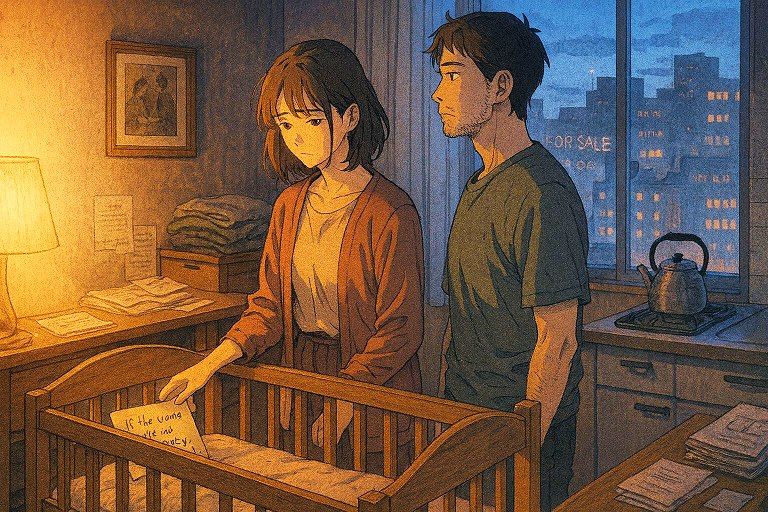
The esports suite had been designed as a capsule of efficiency: white walls dotted with acoustic panels, adjustable cool lighting, an ergonomic chair promising hours without harm, and fiber connections that erased the distance between player and match. For the hotel, that space represented the cutting edge; for Alejandro, at first, it was a platform. He arrived with the certainty of a champion: a simple suitcase, headphones around his neck, a tense smile reserved for the entrance. No one imagined that, in time, that platform would become a cell.
At first his presence was easy to explain. People spoke of tournaments, preparation, late-night strategies. Carlos, the young receptionist, offered those light explanations whenever other staff showed curiosity: “He’s concentrating for the tournament,” he would say, with a tone meant to preserve privacy and normality. Pablo, the esports technician and a distant friend of Alejandro’s, made more pragmatic observations: Alejandro needed calm, a place to test builds and practice until his reflexes were sharp. Management celebrated the implicit sponsorship: having a player of his level living in such a suite was good publicity.
“No judge him yet,” Pablo said one night at the hotel bar while looking over a list of recorded matches. “Sometimes they do this to isolate before a big event.”
Carlos tilted his head. “And what if it isn’t that?” he asked. “I see him only leaving to order food. He doesn’t talk to anyone.”
“Then we’ll have to watch him,” Pablo replied. “If he gets lost, it won’t be the hotel’s fault.”
Days stretched into months with the same silent inertia that marks sleepless nights. The suite’s door, which had opened frequently for conversations, services, and visits, began to stay only slightly ajar to receive food. Alejandro stopped going out. The curtains remained drawn most of the time; the outside world shrank to the glow of the screen and the hum of the cooling. His screens never went black: matches looped, streams paused, chat windows frozen. Cables formed vines across the floor, chargers and adapters rooting something to the ground.
The reduction of the world to a screen carried with it a subtler and more devastating transformation: the gradual abandonment of habits that anchor a person to reality. Food remnants that were once discreet—a disposable plate, a hastily sealed bag—accumulated into mounds. Empty bottles stacked almost to the height of the side table. Cans and wrappers organized into piles that imposed their own order, an architecture of neglect that eventually delimited Alejandro’s living space. Documents, notebooks, and strategy manuals met grease stains and fingerprints. At the center of that still life, the chair and keyboard remained upright like offerings to something that no longer inspired glory.
The hotel staff, accustomed to dealing with travelers and celebrities, began to sense this was not mere neglect. María, head of housekeeping with years of experience, ran a hand over an armrest and felt the sticky buildup on her fingertips.
“This isn’t normal,” she muttered. “There’s something else.”
Carlos, who had been arranging meals at the desk, recognized a restlessness in his colleague masked by professionalism.
“I never saw him go for a walk,” he confessed quietly. “It seemed the match was the only thing that pulled him out of the room.”
Pablo tried to intervene from his technical position. He went to management more than once, with the urgency of someone who knew the person behind the player.
“It’s not just dirt,” he told Doña Rosa in her office. “Alejandro is isolating himself. He needs someone to force him to open the door.”
Doña Rosa raised an eyebrow and rested her hands on the desk. “We cannot force him,” she replied. “As long as he pays and doesn’t cause trouble, the law protects us.”
“But that’s not humane,” Pablo said, voice tight. “He’s sinking.”
Doña Rosa’s gaze, used to balancing risks and smoothing incidents, was cool but not without concern.
“I will monitor it,” she said. “But I won’t intervene beyond what’s legal.”
Time is a slow sculptor that shapes filth with the same precision it uses to shape habit. What began as piles of wrappers became a landscape: hills of trash around the gaming table, pits of clutter in the corners, barely passable paths lined with cans and packaging. The smell became a presence that clung to the throat: an acrid mix of fermentation, gas, and rancid oil. Stains found their own language on the furniture, and the keyboard’s keys became dead points where grease collected along with the handwriting of someone who had lived too close to the screen.
One afternoon the implicit decision not to intervene gave way to an explicit rupture: Alejandro left. No one could say for certain whether his departure was an act of will or a physical and emotional surrender; only the final scene was clear, improvised and silent. Pablo saw him pass through reception with a rounded back and a coat that no longer covered a well-kept body. He approached with the awkwardness of a friend trying, without heroic words, to repair the irreparable.
“Ale, what happened to you?” Pablo asked.
Alejandro looked at him with sunken eyes; the words came as if each cost him effort. “I got tired,” he said. “Matches weren’t victories anymore; they became excuses.”
Pablo swallowed hard. “We could have helped you.”
“I haven’t known how to ask for help in a long time,” Alejandro answered, and he kept walking without looking back.
What remained after his exit was a dark vindication of the human condition: a room turned into witness. When housekeeping opened the door, the scene hit them with the force of something far beyond the norms of coexistence. Mountains of trash leaned against the walls, objects piled into formations that seemed to protect a core, leftovers marking trajectories of uninterrupted days and nights. Cleaning was not merely a technical task; it was an emergency operation requiring time, effort, and something like compassion. For three full days María and her team worked in shifts, bagging kilos of waste, disinfecting surfaces, scraping stains that had adhered with the tenacity of things not cleaned quickly.
María was surprised to find fragments of Alejandro’s life among the garbage: notes, sketches, stickers showing past achievements. Seeing those personal traces scattered among wrappers and bottles left her disoriented and sorrowful.
“It’s not just trash,” she said softly one night as she loaded a heavy bag onto a cart. “It’s a surrender.”
Carlos, who helped with logistics at times, added, “It’s as if he wanted to disappear without moving.”
Explanations form in the silence of those who cannot ask too many questions. Management documented the damage and calculated the bill: four hundred dollars for cleaning, replacement of some items, and staff overtime. From the cold objectivity of administration, the figure seemed a sufficient solution to close the file: fix the room, put the suite back in service, erase the tangible evidence of what had happened. Doña Rosa, aware the law allowed more rigorous measures, made a decision that was part calculation and part humanity: she would not press charges nor pursue legal action against Alejandro. In a brief meeting with Pablo and María she explained her reasoning with measured pragmatism.
“I won’t turn this into a spectacle,” Doña Rosa said. “We did what is appropriate as a company; involving the justice system would be disproportionate.”
Pablo protested vehemently. “If there are no consequences, this could happen again. Don’t we have social responsibility?”
María looked at the floor before answering. “There are limits, Pablo. Sometimes the humane thing is not to humiliate.”
Down corridors and in bars the story took the shape of rumor and epitaph. Some, seeking relief in a label, nicknamed him “the hotel guest from hell.” Others saw in the name a blunt metaphor: hell as an inner place, a private geography of suffering rather than moral condemnation.
Staff memory retained the image of a suite restored to technical cleanliness but also a lingering sense that couldn’t be wiped away with soap and water: the feeling that at some point Alejandro’s humanity had given ground to the compulsion to play until the match and life became confused.
There were conversations that tried to hold more than consternation. Doña Rosa asked anyone who encountered Alejandro to invite him to talk, to offer a form of care that was neither intrusive nor judicial.
“If you see him, don’t say anything hostile,” she requested. “Invite him for coffee. Listen.”
María nodded. “Sometimes people just need someone to keep the door open until they want to leave.”
Pablo tried to propose concrete actions. “We can offer him sessions with a psychologist and support from teammates,” he said. “It’s not much, but it’s something.”
Alejandro’s final decision regarding any help remained unknown. The choice not to take the case to the police left an ambivalent mark. For some staff it was an act of compassion; for others, administrative resignation. In the hotel they spoke of dignity and limits, of the boundary between the duty to protect and the power to intervene. Doña Rosa’s choice condensed that tension: not exposing a man to public humiliation, but also not forcing him to face a society that barely tolerates weakness without turning it into spectacle.
Months later the suite resumed its original function: it hosted young players again, teams buzzing with tournament excitement, headphones hanging like medals. The technology remained, impassive, waiting for another human to inhabit it without getting lost. Yet at night some staff swore they felt a residual memory in the walls: the distant echo of keys struck in desperation, a held breath in the midnight silence, the sense that a match had been left unfinished. That perception was not supernatural but human: places keep stories, and stories exert a pull on those who pass through them.
The drama offered no visible catharsis; there were no public confessions or grand reconciliations. It was a quiet descent, marked by small negligences that, accumulated, constituted a fall. Alejandro’s story remained unfinished, like many lives that fracture without attention. For those who cleaned the suite and saw the trace he left, the episode was both a warning and an interrogation: what is lost first when someone locks themselves away? The ability to ask for help, the habit of self-care, presence in the world? And, above all, who takes responsibility when the collective response is administrative indifference or resigned compassion?
In a hotel corridor, while morning light filtered in straight lines, María took off her apron and looked toward the suite’s closed door. She had no easy answers—only a simple conviction that hesitated and insisted at once: sometimes opening the door in time matters more than issuing a bill. Carlos, leaning on the reception desk, said in a low voice, “We gave him a cruel nickname, but the truth is none of us wants to remember that we could have been him.” Pablo kept reviewing lists and contacts, hoping that if fate allowed another chance, he would find the strength to reach out.
And in an unwritten future, perhaps Alejandro tried again. Perhaps he did not. What remained, in any case, was the trace of a failed encounter between machine and human vulnerability, between competition and fragility. The suite was cleaned, repaired, and reopened for competition. The city kept its rhythm. But something happens to places where someone gets lost: they hold a resonance, a possible memory that makes those who pass by pause and ask themselves whether, next time they see a door ajar and someone sitting too long in front of a screen, they will do something different.
Source of the images.
Image created with Bing.
Short story: A night that changed everything
The house was immersed in the usual calm of neighborhood nights: the distant whisper of traffic, the hum of a refrigerator, and the dim light filtering through the curtains in the upstairs bedroom. Valeria, twenty-four, had returned that night from a long shift at the bookstore where she worked and, before going to bed, answered a message from her mother. She placed the phone on the nightstand, plugged it in with a cable she had bought cheaply at a street stall, and, without thinking much about it, turned off the lamp.
“Good night, Mom,” she had said with a voice already thick from tiredness. “I’ll call you early tomorrow.”
Her mother, Rosa, a woman whose hands were worn from years of sewing, replied in her usual tone, half-joking, half-caring:
“Sleep, my life. Don’t you remember there’s a meeting at the younger one’s school tomorrow? Turn the light off at eleven.”
“Yes, Mom,” Valeria answered. “I love you.”
That exchange, so ordinary, hung in the darkness like so many little routines that make up the sense of safety in a life. The phone, a constant companion of chats, photos and podcasts, rested on the bedside table, its plastic case almost touching the pillowcase. No one in the house imagined that that innocent habit could become a tiny bomb.
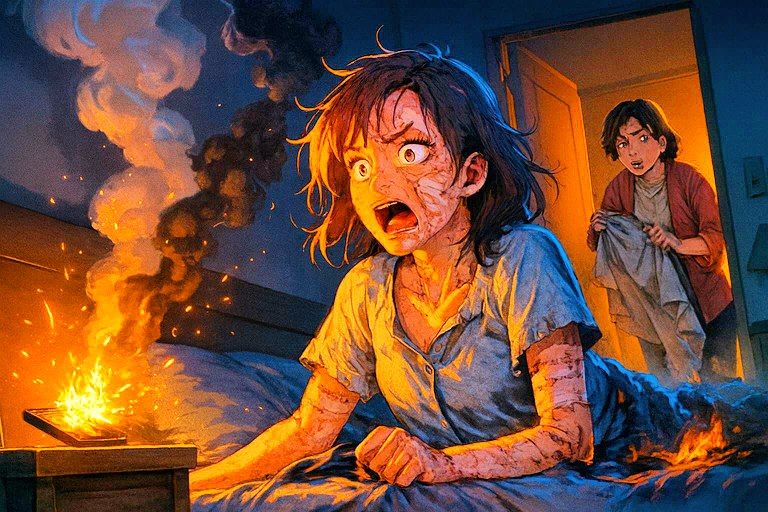
Around three in the morning, something changed. A sharp smell of burning plastic broke into Valeria’s sleep. It was a dull warning that half-awoke her: first her nose, then her consciousness. A dry crack sounded in the dark and, within seconds, a small explosion lit the room with orange flashes. The phone’s battery had burst.
The heat struck her face like a wave. She felt a fierce burning that forced her to sit up abruptly; the sheet caught fire, her hair became entangled in the flames, and the skin that normally protected her began to give way. She screamed with a voice she did not recognize, a mix of pain and surprise.
“Mom! —she shouted— Mom, I’m burning!”
Rosa, who slept in the adjoining room, heard the scream and ran. Alberto, her husband, woke up startled; the house turned into light and smoke, doors opening blindly and broken voices. Rosa found her daughter at the edge of the bed, hands groping for something to put out the fire. Without thinking, she threw a heavy blanket over the flames and managed to smother them; neighbors called emergency services, who arrived in minutes that felt like hours.
When the smoke finally cleared and the paramedics’ cold light came in, the scene was different: Valeria’s face was covered in darkened and reddened wounds; the skin on her right arm and part of her hand showed signs of deep burns. Several fingers on her right hand were unrecognizable: burned tissue, charred phalanges, the very shape of her hands altered forever. They rushed her to the hospital.
In the emergency room, the chaos gave way to clinical precision. Dr. Javier, young but steady-handed, examined her quickly.
“She has second- and third-degree burns on the face and the right upper limb,” he informed the family. “We need to stabilize her and prepare for possible grafts. There is a risk of infection and significant functional damage.”
Valeria, between sedation and stabs of pain, tried to speak.
“My fingers…?” she asked in a broken voice.
“We will do everything we can,” Javier answered honestly. “But we must be realistic: you may lose some functions. Rehabilitation and surgeries will be part of the process.”
In the days that followed, the house filled with people coming and going: neighbors bringing food, coworkers from the bookstore taking turns to accompany her, and institutional visitors who wanted to know the details of what had happened. The story of the phone’s explosion spread quickly through the neighborhood, by voice messages and social media. Among the family, the feelings were a mix of guilt and frustration: how had they not foreseen the danger of that cheap charger, why hadn’t they changed the habit of leaving the phone next to the pillow?
The first surgeries were long and painful. Plastic surgeons and burn specialists worked for hours removing necrotic tissue and preparing donor sites for grafts. The harrowing count of days included sleepless nights, dressings that smelled of antiseptic, and tubes that marked the passing of time. Valeria underwent procedures intended to save the essentials: her life, basic function of the arm, and, if possible, some mobility in the hand.
Rosa did not leave the hospital. She slept in an uncomfortable chair beside the bed, washed her hands in silence, and when memories overwhelmed her, she looked at photos of her daughter before the accident: Valeria laughing with friends, reading in the bookstore, holding an ice cream in the square. In those images, there were no traces of the tragedy that now surrounded them.
“I can’t believe we use old outlets in the house,” Alberto murmured one afternoon, his voice hard as someone searching for someone to blame. “I told you to buy an original charger. You must always prevent these things.”
“Lamenting won’t help now,” Rosa replied, her voice breaking. “We must think about rehabilitation, about how we will help her.”
The impact did not end with medical emergency. Valeria faced a calendar of therapies with occupational therapist Daniel, who guided her through regaining autonomy. Daniel encouraged her with patience: passive mobility exercises, strengthening, adaptive tools for basic activities.
“We are going to work every day,” he told her. “The loss is real, but the plasticity of the body and mind has surprising limits. We can improve functionality.”
“I want to learn,” Valeria replied with determination. “I don’t want this to define me, but I need tools to go on.”
Despite medical care and family support, the psychological dimension of the damage was deep. Valeria went through stages of denial, anger, and ultimately a fluctuating acceptance that allowed her to move forward. There were nights when, with a swollen face and bandaged hands, she looked in the mirror and barely recognized the woman she had been. Other times she cried for small daily losses: the speed with which she used to button a shirt, the ease of holding a cup with both hands, the triviality of combing her hair without effort.
It was then she decided to record a video. Not to get pity, she said, but so her story would serve as a warning. With the hospital camera propped on a table, cold light and visible bandages, she spoke with a trembling but steady voice.
“Hello,” she began. “I’m Valeria. I want to tell you what happened so it doesn’t happen to you. I left my phone charging on the nightstand, next to the pillow. I was using a generic cable. I never imagined something like this could explode. I lost several fingers and have burns on my face. Please: don’t charge your phone next to your bed, check your chargers, and use certified products.”
The video spread on social media quickly. People reacted with shock and empathy; thousands of messages of support arrived from friends, bookstore customers, and strangers with similar stories. Clara, her university friend, was one of the first to leave a message.
“Valeria, I’m coming tomorrow. You are not alone,” Clara wrote.
Diego, her younger brother, called between sobs.
“Sis, I need you. I’ll help you with everything,” he promised.
The repercussions were not limited to words of encouragement. In the community, Valeria’s case prompted real changes: the local school organized a safety talk about electrical devices; the neighborhood store that sold cheap chargers underwent a municipal inspection; a technician, Mauricio, offered a free informational session at the community center about the risks of faulty installations and the importance of using certified chargers.
“If a device overheats, unplug it,” Mauricio explained in the talk. “Avoid leaving it on textiles or pillows and don’t use chargers without certification seals. Cheap can be very costly.”
On a personal level, Valeria’s recovery was a long process of small victories. She learned to write with fewer fingers, to use adaptive tools to hold utensils, to button clothes with hooks designed for limited mobility. Daniel accompanied her through exercises that strengthened the wrist and residual hand; with each small achievement, confidence returned bit by bit.
There were, however, moments that no therapy could fully mend: the emptiness she felt when trying to touch a fabric and not finding the fingers that once traced it; the difficulty of keeping jobs that required manual speed; the need to reposition her identity in front of friends and a partner. Family support was decisive. Rosa, tireless, never let Valeria feel abandoned.
“We will get through this,” she kept telling her. “I will be with you every step of the way.”
Clara and Diego took turns taking her to appointments and spending long afternoons with her. Alberto, who had initially been carried away by anger, ended up actively searching for specialists and technical aids. In the midst of reconstructing routine, the family found new ways to come together.
Months later, Valeria began to participate in support groups for burn survivors. There she met stories that reminded her that tragedy, although unique in each case, had common echoes: physical pain, grieving losses, resilience. Sharing her experience gave her voice new meaning: she stopped being just the young woman who had had an accident and became someone who warned, taught, and supported.
At a public session organized by the municipality, Valeria took the small stage and spoke to a full room. She told her story, showed photos of her recovery without shame, and answered questions about everyday safety habits.
“Don’t look for excuses,” she said. “Life is made of routines. Changing a habit is small compared to what is lost in an instant.”
The phrase struck a chord. Local authorities announced awareness campaigns and guidelines for charger use and household electrical inspections. At the bookstore where she worked, colleagues put up a poster with safety tips and organized a fundraiser to support her rehabilitation.
Still, full repair was not possible. Partial disfigurement of the face and the loss of several fingers left indelible marks: scars that burned in the sun, movements that demanded concentration, and a new need to accept life with limitations. Yet, within that acceptance something powerful formed: a voice that sought to prevent, a will that turned pain into action.
Valeria returned to reading at the bookstore months later, first with reduced hours and then gradually increasing them. She learned to use adaptive tools to handle books and boxes. Every book placed on a shelf, every greeting to a customer, was proof that routine can be rebuilt, albeit differently.
In private, nights remained a challenge. Sleeping without having the phone within reach became both a practical and symbolic lesson: renouncing an old gesture to ensure safety. The household installed new surge strips, bought certified chargers, and declared the bedside table a place where devices would no longer be left plugged in overnight.
Valeria’s story left an ambivalent trail: pain and loss, yes, but also teaching and community. The young woman who once laughed carelessly, who held a book with both hands without difficulty, now spoke with clarity tempered by experience. Her warnings on social networks and at talks were not sermons: they were accounts born of the body itself, of the skin that had been taught in the harshest possible way.
Sometimes, when melancholy visited, she remembered that night as the inflection point that marked before and after. She had lost fingers and time, but she had gained something unexpected: a sensitivity to the fragility of the everyday and a community willing to accompany her. Her recovery continued day by day, between therapies, small conquests and the patient work of rebuilding a life that, although different, remained valuable.
In the end, the lesson was clear and brutal: a moment of neglect was enough to change everything. And Valeria’s voice, firm despite the pain and scars, kept repeating the same warning whenever she had the chance:
“Mind where you charge your phone, mind how you charge it. Sometimes safety lies in the simplest gestures.”
Source of the images.
Image created with Bing.
Short story: The Price of Thirst
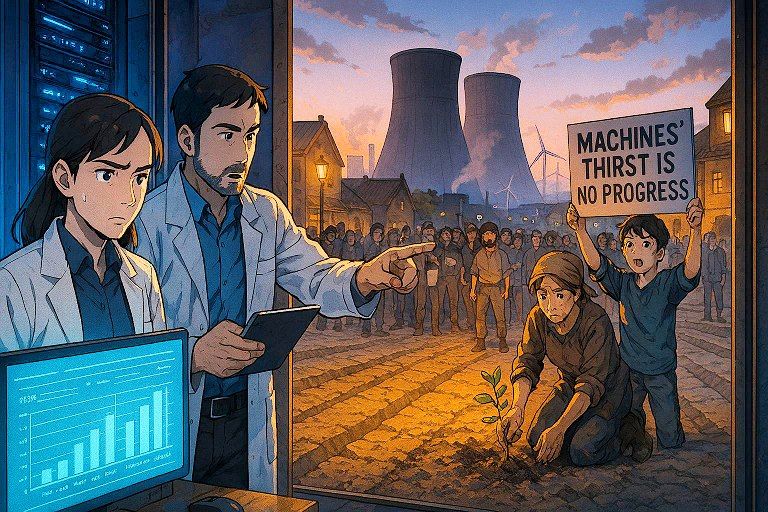
In the dimness of a server room—where the light was more a continuous hum than illumination—Marta turned on the monitor and let the figures unfold like a verdict. Her hands trembled slightly; professionalism forced her to remain composed. The numbers were relentless: between 312.5 and 764.6 billion liters of water consumed in 2025 by artificial intelligence systems, an amount equivalent to the annual consumption of the global bottled water industry. The research also estimated a carbon footprint between 32.6 and 79.7 million tonnes of CO₂. All of it was mainly attributable to evaporative cooling needed to tame the heat of the data centers that power those models.
I. The cold room and the hot news
Marta recalled the first time she had toured a data center: endless corridors, fans roaring like locomotives, metal walkways and cable tunnels coiling like arteries. On that first visit she had felt the mix of wonder and fear typical of someone facing something immense and partly incomprehensible. She had seen the promise: models capable of predicting droughts, optimizing electrical networks, and rescuing ecosystems. At the time she had not thought about the cost of keeping those intelligent machines alive.
The study’s authors—faces anonymous because the focus was the data—had done the math. Marta reviewed the methodology: measurements of water consumption associated with evaporative cooling systems, estimates of energy use, and conversions to CO₂ emissions. The mechanism was simple in concept and devastating in scale: to dissipate the heat generated by intensive computations, data centers rely on systems that evaporate large quantities of water; that evaporation, combined with the energy consumed, explains the sector’s water and carbon footprints.
“Luis, you have to see this,” Marta said when she called her colleague from the lab, the screen visible behind her. “Do you realize? It’s the annual consumption of the entire bottled-water industry.”
Luis, who had spent most of his career designing cooling architectures and measuring flows, came over, placed a hand on the cold console, and read in silence.
“If this is real,” he murmured, “we’re not facing a minor technical problem. It’s systemic. We’ve created a demand that scales with every training run, with every iteration of bigger models.”
“And it’s not just water,” Marta added. “Look at the emissions—figures comparable to those of a large city.”
Luis exhaled, as if trying to expel an unbearable idea.
“Everyone who boasts about optimizing consumption will have to prove it with deeds, not brochures.”
II. The story in the press and the clash of narratives
Clara, the journalist, called that same afternoon to prepare a feature that would put the research in the public eye. She wanted details, sources, and whose voices to include. Marta provided the report, tables, and list of researchers. Clara decided to publish with a dual approach: the quantitative finding and its human consequences.
When the story ran, reactions came fast. In a televised debate on a major channel, Clara confronted Eduardo, an executive at one of the largest tech companies, with the data’s bluntness.
“Mr. Eduardo, your industry is drinking billions of liters. Meanwhile, entire communities suffer scarcity. How do you justify that?” Clara asked without ceremony.
Eduardo, with rhetoric polished by rehearsals and advisors, took the microphone and offered the expected narrative: investments in renewables, commitments to neutrality, roadmaps and pilot projects.
“We are committed to sustainability,” he said. “We have efficiency programs and plans to migrate to clean energy.”
Clara pressed on.
“And the water? How do you justify intensive use and evaporative cooling as a standard practice?”
Eduardo hesitated for a moment. He searched the camera, measured the response, and repeated the corporate script.
“The transition takes time. But we are investing in alternative solutions.”
III. The voice from the land
While companies spoke of roadmaps and the media debated, the story reached places where numbers are lived in the flesh. Sara, a farmer from a region already punished by irregular rains, watched her irrigation channels run unusually low. Her community had suffered water restrictions, and the news about data-center consumption fell like fire on dry grass.
Julián, a young local activist, showed Sara the story on his phone.
“They say server clouds are drinking whole rivers,” he explained. “If it’s true, someone has to answer.”
Sara spat on the ground, a gesture in her village almost akin to blasphemy toward the earth.
“We can’t wait for the industry to finish its transition,” she said. “Crops fail now, not in five years. Who will be held accountable?”
Julián organized a protest in front of the town hall; signs reading “Machines’ Thirst Is Not Progress” gathered neighbors demanding transparency and concrete measures. Clara covered the march and brought the voices of Sara and other farmers to the national circuit.
IV. Technical tables and concrete proposals
Public pressure forced convening of technical tables with Marta, Luis, engineers, corporate representatives, officials, and community members. They discussed immediate measures and policy directions.
“Mandatory transparency in water consumption,” Marta proposed. “All facilities must report monthly water and energy use, with independent audits.”
“Strategic relocation of centers,” Luis suggested. “Prioritize cold climates or coastal areas where nonpotable water can be used, and promote passive cooling whenever possible.”
“Incentives for innovation,” another engineer added. “Funds for technologies that reduce evaporation, like advanced heat exchangers or closed-immersion cooling that does not lose water.”
Eduardo, pressed by public opinion, agreed to participate in a pilot to implement some of these ideas. He offered resources and time and committed to external audits.
“We accept audits,” he said gravely during the meeting. “We also propose investing in solar plants and centers in cold climates.”
V. Distrust and urgency
Even with commitments on paper, community distrust did not vanish. Julián, who had seen many unfulfilled promises, asked aloud during a public assembly:
“What if this is just another promise to pass the scandal? How many roadmaps have we already heard?”
Eduardo responded with calculated frankness.
“I understand the distrust. But there are resources and will. We can start with binding targets and independent auditors.”
Marta, feeling the responsibility to push for technical and ethical rigor, stood up to Eduardo and spoke without euphemism.
“Intention is not enough,” she said. “We need metrics, clear limits, and sanctions. If AI is going to scale, it must do so under rules that prevent externalizing costs onto vulnerable communities.”
VI. The paradox and the choice
In the following nights Marta slept poorly. She dreamed of two overlapping maps: in one, AI appeared as a web of solutions—fire predictions, optimized power grids, improved crops; in the other, its infrastructure increased demand—more water, more energy, more emissions. The question that struck her was not only technical: it was about priorities and governance.
Meeting with Clara, Luis, and Julián in a café by the square where young people planted trees, the conversation became strategic. Clara proposed a series of follow-up reports that would not only expose but also present proposals and successful cases. Luis offered to design and document passive-cooling prototypes applicable to medium-sized centers. Julián convened the community and proposed mechanisms for citizen participation to monitor commitments.
“We will demand audits, binding targets, and community participation in location and consumption decisions,” Julián said with the urgency of youth.
“And we’ll document real solutions,” Luis added. “Criticism is not enough; we must show viable technical paths.”
Clara, with journalistic experience, saw the need for a narrative mixing data and humanity.
“We’ll run serialized coverage,” she proposed. “The press cannot stay with a one-day story; it must follow the process.”
VII. Tensions and small victories
Media exposure, social pressure, and technical evidence began to produce effects. Several regional governments announced regulatory reforms requiring quarterly reporting of critical facilities’ water consumption and independent audits. Some companies suspended new centers in water-stressed regions and opened research funds for low-water cooling.
During a visit to the community, Eduardo—visibly more fatigued than on TV—was obliged to answer before Sara and her neighbors. She confronted him with the look of someone acquainted with time and its cycles.
“You promised development,” Sara said. “But development that kills the land is not progress.”
Eduardo, facing the inevitability of accountability, replied:
“We will perform public audits and set binding goals. It isn’t enough, I know, but it’s a start.”
The response did not placate everyone. Some activists demanded rapid penalties; others, led by Marta and technical experts, proposed gradual but verifiable programs: pilots of immersion-cooled centers without water loss, migration to cold climates where feasible, and hydric compensation schemes for affected areas.
VIII. Final reflections and the unfinished task
Marta walked one morning through the square where Sara, Julián, and other youths planted trees. She watched their callused hands dig, the mud staining their nails, the tangible hope sprouting from the soil. A boy asked her without looking up:
“Do you think AI can help decide where to plant each tree?”
Marta smiled with sadness and determination at once.
“Yes,” she answered, “but first we have to teach it not to drink what others need.”
That sentence condensed the story’s central tension: promise and warning. Technology that measures and optimizes the world can, without rules and appropriate priorities, become a driver of pressure on the resources it aims to protect. Accelerated adoption without limits leaves open the possibility that the cure will be worse than the disease.
The research that triggered the crisis served as a mirror: it showed not only quantities—billions of liters, tens of millions of tonnes of CO₂—but choices. Every training cycle, every massive deployment of models, carried an associated cost someone had to bear. The key was not demonizing the technology but integrating it into governance frameworks that internalize its externalities: regulations requiring transparency, incentives for non-evaporative cooling, redistribution of burdens, and genuine participation of affected communities.
In the months that followed there were advances and setbacks. Some companies complied with audits and improved their designs. Others continued with diluted promises. Several governments moved forward with regulations, though implementation varied. In Sara’s community there were irrigation plans supported by public funds and a pilot for hydric compensation. None of this was definitive; rather, it represented construction of a fragile new balance.
The story remained a reminder: technological progress is not a linear march toward good; it is a set of decisions that must be guided by values and limits. Without them, the tool that promised to save the climate could, paradoxically, contribute to its degradation. Choosing between a technology that cares for itself and one that forces us to pay its thirst is not only a technical dilemma; it is a political, ethical, and collective decision.
One warm afternoon, as Marta closed her notebook in the lab, she thought of the two maps that haunted her: one of possible solutions, the other of unaccounted consequences. Ambition and containment, opportunity and responsibility. She understood that the real battle would not be fought only in laboratories or boardrooms but in the articulation of voices: those who design machines, those who finance them, and those who feel water scarcity on their skin. If there was one lesson, it was that science and technology can offer powerful tools, but without governance and environmental justice, those tools may become instruments of harm.
The narrative ended without closing all wounds, because reality doesn’t either. What remained was a collective decision ahead: to build models and data centers that respect limits, prioritize life, and are accountable to those who suffer scarcity. And there remained the conviction that thirst—of water, energy, speed—must be measured and, if necessary, contained. Only then can the promise of artificial intelligence truly align with caring for the planet.
Source of the images.
Image created with Bing.
Short story: The Willow and the Hands That Hold
The willow house stood at the end of the street, where the air always arrived warm and the smell of coffee seemed to have settled in as a permanent guest. The windows kept reflections of past afternoons and, when the wind moved the curtains, it was as if someone ran their fingers over the pages of a family memory. Four people lived there: Clara, Mateo, and their two parents. Each carried their name like someone bearing a quiet destiny.
Clara had grown up with the habit of making herself small. From as far back as she could remember, her place had been the one who prepares, tidies, and contains. As a child she washed dishes while the others played; as a teenager she sewed buttons during after-dinner conversations; as an adult she kept jobs, paperwork, schedules, and the household’s pulse with that mix of patience and sometimes resignation that makes giving feel natural. Her body learned the gestures before the words: smoothing tablecloths, pulling out a chair for a guest, leaving a glass of water on her father’s nightstand. To everyone’s eyes she was a pillar: not flashy, but steady. Clara interpreted that role as something she had to fulfill—not out of strict obligation, but from a deep belief that her presence should be enough.
Mateo, by contrast, became the magnet for emergencies. He had the misfortune of breaking things and the good habit of asking the world if someone would care for him. When he was a child, a scrape, a stumble, or a problem at school was enough to turn the house into a refuge. His parents rushed as if the danger were greater with him, with a mixture of fear and devotion. They spoke to him with extra tenderness, covered him with questions, hugged him when the night felt long. Over time that protection became an unconscious pattern: in the face of his apparent fragility, the family deployed emotional resources rarely offered to Clara.
The parents, two people of patient affection and marked routines, were both the channel and the current of that imbalance. The father worked long hours and when he was home he furrowed his brow and asked about his family as one checks that a burden hasn’t slipped. The mother, guardian of traditions and family recipes, felt in her chest a thin, persistent guilt that surfaced with Mateo’s stumbles and with the small but dramatic news that sometimes arrived during the day. Both wanted to do right; both, without fully understanding, repeated gestures that reinforced an unequal distribution of care.
Everyday conversations usually took place around the dining table, where dishes steamed and words sought their place in routine. At those dinners Clara’s voice blended with the clatter of cutlery: she asked about others, smiled, and spoke little about herself. When Mateo recounted a bad day at work, the house tightened around him: hugs, advice, plans to help him the next day. The protection wasn’t bad; it was sincere. But that sincerity had an invisible cost: attention that flew toward vulnerability left the one who always showed up without recognition.
One day, an article about family psychology appeared on the table, between the mother’s coffee cup and the father’s phone. It spoke of patterns and technical names—guilt, anchor child, culture of silence—and described, with figures and quotes, something the four of them recognized without words. They read in low voices, first out of curiosity and then with a sense of unease. The article said that it’s common for families to protect the child who appears vulnerable and that the impulse to protect often mixes fear, guilt, and a desire to repair fragility. It also said that the sibling who holds the household often becomes the “anchor” and that anchors usually receive less recognition because their strength is taken for granted.
The reading was a mirror: on one hand, relief at having vocabulary; on the other, anguish because explanations didn’t repair what had already been done. The parents, honestly, tried to correct course. They proposed plans: less mechanical and more attentive phone calls, a family outing, a special day for Clara. For a while those initiatives brought a temporary glow. The mother insisted on treating her to lunch and the father called to offer help with a errand. Clara accepted with gratitude and a wary expectation that things would soon return to normal.
And, as habits often do, normal returned. Spontaneous gestures dulled with the passing days: concern for Mateo came back like a predictable tide, and concrete acts for Clara dissolved again in the dams of routine. It wasn’t a malicious decision; it was the pull of customs and the force of the mechanism that protects what trembles.
Clara endured that quiet swing for years. She learned to contain anger and sadness in almost imperceptible ways: a sigh when folding a napkin, a pause before taking on another task, a smile that fell short. She also carried the weight of not wanting to make others feel guilty, of not making her parents feel they had failed. She grew with the conviction that asking was asking too much.
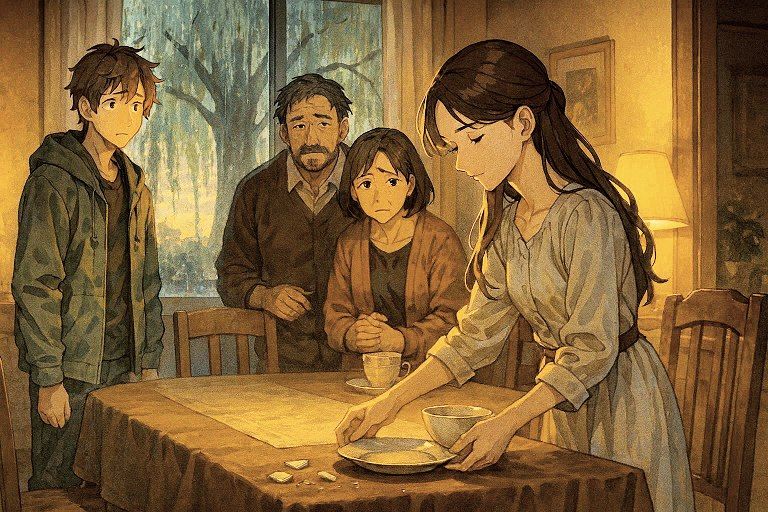
There was a decisive night the family didn’t forget. It was a winter evening, rain drumming on the panes and the willow bowing its branches over the garden. Clara, exhausted from days without recognition, held a cup of tea at the table’s edge when it slipped from her hands. The cup struck the floor and shattered. The sound was a clean cut in routine, like an instrument marking an unexpected measure.
Mateo was the first to look up, surprised.
“What happened?” he asked, with his usual urgency.
“It fell,” Clara said; her voice was small and contained, the fragility no one expected to see.
“Are you okay?” he asked, already standing, ready to help.
But the question arrived with the same surprise as an unexpected rescue: the family was not used to attending to the person who did not ask. The parents looked at each other in the kitchen, the article’s words still fresh in their memory.
“I always thought she would resist because she wanted to,” the father murmured, his voice broken by late honesty.
“And we didn’t see her,” replied the mother, in the crack of a guilt that didn’t know how to heal. “We assumed that being there was enough.”
That night Clara didn’t hide her tiredness. She went out to the yard, sat at the edge of the path, and looked at the willow. The branches moved in the wind, bending without breaking, and something in that image spoke to her of the way she held herself. Soon her father found her there, hands clasped and gaze fixed.
“Dad,” she said with a frankness different from before, “I want you to know how I feel. It’s not a complaint; it’s asking to be seen.”
Her father sat down, cleared his throat, and drew breath.
“I see you, Clara,” he said. “I didn’t know how to before. I’m sorry.”
Those words were both balm and seed. They didn’t fix the years or erase the scars, but they marked the start of a different path. From that moment small changes began to surface: calls that weren’t mechanical, questions that no longer assumed answers, afternoons spent listening without interrupting. It wasn’t uniform or immediate; there were setbacks and forgetfulness. But intention gained weight because it was now named.
Clara, for her part, learned to ask for help more clearly. Not because she wanted to offload burdens, but because she understood that her well-being could not depend solely on others’ goodwill. She began to delegate tasks, to say “no” sometimes, and to accept others’ silence without turning it into a verdict. There were days she felt guilty for doing so—the family culture echoed the lesson—but each act of asking for support returned her to a territory she had not previously explored.
Mateo also came to understand that his vulnerability had produced an asymmetry that granted him attention but may have unintentionally hurt his sister. He began to speak gratitude aloud, to tell Clara sincerely that her efforts were visible.
“Thanks for everything you do,” he said one afternoon, with a tone that had stopped being automatic.
“You don’t have to keep reminding me,” she replied with a softer smile. “But thank you.”
The parents aged with the burden of regret transformed into concrete actions: lunches dedicated to her, reminders to take breaks, small daily favors that weren’t grand but showed steady attention. The mother, in particular, began leaving notes in pockets and making tea at the hour she knew her daughter preferred. They weren’t trying to compensate for the past; they were trying to learn from the present.
Still, reconstruction was fragile. Silences persisted at some dinners, and the habit of assuming the one who holds always can continue to hold lurked like a ghost in stressful moments. But the difference was that now the habit could be named and corrected: when someone noticed Clara falling back into taking everything on, they interrupted with a gesture, a question, or a shared task.
The science that entered through the window one afternoon became more than statistics. It became a tool to warn and to open conversations that had been avoided. Technical words—anchor child, culture of silence—stopped being mere labels and turned into doors to empathy. Studies didn’t heal wounds, but they offered a map to avoid repeating paths.
Over the years there were also unanticipated moments of tenderness: a handwritten note left on Clara’s nightstand reading “thank you for being our calm,” an entire afternoon looking through old photos and naming memories, an impromptu hug from Mateo in the middle of the night. Those gestures didn’t erase anything but softened the edges of a shared life.
In the end, the willow house remained what it had always been: a place where days succeeded each other with joy and with cracks. The family learned that loving doesn’t mean giving the same to everyone, but giving each person what they need without forgetting any of them. Clara didn’t stop being who she was: capable, loving, and steady. But she also began to receive a light she had been denied out of inertia.
Repair wasn’t a grand gesture but patient work: recognizing the debt, asking for forgiveness, changing habits, sustaining new decisions with constancy. And so, over time, Clara’s shadow ceased to be the silhouette of someone who hid so others could shine; it became that of a woman who could allow herself to be seen.
In the last scene the family remembers clearly, the four of them sit in the garden. The willow stands with the simple dignity of one who has endured whole seasons. The father brings a blanket, the mother a box of cookies, Mateo tells anecdotes with his usual dramatics, and Clara laughs—for real. It’s not perfect happiness nor complete repair; it’s more like a truce that arises when a debt is acknowledged and care is redistributed.
“We had no idea,” the mother says softly. “But now we see you.”
“And now we have you,” the father adds, with the tenderness and firmness that now coexist.
Clara looks at her family and feels that part of that night will become a different kind of anchor: not one of obligation but of recognition. She knows there will still be missteps, but she also knows the house has learned to ask, to listen, and to hold in new ways. In the willow house, then, love begins to find better ways to reach those who need it, and Clara’s shadow stops being alone.
Source of the images.
Image created with Bing.
Short story: The Apron and the Little Lamp
The sun still held the last warmth in its hands when the boy closed his notebook with the same care with which promises are kept. It was not a theatrical gesture; it was a learned ritual. The backpack, damp partly from morning sweat and partly from the rain of a stolen nap, was set against a corner while he prepared to turn the same stretch of sidewalk into his double shift: classroom and stall, lesson and sale.
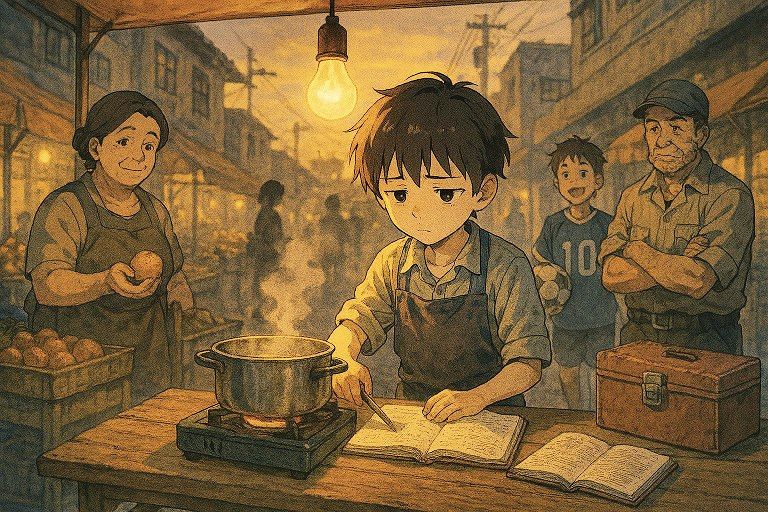
He set up his stand with the precision of someone repeating a practiced choreography. A plank propped on boxes, a pot that seemed to produce enough warmth for several families, an apron whose color had changed from use, and a hand-painted sign with clumsy but sincere strokes. Each object had its story: the apron stained with a sauce that never came out, the tin used as an improvised scale, a spoon with a worn handle that he considered his best tool. Nothing was superfluous; everything was essential.
The neighborhood was a mosaic of presences. Doña Marta, the fruit seller neighbor, passed by carrying bags that smelled of citrus and the daily market. Don Héctor, from the workshop, walked hunched with a screwdriver peeking from his pocket. Mrs. Rosario returned from school with an attentive look; Esteban dribbled the ball against worn walls, apparently oblivious to the weight behind the apron. The gazes with which these characters crossed the boy’s path were not all the same: some were full of compassion, others of indifference, and many of a tenderness they would not allow themselves to voice aloud.
During the afternoon he sold small portions of food and, with each sale, counted more than coins: he calculated whether the math workbook would hold out another month, how much a pack of pens would cost, whether there would be enough for a medical visit if someone at home fell ill. That accounting —which had the rigor of a school exercise— was what defined his immediate future. He repeated imperfect arithmetic formulas in his head like someone rehearsing lessons of hope: add to avoid loss, subtract to endure, multiply to grow.
The dialogues with the story’s secondary characters wove a larger existence.
“How much do I owe you today, little one?” Doña Marta asked one afternoon, leaning in as she usually did when buying fruit.
“Three coins, Doña Marta,” he answered calmly. “Thank you for the orange.”
She was not just a customer: she was an everyday angel who, between juices and conversations, offered small helps without fanfare.
“Save the orange for tomorrow,” she said, squeezing his hand. “Take two more coins. And don’t spend it all on soup; buy a notebook if needed.”
“Don’t use it all,” Mrs. Rosario added another time, checking a homework. Her usually contained voice cracked when she saw the simple handwriting. “Go over this at home. Do you have enough light to study?”
“The one I have is enough,” the boy replied, his eyes finding the little lamp hanging from an improvised post. “But if not, you’ll lend me one, right?”
“I’ll lend you whatever is needed,” the teacher answered. “I don’t want to see you give up.”
Don Héctor, with his gray-haired bearing and mechanic’s hands, sometimes came by to tighten the pot stand or drop a few coins into the tin.
“Here, kid,” he said one afternoon, letting some coins fall into the pot. “And if you need tools to fix something, tell me.”
“Thanks, Don Héctor,” he replied with a small nod. “I promise to bring the tools back clean.”
Esteban, the classmate who spent afternoons running, was evidence of a childhood that had time to play.
“We have training tomorrow,” Esteban announced one day, with the enthusiasm only football produces. “Come, so you can rest.”
“I can’t,” the boy answered. “I have a shift this afternoon. If I don’t work, there’s no money for books.”
“Right, I get it,” Esteban said, with a strange gesture for his age, a mix of pride and pity. “But don’t isolate yourself, okay? You need to play too.”
The boy’s routine continued when the street emptied. He turned off the pots, folded the apron, closed the day’s accounts, and with a mechanical gesture lit a little lamp that never seemed enough. Sitting on a battered bench, he studied in the dimness; the words printed in his notebooks competed with the fatigue weighing on his eyelids. The silence of the night was not empty: it was full of the breathing of those who sleep and the distant sounds of a city that never quite quiets.
His study hours, by the trembling light, were a display of will. The questions he solved in the notebooks had a double purpose: the grade at school and the possibility of dreaming of a different life. Sometimes he whispered sums and definitions so they would stick. Other times he wrote long sentences, patiently correcting mistakes that for others would be trivial. Before closing the notebook he reviewed what he had learned as someone securing a foundation: “If I learn, maybe I can change the course.” That phrase, more than a thought, was a promise upheld.
The scene was immortalized by a passerby who, as a witness, took a photo: the apron hanging, the little lamp, the boy bent over his notebooks. The image began its journey through social networks, multiplying across screens of different sizes, capturing gazes and provoking reactions. Comments ranged between sincere admiration, outrage at inequality, and the comfortable distance of those who viewed everything with a swipe of the finger.
The virality generated —as often happens— a whirlwind of intentions. Donations, messages of support, promises of help arrived, and with them a wave of new eyes on the same scene the boy had lived naturally for years. It was the same routine, but now his daily acts became news. Some people came ready to change his life: organizations offered scholarships; neighbors gathered books and supplies; strangers sent money. The boy’s phone, previously absent, filled with notifications he struggled to understand.
Despite the public commotion, his way of being did not undergo an abrupt transformation. He continued to put the pot on the fire and close each sale with care; he did not forget his school duties. The change was subtle and essential: for the first time, he was not so alone. Doña Marta began bringing fruits to sell and kept part of the money for books; Don Héctor improved his lamp and fixed a bench; Mrs. Rosario bought him a new backpack and colored pencils; Esteban, in the sincerity of a friend, lent him his football jersey for special occasions, as if that gesture said childhood could coexist with responsibility.
There were nights of praise and others of shared silence. One evening, after the street went dark and the last customers had left, Doña Marta sat beside him and looked at the small hands that an hour earlier had served soup to strangers.
“Do you think this changes anything?” she asked, pointing to the photo that had already circulated through many hands.
“I don’t know,” the boy answered honestly. “If people help, maybe. But I stay the same if they don’t.”
“Then I’ll help you,” she said, her voice trembling barely. “Tomorrow I’ll leave fruit to sell and I’ll save part for you. Don’t do it for me.”
“Thank you,” he whispered. “I don’t want them to look at me like I’m different.”
The teacher, seeing that the boy did not abandon his studies despite the burden, decided to accompany him more discreetly. She corrected his exercises more patiently, gave him assignments that motivated him, and quietly arranged for the school to seek support programs. Her gestures were not showy; they were those of someone who knows children’s daily lives and understands that effective help is often the unostentatious kind.
Daily life continued with new shades: donations that arrived and were managed cautiously, promises fulfilled and others lost in the whirlwind, looks that applauded for a day and looks that endured. He learned to receive help without feeling that he lost dignity.
He accepted the new backpack, the colored pencils, the brighter lamp, but he kept selling at the same pace, because the continuity of his commitment did not depend solely on what others gave but on what he had decided to sustain.
In the corner where he had studied so many nights, the little lamp no longer flickered with the same desperation. The words in his notebooks began to fill with better-worked solutions, less shaky handwriting, and questions met with firmer answers. Every completed exercise was a small triumph. Every night he closed a notebook knowing he had given his best was a reaffirmation that his resilience was not a spectacle for networks but a pact with himself.
The community, for its part, learned to look beyond the viral image. It understood that resilience is not measured in likes or comments; it is measured in the consistency of someone who keeps going, in the dignity of someone who asks for what is fair, and in the responsibility of those who can support without intruding. There were debates, reflections, and actions: workshops for youth, school support programs and, above all, a more sincere recognition of the multiple forms of childhood that coexist in the same city.
Over time, the boy’s story ceased to be just a viral photo and began to become part of broader narratives: school projects aimed at supporting vulnerable students, neighbors who coordinated an emergency fund, small businesses that hired young people to balance work and school more equitably. Nothing was perfect, but the social fabric became a little stronger.
Night after night, between pots and notebooks, coins and exercises, the boy continued building his biography through humble gestures: getting up early, going to school, setting up the stall, attending with care, lighting the little lamp and studying until his eyes wanted to close. He did not ask for applause. He let routine, that severe and patient teacher, be his only judge. His strength needed no audience because it showed itself in everyday acts: choosing study when the body asked for rest, meeting a teacher’s steady gaze, accepting a hand when it was sincere.
There were moments when fatigue grew deep and doubt knocked at his door. Old questions returned with a new voice: Is all this effort worth it? Will things change? In those moments, the memory of those who supported him —Doña Marta’s hand, Mrs. Rosario’s counsel, Don Héctor’s repair, Esteban’s lent jersey— was a discreet support. He understood that resilience is not solitary: it has the backing of community, even if that backing sometimes arrives silently.
His story, which began under the dim glow of a little lamp, began to illuminate other corners. Not because of fame, but because of the silent example of a life that chose to keep studying against the logic of fatigue. The city learned, in its own way, to look differently: to value what is unseen, to recognize that true courage does not demand applause, and to support those who work for a future that has not yet arrived.
In the end, when the apron hanging gently swayed in the dawn wind and the notebooks rested beneath a lamp that no longer flickered, the boy closed his eyes with the certainty of someone who had done all he could. He knew there were no guarantees, but he had done the most important thing: he had not given up on education, he had not given up on hope. That constancy, woven between pots and letters, between neighbors and teachers, was the real victory: a resilience that needs no headlines, only perseverance, care, and the commitment of a community that learned not to look the other way.
Source of the images.
Image created with Bing.
Short story: The City of Layers: The Twelve-Year-Old Inventor
The printer arrived on an afternoon when the city seemed to hold its breath. Mateo opened the box with trembling hands and, for a moment, the dining room transformed into a ship’s bridge: the plastic casing gleamed under the neon light filtering through the window, and the manual—pages of diagrams and warnings—seemed to promise maps to unknown territories. Twelve years old, a notebook, a few saved coins, and the contained determination of someone who has decided to turn curiosity into action; that was enough to ignite the first spark of a project that, without him knowing it yet, would stir the network of his neighborhood.
Elena, his mother, stayed close without intruding, watching with the erratic mix of pride and fear that accompanies those who see their children embark on uncertain ventures. She remembered the afternoon of the tech event where it all began: a public demonstration, objects emerging layer by layer like artifacts born from a luminous core. “I remember his eyes lighting up when the machine finished the first figure,” she would tell anyone who would listen, as if explaining the origin of a vocation. The city—a metropolis of solar-paneled façades and avenues where delivery drones circulated—offered a landscape that fed the imagination of a young boy with a taste for mechanisms and puzzles.
Don Luis was the first practical ally. Retired, a former engineer at an orbital assembly plant, he lived two doors down and spent his afternoons on a bench in the plaza, his body wrinkled by years but his mind sharpened by decades of solutions. Seeing the printer on the dining table, he returned with a tool case and old stories about impossible calibrations and parts saved by a millimeter.
“If you need a hand understanding those programs, I’m here,” he offered, and his words sounded weightier than any instruction in the manual.
Mateo soon turned the dining table into his workshop: a lamp, an order ledger, rolls of filament in basic colors, and a corner for waste and failed prints. His first prints were, to put it mildly, uncooperative. Layers misaligned; edges rippled like weather maps; the filament sometimes tangled as if it had a will of its own. For every failure he responded with methodical tests: he adjusted temperature, varied speed, changed the support angle. He learned that in that machine patience and meticulousness replaced the impulse to press the button again and again.
Orders arrived first as neighborhood favors. Rosa, the pastry chef, asked for a cookie-decorating mold; the stationery shop needed a small part for an old printer; Camila, his school friend, needed a perfect gear for her science model. Camila, obsessed with puzzles and logic, acted as a strict critic and faithful collaborator. If Mateo was the builder, she was the one who tested parts under demanding conditions.
“If it doesn’t fit, the whole project collapses,” Camila warned him the first time she entrusted him with a prototype.
“I’ll do it,” Mateo replied, eyes fixed on the screen showing the print’s progress.
Each order was a lesson: Rosa’s mold taught him about textures and how to prevent dough from sticking; Camila’s gear demanded millimetric tolerances; the stationery piece forced him to think about durability over aesthetics. With each success his confidence grew, and with each mistake his curiosity became more precise. He soon began documenting his trials: a sheet with variables—temperature, speed, filament type—and results. Don Luis, who had promoted the habit of record-keeping, celebrated the shift from anecdotal trial to methodology.
Mr. Vargas, a teacher devoted to bridging theory and practice, quickly noticed Mateo’s talent and publicly challenged him: design a prototype of a folding bridge for the end-of-course fair. It was a test combining structural physics and functional aesthetics, a perfect challenge to apply the young boy’s emerging skills.
The bridge’s first iterations seemed destined for fragility: internal walls buckled under load; the hinge didn’t flex with the required smoothness. Mateo felt, at times, overwhelmed. One afternoon, defeated, he buried his face in his hands and said softly:
“I can’t do this, the pieces keep falling apart.”
Don Luis replied with the calm of someone who has watched entire processes be rebuilt: “Remember when you start to feel like you can’t. That means you’re close to learning something new. Try again, step by step.”
It was the guidance he needed. He rechecked measurements, increased wall density, redesigned the hinge points, and experimented with stronger filaments. Between tests, failures, and new attempts, he achieved a version that not only held up under load but did so gracefully: the bridge unfolded its spans like mechanical origami and supported, without giving in, the weight of books that simulated real-world pressure.
The fair’s success was a turning point. The innovation mention—a modest but heartfelt recognition—opened doors: larger orders, interest from other schools in his process, and opportunities to collaborate on community projects. His table, once an improvised workshop, began to receive visitors: classmates seeking solutions for prototypes, the stationery owner with recurring orders, and the neighborhood tech club coordinator interested in workshops for kids.
The support network consolidated into a living cooperation of care and practice. Elena, beyond domestic logistics, became the unofficial manager: she helped organize orders, monitored deadlines, and mediated with clients. Sofía, his younger sister, contributed ideas with the carefree creativity of someone who hasn’t yet learned to constrain imagination: “What if we make glow-in-the-dark pieces?” she suggested one afternoon, and the idea turned into a set of nocturnal keychains that sold well at the neighborhood night fair. Camila helped improve the project’s image: she learned to photograph pieces with neutral backgrounds, to choose angles that highlighted structures and details, and to present the work as a small collection of functional art.
The project’s economics were a lesson in themselves. Mateo had to calculate prices to cover materials and time, negotiate deadlines, and balance quality with demand. He learned to say no to impossible turnaround requests, propose alternatives when the design wasn’t feasible, and remain honest with clients who didn’t understand the technical limits. The transactions didn’t just yield money; they taught responsibility and how a community can sustain a young creator.
In one order, a test produced an unexpected discovery. A part came out with a slight imperfection: an asymmetry in a protrusion. While Mateo considered it defective, Camila looked at it differently.
“It has character,” she said. “We could sell it as a limited edition.”
That observation became a commercial idea: small series of pieces with unique variations, tied to an aesthetic where chance was celebrated as a hallmark. It was another lesson: creativity finds opportunity even in mistakes.
Over time, Mateo’s workshop gained a reputation for efficient solutions and the ability to turn everyday problems into functional parts. He designed educational toys for the school, small prosthetics for biology projects, and replacement pieces for the neighborhood library. Some orders came from beyond the block: a local organization requested printed supports for a vertical garden project; an architecture student asked for scale models for a thesis.
Nighttime printing, however, never lost its toughness. There were moments when frustration weighed heavily: a print canceled midway, filament jammed when the week was full of orders, the constant whir of the machine mixing with fleeting sleep. But in persistence Mateo found his identity: not only as a maker of objects but as a craftsman of processes. The habit of recording variables, the discipline of calibration, and the ability to communicate with clients became his hallmark.
The process also changed how the community viewed technology. Don Luis, who’d once worked in high-tech environments, was moved to see a new generation reuse accessible tools to solve local needs. Elena, for her part, saw in her son a possibility for responsible autonomy; her pride turned into action: she accompanied Mateo to the neighborhood fair, handled payments, and sometimes explained to neighbors the origin of the pieces with a mix of maternal pride and technical admiration.
Meanwhile, the city kept its beat of lights and shadows. Solar-paneled façades and drone routes didn’t erase the human faces needing practical solutions. Mateo positioned himself in that flow as someone able to transform small requests into useful products, and his project—born of childish curiosity—began to have social impact: improving access to affordable spare parts, helping students prototype ideas, and showing that local manufacturing had a place in a city seemingly dominated by tech giants.
A highlight in his journey came when a small NGO dedicated to STEM education invited him to run a workshop for children. Mateo, nervous and proud, accepted. He prepared simple exercises: design a meaningful word on a keychain, calibrate the printer together, and display the pieces. Watching other children experience the sensation of seeing an object arise from an idea multiplied his original joy. It was also an act of knowledge circulation: the spark that had ignited him became a flame that could light others.
Years later, in his memory, the printer would still sound like an engine of small but decisive changes. The notebook of notes—which began as a careless pad—filled with strategies, contacts, and sketches. The faces who had accompanied him—Elena, Don Luis, Camila, Sofía, Mr. Vargas—formed a small crew that, with different skills, allowed him to navigate the challenges of starting a venture while still a child.
When the school fair awarded him an innovation mention for his folding bridge, Mateo climbed the stage with filament-stained hands and the satisfaction of someone who had realized an idea. The ovation, his mother’s gaze, Don Luis’s smile, Camila’s thumbs-up, and Sofía’s spontaneous hug formed a living portrait: proof that dreams have no age, only the courage to begin.
The City of Layers kept its pulse. On a table, next to a cup with glue residue and a stack of filaments, the printer continued its monotonous song of stacked strata. Each object produced was, besides a solution, a piece of a larger story: the tale of a boy who learned to translate curiosity into craft, who understood the responsibility of making, and who, with patience and community, turned a spark into a project that benefited his neighborhood. Beyond awards or sales, the true achievement was the learning: the certainty that entrepreneurship is a practice that, like 3D printing, is built layer by layer.
Source of the images.
Image created with Bing.
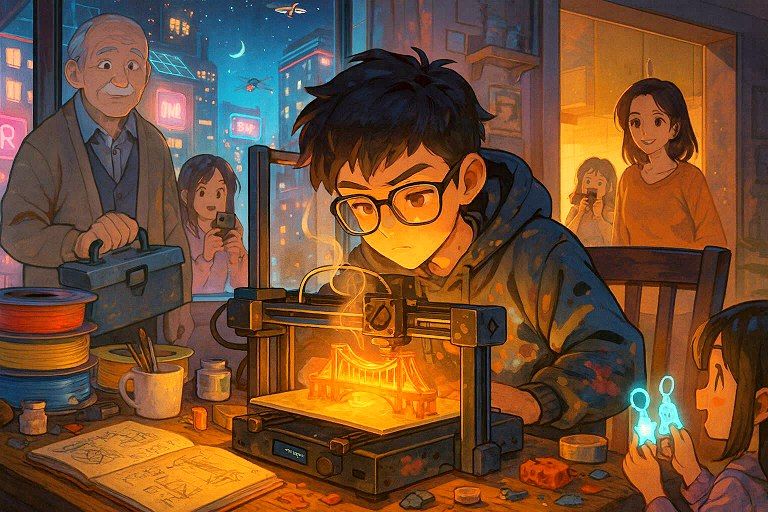
Short story: Snow, Taxis, and Hot Chocolate: A New York Adventure
The city woke wrapped in a snowy calm that altered New York’s familiar contours into a palette of whites and grays. What had begun as a whisper of flakes on Saturday night had turned, by Sunday morning, into a steady curtain covering balconies, awnings, and lampposts. It was the season’s first significant snowfall: a blanket that, though modest in depth downtown—about 2.6 inches (roughly 7 cm)—managed to transform the urban landscape and the moods of its inhabitants.
María, a nurse at the municipal hospital, left her building with the efficiency of someone who organizes shifts: scarf tightly knotted, gloves tucked into a pocket, and a thermos she relied on for long shifts. To her, the snowfall was a practical factor, not a postcard: it meant more slip-and-fall patients on sidewalks, transit delays, and a different flow of emergencies. Still, the prevailing whiteness stirred an odd tenderness in her chest, a brief pause before the daily urgency reclaimed her attention.
Ethan, a taxi driver for years, had learned to find in situations like this the raw material of his trade: stories, forced smiles, and grateful customers thankful for a safe ride. That morning he climbed behind the wheel with a dose of defensive optimism. The taxi radio carried the National Weather Service’s voice, reporting that precipitation would ease by the afternoon, though temperatures would remain low enough for black ice to form. Ethan listened, but preferred looking out the windshield: the snow-covered city offered a different stage for his usual anecdotes, and he was already sharpening a few lines for passengers.
Meanwhile, at the Sanitation Department, Samir and his crew were at work since the night before. Their salt truck was part municipal tool, part emblem of resistance: flashing lights, chains, and the feeling that if anyone had to fight the snow so the city could keep moving, it was them. They had been spreading salt since Friday, prioritizing routes to the hospital, the main station, and key commercial arteries. On the truck radio, Samir repeated the same directive in a serious tone laced with humor: “There’s no route we can’t handle. Today we’re the unsung heroes of the pavement.”
In the outskirts and across the Hudson in New Jersey, the snowfall was more generous: accumulations of up to 6 inches (over 15 cm) were expected. There the streets looked more wintry and maneuvers were tougher; cars became makeshift sleds and families unaccustomed to heavy snow organized among neighbors to clear driveways and share salt. The difference in accumulation sketched the city in two registers: downtown, with a discreet but visible covering, and the periphery, with a thicker white that demanded different management plans.
Lina, a university student and amateur photographer, seized the opportunity like someone spotting a perfect event to practice her eye. With a camera around her neck and the edges of her jacket damp, she wandered streets seeking frames: the geometry of snow-topped roofs, pedestrian footprints forming crossing lines on sidewalks, the light filtering between clouds and buildings. For Lina, the snowfall was an excuse to look at the city closely. She entered the neighborhood café run by Doña Rosa, renowned for her hot chocolate and her ability to remember regular orders without writing them down.
The café was a refuge: a warm, fragrant space where neighbors gathered to talk about the weather’s unfolding. Doña Rosa, apron pocket full of stories, served hot chocolates with the gravity of someone offering a homemade remedy. Her shop filled with hushed conversations, restrained laughter, and the clink of spoons against cups. For many, it was the neighborhood’s emotional service station, where conversation helped coordinate practical assistance—who had an extra shovel, who could help an elderly neighbor—and turned a weather challenge into a community effort.
The morning unfolded with scenes that mixed the ordinary and the unexpected. Ethan picked up María on a side street near the hospital; she climbed in with the determination of someone who had no time to waste, and between the engine hum and the windshield wipers they exchanged a brief but meaningful chat. Ethan, in his usual joking tone, offered a lift and teased about doing “tricks” with the wheel. María, prioritizing duty, asked him not to perform any “tricks”—safety over spectacle—and before getting out she urged him to help anyone who seemed lost. That small exchange captured the web of minor responsibilities that keep a city going on a snowy day: drivers offering help, healthcare workers asking for caution, neighbors looking out for one another.
Samir and his crew worked without pause, adjusting salt amounts, timing runs, and focusing on priority areas. The logistics weren’t only technical: there was a human element in their choices—a street with many elderly residents, access to a dialysis center, the school route that needed to remain passable. When Samir took a coffee break, the cold had reddened his face like a badge of sacrifice; still, he saw the work plainly and honestly: if they kept the main routes clear, everything else had a better chance of carrying on. His coworker joked about ending the day as an ice sculpture, but the laughter didn’t slow the effort.
In other northeastern cities like Boston and Philadelphia, snow also worked its pictorial magic, and reports indicated that precipitation would taper off by the afternoon as forecast, leaving cold temperatures that favored black ice. Authorities repeated their advice: exercise caution while driving, take small steps on foot, and avoid sudden movements in untreated areas. Those warnings prompted communities and services to stay alert.
Inside the café, scenes multiplied: two children debated whether snowmen should wear hats or scarves; an elderly man held his cup with both hands as if striking a truce with winter; a couple looked at each other with the curiosity that a transformed city awakens and, for a moment, seemed to invite them to put off decisions and stroll the streets slowly. Lina, with her camera, hunted these moments: the complicity of a couple, an old patron’s weathered smile, Doña Rosa’s gestures as she served a piece of cake on the house. Each photo was a small visual chronicle of how the city adapted.
Stories crossed naturally. At noon Lina left the café with a steaming cup and ran into Samir, who had just finished treating a nearby street. She offered him the hot chocolate in a gesture of thanks; he accepted with a mix of surprise and pride. A light conversation followed: Lina offered to take his picture to immortalize his work, and Samir, cautious, agreed on the condition that online credit not strip him of his quiet-hero reputation. The exchange marked the kind of community formed around a storm: simple acts that lighten others’ loads.
Meanwhile, Ethan told a colleague about an episode from his shift while waiting for a new fare: passengers confusing fogged windows with solid glass, a tourist asking for photos from inside the cab, parents requesting short rides to keep their children out of the cold. His anecdote book swelled, and he seasoned each tale with humor so the morning wouldn’t feel heavier than necessary.
María moved through her shift with the usual blend of professionalism and fatigue that emergency wards accumulate. Between patient checks, calls, and coordinating with hospital maintenance to keep entrances clear, she also had tender moments: spontaneous gratitude from family members, a nurse leaving a coffee by her locker with a note, and the view from a corridor window of a city softening its loud edges under white—an image that briefly eased the harder lines of her work. For her, the snowfall became a backdrop that, at times, softened the harshness of her tasks.
The National Weather Service did its part: precipitation tapered off in the afternoon as forecast, but cold temperatures remained. That combination turned late-afternoon shadows and damp sidewalks into potential ice traps. Local authorities reiterated precautions, the municipality scheduled extra runs for critical routes, and neighborhood volunteers offered shovels to clear access to homes of elderly residents.
Doña Rosa locked the café’s door reflecting on the day’s scenes: customers sharing stories, the young man who left an extra tip, the older woman who gifted a string of garlic in thanks for keeping the door warm. She closed the shutters knowing she had offered more than hot drinks: she had been a meeting point, a coordination hub, and for some, a place to regain spirits. Before turning off the lights, she soaked a few cups and carefully stowed the chocolate pot as if guarding a recipe not fully revealed.
As night fell and the last light of day mingled with streetlamps, the characters returned to their routines with a shared sense: the city had weathered the season’s first big snow without collapse, thanks to small, shared efforts. Ethan scribbled a new anecdote into his notebook; Lina selected a folder of the day’s best photos; Samir checked his truck and, with his work clothes still damp, thought of his family; María, on a brief rest, gazed out the staff room window and took a deep breath, grateful for the lull after the bustle.
The snowfall, which had altered the city’s rhythm and scenery, left a trail of comic and touching scenes: near-misses turned into laughs, improvised conversations that solved practical problems, and anonymous gestures aligned to sustain mobility and morale. It was, in short, a day of comedy and adventure where the snow played the lead and the neighborhood proved an ensemble ready to improvise.
At the end of the day, Doña Rosa locked up and murmured to herself, “Today the city was covered, but it did not darken.” Ethan drove home carefully, humming a song he’d half-invented on the radio, while Lina mentally chose the filter for the best shot. Samir stowed his tools in the municipal depot and allowed himself one last sip of hot coffee before heading home. María, done with her shift, walked slowly for a stretch, savoring the reflections on the rooftops and thinking about the season ahead—with the quiet confidence of someone who knows that, under any blanket of snow, the city will always find a way to remain a community.
Source of the images.
Image created with Bing.
Short story: Night of Meeting
I
The republic of Novaya stretched like a line between steppe and horizon, cities that sparkled at night and villages where cold made voices heavier. Official figures, printed on emotionless paper, burned in offices: birth rates had plummeted, censuses forecasted an aging nation, and the hope that a young generation could sustain the next vanished like morning mist. Facing that void, seats of power sought quick, visible answers—measures that would read well in headlines and convey urgency.
In marble chambers the state delegation debated without rest. Drastic proposals emerged: cutting electricity and internet from 10:00 p.m. to 2:00 a.m., arguing screens distracted young couples; the creation of a Ministry of Sexuality, later renamed the Ministry of the Encounter, and finally the Agency for Family Support; subsidies for first dates, state-paid wedding nights, and monthly payments to mothers who chose full-time domestic caregiving. Announcements were presented solemnly with graphs and curated testimonies meant to show hope in numbers. In the first half of the previous year there had been only 599,600 births—the lowest since 1999. For many in power, policy had to be manifest and immediate.
II
Lena lived in a neighborhood of low houses whose windows held the fog of long winters. Her life moved in simple rhythms: by day she taught children to read and write; in the afternoons she ran music workshops at school; at night, when the apartment cooled, she sewed cloths for the daycare and let her heart sigh for something she barely dared name. She was patient and pragmatic, with a tenderness she did not always permit herself to show in front of her own fears.
Alexei worked in the municipal workshop: grease on his hands, a reserved smile, eyes that sometimes filled when he repaired something as if discovering a promise in every motor. She met him by chance when a child’s bicycle tire went flat in front of the school and he improvised a repair with the competence of someone who knows how to care. Their early conversations were awkward—small jokes, the sense of recognizing two lonelinesses that might, perhaps, sustain one another.
In the town square, where Boris still told stories about winters when the community gathered around a fire, Darya presented the Agency’s new program: enroll couples to receive funding for a first date, wedding bonuses, and pilot domestic-support programs. The proposal was wrapped in promises: invite couples into encounters that, theoretically, could lead to commitment and, eventually, children.
“This will be an opportunity,” Darya said aloud from an improvised podium, looking at the crowd. “We do not impose paths; we open bridges for those who want to cross them.”
III
Politics presented itself as a quick medicine; society responded unevenly. In more conservative neighborhoods the measures were received with relief: grandparents who feared demographic silence saw in the initiatives a will to uphold tradition. In larger urban centers students, academics, and professionals organized forums and protests: to them the proposals smelled of coercion, a way to instrumentalize people’s intimate lives for demographic ends.
Marina became the public voice of critical opposition. A researcher, an organizer, tireless—she insisted at every assembly that pushing for manufactured encounters would not suffice without addressing the material conditions that make conception and childrearing possible. Her interventions were grave and precise: adequate public daycare, generous and paid parental leave, affordable housing, and jobs with humane hours. For Marina, fertility was not merely a matter of emotional incentives but of social architecture.
“Do not ask us to give up our lives to become parents,” she demanded one night at a rally. “If you want children, create the conditions to raise them. Don’t buy them with a hotel night.”
IV
Lena and Alexei accepted funding for a first date with a mixture of shame and relief. It wasn’t only the subsidy that nudged them; more than that it was the permission implicit in the gesture: a space the state offered, yes, but also a chance to meet without the usual noise. The dinner moved with the slowness of cautious beginnings: both stumbled through silences and exchanged childhood stories, fears, and dreams.
“What is your greatest fear?” Lena asked, holding her teacup with slightly nervous hands.
“That life will run over me,” Alexei replied with a sad smile. “And that I won’t have time to see it when it passes.”
That night, between laughter and pauses, something neither expected took hold: not a miracle, but the sense of facing someone who could accompany everyday uncertainties.
V
The Agency also promoted state-paid wedding nights. Nikolai, owner of the hotel designated by official programs, saw reservations climb and a new current of nervous, bright-eyed couples checked in. Some stories that emerged from those halls were genuine: love that had needed a small nudge to become a commitment. Others exposed the measure’s fragility: couples who, after their subsidized night, returned to impossible rents, insufficient wages, and workdays that devoured any time left for raising children.
The state delegation did not stop at incentives. They intensified digital control through the Protected Net framework: domestic platforms, filters, and, in pilot areas, scheduled internet and power blackouts. The official argument insisted that fewer screens and more real encounters could rekindle interest in family formation. Nighttime blackouts were justified as a temporary “recovery of the night.”
VI
When the first blackouts were implemented responses were immediate and varied. In Lena’s neighborhood the first night of outage left the air tense: cafés closed at ten, screens stopped blinking, neighbors lit candles. On the building’s stairwell people gathered due to the strangeness of new quiet. One neighbor brought a thermos of tea; another an out-of-tune guitar; someone began telling stories that the internet used to erase in seconds.
“This is lovely,” a neighbor whispered to Lena. “Like old times.”
“But it’s invasive,” Lena replied softly. “I worry about being told how to spend the night.”
In major cities reaction grew louder. Protests and televised debates revealed the polarization: some saw the measures as ways to rescue coexistence; others denounced an attempt by the state to regulate affections and bodies. Groups advocating the choice to remain childfree found themselves under scrutiny: new restrictions on “promotion” of that lifestyle were proposed, censored, or even criminalized in some instances. The debate acquired intense moral heat.
VII
Marina organized a broad coalition: unionists, economists, working mothers, and young intellectuals. Their meetings were idea bonfires; they debated turning measures into sustainable structures—full-day daycare, housing subsidies, flexible working hours, shared parental leave, and wages that would prevent precarious parenting. In the Agency’s corridors Marina became impossible to ignore.
Darya, meanwhile, began receiving a range of representatives in her office: part-time mothers, economists with models, activists demanding protection of personal freedoms. Darya, who had entered the post convinced that urgent public interventions were necessary, began to see the complexity behind each statistic. In one meeting she looked at Marina and said, with a fatigue newly apparent:
“I did not create these policies to hurt.”
“Then listen,” Marina replied. “They hurt when they ignore material conditions.”
The tension between them gradually transformed into a cautious dialogue; differences did not vanish, but channels opened. Darya agreed to review some policies and to fund pilot daycare and housing projects in vulnerable districts.
VIII
Change came by fits and starts. Under public pressure the Agency rebranded its mission: from Ministry of the Encounter to Agency for Family Support, explicitly incorporating civil-society actors in decision-making. Subsidized daycares appeared in selected neighborhoods; parental leave policies became more flexible with paid maternity and paternity; priority access to housing for young families was designed through subsidies and soft loans. Night blackouts, once a shock measure, were limited to controlled trials and certain pilot weekends; access to emergency services and medical information was guaranteed without interruption.
Transformations were neither uniform nor instantaneous. In some districts, the arrival of subsidized daycare and more accessible housing allowed young couples to decide to have children without the torment of missing support networks. In others, economic precarity, unstable employment, and eroded real wages continued to constrain family formation.
IX
Lena and Alexei navigated these changes with the courage and vulnerability of those who build life slowly. Irina was born on a rainy morning: a tiny being who filled the modest apartment with light. The subsidy that had helped fund their first date was a symbolic push, but what made it possible for them to raise her were local networks: Sofia organized daycare shifts; Boris took her on afternoon walks and told her stories; neighbors brought meals and company when fatigue weighed heavy on the young couple. Alexei adjusted workshop hours to be home some afternoons; Lena used the new subsidized daycare to return to the classroom without fearing her daughter would be neglected. State support, when it arrived as structures—not mere incentives—functioned like scaffolding that allowed life to continue.
“Watching her sleep,” Alexei murmured one night, holding Lena’s hand while Irina breathed in her crib, “I feel like it was worth everything.”
“It’s not just our merit,” Lena replied. “So many people hold her. That gives me both fear and relief.”
X
While stories of success began to circulate, public disputes did not vanish. The criminalization of “childfree propaganda” provoked heated debate: defenders of free expression and personal rights denounced censorship, while conservative sectors celebrated the move as defense of a national project. Media multiplied testimonies: couples who thanked the aids, families who criticized their insufficiency, professionals demanding more structural policies. The blackouts, though limited, left a symbolic scar: a feeling that the state could enter the bedroom and shape the form of intimate time.
Marina continued to watch closely. She presented reports, organized citizen audits, and pushed for monitoring that also served as public education on reproductive rights. Combining passion and data, her campaigning helped push deeper reforms: the Agency incorporated policy experts, funded social-research programs, and opened dialogue lines with unions and universities.
XI
In practice, numbers began to move—but modestly. Some regions recorded slight upticks in births; others remained flat or declined. Experts emphasized a clear point: the decision to have children does not simply respond to a one-off incentive.
It depends on living conditions, certainties about the future, the ability to reconcile work and care, economic security, and a culture of support. Policies that sought merely to incentivize encounters did not change the substrate that sustains fertility.
In the central square, where Boris continued to gather children and neighbors for his stories, everyday life went on with its mix of beauty and hardship. On a spring afternoon, as golden light fell on benches, Lena laid Irina in Sofia’s arms and walked toward Alexei.
“Do you remember when the night seemed like a promise?” she asked.
“Yes,” he answered. “Now the night feels more like responsibility. And a caress.”
They smiled, and that simple exchange carried the lessons of recent months: that love and the decision to form a family are intimate acts that also need public and community support to endure.
XII
Darya and Marina kept working—each in her own way—refining public machinery. The Agency shifted from offering handouts to financing integrated policies: maternity centers with psychological care, staffed daycares, job training programs for mothers, and tax benefits tied to housing and shared working hours. Darya publicly admitted errors; Marina acknowledged some policies had positive impacts. That political humility—the admission that public policy is not a single decree but a collective construction—was perceived by citizens as hopeful.
Still, the process had costs. The temptation to measure everything in rates and percentages persisted. Some sectors demanded harsher measures; others asked for withdrawal and remedies for intrusive policies. The lesson became clear: politics that attempts to shape intimacy must be extremely cautious and always subject to public oversight.
XIII
Time proved both harsh judge and gentle healer. Years after the initial measures, Novaya’s narrative had thickened: it was no longer just a shock experiment but a field of continuous reform and adjustment. Where there had once been blackouts and bans, social agreements and support structures emerged. Birth rates showed modest rebounds in districts with comprehensive policies; in others recovery stalled. Experts reiterated the same truth: fertility cannot be manufactured; it can be enabled.
On a warm night in the square, without imposed blackouts, the city breathed easier. Boris, with less hair and more stories, played a slow tune that evoked distant seas. Older couples recalled their beginnings; young people made plans with new data and a different caution. Lena and Alexei danced slowly, Irina asleep in their arms, surrounded by neighbors who had gradually learned to support one another.
Marina watched from a nearby bench with a mix of relief and wariness.
“Nothing is guaranteed,” she murmured. “But we can make the attempt worthwhile.”
Darya, who had witnessed the whole process from her Agency office, wrote in her notebook: “Policy that accompanies takes root; policy that imposes tears.” It became a line she repeated in seminars, a justification for change: fewer decrees, more networks.
XIV
The small everyday choices were what truly made a difference: parents who requested reduced hours and received them; companies that adopted flexible schedules; communities that opened municipal daycare centers; neighbors who reactivated informal care networks. Isolated incentives—a hotel night, a subsidized dinner—ceased to be central and became symbolic complements to deeper policies.
But the story was not an unconditional happy ending. There were losses: districts where nothing changed, families still lacking material conditions, debates that flared with each economic crisis. Novaya’s narrative remained split between real progress and reminders of what remained unfinished.
XV (conclusion)
The final scene hung in the square, where the city breathed with calm and vigilance. Beneath the streetlamps that no longer went dark by decree, hands clasped around strollers and cups of tea. Boris, voice thinner but still filled with tenderness, recited another tale about waves returning to the shore.
No one in that moment asked for grand solutions: the simple certainty that if something failed there would be neighbors to reach out their hands sufficed.
Lena looked at Irina sleeping and thought of the years ahead: homework, fevered nights, first words. Alexei squeezed her hand with the steady grip that only comes from the habit of being present. Marina, seated not far off, closed her eyes for a moment and breathed, aware that her work—watching, demanding, proposing—was far from over. Darya wrote in her notebook, not for the headlines but for the long work of real change.
When the music stopped, a silence fell that was not empty but woven: the sum of small fulfilled promises and pending commitments. The republic of Novaya had learned—through conflict and tenderness—that demographics are not fixed by isolated gestures or imposed blackouts, but by policies that accompany real lives. It had also learned that intimacy deserves respect, and that supportive politics can take root.
The night gave way to a mild dawn. Squares resumed routines, schools returned to their classes, workshops revved back to life. In the shared memory remained the conviction that bringing a life into the world is always a pact: between a state that chooses to support prudently, a community that offers care, and people who, despite everything, choose to love and raise children. In that imperfect, constant alliance, Novaya continued to write its story—one life at a time.
Source of the images.
Image created with Bing.

Short story: Echos in the Stained Glass
In San Aurelio, the churches emptied with the slowness of a tide that never announces a storm. The pews, witnesses of litanies and silences, kept a sharp patience; the stained glass filtered a light that seemed to hold memories. The city asked itself, without an easy answer, how to sustain faith when bodies no longer filled the benches and presence shifted toward small screens that glowed at night.
Father Mateo walked through the rectory with the cadence of someone who had survived many seasons. His hands, used to turning pages and blessing heads, flipped through digital proposals wrapped in charts and promises of reach. He did not speak loudly: prudence and fatigue helped him like a habit.
Mateo, in a low voice to himself: “We have lost seats, not stories. But stories need ears, not algorithms.”
Elena, the pastoral coordinator, came in with a folder full of names and faces. Her expression belonged to someone who knew the loneliness of those who call for help and receive silence. She walked to the table and set the folder down gently.
Elena: “Father, people need to feel accompanied. If technology brings them closer, let it serve to call someone. Not to replace the visit. Not to turn the Word into a programmed message.”
Mateo looked at her and recognized in her the urgency of the immediate: hands seeking hands.
Sofía arrived like a cool, precise light: a young developer, a believer, her eyes used to the glow of screens. Her hands spoke in keystrokes and diagrams; she brought “Palabra Amiga,” a promise wrapped in code. She explained, seated, with the calm of someone who knows shortcuts and technical frameworks.
Sofía: “The app can send personalized readings depending on the user’s situation, remind them of gatherings, and keep a 24/7 chat. It can recognize signs of distress and route them to a volunteer. It does not intend to substitute, but to expand pastoral reach.”
Mateo nodded slowly, wary of how technology packages consolation.
Mateo: “And what if people begin trusting that artificial voice more than the community that sustains them? What happens when the screen gives a quick answer and the church takes days?”
Sofía: “That’s why we propose a hybrid model: the bot as threshold and human accompaniment as harbor. Automatic referrals, human review of content, and clear limits on what the bot cannot do.”
Elena, looking at the scheme, let out a contained sigh.
Elena: “Let the machine remember schedules and collect data — that’s fine. But we must not let it dictate consolation or make the final word about the sacred.”
Across town, at the megachurch Luz Mayor, Pastor Ricardo thought in terms of reach and effect. His auditoriums, once full, had taught him that faith can also be measured by the capacity to gather. For him, technology was a tool for scaling, for touching lives that would never cross a physical threshold.
Pastor Ricardo, before his press team: “If we expand our digital presence with chatbots that simulate dialogues with biblical figures, we will reach those who will never come. It’s not about replacing, but about attracting.”
Voices synthesized to recite passages and preconfigured answers were projected during the presentation. The idea seduced many because of its promise of immediate reach. But not everyone received it without unease. Dr. Vega, a theologian with a serious demeanor, attended the conference; her experience with ancient sources and ethics made her intervene gravely.
Dr. Vega: “Recreating sacred voices forces us to make interpretive decisions for others. Who validates the answers? What happens if a simulation offers erroneous or dangerous consolation? There is an ethical weight that cannot be resolved with reach metrics.”
Pastor Ricardo, secure in his need for results, replied without dismissing the concern.
Pastor Ricardo: “People seek immediate consolation. If we can give it to them in a controlled way, we will. We can’t keep waiting for them to cross the physical door; we must meet them where they are.”
On the margins of that debate was Tomás: a teenager who had stopped attending Mass, whose absence hurt in silence. He had grown up with notifications and short messages; long litanies felt alien to him. One night, driven by curiosity and that sharp emptiness, he downloaded “Diálogo Sagrado.”
Tomás, typing hesitantly: “Why do I feel God is far away?”
The answer he received was correct in form and hollow in substance: a well-chosen passage, a standard reflection, lacking tone and listening. Tomás put down the screen with more unease; the words could not reach what burned inside him.
However, the system activated a safety routine: it detected terms and nuances suggesting distress. The conversation was routed to Claudia, a volunteer who watched the late-night chats. Claudia, with warmth in her text, responded promptly.
Claudia (in chat): “Hi, I’m Claudia. Do you want to tell me more? I’m here to listen, not to judge.”
Tomás, surprised by the warmth, wrote with more confidence. He asked if someone could speak on the phone; the words now needed rhythm and human tone. Claudia, sober about responsibility, escalated the case to Elena.
Claudia (internal message): “Elena, I have a young person expressing a lot of loneliness. He asks to talk on the phone. Can you take him?”
Elena picked up the phone at dawn and spoke with Tomás. The conversation was slow, sometimes rough, sometimes filled with silences that said more than sentences.
Elena: “Tomás, tell me. What’s going on? You are not alone in this.”
Tomás: “It’s hard for me to go to Mass. I feel people look at me differently. When I ask about doubts, no one has time. The app gave me a pretty text, but it didn’t listen.”
Elena: “Sometimes an answer doesn’t fit in text. If you want, come this Sunday. We can talk after Mass, have a coffee at the community center. I can’t promise solutions, but I can promise company.”
Tomás attended. He sat on a bench less worn by habit and more by the novelty of his decision. Elena spoke with him, walked alongside him, invited others to listen. Human presence, with its awkwardness and imperfect tenderness, began to restore something algorithms could not touch: trust. It was a silent rescue, without announcement or fanfare.
Meanwhile, the debate in San Aurelio grew in nuance and voices. The diocese convened meetings: pastoral workers, theologians, volunteers and technicians. Father Mateo chaired one session, seeking consensus amid uncertainty.
Father Mateo: “Let us set limits. The bot must not interpret sacraments nor administer deep accompaniment. All content must be reviewed and cite its sources. Above all, there must be a clear referral to people when needed.”
Sofía took notes and proposed precise technical controls designed so technology would obey pastoral prudence.
Sofía: “Let’s implement referral thresholds: if a user mentions self-harm, confession, recent losses, or deep existential doubts, the system triggers an alert and a human mentor must respond within an hour. Automatic replies will always include references and an invitation to personal accompaniment.”
Claudia: “And each interaction should show that behind the message there is a possible human process. Let’s not let people think they spoke to an infallible entity.”
Elena: “Let difficult decisions be made by people trained in pastoral care. Ethics cannot be reduced to a checklist.”
Not everyone accepted moderation. Pastor Ricardo continued pushing for more persuasive simulations. His bots, tuned with synthetic voices and a repertoire of passages, began to attract users seeking quick comfort. Some found refuge in those voices; others felt a different chill: the sense that complete, instant consolation might be, perhaps, packaged consolation.
An anonymous parishioner in a forum commented: “Talking to a digital version of an apostle calms me, but I wonder if it’s real.” Another wrote: “I’d rather the church call me at home than a bot.”
At a public panel, Dr. Vega spoke with grave voice and reasoned arguments.
Dr. Vega: “Artificial intelligence does not possess moral conscience nor pastoral formation. It can be powerful, but it is incapable of understanding the complexity of human suffering. It cannot replace the responsibility that accompaniment entails.”
Still, initiatives pressed forward under new frameworks. The diocese formalized protocols: mixed teams reviewed content, source citations were required, and clear limits were set. Smaller parishes adopted hybrid models: chatbots for coordination, messages and reminders; humans for visits, confessions and deep accompaniment.
On an ochre-hued evening, Sofía and Elena finished a long content review session and left together into the street. Their steps were slow, like a conversation that did not want to end.
Sofía, in a low voice that betrayed fatigue: “Sometimes I doubt. I spent nights refining replies and designing referrals. I feel proud when I think of the girl who found company in the app.”
Elena looked at her with shared tenderness and weariness.
Elena: “I’m glad. But I’m even more glad that the girl ended up speaking with a person. The technology opened the door; we went in. We mustn’t forget that the true task is to accompany after the opening.”
Mateo, from the sacristy, watched Mass with a calm that was not innocent: some pews began to refill, others remained empty like dry rivers. He allowed himself a sigh that contained acceptance and grief.
Mateo, barely audible: “Not everything that gleams is light. If the gleam leads to light, we will have done right. If not, we will be accomplices of the dazzle.”
The following months brought a tense coexistence between reach and care. For some, the immediate responses provided by the systems were honest consolation on sleepless nights; for others, the chance to converse with recreations of sacred figures felt unsettling, like looking into a mirror that returns a familiar voice without a soul. Technology offered promise and loss: it extended the ministry’s reach but also multiplied risks of misinterpretation, dependency, and dehumanization.
In a community meeting, Father Mateo felt the balance found was precarious, fragile as thin glass. He reaffirmed the guidelines in a firm voice.
Father Mateo: “Let technology be a tool, not a master. Let human accompaniment be not an optional function but the heart of our service. Let us safeguard sources, train those who accompany, and never replace the voice of flesh with a preprogrammed voice.”
The community of San Aurelio continued to breathe between stained glass and notifications. Some found consolation in immediate replies; others rediscovered the weight and warmth of a face. Technological tools opened doors that had been closed; pastoral responsibility remained, intact and melancholic, in the hands of those who guide. The city learned, with the pain and hope that adaptation brings, that faith cannot be domesticated to algorithms but must be kept, accompanied, and shared—voice to voice, presence to presence.
Source of the images.
Image created with Bing.
Short story: Love to Measure: Husbands for an Hour
In Vidzeme, when autumn painted the streets with golden leaves and the wind carried a damp river scent, Mara felt her patience with dating had reached its limit. She had tried every modern tactic: polished app profiles, measured smiles in cafés, group outings to avoid awkward conversations. Yet meetings almost always ended the same: a cold coffee, an excuse about Grandma needing company, or a “maybe next time” that never came. If finding a boyfriend in Latvia had become a risky sport, she was willing to train creatively.
That morning, riding the tram to work, Mara skimmed a leaflet listing household services: cleaning, furniture assembly, pet walking. One ad caught her eye: “Husbands for an Hour — Assembly, repairs, cheap empathy included.” The phrase made her laugh and piqued her curiosity; paying for punctual male assistance felt part social satire, part practical solution. She called Liene, her lifelong friend and the official archer of Latvian sarcasm.
“Husbands for an hour?” Liene said when Mara told her. “Sounds like temporary rentals of domestic heroes. Do capes come optional?”
They laughed until their sides hurt. But beneath the humor was a cold truth: the numbers didn’t lie. The news reported the demographic imbalance matter-of-factly: more women than men, especially among older age groups, and factors like smoking and lifestyle had reduced men’s life expectancy. At the neighborhood café people joked that men were a “species in danger of extinction,” a phrase equal parts bitter joke and factual observation.
Determined to turn the joke into an experience, Mara and Liene planned a small domestic operation. They made a meticulous list: the refrigerator that hummed proudly, a lamp that always hung crooked, a bookshelf that had decided to defy gravity, and a string of small repairs that together held the home’s dignity. They agreed to use a stopwatch: “one real hour,” said Liene, “no sentimental overtime.”
Saturday dawned with a clear sky and wind that promised to snap branches. At the agreed hour the doorbell rang. Mara opened to find a tall man with a calm gaze and a T-shirt stamped “HusbandHire.lv.” He carried a toolbox that smelled of oil and hot metal; in his backpack was a thermos of coffee, as if he knew the job would require stamina and small, human pauses.
“I’m Kārlis,” he said, shaking her hand with a firm grip. “Where shall I start?”
His voice didn’t try to impress; it spoke with the clarity of someone who had repaired more than objects—he had repaired days. Liene, who never missed an opportunity to probe the absurd, handed him the list with theatrical seriousness.
Kārlis started with the refrigerator. He unscrewed, tested, listened to the mechanical murmur as though it were an endless conversation between cloths and electricity. While he worked, he casually told how his grandfather had taught him never to underestimate small screws: “A good screw and a good silence fix more than a hundred arguments,” the old man had said in a voice that still echoed in Kārlis’s hands. The phrase filled the kitchen with warmth and unexpected tenderness. Liene burst into laughter that filled the room, and the lamp that had suffered artistic poses finally hung straight, as if some pending things had been straightened too.
As Mara watched, she noticed details that surprised her: how Kārlis folded cables before putting them back, how he always left the toolbox neat after each step, how he asked permission before moving a picture. There was no show of bravado, only respect for another’s space. Between screws and remarks the conversation shifted in tone. They spoke of the serious and the light: how statistics seemed to turn whole lives into cold numbers, the difficulty of adopting healthy habits where smoking was part of social ritual, and the physically demanding jobs that wore down bodies and spirits.
Kārlis told an anecdote about a mural he had tried to hang in an apartment that had belonged to his great-grandmother: after three failed attempts and an online tutorial, he ended up with half the painting on the wall and the other half on what seemed like a time capsule of a living room. Mara laughed, and for the first time in a long while she listened without the usual defenses of dating: she was interested in a real person, with flaws and stories that didn’t seek to impress but to explain.
The agreed hour stretched without need for a stopwatch. Each repair came with a domestic lesson and a comment revealing practical emotional education: how to ask for help without making it loud, how repairing something is, in a sense, caring. During a break between screws, Mara brought out ginger cookies she had baked for the occasion—a symbolic, sincere offering. Kārlis smiled at them and declined the cash fee: “I get paid for the job, but I accept homemade cookies.” It was a simple, honest line that closed the professional transaction and opened a human parenthesis.
While they baked more cookies in Mara’s small oven, the talk became more intimate without hurry. They discussed rain—how sometimes it seemed to taste metallic when it fell on the northern Danube—a metaphor that produced a shared, knowing silence. Mara confessed small household quirks; Kārlis admitted he had learned to cook not out of romance but necessity: long days of work forced one to eat well or resign oneself to bland soups. Amid confessions, the subject turned to men becoming invisible in statistics: Kārlis explained, with a mix of anger and resignation, how smoking habits and exhausting jobs had stolen years from his generation.
Mara realized that behind hard data were faces and motives, choices and lack of resources. It wasn’t simply that there were fewer men; the environment, customs, and economy had conspired to take years from them. That understanding settled over her with tenderness and a certain sorrow: the demographic imbalance wasn’t a joke, but it didn’t preclude the possibility of genuine encounters.
By the end of the day the apartment was tidy. The lamp in place, the bookshelf adjusted, the refrigerator humming contentedly. Liene, exhausted and happy, had fallen asleep on the sofa while the TV repeated a documentary about migratory birds. The contrast between practical life and nature lent a sweet irony: while species balanced between extinction and migration, two humans discovered how to fit better together.
Before leaving, Kārlis, his hands still marked by work, looked at Mara and asked with a frankness that didn’t seek drama, “Would you like to repeat the experiment?”
She paused for a second—not a decision about destiny, but about curiosity—and answered, “If it comes with more cookies and fewer terraces closed off by fear of statistics, yes.”
They laughed. It wasn’t an instant pact for a romantic novel, but a tentative promise: more meetings, more repairs, more learning, and perhaps less fear of being defined by numbers.
In the months that followed the relationship turned into a kind of domestic choreography. What had started as a one-off service led to shared dinners, debates about the best way to fold napkins—Mara defended geometric precision; Kārlis preferred practicality—and afternoons of joint DIY work where two hands, not one, lent the home patience. They stopped using the stopwatch; they measured time by how much flour covered the table or how many screws were left over.
The community began to talk about the phenomenon with the wonder of those who find a practical solution has social ripple effects: the “husbands for an hour” did not just perform chores, they offered company and conversations that demystified stereotypes. Some criticized them—saying they could not replace deep relationships—while others saw them as an ingenious response to a real difficulty. For Mara and Kārlis the truth was less categorical: what began as a professional transaction slowly became companionship.
One afternoon, walking along the Daugava’s bank, between leaden reflections and lights trembling on the water, Mara remembered the headlines calling men a “species in danger of extinction” and let out a laugh that rose like a wave. The wind lifted a curtain of leaves and Kārlis, watching her laugh, replied with a simplicity that needed no statistics:
“I don’t understand much about demography. I only know I found someone who makes the best cookies and isn’t afraid to ask how the instructions work.”
She returned his smile with the same simplicity. In that compact gesture lay the victory of the everyday: shedding the grand narratives of the headlines to find, in the crossing of two hands, a different kind of balance. The demographic scale remained, with its numbers that did not vanish; but in their small universe the imbalance was offset by humor, respect, and the ability to accept help without drama.
Over time the relationship found its rhythm: it wasn’t a story of heroic rescues but a series of repeated acts that build trust—fixing a chair, baking bread, listening when work feels heavy. Daily life proved the best hook for love: not the chance of a perfect date but the sum of shared minutes where fixing a bookshelf also fixed a part of life.
In a Latvia where love sometimes felt like an extreme sport, Mara and Kārlis taught a modest lesson: romantic survival can take practical and comedic forms. A service called “husbands for an hour” didn’t solve demographic inequality, but it opened a door for some people to meet without fanfare, with tools in their hands and cookies on the table. And so, among well-tightened screws and laughter that made a home, what began as a temporary solution stayed far longer than announced.
Source of the images.
Image created with Bing.
Short story: The Perfect Storm
In the east wing of the laboratory, a pale lamp cast a halo over stainless-steel benches where time seemed to have turned liquid. Vials with inked labels, pipettes lined like orchestral instruments, and a monitor flickering with microscopic images were all that inhabited that dimness of glass and salt. Three people watched in silence—not out of reverence but from a need not to disturb what they were seeing: the instant nature organized itself to create.
“Look again,” Ana, the microscopist, whispered without taking her eyes off the screen. “Notice how it starts from the membrane? It isn’t a random glow.”
Marcos, the theoretical biologist, tilted his head and traced an imaginary line in the air as if trying to follow an equation he could not write. His fingers, stained with ink and thought, tapped the table in a steady rhythm.
“It’s not just glow,” he said. “They’re patterns. Spirals, waves folding over themselves. Miniature whirlpools governed by the same rules we see in hurricanes.”
Across from them, Elena—who had spent three decades attached to images like this—allowed herself a look that spanned years of attempts and failures. For her, the screen was not merely a screen; it was a map of questions she had learned to read with patience.
Inside the egg, a universe unfolded. Proteins—millions upon millions of minuscule entities—began to activate at the membrane as if responding to an ancient command. One by one, by the billions, they lit up. There was no disorder in that luminescence: molecules formed shapes, converged in spirals that advanced, collided, and then dissolved, leaving a trail of new configurations. That dance was not caprice; it had purpose. The spirals traced routes that, invisible to the human eye but reproducible by equations, indicated how matter should be organized so the first cell division would occur in the correct place.
“It’s like the cell is drawing itself,” Ana murmured.
“Decision isn’t the whole word,” Marcos replied. “It’s more like synchronization: signals finding the center. If they fail, division doesn’t happen; the egg doesn’t know where to split.”
A low hum ran through the room as the monitor showed a small body approaching: the sperm. No one spoke above a thread of voice. The contact was like a spark: PLCζ, a tiny protein the sperm deposited, acted like a key. Instantly, a different kind of storm opened inside—the rise of calcium sweeping the cytoplasm like a luminous wave.
The calcium oscillations did not arrive as a single impulse: they formed a repeating tempo. A calcium crest crossed the cell in seconds, followed by another, and for hours those pulses continued with the patient insistence of a metronome. Each wave performed critical functions: they blocked other sperm—signing a pact of exclusivity; reactivated the cell cycle that had been paused; and perhaps most importantly, sent precise biochemical instructions that set the embryonic program in motion. Without those oscillations, there would be no first cleavage, no embryo—the development would not begin.
Ana pressed her lips together. “Those waves do more than propagate calcium,” she said. “They organize. They tell these proteins where to gather to find the center.”
Marcos leaned on the table, his gaze lost in the patterns unfolding on the screen. “And the math,” he said softly. “It’s astonishing that the same equations used to describe these waves model hurricanes, ocean currents, and even certain quantum states of matter. It’s the same structure repeated across scales.”
Elena closed her eyes as if trying to hear a symphony that could only be perceived inwardly. “That amazes me,” she murmured. “The same organizing logic appears in such different places. It’s as if nature has a limited vocabulary and uses it over and over to build different realities.”
On the screen, the protein dance showed increasing order: from the periphery, whirlpools began to fuse; their trajectories drew a geometric center that needed no name. Like merchants finding each other at a market, particles found their place by interlocking interactions. The storm of waves, once seemingly diffuse, gained coherence. Proteins were not drawn to the center by chance: the waves pushed them, summoned them, and assembled them into an architecture that allowed fission.
Ana and Marcos exchanged a look, both aware of the smallness of the act compared to the vastness of its consequences. Yet within that smallness lay an intensity almost religious.
“If the center fails,” Ana said softly, “the first division never happens in the right place. It’s like cutting fabric incorrectly: the whole pattern is ruined.”
The sperm, now fully integrated, had initiated an irreversible process. Calcium crests continued to strike the cytoplasm: blocks, restarts, signals establishing a rhythm. The waves acted like a strict director, repeating instructions until the molecular orchestra performed with precision.
Marcos, always seeking concrete analogies, offered a comparison the others took in without surprise. “It’s like choreography we also see in the atmosphere,” he said. “On distant planets, in the gas swirling around a star, or in the dynamics of bacterial swarms—the same geometric rules emerge. This isn’t coincidence; it’s a structural property of the universe.”
Elena let out a brief laugh, loaded with years of verification. “That doesn’t mean life is simple,” she said. “It means the universe is parsimonious: it reuses its most effective strategies in different contexts. What we saw today isn’t unique; it belongs to a family of patterns.”
As they spoke, the image on the screen reached a climax. Proteins converged on the center that the waves had defined. That point, previously imperceptible, became a groove, an imaginary line marking the symmetry about to be severed. With a deliberateness that felt intentional, the egg inhaled its purpose and began to cleave. The membrane folded, the cytoplasm reorganized; in an act that required no trumpet, the cell split into two.
Silence in the room was absolute when the image showed the two daughter cells. No one applauded. There was, however, a contained emotion—the kind felt at the end of an intimate performance too private to comment on.
“It’s the first act,” Elena said, part scientist and part guardian of secrets. “From here, everything is story. But no one in this world has seen that act the way we have.”
Marcos took a deep breath. “Imagine,” he asked, “a pattern that repeats from gigantic whirlpools down to a tiny cell. There must be a way to tell that mathematical story so people understand it—so they see life began with a storm of waves, not just a contact.”
Ana looked down, briefly taking on a maternal expression. “When someone says everything began with an egg and a sperm,” she said, “I want them to add that it began with a perfect storm of waves—whirlpools that teach randomness to obey, calcium waves that set a rhythm.”
Marcos smiled, then glancing back at the screen as if it were possible to freeze that instant forever. “Sometimes,” he replied, “beauty lies in precision. And precision, in the end, is what lets us move from chaos to form.”
When the laboratory lights returned to their usual brightness and the occupants began packing their things, the image of the spirals stuck to their pupils. In the helicopter of words they exchanged while leaving were technical phrases, notes for papers, hypotheses to explore. Beneath all of that, though, lay the same indelible impression: that the origin of life was not only an encounter between two cells but a silent choreography in which waves dictated the place and time of the first cleavage.
That night each of them returned home with a distinct version of the same certainty. Ana thought of hands that would one day hold beings who had begun in microscopic whirlpools; Elena of decades of searches finally linking patterns; and Marcos of equations that, like musical scores, described dances both in the atmosphere and inside a cell.
Alone in her room, Ana imagined the spirals as waves on an invisible shore that had unknowingly written, in advance, the name of a future. Elena, in her armchair, reviewed the similarities across scales and felt that science, at its best, is a way to find kinships where none seemed to exist. Marcos, his head full of formulas, dreamed of a graph that could translate those waves into a language anyone could read—because if people understood that the same patterns govern the biological and the cosmic, perhaps they would perceive the continuity linking an embryo to a galaxy.
Outside, the city continued its course of small miracles and forgettings. Inside the screen, frozen in the scientists’ memory, remained the first cleavage they had witnessed: a microscopic score executed with rigor, a calcium beat that set direction and place, whirlpools that taught chance to obey. A perfect storm that, without ostentation, wrote the first line of what, in time, we will call life.
Source of the images.
Image created with Bing.

Short story: The Shine That Couldn't Make the Escape
Chapter 1 — The Broken Morning
The morning had the measured calm of always: white lights falling on polished floors, shop windows gleaming with patience, and a steady flow of people moving through the mall like those following a familiar choreography. There were faces repeating routines—a mother with her stroller, two young people with headphones, a group of retirees stopping to read the movie poster—and among them the jewelry store seemed a small universe of contained sparkle. Marta, with hands accustomed to delicacy, adjusted a necklace on a velvet pad. She had been the store manager for seven years; she knew the place down to its silences: when the first customers usually arrived, when the café staff asked for the till to be covered, which showcase drew the most looks.
The first blow was like lightning tearing that routine. A glass vibrated, a dry sound that cut through conversations. Marta looked up before she understood; a figure appeared at the entrance, a dark silhouette against the light. Ski mask, slim but steady silhouette, a crowbar in hand. He wasn’t an intruder fumbling with nerves: his bearing was that of someone who had rehearsed that rhythm at night. The first impact on the display produced a contained explosion of glass; the second amplified the force.
“Calm down!” came Raúl’s voice from the adjacent shop, hoarse with shock. “What are you doing?”
The showcases shattered into a shower of metal and fragments that cast flashes across the eyes of those present. People stepped back, café tables shook, a phone hit the floor. The thief, gloved and sure-handed, moved with clinical precision: he opened boxes deftly, grabbed chains, rings, earrings, and stuffed them into a thin plastic bag that seemed both ridiculous and decisive. Twenty thousand dollars in the nearest case—a sum that, on an ordinary day, would have been a mere fetish for shoppers—now rolled in the hands of a stranger.
Chapter 2 — The Public Heartbeat
From the café, Laura dropped a tray; the crash mingled with the chime of necklaces. Two customers spilled their coffee as they recoiled. Sonia, the regional manager who had come that morning to check inventories, dug her nails into her phone until her palms sweated.
“Marta, stay where you are,” Sonia said, her voice trying to be steel. “I’ll call the police.”
The mall guard, Iván, appeared with determined stride. He was a burly man of practical movements, hardened by small incidents that had never reached this level of violence. He stepped forward to block the inner exit with his body. “Get on the ground!” he ordered with the voice of someone trying to impose order on chaos. “Nobody move!”
At that point the mall ceased to be a backdrop and became a convergence of micro-stories. A child, drawn by curiosity, peeked out from behind a toy stroller; his mother, Sofía, dragged him back with the instinctive force of someone who prioritizes life over anything else. Don Alberto, who always sat on the bench across with his newspaper and notebook, looked up in astonishment and began recording with his phone—a gesture that would later prove decisive.
The robber, the plastic bag now bulging with jewels, ran for the exit. The speed with which he acted made clear he had planned each step. The eyes barely visible through the ski mask showed, for an instant, a mix of focus and haste. The bag thumped against his side with a dull, uneven sound; the taut plastic was a membrane containing temporal greed.
Chapter 3 — The Net Tightens
The call to the police arrived in less time than it seems possible in scenes that devour themselves: under five minutes. Two patrols familiar with the mall’s routes pulled up precisely. The officers knew how to move in crowded spaces: they sealed exits and coordinated with cold voices. Officer Mendoza took point, carrying the discipline of someone who has seen the city split into emergencies countless times.
“Stop!” Mendoza shouted at the main door. “Get down, now.”
The thief tried another move, perhaps hoping to find a gap that didn’t exist. But the weight of the bag and the tension of the moment betrayed him: he tripped on a step, pitched forward, and the bag slipped. The sound of jewels clinking together was a small defeat horn, almost comic, that in that scene rang loud and clear. Officer Pérez grabbed him by the belt and pushed him down with practiced control; Mendoza snapped the handcuffs on with firm hands.
The reaction of bystanders was a blend of relief and shock. Some began clapping without thinking; others whispered prayers. Raúl edged toward the fallen bag and looked at it as if observing the tangible consequences of an abstract threat.
“Marta…” he said, voice cracked with adrenaline. “Are you okay?”
“Yes,” she replied, a trembling thread of a voice. “I think so. Thank you.”
Don Alberto, shaking but determined, offered his recording to the patrol officer who introduced herself as Marta Ruiz. Her face showed the mix of fatigue and professionalism of someone who has dealt with situations that unmake the everyday.
“We have everything on the phone,” Don Alberto said. “From the moment he came in until they detained him.”
“Thank you,” the officer answered. “It will be very helpful.”
Chapter 4 — Between Guilt and Glass
At the station, the scene took on a harder light, less theatrical: the plastic bag sat on a cold table while officers opened it with gloves. The jewels flashed with indifference—each piece an inert witness to a failed escape. The detainee, a young man with eyes dulled by glass dust, had trembling hands and marks of the physical strain and moral tension of someone trying to flee a personal labyrinth.
“I didn’t want to hurt anyone,” he said in a whisper more plea than confession. “It was to pay some debts, to get my mother out of a bind. I didn’t think… I didn’t think it would end like this.”
Sonia, who had gone to the station to give her statement, looked at him with a mixture of fatigue and firmness. She had seen Marta’s expression—the way a person clings to small certainties when the rest of the world collapses for a few seconds.
“Your reasons don’t justify putting others at risk,” she replied. “You said you came to check inventory, and you put us all in danger.”
The young man didn’t answer; the silence became a wall containing regret, fear, and a confusion that seemed to pull him inward.
Chapter 5 — Echoes in the City
News of the attempted robbery spread quickly. Headlines, short and blunt, repeated: “Security footage shows attempted robbery at mall jewelry store.” Camera footage, phone videos, frames showing the crowbar, the plastic bag, the moment the thief was intercepted circulated on social media and in bar conversations. For many it was another spectacle; for those who had been there, the scene was etched with intensity that time would not easily erase.
That night the mall closed early. The lights, usually bright, were dimmed almost ceremonially. Jewelry store workers stayed late: cleaning glass, counting pieces, trying to reconstruct inventory and, with it, a semblance of normality. Iván gathered the shards of glass scattered like dead stars and placed them carefully in a box with notes documenting each piece—location, time, witness. For him the box was a way to impose order on something unordered.
“Next time let me know,” Iván said with forced humor intended to ease tension. “No more scares, okay?”
Marta gave a small reflex smile that didn’t reach her eyes. “I don’t want to go through this again,” she whispered. “Not for me, not for anyone.”
Chapter 6 — Consequences and the Weight of Choices
Meanwhile, the detained man’s life took a turn he had only seen in films or heard about in the news. At the station, among paperwork and forms, he faced the tangible possibility of prison—the real cost of a choice made in the dark of need or desperation.
His motives—the debts, the image of his mother he cited—remained a backdrop to a more complex story: a city with demands, failing structures, and above all, a personal choice that broke others’ routines.
Don Alberto returned to his bench and reading, feeling he had fulfilled a civic duty by recording the event. He didn’t like violence, but he was glad to have had his phone at hand.
In the days that followed, the jewelry store reopened with added protections: thicker glass, revised protocols, and increased security presence during vulnerable hours. Marta noticed how customers viewed the cases with a new shadow of caution; some asked about items removed for inventory, others simply came and went with firmer strides. Routine reassembled itself with new pieces—procedures, staff conversations about what they had done and what they could change.
Chapter 7 — Night and Reflection
One night after closing, Marta sat in her car with hands still trembling from the memory. She rested her forehead on the steering wheel, closed her eyes, and let her breath mark a pulse that had to become hers again. She thought of the necklaces, and of the faces she’d seen: the thief, marked by decision and desperation; Iván, who had put his body on the line; Sonia, who had tried to maintain logic amid chaos. She also thought of the fragility of beauty—those pieces of precious metal that glinted and could become objects of desire and crime—and of the quiet resilience of ordinary people who stepped in without overthinking.
The city continued its indifferent rhythm outside the car: sirens in the distance, passing engines, conversations blending into the night. Inside, Marta would return to placing collars, polishing rings, and smiling at customers. But something in the texture of routine had changed: a thread of tension that would remind anyone passing the cases that security isn’t an absolute right but a fragile fabric to be tended.
Epilogue — Behind the Shine
In the days after, hearings were held, statements taken, and the slow progression of procedure moved on. The recording Don Alberto had handed over became key evidence in the file. The attempted robbery became a lesson for the mall: added security, staff training, and protocol reviews. For Marta it became a scar that, over time, stopped hurting so sharply and turned into a mark recalling both fragility and resolve.
The young man faced the consequences of his decision; though his motives were human—debts, pressures, wanting to help a relative—the action had clear outcomes. Sonia, Iván, Raúl, Laura, Don Alberto, and all the witnesses found themselves linked by an event that, brief as it was, reshaped their days. And at the center of it all, the plastic bag with twenty thousand dollars’ worth of jewelry remained the most eloquent symbol—not of the value of things, but of the fleeting shine that failed to escape because someone, at a decisive moment, chose to close a door.
The jewelry shop returned to its craft: placing a necklace, polishing a ring, greeting a customer. But in that calm there was a new awareness, a small inner alarm pushing vigilance and care. Because although the thief didn’t make his escape, the story—one the witnesses would tell again and again, with variations and memory—made clear that security is, at heart, a tapestry we weave together: with attention, courage, and the willingness to respond when the sheen of opportunism collides with collective protection.
Source of the images.
Image created with Bing.
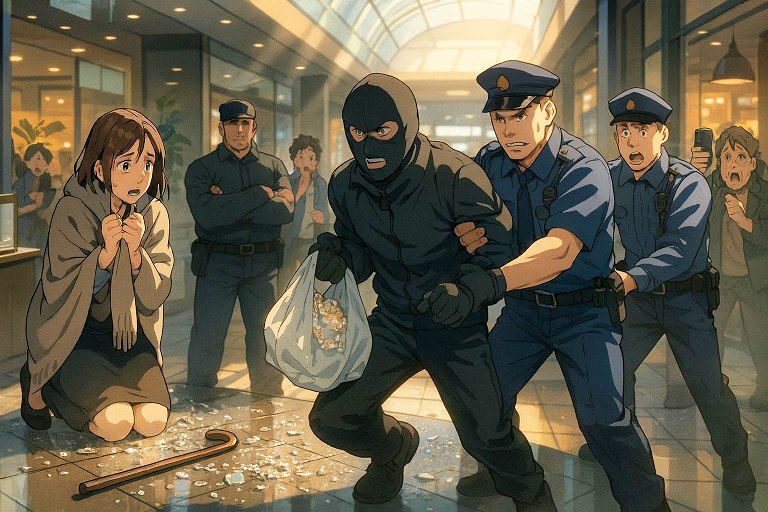
Short story: The Echo of Footsteps
Clara Monteiro was twenty-nine when the world began to call her by a name she had not asked for: the youngest billionaire. The figure — $1.3 billion — made headlines that sounded hollow against something more intimate and persistent: the footprints of her sneakers on the old wooden floor of the dance studio where, years earlier, she had taught her younger brother to find his balance. That number, cold and round, could not weigh the memory of sweaty rehearsals, the silences before going onstage, nor the texture of the creaking boards beneath her feet.
Chapter I — Echoes of Dance
From a very young age, Clara lived guided by the demand for precision: a foot that lands on the exact spot, a gaze that holds for just the right length of time. She grew up in a coastal city in Brazil, in a house where music and political arguments mixed as naturally as having breakfast and debating in the same sentence. Her mother, Rosa, a literature teacher with a deep voice and hands always busy with a book, taught her to listen to language as if it were a score: to feel the pauses, to read what is not said. Her father, Antônio, a radio repairman with the patience of a craftsman, showed her the precise slowness of trades: to take apart, understand, and put back together until everything worked again.
"Never forget to read between the lines, Clara," Rosa would say, folding napkins at the end of dinner. "Beauty does not always arrive with applause."
There were nights when the family huddled to hear the surf pounding against the shore and others when laughter filled the worn furniture. Clara absorbed those contradictions with the intensity of someone who knows that beauty demands sacrifice and resists simple explanations. Dance was not only technique; it was language, resistance, and a way of naming the world with the body. Through effort and will, she joined the prestigious Santa Flor Ballet, a stage of sharp lights and dressing rooms where aspirations were measured in centimeters of jump and hours at the barre.
In the ballet she met Helena, a colleague who soon became both friend and rival: the competition was not only for starring roles but for the look each cast on the same movement. Marco also appeared, a choreographer of gentle character who always seemed to be late to the poetry of his own steps. After a rehearsal, in a damp corner of the studio, Marco whispered to her:
"You have a way of entering the space that is frightening. Take it easy; the body asks questions too."
In the corps de ballet she learned the language of effort: every gesture considered, every fall anticipated, the humility of repeating until the mistake disappeared. But beneath the tutus and warmers, a technological curiosity beat like a secret pulse. Between classes, Clara stole minutes to read programming manuals, decipher diagrams, and hide notebooks of pseudocode under the bed in the shared dorm. She imagined machines that, like a partner, would respond to her impulse: automatons that arranged music with her breathing, systems that translated fatigue into a warm light, algorithms that interpreted the hidden intention in a gesture.
Chapter II — Cambridge and the Ghosts of Calculus
The decision to leave professional dance to study computer science at MIT was not a dramatic break overnight, but the culmination of absences and returns: the absence of rehearsals, the absence of the convictions that had driven her as a child, and the unstoppable arrival of a new desire to understand the world through models. In Cambridge, her classical discipline — that austerity of study and repetition — translated into algorithmic rigor. She learned to think in terms of structures, complexities, and the elegance of code, tending each function as she had once tended each arabesque in the air.
There she met Daniel, a lab partner with whom she shared four‑a.m. coffees, discussions about probability theory, and the shared feeling that every real advance came laden with uncertainty. Daniel had the ease of someone who thinks in diagrams and metaphors, and Clara liked his way of making skepticism a form of intellectual affection. Mei also appeared, an unlikely-looking programmer — with a sharp wit and a laugh that disarmed formalities — who broke code with the same ease an improviser alters a score. With them, hacking nights resembled long rehearsals: they worked until the body begged for truce and clarity emerged just barely, at that hour when dawn stretches ideas until they become sharp.
MIT put her in front of equations that sounded like mathematical music, in front of models that promised to order what had once been intuition. The ghosts of calculus — those functions that move at the margin of the comprehensible — did not frighten her; they pushed her to turn curiosity into a tool. In the halls, her background and discipline aroused admiration and surprise: the dancer who learned to optimize code, the young woman who articulated stage elegance with algorithmic efficiency. Each project was a different choreography: inputs, outputs, synchronizations, error tolerances. Clara drew diagrams as she had once drawn steps, and on more than one occasion discovered that an elegant solution to a computing problem had the same beauty as a well-executed pirouette.
Thus, in the confluence of rhythm and logic, of bodily memory and abstraction, Clara began to build something that was not merely a career but a continuity of her way of being in the world: rigorous, curious, and with the intuition of someone who understands that technique only serves to expand sensitivity.
Source of the images.
Image created with Bing.
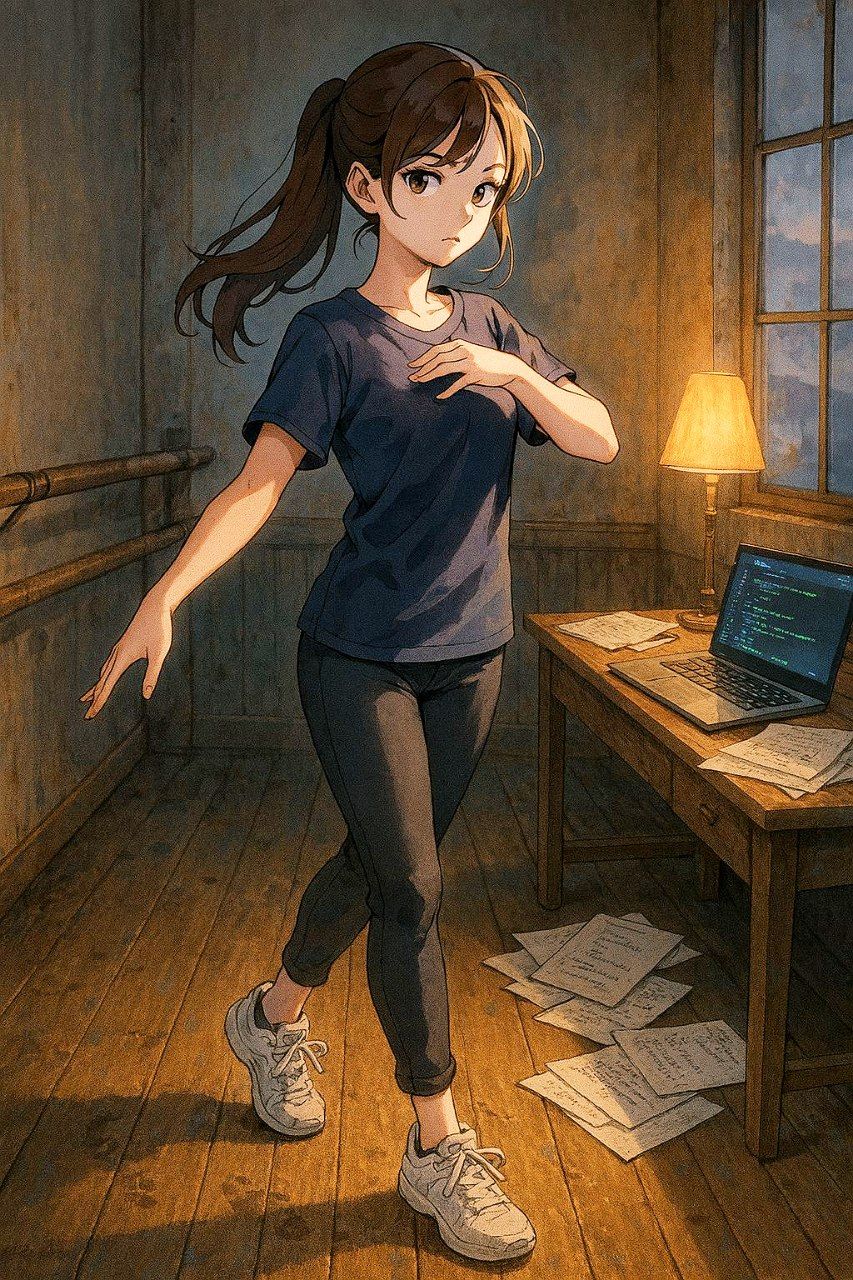
Short story: The Night the Roundabout Flew
The night in Sălcuța had the density of a held breath. Streetlamps washed the sidewalks with a sad halo; fog clung to the walls like a promise that never arrived. Traffic murmured lazily, as if it knew the routes and expected no surprises, and the Market Square roundabout kept to its routine: faded signs, a central patch of repaired grass, and a security camera mounted on a pole that, that night, would record something the town would take a long time to stop talking about.
Petru Ionescu drove with the calm of someone who has learned to measure time. Fifty-five years old, big hands, and a black Mercedes that had long been his shell: a car that smelled of polish and memories, a confessional on long nights. He was returning home after an afternoon of errands; in the passenger seat rode Ana, his younger sister, a nurse of practical habits and hands that soothed those who came to her urgent care. Between them there was trust, familiarity—low jokes and shared silences—that functioned like a lifeline in everyday life.
A few meters from the roundabout, something in Petru’s body broke without announcing itself. It was not a dramatic stumble: it was the betrayal of an organ that stopped obeying. Consciousness slipped through his fingers like a delicate glass; a cold sweat ran down his brow, his nervous system screamed, and his body answered that call in the form of emptiness. The steering wheel trembled in his hands; the dashboard lights turned into a map of incomprehensible signals. Ana raised her voice: “Petru, Pietro, wake up!”—her shout stuck to the glass. He tried to respond; his eyes sought a shore and could not find it.
Behind him, Radu, a night delivery driver, was driving a red Clio. He had headphones hanging around his neck, the music still present on his skin, and the look of someone who has seen too many scenes to be surprised. When he glanced up and saw the Mercedes losing its course, he believed for a brief second that life had handed him the frame of a movie. In the other involved vehicle, a white van came to a sudden stop; Lidia, a primary school teacher, felt her pulse freeze. She was left speechless, as if a lesson had been erased without warning.
The impact against the roundabout curb was not subtle. There was a roar that reminded some of old earthquakes: tires screaming, sheet metal squealing. And then—like an impossible gesture—the Mercedes rose. It was not a poetic flight; it was a brutal leap, a wounded beast thrown by inertia. It passed over the two other cars, describing a parabola that the camera immortalized in high definition: the dark silhouette of the vehicle suspended against the reflection of the city lights, glass flashing like fragments of a fallen sky. Ana screamed; her voice tangled with the noise and the image of her brother rising. Inside the car, her grip became a point of resistance: she clutched the seat with her nails, with a strength born of panic and love.
The fall ended on the central island. Dirt, grass, mud: what had been decorative elements suddenly became a tiny battlefield. When the Mercedes hit the ground, a cloud of dust and smoke rose; glass rained down with a metallic tinkling that sounded like broken music to some. The explosion summoned the town: pedestrians nearby, neighbors peering from balconies, shopkeepers slamming down shutters. An impulse of human aid swept across the scene: people running, hands searching for bodies, voices ordering calm.
Radu was the first to reach the Clio. Still with a headphone dangling and breath ragged, he launched himself at the Mercedes window to help. “Ana!” he shouted as he pulled her out, seeing the tears in her eyes. She coughed, hunched over, and ended up on the curb, trembling. Lidia, acting as one who consoles both by profession and instinct, approached the occupants of the other vehicles to make sure no one else needed aid; her hands, tinged with the memory of chalk and blackboards, took blankets and offered them as shields against the cold and shock.
Petru stayed inside the car, breathing in short, ragged gasps. His forehead glistened with sweat and his mouth tasted of iron. He had no room for speeches, only the urgency of reconstructing his breathing. A paramedic leaned toward him, gloved hands pressing gently on his shoulder, and offered a stretcher.
“Let us check him out,” the paramedic said in a firm voice.
Petru shook his head with an almost childish gesture.
“I’m fine,” he said, but his voice betrayed his strength; a wave of dizziness tore through him. “I just need to sit.”
Ana, her voice trembling from adrenaline, asked aloud more to seek an explanation than to receive one:
“Did something happen to his health? Diabetes?”
A witness who worked at a nearby pharmacy, who had seen Petru go in earlier that afternoon to buy glucose, stepped forward to say so quietly. The paramedics exchanged looks that spoke of medical hypotheses: hypoglycemic episodes, syncopes, the list of betrayals a body can play.
The arrival of the ambulance cut the night with sirens. The technicians acted with the practiced routine of those who have seen too many bodies and learned to read them precisely. They assessed bruises, superficial cuts, and with caution noted the possibility of a cervical whiplash—an injury that demands measured, careful movement. Decisions were made in low voices, professionalism tempering the anxiety of the scene.
Even so, when they offered transport to the hospital, Petru closed himself off to the idea. He looked at Ana with a mix of pride, stubbornness, and accumulated fatigue.
“Don’t take me,” he said firmly. “I’d rather be home. I’m not spending the night in a corridor without seeing the ceiling of my own home.”
Ana protested with the indignation of someone who watched a loved one risk himself. “You have to go, they’ll run tests,” she insisted while gripping his hand with a force that painfully mixed assertion and plea. Petru looked at her, and in his eyes there was a gleam that combined his usual rebelliousness with the vulnerability he would not expose that night.
“Ana,” he murmured, “I don’t want to be a burden. Let me sleep on my couch. If you need me, I’ll be there; but don’t make me go. Trust me.”
She finally yielded—not because reason had changed, but because some loves are like that: battles fought with words and small concessions. The medication would be reviewed, they agreed; a doctor visit would be scheduled for the morning. The pharmacy witness, Radu and Lidia talked among themselves to organize a minimal safety net: calls, checks, watchfulness.
By the time night loosened its hold on the edge of dawn, the camera footage was already circulating. Phones buzzed in neighbors’ hands sharing the video with the same mix of fascination and horror. The images were irresistible: the sequence of the jump, the silence before the impact, the final fall. In Sălcuța’s cafés the next day, conversation revolved around that mechanical and human sequence. Some speculated about a mechanical failure, others about the condition of the roundabout’s signage, and many—more softly—uttered the weighty word: medical crisis.
The rumor did not stop at mere description. It turned into action. Ana stayed with her brother through the night; she watched his breathing, changed his dressings, checked his medication and made sure he would not be left alone in his choice. The next morning they both went to the pharmacy to verify glucose supplies and consulted the local doctor to request adjustments. Medical conversations were meticulous: dose review, timing, recommendations to avoid nocturnal episodes and simple strategies to prevent dangerous drops. Petru, who initially resisted, ultimately accepted the measures with the mixture of pride and realism characteristic of someone who has lived long enough to know that stubbornness can be dangerous.
Meanwhile, Radu and Lidia did not limit themselves to emotional accompaniment: they organized concrete actions. Radu spoke with a trusted mechanic about repairing any defects that could have contributed; he proposed a community check of the curbs and the roundabout edges. Lidia used her network at school to collect signatures demanding better lighting and signage at the intersection; she wrote to the town hall and talked to parents to apply pressure. What began as an isolated episode became a local movement to prevent recurrence.
The town hall, pressured by the video’s virality and neighborhood concern, reviewed the cameras and, after a preliminary investigation, ordered improvements. The roundabout received new reflectors, higher signs, and visible reminders. There was something symbolic in the response: it would not restore the disrupted night, but it aimed to reduce the likelihood that another terrible leap would occur there.
Petru returned home with bruises that hurt every time he breathed; he moved cautiously, rediscovering the slowness of gestures. His stubbornness remained, but now it coexisted with an acceptance rooted in what had happened. Ana did not leave him: care shifted from urgent action to an organized routine. She set alarms, checked bottles, adjusted meal times and set glucose reminders. Between the siblings, conversations that had once been superficial became precise and necessary. In their shared silences there was a truce more honest with fragility.
The pole camera retained, without drama, the file that testified to the scene. That silent footage was analyzed, discussed, and eventually archived—but not without leaving a mark. In Sălcuța’s collective memory that clip became a foundational story: how an ordinary night could have become tragedy and, yet, did not. The town learned that there are visible vectors—like signage—and invisible vectors—like a drop in blood sugar—that intersect at unpredictable moments.
In the following weeks, cafés brimmed with voices repeating the same story with different accents: some emphasizing the spectacle of the accident, others the human stubbornness of refusing hospital care, and some focusing on the fragility that accompanies certain illnesses. But many—almost with a secular reverence—agreed on one thing: the night a car flew over the roundabout was not only a mechanical event; it was a reminder about the town and the ties that hold it together. Petru, Ana, Radu, and Lidia, linked by a thread formed in adrenaline, continued their lives with visible wounds and new agreements: visits, calls, checkups, and the certainty that the town had grown a little more attentive.
In the end, the mute proof remained in a camera’s memory and in the flesh of those who lived it. The roundabout kept its patched grass, but also new signs that shone at night; neighbors kept the memory of a scene that united them, and Petru, with his pride intact and his body aching, learned that stubbornness can coexist with prudence when family and community allow it. Sălcuța stood on, breathing more carefully, having seen how life breaks and recomposes in instants so brief they feel infinite.
Source of the images.
Image created with Bing.
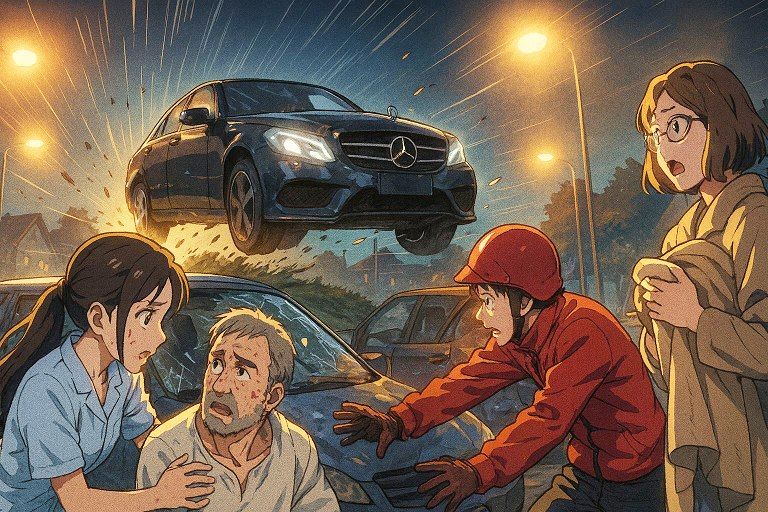
Short story: Plaza of Democratic Distribution
In 2045 the city Elena had known since childhood had changed even in its silences. The old industrial sheds on Avenida Libertad still stood, but their noise was no longer the sound of hurried hands or workers' radios: it was a tuned hum, almost musical, of servomechanisms and balanced batteries. Rows of humanoid robots —of different designs, sizes, and materials— moved with the coordination of an orchestra: some assembled prefabricated housing modules, others repaired the electrical grid, pollinator drones hovered over vertical gardens, and delivery machines slid packages through underground tunnels. The aesthetic had shifted toward warm surfaces, smart textiles, and modulated voices designed to soothe those who remembered the roughness of the first automatons. Technically, the promise debated two decades earlier in forums and panels had largely been fulfilled: automation could cover many of the material needs that had once required intensive human labor.
But that technical realization did not, by itself, resolve the political, social, and ethical questions raised in those debates: how to distribute the abundance produced by machines? Who decided what should remain human and what should be delegated? How to preserve agency and meaning in a society where material subsistence could be guaranteed without employment? Twenty years later, those questions remained the central knot of public conversation and everyday life.
Elena was forty-two. Her ID card, visible in the civic app everyone used, bore a tag that read "Basic Credit: Active." The country had implemented —starting from regional experiments in the previous decade— an Infrastructure Income that was not just a monthly cash flow but an integrated package: guaranteed modular housing, preventive healthcare, autonomous transport, and household energy credits. That package was funded by an automatic tax on the ownership and operation of robotic fleets, licenses for AI clusters, and a levy on data transactions. The transition to that scheme was not linear: there were strikes, protests, governments that tried to dismantle it and others that consolidated it. There were also millions of individual stories of loss, learning, and reinvention.
“Do you think this is what Musk imagined?” Elena asked one morning Raúl, her neighbor, while they watched a group of robotic gardeners readjust roots in the neighborhood’s community garden.
“Not exactly,” Raúl replied, setting his tea cup on the railing. “He talked about machines that would eliminate poverty. Materially, yes: many no longer go hungry or sleep on the street. But the problem wasn't only the lack of goods; it was the lack of something that made people feel alive.”
Elena worked three days a week as a cultural mediator at the Living Archive Center, a hybrid institution combining storytellers, synthesis technicians, and volunteers. Her task was simple in appearance: preserve collective memories. In practice it meant hours of listening to voices, tuning synthesis assistants to reproduce timbres, pauses, and silences, and negotiating with families who feared that generated versions would carry their intimacy into a public library without permission.
“Today a family is coming to tell their migration story,” Elena said at the coordination table in the Center, pointing to a file. “I want the synthesis to respect the silences, not just the data.”
“We can adjust the model,” Maia, the synthesis technician, intervened. “There are parameters to preserve breathing pauses and prosodic variation. But we need their explicit consent for the synthesized version to leave the archive.”
“I’ll ask for it,” Elena answered. “This is their heritage. I don't want a perfect, cold copy.”
That care for human texture was a daily response to a broader dilemma: machines could reproduce styles, execute tasks, and optimize processes, but the community still valued what machines could not "desire." Many people, therefore, even though they did not need to work to survive, chose occupations that enriched the social
fabric: cultural mediation, emotional care, in-person teaching, craft workshops, local curation, or citizen algorithm auditing.
Society had reorganized the concept of work into three main vectors: expressive creation (art, music, intimate narratives), relational services (care, mentorship, companionship), and technical governance (supervision, audit, and maintenance of automated systems). That reorganization was not peaceful. Political and economic groups emerged disputing how the automated wealth should be distributed. In Elena’s neighborhood three currents mirrored national politics: “Participatory Support,” advocating a robust income complemented by paid civic positions; “Creative Market,” favoring less regulation and letting experience and reputation markets allocate nonessential goods; and “Algorithmic Democracy,” proposing binding voting mechanisms to set parameters for automated systems that affected public life. No single current won outright; the resulting balance was a mixed system full of tensions.
“Aren’t you afraid they control so much?” Marco, a local activist, asked during a neighborhood assembly discussing the transparency of energy-prioritization algorithms.
“I’m concerned,” Elena said. “But if we stay out, others will decide for us. We have to occupy these spaces now.”
Elena’s life was full of small coordinations between the human and the automatic. She spent her free mornings at the community vertical garden, where pollinator drones flew precise routes according to maps neighbors reviewed weekly. Afternoons were in a sustainable carpentry workshop: machines and robots assisted with cuts and sanding, but design decisions remained human. At night she attended the citizens’ panel that assessed the equity of local algorithms: a group of randomly selected citizens proposing parameter adjustments for energy allocation during heat waves or rationing.
“We need to include the family-care variable,” Elena proposed at the panel’s last meeting. “The model can’t prioritize shopping centers and leave out residences with elderly people.”
“We can simulate its impact,” Maia, who also worked technically on the panel, replied. “I’ll show a projection with sensitivity to the parameter. If we increase the weight of ‘vulnerability,’ allocations change.”
Material changes were significant: extreme poverty declined. Homeless shelters were repurposed as insertion centers, and old factories turned into hubs for services, training, and community repair. However, the disappearance of material need did not eliminate other forms of scarcity: scarcity of genuine attention, scarcity of legitimate authority, scarcity of social recognition. Reputation and the capacity to influence AI norms became new symbolic resources. New hierarchies therefore emerged.
Economically, diverse actors appeared. Large tech conglomerates reinvented themselves as algorithmic governance platforms: managing robot fleets, experience markets, and data networks. In return they paid taxes for using robotic public space and for environmental externalities. But their power to set model configurations generated friction. In response, AI cooperatives flourished: small platforms governed by community contracts offering personalization, auditing, and repair services. Their advantage was not scale but local trust; whole communities preferred paying a premium for services that respected their language, rhythms, and cultural criteria.
“My uncle lives in the countryside and his 3D printer broke last week,” Elena told Raúl in the communal kitchen. “It took two days to get a spare part. For him it was an eternity.”
“That’s the problem,” Raúl replied. “Rural networks never upgraded the same way. The city seems shielded, but vulnerability exists in places left behind.”
That asymmetry prompted investments in resilience: human emergency centers able to operate critical services manually if networks failed, temporary relocation programs for people at risk, and funds to modernize remote infrastructure.
Still, the presence of those mechanisms did not erase the feeling of abandonment in many areas.
One of the most notable cultural shifts was how people measured social worth. Work, for most, was no longer the main source of identity: instead, community-recognized contribution, local impact, persistent creation, and interpersonal care rose to prominence. Universities and training centers broadened curricula to include applied AI ethics, management of relational ecosystems, multimodal narratology, and techniques to design human experiences that machines could not replace. Degrees still mattered, but social validation diversified: a carpenter designing chairs for public libraries could have the same local relevance as an engineer tuning an energy distribution algorithm.
Money didn’t vanish; it mutated. Daily life saw universal credits covering basic needs coexist with local reputation tokens used to reserve spots in creative residencies or artist studios, and fiat currency for luxury goods and services. The promise that “money would become irrelevant” was partly fulfilled: survival no longer relied solely on wages, but access to higher-tier experiences—long trips, art collections, exclusive spaces—remained mediated by economic and reputational resources.
In foreign policy, countries that developed robust regulatory frameworks for AI governance and efficient tax systems achieved greater stability and attracted talent and capital. In contrast, states that allowed data monopolies and self-regulated models faced protests and migration waves. Human mobility reorganized: cities with inclusive policies and training programs for non-automatable roles became magnets for those seeking reintegration and safety.
Intimate relationships and social fabric also transformed: more available time allowed investment in deeper relationships, but that time competed with attention ecosystems shaped by hyper-personalized algorithms. Movements for “active disconnection” emerged: annual weeks in which nonessential services were limited to encourage face-to-face encounters, rituals, and human networks. Many communities adopted local contracts delimiting machine intervention in sensitive care—for example, the presence of robotic assistants during rites of passage or breastfeeding—to preserve zones of intimate humanity.
Elena witnessed this complexity in many moments. One autumn afternoon she attended the inauguration of a neighborhood collective mural. Dozens of human hands painted alongside drones projecting impossible textures; the work combined traditional pigments and sonic projections that shifted with wind and light.
“Before we worked to survive,” an elderly woman said during the event, her voice resonating across the plaza. “Now we work to feed one another.”
“Isn’t that better?” a young man asked from the crowd, curiosity in his voice.
“It’s better,” the elderly woman answered firmly, “but it’s not automatic. It requires us to see each other and care for one another. If we leave everything to machines, we lose the thread that holds us together.”
The applause that followed was long. Elena thought of her mother, who had lost her job in 2028 when the local plant automated. Her mother found, through urban gardening, not only income but community and purpose. But Elena also remembered neighbors who, despite guaranteed shelter and food, had not escaped emotional precariousness: some lived isolated, trapped by loneliness despite material abundance.
Public space management changed too: the municipal patrol, now staffed by humans trained in mediation, coordinated flows of delivery robots and automated cleaning teams. Their role was less to punish than to intervene when human-machine interactions generated conflict: for instance, when a delivery robot blocked a wheelchair ramp for hours, or when an autonomous ambulance had to prioritize a patient in a complex situation. Those human mediations proved irreplaceable.
In the city center, what had been Station Plaza was officially renamed “Plaza of Democratic Distribution.” On the pedestal that once held a statue, a civic terminal was installed: a panel where any citizen could propose adjustments to public rules governing ubiquitous robots. Proposals were debated in in-person assemblies and in public simulations generated by models showing short- and long-term consequences. One recent vote approved that companies cede a percentage of their computing capacity to community uses during peak demand hours—for local climate modeling, free education, and cultural projects in vulnerable neighborhoods.
“This is progress,” Marco said during the final vote in the plaza. “But we can’t let our guard down. We must establish periodic audits and clear consequences for noncompliance.”
“We will monitor it,” Maia replied from the technical booth. “Transparency is now encoded in the social contract; any citizen can see and audit the metrics in real time.”
Even with these advances, tensions persisted. The concentration of symbolic and computational capital allowed some groups to craft dominant narratives about what should be valued. Political struggle shifted partly from mere material redistribution to a dispute over who defines automation norms: which tasks should be prioritized, what data counts as public, which justice criteria get encoded, and how unpaid labor—like emotional care—that machines do not replace should be compensated.
In daily life, Elena experienced the coexistence of automated and fully human in small rituals. One night, returning to her building—a block whose climate systems automatically adjusted according to health and noise parameters—a community 3D printer finished producing a lamp she had designed for the neighborhood reading room. The machine worked with precision; a young neighbor organized a small handover ceremony.
“The light!” the young man exclaimed as he switched it on. “It’s fantastic.”
“The machine made it, but this is ours,” Elena said, running her hand over the wood. “Not just because of the lamp, but for the story it carries.”
They shared stories beneath the new light: accounts of lost jobs, recent learnings, school anecdotes, and shared silences no synthesis could reproduce fairly. The lamp, produced by automation, acquired meaning through the community that integrated it into life.
Automation, Elena thought, had made work optional for many and necessary for others; it had eliminated many forms of material poverty but not power hierarchies or the human need for meaning. The challenge of 2045 was not merely to manufacture abundance but to build institutions, practices, and recognition networks that translated that abundance into dignity, agency, and belonging. The question still debated in international forums was no longer only technical: it was political and cultural. Society had to decide collectively what to delegate to machines and what to preserve as the human domain; how to remedy inequality that is not solely material; and which values to encode in the systems shaping daily life.
At day’s end, in the Plaza of Democratic Distribution, the civic terminal projected a public simulation: if the minimum community computing share increased from 2% to 5%, free education networks in vulnerable neighborhoods would improve markedly, though commercial computing capacity would temporarily decline during peak hours. People debated, spoke, and voted. That imperfect, noisy public deliberation was also the new form of civic work: making decisions about automation governance.
In the early morning, while the city slept, maintenance teams —human and robotic— worked quietly repairing an energy distribution line. Elena, who had stayed late in the common room, returned to her apartment and thought of the elderly mural painter, her mother who had found community in gardening, and the neighbor who celebrated a printed lamp.
She thought of the new forms of poverty that persisted: loneliness, the feeling of being unnecessary, the fragility of enclaves left behind by modernization.
The balance reached was not perfect, but it offered a possibility: automation could relieve material scarcity, yes, but the real collective task was to transform that abundance into care networks, effective participation, and institutions that guaranteed agency and recognition. The promise of a life in which “work was optional” had been fulfilled in terms of survival; its full realization depended on whether society could reimagine what it means to contribute, belong, and govern in an era where machines do many things for us, but still cannot do the work of seeing and recognizing us as equals.
Source of the images.
Image created with Bing.
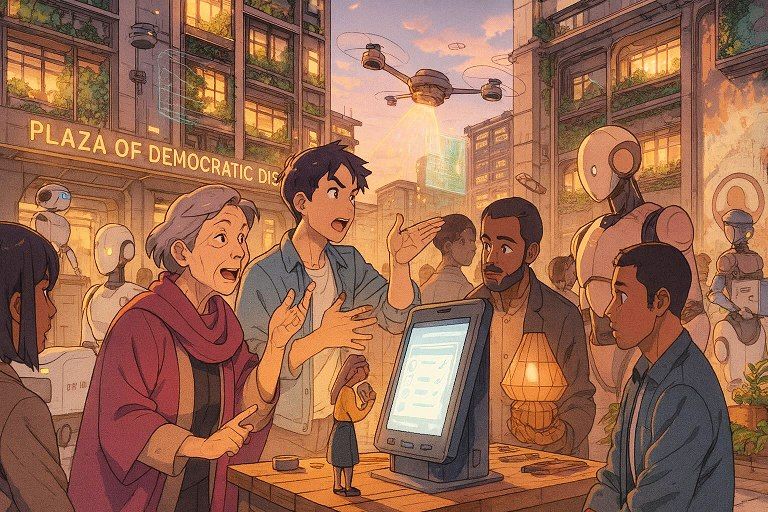
Short story: The Great Improvised Flock
In Punta Serrucho, a coastal town with more seagulls than sense, the daily rhythm matched the waves: market mornings, long siestas, and afternoons when stories stretched like reheated coffee. There lived Manolo, Rafi, and Tito, three friends who shared more anecdotes than fortune and who, like most things in the village, solved problems with humor and whimsy. None were particularly lucky: Manolo sold sandwiches on the beach and always arrived late to his own stall; Rafi tuned old radios nobody listened to but treated with devotion; Tito, insistent and theatrical, called himself a “thumb tamer”—a fancy way to say he did small repairs for everyone. Between the three of them they owed bills, carried broken promises, and had a stubborn tendency to turn scarcity into a joke.
The idea was born one summer night, when people crowded the square to escape the heat. After a few beers and too many laughs, someone tossed out the notion and the others couldn’t say no.
“What if we sneak in with the sheep?” Manolo suggested, with that blend of theatrical seriousness and laziness that defined him. “Nobody looks twice at a flock. It’s like going unnoticed at an ugly hat convention.”
Rafi—usually the cautious one until someone mentioned money—looked at the plaza and then at the list of bills he’d left on the bar counter.
“That sounds insane,” he said. “But… look. Food doesn’t pay for itself. And the baker’s been giving me a look that’s no longer human.”
Tito, for his part, saw more poetry than risk. He rubbed his hands and closed his eyes, imagining a plan that was clever and cheap.
“I’ve got the bleat down,” he assured them. “If we train a bit, nobody will notice the difference. Also, the disguise sells the story.”
Need played its part, and the discussion went on until the idea stopped being a joke and became a project. The initial intent was to cross the border for work on the peninsula; reasons multiplied: promises of temporary jobs, calls from acquaintances saying “come, there’s work here,” and pressure to keep refrigerators from grumbling louder every day. The decision was impulsive but unanimous; they were convinced—wrongly, as it turned out—that together everything would feel less ridiculous.
Logistics fell to Señora Carmelita, the village seamstress, a no-nonsense woman who charged little and gave expensive advice. In her workshop, on tables crowded with threads and buttons, the three friends turned into apprentices at a craft they didn’t know. The synthetic wool, bought with their last coin, smelled of factory, but in Carmelita’s hands it became whimsy: hastily glued layers, poorly placed patches, and improvised stuffing made from crumpled newspapers. The suits were eloquent in their lack of elegance. Manolo insisted on details he wrongly deemed essential: “more volume on the back,” “make the tail dramatic.” Rafi brought chalk to paint their faces; Tito, always theatrical, proposed practicing poses and bleats with the neighborhood dog as their critical audience.
Training became mostly a comedy of errors. Off-key bleats echoed down the main street; the three tried to copy the animals’ gait and ended up with sore backs from bending over so much. The dog, offended in its canine dignity, looked at them with a mix of pity and superiority that only a dog can manage. The nighttime practices had spectators: curious neighbors, children who saw a new game, and an elderly woman who sipped her tea with a gesture somewhere between disapproval and compassion. Meanwhile, the baker watched, frowning, aware that his credit with Rafi was too generous.
The chosen day arrived under a sky promising rain that never came. The plan was simple on paper and chaotic in practice: a truck loaded with sheep would head toward the coast, and the flock—herded by shepherds busy with loading—would provide perfect cover. The three slipped into the loading area among boxes, ropes, and clucks. At first, the mix worked surprisingly well.
The real sheep clustered, shadows blended, and the whitish figures of Manolo, Rafi, and Tito passed as part of the group. They held their breath like people about to perform a heroic act—or open the fridge at night.
“Keep your head down,” Manolo whispered, with an authority that didn’t match his track record of sensible choices. “And please, don’t do the dramatic bleat. You sound like a carnival barker.”
“Quiet,” Tito replied. “I’m channeling my inner sheep. If you call me distracted, I’ll stay in character.”
They crossed the town in a procession that, from a distance, looked natural. The shepherds were focused on loading and schedules and didn’t notice the oddities; the trucks followed their route, and the landscape slipped by in waves and whitewashed houses. Confidence grew with distance, fed by the certainty—so far unpunished—that they hadn’t been spotted. But comedies often save their twist for the most unsuspecting moment.
At the border checkpoint, the convoy passed beneath a booth where an officer, with an interrogative look and a scarce smile, glanced up. He’d seen many flocks in his life, both literal and metaphorical, and something didn’t sit right: the choreography was off. Real sheep moved with the kind of natural, chaotic harmony only animals can manage; among the wool, there were stumbles, calculated pauses, and awkward silences.
“What’s up with that flock?” the officer asked the driver, a mix of curiosity and habit in his voice. “There’s something odd I can’t put my finger on.”
“Must be the fog,” the driver shrugged. “With this weather, anyone looks strange.”
But the officer wasn’t satisfied. He approached and, like someone testing cheese, brushed the wool on one figure. The texture wasn’t what he expected: sticky, warm, smelling of human sweat and cheap glue.
“Uh… this isn’t wool,” he said, incredulity warring with barely contained laughter. “This smells like a low-budget documentary.”
The three immediately felt the comedy flip into farce. Rafi tried to improvise an explanation, voice cracking.
“It’s… performance,” he stammered. “An art installation about animal and human migration.”
“Performance?” the officer repeated, raising an eyebrow. “Noted. Do you have municipal permission for this clandestine art installation?”
The officers’ restrained laughter preluded the inevitable inspection. When the real sheep moved aside, the scene turned as tragic as it was hilarious: face paint cracked, glue failed, and newspaper stuffing collapsed into soggy sheets. The truth—patient and plain—surfaced without embellishment.
The arrest that followed wasn’t violent; it was more a procession of bungled explanations. In the station, among stacks of forms and insipid coffee, the three told their story: job offers that vanished upon arrival, promised wages that evaporated, and a raw need that didn’t fit metaphors. Sometimes their accounts sounded made up in defense of dignity; other times they were as honest as the desperation that spawned them.
“We weren’t thieves,” Manolo said, with the sincerity of someone who believes truth can buy time. “We were trying to get there. There were offers. Then, nothing.”
“We didn’t want to hurt anyone,” Rafi added. “We just needed to cross to work.”
“If this were theater, at least we’d get a round of applause,” Tito murmured, trying to find humor amid gravity.
The officials, accustomed to excuses and pleas, took notes and shuffled papers. Administrative charges were filed; records were logged; notifications scheduled. The station, which had been the stage for a human comedy for hours, returned to bureaucratic calm as the three were placed in temporary custody under migration procedures.
Back in town, opinion and gossip became a chorus. Señora Carmelita swore she’d never sew for anyone with “dangerous ideas” again. The baker, deprived of expected payment, raised an eyebrow and mentally applied a discount no one noticed for weeks.
At the tavern “The Happy Bleat,” the anecdote swelled with each retelling: some called them heroes, others saw them as fools, and a few, with quiet tenderness, understood the mix of courage and stupidity behind the decision.
Children adopted the tale as a game. In the plazas, they bleated and ran as if crossing invisible borders. The elders debated corners about causes and consequences: lack of opportunities, precariousness, the danger of dares hatched over drinks. The conversation, lasting weeks, was as varied as the town itself—ranging from tears of solidarity to laughs that buried the shame.
In the courts and the station the legal process took its course: fines, notifications, and ultimately administrative deportation. The three returned to the village feeling they’d starred in a play with no happy ending but with a lesson nobody asked for. Their comebacks were quiet and loaded with looks; some neighbors offered silent support, others kept their distance.
Time softened the anecdote. Manolo resumed his beach stall and learned, with his characteristic humor, to sell sandwiches without proposing risky logistical ideas. Rafi became more careful with debts and accepted that creativity has limits when it collides with the law. Tito, ever the frustrated artist, enrolled in the local theater class; he wanted to learn to act without resorting to a questionable costume.
Gatherings by the bakery door became rituals where, between coffee and bread, they practiced discreet bleats as if touching an old scar that no longer hurt so much. On summer nights, when seagulls played with the square lights, someone retold the adventure with new impossible details no one could verify: the version where they fought a giant ram, the one with a failed serenade to distract the shepherds, the tale of a mother who brought crumbs to comfort them after they left the station.
The story spawned local sayings. When someone proposed an outrageous plan, another would raise a hand and murmur, “Remember the great improvised flock?” The phrase worked as both a brake and a shared laugh: it warned of impending ridicule while also celebrating the boldness born of necessity. For some, Manolo, Rafi, and Tito were remembered indulgently: they had tried to cross borders not out of ambition but out of hunger and unmet promises. For others, they remained the three who tried to camouflage themselves in a flock and paid the price of local fame.
Years later, in the tavern where the story was now told with the solemnity legends deserve, a local shepherd said he’d dreamed that night of three shadows bleating at the moon. People laughed, knowing laughter was relief. The official record ended up filed away; the wool and paint became anecdotes; the border remained what it had always been: a line of papers, tolls, and glances. But in Punta Serrucho, no one forgot that sometimes need invents impossible disguises and that the mix of ingenuity and desperation can produce the most human thing: a story that makes you laugh and ache at the same time.
And that’s how the episode echoed: whenever someone in town suggested a scheme defying common sense, another would smile wryly and say, “Remember the great improvised flock?” Nobody said it with malice; it was said as warning and embrace. After all, the tale of Manolo, Rafi, and Tito is a modern fable: borders don’t just separate territories but dignities—and when people try to cross them, they use the resources they have: sometimes courage, sometimes clumsiness, and sometimes, simply, glued-on wool.
Source of the images.
Image created with Bing.
Short story: The Star That Did Not Return
The night had its own pulse, a damp cadence that pressed the city together as if trying to erase it with a single breath. A persistent drizzle cleaned lamps and façades; lights blurred in puddles and shoes left small maps of hurried steps. On an ordinary sidewalk, where days were more routine than surprising, a disturbance altered the course of several lives.
The elderly man walked stooped, a pharmacy bag hanging from one arm and his phone a point of contact in the other. It wasn’t a new or luxurious device, but for him it was a line to the world: his daughter’s voice, a photo of his grandchild, the reminder of a doctor’s appointment. He liked feeling the phone’s weight like someone holding an identity card. That night, as he searched his pocket for the written address, a sharp, violent tug ripped the device from his hands. The young man’s hand that took it was quick and determined; his eyes, however, were tinged with a mix of hunger and urgency.
“That’s mine!” the old man shouted, trying to grab at the side of the thief’s clothing, but the criminal already had the phone pressed to his chest and was accelerating.
The thief was not a monster carved by a single bad decision; he was a young body with a face hardened by life on the edge: lack of opportunities, habituation to easy gains, the demands of the street. He ran without looking back, tasting adrenaline in his mouth. The rain glued to his sweat and the phone’s shine gave him a fleeting sense of triumph.
“Please,” the old man murmured, his voice broken by age. “Don’t do this to me, young man. It’s for my grandson.”
Voices rose on the sidewalk: a woman flushed with indignation, a man who took out his phone to film the scene, a child peeking between his mother’s legs with eyes widened like coins. No one moved quickly enough to stop the thief’s primary impulse.
His flight took him onto the roadway. In his head there was no strategy, only instinct: move forward, escape, gain distance. He crossed the crosswalk without calculating timing, as if the asphalt were water to be leapt over with force. A bus approached, its size imposing a presence that the rain emphasized; it was a beast of iron carrying lives within, passengers looking through fogged windows at the oval of the street.
The driver, a man hardened by long shifts, furrowed his brow in concentration. There was no unusual sound until a scream broke the monotony. In a second, he felt the impact on the side mirror, like someone had suddenly thrown a sandbag at the vehicle. He slammed into an emergency stop, the body groaning, passengers grasping at straps. But metal cannot always stop what flesh misjudged in time.
The young man’s body was dragged by the force of the blow and thrown onto the pavement, and the city seemed to hold its breath. The impact produced a sound no one wanted to remember: a crack that resonated with the traffic light’s ticks and the murmur of the rain. Some witnesses ran to the scene; others stood frozen, immersed in the terrible certainty of having witnessed something irreversible.
The old man dropped his bag and kneeled. Among puddles and confusion, his trembling hands sought the phone—his treasure—and then, by instinct and habit, touched the young man’s inert arm. The closeness of the body returned an image no one can manufacture: a life suspended in an instant without explanation.
“Marcos…” the old man whispered, not knowing why he chose that name. “Why did you go?”
Questions at the scene were bullets without effect. A bus passenger had to step out to vomit; others covered their mouths with their hands. A woman shouted for someone to call emergency services; someone began compressing the young man’s chest in a desperate attempt to give back what the city had taken. A witness called the police with trembling hands and a broken voice.
Shortly after, authorities arrived: sirens cutting through the sound of rain, officers unfolding yellow tape like a suture to separate the event from the rest of existence. Forensic police spoke in low voices, interrupted by blue flashlight beams scanning a scene that wanted more answers than certainties. Witnesses gave accounts that seemed mismatched pieces of a hastily assembled puzzle.
“He crossed without looking,” said one woman, her voice choked. “I don’t know why, but I saw him do it.”
“He seemed desperate,” added another. “He wasn’t a common thief; he was someone playing all or nothing.”
Investigators got to work: they reviewed neighborhood cameras, checked angles and minutes; they recorded the bus route and interviewed the driver, who remembered the moment with a mix of guilt and the helplessness of having been unable to do more.
Meanwhile, at the morgue, the young man’s life began to be reconstructed through records and testimonies. His name became known within hours: Eduardo Ramírez, twenty-two, with prior arrests for petty thefts and a history of intermittent informal jobs. His parents, notified by a municipal officer, arrived with faces paralyzed, hands that had once cradled his childhood now unable to hold anything but the void of the news.
“How didn’t we see it coming?” his mother moaned, hugging her other child as if the news were a tremor that could be shared and diminished.
Practical and devastating questions repeated in Eduardo’s home: why hadn’t they gone looking for him that afternoon, what calls had been left undone, which signs had been missed. The family told stories of missed opportunities, discarded jobs, aid brigades that didn’t arrive in time. Fate collected explanations and excuses that could not soothe the raw fact of his absence.
In parallel, the elderly man’s life was reconstructed with almost ritual care. His name was Don Ernesto Velásquez; he was seventy-one, had been a schoolteacher all his life, and kept the habit of walking weekly to the neighborhood pharmacy. His daughter—police confirmed—had spoken with him midmorning; he had promised to send a photo of the grandchild. The phone, now retrieved from the pavement, was scuffed from use, protected by a faded but well-cared-for case.
“My father would greet everyone,” his daughter said, voice steady but breaking. “I don’t understand why someone would do this to him.”
News reports were quick to arrive, tinting the tragedy with headlines that divided roles: “Delinquent dies after being struck by bus after snatching phone from elderly man.” Social networks erupted in opinions: some demanded justice for the old man, others compassion for the young thief, others pointed to failures in public safety. Amid the polarization, the truth of the scene grew small and elusive.
The prosecutor’s office received the reports with a technical coldness aiming to bring order to complexity: speed analysis, brake reports and skid marks, witness interviews, footage from public and private cameras. The bus driver underwent alcohol tests and declared he could not avoid the figure that entered his trajectory suddenly. There were no signs of intentional negligence; the recklessness of the person who crossed the street, however, was indisputable. Prosecutors chose not to press homicide charges against the driver; the death was recorded as an accident precipitated by a sequence of unlawful and desperate decisions.
In the neighborhood, conversations shifted tone. Neighbors remembered Don Ernesto greeting everyone from his balcony each morning; young residents recalled Eduardo as someone who had blurred the line between his own ideas and the street’s legend. Some said they had seen the young man commit minor offenses before, while others defended his story in the name of need. No one, in the days after, could rescue the other’s complexity from the headline’s easy shine.
Eduardo’s family held a modest wake in a community hall, candles trembling to the rhythm of voices trying to console. Neighbors who did not know the family came, sharing sorrow for the loss of a young life. At one point the mother approached the casket as if unsure whether to believe that the body within would never speak again.
“My son…” she whispered, as if the phrase kept her connected to a dimension of hope. Then she looked toward the door. “If I had known this would happen, I would have changed everything.”
Outside Don Ernesto’s house, a small crowd left flowers, notes, and switched-off phones as symbolic offerings. The granddaughter lifted a hand to touch the phone’s case, as if matter could summon the grandfather’s voice. At the funeral, Don Ernesto’s daughter recounted a story of kindness: her father, the teacher, who taught generations to read and kept his phone to stay in touch. The congregation, composed of people sharing the same neighborhood and memories, listened in silence—part condemnation, part grief.
Prosecutors continued their investigation into Eduardo, tracing contacts and reviewing calls, reconstructing a night full of meetings and disputes. They discovered Eduardo had financial troubles and a circle that included other youths who sometimes crossed legal lines. There was no clear motive that justified his act; the theft appeared as a gesture mixing need and impulsivity.
Press coverage kept the case in the headlines for a couple of days before it wilted into the crime section. Analyses turned into public debates about security, protecting the elderly, and the judicial system. Politicians promised measures—more patrols, cameras, prevention campaigns. Others denounced the frivolity of those who judged lives from behind keyboards. In practice, the city seemed to do little beyond its usual rituals: promise, record, eventually forget.
Still, the scene left deep marks. Those who witnessed it carried the memory with a weight that admits no exchange. Many said that since that day crossing the street had become an exercise in greater caution; mothers gripped their children’s hands harder, elders walked in groups, bus drivers checked their routes with a renewed sense of vulnerability. The emptiness caused by death had the odd virtue of altering habits as if it were an unyielding lesson.
Months passed. Eduardo’s family tried to rebuild their lives with the inevitability of those who must move on. The mother returned to work; siblings resumed their studies; sometimes the street returned mournful looks, as if Eduardo’s presence lingered in the air. Don Ernesto’s family continued their mourning with a memory ritual: they placed a plaque on the sidewalk where he knelt the night of the tragedy, a simple inscription honoring “friendship and memory.”
Some neighbors, more conscious, organized community rounds to accompany elderly people to the pharmacy or park. Small gestures that seemed to be a response to pain: security tinged with solidarity. It was not much, but it was a sign that the wounded city was trying to mend itself with human hands.
On a corner of the neighborhood someone left a fresh flower on the sidewalk where the scene had occurred. The flower was a minimal and silent gesture but strong in intention: an acknowledgment that that night the city had been the stage for colliding destinies. An older woman with a voice full of moral authority approached the flower and said softly:
“Rest. It wasn’t just a phone.”
Her words were like a secular prayer. The flower wilted in the rain another afternoon, but the memory endured. In the urban fabric, the event became a scar that opened each time someone looked down and remembered that a phone fell like a shooting star. People shuddered, recalling that sometimes the ephemeral is the prelude to the irreversible.
Source of the images.
Image created with Bing.
Short story: The City of Clicks
The night San Marcos stopped being just any neighborhood, the moon lay pale over the rooftops as if witnessing something that should not be seen. The streetlights vomited tired yellow and shadows clung to the facades. Mariana Soto stepped out of the car with her notebook pressed to her chest and the feeling that she had arrived at the exact place where a story would begin — or end. A journalist, obsessive and with a smile worn thin after weeks of leads that evaporated, she had followed threads that smelled of fraud: conversations in bars, anonymous messages, lists that rose and fell without explanation. That address had come to her wrapped in silence, like an order to look at everything.
Ricardo Melo waited in his car, the flashlight tracing circles on the hood with a nervous tic that betrayed accumulated fatigue. An inspector with the Civil Police, hardened by interrogations of half-truths, he knew that some cases were not journalistic glory but a tangle of names in reports, broken promises, and culprits trying to steer public sight. Mariana showed him the patterns: plays that exploded in minutes, copied comments, subscribers born by the dozens in a matter of hours.
"If this is true," Ricardo said in a low voice, eyes on the graphs, "they're manufacturing fame for money. It's not just fraud; they're manipulating entire careers."
"There are accounts that spike in minutes," Mariana answered, more trembling than she wanted to admit. "And the comments... they're always the same, like templates."
They approached the door with slow steps. From the sidewalk the house seemed bland: a frayed curtain, a bell that sounded hollow. Opening it, the interior hit them with a scene that mixed the domestic and the industrial: tables covered with phones lined up like soldiers, tablets balanced on boxes, cables snaking across the floor toward routers with improvised antennas. The screens looped music videos, synchronized pop-up windows and automated programs that pressed play, like, and even left preconfigured comments. The constant hum of notifications formed a mechanical soundtrack that, for a moment, seemed to mock the sleeping city outside.
On a wall, notebooks with columns of names and figures hung like factory posters. A printed document showed schedules and fake accounts: "Campaign A — 02:00–06:00 — 150 devices — 500k views target." Another recorded payments and commissions. Everything was meticulous.
Iván and Lía sat in the living room, pale as those who have been expecting the nocturnal blow of truth. Their hands trembled, not from cold but from the certainty of being discovered.
"We never meant to hurt anyone," Lía said in a cracked voice, touching the sleeve of her sweatshirt. "They told us it was work. Night shifts. Fixed pay."
Iván avoided Mariana's gaze and spoke in a stammering voice: "My mother needs surgery. What could I do? They offered something steady and I accepted. I didn't think about the consequences."
Ricardo looked at them with the cold calm of someone who has heard excuses and bitter truths. "Who hired you?" he asked. "Names, account numbers, addresses. If you cooperate, this can count in your favor."
The youths gave details: small regular transfers, messages with instructions, an app to synchronize devices. In the caches and logs Mariana had pulled and the police forced, an intangible signature appeared: "The Cartographer." Not a name but a mark, an architecture for tracing audience routes: buying accounts, leasing devices, programming interactions. From somewhere on the network, the Cartographer drew maps that turned plays into currency of reputation.
Alejandro Ruiz emerged with stealth among the invoices found: a young producer, a familiar face at events and public appearances. His name showed up in several transactions. When summoned to give a statement he arrived neat, tie loosened, and a rehearsed serenity.
"I would never pay for that," Alejandro said in front of a small camera already following him online. "My work is legitimate. If someone framed me, I'll prove it."
"The invoices say otherwise," Mariana replied without raising her voice, notebook open.
"Intermediaries," Alejandro asserted with firmness. "I hired a marketing agency. If they used dubious methods, that falls on them, not on me directly."
Those words ignited debate: were artists and managers complicit or victims of a chain that used them? As the story spread, the neighborhood began to react. Sofía Vargas, the owner of the property used as the operation’s hub, paced her building’s stairs with her hands clenched.
"How could they use my house?" Sofía asked Ricardo through tears. "I rented to people who seemed respectable. How did I not see it?"
"Sometimes," Ricardo replied measuredly, "things hide in the everyday. That doesn't erase your pain, but we need your cooperation to rebuild who came in and when."
The operation was not isolated. Following the leads, police discovered at least five operational points with the same setup: tables full of mobiles, operators working shifts, code and templates that reproduced human comments. Chain transfers ended in third-party accounts and, sometimes, in mailboxes abroad, complicating the trace.
"We have at least five branches," Ricardo briefed his team in the operations room. "All operate with the same method: mass devices, scripts, and recycled accounts."
"And the Cartographer?" Mariana asked, holding his gaze. "Any clue who they are or where they operate from?"
"It's an alias," Ricardo answered. "It seems to operate from the shadows. But every time we shut one network down, another appears. They change routes, names, servers."
Tension escalated as the case reached the press. Mariana, pursuing the truth with a mix of outrage and meticulousness, published pieces that lifted the veil on practices many suspected but few confronted. Fans felt betrayed; some musicians began losing contracts and gigs while platforms started internal audits.
On the rainy night they decided to act in coordinated fashion, the downpour intensified as if trying to wash away footprints or swallow secrets. Sirens cut the air. The Civil Police ordered simultaneous raids: one team per address, encrypted communications among units, cameras recording every step. Mariana covered the operation from the permitted distance, notebook in hand, nerves keen.
In one house they found printed contracts and encrypted emails. In another, devices with scripts that generated comments with slight variations to simulate real conversations. In a third, a dashboard listing artists, view targets and rates: "Platinum Package — 1M views — 72 hrs — includes engagement." The machinery was both technological and human: employees following schedules and programs that mimicked the action of a thumb on a screen.
Arrests followed. Some operators, facing the evidence, agreed to cooperate. Others tried to deny the obvious. Alejandro Ruiz, whose name appeared in the documents, found himself cornered by headlines demanding quick answers.
"If they prove I ordered this, I'll pay the consequences," Alejandro told his team in a private meeting. "But I won't let them destroy what we've built without solid proof."
Catalina Rojas, the lawyer representing affected artists, moved across the scene like a legal surgeon. She filed claims for reputational damage, demanded audits and pushed platforms for transparency. It was a battle against giants: algorithms that had until then treated volume as the primary indicator of success, and companies for whom transparency was an operational cost.
"We will file suits for reputational harm," Catalina declared at a press conference. "We will demand platform audits. This cannot become normalized."
Moral debate erupted across social media and producer circles: was it ethical to pay for plays? Where did marketing end and fraud begin? Furious fans demanded sanctions; others defended artists, saying many did not know what happened behind the scenes. Some argued for strict penalties; others called for nuance.
Iván and Lía began appearing in human-interest reports, faces tired, speaking of need and remorse. Their story became, in some accounts, a human one: two young people trapped by promises of easy money.
"We're not monsters," Lía said in an interview with Mariana, voice nearly broken. "We took the easy way. Now we see the harm we caused."
Sofía organized a neighbors' assembly to recount what happened and demand controls. The compensation she received for the use of her property was minimal compared to the blow to her reputation as a landlord. The community spent weeks torn between shame and the need to move forward.
Throughout judicial and administrative proceedings, several defendants negotiated plea deals: they handed over names, accounts, and operational details in exchange for reduced sentences. Platforms began deleting plays and sanctioning accounts, while some honest marketing firms offered audits to clean processes. Still, the Cartographer remained a shadow: their alias and methods had been exposed, but not their face.
"Algorithms are not innocent," Ricardo said in a public interview. "Nor are they guilty; someone uses them. We must force transparency and hold those who design these networks accountable."
The network's dismantling had collateral effects: some artists who had benefited from inflated numbers lost contracts and support; others seized the crisis to show transparency and rebuild trust. Alejandro, for his part, launched a rehabilitation campaign: he hired independent audits, opened his accounts and promised public contracts with verification clauses. It wasn't enough to erase suspicion, but it was a tangible step.
Mariana published a series of reports that dissected the scheme: manuals, accounts, testimonies. The city read them like a map of betrayals; some were scandalized, others awoke to reality. Ricardo, despite recognition for dismantling part of the structure, knew the victory was partial. Cartographers change routes, adopt new aliases, and move to farther servers.
In a final scene that condensed the case's ambivalence, Mariana received an unmarked envelope. Inside was a single sheet with one stroke: a partial map and an address that did not belong to any known neighborhood. No words, only a line suggesting new routes. Mariana left the sheet on the table, looked out the window and thought of the city as a living body where desires and fictions were intertwined.
"This doesn't end here," she murmured, almost to herself. "They only change routes."
The moon, pale and witness, seemed to nod. Ricardo filed the case records in his desk as lessons for the future; Catalina continued pressing in the courts; Alejandro tried to reconcile his image with the truth; Iván and Lía sought to rebuild lives away from keys and screens. San Marcos regained its routine: lights again brightened afternoons, mothers hung laundry on balconies and the city's murmur resumed its pulse.
Yet the sense that fame can be bought, that authenticity can be rented and dressed in naturalness, lingered in the air like an aerosol. For every farm uncovered, someone else could sow another. The Cartographer remained, for now, only a signature on a black page: faceless, methodical, ready to redraw maps where the digital civilization finds a new path to sell illusions.
Source of the images.
Image created with Bing.
Top 5 musical - November, 2025
November, the penultimate month of the year 2025, which brings us absolutely a musical count based on Japanese music - not traditional but in commercial and Moderna genres - belonging to anime productions soundtracks; with rhythms ranging from jazz, heavy metal, hip-hop, among others. Now, without further ado, let's look at our list.
However, it should be remembered that this list is part of my profile on LastFM, a social network that has my statistics on music plays, and which, in turn, is linked to my Spotify account.
And without further ado let's get started.
**Most listened artists**
1- JAM Project
Country of origin: Japan.
2- The Pillows
Country of origin: Japan.
3- L'Arc~en~Ciel
Country of origin: Japan.
4- The Seatbelts
Country of origin: Japan.
5- Nujabes
Country of origin: Japan.
Next, let's look at the most listened to albums section.
**Most listened to albums**
1. Get No Satisfied ! - JAM Project
2. THE HERO!!: Ikareru Kobushi ni Hi o Tsukero - JAM Project
3. JAM Project BEST COLLECTION Ⅹ Ⅳ Max the Max - JAM Project
4. FLCL OST 3 - The Pillows
5. Trigun the First Donuts - Tsuneo Imahori
And extra bonuses I have something special for you all 😏
EXTRA BONUS: MUSIC TO LISTEN TO
The Pillows
https://youtu.be/acrLRi7juX8?si=9F5Hdx-oNNc0J-7k
And without more to say we meet in the next one. I appreciate all the support provided, and remember to leave your comments and musical recommendations at the end of this post.
Until then. And long live the music! 😎👍
Source of the images
Screenshots from my Amazon Fire 8 tablet.


Short story: The Form
The letter arrived on an afternoon when the city seemed to hold its breath. The building’s mailbox spat out a gray envelope that, when it touched Lina’s home, seemed to chill the whole kitchen. She held it against her chest for a few seconds, as if the paper were an injured creature that might tear with a sudden movement. On the front there were no liturgies or beloved names: only a question printed, calculated to open private locks. Would you be willing to do military service?
Inside, the sheet unfolded in administrative language what the question intimated. Dates, boxes for personal data, a space for a signature and an appointment for a medical examination. “All those born in 2008 and subsequent years must complete this form upon reaching the age of majority,” read the paragraph in that neutral voice that pretends not to demand. “Authorities will verify the physical and psychological capacities of the youths. Afterwards, they will decide whether to enlist or not; for now, military service is voluntary. However, the government will maintain an official register of potential recruits.”
Lina set the envelope on the table and called Pavel because she needed to hear someone’s voice that wasn’t the State’s.
“Did you see it?” she asked, phone pressed to her ear.
“Yes,” Pavel replied with the certainty of someone repeating a slogan he wanted to be true. “I wouldn’t do it under any circumstances. And if they forced me, I’d try to declare myself unfit for health reasons.”
Pavel was sixteen and had a scar on his eyebrow that marked his forehead like an old decision. That morning his reply sounded angry and steady; at night, in the room where he collected maps and cut out routes, the same phrase could fray into doubts. For most of his classmates, the answer seemed almost a group duty: saying no was a way to mark distance from a power that now wanted to file their bodies and minds.
Adrian, who had not yet turned sixteen, had been listening to the conversation from a distance, sitting on a park bench with a strip of sawdust between his fingers. His hands were those of someone who worked wood—calloused and sure—and his gaze belonged to someone who had learned to measure things patiently. When asked what he would do, he shrugged and spoke with the calm his craft gave him:
“I’d do it if they forced me. Not out of patriotism or exaltation, but because it’s easier for me to give in than to expend energy on a fight that might not win anyone anything.”
At Lina’s house the conversation became a kind of surgical operation of opinions. Her mother recalled stories of her own father, young in darker times, who returned with empty pockets and a closed mouth, and spoke of duty and civic service. Her father, however, eyed the envelope suspiciously: a register like this, he said, smelled of bureaucratic control.
“Saying no because you believe it is not the same as doing so out of laziness,” he murmured. “This is not just politics; it’s people’s lives.”
Lina listened without intervening, feeling that the question was less an interrogative than a demand: fill in the box, show up for the exam, the State records you. The idea of the medical exam conjured an image of a white room, a lab coat, gloved hands that palpate and interrogate. She thought that no form ever asked about dreams; only about measurements, sizes and aptitudes.
At school the social worker explained the procedure in a voice that seemed to read from a manual: personal data, physical tests, psychological interviews. Students took notes—some out of duty, others out of curiosity. Hallways filled with jokes about uniforms and orders; other adolescents were silent, faces closed in their own thought.
One afternoon, on the soccer field, Pavel stumbled and fell. He laughed as he rubbed his knee, joking about bad luck.
“If health counted as an excuse, I’d be saved already,” he said in a tone meant to ease anxiety.
“You could fake a chronic injury,” suggested a friend, and laughter softened the worry. But when night came and the city lights turned on with a deceptive calm, Pavel found himself holding the imaginary form and thinking of the box that could seal his future.
Lina turned to her maps; the strokes in the margins of her notebooks were routes that never reached a destination because the idea of leaving both paralyzed and invited her. She proposed alternatives: nursing, rescue brigades, civilian training. “What’s the difference between caring for an injured person in a disaster and obeying orders in a camp?” she asked one evening.
“Intention and hierarchy,” her mother replied. “When it’s an order, the margin for choice is reduced.”
Politics inevitably crept into everyday life. On television, parliaments debated: security, cohesion, planning. In the squares, activists denounced the registry as a threat to privacy. “If you control who can be part of the forces, you control part of the future,” said a deputy in a debate Lina watched pressed to the window glass. A minister answered that foresight was not control but responsibility. Words clashed, tense as the threads of a net that no one wanted to see hanging.
The day of the first medical review smelled of antiseptic and stubbornness. Young people in the waiting room watched the clock as if each tick brought a sentence: some with defiance, some apathetic, a few panicked. Doctors took notes; psychologists asked oblique questions that brushed identity: “What moves you? What paralyses you?” Pavel answered with what had always driven him—maps, station names, the sounds of trains at dawn.
“I’m afraid of losing the freedom to choose,” he confessed, in a voice not used to exposure.
The psychologist wrote it down, observed with the equanimity of someone issuing results, and concluded: “You do not present mental disorders.” It was a cold administrative finding, not a deep reading of the soul. When Pavel left the office he felt that the phrase permitted some things and denied others with equal force.
Meanwhile, the administration cross-referenced data: heights, repetition counts on physical tests, psychological results, records. The register grew like an ordered shadow. Society began to split into camps and echoes. Some applauded the opportunity for employability and training. Others saw in the file the materialization of an all-seeing eye. Debates jumped from parliaments to bars to classrooms.
“With proper use, it could be linked to education and job programs,” argued an official on a news segment. “It’s not punishment; it’s a tool.”
“Or a checklist for discrimination,” replied an activist on the same panel. “Where do you draw the line between prevention and surveillance?”
On the riverbank, the friends gathered the night before Adrian’s sixteenth birthday. They made a fire with wood that smelled of sawdust and cheap beer. The flames cast faces like temporary sculptures. They talked, laughed, argued from calm to anger, but kept circling the same idea: there would not be a single answer.
“If I have to do it, I’ll do it,” Adrian said, watching the flames. “I’m not looking for grandeur. I want to know if I can hold the responsibility put in my hands. If it’s a test of character, I’m not afraid to lose it.”
“And what if they ask you to obey without sense?” Lina asked.
“Then you learn to ask questions,” Adrian replied. “You don’t obey blindly. You try to understand what they ask.”
The first cohort of volunteers that signed up disproved both comic and tragic stereotypes. They included technical students, youth seeking discipline to escape precarity, young people hoping to finance studies. They returned with stories tasting sometimes of camaraderie: nights shared in rain, hands learning to suture, radios crackling in remote camps. Others came back with doubts: orders they couldn’t understand, exercises in obedience that clashed with their moral sense.
“They taught me how to calm someone who was bleeding,” a returning woman said. “That left me more than any speech about the homeland.”
“I did it to save money for university,” a young man confessed. “It wasn’t heroism. It was need.”
Pavel, faithful to his caution, stayed on the margins tracing routes and avoiding seals. He didn’t sign until he understood the consequences. Lina enrolled in a first-aid course at the community center and, after an intense practical session where the gap between theory and blood narrowed, said in a small voice:
“Helping doesn’t need a uniform; it needs hands that know what to do.”
Adrian submitted his form in due time, with the same meticulousness he used to measure a plank before cutting it. He went to the exam with the calm of someone who doesn’t seek heroics but does seek options.
“If I must, I will present myself,” he told the psychologist. “I don’t seek glory or hatred. I seek alternatives.”
Public and private life slowly dissolved the novelty into routine. For many, the process became an old paper; for others, it opened doors: training, scholarships, jobs. The registry continued to grow, often invisibly, archived on servers with names and numbers. There were complaints and promises, fears unspoken and reforms slow to arrive. Protocols were proposed to prevent discrimination; assurances were made that the data would be used only for planning. Promises were renewed with the familiar fatigue of politics.
Within the friends’ group the fracture persisted but became less loud—more ordinary. Some enlisted out of conviction, others out of pragmatism, quite a few out of curiosity. Others simply said no and continued their days as if the boxes had not touched their pulse. Each decision was a small catastrophe or a triumph depending on the lens used.
The gray envelope ended up relegated to a drawer in Lina’s desk. Sometimes she took it out, unfolded the blank sheet, looked at it, and folded it again. It wasn’t regret she felt—it was the calm of someone who keeps a map she doesn’t have to follow. Pavel visited one afternoon while the letter lay on the table.
“Do you regret it?” he asked quietly.
“No,” Lina said. “I just know that a box doesn’t define a life.”
The city’s noise continued: cars, sirens, voices crossing the night. In bars, workshops and online forums, the young argued, loved, worked and erred. There was no single generational answer. What emerged, with the slow movement of tides, was a more uncomfortable truth: the State’s question had opened a frontier where each young person picked a stone to stand on. Some chose discipline, others rebellion; some, opportunity; others, indifference. There was no unanimity—only multiplicity.
The true drama did not lie in the form or the registry, but in the way the daily lives of those youths were subjected to decisions that mixed fear, hope, convenience and desire. Each story was a branching off from the same question: choose, yield, resist. And within that diversity was the hardest and most human lesson: adulthood brings papers and obligations, yes, but also a field of possibilities where no box can contain the complexity of a life.
Source of the images.
Image created with Bing.
Short story: "Resonances in Westbridge"
The morning wakes like a gray curtain hanging low over Westbridge. The neighborhood, with its brick facades and cobbled streets, seems transformed into a provisional stage; footsteps that usually flow collide now with movable barriers, orange cones and tarpaulins. The crowd, dense and vibrant, fills squares, avenues and parks, and its collective breathing takes on the cadence of a distant drum.
At the center of the scene a platform has been installed: metal scaffolding, loudspeakers, banners. On it, Victor Hale adjusts the microphone with measured gestures, like someone tuning an instrument before playing a melody he expects others to sing. His figure, upright and confident, projects assurance; his face, carved by years of oratory and cameras, shows no doubt. Around him, placards bearing slogans, some short and aggressive, and flags faded from previous marches flutter. Victor looks at the crowd and, in his mind, the day is already a victory.
Victor lowers his voice and raises his tone; his speech seeks to ignite and to soothe, to provide identity and justification at once. From the platform, he speaks with the cadence of the convinced:
Victor (from the platform): "Today we rise for our future. We will not cede neighborhoods or jobs. This is for our children!"
His words produce a tide of cheers. In the response there are those who repeat slogans out of tradition, out of habit; others do so with newly kindled fervor, driven by accumulated frustrations and personal stories that do not often make the headlines.
Maya Khan arrives at the scene with her backpack slung across her shoulder, her notebook protected inside and her recorder in hand. Born and raised in Westbridge to an immigrant family, she has learned to look—and to listen—with double attention: that of someone covering the news and of someone who may, at times, find themselves within it. Her walk among groups is a map of voices: an older man clutching a flag with nostalgia, a young woman shouting slogans in anger, a mother instinctively shielding her child. Maya does not seek confrontation; she seeks stories. When she approaches a woman with tired eyes and asks why she has come, the answer comes with restrained voice.
Maya (to a passing mother): "Why did you come today?"
Mother: "I want them to hear us. I don't ask for luxuries, only peace."
Inspector Aaron Cole carries the responsibility with an appearance of calm. His reflective vest catches the pale dawn light; his radio crackles with orders and confirmations. Aaron has spent years on neighborhood shifts; he knows the shortcuts of conflict and has learned that the most prudent decision is usually the one that avoids escalation. While he positions his officers in cordons, he makes calculations he does not share aloud: crossing points, evacuation routes, medical stations, possible flashpoints.
Aaron (over the radio): "Keep calm and distance. Priority: prevent injuries. Do not engage in provocations."
A short distance away, in a sunny corner of the park, Sami Noor and a group of young people have set up a table with cups of tea, blankets and signs reading "Neighbors, not enemies." Sami, a university student and community activist, believes in the possibility of breaking through slogans with human stories: recipes, work histories, shared memories. His voice, when he climbs onto a bench, does not try to compete with the megaphones; his strategy is different: to humanize the conflict.
Sami (into the microphone): "We are not numbers. We are the ones who share stairways and supermarkets. Let's talk before pointing fingers."
Lena Marsh runs the improvised first-aid station organized by a local NGO. Her gloves stain with sweat and dust; her hands, deft from so much bandaging, move with a calm that soothes. She treats everything from bruises and panic attacks to heat exhaustion. Each time she calms someone and offers water, she acts as a last practical barrier against violence: small interventions that prevent tension from escalating.
Lena (while bandaging): "Breathe deeply, ma'am. Here is some water. You are safe."
As the morning progresses, tension becomes more tangible: groups of different persuasions meet within a few meters of each other, separated by police cordons. Mixed emotions swirl through the crowd: anger, fear, curiosity, routine. Some come driven by speeches that promise control and pride; others arrive with signs of tolerance that seem almost timid against the media apparatus. The conflict, until then contained, continues to simmer, waiting for a spark.
That spark arrives in the form of a small but deliberate act of provocation. A group of individuals, hooded and wearing aggressive insignia, lunges at a police line intent on forcing a clash. A shove, a shout, a bottle rolling. The scene tightens. Aaron, who anticipated several scenarios, gives the order with a firm, weary voice.
Aaron (firmly): "Halt. Fall back or we will stop the march for safety."
The response becomes a contest of stares, small advances and retreats. Victor, from the platform, perceives opportunity and doubles down on his rhetoric with an incendiary tone, sketching a map of culprits that simplifies complexity into a single clear antagonist. His words act as fuel for those seeking confirmation of their resentment.
Victor: "We won't wait for others to decide for us. Our voice must be the first!"
Meanwhile, Sami continues his practice of social stitching. Perched on the statue of a local defender, he tells stories without seeking glory: the teacher who worked two jobs, the grocer who stopped closing at six to help customers, the neighbor who always handed out cookies at Christmas. His accounts are not panaceas; they are everyday images that try to erode the coldness of hatred.
Sami: "My teacher woke up at five her whole life. One does not earn less for being different. Don't we want our children to have teachers who work for them?"
The atmosphere bursts when, unexpectedly and deliberately, pyrotechnic projectiles fly through the sky. The flash and the bang trigger instant panic. Smoke mingles with confusion and the crowd fragments into streams of people pushing and seeking refuge. Someone falls; someone else stumbles; cries and shouts mix with radio orders. The cameras covering the event capture images that will soon travel the world: smoke, shoving, strained faces.
But amid the visible violence, scenes of solidarity arise that contest the singular conflict narrative. A protester helps a counter-protester up after a fall; an old woman on a balcony throws bottles of water and cookies into the street; Lena improvises stretchers with blankets to tend to the injured; Aaron opens the door of a nearby pharmacy so groups can shelter and receive first aid. Those images, less viral but no less powerful, show another face of the event.
Protester (offering help): "Are you okay? Get up, dear."
Old woman Ruth (from a balcony): "I brought water! Make way!"
Amid the smoke and shouts, Sami climbs again onto his bench and calls for silence. His voice, less projection than Victor's but steadier in humanity, moves through the mass.
Sami (shouting to be heard): "Let's stop. We are not natural enemies. Today we can decide whether to add more hate to the soil or to plant something different."
Some hear him; others ignore him. The collective decision, in those minutes, becomes a microspace where the tone of what comes next is defined. Aaron and his officers work urgently to restore order and prioritize the safety of civilians and demonstrators alike. Their orders aim to prevent abuse as much as violence.
Aaron (to his officers): "Cordon now. Protect civilians. We don't want more injuries."
The afternoon descends with an air of uncertainty. Media outlets begin editing footage, cutting speeches to fit their narratives. On the press and social feeds, shots of crowds mix with statements that further polarize discourse. Victor proclaims victory on his channels; for many followers, the march confirms a collective identity they have sought.
But for others, the day confirms a fracture: the city is wounded, debates become politicized, and polarization becomes tangible.
Maya works late into the night. In her small office, under warm lights and with cups of tea, she writes a long feature that chooses to focus on voices that big headlines usually omit. She interviews the mother who came seeking to be heard, Lena who treated dozens, and Aaron who explains the difficult choices involved in containing order. Her piece does not pretend to be an infallible balancing act; it simply aims to restore humanity to the news.
Maya (in her office, writing): "These are not numbers. These are stories. We must tell them."
Subsequent reactions are swift: parliamentary debates, interviews, complaints of violence, police investigations into the fireworks and possible infiltration by radicals seeking to provoke. In the city’s basements, however, less noisy initiatives sprout: neighborhood committees, intercultural meetings, concrete proposals on youth employment and housing. Where rhetoric promises simple answers, community practice pursues complex and sustainable solutions.
Months later, the echo of that day has shifted shape. The modest space Sami opened with borrowed resources has become a modest community center: morning language classes, an afternoon communal kitchen, evening tutoring for children. Neighbors from different backgrounds share schedules and concerns; the neighbor Ruth brings cookies and becomes a small symbol of quotidian reconciliation. Victor continues to organize events and make appearances; his voice does not vanish, but in many neighborhoods the pull he once exerted has diminished in the face of tangible work.
Aaron participates in community meetings and watches with a mix of pride and caution the projects that were once just notes. He knows security is not only the absence of violence on the day of the march; it also requires opportunities, employment and education that close gaps. Maya keeps writing and covering the city with the same tenacity; her piece about those anonymous voices was cited in local debates and helped push some aid and employment initiatives.
Aaron (to Maya at a community meeting): "We did what we could that day. But more dialogue is needed."
Maya: "Then we'll tell it. Words can open doors."
Sami (at the center opening): "We start with a cup of tea. We will end with a neighborhood where no one fears their neighbor."
The lesson left behind is complex and does not fit simple headlines: the barricade of one afternoon was not erased in a sigh. The rhetoric of hate is not extinguished by a single act of resistance; yet the cracks opened by conflict are also passages for solutions. In Westbridge, the crowd ceased to be merely an anonymous mass: some saw their angry reflection in it; others saw a map of possibilities for rebuilding coexistence.
At community tables they discuss youth employment and cultural spaces; at schools they hold workshops on living together; at corner shops neighbors who once regarded each other with suspicion now greet one another. Nothing erases the events or the wounds of that day, but the city—slow as it is—begins to weave a response that doesn't fit slogans: daily work, sustained listening and projects that, little by little, show that useful politics can be born from the sum of small gestures.
Victor Hale continues his activism, finds audiences and listeners, and his figure retains relevance in sympathetic circles. But in Westbridge’s collective narrative, the force that once seemed absolute has been contested by initiatives that, without fanfare, demonstrate that coexistence is built with patience: shared cups of tea, language classes, centers with volunteers teaching trades. The divides did not disappear, but they gained interlocutors who were not previously seated at the table.
The echo of that day remains: in photographs, in memories, in policies debated. No flag erased the conflict, nor did any speech close it forever. There were, however, hands that clasped amid smoke and confusion; there were stories that circulated and began to change perceptions; there were neighborhood initiatives whose concrete work began to show that another narrative was possible.
The End.
Source of the images.
Image created with Bing.
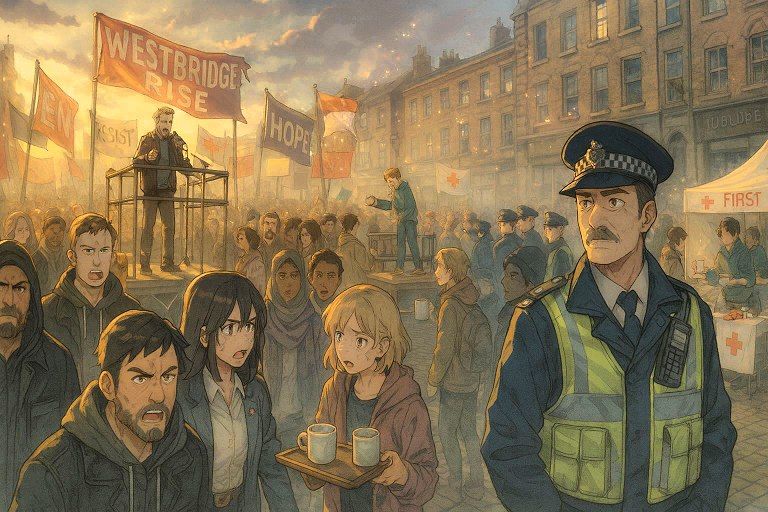
Short story: Five Curves
The lights in Laboratory 7B at the University of Cambridge were always too cold, as if they tried to keep humanity at bay. That morning the rain sharpened its rhythm against the glass and the building seemed to hold its breath. In the center of the room, a long table bearing the dust of ideas held empty teacups, stacks of consent forms, folders with histories, and a dozen screens showing brain maps in shades of blue and orange. The hum of the machines kept an implacable metronome; the cables were arteries carrying information and secrecy.
Elena Marín ran a hand through her hair, draped her lab coat over her shoulders, and looked at her people. She was not just the team leader; she was the force that had driven the obsession to understand how the brain transforms over a lifetime. Her eyes, used to reading scans, also learned to read doubts. Across from her were Marco, the programmer who seemed to live in a world of algorithms and coffee, his gaze marked by nights of debugging; Amina, the neuropsychologist whose craft was patience and whose voice provided refuge; and Jonah, a doctoral student with the energy of someone seeking legitimacy in every consent he gathered. They were an imperfect ensemble, but they had become a necessary assembly.
“Are you ready?” Elena asked, without needing an answer.
Marco tilted his head toward the visualizations.
“Ready or not, we have to know the truth,” he said, his tone carrying both challenge and fatigue.
Months of meticulous work followed: scans from nearly 4,000 participants, from childhood into their nineties; protocols that demanded patience in acquisition and rigor in noise control; interviews that humanized the data. Each MRI was a map; each map, a constellation of synapses. The team fed those maps into an artificial intelligence algorithm that Marco had obsessively tuned. The program was not an oracle but a detective looking for patterns, repetitions, and traces of neuronal reorganization.
Amina organized battery after battery of cognitive tests, translating numbers into stories: “This child smiles in response to music; that smile later appears as greater connectivity in networks associated with attention.” Jonah visited schools and care homes, speaking with mothers and grandparents. He brought consent forms and, more importantly, narratives: the teacher who convinced a reluctant parent; the craftsperson who arrived smelling of wood and ended up explaining how a memory workshop returned meaning to his life; the single mother who feared she couldn’t afford extra lessons for her child. None of that appeared in the algorithm, but it all helped explain why certain connections emerged or weakened.
One evening when night fell early because of the storm, the algorithm produced a visualization that left everyone in the lab holding their breath. The curves representing the organization of connections were not a smooth gradient but a textured relief with five major stages and four clear inflection points: ages 9, 32, 60, and 83. On the screen the lines arced and diverged; in the silence, the numbers rang like bells.
“What is this?” Jonah asked, his voice broken by surprise.
“They’re stages,” Amina murmured, her hands trembling slightly. “It’s not just decline; it’s reorganization.”
Marco, with the coolness of someone who has faced too many binary decisions, let out an incredulous laugh.
“Thirty-two… I thought the peak would be much earlier. Thirty-two is where it reaches its maximum organization?”
“Yes,” Elena replied, wearing calm like armor. “The data suggest the brain continues to grow and reorganize until that age. It’s not a straight line; it’s a map with five elevations.”
The news did not take its time: universities, journalists, social networks, and public policy reacted almost as quickly as the paper was released.
There were celebrations —teachers who saw support for extended training— and there was another response: the Old Narrative, that comfortable notion that the brain peaks very early and then declines, felt threatened. Voices in opinion columns labeled the work “dangerously optimistic”; politicians speculated about policy changes; startups smelled an opportunity to sell quick fixes.
Pressure became personal. Hate emails arrived at Marco’s inbox accusing him of manipulation; Jonah received messages attacking his youth and professionalism; Amina spent afternoons soothing patients and colleagues disoriented by the uncertainty the science had unearthed. Elena began receiving calls demanding data, transparency, and immediate explanations. She knew integrity would be their only valid defense.
“Let’s open everything,” she said in a tense meeting. “We’ll publish the methods, make the protocols available. We mustn’t leave room for malicious interpretation.”
The decision was a calculated risk. In conferences and public talks, the team presented not only figures but people. They invited the retired teacher who had appeared in the project records, the single mother who had agreed to participate, and the craftsperson who spoke candidly about the memory workshop. Those voices turned graphs into narratives. A teacher, voice trembling but resolute, stood and said, “Windows open at nine—attention, music, coordination. Don’t shut them.”
The impact was humane and penetrating, but resistance was not only rhetorical; temptations arose. A multinational pharmaceutical company approached with a deal that smelled like a shortcut: massive funding to expand the study and a promise to commercialize a “neuroprotective drug” that, according to their dossier, could slow neuronal aging. The offer endangered the team’s independence and credibility and ignited tensions that threatened friendships.
“We could triple our sample,” Jonah whispered one night with hope. “We could get more robust results, faster.”
“At what cost?” Marco retorted, harsh. “Sell our name so others can profit from something we are only beginning to understand?”
Elena looked at her team—faces that had shared sleepless nights and dizzying days. The decision was not sentimental, but it was made from conviction.
“We will reject the offer,” she said. “If we accept conditions, we lose the only thing that makes us credible: transparency.”
The reply was a blow that split the night. The rejection cost them: funds, closed doors, sleepless nights. But it also earned them the respect of many colleagues and the trust of part of the scientific community. That loyalty was not measured in money but in integrity.
Over the years the five curves began to permeate reality with the slowness bureaucracy imposes. Changes were not immediate everywhere; policies lagged, education systems did not transform overnight, and companies continued peddling piecemeal fixes. But in neighborhoods, schools, and community health centers, programs inspired by the research emerged: music and motor workshops for schoolchildren, mentorship and support programs for young adults approaching their thirties, prevention and stimulation initiatives for people around sixty, and spaces for companionship and reading for those over eighty. There were no miracles, only practices that respected evidence and human dignity.
Individual stories were what finally revealed the study’s reach. A nine-year-old girl in the study discovered a talent for piano when offered a free class at school; her trajectory showed how small interventions in childhood could consolidate attention and memory networks. A man who considered changing careers at thirty-two found that patience and continued training enabled reinvention; his brain, far from fixed, showed changes validating later maturation. A sixty-year-old woman who adopted routines of exercise, socializing, and cognitive activities maintained and in some tests improved executive functions.
An eighty-three-year-old craftsperson attending the memory workshop explained how companionship and stimulation didn’t erase age but restored quality and meaning.
In a particularly intense public session, a journalist aimed for the headline: “Is it too late for many?” Elena looked not like a detached expert but as someone who had seen lives pierced by uncertainty.
“It is not a terminal sentence,” she answered firmly. “It’s a cartography. It tells us where and when the brain reorganizes its networks. It forces us to rethink when and how we intervene. But it does not promise miracles nor deny limits.”
Amina added from her clinical vantage, with the tenderness of someone who accompanies people in private struggles:
“I’ve seen patients in their thirties recover functions with sustained work. It’s not magic; it’s consistency, tools, and time.”
The fight against misinformation persisted: out-of-context fragments, catastrophic headlines, ridicule on social media. The campaign made visible the courage required to sustain a scientific project under public scrutiny. There were nights when everyone wondered if it had been worth it. An anonymous note on Elena’s car—“Stop playing god”—left a mark not on the science but on the flesh. There were no direct physical threats, but a moral weight the team carried quietly.
Yet the commitment to transparency—sharing data and methods, engaging communities and educators—ultimately bore fruit. Policies—slow, clumsy, sometimes inconsistent—began to incorporate recommendations: greater investment in early education, continued training during young adulthood, community strategies for dignified aging, and, above all, a gradual shift in the public narrative about when a person is “useful” or “capable.”
Years later Laboratory 7B had changed. The lights were still cool but less sharp. The screens projected overlapping brain maps moving like galaxies; the cables remained arteries but now connected to people and projects in distant neighborhoods. Jonah had grown: no longer the trembling student, he was the principal investigator maintaining project continuity with the calm born of experience. Marco still coded, but with less urgency and a clearer sense of the limits of what an algorithm can say. Amina had authored practical guides for therapists and led workshops where science and compassion met.
Elena, who had borne the burden of leading both the science and its public exposure, watched one day from the lab window the city where some lives seemed to sync with the curves they had drawn. She saw a nine-year-old practicing piano with eager hands; a thirty-two-year-old man receiving his degree after a late master’s; a sixty-year-old woman laughing with friends as they walked in a community program; an eighty-three-year-old craftsperson smiling in his workshop, hands marked by experience and the joy of telling stories. Those scenes were small rewards against the discomfort the research had caused, but for Elena they represented the reason for everything: that science, when honest, can open possibilities.
Around a now-clean table with fresh teacups, the team spoke without hurry.
“We have more work,” Marco said. “Algorithms improve, but ethical problems don’t resolve themselves.”
“And policies won’t either,” Jonah added. “But we changed something: the public narrative no longer ignores the evidence.”
Amina closed a folder filled with maps bearing decades of stories.
“We planted a different way of looking. We didn’t cure everything or promise the impossible. We gave a map and, with it, options.”
Elena inhaled deeply. There was no triumphalism in her chest, only sober certainty.
“Science is that: a way to answer questions the world throws at us. And when that data meets human dignity, transformation follows.”
The Old Narrative would persist; there would always be those who prefer comfortable certainties and quick answers. But evidence—woven with rigor, transparency, and ethics—had opened a crack in its hegemony. The five curves were not catalogs of promises or condemnations; they were orientation tools: inflection points signaling moments to attend, intervene, and sustain. They were also a reminder that human development does not extinguish early but unfolds in complex rhythms deserving patience and smart policy.
The curtain did not fall to fanfare. Instead there was a quotidian scene: Jonah handed Elena a cup of tea; Marco fixed one last detail in code that finally allowed visualization of an emerging pattern; Amina scanned the latest clinical guide. Outside, the city continued: children, young adults, middle-aged and elderly people weaving their days with the concrete implications of a science that chose honesty.
And in that everydayness lay the clearest lesson: research does not transform lives by headlines but by the practices it generates; by the networks and policies it moves; by the difficult conversations it forces us to hold. The five curves were therefore less a spectacular revelation and more an invitation to accompany lives through their rhythms—with patience, respect, and informed action.
Source of the images.
Image created with Bing.
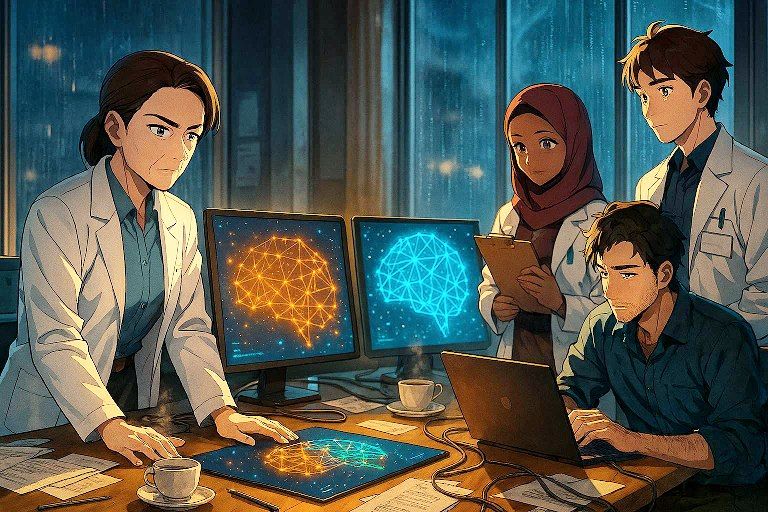
Short story: The Silence of Montclar
The Montclar range rose like an ancient scar on the horizon: a succession of ridges and ravines where the wind seemed to carry the memories of whole generations. The pines, black and upright, drove their shadows into the parched earth; the trails, worn by footsteps over decades, vanished among bushes and stones. In winter the fog descended like a heavy curtain; in summer the silence was so dense that any sound felt like a blasphemy.
The dawn when everything began, the fog came thick and cold, falling over the mountain like an old veil. Héctor, a forest warden who had been born in a stone cottage halfway up the slope, walked with his flashlight in hand following the trail of a wild boar seen the night before near the Bellido farmhouse. He had spent more than thirty years marked by the loneliness of the paths and by the habit of listening before speaking. That morning something chilled his blood: the animals he found were not like the dead boars sometimes seen in the area, victims of collisions or territorial fights. They lay scattered, as if death had arranged its own sowing.
“Héctor, come carefully,” Ana, the veterinary officer at the post, called from the track, young but with steady hands. “Don’t touch anything without gloves.”
Ana arrived in the van and unpacked the equipment with the precision of someone who had practiced the same gestures a thousand times. She examined the bodies, the postures, the absence of external wounds that might explain such sudden and uniform endings.
“These aren’t wounds,” she murmured, presided over by a professional calm that allowed her to say what others felt. “This isn’t an accident. It’s probably pathological. Take samples, mark coordinates, and notify the Ministry.”
Héctor shook his head. His eyes, used to the murmur of the mountain, now searched for causes in the folds: fresh tracks that faded away, scraps of skin caught in brambles, a trail of droppings that lacked the normal pattern of wild animals. All of this smelled of something larger than an isolated death.
The news traveled up the paths to the village like a glowing coal. In Montclar, the plaza that had once been a market and now served as a meeting point, people gathered in low voices. Theories wound in the dusk: some spoke of poison, others of a poacher, others merely commented on the inexplicable. Marta, one of the area’s farmers, listened with her hands shoved into the pockets of her apron, feeling a cold thread coil in her throat.
“If this reaches the pens, I don’t know what I’ll do,” she said, voice bitten by fear. “These animals are my work, my inheritance. If I lose them, I lose everything.”
The rumor reached the Regional Department of Agriculture and Natural Resources desk like a file on a table: notification of possible cases, coordinates, blurry photos and, above all, insistence that the matter be handled urgently. Marcos Vidal received the call with a mixture of routine and something he didn’t know whether to call worry. It wasn’t the first time he had faced the possibility of an outbreak: the region had dealt with diseases and alerts before, but the responsibility weighed heavier each time. With headquarters pressing, he coordinated the dispatch of a technical team and scheduled an interview with the local station to inform the population without causing alarm.
When he arrived at the site where the wardens had worked, Marcos got out of the car with the broad, steady look that sometimes comes to those who have learned to contain their reactions until they have the facts. He approached the bodies with the attention of a man who knows that every detail has both administrative and human weight.
“What do we have?” he asked, containing in the question the urgency of someone who mustn’t rush.
“Four specimens,” Ana replied, pointing to the marks. “They’re in the same area as the two found a few days ago. We’ve taken samples and sent them to the regional labs,” she explained.
The interview on Radio 1 had to be measured. The presenter, whose voice was known for bringing calm to the lunch hour, connected with Marcos for facts to relay with prudence.
“Mr. Vidal, can you explain to people exactly what is happening?” she asked professionally.
Marcos, aware that every word could open doors of alarm or of calm, spoke with the firm voice of someone juggling truth and public reassurance.
“We have detected four possible new cases of African swine fever in wild boars. They were found dead in the same area as the first two in the Montclar range. Samples have been sent to the regional laboratories and national institutions are pointing in the same direction, although we are awaiting validation from central services,” he said.
The phrase fell into homes like a blow under the covers, stirring a buzz that became a rumor. In the regional laboratory, Lorena, the chief microbiologist, worked beneath the cold light of analyzers and with the tension of someone interpreting figures that could mean far more than a piece of paper. Internal tests indicated compatibility with African swine fever, but definitive confirmation required validation from the central laboratory, a process that by its nature demanded protocols and time.
“We ran the PCRs and the results are compatible,” Lorena told Marcos on the phone. “The correct procedure is to request validation from the central service. We cannot issue a definitive public confirmation until they do.”
“How long will that take?” asked Diego, a field technician, impatient like someone who sees disease advancing while decisions lag.
“I don’t know,” Lorena answered honestly. “It can be hours or days. It depends on workload and the shipping and analysis protocol. We will continue collecting data and controlling the perimeter.”
Meanwhile, in Montclar’s streets the uncertainty acted like yeast that transformed coexistence. Phones rang with news, photos, questions and pleas for help. The mayor, a middle-aged man used to crafting phrases that cushion blows, organized an initial support device: disinfectant supplies, informational posters and a team of volunteers to assist with tasks not requiring technical intervention.
“We need people to remain calm and follow official guidance,” he declared at the Town Hall door. “If you find a dead animal, do not touch it—notify the wardens and keep your distance.”
In the days that followed, the mountains seemed to thicken. Dogs howled with a cadence no one remembered, like a primitive alarm. Some neighbors said they had seen lights among the vegetation at night, shadows moving with an odd rhythm. People’s imaginations ran fast in the ready engine of fear: the unknown filled itself with figures, rumors, stories born on the corners.
Misinformation spread at the speed of someone finding a hole to slip through: videos without context, alleged anonymous testimonials and theories ranging from the plausible to the absurd. Social networks, saturated with half-truths, put the village in the spotlight for curious and alarmists alike. Radio remained the most reliable instrument for many; Marcos’s voice, replayed in different formats, tried to impose serenity without hiding the severity.
Measures were implemented with a pendulous rhythm between urgency and waiting: reinforced surveillance in the mountains, restricted access to some zones, bolstered biosecurity protocols on farms and, above all, a recommendation not to move animals outside the area until official validation was obtained. Nights, however, filled with whispers. Some residents recounted seeing trucks at dawn, people speaking rapidly in parking lots or doors creaking. None of those stories were confirmed; they were imaginations lit by tension.
Marcos spent many hours beside his desk, receiving reports, answering calls, coordinating with the regional lab and seeking ways to speed up communication with central services. He knew that a delayed confirmation could allow the problem to spread; he also knew that an unwarranted alarm could destroy the area’s economy.
It was a fragile balance.
“We can’t make mistakes,” he told Ana one night in the technical post’s kitchen. “If we raise the alarm without solid proof, we do harm. If we delay, the harm might be worse.”
“I know,” Ana replied. “But every hour brings us closer to the possibility of this crossing into farms. We need you to request expedited validation, to get resources sent.”
The central lab’s results arrived at last, after a bureaucratic process that for villagers felt like an unbearable string of minutes. The confirmation, when it came, was cold and blunt: positive for African swine fever. With that document in hand, the authorities activated planned measures: selective quarantines, strict control of animal movement, sanitary culls where necessary, and a decontamination operation for facilities.
The news fell on Montclar like freezing rain. There were tears, painful choices, farewells. Marta had to surrender some of her animals for sanitary culling; she did so with the resignation of one fulfilling an obligation that shattered her inside. The mayor, who had promised support, secured emergency aid and coordination with higher bodies, but the sense of emptiness in the pens felt like a wound in the landscape.
Compensation programs and aid were activated, but emotional recovery took longer. Conversations in the plaza shifted from speculation to survival: how to resume production, where to sell, how to keep the land clean. Daily life was invaded by a disinfecting routine: boots soaked in bleach buckets, trucks sterilized, temporary fences raised across former free paths. The mountain, once a source of food and shelter, became a monitored territory.
Nights brought new stories and with them a mixture of fatigue and vigilance. Some neighbors reported dogs disappearing, a sense that the mountain had become more private. Others noticed that young people who left to study in the city didn’t return as often; the economic and social impact stretched beyond the loss of animals. There was a withdrawal: fewer celebrations, fewer gatherings, a contraction of sociability felt in the length of glances.
At the operations center, Lorena and her team worked tirelessly, processing samples, updating protocols and advising on containment bands. Field technicians continued patrols, marking zones and collecting any signs. Institutional cooperation was strained and strengthened in equal measure as necessity demanded. Mobile units provided guidance to farmers on biosecurity measures, delivery of supplies and reporting procedures.
Toward the end of that cycle of days, with measures in place and the mountains under intense surveillance, life regained a new kind of routine. It wasn’t the calm of before or a full return to normality: it was an adaptation. Pens were cleaned more rigorously, children’s backpacks carried disinfectant, local markets operated with schedules and distancing. The local economy received aid but also learned to live with risk and the need for protocols.
Marcos, who had spent sleepless nights and countless hours on the phone, walked one morning along the mountain’s edge. He observed the landscape, now marked by intervention: warning tape, checkpoints, official vehicle tracks. He stopped in front of an old pine that had seen better days and, without realizing it, sat on a rock. Ana appeared at his side, soles muddy and offering a cup of coffee in silence.
“We did what we could,” Ana finally said, voice worn but steady. “There were losses, yes, but we also protected many who could have lost everything.”
“It’s not consolation for those who lost,” Marcos replied. “But it comforts me that people didn’t give up—labs that worked, wardens who kept going, neighbors who helped.”
The mountain continued its immutable rhythm: rain, sun, seasons rolling on with indifference. Montclar remained as a before and after in collective memory.
The bodies found that dawn and the chain of decisions that followed became part of the village’s history, not as an isolated tragedy but as a demonstration of how a community mobilizes when the unexpected arrives.
In the months that followed there were information campaigns, biosecurity courses and revised protocols. Some farmers sold or rebuilt their operations; others adapted and stayed. Life went on, with an awareness that nature, in its unpredictability, can exact a toll in the form of disease and that preparedness, coordination and solidarity are the best defenses.
And in the mountain, where fog returned to the paths each morning and afternoons smelled of resin and earth, a new silence remained: that of hard-to-erase scars, but also of a territory learning to care for itself and, between watches and guards, to look ahead.
Source of the images.
Image created with Bing.
Short story: The Flame in Lian Yue
The afternoon tilted with a wind that smelled of salt and metal. Lian Yue—a cluster of towers that had grown in fits and starts between narrow streets and noisy markets—breathed its routine: doors closing late, cables crossing balconies, workers laboring until the light thinned. That familiar breath gave its inhabitants a sense of security; even precariousness had become part of everyday life. That confidence was the first thing to break when a tiny, impatient spark touched the dry bamboo of the scaffold on Block C.
Hao Chen thought he saw it. He had spent decades building and repairing; he knew planks and knots, the way bamboo flexed under wind. That afternoon he was tightening a rope while a young laborer packed up tools. The crack he heard did not fit the choreography of their work—it was a dry, brief sound, an omen. The small flame kissed the joint of a metal bar and a bamboo pole. In seconds the wood became fuel. No one in the building was ready for it: minutes stretched as if time itself had been pulled taut, and in that stretch the fire learned to run.
From the twelfth floor, Liam, eight years old, watched the façade as if it were a moving painting. His mother pressed her forehead to the glass, eyes wide with disbelief. At the community clinic, Mei Lin set down her instruments and answered the call that turned every voice urgent: category five. In her tone there was something not captured by bulletins—the knowledge that there would not be enough hands that night to heal all the damage.
The blaze ignored the rules in manuals: it consumed what it found with a cruel intent. The scaffold, a lattice of bamboo and ropes embracing the walls, acted as a ladder for the flames; the fire climbed to balconies and windows, leapt from façade to façade with a promiscuous disregard for floor divisions. Thick, black smoke crept into vents and corridors, and the city's skyline filled with a column that cut against the dusk, visible for miles.
Within stairwells and hallways, movement turned into misdirected panic. Some exits were blocked by planks and clutter; others filled with people trying to descend at once. An elbow, a fall, a stumble—short distances became traps. Grandmother Sun—known by everyone as the keeper of stories—clutched her scrapbook with trembling hands. Between yellowed photographs and old newspaper clippings she held an image of her husband as if hugging an arm that might still return.
Emergency teams arrived in strength but were overwhelmed by scale. Pumps and hoses spat water that the height of the fire swallowed; ladders struggled to reach high balconies; sirens and flashlights painted the night in strokes of urgency. Firefighters faced an adversary favored by the wind, and the improvised scaffolding was an obstacle that machinery and technique took time to overcome. Throughout the night, the city watched as homes became furnaces and windows turned into burning eyes that returned not looks but moans.
The human toll began as rumor and hardened into a grim tally: 44 confirmed dead and hundreds missing, local press reported. The numbers provided an initial way to name the disaster, but in improvised shelters statistics became faces, stories, and absence. Mei Lin worked without respite, treating burns and smoke inhalation, holding hands that sought solace. Yara, a volunteer at the school-turned-shelter, organized cots and handed out fruit; her voice cracked at times but she never stopped managing lines and logging names, tending the administrative chaos that any catastrophe spawns.
Police cordoned the area with yellow tape while Inspector Kwok—a man who had spent long nights chasing lesser crimes and now faced the enormity of tragedy—coordinated the operation. The early investigation produced what many expected and feared: three men were arrested, accused of involuntary manslaughter, arson, and conspiracy. The arrests raised questions and deepened shock. Hao was summoned to testify until his voice lost color.
In the precinct, under harsh white light that exaggerated every line on his face, he told what he could remember: the spark, the odor of overheated metal, how fast the flames found the bamboo. His words stumbled between the certainty of having seen and the uncertainty of what he could not grasp. One arrestee cried his innocence with the desperation of someone who knows presence at a scene is not proof of guilt. “We were eating,” he said, as if routine could serve as an alibi; another voice in the room hinted at bribes and favors, sketching a web of responsibility that reached higher than the workers on the scaffold.
Evidence soon pointed to a toxic mix: technical negligence, lax permits, inspections left unfinished, decisions made in haste. A fragment of video from a nearby camera showed hands near the scaffold minutes before the fire burst out. Offices whispered of inspections half-done and authorizations granted too easily; in the pale corridors of bureaucracy murmurs of complicity spread. Kwok felt the weight of a case that would not be resolved by punishing individuals alone; he knew the chain of acts and omissions that converged that afternoon had to be examined.
While the inquiry continued, the city found ways to hold itself together. Neighbors in adjacent buildings opened communal kitchens and offered bathrooms; volunteer groups gathered donations and compiled lists to help families locate one another. The school that served as a refuge became a map of the tragedy: blankets, pots of food, children repeating the names of missing friends as if saying them could conjure them back. Volunteers posted cardboard signs with evacuees’ names so the lists wouldn't be lost to fatigue and hurry. That nearly bureaucratic act was also an act of faith: insisting on identity against the tendency of disaster to turn people into numbers.
Objects recovered from the ruins offered testimony more eloquent than many formal statements: a guitar with melted strings that had belonged to a young musician; a recipe book stained with grease and charred at the edges; a blackened stuffed animal whose fur could no longer comfort anybody. These items, pulled from twisted beams, spoke of lives interrupted and private intimacies turned into public evidence. Grandmother Sun placed a chipped cup on a table at the school—putting it where all could see seemed to restore a fragile ownership.
Interrogations widened to include not only witnesses and workers but also officials and those responsible for permits. Conversations in offices grew long and thick with euphemisms; for every claim of transparency, another shadow surfaced. One detainee murmured in his cell that the fire was not only shaped by error: “This splashes high,” he said, and the phrase slid through hallways like a premonition. Kwok understood the path to truth would be twofold: technical, through forensic analyses and material tests; and political, via hearings and responsibilities that—beyond criminal sanctions—would have to correct systemic failures.
The fabric of ordinary community life stitched the healing. Strangers shared tea and words; someone left a note with names so the missing would not be forgotten. Mei Lin, despite exhaustion, remained an anchor: dressing burns, triaging emergencies, and, when protocol ran thin, offering company. Her hands, marked by the night of fire, learned to hold others’ grief and to manage hospital paperwork so the lists of arrivals did not vanish amongst sloppy forms.
Weeks became an exercise in memory and rebuilding. Forensic teams worked ceaselessly to identify bodies the night had disfigured; rescue crews combed basements and voids where flames often harbor remnants. Results brought relief and fresh pain: some names surfaced and families could have a partial closure; others remained shadowed in lists that sometimes never closed.
Public authorities pledged to review regulations and tighten controls so scaffolds would be tools rather than traps; audits and administrative sanctions were announced. Promises, however, had the fragility of words attempting to remedy intangible loss: decrees could not return photographs or restore calm to parents who no longer found their children. For the neighborhood, press conferences felt like insufficient repair for the emptiness of a charred home.
Hao, feeling guilt as a dampness that never dried, became a man split between professional responsibility and impotence. He found among the debris the rope with the knot he had tied the week before and kept it like both evidence and testimony. His hands, hardened by labor, shook as he held it. Nights no longer brought rest; sleep arrived in fits, and imagined sparks jolted him awake.
Inspector Kwok did not relent. He replayed footage, confronted testimony, demanded paperwork. He knew the case had layers: forensic detail, witness truth, and the potential political ramifications tied to permits. His inquiries led him to offices and administrative corridors where bureaucracy often acted less as protection and more as collusion. In public appearances, Kwok spoke of responsibility and the need for reform; in private he admitted that justice would be slow and full reparation perhaps unattainable.
The city, on its part, began the practical work of recovery. Support drives, psychological aid sessions, and a memorial plaque with identified names were organized. New construction followed stricter protocols: material supervision, regulated welding hours, and controlled fuel storage. These were not merely technical changes; they were responses shaped by memory.
Yet the marks the fire left on people’s looks lingered. Whenever a scaffold rose in Lian Yue, many watched it with suspicion. Market conversations returned often to the same question: how to prevent the next spark from becoming a new calamity? The concern mixed distrust with insistence—distrust toward possible negligence and insistence upon authorities to ensure that hazards were seriously managed.
The characters carried on, each with different scars. Mei Lin stayed at the clinic with a reinforced emergency team and tightened procedures. Yara, who had known the exhaustion of that night, engaged more deeply in community organization and child trauma support. Grandmother Sun stopped whispering names in the dark and became a steady presence at support meetings; her memory, once private, became collective resource. Hao joined safety initiatives on sites and spoke at meetings about what had happened so others might avoid repeating it.
Inspector Kwok pursued the investigation as far as he could, identifying formal responsibilities and contributing to administrative and criminal processes that attempted to account for what had occurred. His work fed procedures and public debate about shared accountability: workers, companies, and oversight authorities alike.
The city never again returned to its previous indifference. Lian Yue regained its everyday noise, but that hum now contained a thread of vigilance: the memory of the night when windows were eyes of fire. Physical scars were repaired with concrete and metal; the wounds of the soul stayed open longer.
The scars of the soul remained longer. Over months, some wounds closed through steady work and care; others turned into sharp memories that resurfaced on anniversaries, at the smell of smoke after a storm, or in the creak of old wood.
On a mild afternoon months after the fire, the community gathered in front of the plot where the scorched towers had once stood. A simple plaque bore the names of those identified; hands that had carried blankets, food, and words when the city burned now stood around it. Grandmother Sun laid her palm on the cold metal and, for the first time with a clear voice, recited the names she had chanted during vigil nights. Mei Lin held Liam’s hand—he had grown taller—and thought of the days when healing also meant holding lives shattered by loss.
Hao, still keeping the rope with his knot as a reminder and lesson, looked at the plaque not seeking absolution but commitment.
The investigations made progress: administrative sanctions, legal processes linking those responsible for the work, and calls to revise regulations. Nothing was fast or clean; justice moved between delays and small victories. In practice, however, real changes took root: stricter protocols for high work, independent inspections, and greater community involvement in monitoring construction. These steps reduced the likelihood of repeating the tragedy.
Memory did not settle only into policy. In homes across the neighborhood, rituals of care continued: neighbor meetings that included evacuation drills, phone networks offering mutual check-ins, and support groups for those who still woke up with smoke in their throats. These less visible practices sustained Lian Yue’s emotional recovery.
One night, rounding the corner where the scaffold had stood, Hao saw a group of young people poring over plans and measuring carefully. He approached without being summoned and, in a voice deepened by years and by seeing a city burn, told them: “Don’t take shortcuts. Speed is worthless if it costs lives.” The young men nodded—not out of fear, but because they took his warning seriously.
After the remembrance ceremony, when candles had burned down and people dispersed into streets filling again with voices, one understanding lingered: the tragedy had taught that the fragility of everyday life demands constant vigilance and shared care. Lian Yue returned to its noise, but it was no longer the indifferent hum of before; it was a sound built of work, memory, and small upheld promises.
In the end, what remained was not only the recollection of the flame that consumed a night, but the constellation of acts that followed: hands bringing water and blankets, people calling until they found a relative, neighbors refusing to abandon the search. That constellation allowed the neighborhood not to be swallowed by endless mourning. The city, wounded yet moving, learned that no construction can rest solely on materials; it must also be built on responsibility, memory, and the daily insistence of those who refuse to let others fall.
Source of the images.
Image created with Bing.
Daffy Duck
In a few very steps - since the sketch had already been done after a previous work, which allowed to get a duplicate - the following drawing was made based on the Looney Tunes character, Daffy Duck. A drawing in which materials such as: black marker, Tempera, and colored pencil were used; with this diversity we achieved the result that you will see in these images. I hope you enjoy it 😁👍
Source of the images.
All the images were captured with my Samsung mobile phone.
Back to the drawings
On a quiet day and after going through my belongings I get a drawing of Toad - famous for signing part of the world of Super Mario-, and to take advantage of the time I decided to make several replicas of it in different styles, to publish them in this space.
The drawings you will see below were made with alcohol-based markers, white ink pen and fine-tipped markers.
So without more to say, I hope you liked it and let me know in the comments box which one of all is your favorite 😉
Source of the images.
All the images were captured with my Samsung mobile phone.
Short story: Lúmen in Silence (Final)
Chapter IX — Conflicts and Small Victories
The tensions that had lain dormant for months resurfaced with renewed force. Disinformation campaigns multiplied, aimed at undermining public trust in community initiatives: rumors about security failures were spread, isolated incidents were exaggerated, and narratives were crafted to sow doubt about the cooperatives. At the same time, entrenched interests launched organized attempts to boycott them: pressuring suppliers, trying to economically isolate independent labs, and using their influence to shut doors within formal contracting networks. Concurrently, actors with legal leverage pushed lawsuits and regulatory proposals intended to restrict open access to critical models — arguing risks, liability, and the need for “centralized control” — thereby hampering the flow of tools and knowledge the community had produced.
That mix of informational campaigns, economic actions, and legal maneuvers caused inevitable setbacks. Some projects suffered temporary or permanent closures; others were forced to reinvent themselves. One lab that had initially chosen to operate from more permissive jurisdictions to avoid regulatory hurdles suddenly found itself shut down by external pressures and decided to relocate, forming new alliances and support networks in other territories. By contrast, another lab found new opportunities inside a public university whose leadership chose to prioritize ethical principles and open collaboration: there a responsible research ecosystem flourished, combining academic rigor with social commitment.
But the story was not only about losses: there were concrete, hard-won victories. The ASA — an association of professionals, activists, and technicians committed to fair decision-making — managed to introduce and enforce a “human-in-the-loop” clause in automated processes that affect critical health and housing decisions. That clause was not merely symbolic: it required that algorithmic systems recommending medical treatments, allocating housing resources, or setting eligibility criteria undergo deliberate human review, reducing automated errors and preserving spaces for appeals and ethical judgment.
Locally, the community mesh network, formed by citizen nodes of connectivity and digital services, secured a municipal budget dedicated to maintaining and expanding its distribution points. Thanks to that funding, the network’s infrastructure was consolidated, redundancy against failures improved, and access was extended in peripheral neighborhoods where connectivity had previously been fragmented. Likewise, the repository of local models — a library of algorithms and datasets managed openly by the community — ceased to be only a technical resource for engineers: it became an educational tool in schools on the periphery. Teachers and students used it to learn about data, algorithmic ethics, and local problem-solving, incorporating it into curricula to support community projects and hands-on activities.
It was on a stormy afternoon, with wind and rain sweeping the streets, that the system’s fragility and strength became visible at once. A minor failure in the central network — the sort of interruption that would normally have caused administrative delays and difficulties in sensitive services — threatened to paralyze processes and create uncertainty. Yet the local mesh activated almost imperceptibly. Without hierarchical commands or lengthy protocols, community nodes rerouted traffic, deployed local mirrors of critical services, and coordinated the delivery of information through alternative channels. They did it calmly, with experience and collaboration: volunteer technicians exchanged instructions, neighbors offered spaces and resources, and small maintenance teams worked to stabilize the most vulnerable points.
Irene, watching from the window of a café in one of the affected plazas, saw that response being woven. There were no fanfares or speeches: only people moved by shared responsibility, connecting wills and knowledge. Under the rain, the community quietly solved what could have been a visible crisis. To her, the gesture was simple and everyday, yet laden with meaning: the city defended itself with tools built by its inhabitants, with devices and agreements born from collective practice. That defense — not centralized, not spectacular, but practical and distributed — showed that technological resilience can also be a form of civic autonomy.
The small victories thus took on cumulative value. Every negotiated clause, every node saved, every classroom that adopted the repository was another piece in a social architecture that withstood greater pressures. The conflicts continued — campaigns and pressures did not cease — but experience proved that when a community organizes with transparency and ethical principles, setbacks can become lessons, and reprisals can turn into opportunities to strengthen networks, protocols, and solidarities. Yesterday’s partial defeat often taught the tactic that would make tomorrow’s victory possible.
Chapter X — Concert and Reflection
The night of the concert at the Lúmen amphitheater carried the density of a celebration and the precision of collective work. It was not just a musical event: it was a demonstration of how the artistic, the technological, and the communal could intertwine in everyday acts. On stage, human musicians improvised with intelligent sound systems capable of analyzing timbre, rhythm, and audience response to modulate effects in real time; the algorithms replied, the performers answered, and the music became a dialogue between bodies and machines. Kim and Rafael presented a pedagogical and provocative installation that materialized the logic of algorithmic decisions: panels of light that shifted according to audience votes, visualizations of data flows, and a layer of code visible and editable live so anyone could read, propose changes, and observe the consequences immediately. The gesture was not merely exhibitionist: it sought to demystify opaque processes and offer concrete tools for understanding.
In one of the side amphitheaters a panel moderated by Sefa took place on technological citizenship: how to exercise digital rights, how to negotiate algorithmic governance, and how to make tools serve collective ends rather than reproduce privileges. Meanwhile, Mateo set up a table with artisanal breads; sales became direct funding for a repair workshop in the periphery, so everyday economy fed local technical capacities. Marcos, calm as someone who has written many protocols, gave a brief, direct talk about the need for redundant networks, explaining not only the technical value but the political value of redundancy: guaranteeing multiple paths of access and avoiding single points of failure. He insisted on the urgency of teaching people to read logs, because understanding system records was a form of civic literacy that made it possible to detect biases, errors, and attacks.
Irene, sitting on the edge of the stage, became an attentive observer of that whole. She looked at the crowd and saw generations and trades interweaving: young people organizing community projects and sharing tools, retirees discussing local policies and offering time for tutoring, volunteers coordinating the repair network so no one would be excluded by a technical failure. She watched hands fastening screws, fingers programming, voices negotiating who could modify the public layer of projects. Around Lúmen, the city shone with an unusual mix: metal and hands, code and affection; a shine that was not only aesthetic but functional: infrastructures and ties that sustained one another.
Leaving the concert, with the night still warm from voices, Amina stopped Irene and asked her a direct question, wrapped in curiosity and fear:
—Do you think poverty has been eradicated?
Irene looked at the distant lights, the outlines of community antennas and the lit windows, and answered with contained frankness:
—Extreme poverty, yes. But the inequality of power still exists. Having the essentials is not the same as having control over who decides.
The answer hung between them like an uncomfortable statement: there were tangible material achievements —fewer deprivations, broader access to basic services, emergencies addressed— but asymmetries in the capacity to influence, symbolic capital, and decision channels persisted. It was neither consolation nor condemnation; it was a diagnosis that opened questions.
That same night scenes unfolded that illustrated the complexity of that reality. A drone left supplies in a plaza where collectives organized community kitchens; it was an immediate gesture of logistical solidarity. In another courtroom, a judge applied the new human-appeal clause to overturn an automated decision that had denied access to medical treatment, and the ruling sparked a public debate about limits, responsibilities, and standards for human intervention in algorithmic processes.
Noa, at her terminal, updated models with equity criteria integrated into the metrics; she calibrated thresholds, reviewed datasets, and documented changes so future audits would be possible. Lucho led a night workshop where young people learned to solder circuits and reprogram controllers; he taught not only technique but habits of care and mutual support. Mateo, exhausted but satisfied, handed out breads with a smile: his small enterprise had financed a crucial part of the repair network.
The scene was multifaceted: drops of relief, strokes of justice, and persistent shadows. In the same neighborhood people experienced both the feeling that things had improved and the awareness that much remained to be contested. The concert, then, functioned as a micro-narrative of that tension: a space where what had been achieved was celebrated and, at the same time, practical politics was practiced about the kind of world people wanted to build. The music, the editable lights, the workshops, and the discussion tables were not merely different formats; they were convergent strategies to cultivate civic capacities, to articulate knowledge and responsibilities, and to remind everyone that social transformation is simultaneously technical, aesthetic, and ethical.
Epigraph — Ongoing Task
Twenty years after that solemn speech promising to eradicate poverty through artificial intelligence and robotics, the world had not been neatly resolved nor irreparably broken: the outcomes were complex, contradictory, and largely still unwritten. In material terms, the promise had delivered much of what it announced. Technical abundance—automated systems that produced more with less, efficient distribution platforms, AI‑enhanced health and education services—had eased the most visible deprivations. Scarcity of basic needs ceased to be the dominant trait for large swathes of the population: housing became more affordable through automated construction processes, food was produced at lower cost with optimized supply chains, early diagnoses were accessible through digital tools, and personalized education reached sectors once disconnected.
But reducing material misery did not amount to the automatic establishment of justice. The way that technical abundance translated into real goods depended on political decisions, regulatory frameworks, and civic initiative. Where public will and redistributive policies existed, improvements were felt in neighborhoods and towns; where concentrated interests prevailed, technical prosperity remained trapped behind legal and financial walls. Control over critical infrastructure—energy services, data networks, automated factories—remained in the hands of conglomerates that set prices, access, and priorities. Intellectual property and control over models and data became new forms of capital that reproduced hierarchies: not only who had money, but who owned the algorithms and datasets that shaped markets and social decisions.
Solera, the city where these dynamics interwove, offered no definitive conclusion nor a model to export without caveats: it was a contested territory, a mosaic of small victories and ongoing debates. Its streets displayed both community projects that repurposed technology for the common good and closed societies that privatized benefits. Some technology cooperatives reinvented shared ownership of software and machines, while the labor market reconfigured with new jobs—many creative, caregiving, or ethical oversight roles—alongside precarious platform‑integrated work governed by opaque rules.
This combination made the city a school of contradictions: laws recognizing digital rights and limits to surveillance coexisted with regulatory gaps exploited by powerful actors. Collective decisions about urban design, public health, and education required constant negotiation among government, businesses, and communities. Technology ceased to be a neutral agent and became a field of contest about values: what to automate, for whom, and according to which equity criteria.
Irene, one of many residents who had seen the city transform, allowed herself a pause amid the noise: one night she closed her eyes and listened to Solera’s heartbeat. It was a pulse made of metal and flesh, algorithms and calloused hands, old promises and recent repairs. She heard the hum of automated factories alongside the murmur of community gardens, a platform notification that replenished supplies and a conversation in a plaza about care shifts. In that rhythm she recognized that eradicating material poverty had been only an open door: the real work began now.
She understood that turning technical abundance into tangible democracy required multiple, sustained efforts. Oversight—understood not as repressive control but as civic attention and public supervision of technologies—was necessary to prevent innovations from creating new risks or exclusion. Education, both formal and community‑based, had to equip people to understand the tools governing their lives, demand transparency, and take part in their design. Solidarity meant building support networks to protect those left at the margins of automation and, at the same time, creating collective mechanisms for ownership and management of technological resources.
Political will was also needed to legislate in the public interest: taxes on windfall gains from automation, regulation of data and algorithms, incentives for open‑source projects and cooperative models.
The task was technical and moral, institutional and cultural. Machines producing abundance were not enough; institutions had to be shaped to decide how that abundance would be distributed, how the dignity of transformed work would be recognized, and how diverse voices would influence technological decisions. Real justice required participatory procedures, transparency in algorithms that affect lives, social safety nets adapted to new forms of employment, and a collective imagination that valued care and community as much as efficiency.
In that ongoing tension—between what had been achieved and what remained, between technological promise and everyday politics—resided the true story. It was not the simple fable of machines that replaced jobs until human need vanished; it was, rather, the complex account of communities renegotiating their institutions, economies, and affections. Solera showed that machines could relieve material needs, but building a just social fabric depended on human choices: laws prioritizing the common good, pedagogies forming critical citizens, economies that treated equity as an objective, and a culture of shared responsibility.
Thus the epigraph did not close the narrative: it presented it as a continuous task. Each technological advance brought new questions: who controls automated means of production, how are the benefits of knowledge and intellectual property distributed, what limits should be imposed on the commodification of digital life. Each answer would be provisional and subject to renegotiation. And in that everyday contest—in neighborhood assemblies, courts, classrooms, and plazas—a democracy capable of turning technical abundance into distributed well‑being would be slowly constructed.
Irene opened her eyes and saw the city in motion again: people and machines intertwined, tensions and alliances, defeats and works in progress. She understood that her role—and everyone’s—was not to celebrate an ending but to keep watch, educate others, weave solidarities, and push for fairer rules. Eradicating material poverty was a vital milestone, but lasting justice would be the result of collective, ongoing practice: active politics that would not leave prosperity in the hands of a few but turn it into real opportunity for the many. In that unfinished labor lay, ultimately, hope.
See previous chapters:
https://read.cash/@mc5punk/short-story-lumen-in-silence-chapters-vii-and-viii-2bc589df
Source of the images.
Image created with Bing.
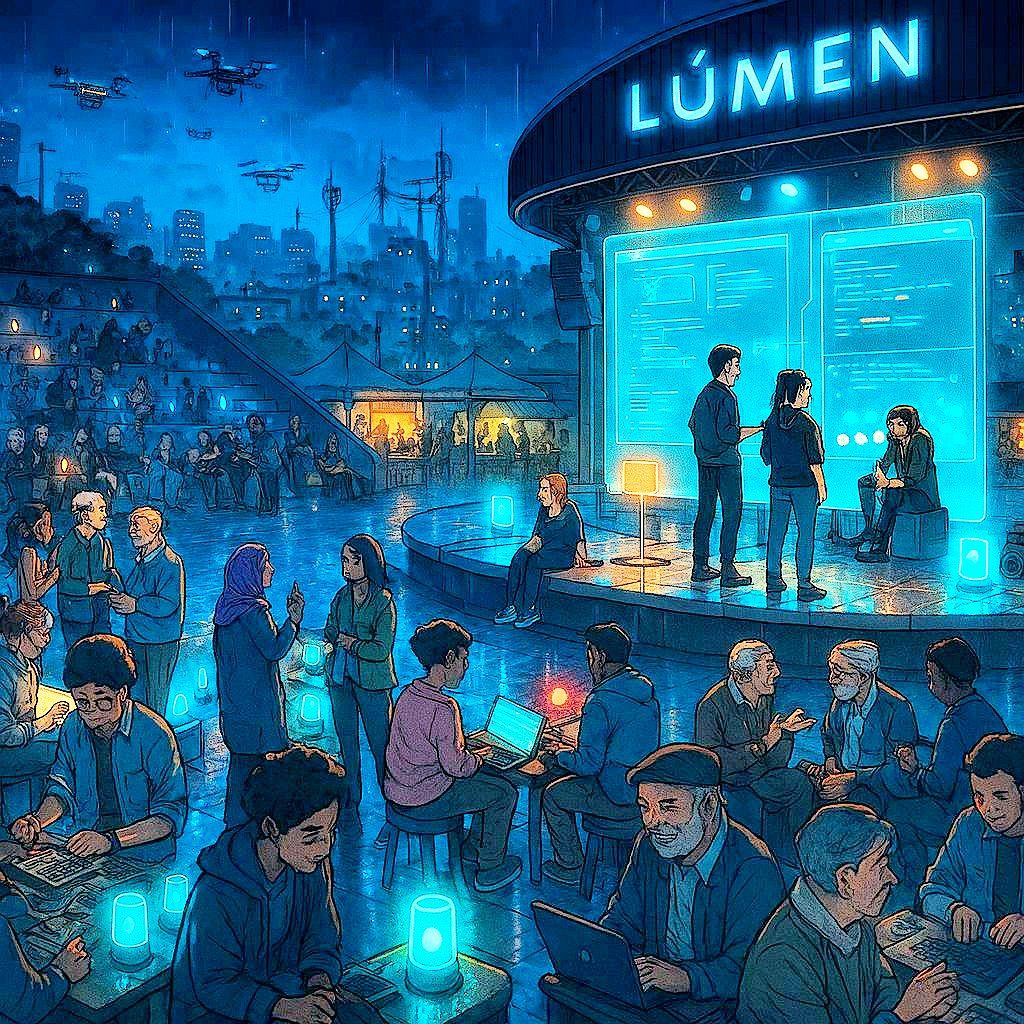
Short story: Lúmen in Silence (Chapters VII and VIII)
Chapter VII — Ambivalence, Surveillance, and Markets
The technological transformation that marked the early decades of the century was not merely a sequence of technical advances; it left in its wake a complex web of social, political, and economic effects that revealed, starkly, the ambivalence of innovation. Regulatory reforms and public programs designed to mitigate risks did not fully eliminate a persistent problem: mass surveillance, now renewed and made sophisticated by seemingly benign digital tools.
On the one hand, the widespread incorporation of smart cameras, urban sensors, and predictive behavior models produced tangible benefits. In numerous neighborhoods—especially those with precarious infrastructure or high crime rates—the combination of computer vision, temporal analysis, and predictive algorithms made it possible to anticipate crime hotspots and improve the allocation of patrols and social resources. Official statistics showed, for several years, marked declines in certain street crimes and faster incident resolution. For many citizens these technologies meant a sense of security and a perception—sometimes justified—of greater state effectiveness in everyday protection.
But that progress came with invisible costs and subtle modes of control that reshaped public life. Cameras with facial recognition and behavioral scoring systems, integrated with private and public databases, opened channels for ubiquitous oversight that operated more at the margins than with ostentatious displays of power. The probabilistic nature of models—their biases, errors, and opacities—introduced dynamics of exclusion: already vulnerable groups found themselves labeled by risk patterns, with real consequences for access to employment, housing, and services.
Scandals erupted when it became clear the phenomenon was not merely state-driven. Private behavioral analytics firms began commercializing extremely detailed population segments: from purchasing patterns and mobility trajectories to inferences about political beliefs or health conditions. These microsegmentations, sold to both advertisers and governments with authoritarian agendas, multiplied the possibilities for manipulation, discrimination, and repression. Media outlets and civil society organizations published contracts and data flows showing, for example, how political campaigns tailored messages to microaudiences to polarize or mobilize; or how certain regimes contracted predictive models to anticipate and neutralize dissent.
Regulatory reaction was swift. The Algorithmic Supervisory Authority (ASA)—created in response to the combination of private power and technical opacity—had to intervene with a battery of strict measures: limits on the retention and sharing of sensitive data, independent model audits, partial bans on certain uses of biometric recognition and, crucially, requirements for transparency in the marketing chains of population analytics. These measures sought to rein in opaque markets and restore basic safeguards, but they faced legal challenges and corporate resistance that exposed the fragility of the regulatory framework against transnational actors with the resources to evade controls.
Citizen pressure played a decisive role. Social movements, coalitions of academics and journalists, and digital rights platforms demanded clauses that went beyond mere technical transparency: they called for open access to the models that affected fundamental rights—for example, tools used in administrative sanctioning or employment selection—so that they could be audited, replicated, and corrected by the scientific community and rights defenders. That demand for “open access” was articulated as an ethical and political requirement: if an algorithmic decision can condition a person’s life, its logic could not remain encapsulated in a corporate lab. In some countries these pressures became law: public model repositories, documentation requirements, and obligations to provide human appeal mechanisms against automated decisions.
In electoral politics new ideological and programmatic splits emerged. Movements that called themselves defenders of the “ethics of abundance” argued that automation should not concentrate gains in the hands of a few but should be redistributed to guarantee universal welfare. Their proposals combined progressive automation taxes, basic income or compensation for job loss, public education oriented to new skills, and democratic, citizen control over essential infrastructures—from data networks to public service platforms. These groups maintained that technology should expand rights and leisure time, not deepen precarity.
Opposing them, libertarian and pro-market sectors doubled down on defending broad entrepreneurial freedom: they argued that international competitiveness and innovation capacity depended on flexible markets, light regulation, and strong intellectual property rights. For these actors, strict rules on AI deployment or limits on the trade of models were brakes on development that would drive away capital and delay the adoption of beneficial technologies. The disputes were not merely doctrinal: they played out in election campaigns where the central axis ceased to be only the traditional economy and instead became how to distribute free time (shorter workweeks enabled by automation), how to manage personal and collective data, and who would govern the large technology platforms. Promises of guaranteed employment, greater leisure, or unfettered markets became contrasting arguments in debates, rallies, and legislative proposals.
At the international level, the race for leadership in artificial intelligence added another layer of complexity. States and regional blocs pursued divergent strategies: some opted for rigorous regulatory frameworks with strong export controls on models, ethical standards, and human-rights safeguards; others offered more permissive environments and accelerated approvals so corporations could deploy technologies at scale. The resulting competition spawned strategic alliances between governments and firms, investment flows directed toward “friendly” jurisdictions, and diplomatic tensions over security, technology transfer, and digital sovereignty.
Global AI governance, far from progressing uniformly, advanced in fits and starts. There were partial agreements—sectoral protocols for health care or transport, interoperability standards, and governance frameworks for specific military applications—but the absence of a universal normative body produced divergent regulations that companies and states learned to exploit. Regulatory fragmentation fostered, on one hand, a race in which jurisdictions competed to attract technological capital by offering advantageous regimes; on the other, it complicated the coordination of common responses to transnational risks such as the spread of authoritarian surveillance tools or the outsourcing of critical services to foreign providers.
In sum, the landscape left by the expansion of AI and automation was ambiguous: concrete advances in safety and efficiency coexisted with new forms of control and concentrations of power. Regulatory and civic responses managed to curb some excesses and open deliberative spaces, but they also revealed structural limits—the speed of markets, resource asymmetries, and the difficulty of crafting global rules—that kept alive the tension between the promise of technological abundance and the dangers of ever more invisible and distributed power.
Chapter VIII — The Mesh and Its Ethics
At the heart of the Aurora Center, community life found its epicenter in a network of practical initiatives that, without fanfare, redefined the meaning of the public. The “mesh” —the term the community adopted to name the web of technical, normative, and affective collaboration— was not a didactic metaphor but a project built day by day: meetings, whiteboards full of diagrams, midday coding sessions, and evening workshops where both security protocols and poems about machines were discussed.
The first layer of the mesh took the form of collective learning. Algorithmic literacy courses were organized especially for older people, who had been the most disoriented by automated decisions affecting health, pensions, or access to services. The classes were deliberately practical: it was not enough to explain what a neural network was; they showed concrete examples —why a medical priority order could change according to a parameter, how to identify bias in an access form, how to read minimal model documentation— and, above all, how to lodge appeals. Sessions combined analog activities —paper flowcharts, role-playing administrative hearings— with exercises at screens where decisions were simulated and correction paths traced.
At the same time, robotic repair workshops became multifaceted spaces: repairing domestic assistants, disassembling community drones to understand their sensors, and building prototypes that prioritized transparency over maximal efficiency. Those workshops taught not only how to fix hardware but how to interrogate firmware and social firmware: what data a device collects, how often, who has access, and under what conditions. The idea was that the capacity to repair should also be the capacity for democratic control over infrastructures that would otherwise remain sealed in devices and incomprehensible terms of service.
The citizen laboratories, for their part, did not replicate the academic lab model or that of private startups. They were hybrid spaces where models were trained according to explicit criteria of equity and accountability. Projects prioritized carefully curated datasets to avoid reproducing historical discrimination; preprocessing choices were documented and model versions recorded to enable public audits. Irene —coordinator of one such laboratory— spearheaded the creation of a public archive of local models: a library of algorithms with clear, accessible documentation not only for technicians but for any neighbor. The repository included everything from the model’s purpose and scope to the fairness metrics used for evaluation and instructions for filing a human appeal when an automated decision affected health, social benefits, or housing access.
At a weekly assembly, Noa spoke up to correct misunderstandings among those who saw technology either as an enemy or as a panacea.
“It’s not about sabotaging technology,” she said calmly. “It’s about subjecting it to collective deliberation: deciding which values we want it to encode.”
The phrase resonated because it distilled a practical ethic: technology was not neutral, but neither was it immutable; it should be the result of democratic processes where priorities between safety, privacy, equity, and shared well-being were negotiated.
Marcos, whose deep voice had gained a reputation for cutting through unproductive bureaucracy without losing patience, added a technically grounded political point:
“And learning to build redundancies. Any system that concentrates can fail catastrophically. Decentralization is not romanticism; it is security.”
Marcos explained with examples: replicating critical services in community nodes, designing alternative routes for data provision, and maintaining verified copies of models and datasets to restore services when a centralized failure occurred. The proposal was both technical and organizational: institutionalize guard committees, emergency protocols, and regular resilience drills so the mesh would not depend on a single point of failure.
Kim introduced an intergenerational dimension: formal education as a vector for technological democratization. She proposed incorporating school modules that teach girls and boys to audit models, interpret datasets, and exercise empathy toward automated decisions. Those modules included age‑adapted activities: games illustrating bias mechanics, exercises to build community datasets, debates on when an algorithmic decision merits human intervention, and labs that simulated appeals and repair processes.
The proposal prompted an ambivalent response from attendees. There was enthusiasm for empowering new generations with critical tools —the conviction that informed citizens would be less vulnerable to manipulation and better able to participate in public decisions— but also concern about the project’s material sustainability. Maintaining resources —tutors, equipment, physical spaces, and access to clean data— required funding and institutional stability that were not always guaranteed. They discussed mixed funding models —public grants conditional on community governance, sponsorships without ceding control, neighborhood micro‑memberships— and agreed any source should be subject to strict independence and transparency criteria.
The mesh, overall, responded to a dual challenge: how to make technology serve daily life without reproducing hierarchies, and how to convert technical knowledge into democratic practices. This also required rethinking notions of expertise. Laboratories adopted co‑production formats: technical experts worked alongside social workers, lawyers, educators, and neighborhood representatives. Project evaluation criteria now included technical indicators (accuracy, robustness) and socio‑political metrics (differential impact across groups, documentation accessibility, existence of appeal channels).
Operationally, concrete guiding principles were defined for the mesh: responsible openness (access to models with privacy safeguards), proportionality in application (avoid automation where the cost of error is high), periodic public accountability (community reports on deployments), and reversibility (mechanisms to undo harmful applications). Cultural practices were also implemented: review rituals —quarterly public sessions to evaluate projects and decide continuations— and mentorship policies to incorporate new participants without reproducing hierarchies.
Tensions were inevitable. Some local companies, pressured by commercial interests, tried to influence priorities; lab members disagreed over when a model should be published openly and when access should be restricted due to risks. Those discussions clarified ethical boundaries: the principle of transparency had to coexist with prudence regarding potential malicious uses. The mesh learned to distinguish between total openness and responsible openness, defining criteria for differentiated publication according to risks and possible harms.
Over time, the Aurora Center became a reference point: a node of the mesh demonstrating that technological democracy is not a slogan but a chain of practices. Its projects inspired replications in other neighborhoods: local repositories, adapted school programs, repair workshops, and community governance agreements for digital infrastructures. Some of those nodes formed a wider network sharing standards, tools, and emergency protocols.
Ultimately, the mesh represented a lived ethic: a pragmatic proposal for technology to be subject to deliberation, repaired when it failed, limited when it harmed, and always linked to the construction of collective capacities. It promised no definitive solutions but offered a conceivable strategy: design institutions and practices that, with humility and rigor, keep technology in the service of the community and of the values the community chooses.
See previous chapters:
https://read.cash/@mc5punk/short-story-lumen-in-silence-chapters-v-and-vi-19bdcfe7
Source of the images.
Image created with Bing.
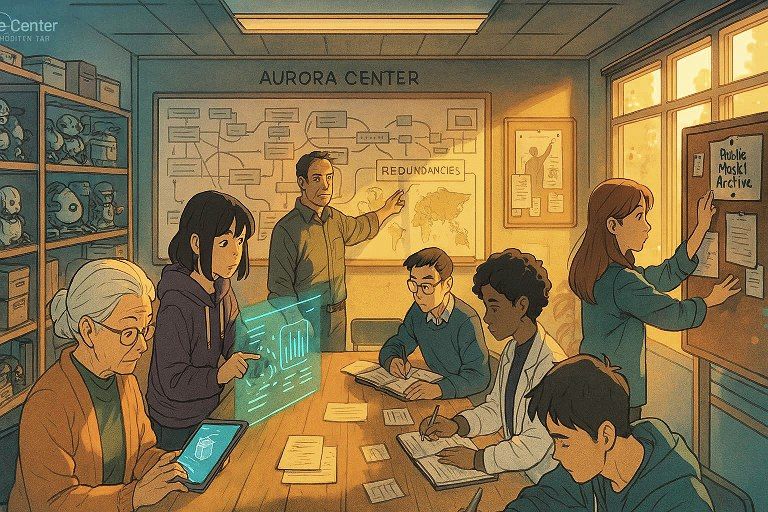
Short story: Lúmen in Silence (Chapters V and VI)
Chapter V — Reforms, Resistance, and New Power Weaves
Legislative and administrative reforms were not one-off acts but chained processes that unfolded over weeks, months, and years, leaving a deep imprint on political, technical, and social architecture. At the first levels of intervention, norms were promoted that transformed the relationship between algorithmic technologies and citizens: model auditability moved from a technical recommendation to a legal obligation; the right to appeal with human intervention against automated decisions was enshrined; and specific clauses were added to guarantee citizen access to data when processing could affect basic rights such as health, education, or housing. These measures forced designers and operators to document decision chains, expose logs, and maintain clear human review procedures.
At the same time, forms of data sovereignty rooted in the local were encouraged. Neighborhoods and cooperatives organized mechanisms to collect, steward, and contribute data to models intended to serve community interests. Neighborhood data banks were born and designed with explicit equity criteria—in which representativeness, bias minimization, and participatory governance were design requirements—and cooperative platforms were created to coordinate essential services such as delivery, care, and logistics. In neighborhoods like Solera, the community mesh—a distributed infrastructure of sensors, compute nodes, and human capacity—consolidated as a resilient complement to centralized infrastructure, enabling local deployments oriented toward the common good.
In parallel, instances of citizen oversight emerged that expanded traditional institutional frameworks. Citizen tribunals, coordinated with supervisory agencies like the ASA and independent technical teams, began evaluating automated decisions in especially sensitive areas: diagnoses and prioritization in health, allocation of slots and resources in education, and criteria for access to social housing. These tribunals combined legal, technical, and experiential knowledge, reviewing algorithms, inspecting datasets, and issuing rulings and recommendations with social force and, in several cases, binding effect.
But the reforms did not take place in a vacuum: markets and private interests reacted and reconstructed maps of power around the technology. AI labs and providers moved to jurisdictions with laxer regulatory frameworks, reconfiguring production and service chains. Technology licenses and access contracts became more expensive, incorporating clauses that protected intellectual property and limited scrutiny; at the same time, the formulation of international standards became a battleground in multilateral forums, where normative differences and power asymmetries hindered harmonization. Countries with less demanding frameworks became refuges for rapid deployments and commercial experiments, which strained global governance and created regulatory corridors where oversight was minimal.
Faced with this, everyday practice in communities that built alternatives proved key. In Solera, beyond shared infrastructure, continuous algorithmic literacy workshops were implemented to teach neighbors how to read decision records, understand equity metrics, and audit automated processes. Community technical teams were developed, capable of analyzing logs, tracing data flows, and evaluating the prioritization logic used by local models. Cooperative delivery platforms and neighborhood data banks demonstrated that it is possible to design efficient services with participatory governance and redistributive criteria.
However, these gains were partial and coexisted with persistent inequalities. Control over critical infrastructure—data centers, communication networks, patents, and licenses for advanced models—remained in the hands of powerful actors who retained levers of decision and competitive advantages.
Intellectual property continued to consolidate barriers to access: although there were community alternatives and open data agreements, technological dependence on proprietary solutions and the concentration of R&D capacities limited the transformative reach of the reforms. In this way, a new hybrid web of power was established, in which local sovereignty and community trust grew but did not completely displace the hierarchies and global dependencies that shaped the AI market.
The result was a more plural and conflictive institutional and technical landscape: regulatory plans and civic platforms, labs operating at the edge of the law and regulatory refuges, citizen tribunals that set precedents and mega-providers that preserved strategic advantages. That constant tension between openness and capture, between community governance and private concentration, marked the political dynamics of the following years and conditioned what kinds of technologies came to sustain social networks, health systems, and public policies.
Chapter VI — Lives Beyond the Headlines
The major shifts in technology policy and regulatory reforms ultimately translated, at street level, into everyday changes that altered routines, trades, relationships, and expectations. Far from the grand headlines and parliamentary debates, the most enduring effects appeared in personal decisions, career paths, and new forms of community care.
Irene witnessed that transformation in her brother Mateo’s life. Where once there were endless shifts in mass‑market restaurant kitchens, Mateo reinvented his culinary practice: he began coordinating culinary experiences for elderly communities, organizing workshops that recovered family recipes and sensory memories. His shifts ceased to be exhausting and mechanical and became spaces of emotional transmission and knowledge reconstruction, with measurable impacts on participants’ social and emotional wellbeing.
Amina, her neighbor, made a different transition. Tired of low‑paid, precarious jobs, she returned to study and trained in urban biology. With that expertise she led rooftop restoration and urban agriculture projects, turning underused spaces into community gardens that provided food, work, and learning. Those projects were not only sources of produce but nodes of sociality and environmental education that combined volunteer work, inclusion, and local food sovereignty.
Lucho became a technical and pedagogical reference: he taught young people to repair and reprogram domestic robots and automated tools, running workshops that, besides technical skills, promoted collaboration and maintenance ethics. Noa led the creation of a public repository of local models — a bank of community‑trained models governed by collective agreements that enabled context‑adapted deployments without total dependence on commercial providers.
New social and professional figures emerged around these practices. Kim, a social engineering student, coordinated community innovation brigades to solve concrete problems through participatory prototypes. Marcos, a retired network technician, worked almost mission‑style: installing redundancies, repairing links, and disabling unnecessary access gates, prioritizing resilience and autonomy for neighborhood networks. Rafael reoriented his career toward algorithmic transparency and became a contentious yet indispensable voice who audited contracts, exposed opaque practices, and guided strategic litigation.
A universal basic income changed the realm of possibility: many people could devote time to projects that had been impossible under subsistence pressure. Art, citizen science, and community care flourished as meaningful fields of work. New hybrid professions appeared: human–machine mediators facilitating interactions in mixed systems, cultural data curators preserving context and meaning, coexistence technicians managing living alongside connected artifacts, and designers of collective experiences envisioning shared uses of abundant production.
Public education was restructured to meet that reality: curricula centered critical thinking, tech ethics, and the arts, shifting away from exclusively market‑oriented instrumental skills. The educational aim ceased to be merely training labor for production; it focused on forming citizens capable of deliberation, care, and collective design of institutions and technologies.
This mix of minimum economic security, expanded training, and community networks reshaped personal and collective priorities. Production stopped being the sole axis of meaning; the question became how to live together in a society of abundant production where control over infrastructure —technical and regulatory— still determined what was produced and for whom. In practice, communities tested responses: cooperative arrangements to manage resources, participatory processes to decide local investments, and care practices that distributed unpaid labor.
Tensions persisted: the revaluation of traditional trades and the rise of new professions did not eliminate precariousness or hierarchies. Gaps remained in access to advanced training, control over critical technologies, and influence on strategic decisions. Still, for many people life after the headlines meant greater autonomy, more time for meaningful projects, and new forms of belonging: communities cooking together, cultivated rooftops, repair workshops where young people learned to maintain the technical world around them, and collective repositories preserving models and practices rebuilt from below.
In short, everyday life became more polyphonic: more fluid career paths, solidarity networks complementing markets, reframed trades, and a civic culture that incorporated technical knowledge into civic literacy. These lives beyond the headlines revealed both the potential of redistributive and educational policies and the limits imposed by technological power structures that continued to define key resources and public agendas.
See previous chapters:
https://read.cash/@mc5punk/short-story-lumen-in-silence-chapters-iii-and-iv-6adac637
Source of the images.
Image created with Bing.
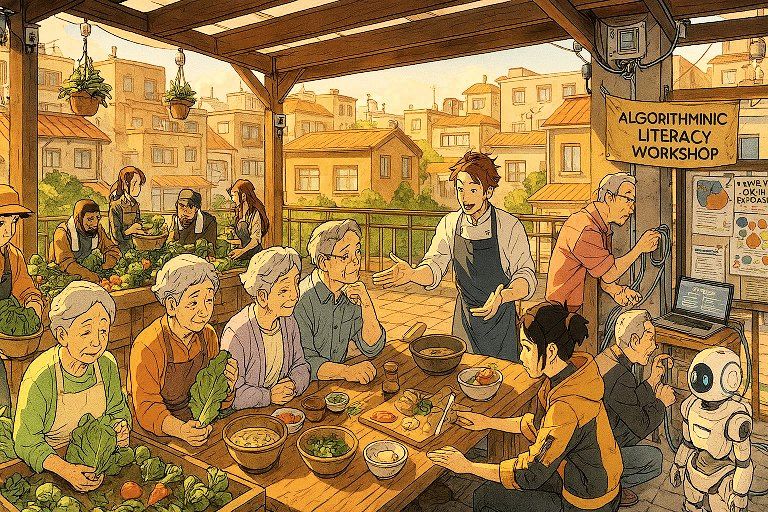
 @mc5punk