 @mc5punk
Short story: The Form
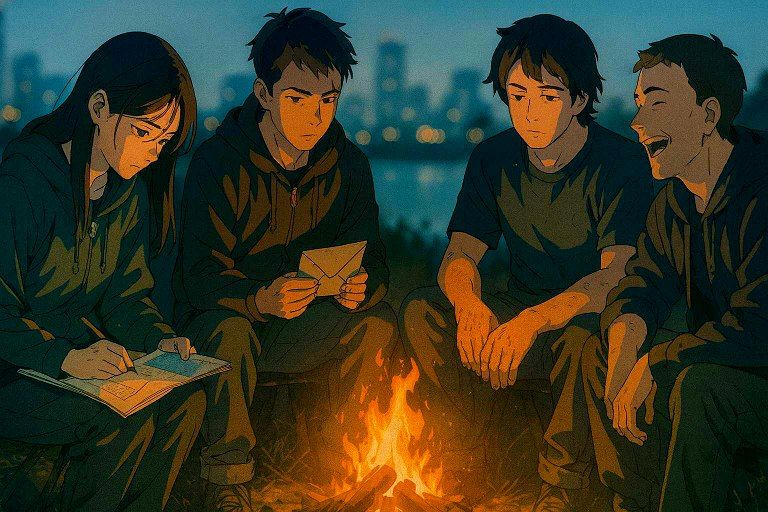
The letter arrived on an afternoon when the city seemed to hold its breath. The building’s mailbox spat out a gray envelope that, when it touched Lina’s home, seemed to chill the whole kitchen. She held it against her chest for a few seconds, as if the paper were an injured creature that might tear with a sudden movement. On the front there were no liturgies or beloved names: only a question printed, calculated to open private locks. Would you be willing to do military service? Inside, the sheet unfolded in administrative language what the question intimated. Dates, boxes for personal data, a space for a signature and an appointment for a medical examination. “All those born in 2008 and subsequent years must complete this form upon reaching the age of majority,” read the paragraph in that neutral voice that pretends not to demand. “Authorities will verify the physical and psychological capacities of the youths. Afterwards, they will decide whether to enlist or not; for now, military service is voluntary. However, the government will maintain an official register of potential recruits.” Lina set the envelope on the table and called Pavel because she needed to hear someone’s voice that wasn’t the State’s. “Did you see it?” she asked, phone pressed to her ear. “Yes,” Pavel replied with the certainty of someone repeating a slogan he wanted to be true. “I wouldn’t do it under any circumstances. And if they forced me, I’d try to declare myself unfit for health reasons.” Pavel was sixteen and had a scar on his eyebrow that marked his forehead like an old decision. That morning his reply sounded angry and steady; at night, in the room where he collected maps and cut out routes, the same phrase could fray into doubts. For most of his classmates, the answer seemed almost a group duty: saying no was a way to mark distance from a power that now wanted to file their bodies and minds. Adrian, who had not yet turned sixteen, had been listening to the conversation from a distance, sitting on a park bench with a strip of sawdust between his fingers. His hands were those of someone who worked wood—calloused and sure—and his gaze belonged to someone who had learned to measure things patiently. When asked what he would do, he shrugged and spoke with the calm his craft gave him: “I’d do it if they forced me. Not out of patriotism or exaltation, but because it’s easier for me to give in than to expend energy on a fight that might not win anyone anything.” At Lina’s house the conversation became a kind of surgical operation of opinions. Her mother recalled stories of her own father, young in darker times, who returned with empty pockets and a closed mouth, and spoke of duty and civic service. Her father, however, eyed the envelope suspiciously: a register like this, he said, smelled of bureaucratic control. “Saying no because you believe it is not the same as doing so out of laziness,” he murmured. “This is not just politics; it’s people’s lives.” Lina listened without intervening, feeling that the question was less an interrogative than a demand: fill in the box, show up for the exam, the State records you. The idea of the medical exam conjured an image of a white room, a lab coat, gloved hands that palpate and interrogate. She thought that no form ever asked about dreams; only about measurements, sizes and aptitudes. At school the social worker explained the procedure in a voice that seemed to read from a manual: personal data, physical tests, psychological interviews. Students took notes—some out of duty, others out of curiosity. Hallways filled with jokes about uniforms and orders; other adolescents were silent, faces closed in their own thought. One afternoon, on the soccer field, Pavel stumbled and fell. He laughed as he rubbed his knee, joking about bad luck. “If health counted as an excuse, I’d be saved already,” he said in a tone meant to ease anxiety. “You could fake a chronic injury,” suggested a friend, and laughter softened the worry. But when night came and the city lights turned on with a deceptive calm, Pavel found himself holding the imaginary form and thinking of the box that could seal his future. Lina turned to her maps; the strokes in the margins of her notebooks were routes that never reached a destination because the idea of leaving both paralyzed and invited her. She proposed alternatives: nursing, rescue brigades, civilian training. “What’s the difference between caring for an injured person in a disaster and obeying orders in a camp?” she asked one evening. “Intention and hierarchy,” her mother replied. “When it’s an order, the margin for choice is reduced.” Politics inevitably crept into everyday life. On television, parliaments debated: security, cohesion, planning. In the squares, activists denounced the registry as a threat to privacy. “If you control who can be part of the forces, you control part of the future,” said a deputy in a debate Lina watched pressed to the window glass. A minister answered that foresight was not control but responsibility. Words clashed, tense as the threads of a net that no one wanted to see hanging. The day of the first medical review smelled of antiseptic and stubbornness. Young people in the waiting room watched the clock as if each tick brought a sentence: some with defiance, some apathetic, a few panicked. Doctors took notes; psychologists asked oblique questions that brushed identity: “What moves you? What paralyses you?” Pavel answered with what had always driven him—maps, station names, the sounds of trains at dawn. “I’m afraid of losing the freedom to choose,” he confessed, in a voice not used to exposure. The psychologist wrote it down, observed with the equanimity of someone issuing results, and concluded: “You do not present mental disorders.” It was a cold administrative finding, not a deep reading of the soul. When Pavel left the office he felt that the phrase permitted some things and denied others with equal force. Meanwhile, the administration cross-referenced data: heights, repetition counts on physical tests, psychological results, records. The register grew like an ordered shadow. Society began to split into camps and echoes. Some applauded the opportunity for employability and training. Others saw in the file the materialization of an all-seeing eye. Debates jumped from parliaments to bars to classrooms. “With proper use, it could be linked to education and job programs,” argued an official on a news segment. “It’s not punishment; it’s a tool.” “Or a checklist for discrimination,” replied an activist on the same panel. “Where do you draw the line between prevention and surveillance?” On the riverbank, the friends gathered the night before Adrian’s sixteenth birthday. They made a fire with wood that smelled of sawdust and cheap beer. The flames cast faces like temporary sculptures. They talked, laughed, argued from calm to anger, but kept circling the same idea: there would not be a single answer. “If I have to do it, I’ll do it,” Adrian said, watching the flames. “I’m not looking for grandeur. I want to know if I can hold the responsibility put in my hands. If it’s a test of character, I’m not afraid to lose it.” “And what if they ask you to obey without sense?” Lina asked. “Then you learn to ask questions,” Adrian replied. “You don’t obey blindly. You try to understand what they ask.” The first cohort of volunteers that signed up disproved both comic and tragic stereotypes. They included technical students, youth seeking discipline to escape precarity, young people hoping to finance studies. They returned with stories tasting sometimes of camaraderie: nights shared in rain, hands learning to suture, radios crackling in remote camps. Others came back with doubts: orders they couldn’t understand, exercises in obedience that clashed with their moral sense. “They taught me how to calm someone who was bleeding,” a returning woman said. “That left me more than any speech about the homeland.” “I did it to save money for university,” a young man confessed. “It wasn’t heroism. It was need.” Pavel, faithful to his caution, stayed on the margins tracing routes and avoiding seals. He didn’t sign until he understood the consequences. Lina enrolled in a first-aid course at the community center and, after an intense practical session where the gap between theory and blood narrowed, said in a small voice: “Helping doesn’t need a uniform; it needs hands that know what to do.” Adrian submitted his form in due time, with the same meticulousness he used to measure a plank before cutting it. He went to the exam with the calm of someone who doesn’t seek heroics but does seek options. “If I must, I will present myself,” he told the psychologist. “I don’t seek glory or hatred. I seek alternatives.” Public and private life slowly dissolved the novelty into routine. For many, the process became an old paper; for others, it opened doors: training, scholarships, jobs. The registry continued to grow, often invisibly, archived on servers with names and numbers. There were complaints and promises, fears unspoken and reforms slow to arrive. Protocols were proposed to prevent discrimination; assurances were made that the data would be used only for planning. Promises were renewed with the familiar fatigue of politics. Within the friends’ group the fracture persisted but became less loud—more ordinary. Some enlisted out of conviction, others out of pragmatism, quite a few out of curiosity. Others simply said no and continued their days as if the boxes had not touched their pulse. Each decision was a small catastrophe or a triumph depending on the lens used. The gray envelope ended up relegated to a drawer in Lina’s desk. Sometimes she took it out, unfolded the blank sheet, looked at it, and folded it again. It wasn’t regret she felt—it was the calm of someone who keeps a map she doesn’t have to follow. Pavel visited one afternoon while the letter lay on the table. “Do you regret it?” he asked quietly. “No,” Lina said. “I just know that a box doesn’t define a life.” The city’s noise continued: cars, sirens, voices crossing the night. In bars, workshops and online forums, the young argued, loved, worked and erred. There was no single generational answer. What emerged, with the slow movement of tides, was a more uncomfortable truth: the State’s question had opened a frontier where each young person picked a stone to stand on. Some chose discipline, others rebellion; some, opportunity; others, indifference. There was no unanimity—only multiplicity. The true drama did not lie in the form or the registry, but in the way the daily lives of those youths were subjected to decisions that mixed fear, hope, convenience and desire. Each story was a branching off from the same question: choose, yield, resist. And within that diversity was the hardest and most human lesson: adulthood brings papers and obligations, yes, but also a field of possibilities where no box can contain the complexity of a life. Source of the images. Image created with Bing.
No comments yet