 @mc5punk
Short story: The Silence of Montclar
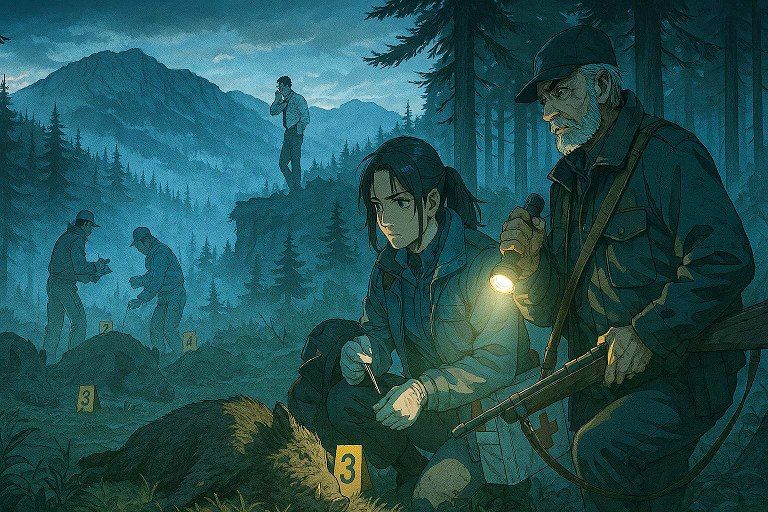
The Montclar range rose like an ancient scar on the horizon: a succession of ridges and ravines where the wind seemed to carry the memories of whole generations. The pines, black and upright, drove their shadows into the parched earth; the trails, worn by footsteps over decades, vanished among bushes and stones. In winter the fog descended like a heavy curtain; in summer the silence was so dense that any sound felt like a blasphemy. The dawn when everything began, the fog came thick and cold, falling over the mountain like an old veil. Héctor, a forest warden who had been born in a stone cottage halfway up the slope, walked with his flashlight in hand following the trail of a wild boar seen the night before near the Bellido farmhouse. He had spent more than thirty years marked by the loneliness of the paths and by the habit of listening before speaking. That morning something chilled his blood: the animals he found were not like the dead boars sometimes seen in the area, victims of collisions or territorial fights. They lay scattered, as if death had arranged its own sowing. “Héctor, come carefully,” Ana, the veterinary officer at the post, called from the track, young but with steady hands. “Don’t touch anything without gloves.” Ana arrived in the van and unpacked the equipment with the precision of someone who had practiced the same gestures a thousand times. She examined the bodies, the postures, the absence of external wounds that might explain such sudden and uniform endings. “These aren’t wounds,” she murmured, presided over by a professional calm that allowed her to say what others felt. “This isn’t an accident. It’s probably pathological. Take samples, mark coordinates, and notify the Ministry.” Héctor shook his head. His eyes, used to the murmur of the mountain, now searched for causes in the folds: fresh tracks that faded away, scraps of skin caught in brambles, a trail of droppings that lacked the normal pattern of wild animals. All of this smelled of something larger than an isolated death. The news traveled up the paths to the village like a glowing coal. In Montclar, the plaza that had once been a market and now served as a meeting point, people gathered in low voices. Theories wound in the dusk: some spoke of poison, others of a poacher, others merely commented on the inexplicable. Marta, one of the area’s farmers, listened with her hands shoved into the pockets of her apron, feeling a cold thread coil in her throat. “If this reaches the pens, I don’t know what I’ll do,” she said, voice bitten by fear. “These animals are my work, my inheritance. If I lose them, I lose everything.” The rumor reached the Regional Department of Agriculture and Natural Resources desk like a file on a table: notification of possible cases, coordinates, blurry photos and, above all, insistence that the matter be handled urgently. Marcos Vidal received the call with a mixture of routine and something he didn’t know whether to call worry. It wasn’t the first time he had faced the possibility of an outbreak: the region had dealt with diseases and alerts before, but the responsibility weighed heavier each time. With headquarters pressing, he coordinated the dispatch of a technical team and scheduled an interview with the local station to inform the population without causing alarm. When he arrived at the site where the wardens had worked, Marcos got out of the car with the broad, steady look that sometimes comes to those who have learned to contain their reactions until they have the facts. He approached the bodies with the attention of a man who knows that every detail has both administrative and human weight. “What do we have?” he asked, containing in the question the urgency of someone who mustn’t rush. “Four specimens,” Ana replied, pointing to the marks. “They’re in the same area as the two found a few days ago. We’ve taken samples and sent them to the regional labs,” she explained. The interview on Radio 1 had to be measured. The presenter, whose voice was known for bringing calm to the lunch hour, connected with Marcos for facts to relay with prudence. “Mr. Vidal, can you explain to people exactly what is happening?” she asked professionally. Marcos, aware that every word could open doors of alarm or of calm, spoke with the firm voice of someone juggling truth and public reassurance. “We have detected four possible new cases of African swine fever in wild boars. They were found dead in the same area as the first two in the Montclar range. Samples have been sent to the regional laboratories and national institutions are pointing in the same direction, although we are awaiting validation from central services,” he said. The phrase fell into homes like a blow under the covers, stirring a buzz that became a rumor. In the regional laboratory, Lorena, the chief microbiologist, worked beneath the cold light of analyzers and with the tension of someone interpreting figures that could mean far more than a piece of paper. Internal tests indicated compatibility with African swine fever, but definitive confirmation required validation from the central laboratory, a process that by its nature demanded protocols and time. “We ran the PCRs and the results are compatible,” Lorena told Marcos on the phone. “The correct procedure is to request validation from the central service. We cannot issue a definitive public confirmation until they do.” “How long will that take?” asked Diego, a field technician, impatient like someone who sees disease advancing while decisions lag. “I don’t know,” Lorena answered honestly. “It can be hours or days. It depends on workload and the shipping and analysis protocol. We will continue collecting data and controlling the perimeter.” Meanwhile, in Montclar’s streets the uncertainty acted like yeast that transformed coexistence. Phones rang with news, photos, questions and pleas for help. The mayor, a middle-aged man used to crafting phrases that cushion blows, organized an initial support device: disinfectant supplies, informational posters and a team of volunteers to assist with tasks not requiring technical intervention. “We need people to remain calm and follow official guidance,” he declared at the Town Hall door. “If you find a dead animal, do not touch it—notify the wardens and keep your distance.” In the days that followed, the mountains seemed to thicken. Dogs howled with a cadence no one remembered, like a primitive alarm. Some neighbors said they had seen lights among the vegetation at night, shadows moving with an odd rhythm. People’s imaginations ran fast in the ready engine of fear: the unknown filled itself with figures, rumors, stories born on the corners. Misinformation spread at the speed of someone finding a hole to slip through: videos without context, alleged anonymous testimonials and theories ranging from the plausible to the absurd. Social networks, saturated with half-truths, put the village in the spotlight for curious and alarmists alike. Radio remained the most reliable instrument for many; Marcos’s voice, replayed in different formats, tried to impose serenity without hiding the severity. Measures were implemented with a pendulous rhythm between urgency and waiting: reinforced surveillance in the mountains, restricted access to some zones, bolstered biosecurity protocols on farms and, above all, a recommendation not to move animals outside the area until official validation was obtained. Nights, however, filled with whispers. Some residents recounted seeing trucks at dawn, people speaking rapidly in parking lots or doors creaking. None of those stories were confirmed; they were imaginations lit by tension. Marcos spent many hours beside his desk, receiving reports, answering calls, coordinating with the regional lab and seeking ways to speed up communication with central services. He knew that a delayed confirmation could allow the problem to spread; he also knew that an unwarranted alarm could destroy the area’s economy. It was a fragile balance. “We can’t make mistakes,” he told Ana one night in the technical post’s kitchen. “If we raise the alarm without solid proof, we do harm. If we delay, the harm might be worse.” “I know,” Ana replied. “But every hour brings us closer to the possibility of this crossing into farms. We need you to request expedited validation, to get resources sent.” The central lab’s results arrived at last, after a bureaucratic process that for villagers felt like an unbearable string of minutes. The confirmation, when it came, was cold and blunt: positive for African swine fever. With that document in hand, the authorities activated planned measures: selective quarantines, strict control of animal movement, sanitary culls where necessary, and a decontamination operation for facilities. The news fell on Montclar like freezing rain. There were tears, painful choices, farewells. Marta had to surrender some of her animals for sanitary culling; she did so with the resignation of one fulfilling an obligation that shattered her inside. The mayor, who had promised support, secured emergency aid and coordination with higher bodies, but the sense of emptiness in the pens felt like a wound in the landscape. Compensation programs and aid were activated, but emotional recovery took longer. Conversations in the plaza shifted from speculation to survival: how to resume production, where to sell, how to keep the land clean. Daily life was invaded by a disinfecting routine: boots soaked in bleach buckets, trucks sterilized, temporary fences raised across former free paths. The mountain, once a source of food and shelter, became a monitored territory. Nights brought new stories and with them a mixture of fatigue and vigilance. Some neighbors reported dogs disappearing, a sense that the mountain had become more private. Others noticed that young people who left to study in the city didn’t return as often; the economic and social impact stretched beyond the loss of animals. There was a withdrawal: fewer celebrations, fewer gatherings, a contraction of sociability felt in the length of glances. At the operations center, Lorena and her team worked tirelessly, processing samples, updating protocols and advising on containment bands. Field technicians continued patrols, marking zones and collecting any signs. Institutional cooperation was strained and strengthened in equal measure as necessity demanded. Mobile units provided guidance to farmers on biosecurity measures, delivery of supplies and reporting procedures. Toward the end of that cycle of days, with measures in place and the mountains under intense surveillance, life regained a new kind of routine. It wasn’t the calm of before or a full return to normality: it was an adaptation. Pens were cleaned more rigorously, children’s backpacks carried disinfectant, local markets operated with schedules and distancing. The local economy received aid but also learned to live with risk and the need for protocols. Marcos, who had spent sleepless nights and countless hours on the phone, walked one morning along the mountain’s edge. He observed the landscape, now marked by intervention: warning tape, checkpoints, official vehicle tracks. He stopped in front of an old pine that had seen better days and, without realizing it, sat on a rock. Ana appeared at his side, soles muddy and offering a cup of coffee in silence. “We did what we could,” Ana finally said, voice worn but steady. “There were losses, yes, but we also protected many who could have lost everything.” “It’s not consolation for those who lost,” Marcos replied. “But it comforts me that people didn’t give up—labs that worked, wardens who kept going, neighbors who helped.” The mountain continued its immutable rhythm: rain, sun, seasons rolling on with indifference. Montclar remained as a before and after in collective memory. The bodies found that dawn and the chain of decisions that followed became part of the village’s history, not as an isolated tragedy but as a demonstration of how a community mobilizes when the unexpected arrives. In the months that followed there were information campaigns, biosecurity courses and revised protocols. Some farmers sold or rebuilt their operations; others adapted and stayed. Life went on, with an awareness that nature, in its unpredictability, can exact a toll in the form of disease and that preparedness, coordination and solidarity are the best defenses. And in the mountain, where fog returned to the paths each morning and afternoons smelled of resin and earth, a new silence remained: that of hard-to-erase scars, but also of a territory learning to care for itself and, between watches and guards, to look ahead. Source of the images. Image created with Bing.
No comments yet