 @mc5punk
Short story: The Flame in Lian Yue
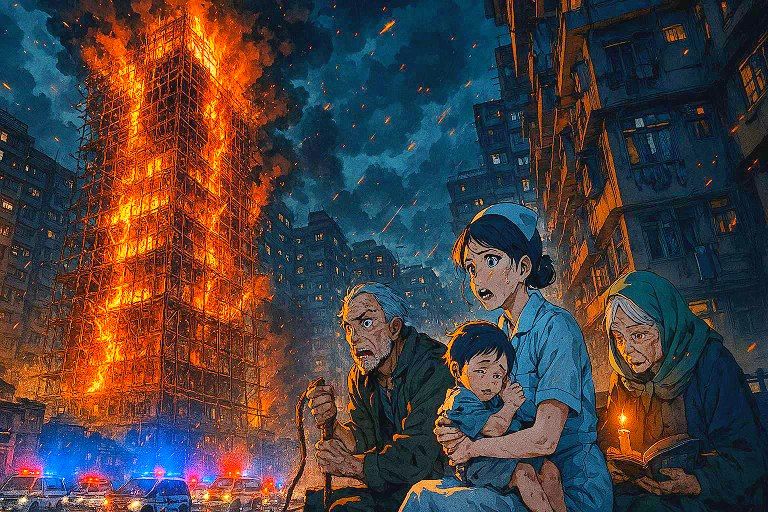
The afternoon tilted with a wind that smelled of salt and metal. Lian Yue—a cluster of towers that had grown in fits and starts between narrow streets and noisy markets—breathed its routine: doors closing late, cables crossing balconies, workers laboring until the light thinned. That familiar breath gave its inhabitants a sense of security; even precariousness had become part of everyday life. That confidence was the first thing to break when a tiny, impatient spark touched the dry bamboo of the scaffold on Block C. Hao Chen thought he saw it. He had spent decades building and repairing; he knew planks and knots, the way bamboo flexed under wind. That afternoon he was tightening a rope while a young laborer packed up tools. The crack he heard did not fit the choreography of their work—it was a dry, brief sound, an omen. The small flame kissed the joint of a metal bar and a bamboo pole. In seconds the wood became fuel. No one in the building was ready for it: minutes stretched as if time itself had been pulled taut, and in that stretch the fire learned to run. From the twelfth floor, Liam, eight years old, watched the façade as if it were a moving painting. His mother pressed her forehead to the glass, eyes wide with disbelief. At the community clinic, Mei Lin set down her instruments and answered the call that turned every voice urgent: category five. In her tone there was something not captured by bulletins—the knowledge that there would not be enough hands that night to heal all the damage. The blaze ignored the rules in manuals: it consumed what it found with a cruel intent. The scaffold, a lattice of bamboo and ropes embracing the walls, acted as a ladder for the flames; the fire climbed to balconies and windows, leapt from façade to façade with a promiscuous disregard for floor divisions. Thick, black smoke crept into vents and corridors, and the city's skyline filled with a column that cut against the dusk, visible for miles. Within stairwells and hallways, movement turned into misdirected panic. Some exits were blocked by planks and clutter; others filled with people trying to descend at once. An elbow, a fall, a stumble—short distances became traps. Grandmother Sun—known by everyone as the keeper of stories—clutched her scrapbook with trembling hands. Between yellowed photographs and old newspaper clippings she held an image of her husband as if hugging an arm that might still return. Emergency teams arrived in strength but were overwhelmed by scale. Pumps and hoses spat water that the height of the fire swallowed; ladders struggled to reach high balconies; sirens and flashlights painted the night in strokes of urgency. Firefighters faced an adversary favored by the wind, and the improvised scaffolding was an obstacle that machinery and technique took time to overcome. Throughout the night, the city watched as homes became furnaces and windows turned into burning eyes that returned not looks but moans. The human toll began as rumor and hardened into a grim tally: 44 confirmed dead and hundreds missing, local press reported. The numbers provided an initial way to name the disaster, but in improvised shelters statistics became faces, stories, and absence. Mei Lin worked without respite, treating burns and smoke inhalation, holding hands that sought solace. Yara, a volunteer at the school-turned-shelter, organized cots and handed out fruit; her voice cracked at times but she never stopped managing lines and logging names, tending the administrative chaos that any catastrophe spawns. Police cordoned the area with yellow tape while Inspector Kwok—a man who had spent long nights chasing lesser crimes and now faced the enormity of tragedy—coordinated the operation. The early investigation produced what many expected and feared: three men were arrested, accused of involuntary manslaughter, arson, and conspiracy. The arrests raised questions and deepened shock. Hao was summoned to testify until his voice lost color. In the precinct, under harsh white light that exaggerated every line on his face, he told what he could remember: the spark, the odor of overheated metal, how fast the flames found the bamboo. His words stumbled between the certainty of having seen and the uncertainty of what he could not grasp. One arrestee cried his innocence with the desperation of someone who knows presence at a scene is not proof of guilt. “We were eating,” he said, as if routine could serve as an alibi; another voice in the room hinted at bribes and favors, sketching a web of responsibility that reached higher than the workers on the scaffold. Evidence soon pointed to a toxic mix: technical negligence, lax permits, inspections left unfinished, decisions made in haste. A fragment of video from a nearby camera showed hands near the scaffold minutes before the fire burst out. Offices whispered of inspections half-done and authorizations granted too easily; in the pale corridors of bureaucracy murmurs of complicity spread. Kwok felt the weight of a case that would not be resolved by punishing individuals alone; he knew the chain of acts and omissions that converged that afternoon had to be examined. While the inquiry continued, the city found ways to hold itself together. Neighbors in adjacent buildings opened communal kitchens and offered bathrooms; volunteer groups gathered donations and compiled lists to help families locate one another. The school that served as a refuge became a map of the tragedy: blankets, pots of food, children repeating the names of missing friends as if saying them could conjure them back. Volunteers posted cardboard signs with evacuees’ names so the lists wouldn't be lost to fatigue and hurry. That nearly bureaucratic act was also an act of faith: insisting on identity against the tendency of disaster to turn people into numbers. Objects recovered from the ruins offered testimony more eloquent than many formal statements: a guitar with melted strings that had belonged to a young musician; a recipe book stained with grease and charred at the edges; a blackened stuffed animal whose fur could no longer comfort anybody. These items, pulled from twisted beams, spoke of lives interrupted and private intimacies turned into public evidence. Grandmother Sun placed a chipped cup on a table at the school—putting it where all could see seemed to restore a fragile ownership. Interrogations widened to include not only witnesses and workers but also officials and those responsible for permits. Conversations in offices grew long and thick with euphemisms; for every claim of transparency, another shadow surfaced. One detainee murmured in his cell that the fire was not only shaped by error: “This splashes high,” he said, and the phrase slid through hallways like a premonition. Kwok understood the path to truth would be twofold: technical, through forensic analyses and material tests; and political, via hearings and responsibilities that—beyond criminal sanctions—would have to correct systemic failures. The fabric of ordinary community life stitched the healing. Strangers shared tea and words; someone left a note with names so the missing would not be forgotten. Mei Lin, despite exhaustion, remained an anchor: dressing burns, triaging emergencies, and, when protocol ran thin, offering company. Her hands, marked by the night of fire, learned to hold others’ grief and to manage hospital paperwork so the lists of arrivals did not vanish amongst sloppy forms. Weeks became an exercise in memory and rebuilding. Forensic teams worked ceaselessly to identify bodies the night had disfigured; rescue crews combed basements and voids where flames often harbor remnants. Results brought relief and fresh pain: some names surfaced and families could have a partial closure; others remained shadowed in lists that sometimes never closed. Public authorities pledged to review regulations and tighten controls so scaffolds would be tools rather than traps; audits and administrative sanctions were announced. Promises, however, had the fragility of words attempting to remedy intangible loss: decrees could not return photographs or restore calm to parents who no longer found their children. For the neighborhood, press conferences felt like insufficient repair for the emptiness of a charred home. Hao, feeling guilt as a dampness that never dried, became a man split between professional responsibility and impotence. He found among the debris the rope with the knot he had tied the week before and kept it like both evidence and testimony. His hands, hardened by labor, shook as he held it. Nights no longer brought rest; sleep arrived in fits, and imagined sparks jolted him awake. Inspector Kwok did not relent. He replayed footage, confronted testimony, demanded paperwork. He knew the case had layers: forensic detail, witness truth, and the potential political ramifications tied to permits. His inquiries led him to offices and administrative corridors where bureaucracy often acted less as protection and more as collusion. In public appearances, Kwok spoke of responsibility and the need for reform; in private he admitted that justice would be slow and full reparation perhaps unattainable. The city, on its part, began the practical work of recovery. Support drives, psychological aid sessions, and a memorial plaque with identified names were organized. New construction followed stricter protocols: material supervision, regulated welding hours, and controlled fuel storage. These were not merely technical changes; they were responses shaped by memory. Yet the marks the fire left on people’s looks lingered. Whenever a scaffold rose in Lian Yue, many watched it with suspicion. Market conversations returned often to the same question: how to prevent the next spark from becoming a new calamity? The concern mixed distrust with insistence—distrust toward possible negligence and insistence upon authorities to ensure that hazards were seriously managed. The characters carried on, each with different scars. Mei Lin stayed at the clinic with a reinforced emergency team and tightened procedures. Yara, who had known the exhaustion of that night, engaged more deeply in community organization and child trauma support. Grandmother Sun stopped whispering names in the dark and became a steady presence at support meetings; her memory, once private, became collective resource. Hao joined safety initiatives on sites and spoke at meetings about what had happened so others might avoid repeating it. Inspector Kwok pursued the investigation as far as he could, identifying formal responsibilities and contributing to administrative and criminal processes that attempted to account for what had occurred. His work fed procedures and public debate about shared accountability: workers, companies, and oversight authorities alike. The city never again returned to its previous indifference. Lian Yue regained its everyday noise, but that hum now contained a thread of vigilance: the memory of the night when windows were eyes of fire. Physical scars were repaired with concrete and metal; the wounds of the soul stayed open longer. The scars of the soul remained longer. Over months, some wounds closed through steady work and care; others turned into sharp memories that resurfaced on anniversaries, at the smell of smoke after a storm, or in the creak of old wood. On a mild afternoon months after the fire, the community gathered in front of the plot where the scorched towers had once stood. A simple plaque bore the names of those identified; hands that had carried blankets, food, and words when the city burned now stood around it. Grandmother Sun laid her palm on the cold metal and, for the first time with a clear voice, recited the names she had chanted during vigil nights. Mei Lin held Liam’s hand—he had grown taller—and thought of the days when healing also meant holding lives shattered by loss. Hao, still keeping the rope with his knot as a reminder and lesson, looked at the plaque not seeking absolution but commitment. The investigations made progress: administrative sanctions, legal processes linking those responsible for the work, and calls to revise regulations. Nothing was fast or clean; justice moved between delays and small victories. In practice, however, real changes took root: stricter protocols for high work, independent inspections, and greater community involvement in monitoring construction. These steps reduced the likelihood of repeating the tragedy. Memory did not settle only into policy. In homes across the neighborhood, rituals of care continued: neighbor meetings that included evacuation drills, phone networks offering mutual check-ins, and support groups for those who still woke up with smoke in their throats. These less visible practices sustained Lian Yue’s emotional recovery. One night, rounding the corner where the scaffold had stood, Hao saw a group of young people poring over plans and measuring carefully. He approached without being summoned and, in a voice deepened by years and by seeing a city burn, told them: “Don’t take shortcuts. Speed is worthless if it costs lives.” The young men nodded—not out of fear, but because they took his warning seriously. After the remembrance ceremony, when candles had burned down and people dispersed into streets filling again with voices, one understanding lingered: the tragedy had taught that the fragility of everyday life demands constant vigilance and shared care. Lian Yue returned to its noise, but it was no longer the indifferent hum of before; it was a sound built of work, memory, and small upheld promises. In the end, what remained was not only the recollection of the flame that consumed a night, but the constellation of acts that followed: hands bringing water and blankets, people calling until they found a relative, neighbors refusing to abandon the search. That constellation allowed the neighborhood not to be swallowed by endless mourning. The city, wounded yet moving, learned that no construction can rest solely on materials; it must also be built on responsibility, memory, and the daily insistence of those who refuse to let others fall. Source of the images. Image created with Bing.
No comments yet