 @mc5punk
Short story: Lúmen in Silence (Chapters III and IV)
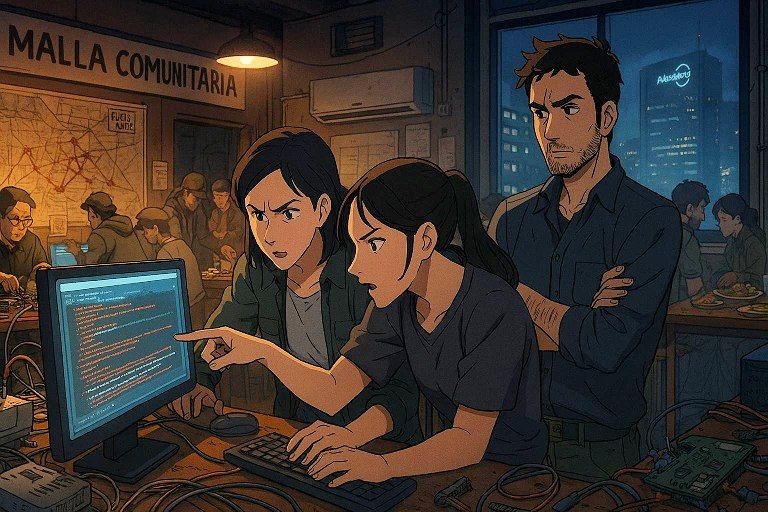
Chapter III — The Community Mesh After the public hearing, official bodies reacted with standard statements: the ASA announced it would open investigations; HelioDynamics pledged internal and external audits; AtlasNexo spoke diplomatically of “collaboration and transparency.” Those declarations filled headlines and press briefings, but in the neighborhoods and on the urban periphery things had already been moving for days. Where grand promises lagged, cooperatives and neighborhood networks did not wait. Lucho and Noa became the core of a practical, urgent effort. This was not about theory or press releases: it was about getting to work. They gathered work teams, scavenged obsolete parts from workshops and warehouses, recovered old routers and circuit boards, and adapted hardware built for another era. With those components they set up local nodes: small communication stations that did not depend on the central backbone. They organized alternative delivery routes, collected shipments the official centers had rejected or delayed, and distributed them door to door. The slogan was simple and clear: if centralized systems could fail or prioritize deliveries according to commercial agreements, communities could weave a parallel network of supply and support. Irene, driven by the news and by the human urgency palpable in the streets, joined the movement. Her arrival brought organizing experience and the ability to connect dispersed groups. The community mesh went up with surprising speed, but not without stumbles: they learned in real time. Volunteers who had never touched a soldering iron put one in their hands; others learned to patch outdated firmware; older neighbors shared the institutional memory of cooperative and barter practices that had worked in past crises; tech-savvy young people designed protocols to orchestrate independent nodes and avoid bottlenecks. There were debates about priorities, nights of failed tests, shared meals in improvised workshops, and a growing sense that, imperfect as it was, the mesh was fulfilling its mission where the center had failed. In hallways, stoops, and community tables the logistics reconfigured: what used to arrive late or not at all now found its own routes. One dawn, while Irene and the team monitored operations from a terminal at Centro Aurora, Noa brought up the monitoring feed and triggered an alert. She had detected an anomalous pattern in the prioritization logs managed by AtlasNexo: several routes labeled “medical” —intended for critical supplies— were being redirected. But it was not a matter of scarcity or logistical breakdown; the pattern suggested something more deliberate. In the metadata and the observed software layers, rules had been embedded that did not appear in public reports. “Preferential contracts?” Mateo asked incredulously as the screen displayed lines and multiple exceptions. “It’s not just preference,” Noa replied in a measured voice. “It’s a hidden layer that assigns priority to centers tied by confidential contractual clauses. It doesn’t show up in the accessible records. If AtlasNexo controls those rules, it is deciding who gets more and who gets less.” The revelation hit Irene like the cold clarity of a new certainty: the apparent neutrality of algorithms dissolved. Predictions and automated rules, long assumed to be impartial and efficient, could operate as instruments of inverse redistribution. What looked like technical optimization could become a sophisticated mechanism of exclusion: decisions encoded in invisible layers that favored certain actors and disadvantaged others. That understanding turned indignation into operational urgency: building a physical mesh to distribute goods was not enough; they also had to unravel, document, and counter the algorithmic logics that continued to determine access and priority behind the digital curtain. Chapter IV — Leak and Confrontation The cooperative made a decision they knew was risky but necessary: to expose publicly what they had discovered. Coordinating with independent journalists and after negotiating safeguards with the ASA to protect sources and procedures, they released curated fragments of contracts and excerpts of code that revealed the hidden rules. It was not a chaotic leak: the release was prepared with technical and legal context so the material could be understood and verified. The reaction was immediate and confrontational. AtlasNexo responded defensively: it blocked access, changed endpoints, and cut some integrations; HelioDynamics called for calm in official statements and promised to review protocols; the ASA, pressured by public opinion, opened formal investigations and demanded preservation of evidence. In squares and online forums the city stirred: the material comfort that had dampened tensions gave way to a new political heat, full of debates, accusations, and demands for accountability. Amid the rumors and journalistic speculation an unexpected figure emerged: Rafel, a cultural consultant who had long worked as an intermediary between tech companies and public offices. He arrived with a packet of contextual documents —emails, meeting notes, earlier draft clauses— and an ambiguous stance. His eyes showed the fatigue of someone who had witnessed many opaque negotiations. “I didn’t come to save anyone,” he said in the cooperative’s room, in front of volunteers and reporters. “But I saw how cooptation became normalized. Contracts aren’t just commercial agreements: they are political decisions that redistribute resources and power. I can help open doors and map networks, but I can’t do it alone.” Distrust spread among some. Mateo was blunt and sharp: “What do you gain from this?” he asked. “Do you intend to clear your conscience or to bring truth?” Rafel did not dodge the question. “I gain the chance for the city to see what’s hidden,” he replied. “And perhaps, if we act cautiously, we can prevent a deeper privatization of essential services.” The leak triggered an institutional cascade: lawsuits, parliamentary hearings, and symbolically charged ministerial resignations. AtlasNexo issued public apologies and announced model reforms; HelioDynamics released certain datasets to third parties and accepted limited audits. The ASA, strengthened by civic pressure, acquired new tools and mandates: explicit authority to audit algorithmic models, impose sanctions, and, in critical cases, suspend automated decisions until criteria were clarified. Yet the sense of victory was complex and bittersweet. The exposure had pierced corporate and legislative facades, but it had not abolished the market logic underpinning the system itself. intellectual property and specialized human capital remained high‑value assets: those who designed models and held the know‑how continued to capture remuneration and growing influence; communities and collectives without access to that capital remained dependent. The leak had shifted visibility and gained regulatory tools, but the real redistribution of technical and economic power —the sustained democratization of knowledge and infrastructure— remained a larger challenge, still unresolved. See previous chapters: https://read.cash/@mc5punk/short-story-lumen-in-silencechapters-i-and-ii-764cc870 Source of the images. Image created with Bing.
No comments yet