 @mc5punk
Short story: The Shine That Couldn't Make the Escape
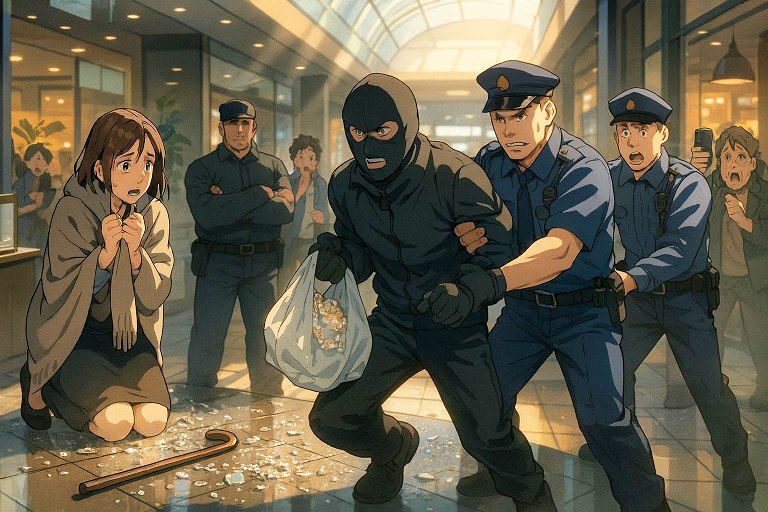
Chapter 1 — The Broken Morning The morning had the measured calm of always: white lights falling on polished floors, shop windows gleaming with patience, and a steady flow of people moving through the mall like those following a familiar choreography. There were faces repeating routines—a mother with her stroller, two young people with headphones, a group of retirees stopping to read the movie poster—and among them the jewelry store seemed a small universe of contained sparkle. Marta, with hands accustomed to delicacy, adjusted a necklace on a velvet pad. She had been the store manager for seven years; she knew the place down to its silences: when the first customers usually arrived, when the café staff asked for the till to be covered, which showcase drew the most looks. The first blow was like lightning tearing that routine. A glass vibrated, a dry sound that cut through conversations. Marta looked up before she understood; a figure appeared at the entrance, a dark silhouette against the light. Ski mask, slim but steady silhouette, a crowbar in hand. He wasn’t an intruder fumbling with nerves: his bearing was that of someone who had rehearsed that rhythm at night. The first impact on the display produced a contained explosion of glass; the second amplified the force. “Calm down!” came Raúl’s voice from the adjacent shop, hoarse with shock. “What are you doing?” The showcases shattered into a shower of metal and fragments that cast flashes across the eyes of those present. People stepped back, café tables shook, a phone hit the floor. The thief, gloved and sure-handed, moved with clinical precision: he opened boxes deftly, grabbed chains, rings, earrings, and stuffed them into a thin plastic bag that seemed both ridiculous and decisive. Twenty thousand dollars in the nearest case—a sum that, on an ordinary day, would have been a mere fetish for shoppers—now rolled in the hands of a stranger. Chapter 2 — The Public Heartbeat From the café, Laura dropped a tray; the crash mingled with the chime of necklaces. Two customers spilled their coffee as they recoiled. Sonia, the regional manager who had come that morning to check inventories, dug her nails into her phone until her palms sweated. “Marta, stay where you are,” Sonia said, her voice trying to be steel. “I’ll call the police.” The mall guard, Iván, appeared with determined stride. He was a burly man of practical movements, hardened by small incidents that had never reached this level of violence. He stepped forward to block the inner exit with his body. “Get on the ground!” he ordered with the voice of someone trying to impose order on chaos. “Nobody move!” At that point the mall ceased to be a backdrop and became a convergence of micro-stories. A child, drawn by curiosity, peeked out from behind a toy stroller; his mother, Sofía, dragged him back with the instinctive force of someone who prioritizes life over anything else. Don Alberto, who always sat on the bench across with his newspaper and notebook, looked up in astonishment and began recording with his phone—a gesture that would later prove decisive. The robber, the plastic bag now bulging with jewels, ran for the exit. The speed with which he acted made clear he had planned each step. The eyes barely visible through the ski mask showed, for an instant, a mix of focus and haste. The bag thumped against his side with a dull, uneven sound; the taut plastic was a membrane containing temporal greed. Chapter 3 — The Net Tightens The call to the police arrived in less time than it seems possible in scenes that devour themselves: under five minutes. Two patrols familiar with the mall’s routes pulled up precisely. The officers knew how to move in crowded spaces: they sealed exits and coordinated with cold voices. Officer Mendoza took point, carrying the discipline of someone who has seen the city split into emergencies countless times. “Stop!” Mendoza shouted at the main door. “Get down, now.” The thief tried another move, perhaps hoping to find a gap that didn’t exist. But the weight of the bag and the tension of the moment betrayed him: he tripped on a step, pitched forward, and the bag slipped. The sound of jewels clinking together was a small defeat horn, almost comic, that in that scene rang loud and clear. Officer Pérez grabbed him by the belt and pushed him down with practiced control; Mendoza snapped the handcuffs on with firm hands. The reaction of bystanders was a blend of relief and shock. Some began clapping without thinking; others whispered prayers. Raúl edged toward the fallen bag and looked at it as if observing the tangible consequences of an abstract threat. “Marta…” he said, voice cracked with adrenaline. “Are you okay?” “Yes,” she replied, a trembling thread of a voice. “I think so. Thank you.” Don Alberto, shaking but determined, offered his recording to the patrol officer who introduced herself as Marta Ruiz. Her face showed the mix of fatigue and professionalism of someone who has dealt with situations that unmake the everyday. “We have everything on the phone,” Don Alberto said. “From the moment he came in until they detained him.” “Thank you,” the officer answered. “It will be very helpful.” Chapter 4 — Between Guilt and Glass At the station, the scene took on a harder light, less theatrical: the plastic bag sat on a cold table while officers opened it with gloves. The jewels flashed with indifference—each piece an inert witness to a failed escape. The detainee, a young man with eyes dulled by glass dust, had trembling hands and marks of the physical strain and moral tension of someone trying to flee a personal labyrinth. “I didn’t want to hurt anyone,” he said in a whisper more plea than confession. “It was to pay some debts, to get my mother out of a bind. I didn’t think… I didn’t think it would end like this.” Sonia, who had gone to the station to give her statement, looked at him with a mixture of fatigue and firmness. She had seen Marta’s expression—the way a person clings to small certainties when the rest of the world collapses for a few seconds. “Your reasons don’t justify putting others at risk,” she replied. “You said you came to check inventory, and you put us all in danger.” The young man didn’t answer; the silence became a wall containing regret, fear, and a confusion that seemed to pull him inward. Chapter 5 — Echoes in the City News of the attempted robbery spread quickly. Headlines, short and blunt, repeated: “Security footage shows attempted robbery at mall jewelry store.” Camera footage, phone videos, frames showing the crowbar, the plastic bag, the moment the thief was intercepted circulated on social media and in bar conversations. For many it was another spectacle; for those who had been there, the scene was etched with intensity that time would not easily erase. That night the mall closed early. The lights, usually bright, were dimmed almost ceremonially. Jewelry store workers stayed late: cleaning glass, counting pieces, trying to reconstruct inventory and, with it, a semblance of normality. Iván gathered the shards of glass scattered like dead stars and placed them carefully in a box with notes documenting each piece—location, time, witness. For him the box was a way to impose order on something unordered. “Next time let me know,” Iván said with forced humor intended to ease tension. “No more scares, okay?” Marta gave a small reflex smile that didn’t reach her eyes. “I don’t want to go through this again,” she whispered. “Not for me, not for anyone.” Chapter 6 — Consequences and the Weight of Choices Meanwhile, the detained man’s life took a turn he had only seen in films or heard about in the news. At the station, among paperwork and forms, he faced the tangible possibility of prison—the real cost of a choice made in the dark of need or desperation. His motives—the debts, the image of his mother he cited—remained a backdrop to a more complex story: a city with demands, failing structures, and above all, a personal choice that broke others’ routines. Don Alberto returned to his bench and reading, feeling he had fulfilled a civic duty by recording the event. He didn’t like violence, but he was glad to have had his phone at hand. In the days that followed, the jewelry store reopened with added protections: thicker glass, revised protocols, and increased security presence during vulnerable hours. Marta noticed how customers viewed the cases with a new shadow of caution; some asked about items removed for inventory, others simply came and went with firmer strides. Routine reassembled itself with new pieces—procedures, staff conversations about what they had done and what they could change. Chapter 7 — Night and Reflection One night after closing, Marta sat in her car with hands still trembling from the memory. She rested her forehead on the steering wheel, closed her eyes, and let her breath mark a pulse that had to become hers again. She thought of the necklaces, and of the faces she’d seen: the thief, marked by decision and desperation; Iván, who had put his body on the line; Sonia, who had tried to maintain logic amid chaos. She also thought of the fragility of beauty—those pieces of precious metal that glinted and could become objects of desire and crime—and of the quiet resilience of ordinary people who stepped in without overthinking. The city continued its indifferent rhythm outside the car: sirens in the distance, passing engines, conversations blending into the night. Inside, Marta would return to placing collars, polishing rings, and smiling at customers. But something in the texture of routine had changed: a thread of tension that would remind anyone passing the cases that security isn’t an absolute right but a fragile fabric to be tended. Epilogue — Behind the Shine In the days after, hearings were held, statements taken, and the slow progression of procedure moved on. The recording Don Alberto had handed over became key evidence in the file. The attempted robbery became a lesson for the mall: added security, staff training, and protocol reviews. For Marta it became a scar that, over time, stopped hurting so sharply and turned into a mark recalling both fragility and resolve. The young man faced the consequences of his decision; though his motives were human—debts, pressures, wanting to help a relative—the action had clear outcomes. Sonia, Iván, Raúl, Laura, Don Alberto, and all the witnesses found themselves linked by an event that, brief as it was, reshaped their days. And at the center of it all, the plastic bag with twenty thousand dollars’ worth of jewelry remained the most eloquent symbol—not of the value of things, but of the fleeting shine that failed to escape because someone, at a decisive moment, chose to close a door. The jewelry shop returned to its craft: placing a necklace, polishing a ring, greeting a customer. But in that calm there was a new awareness, a small inner alarm pushing vigilance and care. Because although the thief didn’t make his escape, the story—one the witnesses would tell again and again, with variations and memory—made clear that security is, at heart, a tapestry we weave together: with attention, courage, and the willingness to respond when the sheen of opportunism collides with collective protection. Source of the images. Image created with Bing.
No comments yet