 @mc5punk
Short story: The Echo of Footsteps
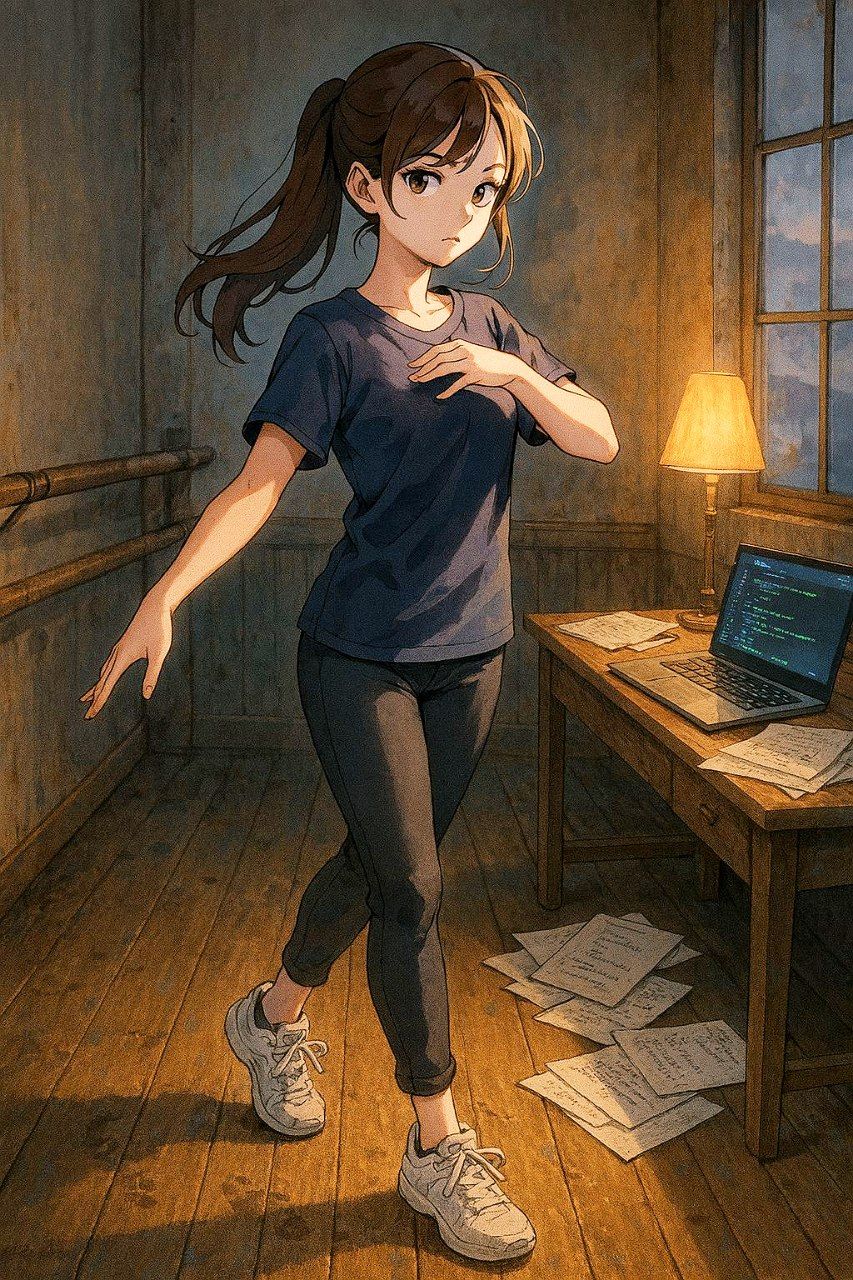
Clara Monteiro was twenty-nine when the world began to call her by a name she had not asked for: the youngest billionaire. The figure — $1.3 billion — made headlines that sounded hollow against something more intimate and persistent: the footprints of her sneakers on the old wooden floor of the dance studio where, years earlier, she had taught her younger brother to find his balance. That number, cold and round, could not weigh the memory of sweaty rehearsals, the silences before going onstage, nor the texture of the creaking boards beneath her feet. Chapter I — Echoes of Dance From a very young age, Clara lived guided by the demand for precision: a foot that lands on the exact spot, a gaze that holds for just the right length of time. She grew up in a coastal city in Brazil, in a house where music and political arguments mixed as naturally as having breakfast and debating in the same sentence. Her mother, Rosa, a literature teacher with a deep voice and hands always busy with a book, taught her to listen to language as if it were a score: to feel the pauses, to read what is not said. Her father, Antônio, a radio repairman with the patience of a craftsman, showed her the precise slowness of trades: to take apart, understand, and put back together until everything worked again. "Never forget to read between the lines, Clara," Rosa would say, folding napkins at the end of dinner. "Beauty does not always arrive with applause." There were nights when the family huddled to hear the surf pounding against the shore and others when laughter filled the worn furniture. Clara absorbed those contradictions with the intensity of someone who knows that beauty demands sacrifice and resists simple explanations. Dance was not only technique; it was language, resistance, and a way of naming the world with the body. Through effort and will, she joined the prestigious Santa Flor Ballet, a stage of sharp lights and dressing rooms where aspirations were measured in centimeters of jump and hours at the barre. In the ballet she met Helena, a colleague who soon became both friend and rival: the competition was not only for starring roles but for the look each cast on the same movement. Marco also appeared, a choreographer of gentle character who always seemed to be late to the poetry of his own steps. After a rehearsal, in a damp corner of the studio, Marco whispered to her: "You have a way of entering the space that is frightening. Take it easy; the body asks questions too." In the corps de ballet she learned the language of effort: every gesture considered, every fall anticipated, the humility of repeating until the mistake disappeared. But beneath the tutus and warmers, a technological curiosity beat like a secret pulse. Between classes, Clara stole minutes to read programming manuals, decipher diagrams, and hide notebooks of pseudocode under the bed in the shared dorm. She imagined machines that, like a partner, would respond to her impulse: automatons that arranged music with her breathing, systems that translated fatigue into a warm light, algorithms that interpreted the hidden intention in a gesture. Chapter II — Cambridge and the Ghosts of Calculus The decision to leave professional dance to study computer science at MIT was not a dramatic break overnight, but the culmination of absences and returns: the absence of rehearsals, the absence of the convictions that had driven her as a child, and the unstoppable arrival of a new desire to understand the world through models. In Cambridge, her classical discipline — that austerity of study and repetition — translated into algorithmic rigor. She learned to think in terms of structures, complexities, and the elegance of code, tending each function as she had once tended each arabesque in the air. There she met Daniel, a lab partner with whom she shared four‑a.m. coffees, discussions about probability theory, and the shared feeling that every real advance came laden with uncertainty. Daniel had the ease of someone who thinks in diagrams and metaphors, and Clara liked his way of making skepticism a form of intellectual affection. Mei also appeared, an unlikely-looking programmer — with a sharp wit and a laugh that disarmed formalities — who broke code with the same ease an improviser alters a score. With them, hacking nights resembled long rehearsals: they worked until the body begged for truce and clarity emerged just barely, at that hour when dawn stretches ideas until they become sharp. MIT put her in front of equations that sounded like mathematical music, in front of models that promised to order what had once been intuition. The ghosts of calculus — those functions that move at the margin of the comprehensible — did not frighten her; they pushed her to turn curiosity into a tool. In the halls, her background and discipline aroused admiration and surprise: the dancer who learned to optimize code, the young woman who articulated stage elegance with algorithmic efficiency. Each project was a different choreography: inputs, outputs, synchronizations, error tolerances. Clara drew diagrams as she had once drawn steps, and on more than one occasion discovered that an elegant solution to a computing problem had the same beauty as a well-executed pirouette. Thus, in the confluence of rhythm and logic, of bodily memory and abstraction, Clara began to build something that was not merely a career but a continuity of her way of being in the world: rigorous, curious, and with the intuition of someone who understands that technique only serves to expand sensitivity. Source of the images. Image created with Bing.
No comments yet