 @mc5punk
Short story: The Price of Thirst
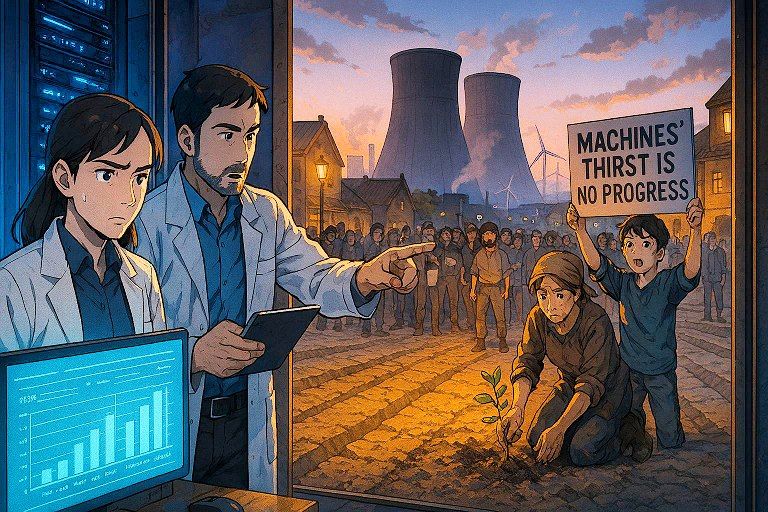
In the dimness of a server room—where the light was more a continuous hum than illumination—Marta turned on the monitor and let the figures unfold like a verdict. Her hands trembled slightly; professionalism forced her to remain composed. The numbers were relentless: between 312.5 and 764.6 billion liters of water consumed in 2025 by artificial intelligence systems, an amount equivalent to the annual consumption of the global bottled water industry. The research also estimated a carbon footprint between 32.6 and 79.7 million tonnes of CO₂. All of it was mainly attributable to evaporative cooling needed to tame the heat of the data centers that power those models. I. The cold room and the hot news Marta recalled the first time she had toured a data center: endless corridors, fans roaring like locomotives, metal walkways and cable tunnels coiling like arteries. On that first visit she had felt the mix of wonder and fear typical of someone facing something immense and partly incomprehensible. She had seen the promise: models capable of predicting droughts, optimizing electrical networks, and rescuing ecosystems. At the time she had not thought about the cost of keeping those intelligent machines alive. The study’s authors—faces anonymous because the focus was the data—had done the math. Marta reviewed the methodology: measurements of water consumption associated with evaporative cooling systems, estimates of energy use, and conversions to CO₂ emissions. The mechanism was simple in concept and devastating in scale: to dissipate the heat generated by intensive computations, data centers rely on systems that evaporate large quantities of water; that evaporation, combined with the energy consumed, explains the sector’s water and carbon footprints. “Luis, you have to see this,” Marta said when she called her colleague from the lab, the screen visible behind her. “Do you realize? It’s the annual consumption of the entire bottled-water industry.” Luis, who had spent most of his career designing cooling architectures and measuring flows, came over, placed a hand on the cold console, and read in silence. “If this is real,” he murmured, “we’re not facing a minor technical problem. It’s systemic. We’ve created a demand that scales with every training run, with every iteration of bigger models.” “And it’s not just water,” Marta added. “Look at the emissions—figures comparable to those of a large city.” Luis exhaled, as if trying to expel an unbearable idea. “Everyone who boasts about optimizing consumption will have to prove it with deeds, not brochures.” II. The story in the press and the clash of narratives Clara, the journalist, called that same afternoon to prepare a feature that would put the research in the public eye. She wanted details, sources, and whose voices to include. Marta provided the report, tables, and list of researchers. Clara decided to publish with a dual approach: the quantitative finding and its human consequences. When the story ran, reactions came fast. In a televised debate on a major channel, Clara confronted Eduardo, an executive at one of the largest tech companies, with the data’s bluntness. “Mr. Eduardo, your industry is drinking billions of liters. Meanwhile, entire communities suffer scarcity. How do you justify that?” Clara asked without ceremony. Eduardo, with rhetoric polished by rehearsals and advisors, took the microphone and offered the expected narrative: investments in renewables, commitments to neutrality, roadmaps and pilot projects. “We are committed to sustainability,” he said. “We have efficiency programs and plans to migrate to clean energy.” Clara pressed on. “And the water? How do you justify intensive use and evaporative cooling as a standard practice?” Eduardo hesitated for a moment. He searched the camera, measured the response, and repeated the corporate script. “The transition takes time. But we are investing in alternative solutions.” III. The voice from the land While companies spoke of roadmaps and the media debated, the story reached places where numbers are lived in the flesh. Sara, a farmer from a region already punished by irregular rains, watched her irrigation channels run unusually low. Her community had suffered water restrictions, and the news about data-center consumption fell like fire on dry grass. Julián, a young local activist, showed Sara the story on his phone. “They say server clouds are drinking whole rivers,” he explained. “If it’s true, someone has to answer.” Sara spat on the ground, a gesture in her village almost akin to blasphemy toward the earth. “We can’t wait for the industry to finish its transition,” she said. “Crops fail now, not in five years. Who will be held accountable?” Julián organized a protest in front of the town hall; signs reading “Machines’ Thirst Is Not Progress” gathered neighbors demanding transparency and concrete measures. Clara covered the march and brought the voices of Sara and other farmers to the national circuit. IV. Technical tables and concrete proposals Public pressure forced convening of technical tables with Marta, Luis, engineers, corporate representatives, officials, and community members. They discussed immediate measures and policy directions. “Mandatory transparency in water consumption,” Marta proposed. “All facilities must report monthly water and energy use, with independent audits.” “Strategic relocation of centers,” Luis suggested. “Prioritize cold climates or coastal areas where nonpotable water can be used, and promote passive cooling whenever possible.” “Incentives for innovation,” another engineer added. “Funds for technologies that reduce evaporation, like advanced heat exchangers or closed-immersion cooling that does not lose water.” Eduardo, pressed by public opinion, agreed to participate in a pilot to implement some of these ideas. He offered resources and time and committed to external audits. “We accept audits,” he said gravely during the meeting. “We also propose investing in solar plants and centers in cold climates.” V. Distrust and urgency Even with commitments on paper, community distrust did not vanish. Julián, who had seen many unfulfilled promises, asked aloud during a public assembly: “What if this is just another promise to pass the scandal? How many roadmaps have we already heard?” Eduardo responded with calculated frankness. “I understand the distrust. But there are resources and will. We can start with binding targets and independent auditors.” Marta, feeling the responsibility to push for technical and ethical rigor, stood up to Eduardo and spoke without euphemism. “Intention is not enough,” she said. “We need metrics, clear limits, and sanctions. If AI is going to scale, it must do so under rules that prevent externalizing costs onto vulnerable communities.” VI. The paradox and the choice In the following nights Marta slept poorly. She dreamed of two overlapping maps: in one, AI appeared as a web of solutions—fire predictions, optimized power grids, improved crops; in the other, its infrastructure increased demand—more water, more energy, more emissions. The question that struck her was not only technical: it was about priorities and governance. Meeting with Clara, Luis, and Julián in a café by the square where young people planted trees, the conversation became strategic. Clara proposed a series of follow-up reports that would not only expose but also present proposals and successful cases. Luis offered to design and document passive-cooling prototypes applicable to medium-sized centers. Julián convened the community and proposed mechanisms for citizen participation to monitor commitments. “We will demand audits, binding targets, and community participation in location and consumption decisions,” Julián said with the urgency of youth. “And we’ll document real solutions,” Luis added. “Criticism is not enough; we must show viable technical paths.” Clara, with journalistic experience, saw the need for a narrative mixing data and humanity. “We’ll run serialized coverage,” she proposed. “The press cannot stay with a one-day story; it must follow the process.” VII. Tensions and small victories Media exposure, social pressure, and technical evidence began to produce effects. Several regional governments announced regulatory reforms requiring quarterly reporting of critical facilities’ water consumption and independent audits. Some companies suspended new centers in water-stressed regions and opened research funds for low-water cooling. During a visit to the community, Eduardo—visibly more fatigued than on TV—was obliged to answer before Sara and her neighbors. She confronted him with the look of someone acquainted with time and its cycles. “You promised development,” Sara said. “But development that kills the land is not progress.” Eduardo, facing the inevitability of accountability, replied: “We will perform public audits and set binding goals. It isn’t enough, I know, but it’s a start.” The response did not placate everyone. Some activists demanded rapid penalties; others, led by Marta and technical experts, proposed gradual but verifiable programs: pilots of immersion-cooled centers without water loss, migration to cold climates where feasible, and hydric compensation schemes for affected areas. VIII. Final reflections and the unfinished task Marta walked one morning through the square where Sara, Julián, and other youths planted trees. She watched their callused hands dig, the mud staining their nails, the tangible hope sprouting from the soil. A boy asked her without looking up: “Do you think AI can help decide where to plant each tree?” Marta smiled with sadness and determination at once. “Yes,” she answered, “but first we have to teach it not to drink what others need.” That sentence condensed the story’s central tension: promise and warning. Technology that measures and optimizes the world can, without rules and appropriate priorities, become a driver of pressure on the resources it aims to protect. Accelerated adoption without limits leaves open the possibility that the cure will be worse than the disease. The research that triggered the crisis served as a mirror: it showed not only quantities—billions of liters, tens of millions of tonnes of CO₂—but choices. Every training cycle, every massive deployment of models, carried an associated cost someone had to bear. The key was not demonizing the technology but integrating it into governance frameworks that internalize its externalities: regulations requiring transparency, incentives for non-evaporative cooling, redistribution of burdens, and genuine participation of affected communities. In the months that followed there were advances and setbacks. Some companies complied with audits and improved their designs. Others continued with diluted promises. Several governments moved forward with regulations, though implementation varied. In Sara’s community there were irrigation plans supported by public funds and a pilot for hydric compensation. None of this was definitive; rather, it represented construction of a fragile new balance. The story remained a reminder: technological progress is not a linear march toward good; it is a set of decisions that must be guided by values and limits. Without them, the tool that promised to save the climate could, paradoxically, contribute to its degradation. Choosing between a technology that cares for itself and one that forces us to pay its thirst is not only a technical dilemma; it is a political, ethical, and collective decision. One warm afternoon, as Marta closed her notebook in the lab, she thought of the two maps that haunted her: one of possible solutions, the other of unaccounted consequences. Ambition and containment, opportunity and responsibility. She understood that the real battle would not be fought only in laboratories or boardrooms but in the articulation of voices: those who design machines, those who finance them, and those who feel water scarcity on their skin. If there was one lesson, it was that science and technology can offer powerful tools, but without governance and environmental justice, those tools may become instruments of harm. The narrative ended without closing all wounds, because reality doesn’t either. What remained was a collective decision ahead: to build models and data centers that respect limits, prioritize life, and are accountable to those who suffer scarcity. And there remained the conviction that thirst—of water, energy, speed—must be measured and, if necessary, contained. Only then can the promise of artificial intelligence truly align with caring for the planet. Source of the images. Image created with Bing.
4 comments
This story really struck me, brother. It captures something we often forget in conversations about technology — that every advancement carries a cost, and someone, somewhere, ends up paying that price. The way you wove together the scientists, the journalist, the corporate world, and the everyday people who feel the consequences made the message hit even harder. What stood out most to me was the contrast between the promise of AI and the hidden burden placed on communities already struggling with scarcity. It reminded me of how Scripture teaches that wisdom isn’t just about what we can build, but about whether what we build honors life, justice, and stewardship. Technology without accountability becomes like a fire without boundaries — powerful, but dangerous. Sara’s voice especially resonated. Her simple question — “Who will be held accountable?” — echoes the cry of so many who feel unheard. And Marta’s final reflection about teaching AI “not to drink what others need” felt almost prophetic. It’s a reminder that progress must never come at the expense of the vulnerable. Your story shows that real change doesn’t come from one group alone. It takes scientists, journalists, communities, and even those inside the corporations to push for transparency and responsibility. That kind of unity is something the Bible often points us toward — many parts, one body, each doing its part for the good of all. Thank you for writing something that challenges the mind and stirs the conscience. May we all learn to pursue innovation with humility, compassion, and respect for God’s creation. Grace and peace to you, my friend. 🙏
I'm glad you liked the story, friend, and thanks a lot for your comment, it's quite appreciated. I send you a big hug. Blessings 🙏
moral story amazing 👏
Thanx 😁👍