 @mc5punk
more from that month
@mc5punk
more from that month
Short story: The Night the Roundabout Flew
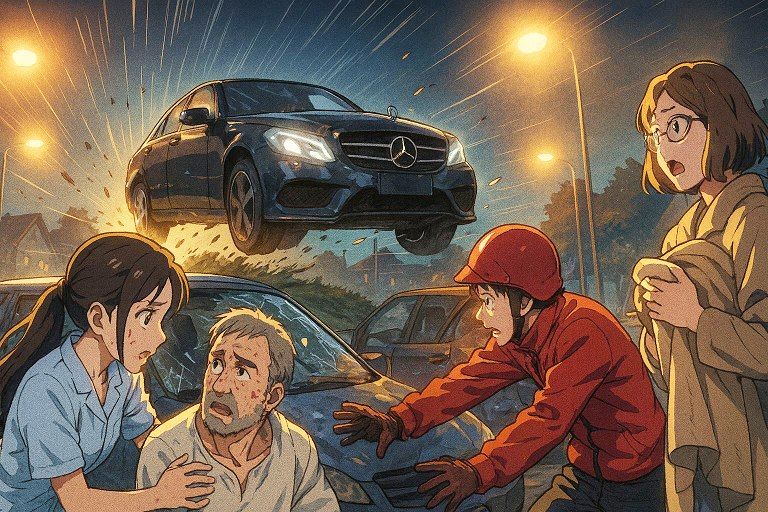
The night in Sălcuța had the density of a held breath. Streetlamps washed the sidewalks with a sad halo; fog clung to the walls like a promise that never arrived. Traffic murmured lazily, as if it knew the routes and expected no surprises, and the Market Square roundabout kept to its routine: faded signs, a central patch of repaired grass, and a security camera mounted on a pole that, that night, would record something the town would take a long time to stop talking about. Petru Ionescu drove with the calm of someone who has learned to measure time. Fifty-five years old, big hands, and a black Mercedes that had long been his shell: a car that smelled of polish and memories, a confessional on long nights. He was returning home after an afternoon of errands; in the passenger seat rode Ana, his younger sister, a nurse of practical habits and hands that soothed those who came to her urgent care. Between them there was trust, familiarity—low jokes and shared silences—that functioned like a lifeline in everyday life. A few meters from the roundabout, something in Petru’s body broke without announcing itself. It was not a dramatic stumble: it was the betrayal of an organ that stopped obeying. Consciousness slipped through his fingers like a delicate glass; a cold sweat ran down his brow, his nervous system screamed, and his body answered that call in the form of emptiness. The steering wheel trembled in his hands; the dashboard lights turned into a map of incomprehensible signals. Ana raised her voice: “Petru, Pietro, wake up!”—her shout stuck to the glass. He tried to respond; his eyes sought a shore and could not find it. Behind him, Radu, a night delivery driver, was driving a red Clio. He had headphones hanging around his neck, the music still present on his skin, and the look of someone who has seen too many scenes to be surprised. When he glanced up and saw the Mercedes losing its course, he believed for a brief second that life had handed him the frame of a movie. In the other involved vehicle, a white van came to a sudden stop; Lidia, a primary school teacher, felt her pulse freeze. She was left speechless, as if a lesson had been erased without warning. The impact against the roundabout curb was not subtle. There was a roar that reminded some of old earthquakes: tires screaming, sheet metal squealing. And then—like an impossible gesture—the Mercedes rose. It was not a poetic flight; it was a brutal leap, a wounded beast thrown by inertia. It passed over the two other cars, describing a parabola that the camera immortalized in high definition: the dark silhouette of the vehicle suspended against the reflection of the city lights, glass flashing like fragments of a fallen sky. Ana screamed; her voice tangled with the noise and the image of her brother rising. Inside the car, her grip became a point of resistance: she clutched the seat with her nails, with a strength born of panic and love. The fall ended on the central island. Dirt, grass, mud: what had been decorative elements suddenly became a tiny battlefield. When the Mercedes hit the ground, a cloud of dust and smoke rose; glass rained down with a metallic tinkling that sounded like broken music to some. The explosion summoned the town: pedestrians nearby, neighbors peering from balconies, shopkeepers slamming down shutters. An impulse of human aid swept across the scene: people running, hands searching for bodies, voices ordering calm. Radu was the first to reach the Clio. Still with a headphone dangling and breath ragged, he launched himself at the Mercedes window to help. “Ana!” he shouted as he pulled her out, seeing the tears in her eyes. She coughed, hunched over, and ended up on the curb, trembling. Lidia, acting as one who consoles both by profession and instinct, approached the occupants of the other vehicles to make sure no one else needed aid; her hands, tinged with the memory of chalk and blackboards, took blankets and offered them as shields against the cold and shock. Petru stayed inside the car, breathing in short, ragged gasps. His forehead glistened with sweat and his mouth tasted of iron. He had no room for speeches, only the urgency of reconstructing his breathing. A paramedic leaned toward him, gloved hands pressing gently on his shoulder, and offered a stretcher. “Let us check him out,” the paramedic said in a firm voice. Petru shook his head with an almost childish gesture. “I’m fine,” he said, but his voice betrayed his strength; a wave of dizziness tore through him. “I just need to sit.” Ana, her voice trembling from adrenaline, asked aloud more to seek an explanation than to receive one: “Did something happen to his health? Diabetes?” A witness who worked at a nearby pharmacy, who had seen Petru go in earlier that afternoon to buy glucose, stepped forward to say so quietly. The paramedics exchanged looks that spoke of medical hypotheses: hypoglycemic episodes, syncopes, the list of betrayals a body can play. The arrival of the ambulance cut the night with sirens. The technicians acted with the practiced routine of those who have seen too many bodies and learned to read them precisely. They assessed bruises, superficial cuts, and with caution noted the possibility of a cervical whiplash—an injury that demands measured, careful movement. Decisions were made in low voices, professionalism tempering the anxiety of the scene. Even so, when they offered transport to the hospital, Petru closed himself off to the idea. He looked at Ana with a mix of pride, stubbornness, and accumulated fatigue. “Don’t take me,” he said firmly. “I’d rather be home. I’m not spending the night in a corridor without seeing the ceiling of my own home.” Ana protested with the indignation of someone who watched a loved one risk himself. “You have to go, they’ll run tests,” she insisted while gripping his hand with a force that painfully mixed assertion and plea. Petru looked at her, and in his eyes there was a gleam that combined his usual rebelliousness with the vulnerability he would not expose that night. “Ana,” he murmured, “I don’t want to be a burden. Let me sleep on my couch. If you need me, I’ll be there; but don’t make me go. Trust me.” She finally yielded—not because reason had changed, but because some loves are like that: battles fought with words and small concessions. The medication would be reviewed, they agreed; a doctor visit would be scheduled for the morning. The pharmacy witness, Radu and Lidia talked among themselves to organize a minimal safety net: calls, checks, watchfulness. By the time night loosened its hold on the edge of dawn, the camera footage was already circulating. Phones buzzed in neighbors’ hands sharing the video with the same mix of fascination and horror. The images were irresistible: the sequence of the jump, the silence before the impact, the final fall. In Sălcuța’s cafés the next day, conversation revolved around that mechanical and human sequence. Some speculated about a mechanical failure, others about the condition of the roundabout’s signage, and many—more softly—uttered the weighty word: medical crisis. The rumor did not stop at mere description. It turned into action. Ana stayed with her brother through the night; she watched his breathing, changed his dressings, checked his medication and made sure he would not be left alone in his choice. The next morning they both went to the pharmacy to verify glucose supplies and consulted the local doctor to request adjustments. Medical conversations were meticulous: dose review, timing, recommendations to avoid nocturnal episodes and simple strategies to prevent dangerous drops. Petru, who initially resisted, ultimately accepted the measures with the mixture of pride and realism characteristic of someone who has lived long enough to know that stubbornness can be dangerous. Meanwhile, Radu and Lidia did not limit themselves to emotional accompaniment: they organized concrete actions. Radu spoke with a trusted mechanic about repairing any defects that could have contributed; he proposed a community check of the curbs and the roundabout edges. Lidia used her network at school to collect signatures demanding better lighting and signage at the intersection; she wrote to the town hall and talked to parents to apply pressure. What began as an isolated episode became a local movement to prevent recurrence. The town hall, pressured by the video’s virality and neighborhood concern, reviewed the cameras and, after a preliminary investigation, ordered improvements. The roundabout received new reflectors, higher signs, and visible reminders. There was something symbolic in the response: it would not restore the disrupted night, but it aimed to reduce the likelihood that another terrible leap would occur there. Petru returned home with bruises that hurt every time he breathed; he moved cautiously, rediscovering the slowness of gestures. His stubbornness remained, but now it coexisted with an acceptance rooted in what had happened. Ana did not leave him: care shifted from urgent action to an organized routine. She set alarms, checked bottles, adjusted meal times and set glucose reminders. Between the siblings, conversations that had once been superficial became precise and necessary. In their shared silences there was a truce more honest with fragility. The pole camera retained, without drama, the file that testified to the scene. That silent footage was analyzed, discussed, and eventually archived—but not without leaving a mark. In Sălcuța’s collective memory that clip became a foundational story: how an ordinary night could have become tragedy and, yet, did not. The town learned that there are visible vectors—like signage—and invisible vectors—like a drop in blood sugar—that intersect at unpredictable moments. In the following weeks, cafés brimmed with voices repeating the same story with different accents: some emphasizing the spectacle of the accident, others the human stubbornness of refusing hospital care, and some focusing on the fragility that accompanies certain illnesses. But many—almost with a secular reverence—agreed on one thing: the night a car flew over the roundabout was not only a mechanical event; it was a reminder about the town and the ties that hold it together. Petru, Ana, Radu, and Lidia, linked by a thread formed in adrenaline, continued their lives with visible wounds and new agreements: visits, calls, checkups, and the certainty that the town had grown a little more attentive. In the end, the mute proof remained in a camera’s memory and in the flesh of those who lived it. The roundabout kept its patched grass, but also new signs that shone at night; neighbors kept the memory of a scene that united them, and Petru, with his pride intact and his body aching, learned that stubbornness can coexist with prudence when family and community allow it. Sălcuța stood on, breathing more carefully, having seen how life breaks and recomposes in instants so brief they feel infinite. Source of the images. Image created with Bing.
No comments yet