 @mc5punk
Short story: The Willow and the Hands That Hold
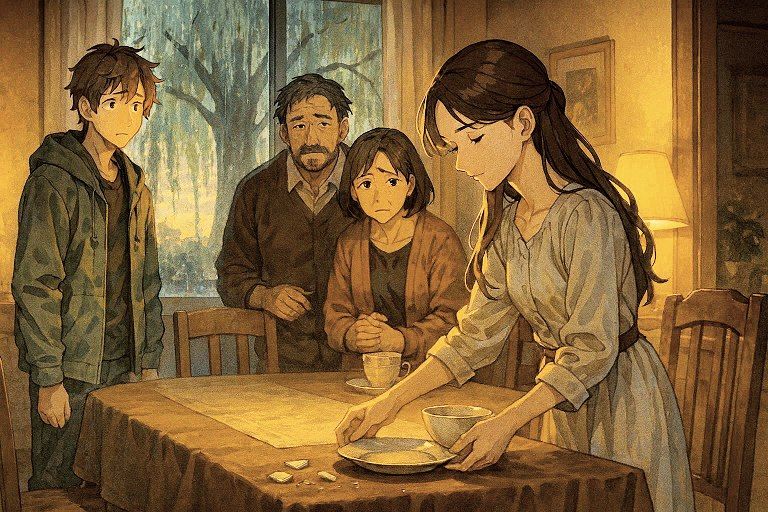
The willow house stood at the end of the street, where the air always arrived warm and the smell of coffee seemed to have settled in as a permanent guest. The windows kept reflections of past afternoons and, when the wind moved the curtains, it was as if someone ran their fingers over the pages of a family memory. Four people lived there: Clara, Mateo, and their two parents. Each carried their name like someone bearing a quiet destiny. Clara had grown up with the habit of making herself small. From as far back as she could remember, her place had been the one who prepares, tidies, and contains. As a child she washed dishes while the others played; as a teenager she sewed buttons during after-dinner conversations; as an adult she kept jobs, paperwork, schedules, and the household’s pulse with that mix of patience and sometimes resignation that makes giving feel natural. Her body learned the gestures before the words: smoothing tablecloths, pulling out a chair for a guest, leaving a glass of water on her father’s nightstand. To everyone’s eyes she was a pillar: not flashy, but steady. Clara interpreted that role as something she had to fulfill—not out of strict obligation, but from a deep belief that her presence should be enough. Mateo, by contrast, became the magnet for emergencies. He had the misfortune of breaking things and the good habit of asking the world if someone would care for him. When he was a child, a scrape, a stumble, or a problem at school was enough to turn the house into a refuge. His parents rushed as if the danger were greater with him, with a mixture of fear and devotion. They spoke to him with extra tenderness, covered him with questions, hugged him when the night felt long. Over time that protection became an unconscious pattern: in the face of his apparent fragility, the family deployed emotional resources rarely offered to Clara. The parents, two people of patient affection and marked routines, were both the channel and the current of that imbalance. The father worked long hours and when he was home he furrowed his brow and asked about his family as one checks that a burden hasn’t slipped. The mother, guardian of traditions and family recipes, felt in her chest a thin, persistent guilt that surfaced with Mateo’s stumbles and with the small but dramatic news that sometimes arrived during the day. Both wanted to do right; both, without fully understanding, repeated gestures that reinforced an unequal distribution of care. Everyday conversations usually took place around the dining table, where dishes steamed and words sought their place in routine. At those dinners Clara’s voice blended with the clatter of cutlery: she asked about others, smiled, and spoke little about herself. When Mateo recounted a bad day at work, the house tightened around him: hugs, advice, plans to help him the next day. The protection wasn’t bad; it was sincere. But that sincerity had an invisible cost: attention that flew toward vulnerability left the one who always showed up without recognition. One day, an article about family psychology appeared on the table, between the mother’s coffee cup and the father’s phone. It spoke of patterns and technical names—guilt, anchor child, culture of silence—and described, with figures and quotes, something the four of them recognized without words. They read in low voices, first out of curiosity and then with a sense of unease. The article said that it’s common for families to protect the child who appears vulnerable and that the impulse to protect often mixes fear, guilt, and a desire to repair fragility. It also said that the sibling who holds the household often becomes the “anchor” and that anchors usually receive less recognition because their strength is taken for granted. The reading was a mirror: on one hand, relief at having vocabulary; on the other, anguish because explanations didn’t repair what had already been done. The parents, honestly, tried to correct course. They proposed plans: less mechanical and more attentive phone calls, a family outing, a special day for Clara. For a while those initiatives brought a temporary glow. The mother insisted on treating her to lunch and the father called to offer help with a errand. Clara accepted with gratitude and a wary expectation that things would soon return to normal. And, as habits often do, normal returned. Spontaneous gestures dulled with the passing days: concern for Mateo came back like a predictable tide, and concrete acts for Clara dissolved again in the dams of routine. It wasn’t a malicious decision; it was the pull of customs and the force of the mechanism that protects what trembles. Clara endured that quiet swing for years. She learned to contain anger and sadness in almost imperceptible ways: a sigh when folding a napkin, a pause before taking on another task, a smile that fell short. She also carried the weight of not wanting to make others feel guilty, of not making her parents feel they had failed. She grew with the conviction that asking was asking too much. There was a decisive night the family didn’t forget. It was a winter evening, rain drumming on the panes and the willow bowing its branches over the garden. Clara, exhausted from days without recognition, held a cup of tea at the table’s edge when it slipped from her hands. The cup struck the floor and shattered. The sound was a clean cut in routine, like an instrument marking an unexpected measure. Mateo was the first to look up, surprised. “What happened?” he asked, with his usual urgency. “It fell,” Clara said; her voice was small and contained, the fragility no one expected to see. “Are you okay?” he asked, already standing, ready to help. But the question arrived with the same surprise as an unexpected rescue: the family was not used to attending to the person who did not ask. The parents looked at each other in the kitchen, the article’s words still fresh in their memory. “I always thought she would resist because she wanted to,” the father murmured, his voice broken by late honesty. “And we didn’t see her,” replied the mother, in the crack of a guilt that didn’t know how to heal. “We assumed that being there was enough.” That night Clara didn’t hide her tiredness. She went out to the yard, sat at the edge of the path, and looked at the willow. The branches moved in the wind, bending without breaking, and something in that image spoke to her of the way she held herself. Soon her father found her there, hands clasped and gaze fixed. “Dad,” she said with a frankness different from before, “I want you to know how I feel. It’s not a complaint; it’s asking to be seen.” Her father sat down, cleared his throat, and drew breath. “I see you, Clara,” he said. “I didn’t know how to before. I’m sorry.” Those words were both balm and seed. They didn’t fix the years or erase the scars, but they marked the start of a different path. From that moment small changes began to surface: calls that weren’t mechanical, questions that no longer assumed answers, afternoons spent listening without interrupting. It wasn’t uniform or immediate; there were setbacks and forgetfulness. But intention gained weight because it was now named. Clara, for her part, learned to ask for help more clearly. Not because she wanted to offload burdens, but because she understood that her well-being could not depend solely on others’ goodwill. She began to delegate tasks, to say “no” sometimes, and to accept others’ silence without turning it into a verdict. There were days she felt guilty for doing so—the family culture echoed the lesson—but each act of asking for support returned her to a territory she had not previously explored. Mateo also came to understand that his vulnerability had produced an asymmetry that granted him attention but may have unintentionally hurt his sister. He began to speak gratitude aloud, to tell Clara sincerely that her efforts were visible. “Thanks for everything you do,” he said one afternoon, with a tone that had stopped being automatic. “You don’t have to keep reminding me,” she replied with a softer smile. “But thank you.” The parents aged with the burden of regret transformed into concrete actions: lunches dedicated to her, reminders to take breaks, small daily favors that weren’t grand but showed steady attention. The mother, in particular, began leaving notes in pockets and making tea at the hour she knew her daughter preferred. They weren’t trying to compensate for the past; they were trying to learn from the present. Still, reconstruction was fragile. Silences persisted at some dinners, and the habit of assuming the one who holds always can continue to hold lurked like a ghost in stressful moments. But the difference was that now the habit could be named and corrected: when someone noticed Clara falling back into taking everything on, they interrupted with a gesture, a question, or a shared task. The science that entered through the window one afternoon became more than statistics. It became a tool to warn and to open conversations that had been avoided. Technical words—anchor child, culture of silence—stopped being mere labels and turned into doors to empathy. Studies didn’t heal wounds, but they offered a map to avoid repeating paths. Over the years there were also unanticipated moments of tenderness: a handwritten note left on Clara’s nightstand reading “thank you for being our calm,” an entire afternoon looking through old photos and naming memories, an impromptu hug from Mateo in the middle of the night. Those gestures didn’t erase anything but softened the edges of a shared life. In the end, the willow house remained what it had always been: a place where days succeeded each other with joy and with cracks. The family learned that loving doesn’t mean giving the same to everyone, but giving each person what they need without forgetting any of them. Clara didn’t stop being who she was: capable, loving, and steady. But she also began to receive a light she had been denied out of inertia. Repair wasn’t a grand gesture but patient work: recognizing the debt, asking for forgiveness, changing habits, sustaining new decisions with constancy. And so, over time, Clara’s shadow ceased to be the silhouette of someone who hid so others could shine; it became that of a woman who could allow herself to be seen. In the last scene the family remembers clearly, the four of them sit in the garden. The willow stands with the simple dignity of one who has endured whole seasons. The father brings a blanket, the mother a box of cookies, Mateo tells anecdotes with his usual dramatics, and Clara laughs—for real. It’s not perfect happiness nor complete repair; it’s more like a truce that arises when a debt is acknowledged and care is redistributed. “We had no idea,” the mother says softly. “But now we see you.” “And now we have you,” the father adds, with the tenderness and firmness that now coexist. Clara looks at her family and feels that part of that night will become a different kind of anchor: not one of obligation but of recognition. She knows there will still be missteps, but she also knows the house has learned to ask, to listen, and to hold in new ways. In the willow house, then, love begins to find better ways to reach those who need it, and Clara’s shadow stops being alone. Source of the images. Image created with Bing.
No comments yet