 @mc5punk
Short story: The Empty Cradle
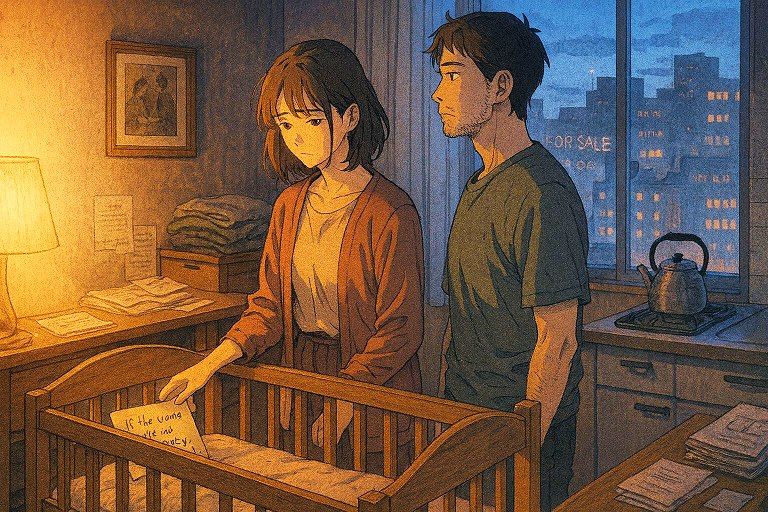
Mrs. Alba looks at the empty cradle as one who studies a wrinkled map of a country she no longer recognizes. Outside, the city breathes shallowly: cars circling, lights advertising sales, and buildings with “for sale” signs planted like flags of surrender. Inside that room, the apartment tells another story: a rental contract with an implicit expiration date, bills piled up trembling like playing cards, and the photograph of a child who never arrived. Alba and Mateo met young, with promises as wide as the sea. They loved with the urgency of those who know time is short; they dreamed of a family and a home whose walls would smell of fresh bread. In the early years life seemed like a board to fill: jobs that felt provisional, projects born in cafés, afternoons without clocks. But dreams are demanding creatures, and the world they inherited required them to give up almost everything in return. She worked endless shifts at a clinic, her tired fingers correcting the stories of other people's pain; he alternated temporary contracts that ended in silence, makeshift solutions in a career that would not settle. For ten years every price increase was a small amputation: groceries, daycare, transport, the dentist. Each rise added up and subtracted hope. “Do you remember when we said we’d buy a house before thirty?” Alba asked one night while folding the clean laundry with hands that already knew the symmetry of the gesture. “I remember,” Mateo answered without looking, as if speaking to memory. “And I remember how we thought stability would be like sunrise, that it would appear on its own.” They both laughed, but the laugh felt like a suit that no longer fit. What had been a plan became an impossible equation: salaries that did not rise, bills growing voraciously, and the sense that life had become a series of impossible choices. Then came the calls that disordered their calendar: the landlord announcing renovations and rent increases, job offers that demanded mobility and constant presence, the news that an entire building had been bought by an investment firm seeking quick returns. One day the notary called to inform them that the building across the street had been bought by a company that speculated on housing. The landlord offered their flat “at a good price” if they agreed to renew the lease for three years. “That’s a trap,” Mateo said, his voice rough. “Three more years and they’ll eat half our wages.” “And if we buy, we mortgage ourselves for twenty years,” Alba murmured, the phrase falling like a preface of fear. “What kind of freedom is that?” Marta—the neighborhood friend, mother of two children who always arrived late and with muddy hands—looked at them bluntly in the neighbor’s kitchen, where smells and worries were shared. “If you buy, you mortgage yourselves for twenty years; if you don’t, they can evict you whenever they want. There’s no middle ground,” Marta said, pinning the truth like a needle. Alba looked at Mateo and saw the number nailed into his eyes: mortgage equals prison without bars. The possibility of owning a home had become a crossroads where desires were crushed: buying meant binding themselves to a long, suffocating debt; renting meant living under the sword of possible eviction. The system, Alba thought in nights when sleep came with dark circles under her eyes, was not a monster with a single face but a machine of small violences: the monthly bill that does not ask about projects; employment that demands everything and offers nothing; housing hung up as a privilege for those who had already inherited their luck. The most frequent conversation at their dinners reduced to a litany repeated to exhaustion: “If we had stability…” The phrase contained a harbor that never arrived, a promise always kept on hold. “If we had stability, we could really think about it,” Alba said one night, holding a mug too delicate to bear so many certainties. “I wouldn’t ask for luxuries; covering the essentials would be enough.” “I know,” Mateo replied. “But they sell stability as a luxury product. They sell it in installments that don’t let us breathe.” The language of desire was replaced by the calculus of survival. There was absence where children once would have been. Families of their generation postponed pregnancies, or shelved them with the same gentle motion of putting letters into a drawer: “later,” “maybe when we have security,” “when the country stops trembling beneath our feet.” With each couple that gave up, the city aged a little more: benches filled with weathered faces in the squares, classrooms closed for lack of students, municipal corridors populated by voids and statistics no one quite knew how to interpret. “Look at that park,” Mateo said, pointing to a hill where bikes and voices used to pile up. “There used to be three kids on every bench. Now I almost don’t hear voices.” “The voices are going out,” Alba replied. “Not because people don’t want to speak, but because no one listens; and if no one listens, voices get used to silence.” Alba read voraciously about empires that did not die because of invaders but because of internal silences: Rome, with its streets that ended empty of heirs; Japan, which aged until it lost momentum and part of its inventiveness; parts of Eastern Europe where train stations carry more memories than children. Each example was a black-and-white photograph that seemed to have been taken from tomorrow, a warning the majority failed to read in time. “That’s how civilizations collapse from within,” the professor told them once at a forum they attended, speaking with the calm of someone who has studied long patterns. “It’s not spectacular; it’s silent. They don’t die from one blow; they fade for lack of continuity.” “Is that what awaits us?” Alba asked, the fear vibrating at the edge of her voice. “I don’t know,” the professor answered. “But the pattern is there: cost of living rises, wages stagnate, housing becomes inaccessible peaks…” Fear took shape in everyday life. One winter the city went dark for three days because of a grid failure. The lights went out, but with them something deeper was extinguished: the façade of normality that conceals the fragility of the social fabric. Conversations in the building transformed; they stopped being individual complaints and became shared confessions. Neighbors who barely spoke met on the stairs wrapped in blankets, exchanging food, stories, and time. An elderly woman, Mrs. Irene, rolled back memory with the firmness of someone who has seen everything and still keeps lucid sorrow. “We survived wars,” Irene said, holding a cup warmed by a candle flame. “But we won’t survive if we accept poverty as normal. Dignity isn’t an individual skill; it’s a social pact.” It was then that Alba understood that unsustainability is not a sum of technical factors: it’s a social decision, a tacit pact that makes future generations pay the debt of the present. It wasn’t only rising prices or precarious contracts; it was that, blow after blow, the horizon upon which the idea of having children grows was being demolished: the confidence that there would be schools, health care, jobs, and time to raise them. Mateo lost a stable job when the company outsourced his department. That afternoon he returned with the work jacket on his shoulder and the hollow look of someone who had lost more than a salary. “You can go to another company,” they told him. “Or you can go home.” “It wasn’t just the salary,” Mateo said, his gaze distant. “It was the calendar emptying of plans. I had meant to start that course, to organize our life, but with this everything becomes perpetual improvisation.” They thought about moving to a town where rent was lower and time ran less quickly. They imagined gardens, yards, a school with less stress. But the rural mirage came with hidden costs: no pediatricians, poor transport, few opportunities for professional growth. It was a choice between dying in a city that squeezed every resource or in a corner without professional horizons or support networks. “And the children?” a cousin asked over the phone, curiosity and concern threaded through her voice. “How can you secure them in a place that offers no future?” The question was not rhetorical; it was a saw that cut desire in two. The decision, they realized, no longer depended only on affection or intimate desire: it depended on an intact social fabric offering tangible guarantees. When those guarantees break, the project of forming a family becomes a blind bet far too risky. The years passed with a crust of renunciations and compromises. Friends who did have children spoke begrudgingly, with a mixture of pride and fatigue. “It’s not what it used to be, but we do it,” Alejandra would say while changing diapers, smiling with a sadness hidden between the folds of the gesture. “There’s love, yes, but also fear for the future they’ll face.” Those without descendants found a different loneliness: not the material emptiness of the home, but the murmur of not having contributed to the cycle. It was an absence that could not always be named: the sense of a generation forced to tuck away its desires in the dimness because conditions did not allow them to bloom. “Sometimes I feel like something is missing,” Mateo confessed one night, staring at the window as if trying to find the voices that were no longer there in the street. “It’s not nostalgia for what I didn’t have; it’s the feeling that I didn’t do what was expected of me, or maybe that what was expected stopped making sense.” “It wasn’t our hearts that stopped us,” Alba replied with tenderness and firmness. “A system that sells insecurity as destiny did.” One afternoon, in an improvised neighborhood assembly convened after a series of evictions, Alba spoke without intending to give a speech. She told of the cuts in her daily life, the sleepless nights adding up numbers, the fear of not being able to guarantee a future. She spoke with the simple voice of someone who lives precarity and manages it day by day. No one interrupted; the words found a ready ear. “We shouldn’t blame people,” a young man stood up after Alba, the contained anger that arises when truths are finally shared. “We don’t refuse to be parents out of caprice. A system that sells insecurity as destiny forbids us.” The room applauded as one who recognizes a truth that had always existed but had not been put into words. The applause was not festive: it was the acknowledgment of a reality hidden in figures and statistics that finally found a face. The story has no single or easy ending. Some couples found community-based solutions that worked as emergency patches but also as experiments in reconstruction: cooperative creches in borrowed premises, shared gardens in neglected lots, barter networks for childcare services. In those spaces something that felt old and new at the same time was born: organized solidarity, that form of mutual support that reduces the loneliness of raising children and returns the idea of the future to the realm of the common project. Other couples emigrated, seeking air in distant shores. They left in waves of talent and need, abandoning neighborhoods with less energy, fewer initiatives, fewer embryos of future. Many who remained carried on day by day with the feeling that deciding to have children no longer depended only on intimate desires but on a torn social fabric: private life rendered into public concern. “If the world gave me certainty, I would have you,” Alba wrote once on a note and left it in the cradle. “It’s not pain I feel; it’s an evidence.” The note stayed folded between an unused toy and a lavender-scented blanket. It was not a plea nor a bitter renunciation; it was a sober, bitter observation: there was an unbridgeable distance between wanting and being able. In the empty cradle the handwritten evidence remained. The note was not painful: it was an invitation to look beyond individual reproach and understand that the problem was collective. Birthrates do not fall because people don’t want children; they drop because the system has made life unsustainable. The city, for the moment, does not wake with the energy of old days. It tends to hoard the same faces in its arteries, faces that age; the squares become terraces of memory. But on corners, in community rooms and shared kitchens, groups form to distribute time and skills: someone watches a child in the morning, another fixes a boiler in the afternoon, a third teaches basic accounting at night so people can start small projects. These are emergency measures, improvised and valuable; sometimes they are not enough, but they allow people to breathe. “We can’t just survive,” Marta said in one of those community meetings, with a voice that would no longer tolerate indulgence. “We have to rebuild what broke.” “If civilizations collapse from within, they can also be recomposed from within,” Alba said in that same meeting, with the conviction born of pain and hope. “If we decide the future will not be a privilege but a shared obligation, maybe the cradle will stop being empty.” Nostalgic and reflective addendum: Sometimes when Alba closes the blind and the apartment falls into dusk, she allows herself a small, direct journey into memory. Nostalgia is not a futile remorse; it is a landscape where old certainties rest. She evokes childhood in a kitchen with yellow tiles, the smell of milk cooling on a windowsill, her mother’s voice singing a bolero while dyeing the afternoon with tales of times when cities were louder with play than with promotions. In those moments everything seems simpler: a promise of the future was then a song, and stability was not negotiated in contracts but inherited in long embraces and networks knitted by friendly hands. Mateo, arriving late and opening the door with the sound of keys seeking rest, sometimes stops in the doorway and looks at the cradle as if it were an object from another century, a relic of possibilities the city decided not to allow. He remembers his father teaching him to ride a bicycle on a street without cars, the first time he felt the vertigo of freedom and the certainty that the world would give him time to grow. Now he sighs differently: his nostalgia is not only for what might have been but for the gentle slowness of other times, when promises were fulfilled by labor and not by predatory conditions. At community meetings, amid lists of needs and practical proposals, stories that smell of past times and awaken a bitter tenderness emerge. A neighbor recounts how her mother took her hand to cross the square; another remembers songs in the building entrance that turned the night into a space of encounter. These memories are not mere yearnings: they are models of a lost fabric that cannot be replaced with cold policies. Nostalgia, for a moment, offers the certainty that there once was a time when life allowed generations to sprout from one another without the system blocking them. That melancholy does not paralyze those who share it; it becomes fuel. Collective memory pushes some to try to rebuild with the few tools they have: time, patience, shared knowledge, and the inventiveness of those who have learned to survive with little. The cradle remains empty, but it is no longer just a symbol of renunciation; it is also an invitation. In the dusk Alba imagines small hands scribbling on sheets of paper, laughter breaking the silence of afternoons, a future not bought but woven together. And in that nostalgic gaze one thing resists: hope is not naive, it is persistent. The city remembers how to be a cradle in its own way: not by decree but by the sum of small everyday acts that make a future habitable. Maybe, Alba thinks many nights, the city will learn again to provide conditions; maybe policies will restore dignity; maybe the idea that sustaining childhood is sustaining the country will be recovered. But while she waits, Alba keeps the note in the cradle and looks at it before turning off the light, like someone watching a letter she does not know if it will ever be read. The empty cradle remains, both evidence of a failure and the promise of a struggle: if civilizations collapse from within, they can also be recomposed from within. Maybe not today, maybe not tomorrow, but someday voices will multiply in the parks again, and lullabies will be songs of promise rather than farewell. Source of the images. Image created with Bing.
1 comment
I liked the calm tone of this piece. It made the experience feel very real and easy to imagine.