 @mc5punk
more from that month
@mc5punk
more from that month
Short story: The Hotel Guest from Hell
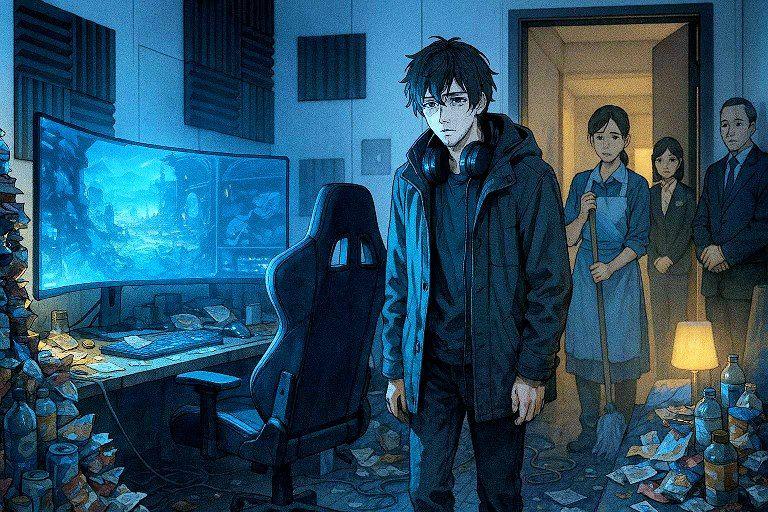
The esports suite had been designed as a capsule of efficiency: white walls dotted with acoustic panels, adjustable cool lighting, an ergonomic chair promising hours without harm, and fiber connections that erased the distance between player and match. For the hotel, that space represented the cutting edge; for Alejandro, at first, it was a platform. He arrived with the certainty of a champion: a simple suitcase, headphones around his neck, a tense smile reserved for the entrance. No one imagined that, in time, that platform would become a cell. At first his presence was easy to explain. People spoke of tournaments, preparation, late-night strategies. Carlos, the young receptionist, offered those light explanations whenever other staff showed curiosity: “He’s concentrating for the tournament,” he would say, with a tone meant to preserve privacy and normality. Pablo, the esports technician and a distant friend of Alejandro’s, made more pragmatic observations: Alejandro needed calm, a place to test builds and practice until his reflexes were sharp. Management celebrated the implicit sponsorship: having a player of his level living in such a suite was good publicity. “No judge him yet,” Pablo said one night at the hotel bar while looking over a list of recorded matches. “Sometimes they do this to isolate before a big event.” Carlos tilted his head. “And what if it isn’t that?” he asked. “I see him only leaving to order food. He doesn’t talk to anyone.” “Then we’ll have to watch him,” Pablo replied. “If he gets lost, it won’t be the hotel’s fault.” Days stretched into months with the same silent inertia that marks sleepless nights. The suite’s door, which had opened frequently for conversations, services, and visits, began to stay only slightly ajar to receive food. Alejandro stopped going out. The curtains remained drawn most of the time; the outside world shrank to the glow of the screen and the hum of the cooling. His screens never went black: matches looped, streams paused, chat windows frozen. Cables formed vines across the floor, chargers and adapters rooting something to the ground. The reduction of the world to a screen carried with it a subtler and more devastating transformation: the gradual abandonment of habits that anchor a person to reality. Food remnants that were once discreet—a disposable plate, a hastily sealed bag—accumulated into mounds. Empty bottles stacked almost to the height of the side table. Cans and wrappers organized into piles that imposed their own order, an architecture of neglect that eventually delimited Alejandro’s living space. Documents, notebooks, and strategy manuals met grease stains and fingerprints. At the center of that still life, the chair and keyboard remained upright like offerings to something that no longer inspired glory. The hotel staff, accustomed to dealing with travelers and celebrities, began to sense this was not mere neglect. María, head of housekeeping with years of experience, ran a hand over an armrest and felt the sticky buildup on her fingertips. “This isn’t normal,” she muttered. “There’s something else.” Carlos, who had been arranging meals at the desk, recognized a restlessness in his colleague masked by professionalism. “I never saw him go for a walk,” he confessed quietly. “It seemed the match was the only thing that pulled him out of the room.” Pablo tried to intervene from his technical position. He went to management more than once, with the urgency of someone who knew the person behind the player. “It’s not just dirt,” he told Doña Rosa in her office. “Alejandro is isolating himself. He needs someone to force him to open the door.” Doña Rosa raised an eyebrow and rested her hands on the desk. “We cannot force him,” she replied. “As long as he pays and doesn’t cause trouble, the law protects us.” “But that’s not humane,” Pablo said, voice tight. “He’s sinking.” Doña Rosa’s gaze, used to balancing risks and smoothing incidents, was cool but not without concern. “I will monitor it,” she said. “But I won’t intervene beyond what’s legal.” Time is a slow sculptor that shapes filth with the same precision it uses to shape habit. What began as piles of wrappers became a landscape: hills of trash around the gaming table, pits of clutter in the corners, barely passable paths lined with cans and packaging. The smell became a presence that clung to the throat: an acrid mix of fermentation, gas, and rancid oil. Stains found their own language on the furniture, and the keyboard’s keys became dead points where grease collected along with the handwriting of someone who had lived too close to the screen. One afternoon the implicit decision not to intervene gave way to an explicit rupture: Alejandro left. No one could say for certain whether his departure was an act of will or a physical and emotional surrender; only the final scene was clear, improvised and silent. Pablo saw him pass through reception with a rounded back and a coat that no longer covered a well-kept body. He approached with the awkwardness of a friend trying, without heroic words, to repair the irreparable. “Ale, what happened to you?” Pablo asked. Alejandro looked at him with sunken eyes; the words came as if each cost him effort. “I got tired,” he said. “Matches weren’t victories anymore; they became excuses.” Pablo swallowed hard. “We could have helped you.” “I haven’t known how to ask for help in a long time,” Alejandro answered, and he kept walking without looking back. What remained after his exit was a dark vindication of the human condition: a room turned into witness. When housekeeping opened the door, the scene hit them with the force of something far beyond the norms of coexistence. Mountains of trash leaned against the walls, objects piled into formations that seemed to protect a core, leftovers marking trajectories of uninterrupted days and nights. Cleaning was not merely a technical task; it was an emergency operation requiring time, effort, and something like compassion. For three full days María and her team worked in shifts, bagging kilos of waste, disinfecting surfaces, scraping stains that had adhered with the tenacity of things not cleaned quickly. María was surprised to find fragments of Alejandro’s life among the garbage: notes, sketches, stickers showing past achievements. Seeing those personal traces scattered among wrappers and bottles left her disoriented and sorrowful. “It’s not just trash,” she said softly one night as she loaded a heavy bag onto a cart. “It’s a surrender.” Carlos, who helped with logistics at times, added, “It’s as if he wanted to disappear without moving.” Explanations form in the silence of those who cannot ask too many questions. Management documented the damage and calculated the bill: four hundred dollars for cleaning, replacement of some items, and staff overtime. From the cold objectivity of administration, the figure seemed a sufficient solution to close the file: fix the room, put the suite back in service, erase the tangible evidence of what had happened. Doña Rosa, aware the law allowed more rigorous measures, made a decision that was part calculation and part humanity: she would not press charges nor pursue legal action against Alejandro. In a brief meeting with Pablo and María she explained her reasoning with measured pragmatism. “I won’t turn this into a spectacle,” Doña Rosa said. “We did what is appropriate as a company; involving the justice system would be disproportionate.” Pablo protested vehemently. “If there are no consequences, this could happen again. Don’t we have social responsibility?” María looked at the floor before answering. “There are limits, Pablo. Sometimes the humane thing is not to humiliate.” Down corridors and in bars the story took the shape of rumor and epitaph. Some, seeking relief in a label, nicknamed him “the hotel guest from hell.” Others saw in the name a blunt metaphor: hell as an inner place, a private geography of suffering rather than moral condemnation. Staff memory retained the image of a suite restored to technical cleanliness but also a lingering sense that couldn’t be wiped away with soap and water: the feeling that at some point Alejandro’s humanity had given ground to the compulsion to play until the match and life became confused. There were conversations that tried to hold more than consternation. Doña Rosa asked anyone who encountered Alejandro to invite him to talk, to offer a form of care that was neither intrusive nor judicial. “If you see him, don’t say anything hostile,” she requested. “Invite him for coffee. Listen.” María nodded. “Sometimes people just need someone to keep the door open until they want to leave.” Pablo tried to propose concrete actions. “We can offer him sessions with a psychologist and support from teammates,” he said. “It’s not much, but it’s something.” Alejandro’s final decision regarding any help remained unknown. The choice not to take the case to the police left an ambivalent mark. For some staff it was an act of compassion; for others, administrative resignation. In the hotel they spoke of dignity and limits, of the boundary between the duty to protect and the power to intervene. Doña Rosa’s choice condensed that tension: not exposing a man to public humiliation, but also not forcing him to face a society that barely tolerates weakness without turning it into spectacle. Months later the suite resumed its original function: it hosted young players again, teams buzzing with tournament excitement, headphones hanging like medals. The technology remained, impassive, waiting for another human to inhabit it without getting lost. Yet at night some staff swore they felt a residual memory in the walls: the distant echo of keys struck in desperation, a held breath in the midnight silence, the sense that a match had been left unfinished. That perception was not supernatural but human: places keep stories, and stories exert a pull on those who pass through them. The drama offered no visible catharsis; there were no public confessions or grand reconciliations. It was a quiet descent, marked by small negligences that, accumulated, constituted a fall. Alejandro’s story remained unfinished, like many lives that fracture without attention. For those who cleaned the suite and saw the trace he left, the episode was both a warning and an interrogation: what is lost first when someone locks themselves away? The ability to ask for help, the habit of self-care, presence in the world? And, above all, who takes responsibility when the collective response is administrative indifference or resigned compassion? In a hotel corridor, while morning light filtered in straight lines, María took off her apron and looked toward the suite’s closed door. She had no easy answers—only a simple conviction that hesitated and insisted at once: sometimes opening the door in time matters more than issuing a bill. Carlos, leaning on the reception desk, said in a low voice, “We gave him a cruel nickname, but the truth is none of us wants to remember that we could have been him.” Pablo kept reviewing lists and contacts, hoping that if fate allowed another chance, he would find the strength to reach out. And in an unwritten future, perhaps Alejandro tried again. Perhaps he did not. What remained, in any case, was the trace of a failed encounter between machine and human vulnerability, between competition and fragility. The suite was cleaned, repaired, and reopened for competition. The city kept its rhythm. But something happens to places where someone gets lost: they hold a resonance, a possible memory that makes those who pass by pause and ask themselves whether, next time they see a door ajar and someone sitting too long in front of a screen, they will do something different. Source of the images. Image created with Bing.
4 comments
Such a powerful and sobering story. It’s a reminder of how quietly a person can slip into isolation, and how much it matters that we notice one another before the darkness settles in. May God give us eyes to see, hearts to care, and the courage to reach out when someone’s door stays closed too long. — Your_Brother_in_Christ 🙏
Thanx 🙂👍
This story made me pause and smile. Simple, human, and meaningful.
😄👍