 @mc5punk
Short story: The Perfect Storm
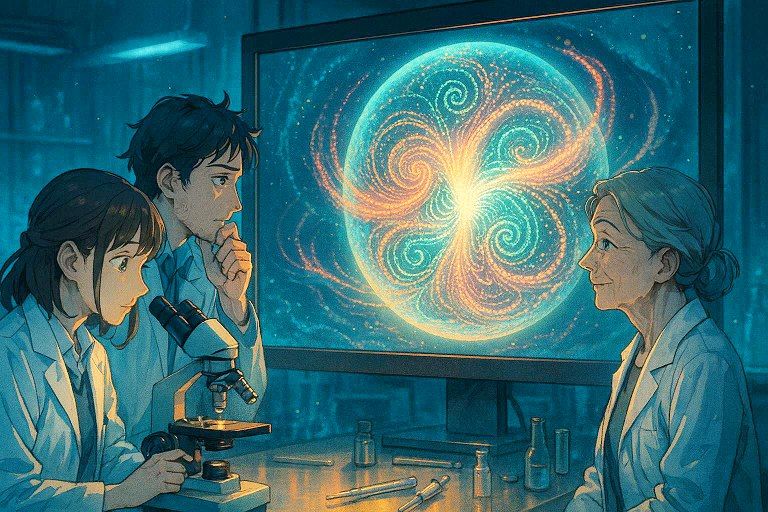
In the east wing of the laboratory, a pale lamp cast a halo over stainless-steel benches where time seemed to have turned liquid. Vials with inked labels, pipettes lined like orchestral instruments, and a monitor flickering with microscopic images were all that inhabited that dimness of glass and salt. Three people watched in silence—not out of reverence but from a need not to disturb what they were seeing: the instant nature organized itself to create. “Look again,” Ana, the microscopist, whispered without taking her eyes off the screen. “Notice how it starts from the membrane? It isn’t a random glow.” Marcos, the theoretical biologist, tilted his head and traced an imaginary line in the air as if trying to follow an equation he could not write. His fingers, stained with ink and thought, tapped the table in a steady rhythm. “It’s not just glow,” he said. “They’re patterns. Spirals, waves folding over themselves. Miniature whirlpools governed by the same rules we see in hurricanes.” Across from them, Elena—who had spent three decades attached to images like this—allowed herself a look that spanned years of attempts and failures. For her, the screen was not merely a screen; it was a map of questions she had learned to read with patience. Inside the egg, a universe unfolded. Proteins—millions upon millions of minuscule entities—began to activate at the membrane as if responding to an ancient command. One by one, by the billions, they lit up. There was no disorder in that luminescence: molecules formed shapes, converged in spirals that advanced, collided, and then dissolved, leaving a trail of new configurations. That dance was not caprice; it had purpose. The spirals traced routes that, invisible to the human eye but reproducible by equations, indicated how matter should be organized so the first cell division would occur in the correct place. “It’s like the cell is drawing itself,” Ana murmured. “Decision isn’t the whole word,” Marcos replied. “It’s more like synchronization: signals finding the center. If they fail, division doesn’t happen; the egg doesn’t know where to split.” A low hum ran through the room as the monitor showed a small body approaching: the sperm. No one spoke above a thread of voice. The contact was like a spark: PLCζ, a tiny protein the sperm deposited, acted like a key. Instantly, a different kind of storm opened inside—the rise of calcium sweeping the cytoplasm like a luminous wave. The calcium oscillations did not arrive as a single impulse: they formed a repeating tempo. A calcium crest crossed the cell in seconds, followed by another, and for hours those pulses continued with the patient insistence of a metronome. Each wave performed critical functions: they blocked other sperm—signing a pact of exclusivity; reactivated the cell cycle that had been paused; and perhaps most importantly, sent precise biochemical instructions that set the embryonic program in motion. Without those oscillations, there would be no first cleavage, no embryo—the development would not begin. Ana pressed her lips together. “Those waves do more than propagate calcium,” she said. “They organize. They tell these proteins where to gather to find the center.” Marcos leaned on the table, his gaze lost in the patterns unfolding on the screen. “And the math,” he said softly. “It’s astonishing that the same equations used to describe these waves model hurricanes, ocean currents, and even certain quantum states of matter. It’s the same structure repeated across scales.” Elena closed her eyes as if trying to hear a symphony that could only be perceived inwardly. “That amazes me,” she murmured. “The same organizing logic appears in such different places. It’s as if nature has a limited vocabulary and uses it over and over to build different realities.” On the screen, the protein dance showed increasing order: from the periphery, whirlpools began to fuse; their trajectories drew a geometric center that needed no name. Like merchants finding each other at a market, particles found their place by interlocking interactions. The storm of waves, once seemingly diffuse, gained coherence. Proteins were not drawn to the center by chance: the waves pushed them, summoned them, and assembled them into an architecture that allowed fission. Ana and Marcos exchanged a look, both aware of the smallness of the act compared to the vastness of its consequences. Yet within that smallness lay an intensity almost religious. “If the center fails,” Ana said softly, “the first division never happens in the right place. It’s like cutting fabric incorrectly: the whole pattern is ruined.” The sperm, now fully integrated, had initiated an irreversible process. Calcium crests continued to strike the cytoplasm: blocks, restarts, signals establishing a rhythm. The waves acted like a strict director, repeating instructions until the molecular orchestra performed with precision. Marcos, always seeking concrete analogies, offered a comparison the others took in without surprise. “It’s like choreography we also see in the atmosphere,” he said. “On distant planets, in the gas swirling around a star, or in the dynamics of bacterial swarms—the same geometric rules emerge. This isn’t coincidence; it’s a structural property of the universe.” Elena let out a brief laugh, loaded with years of verification. “That doesn’t mean life is simple,” she said. “It means the universe is parsimonious: it reuses its most effective strategies in different contexts. What we saw today isn’t unique; it belongs to a family of patterns.” As they spoke, the image on the screen reached a climax. Proteins converged on the center that the waves had defined. That point, previously imperceptible, became a groove, an imaginary line marking the symmetry about to be severed. With a deliberateness that felt intentional, the egg inhaled its purpose and began to cleave. The membrane folded, the cytoplasm reorganized; in an act that required no trumpet, the cell split into two. Silence in the room was absolute when the image showed the two daughter cells. No one applauded. There was, however, a contained emotion—the kind felt at the end of an intimate performance too private to comment on. “It’s the first act,” Elena said, part scientist and part guardian of secrets. “From here, everything is story. But no one in this world has seen that act the way we have.” Marcos took a deep breath. “Imagine,” he asked, “a pattern that repeats from gigantic whirlpools down to a tiny cell. There must be a way to tell that mathematical story so people understand it—so they see life began with a storm of waves, not just a contact.” Ana looked down, briefly taking on a maternal expression. “When someone says everything began with an egg and a sperm,” she said, “I want them to add that it began with a perfect storm of waves—whirlpools that teach randomness to obey, calcium waves that set a rhythm.” Marcos smiled, then glancing back at the screen as if it were possible to freeze that instant forever. “Sometimes,” he replied, “beauty lies in precision. And precision, in the end, is what lets us move from chaos to form.” When the laboratory lights returned to their usual brightness and the occupants began packing their things, the image of the spirals stuck to their pupils. In the helicopter of words they exchanged while leaving were technical phrases, notes for papers, hypotheses to explore. Beneath all of that, though, lay the same indelible impression: that the origin of life was not only an encounter between two cells but a silent choreography in which waves dictated the place and time of the first cleavage. That night each of them returned home with a distinct version of the same certainty. Ana thought of hands that would one day hold beings who had begun in microscopic whirlpools; Elena of decades of searches finally linking patterns; and Marcos of equations that, like musical scores, described dances both in the atmosphere and inside a cell. Alone in her room, Ana imagined the spirals as waves on an invisible shore that had unknowingly written, in advance, the name of a future. Elena, in her armchair, reviewed the similarities across scales and felt that science, at its best, is a way to find kinships where none seemed to exist. Marcos, his head full of formulas, dreamed of a graph that could translate those waves into a language anyone could read—because if people understood that the same patterns govern the biological and the cosmic, perhaps they would perceive the continuity linking an embryo to a galaxy. Outside, the city continued its course of small miracles and forgettings. Inside the screen, frozen in the scientists’ memory, remained the first cleavage they had witnessed: a microscopic score executed with rigor, a calcium beat that set direction and place, whirlpools that taught chance to obey. A perfect storm that, without ostentation, wrote the first line of what, in time, we will call life. Source of the images. Image created with Bing.
No comments yet