 @mc5punk
more from that month
@mc5punk
more from that month
Short story: Echos in the Stained Glass
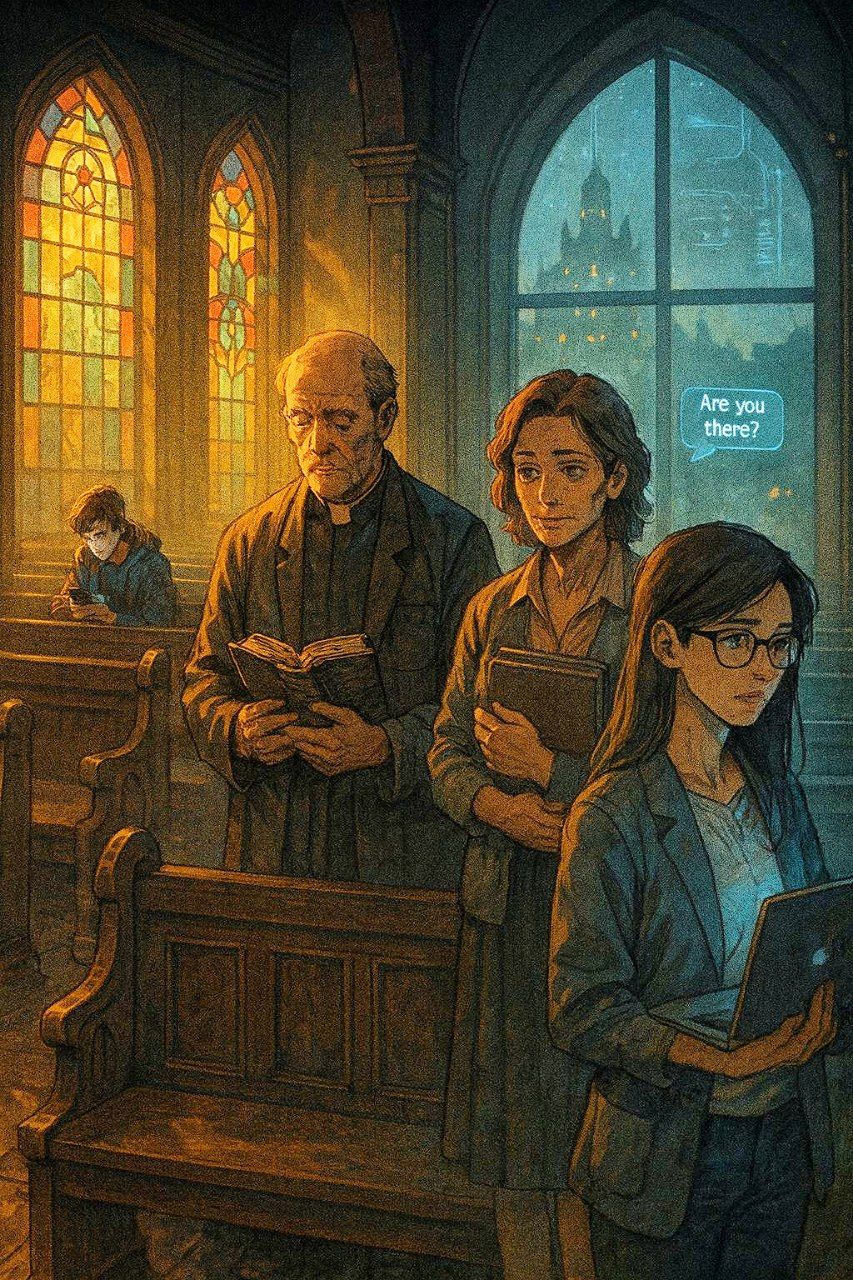
In San Aurelio, the churches emptied with the slowness of a tide that never announces a storm. The pews, witnesses of litanies and silences, kept a sharp patience; the stained glass filtered a light that seemed to hold memories. The city asked itself, without an easy answer, how to sustain faith when bodies no longer filled the benches and presence shifted toward small screens that glowed at night. Father Mateo walked through the rectory with the cadence of someone who had survived many seasons. His hands, used to turning pages and blessing heads, flipped through digital proposals wrapped in charts and promises of reach. He did not speak loudly: prudence and fatigue helped him like a habit. Mateo, in a low voice to himself: “We have lost seats, not stories. But stories need ears, not algorithms.” Elena, the pastoral coordinator, came in with a folder full of names and faces. Her expression belonged to someone who knew the loneliness of those who call for help and receive silence. She walked to the table and set the folder down gently. Elena: “Father, people need to feel accompanied. If technology brings them closer, let it serve to call someone. Not to replace the visit. Not to turn the Word into a programmed message.” Mateo looked at her and recognized in her the urgency of the immediate: hands seeking hands. Sofía arrived like a cool, precise light: a young developer, a believer, her eyes used to the glow of screens. Her hands spoke in keystrokes and diagrams; she brought “Palabra Amiga,” a promise wrapped in code. She explained, seated, with the calm of someone who knows shortcuts and technical frameworks. Sofía: “The app can send personalized readings depending on the user’s situation, remind them of gatherings, and keep a 24/7 chat. It can recognize signs of distress and route them to a volunteer. It does not intend to substitute, but to expand pastoral reach.” Mateo nodded slowly, wary of how technology packages consolation. Mateo: “And what if people begin trusting that artificial voice more than the community that sustains them? What happens when the screen gives a quick answer and the church takes days?” Sofía: “That’s why we propose a hybrid model: the bot as threshold and human accompaniment as harbor. Automatic referrals, human review of content, and clear limits on what the bot cannot do.” Elena, looking at the scheme, let out a contained sigh. Elena: “Let the machine remember schedules and collect data — that’s fine. But we must not let it dictate consolation or make the final word about the sacred.” Across town, at the megachurch Luz Mayor, Pastor Ricardo thought in terms of reach and effect. His auditoriums, once full, had taught him that faith can also be measured by the capacity to gather. For him, technology was a tool for scaling, for touching lives that would never cross a physical threshold. Pastor Ricardo, before his press team: “If we expand our digital presence with chatbots that simulate dialogues with biblical figures, we will reach those who will never come. It’s not about replacing, but about attracting.” Voices synthesized to recite passages and preconfigured answers were projected during the presentation. The idea seduced many because of its promise of immediate reach. But not everyone received it without unease. Dr. Vega, a theologian with a serious demeanor, attended the conference; her experience with ancient sources and ethics made her intervene gravely. Dr. Vega: “Recreating sacred voices forces us to make interpretive decisions for others. Who validates the answers? What happens if a simulation offers erroneous or dangerous consolation? There is an ethical weight that cannot be resolved with reach metrics.” Pastor Ricardo, secure in his need for results, replied without dismissing the concern. Pastor Ricardo: “People seek immediate consolation. If we can give it to them in a controlled way, we will. We can’t keep waiting for them to cross the physical door; we must meet them where they are.” On the margins of that debate was Tomás: a teenager who had stopped attending Mass, whose absence hurt in silence. He had grown up with notifications and short messages; long litanies felt alien to him. One night, driven by curiosity and that sharp emptiness, he downloaded “Diálogo Sagrado.” Tomás, typing hesitantly: “Why do I feel God is far away?” The answer he received was correct in form and hollow in substance: a well-chosen passage, a standard reflection, lacking tone and listening. Tomás put down the screen with more unease; the words could not reach what burned inside him. However, the system activated a safety routine: it detected terms and nuances suggesting distress. The conversation was routed to Claudia, a volunteer who watched the late-night chats. Claudia, with warmth in her text, responded promptly. Claudia (in chat): “Hi, I’m Claudia. Do you want to tell me more? I’m here to listen, not to judge.” Tomás, surprised by the warmth, wrote with more confidence. He asked if someone could speak on the phone; the words now needed rhythm and human tone. Claudia, sober about responsibility, escalated the case to Elena. Claudia (internal message): “Elena, I have a young person expressing a lot of loneliness. He asks to talk on the phone. Can you take him?” Elena picked up the phone at dawn and spoke with Tomás. The conversation was slow, sometimes rough, sometimes filled with silences that said more than sentences. Elena: “Tomás, tell me. What’s going on? You are not alone in this.” Tomás: “It’s hard for me to go to Mass. I feel people look at me differently. When I ask about doubts, no one has time. The app gave me a pretty text, but it didn’t listen.” Elena: “Sometimes an answer doesn’t fit in text. If you want, come this Sunday. We can talk after Mass, have a coffee at the community center. I can’t promise solutions, but I can promise company.” Tomás attended. He sat on a bench less worn by habit and more by the novelty of his decision. Elena spoke with him, walked alongside him, invited others to listen. Human presence, with its awkwardness and imperfect tenderness, began to restore something algorithms could not touch: trust. It was a silent rescue, without announcement or fanfare. Meanwhile, the debate in San Aurelio grew in nuance and voices. The diocese convened meetings: pastoral workers, theologians, volunteers and technicians. Father Mateo chaired one session, seeking consensus amid uncertainty. Father Mateo: “Let us set limits. The bot must not interpret sacraments nor administer deep accompaniment. All content must be reviewed and cite its sources. Above all, there must be a clear referral to people when needed.” Sofía took notes and proposed precise technical controls designed so technology would obey pastoral prudence. Sofía: “Let’s implement referral thresholds: if a user mentions self-harm, confession, recent losses, or deep existential doubts, the system triggers an alert and a human mentor must respond within an hour. Automatic replies will always include references and an invitation to personal accompaniment.” Claudia: “And each interaction should show that behind the message there is a possible human process. Let’s not let people think they spoke to an infallible entity.” Elena: “Let difficult decisions be made by people trained in pastoral care. Ethics cannot be reduced to a checklist.” Not everyone accepted moderation. Pastor Ricardo continued pushing for more persuasive simulations. His bots, tuned with synthetic voices and a repertoire of passages, began to attract users seeking quick comfort. Some found refuge in those voices; others felt a different chill: the sense that complete, instant consolation might be, perhaps, packaged consolation. An anonymous parishioner in a forum commented: “Talking to a digital version of an apostle calms me, but I wonder if it’s real.” Another wrote: “I’d rather the church call me at home than a bot.” At a public panel, Dr. Vega spoke with grave voice and reasoned arguments. Dr. Vega: “Artificial intelligence does not possess moral conscience nor pastoral formation. It can be powerful, but it is incapable of understanding the complexity of human suffering. It cannot replace the responsibility that accompaniment entails.” Still, initiatives pressed forward under new frameworks. The diocese formalized protocols: mixed teams reviewed content, source citations were required, and clear limits were set. Smaller parishes adopted hybrid models: chatbots for coordination, messages and reminders; humans for visits, confessions and deep accompaniment. On an ochre-hued evening, Sofía and Elena finished a long content review session and left together into the street. Their steps were slow, like a conversation that did not want to end. Sofía, in a low voice that betrayed fatigue: “Sometimes I doubt. I spent nights refining replies and designing referrals. I feel proud when I think of the girl who found company in the app.” Elena looked at her with shared tenderness and weariness. Elena: “I’m glad. But I’m even more glad that the girl ended up speaking with a person. The technology opened the door; we went in. We mustn’t forget that the true task is to accompany after the opening.” Mateo, from the sacristy, watched Mass with a calm that was not innocent: some pews began to refill, others remained empty like dry rivers. He allowed himself a sigh that contained acceptance and grief. Mateo, barely audible: “Not everything that gleams is light. If the gleam leads to light, we will have done right. If not, we will be accomplices of the dazzle.” The following months brought a tense coexistence between reach and care. For some, the immediate responses provided by the systems were honest consolation on sleepless nights; for others, the chance to converse with recreations of sacred figures felt unsettling, like looking into a mirror that returns a familiar voice without a soul. Technology offered promise and loss: it extended the ministry’s reach but also multiplied risks of misinterpretation, dependency, and dehumanization. In a community meeting, Father Mateo felt the balance found was precarious, fragile as thin glass. He reaffirmed the guidelines in a firm voice. Father Mateo: “Let technology be a tool, not a master. Let human accompaniment be not an optional function but the heart of our service. Let us safeguard sources, train those who accompany, and never replace the voice of flesh with a preprogrammed voice.” The community of San Aurelio continued to breathe between stained glass and notifications. Some found consolation in immediate replies; others rediscovered the weight and warmth of a face. Technological tools opened doors that had been closed; pastoral responsibility remained, intact and melancholic, in the hands of those who guide. The city learned, with the pain and hope that adaptation brings, that faith cannot be domesticated to algorithms but must be kept, accompanied, and shared—voice to voice, presence to presence. Source of the images. Image created with Bing.
No comments yet