 @mc5punk
Short story: Plaza of Democratic Distribution
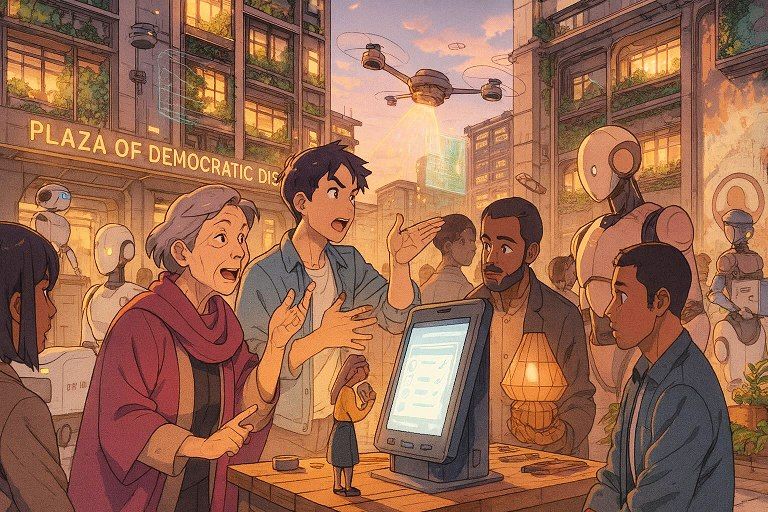
In 2045 the city Elena had known since childhood had changed even in its silences. The old industrial sheds on Avenida Libertad still stood, but their noise was no longer the sound of hurried hands or workers' radios: it was a tuned hum, almost musical, of servomechanisms and balanced batteries. Rows of humanoid robots —of different designs, sizes, and materials— moved with the coordination of an orchestra: some assembled prefabricated housing modules, others repaired the electrical grid, pollinator drones hovered over vertical gardens, and delivery machines slid packages through underground tunnels. The aesthetic had shifted toward warm surfaces, smart textiles, and modulated voices designed to soothe those who remembered the roughness of the first automatons. Technically, the promise debated two decades earlier in forums and panels had largely been fulfilled: automation could cover many of the material needs that had once required intensive human labor. But that technical realization did not, by itself, resolve the political, social, and ethical questions raised in those debates: how to distribute the abundance produced by machines? Who decided what should remain human and what should be delegated? How to preserve agency and meaning in a society where material subsistence could be guaranteed without employment? Twenty years later, those questions remained the central knot of public conversation and everyday life. Elena was forty-two. Her ID card, visible in the civic app everyone used, bore a tag that read "Basic Credit: Active." The country had implemented —starting from regional experiments in the previous decade— an Infrastructure Income that was not just a monthly cash flow but an integrated package: guaranteed modular housing, preventive healthcare, autonomous transport, and household energy credits. That package was funded by an automatic tax on the ownership and operation of robotic fleets, licenses for AI clusters, and a levy on data transactions. The transition to that scheme was not linear: there were strikes, protests, governments that tried to dismantle it and others that consolidated it. There were also millions of individual stories of loss, learning, and reinvention. “Do you think this is what Musk imagined?” Elena asked one morning Raúl, her neighbor, while they watched a group of robotic gardeners readjust roots in the neighborhood’s community garden. “Not exactly,” Raúl replied, setting his tea cup on the railing. “He talked about machines that would eliminate poverty. Materially, yes: many no longer go hungry or sleep on the street. But the problem wasn't only the lack of goods; it was the lack of something that made people feel alive.” Elena worked three days a week as a cultural mediator at the Living Archive Center, a hybrid institution combining storytellers, synthesis technicians, and volunteers. Her task was simple in appearance: preserve collective memories. In practice it meant hours of listening to voices, tuning synthesis assistants to reproduce timbres, pauses, and silences, and negotiating with families who feared that generated versions would carry their intimacy into a public library without permission. “Today a family is coming to tell their migration story,” Elena said at the coordination table in the Center, pointing to a file. “I want the synthesis to respect the silences, not just the data.” “We can adjust the model,” Maia, the synthesis technician, intervened. “There are parameters to preserve breathing pauses and prosodic variation. But we need their explicit consent for the synthesized version to leave the archive.” “I’ll ask for it,” Elena answered. “This is their heritage. I don't want a perfect, cold copy.” That care for human texture was a daily response to a broader dilemma: machines could reproduce styles, execute tasks, and optimize processes, but the community still valued what machines could not "desire." Many people, therefore, even though they did not need to work to survive, chose occupations that enriched the social fabric: cultural mediation, emotional care, in-person teaching, craft workshops, local curation, or citizen algorithm auditing. Society had reorganized the concept of work into three main vectors: expressive creation (art, music, intimate narratives), relational services (care, mentorship, companionship), and technical governance (supervision, audit, and maintenance of automated systems). That reorganization was not peaceful. Political and economic groups emerged disputing how the automated wealth should be distributed. In Elena’s neighborhood three currents mirrored national politics: “Participatory Support,” advocating a robust income complemented by paid civic positions; “Creative Market,” favoring less regulation and letting experience and reputation markets allocate nonessential goods; and “Algorithmic Democracy,” proposing binding voting mechanisms to set parameters for automated systems that affected public life. No single current won outright; the resulting balance was a mixed system full of tensions. “Aren’t you afraid they control so much?” Marco, a local activist, asked during a neighborhood assembly discussing the transparency of energy-prioritization algorithms. “I’m concerned,” Elena said. “But if we stay out, others will decide for us. We have to occupy these spaces now.” Elena’s life was full of small coordinations between the human and the automatic. She spent her free mornings at the community vertical garden, where pollinator drones flew precise routes according to maps neighbors reviewed weekly. Afternoons were in a sustainable carpentry workshop: machines and robots assisted with cuts and sanding, but design decisions remained human. At night she attended the citizens’ panel that assessed the equity of local algorithms: a group of randomly selected citizens proposing parameter adjustments for energy allocation during heat waves or rationing. “We need to include the family-care variable,” Elena proposed at the panel’s last meeting. “The model can’t prioritize shopping centers and leave out residences with elderly people.” “We can simulate its impact,” Maia, who also worked technically on the panel, replied. “I’ll show a projection with sensitivity to the parameter. If we increase the weight of ‘vulnerability,’ allocations change.” Material changes were significant: extreme poverty declined. Homeless shelters were repurposed as insertion centers, and old factories turned into hubs for services, training, and community repair. However, the disappearance of material need did not eliminate other forms of scarcity: scarcity of genuine attention, scarcity of legitimate authority, scarcity of social recognition. Reputation and the capacity to influence AI norms became new symbolic resources. New hierarchies therefore emerged. Economically, diverse actors appeared. Large tech conglomerates reinvented themselves as algorithmic governance platforms: managing robot fleets, experience markets, and data networks. In return they paid taxes for using robotic public space and for environmental externalities. But their power to set model configurations generated friction. In response, AI cooperatives flourished: small platforms governed by community contracts offering personalization, auditing, and repair services. Their advantage was not scale but local trust; whole communities preferred paying a premium for services that respected their language, rhythms, and cultural criteria. “My uncle lives in the countryside and his 3D printer broke last week,” Elena told Raúl in the communal kitchen. “It took two days to get a spare part. For him it was an eternity.” “That’s the problem,” Raúl replied. “Rural networks never upgraded the same way. The city seems shielded, but vulnerability exists in places left behind.” That asymmetry prompted investments in resilience: human emergency centers able to operate critical services manually if networks failed, temporary relocation programs for people at risk, and funds to modernize remote infrastructure. Still, the presence of those mechanisms did not erase the feeling of abandonment in many areas. One of the most notable cultural shifts was how people measured social worth. Work, for most, was no longer the main source of identity: instead, community-recognized contribution, local impact, persistent creation, and interpersonal care rose to prominence. Universities and training centers broadened curricula to include applied AI ethics, management of relational ecosystems, multimodal narratology, and techniques to design human experiences that machines could not replace. Degrees still mattered, but social validation diversified: a carpenter designing chairs for public libraries could have the same local relevance as an engineer tuning an energy distribution algorithm. Money didn’t vanish; it mutated. Daily life saw universal credits covering basic needs coexist with local reputation tokens used to reserve spots in creative residencies or artist studios, and fiat currency for luxury goods and services. The promise that “money would become irrelevant” was partly fulfilled: survival no longer relied solely on wages, but access to higher-tier experiences—long trips, art collections, exclusive spaces—remained mediated by economic and reputational resources. In foreign policy, countries that developed robust regulatory frameworks for AI governance and efficient tax systems achieved greater stability and attracted talent and capital. In contrast, states that allowed data monopolies and self-regulated models faced protests and migration waves. Human mobility reorganized: cities with inclusive policies and training programs for non-automatable roles became magnets for those seeking reintegration and safety. Intimate relationships and social fabric also transformed: more available time allowed investment in deeper relationships, but that time competed with attention ecosystems shaped by hyper-personalized algorithms. Movements for “active disconnection” emerged: annual weeks in which nonessential services were limited to encourage face-to-face encounters, rituals, and human networks. Many communities adopted local contracts delimiting machine intervention in sensitive care—for example, the presence of robotic assistants during rites of passage or breastfeeding—to preserve zones of intimate humanity. Elena witnessed this complexity in many moments. One autumn afternoon she attended the inauguration of a neighborhood collective mural. Dozens of human hands painted alongside drones projecting impossible textures; the work combined traditional pigments and sonic projections that shifted with wind and light. “Before we worked to survive,” an elderly woman said during the event, her voice resonating across the plaza. “Now we work to feed one another.” “Isn’t that better?” a young man asked from the crowd, curiosity in his voice. “It’s better,” the elderly woman answered firmly, “but it’s not automatic. It requires us to see each other and care for one another. If we leave everything to machines, we lose the thread that holds us together.” The applause that followed was long. Elena thought of her mother, who had lost her job in 2028 when the local plant automated. Her mother found, through urban gardening, not only income but community and purpose. But Elena also remembered neighbors who, despite guaranteed shelter and food, had not escaped emotional precariousness: some lived isolated, trapped by loneliness despite material abundance. Public space management changed too: the municipal patrol, now staffed by humans trained in mediation, coordinated flows of delivery robots and automated cleaning teams. Their role was less to punish than to intervene when human-machine interactions generated conflict: for instance, when a delivery robot blocked a wheelchair ramp for hours, or when an autonomous ambulance had to prioritize a patient in a complex situation. Those human mediations proved irreplaceable. In the city center, what had been Station Plaza was officially renamed “Plaza of Democratic Distribution.” On the pedestal that once held a statue, a civic terminal was installed: a panel where any citizen could propose adjustments to public rules governing ubiquitous robots. Proposals were debated in in-person assemblies and in public simulations generated by models showing short- and long-term consequences. One recent vote approved that companies cede a percentage of their computing capacity to community uses during peak demand hours—for local climate modeling, free education, and cultural projects in vulnerable neighborhoods. “This is progress,” Marco said during the final vote in the plaza. “But we can’t let our guard down. We must establish periodic audits and clear consequences for noncompliance.” “We will monitor it,” Maia replied from the technical booth. “Transparency is now encoded in the social contract; any citizen can see and audit the metrics in real time.” Even with these advances, tensions persisted. The concentration of symbolic and computational capital allowed some groups to craft dominant narratives about what should be valued. Political struggle shifted partly from mere material redistribution to a dispute over who defines automation norms: which tasks should be prioritized, what data counts as public, which justice criteria get encoded, and how unpaid labor—like emotional care—that machines do not replace should be compensated. In daily life, Elena experienced the coexistence of automated and fully human in small rituals. One night, returning to her building—a block whose climate systems automatically adjusted according to health and noise parameters—a community 3D printer finished producing a lamp she had designed for the neighborhood reading room. The machine worked with precision; a young neighbor organized a small handover ceremony. “The light!” the young man exclaimed as he switched it on. “It’s fantastic.” “The machine made it, but this is ours,” Elena said, running her hand over the wood. “Not just because of the lamp, but for the story it carries.” They shared stories beneath the new light: accounts of lost jobs, recent learnings, school anecdotes, and shared silences no synthesis could reproduce fairly. The lamp, produced by automation, acquired meaning through the community that integrated it into life. Automation, Elena thought, had made work optional for many and necessary for others; it had eliminated many forms of material poverty but not power hierarchies or the human need for meaning. The challenge of 2045 was not merely to manufacture abundance but to build institutions, practices, and recognition networks that translated that abundance into dignity, agency, and belonging. The question still debated in international forums was no longer only technical: it was political and cultural. Society had to decide collectively what to delegate to machines and what to preserve as the human domain; how to remedy inequality that is not solely material; and which values to encode in the systems shaping daily life. At day’s end, in the Plaza of Democratic Distribution, the civic terminal projected a public simulation: if the minimum community computing share increased from 2% to 5%, free education networks in vulnerable neighborhoods would improve markedly, though commercial computing capacity would temporarily decline during peak hours. People debated, spoke, and voted. That imperfect, noisy public deliberation was also the new form of civic work: making decisions about automation governance. In the early morning, while the city slept, maintenance teams —human and robotic— worked quietly repairing an energy distribution line. Elena, who had stayed late in the common room, returned to her apartment and thought of the elderly mural painter, her mother who had found community in gardening, and the neighbor who celebrated a printed lamp. She thought of the new forms of poverty that persisted: loneliness, the feeling of being unnecessary, the fragility of enclaves left behind by modernization. The balance reached was not perfect, but it offered a possibility: automation could relieve material scarcity, yes, but the real collective task was to transform that abundance into care networks, effective participation, and institutions that guaranteed agency and recognition. The promise of a life in which “work was optional” had been fulfilled in terms of survival; its full realization depended on whether society could reimagine what it means to contribute, belong, and govern in an era where machines do many things for us, but still cannot do the work of seeing and recognizing us as equals. Source of the images. Image created with Bing.
No comments yet