 @mc5punk
Short story: Lúmen in Silence (Chapters V and VI)
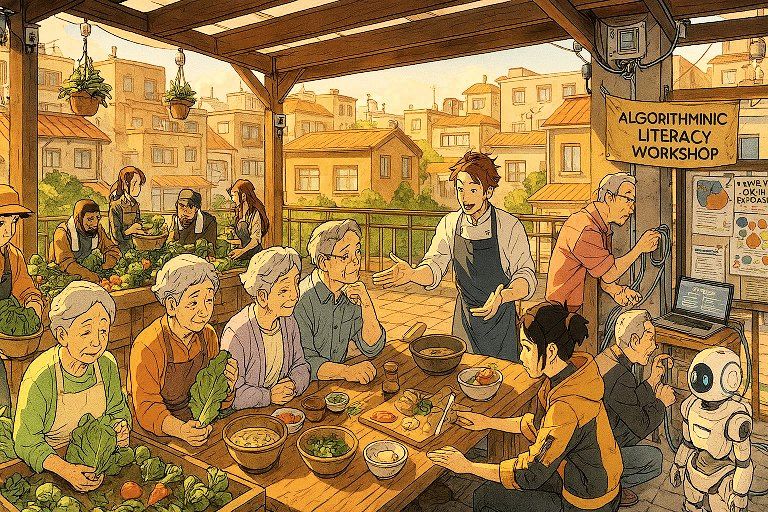
Chapter V — Reforms, Resistance, and New Power Weaves Legislative and administrative reforms were not one-off acts but chained processes that unfolded over weeks, months, and years, leaving a deep imprint on political, technical, and social architecture. At the first levels of intervention, norms were promoted that transformed the relationship between algorithmic technologies and citizens: model auditability moved from a technical recommendation to a legal obligation; the right to appeal with human intervention against automated decisions was enshrined; and specific clauses were added to guarantee citizen access to data when processing could affect basic rights such as health, education, or housing. These measures forced designers and operators to document decision chains, expose logs, and maintain clear human review procedures. At the same time, forms of data sovereignty rooted in the local were encouraged. Neighborhoods and cooperatives organized mechanisms to collect, steward, and contribute data to models intended to serve community interests. Neighborhood data banks were born and designed with explicit equity criteria—in which representativeness, bias minimization, and participatory governance were design requirements—and cooperative platforms were created to coordinate essential services such as delivery, care, and logistics. In neighborhoods like Solera, the community mesh—a distributed infrastructure of sensors, compute nodes, and human capacity—consolidated as a resilient complement to centralized infrastructure, enabling local deployments oriented toward the common good. In parallel, instances of citizen oversight emerged that expanded traditional institutional frameworks. Citizen tribunals, coordinated with supervisory agencies like the ASA and independent technical teams, began evaluating automated decisions in especially sensitive areas: diagnoses and prioritization in health, allocation of slots and resources in education, and criteria for access to social housing. These tribunals combined legal, technical, and experiential knowledge, reviewing algorithms, inspecting datasets, and issuing rulings and recommendations with social force and, in several cases, binding effect. But the reforms did not take place in a vacuum: markets and private interests reacted and reconstructed maps of power around the technology. AI labs and providers moved to jurisdictions with laxer regulatory frameworks, reconfiguring production and service chains. Technology licenses and access contracts became more expensive, incorporating clauses that protected intellectual property and limited scrutiny; at the same time, the formulation of international standards became a battleground in multilateral forums, where normative differences and power asymmetries hindered harmonization. Countries with less demanding frameworks became refuges for rapid deployments and commercial experiments, which strained global governance and created regulatory corridors where oversight was minimal. Faced with this, everyday practice in communities that built alternatives proved key. In Solera, beyond shared infrastructure, continuous algorithmic literacy workshops were implemented to teach neighbors how to read decision records, understand equity metrics, and audit automated processes. Community technical teams were developed, capable of analyzing logs, tracing data flows, and evaluating the prioritization logic used by local models. Cooperative delivery platforms and neighborhood data banks demonstrated that it is possible to design efficient services with participatory governance and redistributive criteria. However, these gains were partial and coexisted with persistent inequalities. Control over critical infrastructure—data centers, communication networks, patents, and licenses for advanced models—remained in the hands of powerful actors who retained levers of decision and competitive advantages. Intellectual property continued to consolidate barriers to access: although there were community alternatives and open data agreements, technological dependence on proprietary solutions and the concentration of R&D capacities limited the transformative reach of the reforms. In this way, a new hybrid web of power was established, in which local sovereignty and community trust grew but did not completely displace the hierarchies and global dependencies that shaped the AI market. The result was a more plural and conflictive institutional and technical landscape: regulatory plans and civic platforms, labs operating at the edge of the law and regulatory refuges, citizen tribunals that set precedents and mega-providers that preserved strategic advantages. That constant tension between openness and capture, between community governance and private concentration, marked the political dynamics of the following years and conditioned what kinds of technologies came to sustain social networks, health systems, and public policies. Chapter VI — Lives Beyond the Headlines The major shifts in technology policy and regulatory reforms ultimately translated, at street level, into everyday changes that altered routines, trades, relationships, and expectations. Far from the grand headlines and parliamentary debates, the most enduring effects appeared in personal decisions, career paths, and new forms of community care. Irene witnessed that transformation in her brother Mateo’s life. Where once there were endless shifts in mass‑market restaurant kitchens, Mateo reinvented his culinary practice: he began coordinating culinary experiences for elderly communities, organizing workshops that recovered family recipes and sensory memories. His shifts ceased to be exhausting and mechanical and became spaces of emotional transmission and knowledge reconstruction, with measurable impacts on participants’ social and emotional wellbeing. Amina, her neighbor, made a different transition. Tired of low‑paid, precarious jobs, she returned to study and trained in urban biology. With that expertise she led rooftop restoration and urban agriculture projects, turning underused spaces into community gardens that provided food, work, and learning. Those projects were not only sources of produce but nodes of sociality and environmental education that combined volunteer work, inclusion, and local food sovereignty. Lucho became a technical and pedagogical reference: he taught young people to repair and reprogram domestic robots and automated tools, running workshops that, besides technical skills, promoted collaboration and maintenance ethics. Noa led the creation of a public repository of local models — a bank of community‑trained models governed by collective agreements that enabled context‑adapted deployments without total dependence on commercial providers. New social and professional figures emerged around these practices. Kim, a social engineering student, coordinated community innovation brigades to solve concrete problems through participatory prototypes. Marcos, a retired network technician, worked almost mission‑style: installing redundancies, repairing links, and disabling unnecessary access gates, prioritizing resilience and autonomy for neighborhood networks. Rafael reoriented his career toward algorithmic transparency and became a contentious yet indispensable voice who audited contracts, exposed opaque practices, and guided strategic litigation. A universal basic income changed the realm of possibility: many people could devote time to projects that had been impossible under subsistence pressure. Art, citizen science, and community care flourished as meaningful fields of work. New hybrid professions appeared: human–machine mediators facilitating interactions in mixed systems, cultural data curators preserving context and meaning, coexistence technicians managing living alongside connected artifacts, and designers of collective experiences envisioning shared uses of abundant production. Public education was restructured to meet that reality: curricula centered critical thinking, tech ethics, and the arts, shifting away from exclusively market‑oriented instrumental skills. The educational aim ceased to be merely training labor for production; it focused on forming citizens capable of deliberation, care, and collective design of institutions and technologies. This mix of minimum economic security, expanded training, and community networks reshaped personal and collective priorities. Production stopped being the sole axis of meaning; the question became how to live together in a society of abundant production where control over infrastructure —technical and regulatory— still determined what was produced and for whom. In practice, communities tested responses: cooperative arrangements to manage resources, participatory processes to decide local investments, and care practices that distributed unpaid labor. Tensions persisted: the revaluation of traditional trades and the rise of new professions did not eliminate precariousness or hierarchies. Gaps remained in access to advanced training, control over critical technologies, and influence on strategic decisions. Still, for many people life after the headlines meant greater autonomy, more time for meaningful projects, and new forms of belonging: communities cooking together, cultivated rooftops, repair workshops where young people learned to maintain the technical world around them, and collective repositories preserving models and practices rebuilt from below. In short, everyday life became more polyphonic: more fluid career paths, solidarity networks complementing markets, reframed trades, and a civic culture that incorporated technical knowledge into civic literacy. These lives beyond the headlines revealed both the potential of redistributive and educational policies and the limits imposed by technological power structures that continued to define key resources and public agendas. See previous chapters: https://read.cash/@mc5punk/short-story-lumen-in-silence-chapters-iii-and-iv-6adac637 Source of the images. Image created with Bing.
No comments yet