 @mc5punk
Short story: The City of Layers: The Twelve-Year-Old Inventor
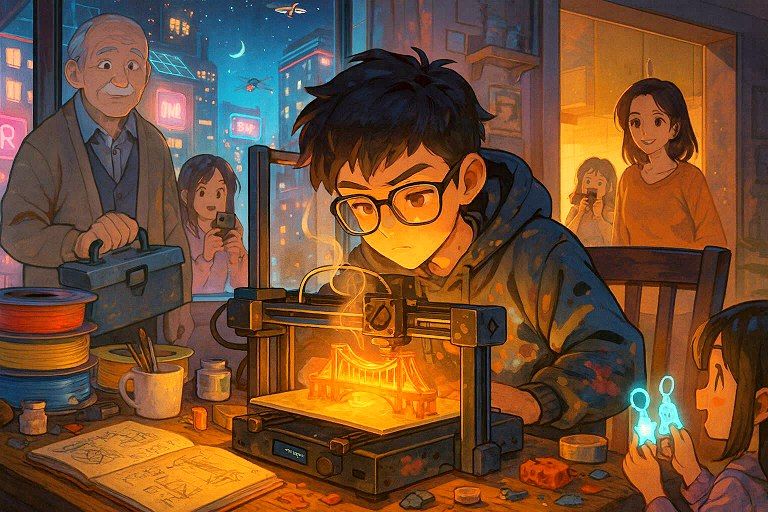
The printer arrived on an afternoon when the city seemed to hold its breath. Mateo opened the box with trembling hands and, for a moment, the dining room transformed into a ship’s bridge: the plastic casing gleamed under the neon light filtering through the window, and the manual—pages of diagrams and warnings—seemed to promise maps to unknown territories. Twelve years old, a notebook, a few saved coins, and the contained determination of someone who has decided to turn curiosity into action; that was enough to ignite the first spark of a project that, without him knowing it yet, would stir the network of his neighborhood. Elena, his mother, stayed close without intruding, watching with the erratic mix of pride and fear that accompanies those who see their children embark on uncertain ventures. She remembered the afternoon of the tech event where it all began: a public demonstration, objects emerging layer by layer like artifacts born from a luminous core. “I remember his eyes lighting up when the machine finished the first figure,” she would tell anyone who would listen, as if explaining the origin of a vocation. The city—a metropolis of solar-paneled façades and avenues where delivery drones circulated—offered a landscape that fed the imagination of a young boy with a taste for mechanisms and puzzles. Don Luis was the first practical ally. Retired, a former engineer at an orbital assembly plant, he lived two doors down and spent his afternoons on a bench in the plaza, his body wrinkled by years but his mind sharpened by decades of solutions. Seeing the printer on the dining table, he returned with a tool case and old stories about impossible calibrations and parts saved by a millimeter. “If you need a hand understanding those programs, I’m here,” he offered, and his words sounded weightier than any instruction in the manual. Mateo soon turned the dining table into his workshop: a lamp, an order ledger, rolls of filament in basic colors, and a corner for waste and failed prints. His first prints were, to put it mildly, uncooperative. Layers misaligned; edges rippled like weather maps; the filament sometimes tangled as if it had a will of its own. For every failure he responded with methodical tests: he adjusted temperature, varied speed, changed the support angle. He learned that in that machine patience and meticulousness replaced the impulse to press the button again and again. Orders arrived first as neighborhood favors. Rosa, the pastry chef, asked for a cookie-decorating mold; the stationery shop needed a small part for an old printer; Camila, his school friend, needed a perfect gear for her science model. Camila, obsessed with puzzles and logic, acted as a strict critic and faithful collaborator. If Mateo was the builder, she was the one who tested parts under demanding conditions. “If it doesn’t fit, the whole project collapses,” Camila warned him the first time she entrusted him with a prototype. “I’ll do it,” Mateo replied, eyes fixed on the screen showing the print’s progress. Each order was a lesson: Rosa’s mold taught him about textures and how to prevent dough from sticking; Camila’s gear demanded millimetric tolerances; the stationery piece forced him to think about durability over aesthetics. With each success his confidence grew, and with each mistake his curiosity became more precise. He soon began documenting his trials: a sheet with variables—temperature, speed, filament type—and results. Don Luis, who had promoted the habit of record-keeping, celebrated the shift from anecdotal trial to methodology. Mr. Vargas, a teacher devoted to bridging theory and practice, quickly noticed Mateo’s talent and publicly challenged him: design a prototype of a folding bridge for the end-of-course fair. It was a test combining structural physics and functional aesthetics, a perfect challenge to apply the young boy’s emerging skills. The bridge’s first iterations seemed destined for fragility: internal walls buckled under load; the hinge didn’t flex with the required smoothness. Mateo felt, at times, overwhelmed. One afternoon, defeated, he buried his face in his hands and said softly: “I can’t do this, the pieces keep falling apart.” Don Luis replied with the calm of someone who has watched entire processes be rebuilt: “Remember when you start to feel like you can’t. That means you’re close to learning something new. Try again, step by step.” It was the guidance he needed. He rechecked measurements, increased wall density, redesigned the hinge points, and experimented with stronger filaments. Between tests, failures, and new attempts, he achieved a version that not only held up under load but did so gracefully: the bridge unfolded its spans like mechanical origami and supported, without giving in, the weight of books that simulated real-world pressure. The fair’s success was a turning point. The innovation mention—a modest but heartfelt recognition—opened doors: larger orders, interest from other schools in his process, and opportunities to collaborate on community projects. His table, once an improvised workshop, began to receive visitors: classmates seeking solutions for prototypes, the stationery owner with recurring orders, and the neighborhood tech club coordinator interested in workshops for kids. The support network consolidated into a living cooperation of care and practice. Elena, beyond domestic logistics, became the unofficial manager: she helped organize orders, monitored deadlines, and mediated with clients. Sofía, his younger sister, contributed ideas with the carefree creativity of someone who hasn’t yet learned to constrain imagination: “What if we make glow-in-the-dark pieces?” she suggested one afternoon, and the idea turned into a set of nocturnal keychains that sold well at the neighborhood night fair. Camila helped improve the project’s image: she learned to photograph pieces with neutral backgrounds, to choose angles that highlighted structures and details, and to present the work as a small collection of functional art. The project’s economics were a lesson in themselves. Mateo had to calculate prices to cover materials and time, negotiate deadlines, and balance quality with demand. He learned to say no to impossible turnaround requests, propose alternatives when the design wasn’t feasible, and remain honest with clients who didn’t understand the technical limits. The transactions didn’t just yield money; they taught responsibility and how a community can sustain a young creator. In one order, a test produced an unexpected discovery. A part came out with a slight imperfection: an asymmetry in a protrusion. While Mateo considered it defective, Camila looked at it differently. “It has character,” she said. “We could sell it as a limited edition.” That observation became a commercial idea: small series of pieces with unique variations, tied to an aesthetic where chance was celebrated as a hallmark. It was another lesson: creativity finds opportunity even in mistakes. Over time, Mateo’s workshop gained a reputation for efficient solutions and the ability to turn everyday problems into functional parts. He designed educational toys for the school, small prosthetics for biology projects, and replacement pieces for the neighborhood library. Some orders came from beyond the block: a local organization requested printed supports for a vertical garden project; an architecture student asked for scale models for a thesis. Nighttime printing, however, never lost its toughness. There were moments when frustration weighed heavily: a print canceled midway, filament jammed when the week was full of orders, the constant whir of the machine mixing with fleeting sleep. But in persistence Mateo found his identity: not only as a maker of objects but as a craftsman of processes. The habit of recording variables, the discipline of calibration, and the ability to communicate with clients became his hallmark. The process also changed how the community viewed technology. Don Luis, who’d once worked in high-tech environments, was moved to see a new generation reuse accessible tools to solve local needs. Elena, for her part, saw in her son a possibility for responsible autonomy; her pride turned into action: she accompanied Mateo to the neighborhood fair, handled payments, and sometimes explained to neighbors the origin of the pieces with a mix of maternal pride and technical admiration. Meanwhile, the city kept its beat of lights and shadows. Solar-paneled façades and drone routes didn’t erase the human faces needing practical solutions. Mateo positioned himself in that flow as someone able to transform small requests into useful products, and his project—born of childish curiosity—began to have social impact: improving access to affordable spare parts, helping students prototype ideas, and showing that local manufacturing had a place in a city seemingly dominated by tech giants. A highlight in his journey came when a small NGO dedicated to STEM education invited him to run a workshop for children. Mateo, nervous and proud, accepted. He prepared simple exercises: design a meaningful word on a keychain, calibrate the printer together, and display the pieces. Watching other children experience the sensation of seeing an object arise from an idea multiplied his original joy. It was also an act of knowledge circulation: the spark that had ignited him became a flame that could light others. Years later, in his memory, the printer would still sound like an engine of small but decisive changes. The notebook of notes—which began as a careless pad—filled with strategies, contacts, and sketches. The faces who had accompanied him—Elena, Don Luis, Camila, Sofía, Mr. Vargas—formed a small crew that, with different skills, allowed him to navigate the challenges of starting a venture while still a child. When the school fair awarded him an innovation mention for his folding bridge, Mateo climbed the stage with filament-stained hands and the satisfaction of someone who had realized an idea. The ovation, his mother’s gaze, Don Luis’s smile, Camila’s thumbs-up, and Sofía’s spontaneous hug formed a living portrait: proof that dreams have no age, only the courage to begin. The City of Layers kept its pulse. On a table, next to a cup with glue residue and a stack of filaments, the printer continued its monotonous song of stacked strata. Each object produced was, besides a solution, a piece of a larger story: the tale of a boy who learned to translate curiosity into craft, who understood the responsibility of making, and who, with patience and community, turned a spark into a project that benefited his neighborhood. Beyond awards or sales, the true achievement was the learning: the certainty that entrepreneurship is a practice that, like 3D printing, is built layer by layer. Source of the images. Image created with Bing.
No comments yet