 @mc5punk
Short story: "Resonances in Westbridge"
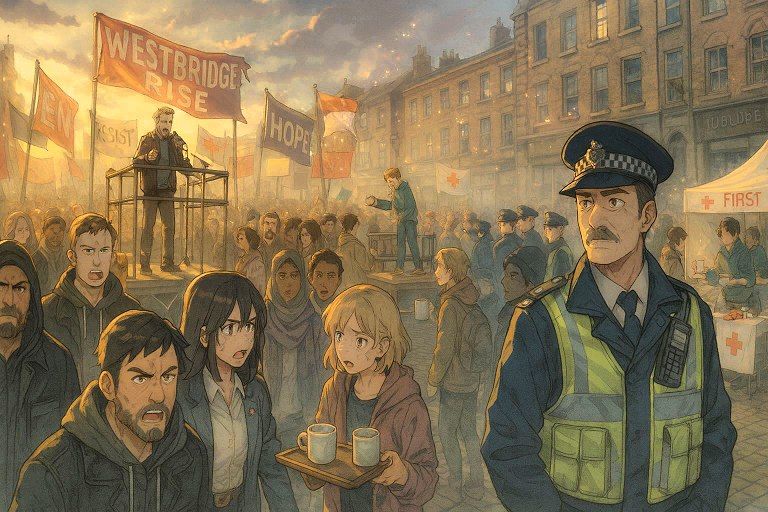
The morning wakes like a gray curtain hanging low over Westbridge. The neighborhood, with its brick facades and cobbled streets, seems transformed into a provisional stage; footsteps that usually flow collide now with movable barriers, orange cones and tarpaulins. The crowd, dense and vibrant, fills squares, avenues and parks, and its collective breathing takes on the cadence of a distant drum. At the center of the scene a platform has been installed: metal scaffolding, loudspeakers, banners. On it, Victor Hale adjusts the microphone with measured gestures, like someone tuning an instrument before playing a melody he expects others to sing. His figure, upright and confident, projects assurance; his face, carved by years of oratory and cameras, shows no doubt. Around him, placards bearing slogans, some short and aggressive, and flags faded from previous marches flutter. Victor looks at the crowd and, in his mind, the day is already a victory. Victor lowers his voice and raises his tone; his speech seeks to ignite and to soothe, to provide identity and justification at once. From the platform, he speaks with the cadence of the convinced: Victor (from the platform): "Today we rise for our future. We will not cede neighborhoods or jobs. This is for our children!" His words produce a tide of cheers. In the response there are those who repeat slogans out of tradition, out of habit; others do so with newly kindled fervor, driven by accumulated frustrations and personal stories that do not often make the headlines. Maya Khan arrives at the scene with her backpack slung across her shoulder, her notebook protected inside and her recorder in hand. Born and raised in Westbridge to an immigrant family, she has learned to look—and to listen—with double attention: that of someone covering the news and of someone who may, at times, find themselves within it. Her walk among groups is a map of voices: an older man clutching a flag with nostalgia, a young woman shouting slogans in anger, a mother instinctively shielding her child. Maya does not seek confrontation; she seeks stories. When she approaches a woman with tired eyes and asks why she has come, the answer comes with restrained voice. Maya (to a passing mother): "Why did you come today?" Mother: "I want them to hear us. I don't ask for luxuries, only peace." Inspector Aaron Cole carries the responsibility with an appearance of calm. His reflective vest catches the pale dawn light; his radio crackles with orders and confirmations. Aaron has spent years on neighborhood shifts; he knows the shortcuts of conflict and has learned that the most prudent decision is usually the one that avoids escalation. While he positions his officers in cordons, he makes calculations he does not share aloud: crossing points, evacuation routes, medical stations, possible flashpoints. Aaron (over the radio): "Keep calm and distance. Priority: prevent injuries. Do not engage in provocations." A short distance away, in a sunny corner of the park, Sami Noor and a group of young people have set up a table with cups of tea, blankets and signs reading "Neighbors, not enemies." Sami, a university student and community activist, believes in the possibility of breaking through slogans with human stories: recipes, work histories, shared memories. His voice, when he climbs onto a bench, does not try to compete with the megaphones; his strategy is different: to humanize the conflict. Sami (into the microphone): "We are not numbers. We are the ones who share stairways and supermarkets. Let's talk before pointing fingers." Lena Marsh runs the improvised first-aid station organized by a local NGO. Her gloves stain with sweat and dust; her hands, deft from so much bandaging, move with a calm that soothes. She treats everything from bruises and panic attacks to heat exhaustion. Each time she calms someone and offers water, she acts as a last practical barrier against violence: small interventions that prevent tension from escalating. Lena (while bandaging): "Breathe deeply, ma'am. Here is some water. You are safe." As the morning progresses, tension becomes more tangible: groups of different persuasions meet within a few meters of each other, separated by police cordons. Mixed emotions swirl through the crowd: anger, fear, curiosity, routine. Some come driven by speeches that promise control and pride; others arrive with signs of tolerance that seem almost timid against the media apparatus. The conflict, until then contained, continues to simmer, waiting for a spark. That spark arrives in the form of a small but deliberate act of provocation. A group of individuals, hooded and wearing aggressive insignia, lunges at a police line intent on forcing a clash. A shove, a shout, a bottle rolling. The scene tightens. Aaron, who anticipated several scenarios, gives the order with a firm, weary voice. Aaron (firmly): "Halt. Fall back or we will stop the march for safety." The response becomes a contest of stares, small advances and retreats. Victor, from the platform, perceives opportunity and doubles down on his rhetoric with an incendiary tone, sketching a map of culprits that simplifies complexity into a single clear antagonist. His words act as fuel for those seeking confirmation of their resentment. Victor: "We won't wait for others to decide for us. Our voice must be the first!" Meanwhile, Sami continues his practice of social stitching. Perched on the statue of a local defender, he tells stories without seeking glory: the teacher who worked two jobs, the grocer who stopped closing at six to help customers, the neighbor who always handed out cookies at Christmas. His accounts are not panaceas; they are everyday images that try to erode the coldness of hatred. Sami: "My teacher woke up at five her whole life. One does not earn less for being different. Don't we want our children to have teachers who work for them?" The atmosphere bursts when, unexpectedly and deliberately, pyrotechnic projectiles fly through the sky. The flash and the bang trigger instant panic. Smoke mingles with confusion and the crowd fragments into streams of people pushing and seeking refuge. Someone falls; someone else stumbles; cries and shouts mix with radio orders. The cameras covering the event capture images that will soon travel the world: smoke, shoving, strained faces. But amid the visible violence, scenes of solidarity arise that contest the singular conflict narrative. A protester helps a counter-protester up after a fall; an old woman on a balcony throws bottles of water and cookies into the street; Lena improvises stretchers with blankets to tend to the injured; Aaron opens the door of a nearby pharmacy so groups can shelter and receive first aid. Those images, less viral but no less powerful, show another face of the event. Protester (offering help): "Are you okay? Get up, dear." Old woman Ruth (from a balcony): "I brought water! Make way!" Amid the smoke and shouts, Sami climbs again onto his bench and calls for silence. His voice, less projection than Victor's but steadier in humanity, moves through the mass. Sami (shouting to be heard): "Let's stop. We are not natural enemies. Today we can decide whether to add more hate to the soil or to plant something different." Some hear him; others ignore him. The collective decision, in those minutes, becomes a microspace where the tone of what comes next is defined. Aaron and his officers work urgently to restore order and prioritize the safety of civilians and demonstrators alike. Their orders aim to prevent abuse as much as violence. Aaron (to his officers): "Cordon now. Protect civilians. We don't want more injuries." The afternoon descends with an air of uncertainty. Media outlets begin editing footage, cutting speeches to fit their narratives. On the press and social feeds, shots of crowds mix with statements that further polarize discourse. Victor proclaims victory on his channels; for many followers, the march confirms a collective identity they have sought. But for others, the day confirms a fracture: the city is wounded, debates become politicized, and polarization becomes tangible. Maya works late into the night. In her small office, under warm lights and with cups of tea, she writes a long feature that chooses to focus on voices that big headlines usually omit. She interviews the mother who came seeking to be heard, Lena who treated dozens, and Aaron who explains the difficult choices involved in containing order. Her piece does not pretend to be an infallible balancing act; it simply aims to restore humanity to the news. Maya (in her office, writing): "These are not numbers. These are stories. We must tell them." Subsequent reactions are swift: parliamentary debates, interviews, complaints of violence, police investigations into the fireworks and possible infiltration by radicals seeking to provoke. In the city’s basements, however, less noisy initiatives sprout: neighborhood committees, intercultural meetings, concrete proposals on youth employment and housing. Where rhetoric promises simple answers, community practice pursues complex and sustainable solutions. Months later, the echo of that day has shifted shape. The modest space Sami opened with borrowed resources has become a modest community center: morning language classes, an afternoon communal kitchen, evening tutoring for children. Neighbors from different backgrounds share schedules and concerns; the neighbor Ruth brings cookies and becomes a small symbol of quotidian reconciliation. Victor continues to organize events and make appearances; his voice does not vanish, but in many neighborhoods the pull he once exerted has diminished in the face of tangible work. Aaron participates in community meetings and watches with a mix of pride and caution the projects that were once just notes. He knows security is not only the absence of violence on the day of the march; it also requires opportunities, employment and education that close gaps. Maya keeps writing and covering the city with the same tenacity; her piece about those anonymous voices was cited in local debates and helped push some aid and employment initiatives. Aaron (to Maya at a community meeting): "We did what we could that day. But more dialogue is needed." Maya: "Then we'll tell it. Words can open doors." Sami (at the center opening): "We start with a cup of tea. We will end with a neighborhood where no one fears their neighbor." The lesson left behind is complex and does not fit simple headlines: the barricade of one afternoon was not erased in a sigh. The rhetoric of hate is not extinguished by a single act of resistance; yet the cracks opened by conflict are also passages for solutions. In Westbridge, the crowd ceased to be merely an anonymous mass: some saw their angry reflection in it; others saw a map of possibilities for rebuilding coexistence. At community tables they discuss youth employment and cultural spaces; at schools they hold workshops on living together; at corner shops neighbors who once regarded each other with suspicion now greet one another. Nothing erases the events or the wounds of that day, but the city—slow as it is—begins to weave a response that doesn't fit slogans: daily work, sustained listening and projects that, little by little, show that useful politics can be born from the sum of small gestures. Victor Hale continues his activism, finds audiences and listeners, and his figure retains relevance in sympathetic circles. But in Westbridge’s collective narrative, the force that once seemed absolute has been contested by initiatives that, without fanfare, demonstrate that coexistence is built with patience: shared cups of tea, language classes, centers with volunteers teaching trades. The divides did not disappear, but they gained interlocutors who were not previously seated at the table. The echo of that day remains: in photographs, in memories, in policies debated. No flag erased the conflict, nor did any speech close it forever. There were, however, hands that clasped amid smoke and confusion; there were stories that circulated and began to change perceptions; there were neighborhood initiatives whose concrete work began to show that another narrative was possible. The End. Source of the images. Image created with Bing.
No comments yet