 @mc5punk
Short story: Lúmen in Silence (Final)
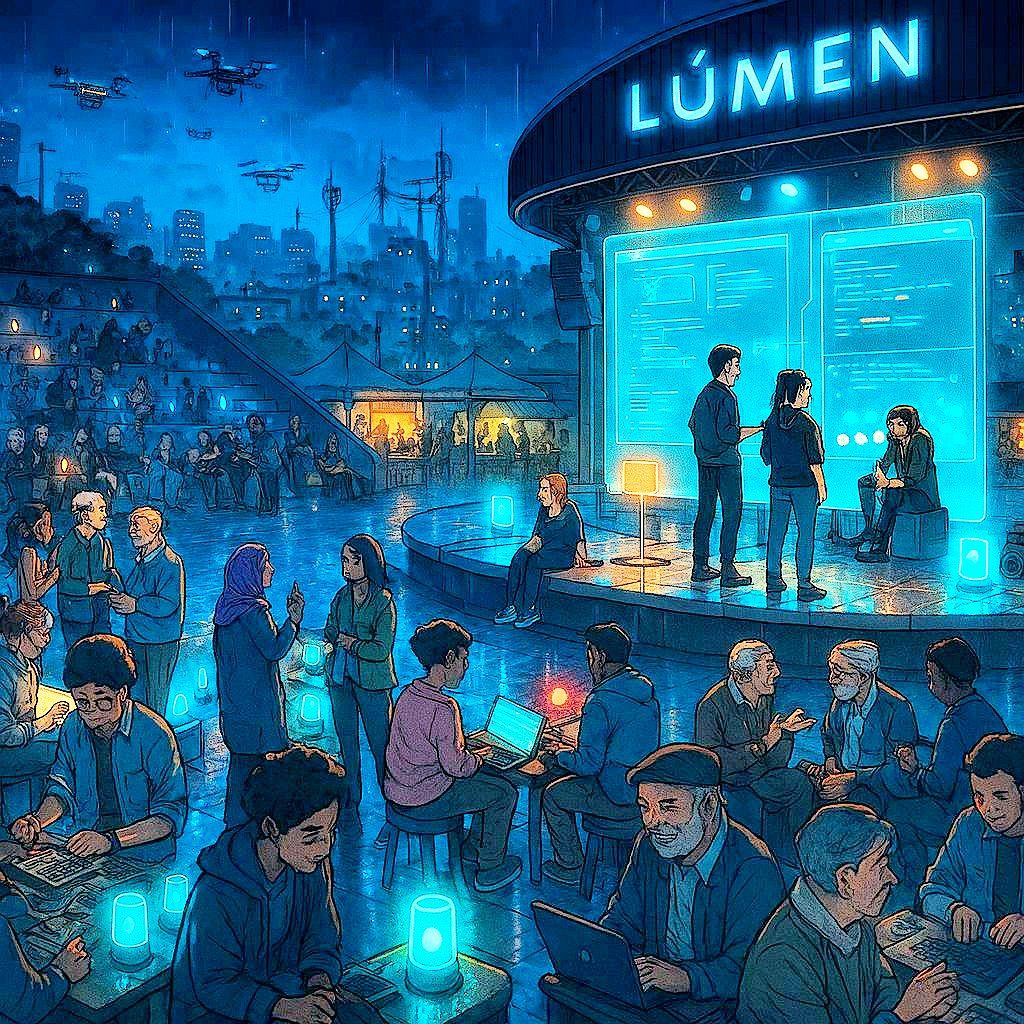
Chapter IX — Conflicts and Small Victories The tensions that had lain dormant for months resurfaced with renewed force. Disinformation campaigns multiplied, aimed at undermining public trust in community initiatives: rumors about security failures were spread, isolated incidents were exaggerated, and narratives were crafted to sow doubt about the cooperatives. At the same time, entrenched interests launched organized attempts to boycott them: pressuring suppliers, trying to economically isolate independent labs, and using their influence to shut doors within formal contracting networks. Concurrently, actors with legal leverage pushed lawsuits and regulatory proposals intended to restrict open access to critical models — arguing risks, liability, and the need for “centralized control” — thereby hampering the flow of tools and knowledge the community had produced. That mix of informational campaigns, economic actions, and legal maneuvers caused inevitable setbacks. Some projects suffered temporary or permanent closures; others were forced to reinvent themselves. One lab that had initially chosen to operate from more permissive jurisdictions to avoid regulatory hurdles suddenly found itself shut down by external pressures and decided to relocate, forming new alliances and support networks in other territories. By contrast, another lab found new opportunities inside a public university whose leadership chose to prioritize ethical principles and open collaboration: there a responsible research ecosystem flourished, combining academic rigor with social commitment. But the story was not only about losses: there were concrete, hard-won victories. The ASA — an association of professionals, activists, and technicians committed to fair decision-making — managed to introduce and enforce a “human-in-the-loop” clause in automated processes that affect critical health and housing decisions. That clause was not merely symbolic: it required that algorithmic systems recommending medical treatments, allocating housing resources, or setting eligibility criteria undergo deliberate human review, reducing automated errors and preserving spaces for appeals and ethical judgment. Locally, the community mesh network, formed by citizen nodes of connectivity and digital services, secured a municipal budget dedicated to maintaining and expanding its distribution points. Thanks to that funding, the network’s infrastructure was consolidated, redundancy against failures improved, and access was extended in peripheral neighborhoods where connectivity had previously been fragmented. Likewise, the repository of local models — a library of algorithms and datasets managed openly by the community — ceased to be only a technical resource for engineers: it became an educational tool in schools on the periphery. Teachers and students used it to learn about data, algorithmic ethics, and local problem-solving, incorporating it into curricula to support community projects and hands-on activities. It was on a stormy afternoon, with wind and rain sweeping the streets, that the system’s fragility and strength became visible at once. A minor failure in the central network — the sort of interruption that would normally have caused administrative delays and difficulties in sensitive services — threatened to paralyze processes and create uncertainty. Yet the local mesh activated almost imperceptibly. Without hierarchical commands or lengthy protocols, community nodes rerouted traffic, deployed local mirrors of critical services, and coordinated the delivery of information through alternative channels. They did it calmly, with experience and collaboration: volunteer technicians exchanged instructions, neighbors offered spaces and resources, and small maintenance teams worked to stabilize the most vulnerable points. Irene, watching from the window of a café in one of the affected plazas, saw that response being woven. There were no fanfares or speeches: only people moved by shared responsibility, connecting wills and knowledge. Under the rain, the community quietly solved what could have been a visible crisis. To her, the gesture was simple and everyday, yet laden with meaning: the city defended itself with tools built by its inhabitants, with devices and agreements born from collective practice. That defense — not centralized, not spectacular, but practical and distributed — showed that technological resilience can also be a form of civic autonomy. The small victories thus took on cumulative value. Every negotiated clause, every node saved, every classroom that adopted the repository was another piece in a social architecture that withstood greater pressures. The conflicts continued — campaigns and pressures did not cease — but experience proved that when a community organizes with transparency and ethical principles, setbacks can become lessons, and reprisals can turn into opportunities to strengthen networks, protocols, and solidarities. Yesterday’s partial defeat often taught the tactic that would make tomorrow’s victory possible. Chapter X — Concert and Reflection The night of the concert at the Lúmen amphitheater carried the density of a celebration and the precision of collective work. It was not just a musical event: it was a demonstration of how the artistic, the technological, and the communal could intertwine in everyday acts. On stage, human musicians improvised with intelligent sound systems capable of analyzing timbre, rhythm, and audience response to modulate effects in real time; the algorithms replied, the performers answered, and the music became a dialogue between bodies and machines. Kim and Rafael presented a pedagogical and provocative installation that materialized the logic of algorithmic decisions: panels of light that shifted according to audience votes, visualizations of data flows, and a layer of code visible and editable live so anyone could read, propose changes, and observe the consequences immediately. The gesture was not merely exhibitionist: it sought to demystify opaque processes and offer concrete tools for understanding. In one of the side amphitheaters a panel moderated by Sefa took place on technological citizenship: how to exercise digital rights, how to negotiate algorithmic governance, and how to make tools serve collective ends rather than reproduce privileges. Meanwhile, Mateo set up a table with artisanal breads; sales became direct funding for a repair workshop in the periphery, so everyday economy fed local technical capacities. Marcos, calm as someone who has written many protocols, gave a brief, direct talk about the need for redundant networks, explaining not only the technical value but the political value of redundancy: guaranteeing multiple paths of access and avoiding single points of failure. He insisted on the urgency of teaching people to read logs, because understanding system records was a form of civic literacy that made it possible to detect biases, errors, and attacks. Irene, sitting on the edge of the stage, became an attentive observer of that whole. She looked at the crowd and saw generations and trades interweaving: young people organizing community projects and sharing tools, retirees discussing local policies and offering time for tutoring, volunteers coordinating the repair network so no one would be excluded by a technical failure. She watched hands fastening screws, fingers programming, voices negotiating who could modify the public layer of projects. Around Lúmen, the city shone with an unusual mix: metal and hands, code and affection; a shine that was not only aesthetic but functional: infrastructures and ties that sustained one another. Leaving the concert, with the night still warm from voices, Amina stopped Irene and asked her a direct question, wrapped in curiosity and fear: —Do you think poverty has been eradicated? Irene looked at the distant lights, the outlines of community antennas and the lit windows, and answered with contained frankness: —Extreme poverty, yes. But the inequality of power still exists. Having the essentials is not the same as having control over who decides. The answer hung between them like an uncomfortable statement: there were tangible material achievements —fewer deprivations, broader access to basic services, emergencies addressed— but asymmetries in the capacity to influence, symbolic capital, and decision channels persisted. It was neither consolation nor condemnation; it was a diagnosis that opened questions. That same night scenes unfolded that illustrated the complexity of that reality. A drone left supplies in a plaza where collectives organized community kitchens; it was an immediate gesture of logistical solidarity. In another courtroom, a judge applied the new human-appeal clause to overturn an automated decision that had denied access to medical treatment, and the ruling sparked a public debate about limits, responsibilities, and standards for human intervention in algorithmic processes. Noa, at her terminal, updated models with equity criteria integrated into the metrics; she calibrated thresholds, reviewed datasets, and documented changes so future audits would be possible. Lucho led a night workshop where young people learned to solder circuits and reprogram controllers; he taught not only technique but habits of care and mutual support. Mateo, exhausted but satisfied, handed out breads with a smile: his small enterprise had financed a crucial part of the repair network. The scene was multifaceted: drops of relief, strokes of justice, and persistent shadows. In the same neighborhood people experienced both the feeling that things had improved and the awareness that much remained to be contested. The concert, then, functioned as a micro-narrative of that tension: a space where what had been achieved was celebrated and, at the same time, practical politics was practiced about the kind of world people wanted to build. The music, the editable lights, the workshops, and the discussion tables were not merely different formats; they were convergent strategies to cultivate civic capacities, to articulate knowledge and responsibilities, and to remind everyone that social transformation is simultaneously technical, aesthetic, and ethical. Epigraph — Ongoing Task Twenty years after that solemn speech promising to eradicate poverty through artificial intelligence and robotics, the world had not been neatly resolved nor irreparably broken: the outcomes were complex, contradictory, and largely still unwritten. In material terms, the promise had delivered much of what it announced. Technical abundance—automated systems that produced more with less, efficient distribution platforms, AI‑enhanced health and education services—had eased the most visible deprivations. Scarcity of basic needs ceased to be the dominant trait for large swathes of the population: housing became more affordable through automated construction processes, food was produced at lower cost with optimized supply chains, early diagnoses were accessible through digital tools, and personalized education reached sectors once disconnected. But reducing material misery did not amount to the automatic establishment of justice. The way that technical abundance translated into real goods depended on political decisions, regulatory frameworks, and civic initiative. Where public will and redistributive policies existed, improvements were felt in neighborhoods and towns; where concentrated interests prevailed, technical prosperity remained trapped behind legal and financial walls. Control over critical infrastructure—energy services, data networks, automated factories—remained in the hands of conglomerates that set prices, access, and priorities. Intellectual property and control over models and data became new forms of capital that reproduced hierarchies: not only who had money, but who owned the algorithms and datasets that shaped markets and social decisions. Solera, the city where these dynamics interwove, offered no definitive conclusion nor a model to export without caveats: it was a contested territory, a mosaic of small victories and ongoing debates. Its streets displayed both community projects that repurposed technology for the common good and closed societies that privatized benefits. Some technology cooperatives reinvented shared ownership of software and machines, while the labor market reconfigured with new jobs—many creative, caregiving, or ethical oversight roles—alongside precarious platform‑integrated work governed by opaque rules. This combination made the city a school of contradictions: laws recognizing digital rights and limits to surveillance coexisted with regulatory gaps exploited by powerful actors. Collective decisions about urban design, public health, and education required constant negotiation among government, businesses, and communities. Technology ceased to be a neutral agent and became a field of contest about values: what to automate, for whom, and according to which equity criteria. Irene, one of many residents who had seen the city transform, allowed herself a pause amid the noise: one night she closed her eyes and listened to Solera’s heartbeat. It was a pulse made of metal and flesh, algorithms and calloused hands, old promises and recent repairs. She heard the hum of automated factories alongside the murmur of community gardens, a platform notification that replenished supplies and a conversation in a plaza about care shifts. In that rhythm she recognized that eradicating material poverty had been only an open door: the real work began now. She understood that turning technical abundance into tangible democracy required multiple, sustained efforts. Oversight—understood not as repressive control but as civic attention and public supervision of technologies—was necessary to prevent innovations from creating new risks or exclusion. Education, both formal and community‑based, had to equip people to understand the tools governing their lives, demand transparency, and take part in their design. Solidarity meant building support networks to protect those left at the margins of automation and, at the same time, creating collective mechanisms for ownership and management of technological resources. Political will was also needed to legislate in the public interest: taxes on windfall gains from automation, regulation of data and algorithms, incentives for open‑source projects and cooperative models. The task was technical and moral, institutional and cultural. Machines producing abundance were not enough; institutions had to be shaped to decide how that abundance would be distributed, how the dignity of transformed work would be recognized, and how diverse voices would influence technological decisions. Real justice required participatory procedures, transparency in algorithms that affect lives, social safety nets adapted to new forms of employment, and a collective imagination that valued care and community as much as efficiency. In that ongoing tension—between what had been achieved and what remained, between technological promise and everyday politics—resided the true story. It was not the simple fable of machines that replaced jobs until human need vanished; it was, rather, the complex account of communities renegotiating their institutions, economies, and affections. Solera showed that machines could relieve material needs, but building a just social fabric depended on human choices: laws prioritizing the common good, pedagogies forming critical citizens, economies that treated equity as an objective, and a culture of shared responsibility. Thus the epigraph did not close the narrative: it presented it as a continuous task. Each technological advance brought new questions: who controls automated means of production, how are the benefits of knowledge and intellectual property distributed, what limits should be imposed on the commodification of digital life. Each answer would be provisional and subject to renegotiation. And in that everyday contest—in neighborhood assemblies, courts, classrooms, and plazas—a democracy capable of turning technical abundance into distributed well‑being would be slowly constructed. Irene opened her eyes and saw the city in motion again: people and machines intertwined, tensions and alliances, defeats and works in progress. She understood that her role—and everyone’s—was not to celebrate an ending but to keep watch, educate others, weave solidarities, and push for fairer rules. Eradicating material poverty was a vital milestone, but lasting justice would be the result of collective, ongoing practice: active politics that would not leave prosperity in the hands of a few but turn it into real opportunity for the many. In that unfinished labor lay, ultimately, hope. See previous chapters: https://read.cash/@mc5punk/short-story-lumen-in-silence-chapters-vii-and-viii-2bc589df Source of the images. Image created with Bing.
No comments yet