 @mc5punk
Short story: Five Curves
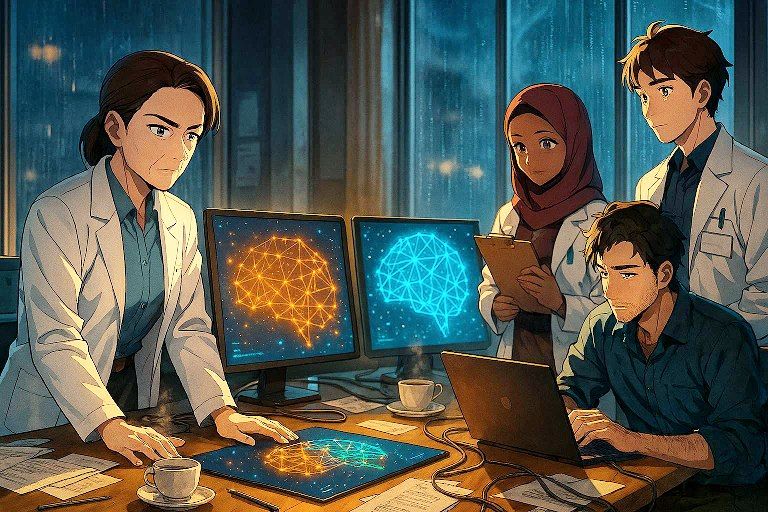
The lights in Laboratory 7B at the University of Cambridge were always too cold, as if they tried to keep humanity at bay. That morning the rain sharpened its rhythm against the glass and the building seemed to hold its breath. In the center of the room, a long table bearing the dust of ideas held empty teacups, stacks of consent forms, folders with histories, and a dozen screens showing brain maps in shades of blue and orange. The hum of the machines kept an implacable metronome; the cables were arteries carrying information and secrecy. Elena Marín ran a hand through her hair, draped her lab coat over her shoulders, and looked at her people. She was not just the team leader; she was the force that had driven the obsession to understand how the brain transforms over a lifetime. Her eyes, used to reading scans, also learned to read doubts. Across from her were Marco, the programmer who seemed to live in a world of algorithms and coffee, his gaze marked by nights of debugging; Amina, the neuropsychologist whose craft was patience and whose voice provided refuge; and Jonah, a doctoral student with the energy of someone seeking legitimacy in every consent he gathered. They were an imperfect ensemble, but they had become a necessary assembly. “Are you ready?” Elena asked, without needing an answer. Marco tilted his head toward the visualizations. “Ready or not, we have to know the truth,” he said, his tone carrying both challenge and fatigue. Months of meticulous work followed: scans from nearly 4,000 participants, from childhood into their nineties; protocols that demanded patience in acquisition and rigor in noise control; interviews that humanized the data. Each MRI was a map; each map, a constellation of synapses. The team fed those maps into an artificial intelligence algorithm that Marco had obsessively tuned. The program was not an oracle but a detective looking for patterns, repetitions, and traces of neuronal reorganization. Amina organized battery after battery of cognitive tests, translating numbers into stories: “This child smiles in response to music; that smile later appears as greater connectivity in networks associated with attention.” Jonah visited schools and care homes, speaking with mothers and grandparents. He brought consent forms and, more importantly, narratives: the teacher who convinced a reluctant parent; the craftsperson who arrived smelling of wood and ended up explaining how a memory workshop returned meaning to his life; the single mother who feared she couldn’t afford extra lessons for her child. None of that appeared in the algorithm, but it all helped explain why certain connections emerged or weakened. One evening when night fell early because of the storm, the algorithm produced a visualization that left everyone in the lab holding their breath. The curves representing the organization of connections were not a smooth gradient but a textured relief with five major stages and four clear inflection points: ages 9, 32, 60, and 83. On the screen the lines arced and diverged; in the silence, the numbers rang like bells. “What is this?” Jonah asked, his voice broken by surprise. “They’re stages,” Amina murmured, her hands trembling slightly. “It’s not just decline; it’s reorganization.” Marco, with the coolness of someone who has faced too many binary decisions, let out an incredulous laugh. “Thirty-two… I thought the peak would be much earlier. Thirty-two is where it reaches its maximum organization?” “Yes,” Elena replied, wearing calm like armor. “The data suggest the brain continues to grow and reorganize until that age. It’s not a straight line; it’s a map with five elevations.” The news did not take its time: universities, journalists, social networks, and public policy reacted almost as quickly as the paper was released. There were celebrations —teachers who saw support for extended training— and there was another response: the Old Narrative, that comfortable notion that the brain peaks very early and then declines, felt threatened. Voices in opinion columns labeled the work “dangerously optimistic”; politicians speculated about policy changes; startups smelled an opportunity to sell quick fixes. Pressure became personal. Hate emails arrived at Marco’s inbox accusing him of manipulation; Jonah received messages attacking his youth and professionalism; Amina spent afternoons soothing patients and colleagues disoriented by the uncertainty the science had unearthed. Elena began receiving calls demanding data, transparency, and immediate explanations. She knew integrity would be their only valid defense. “Let’s open everything,” she said in a tense meeting. “We’ll publish the methods, make the protocols available. We mustn’t leave room for malicious interpretation.” The decision was a calculated risk. In conferences and public talks, the team presented not only figures but people. They invited the retired teacher who had appeared in the project records, the single mother who had agreed to participate, and the craftsperson who spoke candidly about the memory workshop. Those voices turned graphs into narratives. A teacher, voice trembling but resolute, stood and said, “Windows open at nine—attention, music, coordination. Don’t shut them.” The impact was humane and penetrating, but resistance was not only rhetorical; temptations arose. A multinational pharmaceutical company approached with a deal that smelled like a shortcut: massive funding to expand the study and a promise to commercialize a “neuroprotective drug” that, according to their dossier, could slow neuronal aging. The offer endangered the team’s independence and credibility and ignited tensions that threatened friendships. “We could triple our sample,” Jonah whispered one night with hope. “We could get more robust results, faster.” “At what cost?” Marco retorted, harsh. “Sell our name so others can profit from something we are only beginning to understand?” Elena looked at her team—faces that had shared sleepless nights and dizzying days. The decision was not sentimental, but it was made from conviction. “We will reject the offer,” she said. “If we accept conditions, we lose the only thing that makes us credible: transparency.” The reply was a blow that split the night. The rejection cost them: funds, closed doors, sleepless nights. But it also earned them the respect of many colleagues and the trust of part of the scientific community. That loyalty was not measured in money but in integrity. Over the years the five curves began to permeate reality with the slowness bureaucracy imposes. Changes were not immediate everywhere; policies lagged, education systems did not transform overnight, and companies continued peddling piecemeal fixes. But in neighborhoods, schools, and community health centers, programs inspired by the research emerged: music and motor workshops for schoolchildren, mentorship and support programs for young adults approaching their thirties, prevention and stimulation initiatives for people around sixty, and spaces for companionship and reading for those over eighty. There were no miracles, only practices that respected evidence and human dignity. Individual stories were what finally revealed the study’s reach. A nine-year-old girl in the study discovered a talent for piano when offered a free class at school; her trajectory showed how small interventions in childhood could consolidate attention and memory networks. A man who considered changing careers at thirty-two found that patience and continued training enabled reinvention; his brain, far from fixed, showed changes validating later maturation. A sixty-year-old woman who adopted routines of exercise, socializing, and cognitive activities maintained and in some tests improved executive functions. An eighty-three-year-old craftsperson attending the memory workshop explained how companionship and stimulation didn’t erase age but restored quality and meaning. In a particularly intense public session, a journalist aimed for the headline: “Is it too late for many?” Elena looked not like a detached expert but as someone who had seen lives pierced by uncertainty. “It is not a terminal sentence,” she answered firmly. “It’s a cartography. It tells us where and when the brain reorganizes its networks. It forces us to rethink when and how we intervene. But it does not promise miracles nor deny limits.” Amina added from her clinical vantage, with the tenderness of someone who accompanies people in private struggles: “I’ve seen patients in their thirties recover functions with sustained work. It’s not magic; it’s consistency, tools, and time.” The fight against misinformation persisted: out-of-context fragments, catastrophic headlines, ridicule on social media. The campaign made visible the courage required to sustain a scientific project under public scrutiny. There were nights when everyone wondered if it had been worth it. An anonymous note on Elena’s car—“Stop playing god”—left a mark not on the science but on the flesh. There were no direct physical threats, but a moral weight the team carried quietly. Yet the commitment to transparency—sharing data and methods, engaging communities and educators—ultimately bore fruit. Policies—slow, clumsy, sometimes inconsistent—began to incorporate recommendations: greater investment in early education, continued training during young adulthood, community strategies for dignified aging, and, above all, a gradual shift in the public narrative about when a person is “useful” or “capable.” Years later Laboratory 7B had changed. The lights were still cool but less sharp. The screens projected overlapping brain maps moving like galaxies; the cables remained arteries but now connected to people and projects in distant neighborhoods. Jonah had grown: no longer the trembling student, he was the principal investigator maintaining project continuity with the calm born of experience. Marco still coded, but with less urgency and a clearer sense of the limits of what an algorithm can say. Amina had authored practical guides for therapists and led workshops where science and compassion met. Elena, who had borne the burden of leading both the science and its public exposure, watched one day from the lab window the city where some lives seemed to sync with the curves they had drawn. She saw a nine-year-old practicing piano with eager hands; a thirty-two-year-old man receiving his degree after a late master’s; a sixty-year-old woman laughing with friends as they walked in a community program; an eighty-three-year-old craftsperson smiling in his workshop, hands marked by experience and the joy of telling stories. Those scenes were small rewards against the discomfort the research had caused, but for Elena they represented the reason for everything: that science, when honest, can open possibilities. Around a now-clean table with fresh teacups, the team spoke without hurry. “We have more work,” Marco said. “Algorithms improve, but ethical problems don’t resolve themselves.” “And policies won’t either,” Jonah added. “But we changed something: the public narrative no longer ignores the evidence.” Amina closed a folder filled with maps bearing decades of stories. “We planted a different way of looking. We didn’t cure everything or promise the impossible. We gave a map and, with it, options.” Elena inhaled deeply. There was no triumphalism in her chest, only sober certainty. “Science is that: a way to answer questions the world throws at us. And when that data meets human dignity, transformation follows.” The Old Narrative would persist; there would always be those who prefer comfortable certainties and quick answers. But evidence—woven with rigor, transparency, and ethics—had opened a crack in its hegemony. The five curves were not catalogs of promises or condemnations; they were orientation tools: inflection points signaling moments to attend, intervene, and sustain. They were also a reminder that human development does not extinguish early but unfolds in complex rhythms deserving patience and smart policy. The curtain did not fall to fanfare. Instead there was a quotidian scene: Jonah handed Elena a cup of tea; Marco fixed one last detail in code that finally allowed visualization of an emerging pattern; Amina scanned the latest clinical guide. Outside, the city continued: children, young adults, middle-aged and elderly people weaving their days with the concrete implications of a science that chose honesty. And in that everydayness lay the clearest lesson: research does not transform lives by headlines but by the practices it generates; by the networks and policies it moves; by the difficult conversations it forces us to hold. The five curves were therefore less a spectacular revelation and more an invitation to accompany lives through their rhythms—with patience, respect, and informed action. Source of the images. Image created with Bing.
No comments yet