 @mc5punk
Short story: Snow, Taxis, and Hot Chocolate: A New York Adventure
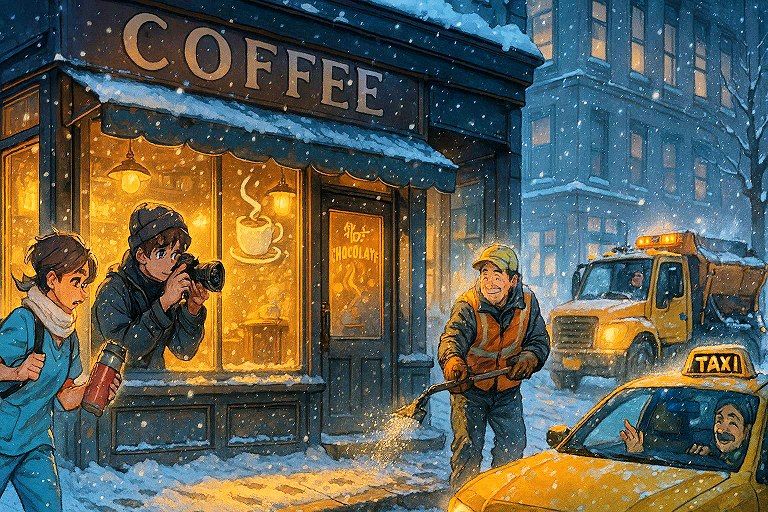
The city woke wrapped in a snowy calm that altered New York’s familiar contours into a palette of whites and grays. What had begun as a whisper of flakes on Saturday night had turned, by Sunday morning, into a steady curtain covering balconies, awnings, and lampposts. It was the season’s first significant snowfall: a blanket that, though modest in depth downtown—about 2.6 inches (roughly 7 cm)—managed to transform the urban landscape and the moods of its inhabitants. María, a nurse at the municipal hospital, left her building with the efficiency of someone who organizes shifts: scarf tightly knotted, gloves tucked into a pocket, and a thermos she relied on for long shifts. To her, the snowfall was a practical factor, not a postcard: it meant more slip-and-fall patients on sidewalks, transit delays, and a different flow of emergencies. Still, the prevailing whiteness stirred an odd tenderness in her chest, a brief pause before the daily urgency reclaimed her attention. Ethan, a taxi driver for years, had learned to find in situations like this the raw material of his trade: stories, forced smiles, and grateful customers thankful for a safe ride. That morning he climbed behind the wheel with a dose of defensive optimism. The taxi radio carried the National Weather Service’s voice, reporting that precipitation would ease by the afternoon, though temperatures would remain low enough for black ice to form. Ethan listened, but preferred looking out the windshield: the snow-covered city offered a different stage for his usual anecdotes, and he was already sharpening a few lines for passengers. Meanwhile, at the Sanitation Department, Samir and his crew were at work since the night before. Their salt truck was part municipal tool, part emblem of resistance: flashing lights, chains, and the feeling that if anyone had to fight the snow so the city could keep moving, it was them. They had been spreading salt since Friday, prioritizing routes to the hospital, the main station, and key commercial arteries. On the truck radio, Samir repeated the same directive in a serious tone laced with humor: “There’s no route we can’t handle. Today we’re the unsung heroes of the pavement.” In the outskirts and across the Hudson in New Jersey, the snowfall was more generous: accumulations of up to 6 inches (over 15 cm) were expected. There the streets looked more wintry and maneuvers were tougher; cars became makeshift sleds and families unaccustomed to heavy snow organized among neighbors to clear driveways and share salt. The difference in accumulation sketched the city in two registers: downtown, with a discreet but visible covering, and the periphery, with a thicker white that demanded different management plans. Lina, a university student and amateur photographer, seized the opportunity like someone spotting a perfect event to practice her eye. With a camera around her neck and the edges of her jacket damp, she wandered streets seeking frames: the geometry of snow-topped roofs, pedestrian footprints forming crossing lines on sidewalks, the light filtering between clouds and buildings. For Lina, the snowfall was an excuse to look at the city closely. She entered the neighborhood café run by Doña Rosa, renowned for her hot chocolate and her ability to remember regular orders without writing them down. The café was a refuge: a warm, fragrant space where neighbors gathered to talk about the weather’s unfolding. Doña Rosa, apron pocket full of stories, served hot chocolates with the gravity of someone offering a homemade remedy. Her shop filled with hushed conversations, restrained laughter, and the clink of spoons against cups. For many, it was the neighborhood’s emotional service station, where conversation helped coordinate practical assistance—who had an extra shovel, who could help an elderly neighbor—and turned a weather challenge into a community effort. The morning unfolded with scenes that mixed the ordinary and the unexpected. Ethan picked up María on a side street near the hospital; she climbed in with the determination of someone who had no time to waste, and between the engine hum and the windshield wipers they exchanged a brief but meaningful chat. Ethan, in his usual joking tone, offered a lift and teased about doing “tricks” with the wheel. María, prioritizing duty, asked him not to perform any “tricks”—safety over spectacle—and before getting out she urged him to help anyone who seemed lost. That small exchange captured the web of minor responsibilities that keep a city going on a snowy day: drivers offering help, healthcare workers asking for caution, neighbors looking out for one another. Samir and his crew worked without pause, adjusting salt amounts, timing runs, and focusing on priority areas. The logistics weren’t only technical: there was a human element in their choices—a street with many elderly residents, access to a dialysis center, the school route that needed to remain passable. When Samir took a coffee break, the cold had reddened his face like a badge of sacrifice; still, he saw the work plainly and honestly: if they kept the main routes clear, everything else had a better chance of carrying on. His coworker joked about ending the day as an ice sculpture, but the laughter didn’t slow the effort. In other northeastern cities like Boston and Philadelphia, snow also worked its pictorial magic, and reports indicated that precipitation would taper off by the afternoon as forecast, leaving cold temperatures that favored black ice. Authorities repeated their advice: exercise caution while driving, take small steps on foot, and avoid sudden movements in untreated areas. Those warnings prompted communities and services to stay alert. Inside the café, scenes multiplied: two children debated whether snowmen should wear hats or scarves; an elderly man held his cup with both hands as if striking a truce with winter; a couple looked at each other with the curiosity that a transformed city awakens and, for a moment, seemed to invite them to put off decisions and stroll the streets slowly. Lina, with her camera, hunted these moments: the complicity of a couple, an old patron’s weathered smile, Doña Rosa’s gestures as she served a piece of cake on the house. Each photo was a small visual chronicle of how the city adapted. Stories crossed naturally. At noon Lina left the café with a steaming cup and ran into Samir, who had just finished treating a nearby street. She offered him the hot chocolate in a gesture of thanks; he accepted with a mix of surprise and pride. A light conversation followed: Lina offered to take his picture to immortalize his work, and Samir, cautious, agreed on the condition that online credit not strip him of his quiet-hero reputation. The exchange marked the kind of community formed around a storm: simple acts that lighten others’ loads. Meanwhile, Ethan told a colleague about an episode from his shift while waiting for a new fare: passengers confusing fogged windows with solid glass, a tourist asking for photos from inside the cab, parents requesting short rides to keep their children out of the cold. His anecdote book swelled, and he seasoned each tale with humor so the morning wouldn’t feel heavier than necessary. María moved through her shift with the usual blend of professionalism and fatigue that emergency wards accumulate. Between patient checks, calls, and coordinating with hospital maintenance to keep entrances clear, she also had tender moments: spontaneous gratitude from family members, a nurse leaving a coffee by her locker with a note, and the view from a corridor window of a city softening its loud edges under white—an image that briefly eased the harder lines of her work. For her, the snowfall became a backdrop that, at times, softened the harshness of her tasks. The National Weather Service did its part: precipitation tapered off in the afternoon as forecast, but cold temperatures remained. That combination turned late-afternoon shadows and damp sidewalks into potential ice traps. Local authorities reiterated precautions, the municipality scheduled extra runs for critical routes, and neighborhood volunteers offered shovels to clear access to homes of elderly residents. Doña Rosa locked the café’s door reflecting on the day’s scenes: customers sharing stories, the young man who left an extra tip, the older woman who gifted a string of garlic in thanks for keeping the door warm. She closed the shutters knowing she had offered more than hot drinks: she had been a meeting point, a coordination hub, and for some, a place to regain spirits. Before turning off the lights, she soaked a few cups and carefully stowed the chocolate pot as if guarding a recipe not fully revealed. As night fell and the last light of day mingled with streetlamps, the characters returned to their routines with a shared sense: the city had weathered the season’s first big snow without collapse, thanks to small, shared efforts. Ethan scribbled a new anecdote into his notebook; Lina selected a folder of the day’s best photos; Samir checked his truck and, with his work clothes still damp, thought of his family; María, on a brief rest, gazed out the staff room window and took a deep breath, grateful for the lull after the bustle. The snowfall, which had altered the city’s rhythm and scenery, left a trail of comic and touching scenes: near-misses turned into laughs, improvised conversations that solved practical problems, and anonymous gestures aligned to sustain mobility and morale. It was, in short, a day of comedy and adventure where the snow played the lead and the neighborhood proved an ensemble ready to improvise. At the end of the day, Doña Rosa locked up and murmured to herself, “Today the city was covered, but it did not darken.” Ethan drove home carefully, humming a song he’d half-invented on the radio, while Lina mentally chose the filter for the best shot. Samir stowed his tools in the municipal depot and allowed himself one last sip of hot coffee before heading home. María, done with her shift, walked slowly for a stretch, savoring the reflections on the rooftops and thinking about the season ahead—with the quiet confidence of someone who knows that, under any blanket of snow, the city will always find a way to remain a community. Source of the images. Image created with Bing.
No comments yet