 @mc5punk
Short story: Love to Measure: Husbands for an Hour
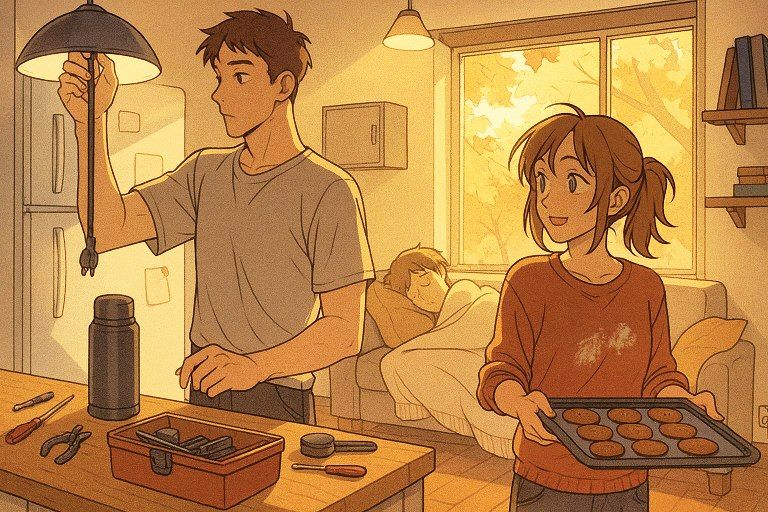
In Vidzeme, when autumn painted the streets with golden leaves and the wind carried a damp river scent, Mara felt her patience with dating had reached its limit. She had tried every modern tactic: polished app profiles, measured smiles in cafés, group outings to avoid awkward conversations. Yet meetings almost always ended the same: a cold coffee, an excuse about Grandma needing company, or a “maybe next time” that never came. If finding a boyfriend in Latvia had become a risky sport, she was willing to train creatively. That morning, riding the tram to work, Mara skimmed a leaflet listing household services: cleaning, furniture assembly, pet walking. One ad caught her eye: “Husbands for an Hour — Assembly, repairs, cheap empathy included.” The phrase made her laugh and piqued her curiosity; paying for punctual male assistance felt part social satire, part practical solution. She called Liene, her lifelong friend and the official archer of Latvian sarcasm. “Husbands for an hour?” Liene said when Mara told her. “Sounds like temporary rentals of domestic heroes. Do capes come optional?” They laughed until their sides hurt. But beneath the humor was a cold truth: the numbers didn’t lie. The news reported the demographic imbalance matter-of-factly: more women than men, especially among older age groups, and factors like smoking and lifestyle had reduced men’s life expectancy. At the neighborhood café people joked that men were a “species in danger of extinction,” a phrase equal parts bitter joke and factual observation. Determined to turn the joke into an experience, Mara and Liene planned a small domestic operation. They made a meticulous list: the refrigerator that hummed proudly, a lamp that always hung crooked, a bookshelf that had decided to defy gravity, and a string of small repairs that together held the home’s dignity. They agreed to use a stopwatch: “one real hour,” said Liene, “no sentimental overtime.” Saturday dawned with a clear sky and wind that promised to snap branches. At the agreed hour the doorbell rang. Mara opened to find a tall man with a calm gaze and a T-shirt stamped “HusbandHire.lv.” He carried a toolbox that smelled of oil and hot metal; in his backpack was a thermos of coffee, as if he knew the job would require stamina and small, human pauses. “I’m Kārlis,” he said, shaking her hand with a firm grip. “Where shall I start?” His voice didn’t try to impress; it spoke with the clarity of someone who had repaired more than objects—he had repaired days. Liene, who never missed an opportunity to probe the absurd, handed him the list with theatrical seriousness. Kārlis started with the refrigerator. He unscrewed, tested, listened to the mechanical murmur as though it were an endless conversation between cloths and electricity. While he worked, he casually told how his grandfather had taught him never to underestimate small screws: “A good screw and a good silence fix more than a hundred arguments,” the old man had said in a voice that still echoed in Kārlis’s hands. The phrase filled the kitchen with warmth and unexpected tenderness. Liene burst into laughter that filled the room, and the lamp that had suffered artistic poses finally hung straight, as if some pending things had been straightened too. As Mara watched, she noticed details that surprised her: how Kārlis folded cables before putting them back, how he always left the toolbox neat after each step, how he asked permission before moving a picture. There was no show of bravado, only respect for another’s space. Between screws and remarks the conversation shifted in tone. They spoke of the serious and the light: how statistics seemed to turn whole lives into cold numbers, the difficulty of adopting healthy habits where smoking was part of social ritual, and the physically demanding jobs that wore down bodies and spirits. Kārlis told an anecdote about a mural he had tried to hang in an apartment that had belonged to his great-grandmother: after three failed attempts and an online tutorial, he ended up with half the painting on the wall and the other half on what seemed like a time capsule of a living room. Mara laughed, and for the first time in a long while she listened without the usual defenses of dating: she was interested in a real person, with flaws and stories that didn’t seek to impress but to explain. The agreed hour stretched without need for a stopwatch. Each repair came with a domestic lesson and a comment revealing practical emotional education: how to ask for help without making it loud, how repairing something is, in a sense, caring. During a break between screws, Mara brought out ginger cookies she had baked for the occasion—a symbolic, sincere offering. Kārlis smiled at them and declined the cash fee: “I get paid for the job, but I accept homemade cookies.” It was a simple, honest line that closed the professional transaction and opened a human parenthesis. While they baked more cookies in Mara’s small oven, the talk became more intimate without hurry. They discussed rain—how sometimes it seemed to taste metallic when it fell on the northern Danube—a metaphor that produced a shared, knowing silence. Mara confessed small household quirks; Kārlis admitted he had learned to cook not out of romance but necessity: long days of work forced one to eat well or resign oneself to bland soups. Amid confessions, the subject turned to men becoming invisible in statistics: Kārlis explained, with a mix of anger and resignation, how smoking habits and exhausting jobs had stolen years from his generation. Mara realized that behind hard data were faces and motives, choices and lack of resources. It wasn’t simply that there were fewer men; the environment, customs, and economy had conspired to take years from them. That understanding settled over her with tenderness and a certain sorrow: the demographic imbalance wasn’t a joke, but it didn’t preclude the possibility of genuine encounters. By the end of the day the apartment was tidy. The lamp in place, the bookshelf adjusted, the refrigerator humming contentedly. Liene, exhausted and happy, had fallen asleep on the sofa while the TV repeated a documentary about migratory birds. The contrast between practical life and nature lent a sweet irony: while species balanced between extinction and migration, two humans discovered how to fit better together. Before leaving, Kārlis, his hands still marked by work, looked at Mara and asked with a frankness that didn’t seek drama, “Would you like to repeat the experiment?” She paused for a second—not a decision about destiny, but about curiosity—and answered, “If it comes with more cookies and fewer terraces closed off by fear of statistics, yes.” They laughed. It wasn’t an instant pact for a romantic novel, but a tentative promise: more meetings, more repairs, more learning, and perhaps less fear of being defined by numbers. In the months that followed the relationship turned into a kind of domestic choreography. What had started as a one-off service led to shared dinners, debates about the best way to fold napkins—Mara defended geometric precision; Kārlis preferred practicality—and afternoons of joint DIY work where two hands, not one, lent the home patience. They stopped using the stopwatch; they measured time by how much flour covered the table or how many screws were left over. The community began to talk about the phenomenon with the wonder of those who find a practical solution has social ripple effects: the “husbands for an hour” did not just perform chores, they offered company and conversations that demystified stereotypes. Some criticized them—saying they could not replace deep relationships—while others saw them as an ingenious response to a real difficulty. For Mara and Kārlis the truth was less categorical: what began as a professional transaction slowly became companionship. One afternoon, walking along the Daugava’s bank, between leaden reflections and lights trembling on the water, Mara remembered the headlines calling men a “species in danger of extinction” and let out a laugh that rose like a wave. The wind lifted a curtain of leaves and Kārlis, watching her laugh, replied with a simplicity that needed no statistics: “I don’t understand much about demography. I only know I found someone who makes the best cookies and isn’t afraid to ask how the instructions work.” She returned his smile with the same simplicity. In that compact gesture lay the victory of the everyday: shedding the grand narratives of the headlines to find, in the crossing of two hands, a different kind of balance. The demographic scale remained, with its numbers that did not vanish; but in their small universe the imbalance was offset by humor, respect, and the ability to accept help without drama. Over time the relationship found its rhythm: it wasn’t a story of heroic rescues but a series of repeated acts that build trust—fixing a chair, baking bread, listening when work feels heavy. Daily life proved the best hook for love: not the chance of a perfect date but the sum of shared minutes where fixing a bookshelf also fixed a part of life. In a Latvia where love sometimes felt like an extreme sport, Mara and Kārlis taught a modest lesson: romantic survival can take practical and comedic forms. A service called “husbands for an hour” didn’t solve demographic inequality, but it opened a door for some people to meet without fanfare, with tools in their hands and cookies on the table. And so, among well-tightened screws and laughter that made a home, what began as a temporary solution stayed far longer than announced. Source of the images. Image created with Bing.
No comments yet